featured

THE SAME

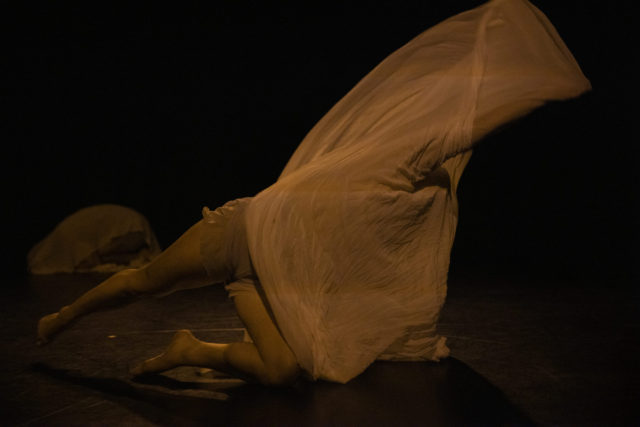
Walsh sisters Eileen (foreground) and Catherine (background) team up for first time in The Same (photo by Nir Arieli)

THE SAME
Irish Arts Center
726 Eleventh Ave. between Fifty-First & Fifty-Second Sts.
Wednesday – Sunday through March 6, $25-$65
irishartscenter.org

Prior to The Same, the closest award-winning Irish actresses and sisters Catherine and Eileen Walsh had come to working together was in Eugene O’Brien’s Eden; Catherine starred as Breda Farrell in the 2001 play, while Eileen, who is eight years younger, took over the role in the 2008 film. They cannot get much closer than they are in The Same, which opened yesterday at the Irish Arts Center’s lovely new 21,700-square-foot home in Hell’s Kitchen.

The two-character play was written specifically for the siblings by Tony winner Enda Walsh (Ballyturk, The Walworth Farce,) who is not related to them. The show, from the Cork-based site-specific specialist Corcadorca company, premiered in 2017 at the decommissioned Old Cork Prison, then later was staged at Galway Airport; both are fitting locations for the fifty-minute work, an intense psychological drama that explores complex issues of time and place, confinement and freedom, focusing on conceptions of past and present particularly as it relates to loss.

The New York City premiere, which runs through March 6, is set in an intimate space filled with randomly arranged cushioned chairs on a plush rug centered by a rectangular carpet. It’s general admission seating, so you can choose a spot right up front or in one of the rows behind. Around the room are two television monitors, a bingo machine, a bookcase with a boombox, and tables with a fishbowl, plants, magazines, games, and puzzles. Overhead is a light grid of 105 squares, some empty, hanging extremely low, as if closing in on the protagonists. (The immersive scenic design is by Owen Boss, with lighting by Michael Hurley and sound and music by Peter Power.)

All audience members must wear masks, but two women’s faces are not covered as you enter the room; even if you are unfamiliar with Catherine and Eileen Walsh, you instantly realize them as the performers. In character already, they fidget uncomfortably in their seats, looking unhappy and distressed while avoiding eye contact with anyone.

Lisa (Eileen Walsh) tries to figure out just where she is in Enda Walsh play (photo by Nir Arieli)

We soon learn that we are in some kind of medical facility or halfway house where Lisa (Eileen Walsh) is recovering from trauma that led to mental instability. In her opening monologue, she speaks of feeling alarm and apprehension as she arrived in a new city. “The dread was real — was felt real,” she says. “Right at the back of my throat and it slid further and grabbed my heart — and further still it slid and sat in my stomach like a bomb.”

The two women talk about personal choice, destiny, rain, and marzipan, mention such other characters as Claire, Gavin, Howard, and Avril, and serve food at a funeral. As time goes on, they begin to share memories, which include a childhood birthday party and the death of a mother. They engage in lyrical conversations that are as existential as they are poetic.

Lisa: Don’t you think we look the same?
Other Woman: No.
Lisa: Not the exact same — just the…
Other Woman: What?
Lisa: There’s similarities, I said.
Other Woman: No there isn’t.
Lisa: In the eyes — and the head too — and maybe the chin and the nose.
Other Woman: Talking fast.
Lisa: Facially we’re very similar me and you. But not the exact same — but similar only, don’t you see that at all?
Other Woman: No not at all.
Lisa: Or maybe just…
Other Woman: What, I said.
Lisa: Something else — something invisible — don’t you see that?
Other Woman: Don’t I see something invisible?
Lisa: “See” meaning sense, I mean. Don’t you sense a similarity between us?
Other Woman: She said.
Lisa: I felt it immediately when I was in that dead woman’s kitchen — didn’t you feel it too — it started just when I said my mother just died?
Other Woman: Maybe you need to eat something, I said, wanting it to stop.

Walsh sisters Catherine (foreground) and Eileen (background) sizzle in The Same at the new Irish Arts Center (photo by Nir Arieli)

In between scenes, bingo balls fly out of the machine, the radio blasts music, or the television turns on Judge Judy and game shows, which feature winners and losers. The sound of water emanates from various speakers as Lisa tries to keep her psyche from drowning. It might all feel random but it’s not necessarily, evoking the kinds of thoughts and memories that can cloud anyone’s mind. “Where is the start and end of me?” Lisa wonders. It’s a question all of us have asked ourselves.

Original director Pat Kiernan, who helmed Enda Walsh’s 1996 debut, Disco Pigs, starring Eileen Walsh, in addition to his later Misterman and The Ginger Ale Boy, keeps the audience guessing as the characters examine themselves. Nothing comes easy in the intricate plot, which takes so many subtle twists and turns you won’t be able to catch them all. The sisters sizzle together, Eileen (The Merchant of Venice, Phaedra’s Love, both also directed by Kiernan) practically collapsing into her body, Catherine (Sharon’s Grave, Enda Walsh’s The New Electric Ballroom) much more physically open. It all fits into a tight, emotional fifty minutes that feels like a bomb about to go off in your stomach, a play that benefits from being performed by a pair of extraordinary actresses who know each other so well.

TOP OF THE HEAP

Christopher St. John wrote, produced, directed, and stars in underrated blaxploitation flick Top of the Heap

TOP OF THE HEAP (Christopher St. John, 1972)
BAM Rose Cinemas
30 Lafayette Ave. between Ashland Pl. & St. Felix St.
February 18-24
718-636-4100
www.bam.org

George Lattimer is not just a cop; he’s a Black cop on the edge in Top of the Heap, screening at BAM February 18-24. The 1972 blaxploitation flick was written, produced, and directed by Christopher St. John, who stars as Lattimer, a Metropolitan Police sergeant in DC who is sick and tired of being treated like a Black man first and not an officer of the law. Surrounded by white men and Black women who take him for granted, he fantasizes about becoming an astronaut preparing to rocket to the moon. In the NASA scenes, he is slick and debonair, sporting ultracool facial hair and an infectious determination to succeed, but as the cop he is unsure of himself and his place in the world.

His mother (Beatrice Webster) has died but he doesn’t want to go to the funeral in his hometown in Alabama. His wife (Florence St. Peter) says he doesn’t communicate with her anymore. His white partner (Leonard Kuras) is corrupt. His daughter (Almeria Quinn) is downing pills. He gets no respect from his captain (John Alderson). His groovy nightclub-singing girlfriend (Paula Kelly, listed in the credits as playing “Black Chick”) makes fun of him. On an incident on a bus, he is mistaken for a criminal by a white rookie cop (Brian Cutler). Driving in his woody station wagon, he is almost hit by a cab driver (character actor extraordinaire Allen Garfield, who died from Covid in April 2020 at the age of eighty) who threatens to bust him up until he finds out he is a cop.

White people see Lattimer only as a Black man and all the racist stereotypes that come with that. Black men see him only as a cop, a traitor working for the man. His life and career are unraveling right before his eyes, and he is threatening to explode at any minute. “I can do any goddamn thing I want!” he cries out, but of course he can’t. When he visits his former colleague, retired police officer Tim Cassidy (Patrick McVey), the old man talks about being overwhelmed with fear and loneliness, feeling useless, all of the things that Lattimer is experiencing; just as America turns its back on the elderly, so it does on Black men like Lattimer just trying to get by day to day. When asked by a reporter what it’s like to be in space, Lattimer explains, “Isolation . . . Sort of like waiting at the mailbox for your welfare check.”

Nominated for the Golden Bear at the Berlin International Film Festival, the film features small touches that lift it above the realm of standard Blaxploitation. A poster in Lattimer’s daughter’s bedroom declares, “War is not healthy for children and other things.” In a fantasy sequence, his blond, sexy white Scandinavian nurse (Ingeborg Sørensen) is reading a copy of Ebony magazine before offering him her services. Soon-to-be heavyweight boxing champion Ken Norton shows up in a bar scene, ready to go at it with Lattimer. Meanwhile, the space fantasies evoke Gil Scott-Heron’s “Whitey on the Moon,” the 1970 song in which Scott-Heron declares, “The man jus’ upped my rent las’ night (’cause Whitey’s on the moon) / No hot water, no toilets, no lights (but Whitey’s on the moon).”

Imaginatively photographed by Richard A. Kelley and featuring a soundtrack by J. J. Johnson with percussive African rhythms and jazz fusion, the Afro-Futurist Top of the Heap is a potent exploration of the Black experience in the United States, as relevant today as it was fifty years ago. “Top of the Heap is a powerful, dynamic story as only a Black man can tell it,” the above original trailer proclaims.

It’s a shame that St. John and this film faded into obscurity; a member of the Actors Studio, St. John played Lumumbas leader Ben Buford in Shaft and had only a handful of film and television roles before quitting the business in 1988. In 2014, he and his son, Emmy-winning soap opera star Kristoff St. John, codirected the documentary A Man Called God, about their family’s involvement with an Indian cult. Kristoff passed away in 2019 at the age of fifty-two; St. John is now eighty.

Be sure to stay through the end of the credits, where a final bonus will make you wonder whether Jordan Peele is a Top of the Heap fan. Writer Josiah Howard, author of Blaxploitation Cinema: The Essential Reference Guide, will introduce the 7:00 screening at BAM on February 18.

THE AUTOMAT

Audrey Hepburn grabs a bite at the Automat in New York City (photo by Lawrence Fried, 1951)

THE AUTOMAT (Lisa Hurwitz, 2021)
Film Forum
209 West Houston St.
Opens Friday, February 18
212-727-8110
filmforum.org
automatmovie.com

New Yorkers are used to saying goodbye to iconic institutions, from the old Penn Station and Ebbets Field to the Carnegie Deli and the Stork Club. One of the hardest to bid farewell to was a most unusual eatery that catered to anyone who had a couple of nickels and time for a quick lunch or dinner: the Automat, a type of self-service restaurant that flourished in New York City and Philadelphia, predominantly during the first six decades of the twentieth century.

At the beginning of Lisa Hurwitz’s thoroughly satisfying yet elegiac debut documentary, The Automat, comedian Mel Brooks tells her, “I’m going to give you what I can in terms of time and effort, and I’ll try to write the song.” He continues, “I suggest you do some narration at the beginning to frame what you’re going to talk about. You know, with pictures — do you have enough pictures of Automats?”

Hurwitz has plenty of pictures of Automats and just the right narrator to open the film, Brooks himself, who explains, “Of course, when you say ‘Automat,’ or ‘Horn & Hardart,’ very few people know what you’re talking about. But one of the greatest inventions in insane centers of paradise were these places that had little glass windows framed in brass with knobs, and if you put two nickels into the slot next to the windows, the windows would open up, and you could take out a piece of lemon meringue pie for ten cents and you could eat it.”

Brooks is one of many people who more than just enjoyed going to the Automat; for them, it was an integral part of their lives, a place to gather with friends, colleagues, and family, schmooze a bit, and have a cheap but good meal. From 1902 to 1991, the Automat served young and old, rich and poor; race, religion, politics — none of that mattered in the egalitarian spaces.

The late Supreme Court Justice Ruth Bader Ginsberg recalls, “Yes, this is the great USA, with people of all different colors, and religions, and manner of dress, and yet we are all together.” The late Secretary of State Colin Powell notes, “All the Automats had that beautiful diversity that didn’t exist in most of the rest of the country, of economic standing, of color, of ethnicity, of language. You never knew what you’d run into in an Automat.” Among the others waxing poetic about the Automat are Carl Reiner, Elliott Gould, former Philly mayor Wilson Goode, and former Starbucks chairman and CEO Howard Schultz, who says, “The Automat for me was a seminal moment in my childhood, and I became a merchant the day that I was in that Automat.” Brooks declares, “The Automat had panache.”

Made over the course of seven years, the film also features interviews with Lorraine Diehl and Marianne Hardart, authors of The Automat: The History, Recipes, and Allure of Horn & Hardart’s Masterpiece; former Automat VP of engineering John Romas; Edwin K. Daly Jr., whose father was president of Horn & Hardart from 1937 to 1960; New York City historian Lisa Keller; H&H architect Roy Rosenbaum; architectural dealer and restorer Steve Stollman, who bought a lot of the old mechanisms when the restaurants closed; and historian Alec Shuldiner, whose PhD dissertation inspired Hurwitz to make the film.

Mel Brooks sings the praises of the Automat in loving documentary (photo by Carl Reiner)

There are tons of great photos and film clips in the documentary, including shots of Audrey Hepburn, Debbie Reynolds and Eddie Fisher, Jackie Gleason, Donna Reed, Abbott & Costello, and James Dean at the Automat and scenes from That Touch of Mink, The Bob Hope Show, The Flintstones, Warner Bros. cartoons A Hare Grows in Manhattan and Tree Cornered Tweety, Candid Camera, and such old movies as The Early Bird, No Limit, and Thirty Day Princess. Jack Benny hosts an opening there, giving out nickels to his guests. The Irving Berlin and Moss Hart musical Face the Music begins with the song “Lunching at the Automat.”

Hurwitz also deals with socioeconomic change that helped make the Automat so popular after the Great Depression and through both wars and, later, led to its downfall. The sentimental attachment everyone has for the Automat in the film is contagious, even if you never had the baked beans, ham and cheese sandwich, or creamed spinach; it was a special place to so many through several generations, and Hurwitz captures those sentimental feelings with panache while leaving you with an ache in your heart and stomach — and a song from Mel Brooks. The Automat opens February 18 at Film Forum, with Hurwitz participating in Q&As on Friday at 7:00, Saturday at 7:30, and Sunday at 5:40.

THE FRIGID FESTIVAL

Eleanor Conway’s Vaxxed & Waxxed is part of 2022 FRIGID Festival

FRIGID Festival
The Kraine Theater
85 East Fourth Street between Second Ave. & Bowery
UNDER St. Marks
94 St. Marks Place between First Ave. & Ave. A
February 16 – March 6, $10-$20
www.frigid.nyc

Baby, it was cold outside, but it looks like winter will be warming up just as the sixteenth annual FRIGID Festival comes to town, taking place February 16 through March 6 at the Kraine Theater and UNDER St. Marks in the East Village as well as online. This year’s hybrid presentation from FRIGID New York features nearly two dozen shows, running the gamut from comedy, improv, performance art, and stand-up to storytelling, music, drama, and clowning. Among the mostly solo shows are Mark Levy’s Blockbuster Guy, about when Levy was a nerd working for Blockbuster in Florida; Jude Treder-Wolff’s Human Flailings, about psychotherapist and storyteller Treder-Wolff’s reaction to unexpected betrayal; Brian Schiller’s autobiographical Three Funerals and a Chimp, dealing with family loss; Matt Storrs’s Portly Lutheran Know-It-All, which goes back to Storrs’s days at a religious middle school; Grant Bowen’s A Public Private Prayer, in which Bowen discusses his relationship with God; and Amanda Erin Miller’s Smile All the Time, which includes puppets in prison.

In addition, As You Will provides improvised Shakespeare, two brothers travel back to the American Southwest in 1680 in Dillon Chitto’s Pueblo Revolt (which asks the critical question “Can we keep the pigs?”), Melody Bates’s immersive A Play for Voices is set in the dark, Megan Quick portrays a dog actress performing cabaret in And Toto Too, and Howie Jones challenges the audience in That sh$t don’t work! Does it? Also on the bill are Jean Ann Le Bec’s The Last to Know, Mike Lemme’s Bathroom of a Bar on Bleecker, Ellie Brelis’s Driver’s Seat, Daniel Kinch’s The Story of Falling Don, Molly Brenner’s The Pleasure’s Mine, Will Clegg’s The Lonely Road, George Steeves’s Love & Sex on the Spectrum, Julia VanderVeen’s My Grandmother’s Eye Patch, Mikaela Duffy’s StarSweeper, Keith Alessi’s Tomatoes Tried to Kill Me But Banjos Saved My Life, and Theatre Group GUMBO’s Are You Lovin’ It? Eleanor Conway’s Vaxxed & Waxxed should be interesting since everyone has to show proof of vaccination to get in, meaning she might have to amend her usual question, “Do we have any anti-vaxxers in?”

THE PACT (PAGTEN)

Birthe Neumann is radiant as socialite and author Karen Blixen in The Pact

THE PACT (PAGTEN) (Bille August, 2021)
Quad Cinema
34 West 13th St. between Fifth & Sixth Aves.
February 11-17
quadcinema.com
pactmovie.com

Birthe Neumann is mesmerizing as Karen Blixen in Bille August’s The Pact, now playing at the Quad. Blixen is better known by her pen name, Isak Dinesen, author of such books as Out of Africa and such stories as Babette’s Feast and The Immortal Story, all of which became films. The Pact opens in 1948, and Blixen, referred to as Tanne or the baroness, holds court over the fanciful and the glitterati at her family estate, Rungstedlund. Now sixty-three, she is seriously ill but still able to revel in manipulating those around her. She forms an instant liking for young poet Thorkild Bjørnvig (Simon Bennebjerg), taking him under her wing and making a pact of spiritual faithfulness with him, built on mutual trust and protection; she compares it to a deal she claims to have made with the devil, trading her soul for the ability to tell stories.

The thirty-year-old Thorkild is reserved and inexperienced, but the baroness is determined to instill in him the courage to be fearless to make him a better writer. “All white people have a fear in them that I can’t stand. And that is the fear of displeasing. Instead of doing what they want, they try to flatter, hoping to be liked,” she advises him. “Do you know why so many people are unhappy nowadays? It’s because they are no longer raised to be brave. But in order to be happy, you need to risk being unhappy.”

As he spends more time at Rungstedlund, the baroness attempts to drive a wedge between him and his wife, Grete (Nanna Skaarup Voss), a shy librarian, and their young son, Bo (Mikkel Kjærsgaard Stubkjær); she also tries to make him grow closer to Benedicte Jensen (Asta Kamma August), the wife of socialite and arts philanthropist Knud W. Jensen (who would go on to found the Louisiana Museum of Modern Art in Humlebæk, Denmark, in 1958). Thorkild finds himself trapped in the middle: He wants to be a successful writer, husband, and father, but the baroness, who is divorced and asexual, living in a mansion with only her housekeeper and assistant, Mrs. Carlsen (Marie Mondrup), pining away for her lost love, Denys Finch Hatton, insists that he cannot be all three and must choose between them.

The baroness (Birthe Neumann) has very specific plans for poet Thorkild Bjørnvig (Simon Bennebjerg) in Bille August’s The Pact

The Pact is a compelling, beautifully photographed tale of unrequited love, heartbreaking loss, and the creative process. Adapted by Christian Torpe from Thorkild Bjørnvig’s 1974 memoir, the film, gorgeously directed by Bille August (Pelle the Conqueror, The Best Intentions) with a subtle simplicity, opens with a pair of fascinating shots: Cinematographer Manuel Alberto Claro first shoots Blixen from the side, her face hidden in shadow as she applies makeup in front of a mirror, followed by Thorkild shaving in bright light, his wife holding their baby beside him. One is facing the end, while the other is just starting, a visualization of the film’s epigraph, a quote from Blixen: “Not by your face but by your mask shall I know you.”

But as good as Neumann is, the film’s heart and soul is Bennebjerg (Borgen, A Report on the Party and the Guests), who has primarily appeared in shorts and television series before assuming this lead role. He walks a fine line as Thorkild navigates his different, deep attractions for the characters played by Neumann (The Celebration, The Kingdom), Voss (Klaphat), and Kamma August (Burn All My Letters, Sex), the daughter of Bille August and Danish superstar Pernilla August. Bennebjerg portrays Thorkild’s coming-of-age as he moves from innocence to experience under the strict tutelage of the baroness with a trepidatious unease that holds everything together; his performance grows more nuanced as the character learns more about what he has signed up for and is often not sure quite how to proceed. It’s a stage of growth we’ve all found ourselves in, even if it didn’t involve a world-famous Danish writer, but Bennebjerg makes it feel like it could happen to any of us, at any moment.

ANDY WARHOL: PHOTO FACTORY / ANDERS PETERSEN: COLOR LEHMITZ

Andy Warhol exhibit has been extended at Fotografiska through February 20 (photo by Dario Lasagni)

ANDY WARHOL: PHOTO FACTORY / ANDERS PETERSEN: COLOR LEHMITZ
Fotografiska
281 Park Ave. South at Twenty-Second St.
Open daily, $16-$26, 9:00 am – 9:00 pm
www.fotografiska.com/nyc

When I told a good friend of mine who teaches visual art that we were going to make our first visit to Fotografiska, she immediately asked, “Why?” The institution refers to itself as “a museum experience for the modern world,” with locations in Estonia, Sweden, Shanghai, and, soon, Berlin and Miami. It opened in the landmarked Church Missions House on Park Ave. South in December 2019, only a few months before the pandemic lockdown. It is not for everyone; seeing a show can feel like attending a gallery opening, with groups of people drinking cocktails, chatting away, and taking their time to get just the right picture of themselves in front of the photographs. Fotografiska’s motto is: “Have fun. Stay late. Get deep. Spill your drink.”

When we went, we saw a few disappointing, uninspiring exhibits; one relied on a slide show and reproductions of the work instead of original pieces, and two others were accompanied by poorly translated wall text. But across the six floors were two eye-opening presentations that make a trip to Fotografiska a must, even if you are not going to down martinis and snap away into the night.

Continuing through February 20, “Andy Warhol: Photo Factory” consists of more than 120 rarely or never-before seen works by Andy Warhol, from shots of familiar celebrities to photobooth strips to eight remarkable stitched photographs and studies from his 1974 Polaroid series “Ladies and Gentlemen,” of trans people and drag queens; he later turned some of these images into silkscreens. A pair of men in tuxedos serve food to a smiling Jean-Michel Basquiat. Keith Haring stands with his arm around Dolly Parton by a pond. Grace Jones is draped in white fur, black gloves, and a red scarf.

Andy Warhol exhibit at Fotografiska includes rarely seen images (photo by Dario Lasagni)

In one area, pictures are arranged on wallpaper depicting high-heeled shoes; several Screen Tests peek out from a wall covered in silver foil. Nine small nudes are arranged in three rows, primarily focusing on buttocks. Quotes from Warhol’s published diaries accompany some works.

The most impressive room contains Warhol’s little-seen stitched photos, in which he took one picture, made duplicates, then stitched them together with thread to create something wholly new, three-dimensional repeated images, loosely held together, of nudes, a beach landscape, and Steven Spielberg. The hand of the artist is key to Warhol’s success here; he went everywhere with his camera, becoming his own Instagram, taking photos that, essentially, anyone could have, in photo booths, with a Polaroid camera, threading some together himself. But, of course, nobody’s Instagram page will ever match his.

Even the introductory text is better, written by culture writer and curator Vince Aletti, who notes, “Andy Warhol’s art has been so thoroughly absorbed into the culture that it’s difficult to imagine the shock, consternation, and thrill it once provoked. He was a joke; he was a genius. His Pop was the purest, the shrewdest, the wittiest — both the most straightforward and the most confounding.” It is this dichotomy that keeps Warhol so popular, both among serious art lovers and people who just want to have some fun, stay late, and spill their drink.

Anders Petersen’s Café Lehmitz series features large-scale contact sheets (photo © Anders Petersen)

The other must-see exhibit at Fotografiska is “Anders Petersen: Color Lehmitz,” through March 6. The show zeroes in on the Stockholm-born photographer’s pictures taken in Café Lehmitz in the late 1960s, shots of men and women having fun, staying late, and drowning themselves in drink. He invites the viewer into the seedy joint, where members of a motley crew play around, get into fights, smoke, and fall in love in a port neighborhood filled with sailors and brothels.

“The people at Lehmitz had a presence and a sincerity that I myself lacked,” Petersen, who goes everywhere with a camera on his belt, says about the series. “You were allowed to be desperate, tender, sit by yourself, or become part of the community. In the vulnerability, there was a lot of warmth and tolerance.” In a short documentary, Petersen explains that when he takes photos, he thinks of them as a book, not just individual images. In the wall text, curator Angie Åström writes, “The photos from Cafe Lehmitz become a kind of family album.”

In an accompanying slide show, Lehmitz, who is in his late seventies — he was twenty-three when he took these photos — talks about many of the photos, recounting each individual, sharing barroom stories about them. If you get the feeling that you’ve walked into a Tom Waits album, you’ve grasped the aesthetic: Petersen’s original photo of a shirtless man with tattoos snuggling into the neck of a laughing woman (“Lilly och Rose”) became the cover of the gravelly voiced singer and actor’s 1985 album, Rain Dogs,.

In other photos, four men argue over beers. A man stands alone against a pole, looking right into the camera, blowing out smoke from his cigarette. A woman seems surprised when a man puts his hand up her shirt, the jukebox and a door with broken glass in the background. A couple Petersen refers to as Bonnie and Clyde smoke while leaning on a pinball machine. A woman puts her hand to the face of an elderly man who blankly stares out at nothing, as if she is checking for signs of life.

Anders Petersen documents the denizens of a Hamburg café in powerful series (photo © Anders Petersen)

The photos also come to life in a series of contact sheets Petersen processed in the late 1960s for the publication of his Café Lehmitz book. Seen in large-scale, the decaying sheets contain yellow and red dots, cross-outs in black, and yellow and green tints, featuring not only the images that he would use in the book and can be seen on their own in the exhibition but additional takes that were not used but form their own narrative on these sheets, as if stills from a film that was never made.

“It’s a place that I absolutely don’t want to romanticize, since the circumstances were anything but that,” Petersen explains. “But there was still that universal togetherness and presence that is often missing from fancy parlors or properly lit break rooms. That thing that many of us are longing for, but that our culture seldom gives us the tools for, to let us really connect with each other.”

Petersen’s photographs give voice to the marginalized, the disenfranchised, lonely people seeking solace in a life that might not have quite gone the way they expected. But Petersen makes no judgment about them, instead merely depicting them as they are, celebrating each and every one, and we are all the better for it.

FUTURES

DubbleX discusses Future Fears at Fountain House Gallery opening (photo by twi-ny/mdr)

FUTURES
Fountain House Gallery
702 Ninth Ave. at Forty-Eighth St.
Tuesday – Saturday through March 2, free, 12:00 – 6:00
212-262-2756
www.fountainhousegallery.org
www.artsy.net

In the nonprofit Art at a Time Like This, cofounders and independent curators Anne Verhallen and Barbara Pollack focus on twenty-first-century art that explores current events and the vast changes being experienced around the world every day. Pollack, author of Brand New Art from China: A Generation on the Rise and The Wild, Wild East: An American Art Critic’s Adventures in China, looks to what’s next in “Futures,” continuing at Fountain House Gallery through March 2. The show features painting, sculpture, and installation by more than twenty artists living with mental illness. The works range from bright and hopeful to dark and foreboding. Alyson Vega’s fabric collage Dear Future… contains such phrases as “Our bad” and “Left a bit of a mess.” In Spirit of 2076, Issa Ibrahim reimagines Archibald M. Willard’s iconic Yankee Doodle (Spirit of ’76) painting of two drummers and a fife player in front of the American flag during the Revolutionary War as Wonder Woman, Superman, and Batman marching for the United States of McDonald’s. Susan Spangenberg is represented by three pieces: Mister Doomsday, in which a strange creature is holding a coffee cup that says “Have a Nice Day” and a sign that declares “The End Is Near”; Octomission, a colorful octopus blasting off; and the large-scale map of the moon, Space Farce, a collaboration with Ibrahim that includes familiar quotes and logos placed on the moon.

Boo Lynn Walsh shares her thoughts on the future in collage Chaos: History Repeats (photo by twi-ny/mdr)

“Post-2020, predicting the future is perhaps an antiquated game, given how the sudden onset of the pandemic surprised all prognosticators,” Pollack said in a statement. “Combining boundless imagination with low-tech materials, the artists of ‘Futures’ create a new way of dealing with our hopes, fears, and anxieties, conjuring visions that cannot be seen through telescopes or crystal balls. From apocalyptic nightmares to over-the-rainbow fantasies, the artworks in this exhibition underscore the limits of politicians, scientists, and astrologers to find a new way of envisioning imminent change. Only artists, like these, seem capable of creating images that are dynamic and capture the diversity of the future, or, more accurately, ‘futures,’ since this holds a different meaning for each.”

At the opening, several artists were on hand to discuss their work. Vermilion put on her blue Ceremonial Helmet, which gallery visitors cannot do, but you can spin her Compass, both of which are made of found materials; Boo Lynn Walsh offered everyone a chance to peer into her electronic wall sculpture Oracle of Artificial Enlightenment, and Ray Lopez talked about the sci-fi influences behind his watercolor Confessions into Another Porthole, in which a woman looks through a black hole in a blue circle, searching for something else. Most of the works are available for sale (some have already been sold), with prices ranging from $90 to $4,500.