featured

EPIPHANY

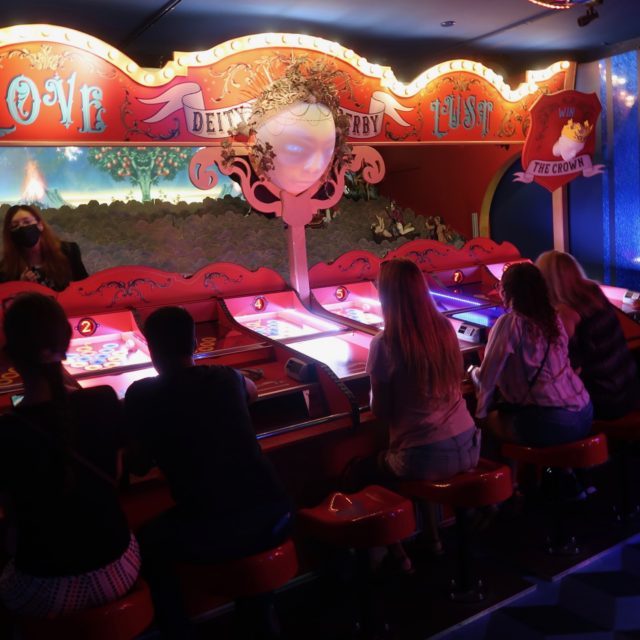
Brian Watkins’s Epiphany takes place at an awkward dinner party (photo by Jeremy Daniel)

EPIPHANY
Lincoln Center Theater at the Mitzi E. Newhouse
150 West 65th St. between Broadway & Amsterdam Ave.
Tuesday – Sunday through July 24, $92
212-362-7600
www.lct.org

In Brian Watkins’s Epiphany, continuing at Lincoln Center’s Mitzi E. Newhouse Theater through July 24, Aran (Carmen Zilles) reads from a letter to guests at a dinner party, “‘A new generation is growing up in our midst, a generation actuated by new ideas and new principles. But we are living in a special . . . ’ — sorry — “‘we are living in a skeptical and, if I may use the phrase, a thought-tormented age: and sometimes I fear that this new generation, educated as it is, will lack those qualities of humanity, of hospitality, of kindly humour which belonged to an older day. It seems to me, I must confess, that we were living in a less spacious age.’ No, that’s not right: ‘that we are living in a less spacious age.’ Well, I can’t tell if it says are or were.

The quote is taken nearly verbatim from James Joyce’s 1914 short story “The Dead,” which served as inspiration for Watkins’s play. But Watkins and director Tyne Rafaeli transport the tale, which also takes place at a dinner party, to modern times; in fact, though it premiered in 2019 in Ireland, the plot has been tweaked to comment on how the Covid-19 pandemic impacted the way humans relate to one another in what may or may not be a less spacious age.

Morkan (a sensational Marylouise Burke) is a woman of a certain age who has invited a diverse group of people to a dinner party celebrating the epiphany: Freddy (C. J. Wilson), a disheveled math teacher whom Morkan is afraid might drink too much; Sam (Omar Metwally), a well-respected psychiatrist, and his partner, the younger Taylor (David Ryan Smith), who is in marketing; a second couple, lawyer Charlie (Francois Battiste) and pianist Kelly (Heather Burns); Ames (Jonathan Hadary), one of Morkan’s oldest and dearest friends; and Gabriel, Morkan’s nephew and a famous writer who has promised to present a new work and is the main reason everyone has trudged through a snowstorm to come to the party at Morkan’s large country house outside an unidentified major city. Morkan has asked the twentysomething Loren (Colby Minifie) to help her with the food and drinks.

While they’re waiting for Gabriel, Morkan tells them that they have to surrender their phones — she refers to them as “thingamajigs” — and puts them in a box that is tantalizingly close. The guests, none of whom is well acquainted with anyone other than Morkan and the person they came with, are instantly rattled, acting as if a part of their body has been temporarily removed. They feel even more uncomfortable after it becomes evident that no one read any of the attachments Morkan included with the invitation, so they’re not prepared for all the activities she has planned, and they don’t know how to tell her. In addition, no one, including Morkan, knows what the word epiphany means or refers to.

Marylouise Burke is sensational as a dinner party host forced to improvise (photo by Jeremy Daniel)

Charlie: Where did the whole celebration idea come from anyway?
Morkan: Well, that’s the question! I actually have very little idea of what epiphany actually is.
Loren: Oh. I thought this was part of your religion or something.
Morkan: Oh no no no, not at all, it’s just sort of a new curiosity, because . . . well, it’s been an odd twelve months. . . . I’m really so forgetful these days, which is why Gabriel is going to do a whole . . . overview thingy and give a speech with the history and all the answers to the whole yadda yadda.
Taylor: Of course he is.
Kelly: Fucking . . . brilliant man.
Morkan: But so, ok, show of hands, who has celebrated Epiphany?
Kelly: Like the idea? The idea I guess, privately, yes — the what? Oh no.
Morkan: The holiday. The holiday. Show of hands for the holiday.

No one raises their hand.

Morkan: Alright so, before I sent you all the stuff with the invitation . . . who knew what epiphany was?
Kelly: The idea or the holiday?
Morkan: The holiday of Epiphany.
Taylor: The general concept or —
Morkan: The holiday.
Taylor: Oh. No.
Freddy: Not me!
Morkan: Ok. Well. I have no idea what Epiphany is. We have no idea what Epiphany is. But the thing that struck my head was, ya know like . . . creating a tradition . . . How does that work?! Or even just creating a reason, to ya know, get together in a terrible month like January to celebrate life!

As if that weren’t enough, Aran, Gabriel’s partner, soon shows up to explain that Gabriel will not be coming after all, which adds further disappointment and awkwardness. But Morkan is determined to soldier on with music, poetry, intellectual conversation, and the goose she has cooked, leading to some prickly physical and verbal exchanges as the snow keeps falling.

At nearly two hours without intermission, Epiphany is too long, and some of the awkwardness onstage leaks into the audience; at times you might feel like you’re at a dinner party that is going nowhere but you can’t leave. In addition to Joyce, it’s got a bit of Luis Buñuel’s The Discreet Charm of the Bourgeoisie mixed in with Samuel Beckett’s Waiting for Godot, Agatha Christie’s And Then There Were None (without the murders), and the disastrous parties Mary Richards used to throw on The Mary Tyler Moore Show, all of which play with the idea of expectations.

A lot of those expectations have changed significantly since the pandemic lockdown, as people wrestle with who to gather with and where. Gabriel chooses not to go because of a deep depression; it’s not a stretch to think that it may have been caused, at least in part, by the coronavirus crisis and a fear of meeting up with people. I have great friends who still refuse to go to gatherings, whether indoors or outdoors. It can be hard to know when to hug, when to shake hands, when to kiss, and when to bump elbows, which is addressed in Epiphany.

The show also plays with the idea of time, something that was difficult to keep track of during the lockdown and still today, when many of us are working from home. Although the story appears to unfold in something close to real time, Morkan makes several confusing references near the end about how much time has passed that will leave you scratching your head and wondering whether her statements are plain mistakes or have another, not immediately clear meaning.

You’re unlikely to reach any epiphanies while at the Newhouse, but it’s not so bad when you’re spending time with such a terrific cast, comprising some of the city’s finest character actors. Drama Desk winner Burke (Ripcord, Fuddy Meers), in the starring role, is phenomenal, short of stature but long on doddering charm and effervescence, her creaky voice reaching poetic heights. Tony nominee and Obie winner Hadary (Gypsy, As Is) excels as Ames, especially after suffering what could be a serious injury that is handled with slapstick humor. Tony nominee and Obie winner Metwally (Sixteen Wounded, Guards at the Taj) is smooth as silk as the curious neuroscientist. And Minifie (The Boys, Punk Rock), dressed in a yellow outfit that just might have been the old color of the dining room, is wonderful as Loren, who has no idea what she has gotten herself into. (The costumes are by Montana Levi Blanco.)

John Lee Beatty’s set has a gothic charm to it, bar carts and tables hovering close to the audience seated in the first row, who could reach out and grab a drink or snack (but shouldn’t). The snow can be seen through two large windows; mysterious stairs go down to the front door and up to the bedrooms and bathroom, lending the house a ghostly atmosphere. Isabella Byrd’s moody lighting reminds everyone that the storm might knock out the electricity at any second, while Daniel Kluger’s sound often adds a chill to the air.

“Life has just felt so wobbly, so even though I’ve lived here over forty years I feel . . . dislocated . . . exiled, I suppose . . . And I’m not sure why,” Morkan says, essentially speaking for many in the theater. “But maybe that’s the world, I dunno . . . I feel like I’m not making any sense.” Perhaps the same can be said of our “thought-tormented age” itself.

DREAMING WALLS: INSIDE THE CHELSEA HOTEL

Dreaming Walls explores the legacy of the Chelsea Hotel

DREAMING WALLS: INSIDE THE CHELSEA HOTEL (Amélie van Elmbt and Maya Duverdier, 2022)
IFC Center
323 Sixth Ave. at West Third St.
Opens Friday, July 8
212-924-7771
www.ifccenter.com

“There’s a lot of history in this building. There’s a lot of ghosts around here. Some ghosts, they just die here; some ghosts, they’re really lost, trying to find their way out. But they can’t find it,” a construction worker tells Chelsea Hotel resident and choreographer Merle Lister Levine in the documentary Dreaming Walls: Inside the Chelsea Hotel. The man explains that he searched online for information about the hotel where he was working on major renovations and found out about numerous deaths, including murder and suicide. But he also discovered that “there were a lot of interesting people here, a lot of musicians, a lot of art people, painters.” The two of them, an elderly woman who uses a walker and a strong, vibrant young man, then do the mambo in front of a window that looks out on the city. That, in a nutshell, summarizes both the hotel itself and the documentary.

Built in the 1880s, the Chelsea Hotel (or Hotel Chelsea) has been home to such artists as Dylan Thomas, Patti Smith and Robert Mapplethorpe, William S. Burroughs, Miloš Forman, Sid Vicious, Madonna, and Larry Rivers. Andy Warhol set his 1966 film Chelsea Girls there. It’s where Janis Joplin met Leonard Cohen, leading to Cohen’s song “Chelsea Hotel No. 2.” Others who have connections include Arthur Miller and Marilyn Monroe, the Ramones, Diego Rivera and Frida Kahlo, and Stanley Kubrick. In the film, images of many of these celebrities are occasionally projected onto the chimney and walls as a reminder of what once was.

The documentary, directed by Amélie van Elmbt and Maya Duverdier, alludes to the hotel’s place in the cultural zeitgeist of New York City, but it focuses on the modern-day residents, a group of older people clinging to the Chelsea’s bygone bohemian days as they try to hold on to their apartments following the ouster of longtime manager Stanley Bard and the sale of the hotel to real estate developers in 2011, 2013, and 2016, which left their future in limbo.

Cinematographers Virginie Surdej and Joachim Philippe shoot the film with a faded, muted palette to make it all look old, as if the hotel is haunted by its memories. The effect makes the current residents seem already part of its past, if not its legacy, doomed to be lost souls wandering the hallways as gentrification takes over. This is not the prime heyday of the Chelsea Hotel as a hotbed for creativity.

At one point, architect Nicholas Pappas and his wife, structural engineer Zoe Serac Pappas, the president of the Chelsea Tenants Association who is fighting for the seemingly endless construction to be finished, are lying in bed, discussing the hotel’s link to art. “There are a lot of people going around saying they’re artists, but they don’t do art. And then there comes the question, What is art?” Nicholas points out.

Choreographer Merle Lister Levine dances with a construction worker in Dreaming Walls

The film includes an archival clip of artist and longtime hotel resident Alpheous Philemon Cole, once the world’s oldest man, being asked what’s wrong with modern art. “Everything,” he responds. In a recent interview with painter Bettina Grossman, the oldest person in the building, she says, “Everybody else was paid to leave, and they did not offer me any money to go. So I’m thinking, maybe they prefer to kill me. . . . They do things to frighten me out.”

Duverdier and van Elmbt don’t delve deeply into the troubles the hotel has experienced this century; they don’t seek comment from the current owners or anyone involved in the construction, which goes on right around the residents, as if they’re already not there.

“For a long time I felt like I was witnessing a slow-motion rape of this building,” multimedia artist Steve Willis, who lives in Joplin’s old suite, explains. “I’m not watching it anymore. I’m not participating. I’ll show up in court and say I saw it happen, but that’s it. The last straw was giving up a large chunk of my apartment here.”

Perhaps the most important line in the film, which is executive produced by Martin Scorsese and opens July 8 at IFC Center, comes from artist Rose Cory, who says, “I live a very unusual life here.”

MONTHLY CLASSICS: MOTHRA

Mothra flies into Japan Society for special screening on July 8

MOTHRA (KAIJU) (Ishirō Honda, 1961)
Japan Society
333 East 47th St. at First Ave.
Friday, July 8, $15, 7:00
www.japansociety.org

Look, up in the sky! It’s a bird! It’s a plane! It’s — well, eventually, it’s a gigantic gynnidomorpha alisman, commonly known as a moth. But first, it’s an enormous caterpillar that moves across Japan slower than the giant breast in Woody Allen’s 1972 Everything You Always Wanted to Know About Sex* But Were Afraid to Ask. And while the mammoth mammary Victor Shakapopulis is hunting down in Allen’s comedy shoots out mother’s milk, the giant lepidoptera, labeled Mothra, dispenses powerful silk.

In the 1950s and ’60s, a series of Japanese films featured monsters born of the aftereffects of the atomic bombs that were dropped on Hiroshima and Nagasaki and the fear of alien invasion. It all started with Ishirō Honda’s Godzilla in 1954 and also included Honda’s Rodan and King Ghidorah and Noriaki Uasa’s Gamera as well as endless sequels.

In 1961, Honda gave us Mothra, a melding of GodzillaGojira in Japanese, the last two letters of which were added to the otherwise harmless word “moth” to make it appear much more dangerous — and the basic plot of King Kong. In fact, the next year Honda made King Kong vs. Godzilla.

The tale begins as human life is discovered on Infant Island, where the government of Rolisica (a combination of Russia and America) conducted hydrogen bomb tests thinking the land mass was uninhabitable. A group of explorers is assembled to investigate, led by the evil Rolisican Clark Nelson (Jerry Ito), who has ulterior motives. Among the others on the expedition are Dr. Shin’ichi Chûjô (Hiroshi Koizumi), an anthropologist and linguist who is excited by what might be discovered, and Zen’ichirō Fukuda (Frankie Sakai), a stowaway reporter (and comic relief) who is trying to get the big story for his demanding editor, Sadakatsu Amano (the great Takashi Shimura of Akira Kurosawa fame).

On the island, they discover a pair of “tiny beauties” (identical twins Yumi Ito and Emi Ito of the pop duo the Peanuts) called the Shobijin, singing sisters who are a mere one foot tall. Using weapons against the peaceful indigenous population, Nelson captures the fairies and brings them to Japan to exploit them. The islanders then perform a ritual ceremony to summon a great monster from its shell to bring the women back. “Whatever some giant monster does is completely unrelated with our work,” Nelson’s cohort declares, setting the stage for a final showdown in New Kirk City, a version of New York, Los Angeles, and San Francisco.

Mothra is a bizarrely masterful movie, a warning about the dangers of atomic warfare, government greed, rampant capitalism, and disregard for indigenous societies. Written by Shinichi Sekizawa, who penned dozens of monster flicks, the film is a kind of parable of the human life cycle from birth to death. The Shobijin, two miniature women, are found on the deftly titled Infant Island, and they are almost like children, growing up in front of us as they learn to speak. Mothra evolves from egg to caterpillar to moth. It’s as if the whole world has been reborn in the aftermath of WWII, with Russia and America merging together to try to become the parents of the planet.

The special effects, courtesy of Eiji Tsuburaya, are often hilarious. When Nelson picks up the tiny beauties, it is obvious he is holding two small dolls. It is clear that many of the cars are toys, and the breaking of a dam looks like a kid’s unwieldy science experiment. Pre-CGI superimposition of characters over various locations is shaky. For some reason, the military pauses for what seems like hours while Mothra spins its cocoon. The skin of the actors portraying the indigenous denizens of Infant Island was (poorly) darkened in a way that would be totally unacceptable today (and should have been in 1961).

But then, amid an attack by Japanese planes on Mothra doing the breaststroke across the ocean, an unintended rainbow flashes for just a second, as if the heavens are declaring him our hero and promising that things will turn out okay, a feeling that is echoed in the Peanuts’ haunting, memorable song.

Mothra is screening in 35mm at Japan Society on July 8 at 7:00 and will be introduced by Kevin Derendorf, author of SF: The Japanese Science Fiction Film Encyclopedia and Kaiju for Hipsters: 101 Alternative Giant Monster Movies. In addition, there will be a Kaiju-themed pop-up sponsored by Seismic Toys, with an exclusive limited-edition Mothra Mini-Print by Robo7 on sale in the lobby.

FIAF’s BASTILLE DAY 2022

BASTILLE DAY
French Institute Alliance Française (FIAF)
Madison Ave. between Fifty-Ninth & Sixty-Third Sts.
Sunday, July 10, free – $75, noon – 5:00 pm
fiaf.org

On July 14, 1789, a Parisian mob stormed the Bastille prison, a symbolic victory that kicked off the French Revolution and the establishment of the Declaration of the Rights of Man and of the Citizen. Ever since, July 14 has been a national holiday celebrating liberté, égalité, and fraternité. In New York City, the Bastille Day festivities are set for Sunday, July 10, on Madison Ave. between Fifty-Ninth & Sixty-Third Sts., where the French Institute Alliance Française hosts its annual daylong party of food and drink, music and dance, and other special activities. The celebration features free live music by Paul Beaubrun, street dance by Cal Hunt, a dance party with DJ Orson, and an excerpt from the French musical Notre Dame de Paris on the main stage at Fifty-Ninth St. from noon to 5:00; a Summer in the South of France Tasting in Tinker Auditorium from 12:30 to 5:00 ($35), with wines from Maison Antech, Château Maris, and Château Haut-Blanville, nonalcoholic wines from Le Petit Béret, gazpacho from Karine & Jeff, and cheese selections from cheese2u.com; a sneak preview screening of Matthieu Rozé’s Azuro starring Valérie Donzelli in Florence Gould Hall at 5:30 ($17); and the elegant Champagne & Musette Party at 1:30 ($65-$75) in Le Skyroom, with live music by Chloé Perrier & the French Heart Jazz Band, Champagnes from Billecart Salmon, Delamotte, and Henriot, macarons from Thierry Atlan, and hors d’oeuvres from Miss Madeleine.

A sneak preview of Matthieu Rozé’s Azuro is part of FIAF Bastille Day festivities

The French Garden between Sixtieth & Sixty-First consists of booths from Thermomix, Thierry Atlan, Stephane Koerwyn, Angelina Paris, Bichon, OCabanon, Oliviers & Co, Opinel, Payot, Silpat, and Tissage Moutet, while Market Booths between Sixtieth & Sixty-Third include Brasserie Cognac, Maman Bakery, Mille-feuille Bakery Cafe, Hanami Designs, Barachou, Miss Madeleine, and dozens more. The FIAF Language Center Booth between Fifty-Ninth & Sixtieth will present special activities for children and a trivia contest for adults from 1:00 to 4:00. And this year’s prize drawing can win you skincare baskets, a wellness collection, a FIAF Premier Membership, a two-night stay at Sofitel New York, or a Dream Getaway for Two to France’s Occitanie region.

NEW AGORA: JULY — ART, MUSIC, YOGA, AND MORE AT SOCRATES SCULPTURE PARK

The art in Socrates Sculpture Park will be activated with special programs on July 9 (photo by twi-ny/mdr)

Who: Woomin Kim, Greg Hammontree, Douglas Paulson and Nicole Brancato, Rudy Walker Ensemble, Cooper-Moore, Ununu, Elliott Sharp, Duology, more
What: Jazz Foundation of America presentation for Second Saturdays
Where: Socrates Sculpture Park, 32-01 Vernon Blvd. at Broadway, Long Island City
When: Saturday, July 9, free, 9:30 am – 8:00 pm
Why: Socrates Sculpture Park and the Jazz Foundation of America have teamed up for a special day of live music, workshops, and more on July 9, activating the historic park and its current art installations. There will be yoga at 9:30 and 11:00 in the morning; from 10:00 to 2:00, the Hellgate Farm Stand will be open, and the Astoria Food Pantry will distribute free clothes, books, and essential items and collect nonperishables and clean clothing; at 11:00, Field Guide: Wildlife Among Us — Finding Shelter will take preregistered participants on a tour of the park, focusing on where animals and insects make their home; and at noon, artist Woomin Kim, whose “Shijang Project” quilts are at Susan Inglett Gallery in Chelsea until July 29, will lead a collage workshop with Noguchi Museum educators. In addition, Greg Hammontree’s ambient soundworld Trumpet Echoes will ring out all day in the Grove of Trees, where you can walk through the adaptive sonic space.

The afternoon will include live thirty-to-forty-five-minute concerts, featuring part I of .soundfullness by Douglas Paulson and pianist Nicole Brancato at the front gate BBQ area at 2:00, the Rudy Walker Ensemble at the Cobblestone Stage at 3:00, pianist Cooper-Moore inside Hélio Oiticica’s Subterranean Tropicália Projects PN15 at 4:00, improv trio Ununu at the North Gate Stage and part II of .soundfullness at the front gate BBQ area at 5:00, the legendary Elliott Sharp playing “Monkulations” on acoustic guitar in Oiticica’s installation at 6:00, and Michael Marcus’s Duology at the Main Stage at 7:00.

As you enter the park, you encounter the Broadway Billboard The Marooned Picturesque Series (Socrates) by New York City native Joiri Minaya, which was selected by the Socrateens. On view through August 14, Oiticica’s Subterranean Tropicália Projects PN15 is an immersive circular environment of an unrealized work by the late Brazilian artist and activist Oiticica, who was honored with a terrific exhibition at the Whitney in 2017, “To Organize Delirium.” Originally conceived for Central Park, the piece is now centered at Socrates, where visitors can follow narrow, winding paths to surprise places; facing the front of the park is a small platform and screen behind mesh, where live performances and screenings are held. Sharp and Cooper-Moore will play inside on July 9; on August 14, the closing reception is highlighted by “We are one only heart, one only earth, one only soul,” an invitation to the public by Brazilian Yanomami shaman Davi Kopenawa to learn about the violence the Yanomami people are facing at the hands of the Brazilian government.

In the Grove of Trees, where you can hear Trumpet Echoes, you will find Maren Hassinger’s Two Bushes, a new pair of sculptures made of iron wire hiding in plain sight among the natural elements of the park, harkening back to Hassinger’s Three Bushes, which were part of the 1988 group exhibition “Sculptors Working” at Socrates. The New York–based artist has also installed “Steel Bodies” throughout the park, consisting of ten steel sculptures inspired by different types of vessels throughout history; some of them resemble open cages, which you can walk into, offering a unique perspective on your relationship to the people and nature around you, while their placement, and the shadows they create, interacts dramatically with the surrounding trees, skyscape, and outdoor studio of Socrates cofounder Mark di Suvero. [To see all the artwork in the park, go here.]

KENZO DIGITAL’S AIR AT THE SUMMIT

Kenzo Digital’s Air offers a new perspective on making connections in the city (photo by twi-ny/mdr)

AIR
SUMMIT One Vanderbilt
45 East Forty-Second St. at Vanderbilt Pl.
Admission: $39-$73
summitov.com
kenzodigital.com
online slideshow

“I wanted New Yorkers to come and watch their home come back to life, to reengage with their friends and family they hadn’t seen for a long time and create ritual and ceremony around human connection, which is actually the antithesis of New York, which is a highly transactional city where people are just trying to survive,” Kenzo Digital said on a private walkthrough of his multipart permanent installation, Air, near the top of the SUMMIT One Vanderbilt skyscraper. “So I want to have a place where people can forget about that aspect of their survival identity in New York and connect through a primal curiosity on a basic, authentic level.”

Kenzo, a graffiti artist, DJ, and film and video director who has worked with Kanye West and Beyoncé, had lofty goals when designing Air; he didn’t want the project to just be an Instagram-friendly tourist attraction but to generate other, more meaningful conversations, especially among New Yorkers.

“In a nutshell, what I wanted to do was essentially create an experience of physical space that was capable of having a deep emotional and psychological relationship with a human being over the course of their entire life. The idea is you walk into this space and it will feel different every time,” he explained. “I wanted to create something that specifically challenges and defies language, both the written word and the image. It’s impossible to describe what this is, even though you can break it down by its components and you’d be correct, but it’s impossible to describe the effect of the experience and the emotional impact. Everyone is wrong and right in different ways, and it will be a different wrong and right every time you come.”

Air consists of several floors of fantastical views of New York City and dramatic reflections, reaching high into the sky and way down below, of the humans occupying the space on the ninety-first floor and above. “We built the entire thing during the pandemic. It was like making art in a science fiction film. It was . . . fucking crazy,” Kenzo notes. Glass windows and mirrors are arranged in geometric patterns that result in awe-inspiring repeated imagery that forces visitors to try to find their body in the space as well as their position in the city and the world. Kenzo, whose previous installations include Social Galaxy, which featured chambers where visitors were barraged by their social media history, and the immersive haunted house Nocturnal Awakening, considers the work to be “the story of your relationship to time, your relationship to New York City, your relationship to weather, and also your relationship to yourself.

“It’s about the relationship between the natural world and the physical world,” he points out. “If there is an approaching storm from New Jersey, you will see the city as an organism react to that storm — cars, traffic, people move differently, with rain on the street, fewer people, umbrellas pop up. You can see the city as an expression of nature. People always talk about the life force of New York; Air is an organ within that life force, the heart of it that contains its spirit. This is expressing the infinite power of chaos that is the collision of uncontrollable variables: nature, time, the world, your emotions, your place in all of this.”

Visitors first take an elevator that recalls one of Yayoi Kusama’s Infinity rooms, with lights flashing on and off and mirrors that reflect the passengers into an endless oblivion. You get out at “Transcendence,” a large rectangular space with tall windows that offer stunning views of the city on three sides and glass floors that reflect the inside and the outside. It will take you a while to orient yourself, especially as you look down at what appear to be multiple levels of people either upright or upside down as buildings, blue sky, and clouds merge with the interior space.

“There are so many avenues, it almost looks like they’re delivering you to the front doorstep of One Vanderbilt,” says Kenzo, who speaks quickly and excitedly, like a child with a new toy. “And because it’s positioned so symmetrically, you can almost see the city like an organized system of neighborhoods; you understand it spatially, you understand the grid, and that grid is magnified and deconstructed within the grid of reflection that exists in here.” The gridlike structure recalls the multimedia installations of the father of digital art, Nam June Paik, who arranged television sets into wholly new, living environments; Kenzo is the late Nam June’s great-nephew and the creative director of his great-uncle’s estate.

Much of the eye contact in Air is made via the reflections, so you can connect with individuals who are not in your immediate physical space, if you can find them. It’s a far cry from being on the subway, for example, where many straphangers go out of their way to avoid eye contact with anyone.

When I mention to Kenzo that it’s hard to tell who is actually on the mezzanine and what are reflections, he replies slyly, “They are asking themselves the same question about you.”

In the mezzanine, you can look down and see how the next batch of people initially react to the area. Kenzo explains, “The idea behind Transcendence II is this concept of folding time in the sense of that when you’re up here, you’re essentially watching people exposed to the concept for the first time, and so the idea of connective language through primal curiosity is in effect because you see people, just where you were a few minutes ago, processing the information at a base level for the first time. So as we were just down there, observing that there’s a physical mezzanine up here and making eye contact, everyone up here has already established equilibrium and has the foundation of knowledge and information, and everyone down there is still figuring out what’s going on.” Kenzo envisions Air as encompassing human development: “crawl, walk, run, fly.”

Kenzo Digital stands next to the Empire State Building in his permanent installation at Summit One (photo by twi-ny/mdr)

The idea for Air emerged from Kenzo’s subconscious.

“This is all based on a recurring dream I’ve had for twenty-five years; it’s a strangely, deeply personal thing,” Kenzo reveals. “In the dreams there’s a fictitious skyscraper, residential; so I’ve had these dreams that took place in the top two floors, the penthouse of the skyscraper, which is circular in shape, which is why I have the two circles on the east and west side as a nod to that dream. So it’s the ability to project my dream and then put it inside of other people’s mind and then for that to be a shared dream. And oftentimes I find people dream about it after the experience.”

Affinity is a room of silver balls, reminiscent of Andy Warhol’s helium Silver Clouds, that visitors can run through, kicking the balls in the air and against mirrors and windows, each ball reflecting themselves, those around them, the view, and other balls as dozens of orbs seem to multiply into thousands in a fun deluge. “It’s constantly engaging with the city; it’s always an inside-outside experience,” Kenzo says. In another room, the inside-outside connection involves a projection of sky and clouds on the wall and the floor as scanned images of your face are added to a large screen.

Levitation puts you in a space where you are seemingly floating above the skyline, standing on a transparent floor facing a window so clear that it makes you feel like it’s not there, that you are on a ledge, midtown Manhattan right below you. Cameras are set up to take a picture and/or video of you in the space that you can pick up at the exit. As wondrous as it is to look at, it also makes you feel the interdependence between nature, technology, and humanity as well as the impermanence of life. “It’s the story of your relationship to time, your relationship to New York City, your relationship to weather, and also your relationship to yourself,” Kenzo explains. You can further those relationships by taking the outside glass elevator, Ascent.

Levitation offers a chance to seemingly float above New York City (photo courtesy Summit One)

Kenzo honors Japanese artist Kusama with her 2019 work Clouds, a collection of amorphous stainless-steel and wax floor sculptures that also reflect visitors and the sky; it is the first of a rotating series of exhibitions Kenzo will curate by other artists in the space.

Kenzo sees Air as an ever-changing, always-evolving experience that changes from day to day, hour to hour, depending on the crowd and the weather, and he wants it to be more than just a photo opportunity that’s over when you leave.

“There’s a part of you that stays in here,” he says thoughtfully.

BroadwayCon 2022

Who: Anthony Rapp, LaChanze, Andrew Barth Feldman, Carolee Carmello, Ben Cameron, Erin Quill, Fredi Walker-Browne, Julie White, Telly Leung, Ilana Levine, Jacqueline B. Arnold, Jennifer Ashley Tepper, Vanessa Williams, Judy Kuhn, Lesli Margherita, Nik Walker, Ryann Redmond, Thayne Jasperson, Hillary Clinton, more
What: BroadwayCon 2022
Where: Manhattan Center, 311 West Thirty-Fourth St., and the New Yorker Hotel, 481 Eighth Ave.
When: July 8-10, day passes $80, general pass $200, gold pass $425, platinum pass $1,250
Why: BroadwayCon is back with an in-person edition taking place July 8-10 at the Manhattan Center and the New Yorker Hotel, right by Madison Square Garden and Penn Station and just a few blocks south of the Theater District. This year’s edition includes panel discussions, interviews, live performances, podcasts, a cosplay contest, workshops, photo and autograph sessions, singalongs, meetups, and celebrations of and inside looks at such shows as A Strange Loop, Six the Musical, Chicago, POTUS, Dear Evan Hansen, Beetlejuice, Thoughts of a Colored Man, Kimberly Akimbo, SpongeBob SquarePants, Harry Potter and the Cursed Child, The Kite Runner, Assassins, and Hamilton.

Among those participating at the three-day festival are Anthony Rapp, LaChanze, Carolee Carmello, Ben Cameron, Erin Quill, Julie White, Telly Leung, Vanessa Williams, Judy Kuhn, Lesli Margherita, and Hillary Clinton, talking about such topics as racial and gender diversity, disability, understudies, anxiety, body positivity, and Stephen Sondheim.

Below are select highlights for each day:

Friday, July 8
Ensemble screening, with Telly Leung, 10:00 am, followed by a talkback at 11:20, Crystal Ballroom, the New Yorker Hotel

BroadwayCon 2022 Opening Ceremony, with Ben Cameron, Manhattan Center Grand Ballroom, 12:40

Here’s to the Ladies: Hillary Rodham Clinton Live at BroadwayCon, with LaChanze, Julie White, and Vanessa Williams, moderated by Hillary Clinton, Manhattan Center Grand Ballroom, 1:00

Making a Living and Having a Life in Theatre Production, with Jameson Croasdale, Mary Kathryn “MK” Blazek, Rebecca Zuber, Lauren Parrish, and Gary Levinson, moderated by Naomi Siegel, Sutton Place Suite, the New Yorker Hotel, 2:20

Lights, Overture, Stage Fright! Breaking Down Performance Anxiety, with Kira Sparks, Sutton Place Suite, the New Yorker Hotel, 3:40

POTUS is one of several Broadway shows that will be featured at BroadwayCon (photo by Paul Kolnick)

Saturday, July 9
Black Lives Matter on Broadway, with T. Oliver Reid, Britton Smith, Emilio Sosa, Michael Dinwiddie, and Lillias White, moderated by Linda Armstrong, New Yorker Hotel Grand Ballroom, 10:00

Broadway Livestreaming: Expanding the Reach of Live Theatre, with Timothy Allen McDonald, Sean Cercone, Luke Naphat, Tralen Doler, Nathan Gehan, and Jen Sandler, moderated by Joshua Turchin, Gramercy Park Suite, the New Yorker Hotel, 11:20

Getting the Show Back on the Road: The Pandemic and Its Impact on Touring Broadway, with Jacob Persily, Sutton Place Suite, the New Yorker Hotel, 2:20

Paul Gemignani and Sondheim’s Musical Legacy, with Margaret Hall and Meg Masseron, Crystal Ballroom, the New Yorker Hotel, 3:40

BroadwayCon Cabaret, with special secret guest, hosted by Ben Cameron, Manhattan Center Grand Ballroom, 5:00

Sunday, July 10
Cheers to Understudies: The Broadway Cast Live!, with Amber Ardolino, Mallory Maedke, Tally Sessions, and Lauren Boyd, hosted by Ben Cameron, New Yorker Hotel Grand Ballroom, 10:00

Body Liberation on Broadway, with Amara Janae Brady, Shantez M. Tolbut, and Evan Ruggiero, moderated by Stephanie Lexis, Gramercy Park Suite, the New Yorker Hotel, 10:00

Directors on Debuts, with Zhailon Levingston and Tina Satter, moderated by Zeynep Akça, Crystal Ballroom, the New Yorker Hotel, 1:00

Tell Me More! Tell Me More!, special guests TBA, Manhattan Center Grand Ballroom, 2:20

Broadway Anecdotes II: Golden Age Gossip, with Kenneth Kantor, Joshua Ellis, and Mimi Quillin, moderated by Ken Bloom, Gramercy Park Suite, the New Yorker Hotel, 5:00