featured

THE MAN WHO SHOT LIBERTY VALANCE

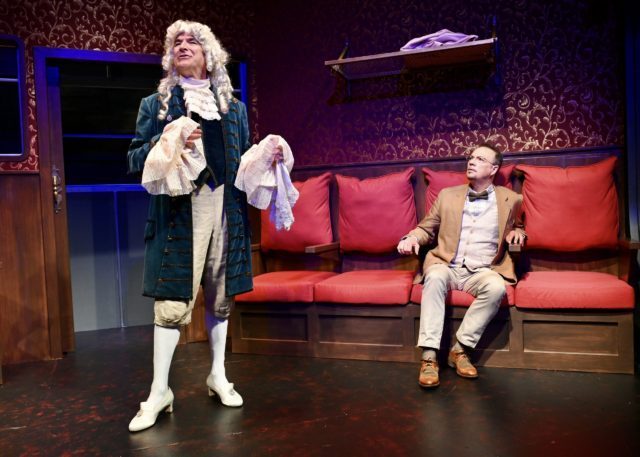
It’s not exactly love at first sight for Hallie (Stephanie Craven) and Ransome Foster (Leighton Samuels) in The Man Who Shot Liberty Valance (photo by Joshua Eichenbaum)

THE MAN WHO SHOT LIBERTY VALANCE
Gene Frankel Theatre
24 Bond St. at Lafayette St.
Wednesday – Sunday through July 31, $15-$25
www.genefrankeltheatre.com
www.theonomatopoeiatheatrecompany.com

“The hairs on your arm will stand up / At the terror in each sip and in each sup / Will you partake of that last offered cup / Or disappear into the potter’s ground? / When the man comes around,” Johnny Cash warned on the title track of his 2002 American IV album. The song is one of many by the Man in Black that echo in the Gene Frankel Theatre before the start and during intermission of Onomatopoeia Theatre Company’s stirring New York premiere of Jethro Compton’s The Man Who Shot Liberty Valance. In this case, the man coming around is Liberty Valance.

British playwright Compton’s 2014 play is based on the 1953 short story by Dorothy M. Johnson; the twenty-two-page tale was turned into a popular 1962 John Ford film packed with an all-star cast — John Wayne, James Stewart, Vera Miles, Lee Marvin, Edmond O’Brien, Andy Devine, John Carradine, Jeanette Nolan, Woody Strode, Denver Pyle, Strother Martin, Lee Van Cleef — but Compton’s adaptation brings the play into the twenty-first century, twisting many of the movie’s genre clichés inside out as he takes on social and racial injustice while toning down the movie’s political rhetoric, general Hollywood misogyny, and freedom of the press blather.

The two-and-a-half-hour show begins in 1910, as Sen. Ransome Foster (Leighton Samuels) and his wife, Hallie (Stephanie Craven), arrive in Twotrees for the funeral of Bert Barricune (Samuel Shurtleff), who seems to have been an insignificant forgotten man in an insignificant one-horse town. Young reporter Jake Dowitt (Jeff Brackett) wants an exclusive with the senator, leading to a flashback to 1890, when a severely injured Foster is brought into the Prairie Belle Saloon by Barricune. After he is tended to by Jackson and Jim “the Reverend” Mosten (Daniel Kornegay), who works for her, he explains that he was beaten by three men who turn out to be the villainous murderer Liberty Valance (Derek Jack Chariton) and his henchmen.

Foster is a peaceful man from New York, a law scholar traveling not with a gun but with legal texts, Shakespeare sonnets, Greek tragedies, and a Bible. When Marshal Johnson (Scott Zimmerman) refuses to arrest Valance, Foster considers going up against the feared gunslinger himself. “I am no law man, sir,” Foster admits. The marshal responds, “Seems from what I’ve heard you ain’t much good at defending yourself, let alone a town.”

Soon Foster is teaching some residents of Twotrees to read, which angers others, especially since Jackson is a woman and Mosten is the only Black man around; book learning is not for the likes of them. Much of the strength of the play comes from the power Compton invests in the two characters; in the short story and movie, Jackson is a restaurant employee, while Mosten is Barricune’s loyal helper and doesn’t even appear in Johnson’s tale. In the play, Jackson speaks her mind with a razor sharpness, while Mosten is a well-respected man who has the ability to memorize whatever anyone says or reads to him.

Barricune is not happy when he sees Foster and Jackson spending a lot of time together; Bert believes he is destined to marry her. “She’s always been my girl,” Barricune says. “Does she know that?” Foster replies.

After Valance and his two sycophants commit a horrific act, Foster is more intent than ever to face him down and let the chips fall where they may.

Ransome Foster (Leighton Samuels) and Liberty Valance (Derek Jack Chariton) are headed to a final showdown in Onomatopoeia production (photo by Joshua Eichenbaum)

The Man Who Shot Liberty Valance takes place primarily on Nino Amari’s intimate set, a small Western saloon with a bar in the far corner, one table, two windows on either side of a piano, and swinging wooden doors in the back (which audience members must walk through to use the restrooms, but not during the performance). Most of the action occurs at the angled bar, including two sizzling scenes with Valance, the first between him and Mosten, the second him and Foster. Neither scene is in the short story or film, so the suspense is ratcheted up.

In his New York stage debut, Charlton is a magnetic force, his every word and move electrifying. He knows exactly who Valance is and what he wants, a villain who has no veneration for the law or for Blacks. When Foster raises the possibility of his defeating him in a showdown, the cocky Valance says, “Unless the hand of God comes down and strikes me dead there ain’t much chance of that.” Foster, knowing he doesn’t really have a shot, responds, “Or the earth opens up and the Devil takes you under.” Valance retorts, “No. We have an agreement, me and him.” When those words are spoken by Charlton, you don’t doubt it.

The rest of the cast holds up its end of the bargain; Samuels and Craven have a sweet chemistry, Shurtleff portrays Barricune with an inner loneliness, and Zimmerman’s marshal is neither coward nor buffoon. (Assistant director Chandler Robyn ably portrays numerous small roles.)

The play is expertly helmed by Onomatopoeia artistic director Thomas R. Gordon, maintaining a thrilling tension throughout. Susan Yanofsky’s period costumes are effective, while Reid Sullivan’s lighting hints at a danger always lurking, although the changing colors in the two windows are sometimes confusing. The narration occasionally gets in the way of the plot, explaining what we already know or making a point that is better left for the audience to decide for themselves.

Compton has also adapted F. Scott Fitzgerald’s The Curious Case of Benjamin Button into a Celtic musical and Jack London’s White Fang into Wolf’s Blood; his Frontier Trilogy is set in the American West in the mid-nineteenth century, while The Bunker Trilogy delves into Arthurian legend, classical Greek tragedy, and Shakespearean drama. In Liberty Valance he has created a stage Western for our times, cleverly referencing the conflicts of contemporary America, as red states battle blue states over jobs, immigration, and education; rights for women, people of color, and LGBTQIA+ are in serious jeopardy; gun control is being hotly debated; and liberal urban elites and the conservative south and Midwest seem immersed in an endless duel. The arguments the citizens of Twotrees are having are not unlike what we see every day on social media and partisan news outlets.

In the play, Foster teaches his class Shakespeare’s seventy-first sonnet, which reads in part: “No longer mourn for me when I am dead / Than you shall hear the surly sullen bell / Give warning to the world that I am fled / From this vile world with vilest worms to dwell.” Johnny Cash couldn’t have said it any better.

twi-ny talk: BARBARA POLLACK / MIRROR IMAGE

Barbara Pollack first visited China in 2004 (photo courtesy Barbara Pollack)

MIRROR IMAGE: A TRANSFORMATION OF CHINESE IDENTITY
Asia Society Museum
725 Park Ave. at 70th St.
Wednesday – Sunday through December 31, $7-$12
Artist Talk July 21, free, 7:00
Brooklyn Rail talk Tuesday, August 9, free, 1:00
asiasociety.org

In a 2010 twi-ny talk, Barbara Pollack noted, discussing her book The Wild, Wild East: An American Art Critic’s Adventures in China, “Until the late 1990s, the art world was extremely narrow-minded and unwilling to think that a major talent could come from somewhere other than Europe or North America. That has changed forever, good riddance.”

Pollack spent the following decade meeting with, writing about, and researching these major talents, in China and other countries, leading to her next book, 2018’s Brand New Art from China: A Generation on the Rise.

Right before Covid-19 forced the lockdown of restaurants, theaters, museums, and other businesses in March 2020, Pollack’s “Mirror Image: A Transformation of Chinese Identity” had been scheduled to open at Asia Society but had to be put on hold. Pollack, a writer, teacher, curator, and visual artist with a law degree, pivoted immediately and formed, with Anne Verhallen, Art at a Time Like This, a nonprofit that presents sociopolitical art, both on- and offline. Finally, after a more than two-year delay, “Mirror Image,” curated by Pollack with guest curatorial assistant Hongzheng Han, opened at the Park Ave. institution in June and has just been extended through the end of the year.

The exhibition, which Pollack sees as a kind of follow-up to Asia Society’s seminal 1998 show “Inside Out: New Chinese Art,” features multimedia works that explore the idea of “Chinese-ness” by seven artists who were born on mainland China in the 1980s, six of whom are still primarily based there. In her curatorial statement, Pollack explains, “These artists continue to push forward. We no longer view them as ambassadors from an exotic land but as representatives of a world we share.”

Pixy Liao, who lives and works in Brooklyn and was born in Shanghai in 1979, contributes intimate digital chromogenic still-lifes of parts of her and her partner’s bodies. Cui Jie creates futuristic cityscapes with hints of the past in large acrylic paintings. Tianzhuo Chen invites viewers into one of his ecstatic theatrical performances in the five-minute two-channel video Trance. Liu Shiyuan, who divides her time between Beijing and Copenhagen, combines found images with original footage in dizzying prints. Miao Ying, who lives and works in Shanghai and New York City, incorporates online gaming into her computer-animated film Surplus Intelligence, while Pilgrimage into Walden XII is a live simulation that learns over time. Tao Hui’s Similar Disguise Stills is accompanied by QR codes that take visitors into digital TikTok soap operas with nonbinary characters. And Nabuqi’s How to Be “Good Life” is a living room installation, influenced by Martin Heidegger and Richard Hamilton, that questions how popular culture invades personal spaces.

Tao Hui, Similar Disguise Stills, archival pigment prints mounted on aluminum panels, 2021 (photo courtesy of the artist, Kiang Malingue, Esther Schipper, and Macalline Art Center, Beijing)

On July 21, Pollack will moderate a conversation with Pixy and Miao at Asia Society and Nabuqi and Tao participating remotely; the talk can be viewed in person as well as online here.

Pollack is an old friend; her second book was represented by Stonesong, my wife’s literary agency. Pollack recently discussed the impact of the internet on Chinese art, putting together an exhibition during a pandemic, the Chinese art market, Chinese identity, and more in her latest twi-ny talk.

twi-ny: The exhibition includes a timeline that goes back to President Nixon’s visit to China in 1972 and Mao’s death in 1976. I know this could take a book – and you’ve written several on the subject – but, in a nutshell if possible, what have been some of the biggest changes in Chinese art and the perception of Chinese artists since then?

barbara pollack: I begin the timeline with Nixon’s visit and Mao’s death, basically the end of the Cultural Revolution, the most repressive period in modern Chinese history. The artists in this show were mostly born five to ten years later and had no experience with that kind of scary attitude toward intellectuals and creatives. In fact, they grew up in a world where there was an art infrastructure including auction houses, galleries, and, finally, new contemporary art museums. This all happened really quickly.

In the 1990s, art was still kind of underground, but by 2000, China hosted a major biennial, several official auction houses, and a few galleries. By the time these artists were exhibiting, China had an art market that rivaled that in the U.S. Most people here don’t realize that Shanghai now has a dozen contemporary art museums and there are several hundred galleries between Shanghai and Beijing and other cities. That creates an incredibly rich environment for artists to exhibit their works, despite censorship and other drawbacks.

twi-ny: The internet came to China in 1994, and much of the art in the show incorporates elements of AI, high-tech social media, and online gaming. How did the internet impact the work Chinese artists were creating?

bp: In 1994, China was still a pretty isolated, agrarian society. The internet changed everything for everyone, but mostly the generation born in the 1980s, as are the artists in this show. Suddenly you no longer had to smuggle in catalogues or merely read about shows of contemporary art elsewhere in the world. It took a while for the internet to improve, but soon you could get information directly. Artists in China learned rapidly how to have their own websites and how to email international curators. I know this firsthand by those who contacted me early on. But more importantly, before the establishment of the Great Firewall — China’s surveillance of all internet activity — people in China could learn about Chinese history not included in domestic textbooks. It was an eye-opening period and one of the reasons that this younger generation is so enthralled with the liberation that came from this technology.

twi-ny: In our 2010 twi-ny talk, you pointed out that Chinese artists were able to produce without the interference of the Ministry of Culture and that restrictions rarely impeded their output. Is that still true? That was two years before Xi Jinping took over as general secretary.

bp: I have no idea what has happened in the last two years, but it should be noted that in 2014, Xi Jinping gave a speech exhorting media, television, films, and art producers to “serve the people” and uphold Chinese culture. That’s a return to Mao’s rhetoric during the Cultural Revolution. As a result, there has been a rise in self-censorship for sure. I need to return to China to see how this has had an impact on cultural institutions and art making.

Miao Ying, Surplus Intelligence, single-channel film with sound, 2021-22 (courtesy of the artist)

twi-ny: Speaking of going to China, what was it like putting “Mirror Image” together during the pandemic? You’re used to traveling there often, but I imagine that because of Covid, the Russian invasion of Ukraine, and other political situations, that is not possible.

bp: “Mirror Image” was supposed to open in the spring of 2020, just as Covid took over New York City and museums and galleries were closed. I was devastated that the show was canceled at that point. In fall 2021, Asia Society came to me and revived the show. By then, I knew we could not ship works from China — not because of Covid but because of shipping tariffs imposed by Donald Trump. So we used “virtual shipping,” with artists sending photo works and videos digitally.

Even Nabuqi’s great installation — originally created in Beijing with elements bought at the local IKEA — was completely assembled in NYC. The artist sent us a “shopping list.” We ordered from IKEA here and then she directed the installation via Zoom with a translator in the museum. I think that’s a perfect example of how globalization can impact — even facilitate — art making in the twenty-first century. Also, several galleries — Kiang Malingue in Hong Kong, Tanya Bonakdar in Chelsea, Pilar Corrias in London, and Chambers Fine Art downtown — were incredibly helpful in sourcing works in the U.S. I really have to thank the team at Asia Society for an extraordinary effort to pull this together.

twi-ny: The exhibition includes a wild video installation by Tianzhuo Chen; a few years back, you attended one of his performances here in the city. What was it like to experience it in person?

bp: Tianzhuo’s work is the most visceral experience I have ever had in an art institution. It’s like watching wild animals refusing to get back in their cages. The tension between the space and the performers is absolutely riveting.

Pixy Liao, Play Station, digital chromogenic print, 2013 (courtesy of the artist and Chambers Fine Art)

twi-ny: Another highlight of the show are ten digital chromogenic prints by Pixy Liao. How did you get introduced to her work?

bp: I met Pixy early in her career, around 2010, when she came to New York. She and her partner, Moro, have their own quirky band and I saw them perform at Printed Matter. I may have known her even before that. I love working with Pixy because she has no ego and comes off like a cutie pie but is actually quite brilliant and powerful. That’s the tension that comes through in the photographs. Her images really speak to people about the state of relationships in today’s gender-fluid world, not just in China or Chinese communities.

twi-ny: For people who might not know that much about contemporary Chinese art, what do you think will most surprise them about this show?

bp: Everything! Many Americans have such a limited view of China that they don’t even believe that creativity is possible in such a repressive society. It is repressive, but that is the framework that Chinese artists push against and test the limits of. Almost all of the work in the show has been shown in China without problems. Many of these artists have major markets with a new generation of young Chinese collectors, and internationally. But this may change. I’m worried about the future. Very worried.

twi-ny: On July 21, you will be moderating a conversation with four of the artists. What are some of the main topics you will be discussing?

bp: We will start with a discussion of how being born in China has influenced their choices as artists and whether that still guides their work. Then I will allow the artists to guide the discussion more or less. But this issue of identity will obviously recur throughout the evening. Most of the artists have told me they are citizens of the internet, not China. We’ll see where that leads us.

[You can watch a recording of the panel discussion here. Pollack will also be participating in a free Brooklyn Rail New Social Environment discussion on Zoom on August 9 at 1:00 with artists Liu Shiyuan and Miao Ying, moderated by Lilly Wei and featuring a poetry reading by Abby Romine.]

twi-ny talk: RUSSELL MALTZ: PAINTED / STACKED / SITE

Visual artist Russell Maltz monitors the load out for installation on Jay St. in DUMBO (photo by Matthew Deleget)

RUSSELL MALTZ: PAINTED / STACKED / SITE
Minus Space
16 Main St., Suite A, Brooklyn
Saturdays through July 30, free, 11:00 am – 5:00 pm
www.minusspace.com
www.russellmaltz.com

When I first arrived at Minus Space in DUMBO to see “Russell Maltz: Painted / Stacked / Site,” I thought that the final phase of the Brooklyn-born visual artist’s multipart four-month retrospective had spilled out of the gallery and into the street. Since the mid-1970s, Maltz has been creating works using a wide range of materials, from concrete cinder blocks, glass, and pegboards to found wood panels, PVC pipes, paper, and a swimming pool; he has collaborated with construction companies, and he enjoys photographing artlike industrial detritus. There’s a lot of construction going on outside the gallery, some of which evoked Maltz’s use of color and materials.

Minus Space first showed his “POOL” project beginning in April, followed by “Stacks,” and now concludes with “Needles,” consisting of long, narrow vertical works of acrylic and polyurethane on glass plate and wood, suspended from a galvanized nail, each at a different height on the wall, forming three-dimensional palimpsests. Depending on where the viewer stands, they’ll experience varying depth of space in the works, including reflections of what is happening on Main St. — in this case, bringing the outside construction inside. In the main gallery each piece is a shade of blue, creating unique shadows on the walls. (There are additional works in other colors in the office.)

In conjunction with the exhibit, Maltz put up a temporary installation in a storefront at 28 Jay St., and his Scatter sculpture is part of a group show in Hillman Garden at 100 Broome St. in Luther Gulick Park this summer.

Maltz is a relaxed, easygoing guy who loves discussing art; below he talks about color, material, Brooklyn, and working during the pandemic.

twi-ny: You’re a Brooklyn boy, like me.

russell maltz: Yes, I am.

twi-ny: What do you think about how Brooklyn has changed over the years? I can’t imagine a place like Minus Space existing when I was a kid.

rm: I was born in Brownsville. My family moved to Canarsie when I was two or three years old. We lived in the Bay View Housing Project down by the Belt Parkway alongside Jamaica Bay.

twi-ny: I was born in Flatbush.

rm: Many different types of people lived [in Canarsie], mostly working class and from many ethnic and religious backgrounds. I’ve always regarded Brooklyn as a place where there is an ever-changing community of people. I think that the essence of any community and its value is all about the neighborhood. It seems that what is changing and what is inevitable is that in many places the need for development and the changes to a neighborhood that the development brings has priced out many of its current and historic residents from living in that particular neighborhood — the folks who made it what it is. Development should enrich a neighborhood and should be community-based so that the people who live there can continue to contribute to its identity and culture.

twi-ny: I couldn’t agree more. Since April, Minus Space has been showing a retrospective of your career in different phases, going back five decades. What has it been like putting together each individual section? Were you flooded with memories?

rm: Always — although, there was a prequel to the Minus Space exhibition in 2017 at the Stadtgalerie Saarbrücken in Saarbrücken, Germany, that was accompanied by a monograph that covered work from 1976 through 2017. The work shown in Saarbrücken was mostly done in Europe during these years. The Minus Space show gave me the opportunity to build from the Saarbrücken show in that [Minus Space owner] Matthew Deleget and I decided to make this show in three phases. Each phase would represent a different period of my work and identify the common threads within the work that continue to identify the work to present.

The “POOL” project (1976–79) explored the origins of my ideas and philosophies, the “Stacked” works (1983–2022) explored works made as sites and examined how color transforms material, and the third phase, “Needles” (2018–22), explores my concerns with painting on glass. Combined with other simultaneous activities, such as at 28 Jay St., the installation of construction materials in a vacant storefront, and the “Yardbirds” installation at the Hillman Houses on the Lower East Side, painted wooden elements used by gardeners in their everyday gardening activities. All of these venues gave me a chance to exhibit the many forms that my work can take and elevate the question of what a painting can be.

twi-ny: How did Scatter come about?

rm: The Hillman Garden came about as an invitation from a good friend, the artist David Goodman. David along with sculptor Bruce Ostler invited several artists to install their work in the garden. A garden to me exudes the energy of change: changing seasons, changing growth, and changing habit. I decided to do a work that comprised numerous wooden stakes used by the gardeners (mostly people who live at the Hillman Houses) to stabilize the trees. I painted the stakes Day-Glo yellow. It started in early April as a pile of painted material leaning against the garden shed and was transformed, evolving into a work that was scattered and used by the gardeners for its original purpose. The yellow color enhanced the daffodils, complemented the daylilies, and spread a smattering of color throughout the garden in a natural and random way, creating yet another way to see a painting.

“Russell Maltz: Painted / Stacked / Site” continues Saturdays through July 30 at Minus Space in DUMBO (photo by twi-ny/mdr)

twi-ny: This month at Minus Space you’re showing your more recent fragile “Needles.” What were some of the main considerations when hanging the show?

rm: The “Needle” works began in 2013. I had been developing a series of works using glass because of my ongoing explorations with transparency. For this phase of the exhibition I wanted to install the most recent pieces on glass and give the work the space to breathe to establish a presence in the site and give the viewer time to experience each work as a unique one.

twi-ny: How do you decide what materials to work with?

rm: The “Needles” are a result of a serendipitous event that occurred while working in my studio. I was cutting long lengths of plywood for another piece I was working on. When the cutting was complete and as I was doing my cleanup, I saw a bunch of sawn-off strips lying in a pile on the floor; the results of one action can be the beginnings of another action — and — Aha! Well, the rest and what was to follow came quickly in that these long narrow strips evolved into the exploration of color, form, and presence with various materials in yet another way to make a painting.

twi-ny: Your use of color is striking, particularly bright yellow and green and bold red. In a recent Minus Space talk, you said that “color is the glue that holds it all together.” What comes first — material or color, and how do they come together for you?

rm: Most, if not all of my inspirations and ideas about what I make, come from everyday life, both locally and when I travel. This is a great question because the answer is not always identifiable for me, in that the order of a thing that is inspirational or evokes me into the process of making has a sequence. However, if there is one thing that might be identifiable, it would most likely be light. It is the light that is the identifier to action, and the color that is the glue that transforms and holds the work in place.

twi-ny: The show also features two red stacks (ACCU-FLO Bundled #1 & #2) in the side window that are visible to passersby. There’s a lot of construction going on in the street, so it makes for a fascinating juxtaposition. You were a carpenter and a house painter, but I can imagine your having been a construction engineer in a previous life. Do construction sites really get your juices flowing?

rm: Yes. Not so much in that the sites are there but in the sheer energy of focus, coordination, and human power and coordination that it takes to engage in the process of making.

twi-ny: How did the pandemic lockdown affect your work? Were you able to spend productive time at your Crosby St. studio, or was creating difficult?

rm: I was in New York City for the entire run of the pandemic. It was for me one of the most productive times I can remember. It gave me the time I needed to do what I want and love most to do . . . the work.

MOVIETOWN: LOS ANGELES PLAYS ITSELF AND OTHER LA VISIONS

Los Angeles Plays Itself looks at LA as a character in the movies

MOVIETOWN: LOS ANGELES PLAYS ITSELF AND OTHER LA VISIONS
IFC Center
323 Sixth Ave. at West Third St.
July 15-28, $17 per film, 3-pack $42, 5-pack $60
212-924-7771
www.ifccenter.com

“This is the city: Los Angeles, California. They make movies here. I live here,” Thom Andersen says in his groundbreaking 2003 documentary, Los Angeles Plays Itself. “Sometimes I think that gives me the right to criticize the way movies depict my city. I know it’s not easy — the city’s big; the image is small. It’s hard not to resent the idea of Hollywood, the idea of the movies as standing apart from and above the city.”

The nonfiction work is the centerpiece of the two-week IFC Center series “Movietown: Los Angeles Plays Itself and Other LA Visions,” consisting of two dozen films in which LA plays a major role — and are included in Andersen’s nearly three-hour video essay and love letter. The wide-ranging festival features noir classics, satires, futuristic thrillers, low-budget indies, and teen rom-coms, from Roman Polanski’s Chinatown, Todd Haynes’s Safe, Martha Coolidge’s Valley Girl, and Billy Woodberry’s Bless Their Little Hearts to James Cameron’s The Terminator, Michelangelo Antonioni’s Zabriskie Point, John Singleton’s Boyz N the Hood, and Alex Cox’s Repo Man in addition to films by John Cassavetes, John McTiernan, Ridley Scott, Amy Heckerling, and Peter Bogdanovich.

Maybe there’s more to LA than what Alvy Singer argues in Woody Allen’s Annie Hall: “I don’t want to live in a city where the only cultural advantage is that you can make a right turn on a red light.”

Below are select highlights from this fourteen-day cinematic sojourn to the West Coast.

The Dude will abide at IFC Center as part of LA festival

THE BIG LEBOWSKI (Joel & Ethan Coen, 1998)
Friday, July 15, 11:45 pm
Saturday, July 23, 11:40 pm
www.ifccenter.com/films/the-big-lebowski

One of the ultimate cult classics and the best bowling movie ever, the Coen brothers’ The Big Lebowski has built up such a following since its 1998 release that fans gather every year for Lebowski Fest, where they honor all things Dude, and with good reason. The Big Lebowski is an intricately weaved gem that is made up of set pieces that come together in magically insane ways. Jeff Bridges is awesome as the Dude, a laid-back cool cat who gets sucked into a noirish plot of jealousy, murder, money, mistaken identity, and messy carpets. Julianne Moore is excellent as free spirit Maude, Tara Reid struts her stuff as Bunny, and Peter Stormare, Flea, and Torsten Voges are a riot as a trio of nihilists. Also on hand are Philip Seymour Hoffman, David Huddleston, Aimee Mann, Jimmie Dale Gilmore, David Thewlis, Sam Elliott, Ben Gazzara, Jon Polito, and other crazy characters, but the film really belongs to the Dude and his fellow bowlers Jesus Quintana (John Turturro, who is so dirty he is completely cut out of the television version), Donny (Steve Buscemi), and Walter (John Goodman), who refuses to roll on Shabbos. And through it all, one thing always holds true: The Dude abides.

THE LONG GOODBYE (Robert Altman, 1973)
Friday, July 15, 5:30
Saturday, July 16, 1:20 & 10:00
www.ifccenter.com/films/the-long-goodbye

This is one odd detective story. King of the ’70s Elliott Gould stars as a mumbling Philip Marlowe who reluctantly becomes enmeshed in a murder case involving a friend of his played by former Yankee Jim Bouton. Marlowe lives next door to a harem of naked brownie-loving women, and he spends most of his time worrying about his cat. In fact, the opening fifteen minutes, in which he has to go out in the middle of the night to get cat food and then trick his cat, is absolutely priceless, one of the best cat story lines ever. The detective stuff plays second fiddle to director Robert Altman’s ’70s mood piece, which is fun to watch even at its most baffling and senseless.

THEY LIVE

Rowdy Roddy Piper tries to save the planet from an alien conspiracy in John Carpenter’s They Live

THEY LIVE (John Carpenter, 1988)
Saturday, July 16, 11:45 pm
Friday, July 22, 11:50 pm
www.ifccenter.com/films/they-live

How can you possibly not love a movie in which wrestling legend Rowdy Roddy Piper, brandishing a shotgun and standing next to an American flag, declares, “I have come here to chew bubblegum and kick ass . . . and I’m all out of bubblegum.” In John Carpenter’s tongue-in-cheek Reagan-era cult favorite, the goofy 1988 political sci-fi thriller They Live, Piper, who passed away in 2015 at the age of sixty-one, stars as John Nada, a drifter who arrives in L.A. and gets a job working construction, where he is befriended by Frank Armitage (Keith David), who is otherwise trying to keep to himself and away from trouble as he makes money to send back to his family. Frank invites John to stay at a tent city for homeless people, across the street from a church where John soon finds some disturbing things happening involving a blind preacher (Raymond St. Jacques), a well-groomed man named Gilbert (Peter Jason), and a bearded weirdo (John Lawrence) taking over television broadcasts and making dire predictions about the future. John then discovers that by using a pair of special sunglasses, he can see, in black-and-white, what is really going on beneath the surface: Alien life-forms disguised as humans have infiltrated Los Angeles, gaining positions of power and placing subliminal messages in signs and billboards, spreading such words and phrases as Obey, Consume, Submit, Conform, Buy, Stay Asleep, and No Independent Thought. John seeks help from Frank and cable channel employee Holly Thompson (Meg Foster), determined to reveal the hidden conspiracy and save the planet.

THEY LIVE

Aliens use television and billboards to send subliminal messages to humanity in prescient sci-fi satire

Loosely based on Ray Nelson’s 1963 short story and 1986 comic-book adaptation “Eight O’Clock in the Morning,” They Live is a fun, if seriously flawed, film that takes on Reaganomics, consumerism, the media, and capitalism and doesn’t much care about its huge, gaping plot holes. Carpenter, an iconoclastic independent auteur who had previously made such other paranoid thrillers as Assault on Precinct 13, Halloween, Escape from New York, and a remake of The Thing, wrote They Live under the pseudonym Frank Armitage (the name of David’s character as well as a reference to H. P. Lovecraft’s Henry Armitage from “The Dunwich Horror”) and composed the ultracool synth score with Alan Howarth. The movie is famous not only for Piper’s not exactly brilliant performance but for one of the longest fight scenes ever, as John and Frank go at each other for five and a half nearly interminable minutes, as well as the influence They Live had on activist artist Shepard Fairey, who admitted in 2003 that it “was a major source of inspiration and the basis for my use of the word ‘obey.’” The film is all over the place, a jumble of political commentary and B-movie nonsense, but it’s also eerily prescient, especially with what is going on in America today. Keep a watch out for such recognizable character actors as Sy Richardson, George Buck Flower, Susan Blanchard, Norman Alden, Lucille Meredith, and Robert Grasmere, whose names you don’t know but whose faces are oh-so-familiar.

SUNSET BLVD.

Billy Wilder takes audiences down quite a Hollywood road in Sunset Boulevard

SUNSET BOULEVARD (Billy Wilder, 1950)
Sunday, July 17, 10:40 am & 3:40 pm
Tuesday, July 19, 11:15 am & 5:20 pm
www.ifccenter.com/films/sunset-boulevard

“You’re Norma Desmond. You used to be in silent pictures. You used to be big,” handsome young screenwriter Joe Gillis (William Holden) remarks to an older woman in Billy Wilder’s Sunset Boulevard. “I am big. It’s the pictures that got small,” the former star (Gloria Swanson) famously replies. It doesn’t get much bigger than Sunset Boulevard, one of the grandest Hollywood movies ever made about Hollywood. The wickedly entertaining film noir begins in a swimming pool, where Gillis is a floating corpse, seen from below. He then posthumously narrates through flashback precisely what landed him there. On the run from a couple of guys trying to repossess his car, the broke Gillis ends up at a seemingly abandoned mansion, only to find out that it is home to Desmond and her dedicated servant, Max Von Mayerling (Erich von Stroheim). They initially mistake Gillis for the undertaker who is coming to perform a funeral service and burial for Desmond’s pet monkey. (You’ve got to see it to believe it.) When Desmond discovers that Gillis is in fact a screenwriter, she lures him into working with her on her script for a new version of Salome, in which she is determined to play the lead role. “I didn’t know you were planning a comeback,” Gillis says. “I hate that word,” Desmond responds. “It’s a return, a return to the millions of people who have never forgiven me for deserting the screen.” But just as Desmond was unable to make the transition from silent black-and-white films to color and sound pictures, getting Salome off the ground is not going to be as easy as she thinks. Hollywood can be a rather vicious place, after all.

SUNSET BLVD.

Norma Desmond (Gloria Swanson) keeps a close hold on screenwriter Joe Gillis (William Holden) in Sunset Boulevard

Nominated for eleven Oscars and winner of three — for the sharp writing, the detailed art/set decoration, and Franz Waxman’s score, which goes from jazzy noir to melodrama — Sunset Boulevard wonderfully bites the hand that feeds it, skewering Hollywood while making references to such real stars as Rudolph Valentino, Mabel Normand, John Gilbert, Greta Garbo, Wallace Reid, and Tyrone Power and such films as Gone with the Wind and King Kong. Actual publicity stills and movie posters abound, in Paramount offices and Desmond’s spectacularly designed home, which was once owned by J. Paul Getty and would later be used for Rebel without a Cause. Cecil B. DeMille, who directed Swanson in many silent films, plays himself in the movie, seen on set making Samson and Delilah. Desmond’s fellow bridge players are portrayed by silent stars Buster Keaton, H. B. Warner, and Anna Q. Nilsson. Meanwhile, before Swanson fired him, von Stroheim directed her in the silent film Queen Kelly, which is the movie Max shows Gillis in Desmond’s screening room. (Swanson herself would go on to make only three more feature films; she passed away in 1983 at the age of eighty-four.) John F. Seitz’s black-and-white cinematography and inventive use of camera placement, from underwater to high above the action, makes the most of Hans Dreier’s sets and Swanson’s fabulous costumes and makeup. Sunset Boulevard is the thirteenth and final collaboration between writer-director Wilder and writer-producer Charles Brackett, who together previously made The Lost Weekend and A Foreign Affair. Wilder and Holden would go on to make Stalag 17, Sabrina, and Fedora together. Finally, of course, Sunset Boulevard concludes with one of the greatest quotes in Hollywood history.

Charles Burnett’s KILLER OF SHEEP examines black life in postwar America

Charles Burnett’s Killer of Sheep examines black life in postwar America

KILLER OF SHEEP (Charles Burnett, 1977)
Wednesday, July 20, 2:30 & 7:00
Tuesday, July 26, 4:05
www.ifccenter.com/films/killer-of-sheep
www.killerofsheep.com

In 2007, Milestone Films restored and released Charles Burnett’s low-budget feature-length debut, Killer of Sheep, with the original soundtrack intact; the film had not been available on VHS or DVD for decades because of music rights problems that were finally cleared. (The soundtrack includes such seminal black artists as Etta James, Dinah Washington, Little Walter, and Paul Robeson.) Shot on weekends for less than $10,000, Killer of Sheep took four years to put together and another four years to get noticed, when it won the FIPRESCI Prize at the 1981 Berlin Film Festival. Reminiscent of the work of Jean Renoir and the Italian neo-Realists, the film tells a simple story about a family just trying to get by, struggling to survive in their tough Watts neighborhood in the mid-1970s.

The slice-of-life scenes are sometimes very funny, sometimes scary, but always poignant, as Stan (Henry Gayle Sanders) trudges to his dirty job in a slaughterhouse in order to provide for his wife (Kaycee Moore) and children (Jack Drummond and Angela Burnett). Every day he is faced with new choices, from participating in a murder to buying a used car engine, but he takes it all in stride. The motley cast of characters, including Charles Bracy and Eugene Cherry, is primarily made up of nonprofessional actors with a limited range of talent, but that is all part of what makes it all feel so real. Killer of Sheep was added to the National Film Registry of the Library of Congress in 1989, the second year of the program, making it among the first fifty to be selected, in the same group as Rebel Without a Cause, The Godfather, Duck Soup, All About Eve, and It’s a Wonderful Life, which certainly puts its place in history in context.

DOUBLE INDEMNITY

Fred MacMurray and Barbara Stanwyck get caught up in murder and deception in Double Indemnity

DOUBLE INDEMNITY (Billy Wilder, 1944)
Saturday, July 23, 11:15 am
Tuesday, July 26, 11:15 am & 6:15 pm
www.ifccenter.com

IFC Center is offering three chances to catch Billy Wilder’s endlessly romantic noir classic Double Indemnity. Three years after a brunette Barbara Stanwyck tried to swindle Henry Fonda in Preston Sturges’s The Lady Eve, a blonde Stanwyck is looking for a way out of her loveless marriage when opportunity knocks in the form of acerbic insurance salesman Walter Neff (Fred MacMurray). Stanwyck plays alluring, tough-talking femme fatale Phyllis Dietrichson, who falls for Neff and soon convinces him that they should do away with her husband (Tom Powers). They’re both in it “straight down the line,” as she repeats throughout the film, but insurance fraud investigator Barton Keyes (Edward G. Robinson) isn’t so sure that Mr. Dietrichson’s death was an accident.

John F. Seitz’s inventive black-and-white cinematography — watch for those Venetian blind shadows — set the standard for the genre. MacMurray, who had to be convinced by Wilder to take the part because he thought he’d be awful in the role, is sensational as Neff, oh-so-cool as he recites his cynical dialogue and lights matches with one hand. He might think he’s tough, but he’s no match for Stanwyck, who rules the roost. Both Stanwyck and MacMurray would go on to successful careers in television in the 1960s, he in My Three Sons, she in The Big Valley. Directed by Wilder from a script he wrote with Raymond Chandler based on a pulp novel by James Cain, with music by Miklós Rózsa — how’s that for a pedigree? — Double Indemnity was nominated for seven Oscars and won none.

The Exiles is screening as part of Los Angeles celebration at IFC Center

THE EXILES (Kent Mackenzie, 1961)
Monday, July 25, 11:30 am
www.ifccenter.com/films/the-exiles

Founded in 1990 by Dennis Doros and Amy Heller as a way to preserve great orphaned works, Milestone Films first restored Charles Burnett’s wonderful Killer of Sheep and My Brother’s Wedding. Milestone, the UCLA Film & Television Archive, and preservationist Ross Lipman teamed up again to bring back Kent Mackenzie’s black-and-white slice-of-life tale The Exiles, which debuted at the 1961 Venice Film Festival and screened at the inaugural 1964 New York Film Festival before disappearing until its restoration, upon which it was selected for the 2008 Berlin International Film Festival. The Exiles follows a group of American Indians as they hang out on a long Friday night of partying and soul searching in the Bunker Hill section of Los Angeles, centering on Homer (Homer Nish) and Yvonne (Yvonne Williams), who are going to have a baby. After Yvonne makes dinner for Homer and his friends, the men drop her off at the movies by herself while they go out drinking and gambling and, in Tommy’s (Tommy Reynolds) case, looking for some female accompaniment.

As the night goes on, Homer, Yvonne, and Tommy share their thoughts and dreams in voice-over monologues that came out of interviews Mackenzie conducted with them. In fact, the cast worked with the director in shaping the story and getting the details right, ensuring its authenticity and realism, giving The Exiles a cinéma vérité feel. Although the film suffers from a poorly synced soundtrack — it is too often too clear that the dialogue was dubbed in later and doesn’t match the movement of the actors’ mouths — it is still an engaging, important independent work (the initial budget was $539) about a subject rarely depicted onscreen with such honesty. Mackenzie, who followed up The Exiles with the documentaries The Teenage Revolution (1965) and Saturday Morning (1971) before his death in 1980 at the age of fifty, avoids sociopolitical remonstrations in favor of a sweet innocence behind which lies the difficulties of the plight of American Indians assimilating into U.S. society.

QUEENS ON SCREEN: SWERVE / ENTRE NOS

Lynne Sachs’s poetic short Swerve moves to the rhythm of Queens

ENTRE NOS (Paola Mendoza & Gloria La Morte, 2009) / SWERVE (Lynne Sachs, 2022)
Museum of the Moving Image
35th Ave. at 36th St., Astoria
Friday, July 15, 7:15, and Sunday, July 17, 1:30, $15
718-777-6800
movingimage.us

The Astoria-based Museum of the Moving Image’s monthly “Queens on Screen” series — which is not about royalty or LGBTQIA+ issues but comprises films set in one of the most diverse areas on the planet — continues July 15 and 17 with two works set in the borough. Up first is Lynne Sachs’s seven-minute Swerve, in which artist and curator Emmy Catedral, blaqlatinx multidisciplinary artist ray ferreira, director and cinematographer Jeff Preiss, film curator and programmer Inney Prakash, and actor Juliana Sass recite excerpts from Pilipinx poet Paolo Javier’s O.B.B. (Nightboat, November 2021, $19.95).

Illustrated by Alex Tarampi and Ernest Concepcion, the book, which stands for Original Brown Boy, consists of such sections as “Aren’t You a Mess,” “Goldfish Kisses,” “Restrained by Time,” and “Last Gasp.” New Yorkers Catedral, ferreira, Preiss, Prakash, and Sass share Javier’s words as they wander around Moore Homestead Playground and Elmhurst’s HK Food Court. “The words each operate on their own swerve, from music that would play in the background and from overheard conversation outside my window, on the subway, at the local Korean deli,” Javier says at the beginning, writing in a notebook.

The film was shot in one day in August 2021, during the Delta wave of Covid-19, so many people are wearing masks, and the food court is nearly empty; when Prakash orders, a plastic sheet separates him from the employee. The performers recite the poems as if engaging in free-flowing speech; words occasionally appear on the screen, including “free emptiness,” “unknown thoroughfare,” and “hum your savage cabbage leaf.”

Experimental documentarian Sachs (Film About a Father Who, Investigation of a Flame), who was the subject of a career retrospective at MoMI last year, captures the unique rhythm of both Javier’s language and the language of Queens; Javier and Sachs will be at the museum to discuss the film after the July 15 screening.

Swerve will be followed by Paola Mendoza and Gloria La Morte’s Entre Nos, a deeply personal semiautobiographical story in which Mendoza stars as a Colombian immigrant whose husband deserts her, leaving her to raise two children in Queens. The film is shot by Oscar-nominated cinematographer Bradford Young (Arrival, Selma), who makes the borough its own character.

In a director’s note, Mendoza explains, “Throughout my childhood my mother worked countless double-shifts at the toilet bowl cleaners business and flipping burgers at local fast food restaurants near me. We never talked about the roaches in the house or the yearning to see our family back in the country and culture of Colombia. Instead we had to learn to smile through the grit, the trial of tears, and dealing with heartache. As the years passed, I came to a sublime new realization that our story was not unique. Thousands of immigrant mothers, for hundreds of years, have endured problems when trying to adapt to their new immigration in the USA. My mother, like those before her, have overcome all that remains for exactly the same reason, to build the foundation for a better life for their children.”

THE SUPPLIANTS PROJECT: UKRAINE

Who: Oscar Isaac, Willem Dafoe, David Strathairn, Kira Meshcherska, Dmytro Zaleskyi, Lyudmila Yankina, Olena Martynenko, Tatiana Tolpezhnikov, Roman Tolpezhnikov, Bryan Doerries, Oksana Yakushko
What: Live, dramatic reading followed by community discussion
Where: Theater of War Zoom
When: Saturday, July 16, free with RSVP, 1:00
Why: “Zeus! Lord and guard of suppliant hands / Look down benign on us who crave / Thine aid — whom winds and waters drave / From where, through drifting shifting sands, / Pours Nilus to the wave. / From where the green land, god-possest, / Closes and fronts the Syrian waste, / We flee as exiles, yet unbanned / By murder’s sentence from our land; / But — since Aegyptus had decreed / His sons should wed his brother’s seed, — / Ourselves we tore from bonds abhorred, / From wedlock not of heart but hand, / Nor brooked to call a kinsman lord!” So the chorus chimes at the beginning of Aeschylus’s The Suppliants, the 460s BCE play involving immigration, the military, borders, and political activism.

Theater of War Productions, which performs Greek tragedies and contemporary texts with all-star casts, followed by community discussions on topics related to the works, including climate change, the pandemic, racialized police violence, caregiving, mental health, incarceration, substance abuse, and homelessness, now turns its attention to the emergency situation in Ukraine. On July 16 at 1:00, Oscar Isaac, Willem Dafoe, Kira Meshcherska, and David Strathairn will headline a staged reading on Zoom of The Suppliants, part of Aeschylus’s Danaid Tetralogy, after which Theater of War artistic director Bryan Doerries will facilitate an interactive discussion with Dr. Dmytro Zaleskyi of the Mobile Medical Center of Ukrainian Territorial Defense, Lyudmila Yankina of the ZMINA Human Rights Center in Ukraine, Kyiv-based communication manager Olena Martynenko, and Mariupol refugees Tatiana Tolpezhnikov and Roman Tolpezhnikov. Admission is free with advance RSVP.

SHAKESPEARE IN THE PARK: RICHARD III

Robert O’Hara’s Richard III is set among moving gothic arches (photo by Joan Marcus)

RICHARD III
Central Park, Delacorte Theater
Tuesday – Sunday through July 17, free, 8:00
publictheater.org

There’s a moment early on in Robert O’Hara’s Shakespeare in the Park production of Richard III that defines the rest of the play. When Richard (playwright and actor Danai Gurira), the Duke of Gloucester, is wooing Lady Anne (Ali Stroker) after having murdered her husband, the prince, and her father, the king, he gives her his dagger so she can kill him. “If thy revengeful heart cannot forgive, / Lo, here I lend thee this sharp-pointed dagger, / Which if thou please to hide in this true breast / And let the soul forth that adoreth thee, / I lay it naked to the deadly stroke / And humbly beg the death upon my knee—” Richard says. She plunges the dagger into his chest, but alas, it is merely a prop that Richard takes back and fake stabs himself with a few times.

Richard smiles and the crowd laughs, but it prepares us for a different kind of Richard III, and a different kind of Richard. The scene is key to the success of the play; if Richard can woo Lady Anne, who passionately despises him, then he can in turn win over the audience to root him on while he treacherously lays waste to anyone and everyone in his way on his journey to acquiring the crown.

Richard is usually portrayed by a white man with a humped back and a menacing limp. But here he is played by a Zimbabwean American woman, looking magnificent in black leather with gold details and a closely shaved head with ominous designs. There’s no limp and no hunch, recalling Jamie Lloyd’s recent staging of Edmond Rostand’s Cyrano de Bergerac at the BAM Harvey, where a stunning James McAvoy wore no embarrassing proboscis, perhaps the hottest Cyrano in history.

So it’s a hard sell when Gurira admits, “I, that am not shaped for sportive tricks, / Nor made to court an amorous looking glass; / I, that am rudely stamped and want love’s majesty / To strut before a wanton ambling nymph; I, that am curtailed of this fair proportion, / Cheated of feature by dissembling nature, / Deformed, unfinished, sent before my time / Into this breathing world scarce half made up, / And that so lamely and unfashionable / That dogs bark at me as I halt by them.”

Ratcliffe (Daniel J. Watts) has some stern words with Richard III (Danai Gurira) in Shakespeare in the Park production (photo by Joan Marcus)

Despite that anomaly, we are with Gurira’s Gloucester from the very start, in a prologue taken from the third part of Henry VI as he stabs the king. Gurira’s monologues to the audience are not as intense as we are used to; this is a more likable Richard, and that works, for the most part. Gurira, who is well known as Michonne on The Walking Dead and Okoye in Black Panther and has appeared on Broadway in Joe Turner’s Come and Gone and at the Delacorte in Measure for Measure, has a charismatic mystique as she marches across Myung Hee Cho’s minimalist set, consisting of eleven large gothic arches that rotate around the stage and occasionally flicker with colored lights. (The lighting is by Alex Jainchill, with fashionable costumes by Dede Ayite and sound and music by Elisheba Ittoop.)

But O’Hara (Slave Play, Barbecue), who has previously directed Gurira’s Eclipsed and The Continuum, never finds the right pace as the show labors through its two hours and forty minutes (with a twenty-minute intermission). We are too often waiting for something to happen instead of it just happening; the electricity rarely sparks.

There are stylish moments, but too many scenes feel like set pieces that stand on their own but do not flow into one another. Tony winner Stroker (Oklahoma! Spring Awakening) is lovely as Lady Anne, especially when she shows up later in a blinged-out wheelchair. Monique Holt (Cymbeline, Romeo & Juliet), who is deaf, adds a unique aspect to the Duchess of York, but not everything she signs is translated. One of the assassins, played by Maleni Chaitoo, is also deaf. And Rivers is portrayed by Matthew August Jeffers, who has a rare form of dwarfism.

Danai Gurira and Matthew August Jeffers rehearse in masks for Richard III (photo by Joan Marcus)

Interestingly, while Gurira’s Richard has no physical disabilities, Richmond and King Edward IV are played by Gregg Mozgala (Cost of Living, Merchant of Venice), who has cerebral palsy, which affects how he walks; Mozgala starred as a high school version of Richard III in Teenage Dick at the Public in 2018.

Sharon Washington (Feeding the Dragon Wild with Happy), who portrayed Lady Anne at the Delacorte in 1990, brings down the house as Queen Margaret, who sees through Richard immediately. She lets loose after declaring, “I can no longer hold me patient,” making us yearn for her return after she exits. The cast also features Sanjit De Silva as Buckingham, Skyler Gallun as the Prince of Wales, Paul Niebanck as George, Michael Potts as Lord Stanley, Ariel Shafir as Lord Hastings, Heather Alicia Simms as Queen Elizabeth, Matthew August Jeffers as a standout among the ensemble, and Daniel J. Watts as Catesby / Ratcliffe.

Richard III kicks off the sixtieth anniversary season of Shakespeare in the Park at the Delacorte; the inaugural presentation, in 1962, was The Merchant of Venice with George C. Scott as Shylock and James Earl Jones as the Prince of Morocco. Richard III has been staged at the Delacorte in 1966 with Philip Bosco, 1983 with Kevin Kline, and 1990 with Denzel Washington. Among the others who have portrayed the devious duke onstage are Scott, Laurence Olivier, Ian McKellen, Kevin Spacey, Al Pacino, Benedict Cumberbatch, Alec Guinness, Peter Dinklage, Mark Rylance, and Lars Eidinger, who was spectacular in Thomas Ostermeier’s adaptation at BAM in 2017. Gurira is a worthy addition to that list, even if the production itself leaves too much to be desired in a hopefully glorious summer.