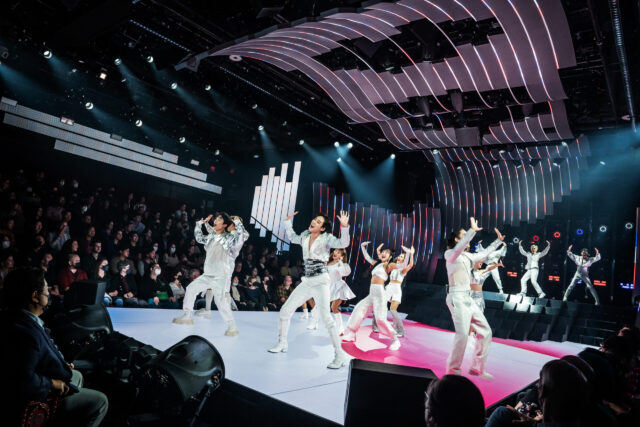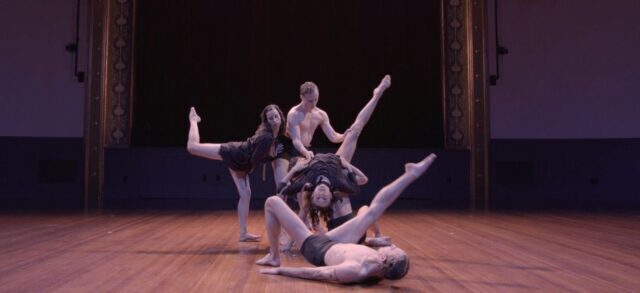
Dimitris Papaioannou returns to BAM with another extravaganza, Transverse Orientation (photo by Julian Mommert)
Who:Dimitris Papaioannou What: US premiere of dance-theater work Where:Brooklyn Academy of Music, BAM Howard Gilman Opera House, 30 Lafayette Ave. between Ashland Pl. & St. Felix St. When: November 7-11, $44.50 – $144, 7:30 Why: In 2019, Greek painter, comics artist, director, choreographer, performer, and set, costume, makeup, and lighting designer Dimitris Papaioannou made his BAM debut with The Great Tamer, which was heavily influenced by the legacy of Pina Bausch; in fact, Papaioannou was the first person invited to create a piece for Tanztheater Wuppertal following Bausch’s passing in 2009. Papaioannou is back at BAM, in the Howard Gilman Opera House, for the US premiere of Transverse Orientation, running November 7-11.
The 105-minute work, which delves into concepts of myth and religion in unusual ways, is performed by Damiano Ottavio Bigi, Šuka Horn, Jan Möllmer, Breanna O’Mara, Tina Papanikolaou, Łukasz Przytarski, Christos Strinopoulos, and Michalis Theophanous, with music by Antonio Vivaldi, sets by Tina Tzoka and Loukas Bakas, sound by Coti K., costumes by Aggelos Mendis, lighting by Stephanos Droussiotis, sculptures and special constructions by Props Nectarios Dionysatos, and mechanical inventions by Dimitris Korres. Bausch fans, and other lovers of experimental dance theater, are sure to delight in what looks to be a mind-blowing experience.
Terry Collingsworth will discuss the evils of the chocolate industry in special MOFAD event
Who: Terrence Collingsworth, Clay Gordon What:MOFAD discussion of the history of the chocolate industry and tasting Where:Chelsea Market Maker’s Studio, 75 Ninth Ave. between Fifteenth & Sixteenth Sts. When: Tuesday, November 8, $45 (including chocolate three bars and beverage), 6:00 Why: Every night before we go to bed, my wife and I have several pieces of dark chocolate. We’re hoping an upcoming discussion sponsored by the Museum of Food and Drink doesn’t change our ritual. On November 8 at 6:00, International Rights Advocates founder and executive director Terry Collingsworth and Discover Chocolate author and TheChocolateLife.com and chocophile.com founder Clay Gordon will be at the Chelsea Market Maker’s Studio for “Bittersweet: The Dark Side of the Chocolate Industry,” which examines labor issues and child trafficking in the production and distribution of chocolate. The event was originally scheduled to include journalist Simran Sethi, who wrote in a June 2021 article for The Counter, “Chocolate brought Americans sweet respite in 2020 — more than usual, according to recent research into pandemic purchasing. But the great irony in our chocolate indulgence is that it’s also a product borne out of great suffering.”
Collingsworth and Gordon will examine specific human rights cases and screen a clip from Miki Mistrati’s 2022 documentary The Chocolate War, which follows Collingsworth over a five-year court battle. The evening will conclude with a tasting of three bars from Missouri-based small-batch purveyors Askinosie Chocolate.
Who:Martha Graham Dance Company,Neil Baldwin, Janet Eilber What:GrahamDeconstructed Where: Martha Graham Studio Theater, 55 Bethune St., eleventh floor When: November 8-9, in person $20-$30 (livestream $25), 7:00 Why: “For me, growing up in the Manhattan neighborhood where Lincoln Center would someday be built, the name ‘Martha Graham’ conjured a distant image: A goddess-like, athletic personage in a tight, shirred bodice extended at the hips into a flowing gown, her bare right foot weighted and planted as if holding to the floor, left leg poised aloft at an impossible angle revealing a long, muscular thigh emerging from the play of fabric in the eloquent garment. Her right arm is bent, her hand half-crooked at the wrist, fingers contracted and crowning a smooth brow while she gazes, angular-featured, luminous half-closed eyes fixed downward and focused inward, seeking an undefined, urgent answer.” That’s how Neil Baldwin describes his subject at the beginning of his new biography, Martha Graham: When Dance Became Modern (Knopf, October 2022, $40).
On November 8 and 9 at 7:00, the Martha Graham Dance Company will present a special program as part of its continuing “GrahamDeconstructed” series. Baldwin, who has also written such books as The American Revelation,Man Ray: American Artist,Edison: Inventing the Century, and Henry Ford and the Jews, will be at the Martha Graham Studio Theater on Bethune St. to launch the book, reading sections — joined by MGDC company members who will perform excerpts from dances he mentions — signing copies, and participating in a discussion with MGDC artistic director Janet Eilber, followed by a wine reception. The event will be livestreamed as well.
Alfredo Jaar explores healing, meditation, and death in Between the Heavens and Me
Who:Alfredo Jaar, Luis Pérez-Oramas What: Film premiere and discussion Where:MoMA, the Roy and Niuta Titus Theater 2, 11 West Fifty-Third St. between Fifth & Sixth Aves. When: Monday, November 7, $8-$12, 7:00 Why: During the pandemic, Chilean artist, architect, activist, and filmmaker Alfredo Jaar made the thirteen-minute video Between the Heavens and Me, which he calls “an exercise in healing, a meditation on the immense curing power of music, a philosophical essay on death, and a futile response to a moment of infinite sadness.” In the film, Jaar, whose Black Lives Matter installation 06.01.2020 18.39 had its own gallery at the Whitney Biennial, explores news footage of a mass grave on Hart Island for victims of Covid-19. “My brain cannot comprehend what my eyes are seeing,” he says in voice-over while watching the scene on his laptop. The haunting score features music by Iranian composer Kayhan Kalhor and Greek composer Eleni Karaindrou. The New York theatrical premiere takes place on November 7 at 7:00 as part of MoMA’s “Modern Mondays” series and will be followed by a discussion with Jaar and curator and art historian Luis Pérez-Oramas, who will examine the 2020 film as well as other projects by Jaar, including the recent Red Pavilion and The Power of an Idea.
Bernd and Hilla Becher, Water Towers (New York, United States), gelatin silver prints, 1978–79 (Estate Bernd & Hilla Becher, represented by Max Becher, courtesy Die Photographische Sammlung/SK Stiftung Kultur — Bernd & Hilla Becher Archive, Cologne)
BERND & HILLA BECHER
The Met Fifth Avenue
1000 Fifth Ave. at 82nd St.
Through November 6, $17-$30 www.metmuseum.org
There are only a few days left to see one of the best exhibits of the year, the posthumous retrospective “Bernd and Hilla Becher,” continuing at the Met through November 6. Beginning in 1959, Bernd and Hilla Becher took photographs of chemical factories, water towers, gas tanks, grain silos, lime kilns, blast furnaces, framework houses, and more, using a large-format camera. They weren’t merely taking photos for posterity; each snap was a carefully considered work of art in itself.
“Over the course of five decades, they created a body of work that is remarkable for its rigorous documentation of thousands of industrial structures throughout Western Europe and North America,” Getty Museum photography curator Virginia Heckert writes in her catalog essay, “Bernd and Hilla Becher: A Lifelong Project of Uninflected Passion.” She continues, “Their legacy is defined equally by the archive of essential visual information that their photographs provide about this often anonymous architecture from the late nineteenth to the mid-twentieth century and by their use of typological groupings to illuminate the basic forms — and functions — of specific structural types.”
Bernd (1931–2007) and Hilla (1934–2015) also arranged their black-and-white photos in artistic themed grids, or “typologies,” that are as striking as the individual pictures; six images across two rows make up Industrial Facades (Germany and Belgium), while there are nine in Coal Tipples, Pennsylvania, United States, twelve in Details (Germany) and Grain Elevators (France and Germany), fifteen in Water Towers (New York, United States), twenty-four in Coal Bunkers (Germany, Belgium, United States, and France), and thirty in Blast Furnaces (United States, Germany, Luxembourg, France, and Belgium). There are also close-ups of leaves and metal forms and shots of mechanical equipment. The entire oeuvre recalls the 2004 Met exhibit “August Sander: People of the Twentieth Century — A Photographic Portrait of Germany,” in which the German artist sought to create an index of the German population.
Many of the individual photos, of what the Bechers called “anonymous sculpture,” are utterly gorgeous, imbued with an emotional power despite the subjects’ being inanimate objects; standouts include Water Tower, Verviers, Belgium; Cooling Tower, Zeche Mont Cenis, Herne, Ruhr Region, Germany; Chemical Factory, Wesseling / Cologne, Germany; Gravel Plant, Günzburg, Germany; and Framework House, Schloßblick 17, Kaan-Marienborn, Siegen, Germany. There are also sketches, collages, Polaroids, lithographs, and a few color photographs of the Bechers traveling in their VW bus; their only misstep is a short video in which they cut down a lovely tree in order to get a better angle on a building.
“They created a kind of factory of images, and they found a way to take something that’s enormous and photograph it so that we can see the poetics of each form,” exhibition curator Jeff Rosenheim says in the above virtual tour. “Bernd and Hilla Becher” unfolds across six well-themed, poetic galleries, but be prepared: The only people you’ll see are other visitors eager to catch this extraordinary show in its final days.
Kimberly Brown will celebrate new book at Rubin Museum on November 4 (photo courtesy Kimberly Brown)
Who:Kimberly Brown What:Book launch Where:Rubin Museum of Art, 150 West 17th St. at Seventh Ave. When: Friday, November 4, free, 6:30 – 8:30 Why: “Unsuccessful attempts to deny, bypass, or discharge pain create disappointment or frustration and increase our suffering. Why do I still feel so angry? When am I going to stop being so tired? These can also make our feelings even more powerful, insistent, and overwhelming, because they need to be heard and cared for by you before they can resolve,” meditation and mindfulness teacher Kimberly Brown writes in her new book, Navigating Grief and Loss: 25 Buddhist Practices to Keep Your Heart Open to Yourself and Others. Brown’s follow-up to July 2020’s Steady, Calm, and Brave: 25 Practices of Resilience and Wisdom in a Crisis,Navigating Grief and Loss pairs chapters with guided practice; for example, “There Is Nothing Wrong with You” is linked with “Stay,” “When People Behave Badly” with “Forgive and Remember,” and “Mourning and Social Media” with “Skillful Speech.”
“I wrote the book to share the practices that supported me after my dear friend Denise died, and when my elderly dad had a health crisis during the pandemic, and included chapters on divorce and job loss too because not all painful losses are deaths,” Brown explained in a Substack post. “I hope it will remind everyone that profound loss doesn’t have to overwhelm or destroy us because we can learn useful and simple tools to meet our pain and sadness with kindness and wisdom, and open our beautiful hearts to ourselves and everyone else — to connect in our sorrows as well as our joys.” Brown will be at the Rubin Museum on November 4 to sign copies of the book as part of the institution’s free K2 Friday Nights program. Brown is one of the teachers in the museum’s Mindfulness Meditation series on Mondays; you can listen to past sessions here. In addition, on November 15 at 7:00, Brown will celebrate the book’s release with an online party hosted by Mindful Astoria.
Duke Riley exhibition at the Brooklyn Museum features hundreds of maritime-related existing artwork and painted salvaged plastic (photo courtesy of the artist)
Who:Duke Riley, Kizzy Charles-Guzman, Larissa Belcic, Michelle Shofet, Ajay Singh Chaudhary What:Panel discussion Where:Brooklyn Museum, 200 Eastern Pkwy. at Washington St. When: Wednesday, November 3, $16, 7:00 (exhibition continues through April 23, 2023) Why: For more than twenty years, Boston-born, Brooklyn-based multimedia installation artist Duke Riley has been trying to save the planet, one pigeon, one fish, and one piece of garbage at a time, creating immersive works that explore the state of the environment, with a focus on water. In 2007’s “After the Battle of Brooklyn,” he reenacted the Revolutionary War mission of the one-manned primitive submarine known as the Turtle in New York harbor. In 2012’s “The Rematch,” he restaged the mythological Chinese race that established the zodiac and the measurement of time in a yearly cycle, using a dozen gondolas with live animals, a person wearing an animal mask, and an opera singer performing a song told from the animal’s perspective. In 2013-14, “See You at the Finish Line” at Magnan Metz Gallery documented fifty homing pigeons that Riley bred and trained to travel back and forth across the Atlantic Ocean from Key West to Cuba. And in 2016’s “Fly by Night,” he trained two thousand pigeons, each fitted with a remote-controlled LED light, to soar through the sky and over the sea at the Brooklyn Navy Yard in a dazzling, glowing dance.
Continuing through April 23 at the Brooklyn Museum, Riley’s “DEATH TO THE LIVING, Long Live Trash” furthers his investigation of our relationship with the natural world. The show consists of several hundred objects, from seventeenth- to twentieth-century porcelain and earthenware with portraits and maritime themes on them to dozens of works by Riley, part of his “Poly S. Tyrene Memorial Maritime Museum” series, in which he draws intricate designs on salvaged plastic garbage — bottles, combs, frames, brushes, flip-flops, coffee cups, a Whiffle ball — echoing the craft of scrimshaw, carvings on whale bone and teeth. They are arranged in glass cases, a few horizontal ones that recall the still-lifes of Giorgio Morandi; some of the portraits are of oil, food, chemical, and plastics industries lobbyists and CEOs.
The exhibition also features the short video Wasteland Fishing, in which Riley goes fishing with lures he made out of recycled trash, many of which are on view in wall cases with such titles as Mother Ocean and Monument to Five Thousand Years of Temptation and Deception III; colorful, kaleidoscopic mosaic panels made of broken shells, cigarette butts, and other effluvia, including one with the message “Tomorrow Is a Mystery”; the videos Beach Clean Up and Newtown Creek; and interventions in the museum’s seventeenth- and eighteenth-century Jan Martense Schenck and Nicholas Schenck Houses, including a plastic chandelier and Riley’s work table. The ink-on-canary-paper The View from the Mouth of the Newtown Creek During Final Days of Battle is a heavily detailed map of boats, skeletal police, merfolk, plastic garbage, tombstones, and more, with an AR component that leads visitors to stories of the history of the polluted Newtown Creek in Brooklyn.
Duke Riley, The View from the Mouth of the Newtown Creek During Final Days of Battle, ink on canary paper, 2021 (photo courtesy of the artist)
“In 2003 I sailed a 26′ dilapidated sloop into the creek and illegally tied it up to an abandoned bulkhead, expecting to get chased off in a matter of days. As days turned into years, other boats began to appear around me and continued to do so long past my departure from the creek in 2013,” Riley explained in a label for the 2022 Biennale of Sydney, which commissioned the piece. “There are currently more than thirty derelict boats moored in the creek, mostly clustered together, with people living aboard full time. At first glance, the people that remain there are living out a romantic maritime dream. A rent-free life enviable to the rest of us caught up in the demands of living in one of the most expensive cities in the world. In reality, for most this alternate existence is coupled with harsh winters without heat and a lack of plumbing, running water, and basic amenities that many of us take for granted. The most notable downside is the continuous and potentially lethal exposure to a highly carcinogenic environment caused by living on top of a federal Superfund site. Most have no financial means to leave and live elsewhere but are constantly in fear of being told to leave in the middle of the night.”
On November 3 at 7:00, Riley will be at the museum for the special program “Brooklyn Talks: Artists and Activists on Climate Grief,” a panel discussion with NYC Mayor’s Office of Climate and Environmental Justice executive director Kizzy Charles-Guzman, Larissa Belcic and Michelle Shofet of Nocturnal Medicine, and Brooklyn Institute for Social Research executive director Ajay Singh Chaudhary, who will serve as moderator. Riley will focus on his works made of found plastic and how everyone can fight local pollution and global marine devastation. And on March 12, 2023, Riley will give a tour of the exhibition as part of the museum’s “Artist’s Eye” program.