featured

ALVIN AILEY AMERICAN DANCE THEATER: ALL NEW AT CITY CENTER

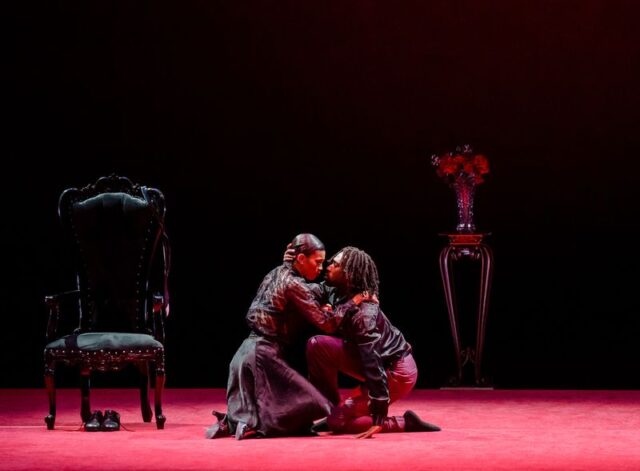
Ghrai DeVore-Stokes and Chalvar Monteiro explore love in Jamar Roberts’s In a Sentimental Mood (photo by Paul Kolnik)

ALVIN AILEY AMERICAN DANCE THEATER: ALL NEW
New York City Center
131 West 55th St. between Sixth & Seventh Aves.
Through December 24, $39-$169
www.alvinailey.org
www.nycitycenter.org

It was all about coupling, uncoupling, and never-coupling at Alvin Ailey American Dance Theater’s all-new program on December 15, part of the annual City Center season that continues through Christmas Eve. The evening began with the world premiere of Jamar Roberts’s poignant and emotional In a Sentimental Mood, in which Courtney Celeste Spears and Christopher R. Wilson follow the trajectory of a relationship in a dark and mysterious red-lit room. Spears appears first, dressed in a long white coat and white hat with red gloves, filled with hope as a scratchy recording of Duke Ellington’s “There’s Something About an Old Love” plays. She rips off her coat and hat to reveal a sexy black outfit underneath as she is joined by Christopher R. Wilson and the two get romantic to Rafiq Bhatia’s version of “The First Time Ever I Saw Your Face,” featuring vocalist Cécile McLorin Salvant, who sings, “The first time ever I kissed your mouth / I felt the earth move in my hand / Like the trembling heart of a captive bird,” holding the last word for a jarring, extended period. As Roberts’s sharp, angular choreography continues, the dancers experience an angry, then melancholic setback and try to reunite to Ornette Coleman’s “Lonely Woman” and Ellington’s “Single Petal of a Rose.” It’s a lovely piece from former longtime Ailey dancer Roberts, who also designed the costumes and set, enhanced with stark lighting by Brandon Stirling Baker.

Belén Indhira Pereyra and Patrick Coker merge as one in Paul Taylor’s DUET (photo by Paul Kolnik)

Following a pause, Jacquelin Harris and Renaldo Maurice become one in the company premiere of Paul Taylor’s 1964 DUET, a classic pas de deux set to Franz Josef Haydn’s “The Seven Last Words of Christ” Sonata VII in E-flat major – Largo. Dressed in George Tacet’s tight-fitting, colorful bodysuits, Harris and Maurice move elegantly with sinewy expertise, their beings merging amid their confident love.

Vernard Gilmore and Ghrai DeVore-Stokes reach for freedom in Alvin Ailey’s Survivors (photo by Paul Kolnik)

After intermission, a new production of Ailey and Mary Barnett’s 1986 Survivors, restaged by Masazumi Chaya, focuses on the love story between Nelson and Winnie Mandela after his arrest. As jazz drummer Max Roach’s “Survivors” and “Triptych” practically explode (balanced by Peter Phillips’s stings), Harris, in a flowing red skirt and African top, and Yannick Lebrun, in brown pants, a white shirt, and suspenders, are separated by incomplete bars, evoking both the injustice of Apartheid and the possibility of freedom. (The costumes are by Toni-Leslie James, with original décor by Douglas Grekin and lighting by Tim Hunter.) They are accompanied by Wilson, Solomon Dumas, Hannah Alissa Richardson, Caroline T. Dartey, and Yazzmeen Laidler, wearing traditional South African hats and serving as a kind of Greek chorus. It’s a powerful work about a determined couple, all the more affecting since we know that Mandela was freed in 1990 and he and Winnie divorced in 1996.

Chalvar Monteiro and Ashley Green come together and break apart in Kyle Abraham’s Are You in Your Feelings? (photo by Paul Kolnik)

The world premiere of Kyle Abraham’s Are You in Your Feelings? brought the house down, an exhilarating celebration of Black culture. Through spoken dialogue and such songs as the Flamingos’ “I Only Have Eyes for You,” Lauryn Hill’s “Forgive Them Father,” Drake’s “That’s How You Feel,” Erykah Badu’s “I’ll Call U Back,” and Kendrick Lamar’s “LOVE. ft. Zacari,” seven women (Dartey, Ghrai DeVoire-Stokes, Samantha Figgins, Ashley Kaylynn Green, Ashey Mayeux, Miranda Quinn, and Deidre Rogan) and five men (Dumas, Maurice, James Gilmer, Chalvar Monteiro, and Jermaine Terry), flirt, diss, come together, and grow apart in front of a backdrop of a fluorescent semicircle and larger, flatter circle, suggesting the sun and the moon. At the center of it all are Monteiro and Green, who swirl, embrace, push away, and keep an eye on each other as various other couples, including two men, form and dissolve. There’s a little bit of West Side Story here, some Night Creature there, leading to a thrilling finale.

Are You in Your Feelings? bursts with a masterful, infectious energy that is a fitting conclusion to a night of love and separation, joy and sadness, humor and romance, starting and ending with the choreographers who are leading AAADT into the future, Roberts and Abraham.

DOWNSTATE

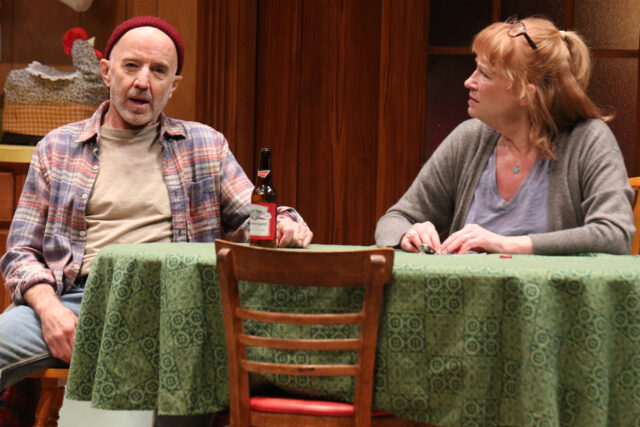
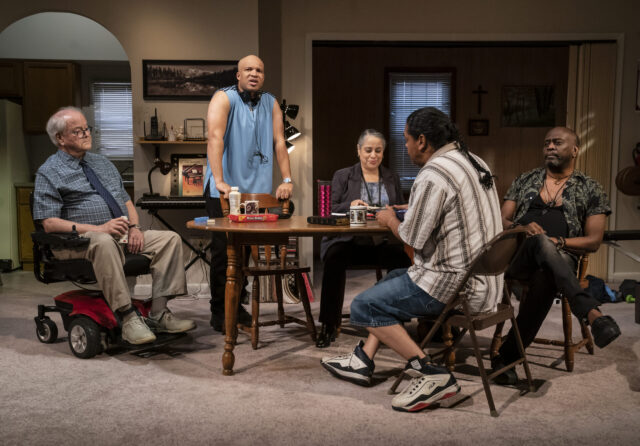
Andy (Tim Hopper) and Em (Sally Murphy) have something to say to Fred (Francis Guinan, at left) in Downstate (photo by Joan Marcus)

DOWNSTATE
Playwrights Horizons, Mainstage Theater
416 West 42nd St. between Ninth & Tenth Aves.
Tuesday – Sunday through January 7, $61-$101
www.playwrightshorizons.org

“If you knew in advance exactly what was going to happen in your life, and how everything was going to turn out, and if you knew you couldn’t do anything to change it, would you still want to go on with your life?” Bee asks Jay in Bruce Norris’s A Parallelogram. “What if it turned out to be for the best if we’d never even existed?”

That question is central to Norris’s latest work, Downstate, extended through January 7 at Playwrights Horizons. One of the best plays of the millennium, Downstate takes an unusual angle on child molesters, making us see them as human rather than evil demons, eliciting compassion but not sympathy while delving into the concept of victimhood from all sides.

“I used to fantasize about how I would kill you,” Andy (Tim Hopper, now replaced by Brian Hutchison) tells his abuser, Fred (Francis Guinan), as Andy calmly reads from a reconciliation contract. “I would park outside your apartment and wait until you pulled in the driveway. And I would bring along my mother’s thirty-eight, the one she kept in her bedside table, and when you stepped out of your car I would hold it against your head and duct tape your mouth so I wouldn’t have to listen to any of your toxic bullshit . . . and I’d drive you to the edge of the forest preserve, and you’d kneel down in the dirt . . . and I’d rip the tape off your mouth and jam the barrel of the gun down your throat so that you —” Andy is cut off by several interruptions before accusing Fred of “exploiting my trust. By enlisting my sympathy. But you will never be deserving of sympathy.”

Em (Sally Murphy), Andy’s wife, says to Fred, “How can I ever explain to my child why Daddy is sometimes sad? Why he’d rather sit alone in the dark instead of using the PlayStation? Children need answers. And they need to know that some monsters are real.”

It’s a tough topic to navigate onstage; in recent years, David Harrower’s Blackbird, Paula Vogel’s How I Learned to Drive, and Jennifer Haley’s The Nether successfully tackled the issue from different angles, but Norris offers several new twists that test the standard dynamic that good and evil are black-and-white.

Four residents of a group home for convicted child molesters meet with parole officer Ivy Delgado (Susanna Guzmán) (photo by Joan Marcus)

Fred is an easygoing old man in a motorized wheelchair who speaks gently; in the script, Norris compares him to Mr. Rogers (whose first name is Fred). Fred was a piano teacher and still has a fondness for Frédéric Chopin, who he is quick to point out led a tragic life after the family of the woman he loved rejected their relationship. All four molesters in the home still believe what they did to their victims was done out of love and understanding, despite what the law and society dictate. Fred has a small keyboard in the living room, where he fake-plays to a CD of Chopin’s “Raindrop” Prelude, the drip-drip-drip of the music evoking the repetitive nature of the crimes by child abusers who think they are in love.

The home is run by Dee (K. Todd Freeman), an impassioned gay man who does the shopping and tries to keep everyone sane; he’s especially supportive of Fred, although he still angrily defends what he himself did to a teenage boy. Fast-talking, Bible-quoting Gio (Glenn Davis) is the youngest of the four and is facing the shortest sentence; convicted of statutory rape of a girl he thought was “old enough,” he considers himself to be better than the others, not an abuser, and has grand plans for starting his own business. Felix (Eddie Torres) is the quiet one who keeps to himself, although he has a problem with lying, especially to the group’s parole officer, Ivy Delgado (Susanna Guzmán), who lets them all know when they have broken the rules of their closely supervised release. The four men are tracked by ankle monitors and are not allowed to use the internet or a cellphone.

When Ivy announces that the local community has passed rulings further limiting their movement, they are furious, but she points out, “Well, ya know what? Nobody really wants y’all livin’ anywhere, much less in their neighborhood.” Dee says, “Why not put us on a desert island?” Gio suggests, “Y’all oughta be banished from human society.”

Gio works with the pert and cheeky Effie (Gabi Samels), who is not a fan of the police. When she shows up to drive Gio to their job, Ivy asks to see her ID. Effie repeatedly states, “Am I being detained?” Ivy then asks her name, to which Effie replies again and again, “I do not consent to the question.” It’s a comic scene, but it brings to the surface the critical ideas of detention and consent.

Things get even more heated in the second act when Andy returns, with more to say to Fred.

Downstate is brilliantly directed by Tony and Obie winner Pam MacKinnon, who previously helmed Norris’s Tony-, Olivier-, and Pulitzer Prize–winning Clybourne Park and The Qualms (as well as superb Broadway adaptations of Edward Albee’s A Delicate Balance and Who’s Afraid of Virginia Woolf?). MacKinnon accounts for every gesture, every interaction, every line of dialogue, making sure each aspect of the story is fully believable, from fighting over the bathroom to bickering over unripe bananas, the latter a reference to children too young for sex; it’s no coincidence that Dee sees no problem with them, telling Gio, who refuses to pay for his share of the bananas because they are too green, “Didn’t want bananas for next week, I wanted bananas for immediate consumption.” Norris and MacKinnon succeed in making the four abusers into a kind of family, with Ivy the de facto parent.

Fred (Francis Guinan) and Dee (K. Todd Freeman) share a rare tender moment in Downstate (photo by Joan Marcus)

Todd Rosenthal’s set is deceptively cozy, a cutaway living room above which is a roof with a satellite dish, emphasizing the limitations of the men’s lives. A flatscreen TV fills the fireplace, blocking the possibility of real warmth. Gio’s exercise equipment is in one corner, in front of Felix’s room, where Felix spends most of the show, behind an accordion door. The window next to the front door is broken, the result of a shotgun blast from an unhappy person in the neighborhood. (The lighting is by Adam Silverman, with sound by Carolyn Downing and costumes by Clint Ramos.)

The cast is exceptional; an ever-present tension hovers over the space as the characters interact as if on the edge of a knife. Guinan (Tribes, The Night Alive) is soft and gentle as Fred, who appears to be tender and harmless, especially in the wheelchair, but he has a dark past. Davis (Bengal Tiger at the Baghdad Zoo, The Christians) is a bundle of nonstop energy as Gio, while Torres, who is primarily a director (Familiar, Water by the Spoonful), makes the most of his few scenes. Two-time Tony nominee and Obie winner Freeman (Airline Highway, Song of Jacob Zulu) is a powder keg as Dee, ready to explode at any moment with the slightest provocation. Samels, in her off-Broadway debut, is electric as Effie, who speaks her mind, not afraid to hang out in a house of sexual predators. At one point she tells Gio, “A workplace is a safe space,” which also reveals a certain naivete.

Hopper (Go Back to Where You Are, More Stately Mansions) is a bundle of nerves as Andy, whose abuse at the hands of Fred has tortured him as he searches desperately for closure, while Murphy (The Minutes, August: Osage County) is forceful and tenacious as Em, who wants her husband to finally be free from pain.

Guzmán (La Luz de un cigarillo, Comida de Puta) is firm and unyielding as Ivy, especially when the concept of victimhood is raised. She tells Felix, “I got forty-seven clients, aright? Forty-seven of y’all I gotta deal with on a weekly basis all shapes and sizes but ya all got one thing in common, okay? Every one of you’s a victim. Everybody’s misunderstood, been done wrong, system’s broke, system ain’t fair blah blah, and that may or may not be the case — but I’ll tell ya something. If y’all feel so victimized? Maybe that gives ya a little idea how ya made other people feel, okay?”

Norris (The Low Road, Domesticated) was inspired to write Downstate by the sociopolitical disconnect between the right and the left in the United States, how the liberals and the conservatives are unable to talk to each other and resolve their differences in any constructive way, instead demonizing the supposed enemy.

The horror of child abuse is one thing that everyone agrees on; in 2019, New York State passed the Child Victims Act, which gave survivors a one-year window to file claims that had been barred by the statute of limitations, leading to approximately ten thousand lawsuits. The vote was 63-0 in the Senate and 130-3 in the Assembly. This past May, New York governor Kathy Hochul signed into law the Adult Survivors Act, which gives survivors who were abused when they were over eighteen a one-year lookback to pursue legal recourse.

In the must-see Downstate, Norris offers a compelling, thought-provoking, and exquisitely rendered exploration of our humanity as a people; it’s about child sexual abuse, justice, and victimhood, but it’s also about so much more.

JOHN ADAMS’ EL NIÑO: NATIVITY RECONSIDERED

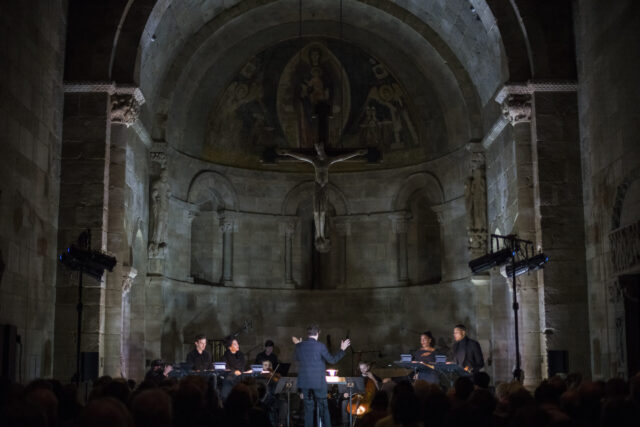
John Adams’ El Niño: Nativity Reconsidered debuted at the Cloisters in 2018 (photo by Joshua Bright for the New York Times)

Who: American Modern Opera Company (AMOC)
What: John Adams’ El Niño: Nativity Reconsidered
Where: The Cathedral Church of St. John the Divine, 1047 Amsterdam Ave. at 112th St.
When: Wednesday, December 21, $5-$45 (choose-what-you-pay), 7:30
Why: Originally presented by American Modern Opera Company (AMOC) in 2018 at the San Martín at Fuentidueña chapel in the Cloisters, John Adams’ El Niño: Nativity Reconsidered will be performed one-time only at the Cathedral Church of St. John the Divine, in a slightly revised iteration. A retelling of the traditional Christmas story, El Niño premiered in Paris in 2000, with a libretto by Peter Sellars. At St. John the Divine, the nativity oratorio, conceived and curated by Julia Bullock, includes soprano Bullock, countertenor Anthony Roth Costanzo, bass-baritone Davóne Tines, violinists Miranda Cuckson and Keir GoGwilt, cellist Coleman Itzkoff, bassist Doug Balliett, flutist Emi Ferguson, percussionist Jonny Allen, pianist Conor Hanick, mezzo-soprano Rachael Wilson, and the Choir of Trinity Wall Street; the conductor is Christian Reif, who is responsible for the new chamber opera arrangement.

In a program note for the Met Museum digital premiere, Bullock wrote, “El Niño is one of my favorite pieces of music and I feel one of John and Peter’s greatest collaborations. . . . It is rarely programmed, either because of the resources needed or possibly because our North American holiday tradition insists upon multiple performances of Handel’s Messiah. The Messiah is, of course, a beloved work, but it doesn’t meditate solely on the nativity story; it also encompasses the life, death, and resurrection of Christ. El Niño, on the other hand, explores the central themes of the nativity — the immaculate conception, the unique relationship between mother and child, and gift giving — and also ruminates on the notion that with the promise of new life, there is the equal threat of inexplicable violence and sacrifice. In creating El Niño, John and Peter consciously decided that alongside European interpretations from the male-centric biblical canon, they would feature the contributions of women and Latin American poets.” Tickets for this special event are $5 to $45 based on what you are able to pay.

DES MOINES

Dan (Arliss Howard) and Marta (Johanna Day) are in for quite a night in Des Moines (photo by Hollis King)

DES MOINES
Theatre for a New Audience, Polonsky Shakespeare Center
262 Ashland Pl. between Lafayette Ave. & Fulton St.
Tuesday – Sunday through January 8, $97
866-811-4111
www.tfana.org

Denis Johnson’s Des Moines is a sly, beguiling black comedy about — well, I’m not quite sure what it’s about, but I couldn’t take my eyes off it, and not in a car-wreck sort of way. The 2007 play opened Friday night at TFANA’s Polonsky Shakespeare Center, but director Arin Arbus started working on the play with Johnson, the German-born novelist who died in 2017 at the age of sixty-seven, way back in 2013. In a program note, TFANA founding artistic director Jeffrey Horowitz explains that in 2015, after a week of workshopping with Arbus, the author, and dramaturg Jonathan Kalb, he told Johnson he “felt the play needed more clarifying. Denis said ‘no.’ Des Moines was finished.”

Now that I’ve seen its off-Broadway premiere, which continues through January 1 in Brooklyn, I am thrilled that Johnson refused to make any changes; clarification would have denuded the hundred-minute work of its endless charms and purposefully chaotic confusion. The characters speak in non-sequiturs, as if they are not listening to one another while engaging in what are generally called conversations. They go off on tangents or suddenly fall into silence. “It’s just kind of a little bit weird,” Marta (Johanna Day) understatedly says.

The play takes place in an upstairs apartment of a two-flat building in the capital of Iowa, whose caucuses have traditionally kicked off the presidential primary cycle, a city steeped in the insurance industry and whose name translates from the French as “of the monks.” The Online Etymology Dictionary posits that the name Des Moines grew out of the Native American word “Moinguena,” explaining, “Historians believe this represents Miami-Illinois mooyiinkweena, literally ‘shitface,’ from mooy ‘excrement’ + iinkwee ‘face,’ a name given by the Peoria tribe (whose name has itself become a sort of insult) to their western neighbors. It is not unusual for Native American peoples to have had hostile or derogatory names for others, but this seems an extreme case.” Now, I’m not claiming that Johnson knew any of this, but it feels like it fits in with the show’s exhilarating bathos.

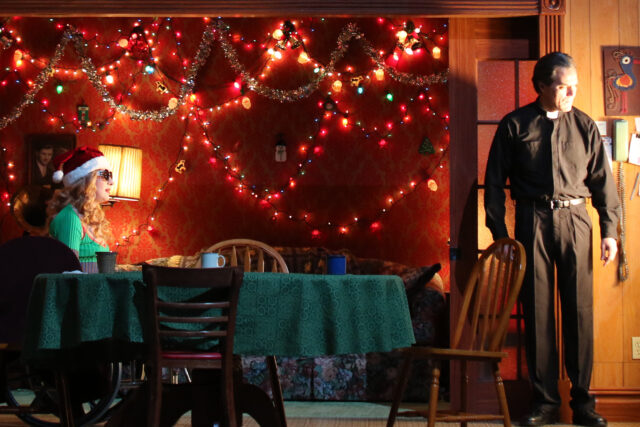
The apartment hovers in midair, with space above and below it, as if it is a kind of floating bardo, way station, or purgatory. Riccardo Hernández’s comfy set includes a standard kitchen with a working sink, microwave, and coffeemaker, tchotchkes on the walls and counters, a small table in the center, two empty metal dog bowls, a garbage can, and a back room behind sliding French doors. Things are a little wilder and less ordinary in the back room, which is drenched in erotic red lighting.

The apartment belongs to the soft-spoken Dan (Arliss Howard), a twenty-year Army veteran who now drives a cab, and his wife, Marta, a relatively simple couple with simple needs, happy with leftover spaghetti and mediocre beer. They are taking care of their late daughter’s daughter, Jimmy (Hari Nef), who lives in the back room, confined to a wheelchair after a botched trans surgery.

Jimmy (Hari Nef) and Father Michael (Michael Shannon) get ready for a party in Denis Johnson’s final play (photo by Hollis King)

On this particular night, Marta has asked their parish priest, Father Michael Dubitsky (Michael Shannon), to come over and be there when she gives Dan some important news; Dan has some important news of his own about Michael, who he saw wearing lipstick outside a gay bar. Meanwhile, Dan is expecting the recently widowed Helen Drinkwater (Heather Alicia Simms) to stop by to pick up her late spouse’s wedding ring, which she left at the garage where Dan works. Her husband, a lawyer, died in a commuter plane crash; Dan had driven him to the airport, so Helen is hoping that the taxi driver will remember something that her husband said, what might have been his last words.

Once everyone is there, depth chargers — the drink in which a shotglass of alcohol is dropped into a mug of beer — are flowing, music is playing, and anarchy ensues as everyone and everything spirals out of control in a party to end all parties, the kind of crazy fete that is best experienced from a distance, like safely ensconced in seats in a theater, with additional physical space between the audience and the set.

Des Moines evokes the classic Twilight Zone episode “Five Characters in Search of an Exit,” in which a clown, a soldier, a ballerina, a hobo, and a bagpiper are trapped in an unknown, inescapable pit. The five characters in Johnson’s play seem trapped as well, if not in the apartment itself then in the city of Des Moines. Dan, who was stationed a few blocks from where he was born, has never been west of town, while it’s his job to take people to other places, including airports, where they travel away from Des Moines. Jimmy is confined to a wheelchair and appears to have no desire to go anywhere, especially after what happened to her when she went to the fictional Barrowville, West Virginia, where she got her problematic sex change operation.

And Ellen, who has lived in Des Moines “always and forever,” is widowed because her husband died on a commuter plane that only made it eight miles upriver before crashing, four miles from the fictional Sheller-Phelps factory, perhaps named after Phelps Sheller, a real-life Illinois farmer and military veteran who worked at the Sangamon Ordnance Plant, which manufactured ammunition during WWII.

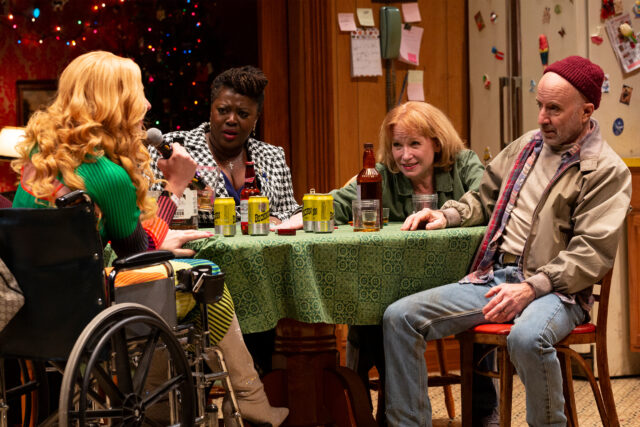
It’s time for depth chargers and karaoke in off-Broadway premiere at TFANA’s Polonsky Shakespeare Center (photo by Hollis King)

Time is irrelevant in Des Moines. Father Michael forgot to turn his clock back to standard time. Ellen doesn’t know whether it’s Halloween or Christmas, confused by the holiday decorations in Jimmy’s room, which has both an antique phonograph with a large horn and a karaoke machine, mixing past and present. Dan and Marta can’t remember whether their dog ran away one winter ago or two, but they still leave two empty dog dishes on the floor as if the pooch just went out for a walk. Father Michael says several times that he hardly recognizes the old neighborhood even though he’s there all the time.

While no one in the apartment is living the American dream, dreams play a major role in the narrative, which is so helter-skelter, so disorganized that it sometimes seems like various scenes are actually dreams we are experiencing through the dreamer’s memories. Dreams are referenced throughout the show. Dan asks Father Michael to yell at him when he least expects it, “Wake up! You’re dreaming!” The first time we see Jimmy, she says, “I woke up. I was somewhere beautiful in a dream.” Ellen tells Dan and Marta, “I’ve been having some very strongly vivid dreams just lately.”

Not everyone likes listening to other people’s dreams. In the 2017 Scientific American article “Why You Shouldn’t Tell People about Your Dreams,” cognitive science professor Jim Davies delves into “why most of your dreams are going to seem pretty boring to most people.” But made-up dreams coming from the mind of Denis Johnson, well, there’s nothing boring about that.

Two-time Tony nominee Day (Sweat, How I Learned to Drive), Howard (Mank, Joe Turner’s Come and Gone), Nef (“Daddy,” Assassination Nation), Shannon (The Killer, Frankie and Johnny in the Clair de Lune) and Simms (Fairview, By the Way, Meet Vera Stark have a field day in Des Moines, National Book Award winner Johnson’s (Jesus’ Son, Tree of Smoke, Hellhound on My Trail) last play. The actors appear to be having so much fun as the the story descends more and more into madness, and that energizes the audience. Obie winner and Shakespeare veteran Arbus (The Skin of Our Teeth, Frankie and Johnny in the Clair de Lune) maintains an ecstatic anarchy throughout the proceedings, with gleeful choreography by Byron Easley.

“I dreamed I was in this weird place,” Dan says the morning after the party. “It was a strange place. I’m trying to remember the kind of place it was, but I can’t remember.” That’s kinda the way I feel about the show, which I will long remember.

GOING ALL THE WAY: THE DIRECTOR’S EDIT

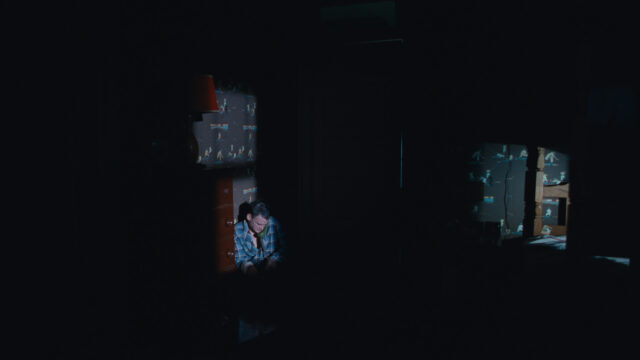
Willard “Sonny” Burns (Jeremy Davies) often finds himself in the dark in Going All the Way: The Director’s Edit

GOING ALL THE WAY: THE DIRECTOR’S EDIT (Mark Pellington, 1997/2022)
Quad Cinema
34 West 13th St. between Fifth & Sixth Aves.
Opens Friday, December 16
212-255-224
goingalltheway.oscilloscope.net
quadcinema.com

During the pandemic lockdown, filmmaker Mark Pellington found the original three-hour-plus cut of his 1997 debut, Going All the Way, a little-known, rarely shown coming-of-age tale with a fabulous young cast set in small-town Indianapolis in 1954. He and editor Leo Trombetta “were just bored in Covid,” so they decided to take another stab at the film, which had previously gone through several iterations nearly a quarter century ago, ranging from 98 to 112 to more than 180 minutes.

The project was mostly to just give them something to do, but soon they had trimmed the first 40 minutes, added 50 minutes of previously unused material and new, gentle voice-over narration by Trombetta, commissioned 50 minutes of new music from composer Pete Adams, and installed an ominous title sequence by Sergio Pinheiro that recalls David Lynch, with images of Main Street, rural America, Jesus, sexuality, and a bleeding razor. The result is a very different 126-minute film, darker, more introspective and character-driven, more attuned to Dan Wakefield’s 1970 bestselling autobiographical novel, which was adapted by the author himself. (Wakefield, who is now ninety, created the late-’70s television series James at 15 and appears as farmer #2 in Going All the Way.)

“I’ve always kinda been more of an outer-directed guy. Right?” Korean War veteran Tom “Gunner” Casselman (Ben Affleck) tells high school classmate Willard “Sonny” Burns (Jeremy Davies) at a bar. “And now, as time goes on, I’m kinda becoming more inner-directed, not giving a shit so much what the crowd thinks. You’ve always been kind of more of an inner-directed guy.” It’s a keen metaphor for the revised film.

Gunner is everybody’s all-American, a classically handsome high school sports star who came back from Korea with gleaming medals on his uniform. Sonny is the kid no one remembers, a wallflower who blends in with the background, a soldier and photographer who spent the war in public information in Kansas City. Gunner is a doer, while Sonny is a watcher, yet each of them wants to be more like the other, almost as if they are two sides of the same person, ego and id. In fact, the name of the high school paper that featured Sonny’s memorable picture of Gunner on the gridiron is named the Echo.

Sonny (Jeremy Davies) watches from behind as Gunner (Ben Affleck) and Marty (Rachel Weisz) stop by the club in Going All the Way

Both men live at home with their family. Gunner’s mother is a sexually attractive, outgoing divorcée who Gunner calls Nina (Lesley Ann Warren); the first time we see them together, it looks like they’re lovers. Sonny’s Bible-thumping mother, Alma (Jill Clayburgh), treats her boy like an innocent fawn unable to make his own decisions or know what’s best for him; Sonny’s father, Elwood (John Lordan), hardly ever speaks while always agreeing with his wife.

Gunner lives life minute to minute, ready to try just about anything since he was reawakened to so many possibilities during his time in Japan, especially if it involves women. When he is immediately taken by Marty Pilcher (Rachel Weisz), a Jewish woman interested in art and who wants to move to New York, Gunner goes with her to a museum, joined by Sonny, and Sonny’s sort-of girlfriend, Buddy Porter (Amy Locane), who is in love with him even though he gives her no reason to be. She has decided that she is going to marry him and start a family in her hometown, but Sonny is not so sure. He uses her, but she lives up to her name, being more of a friend (with benefits) who is willing to carry Sonny’s (heavy psychological) load.

When Gunner and Marty set up Sonny with the unfettered and liberated Gale Ann Thayer (Rose McGowan) at a fancy party, Sonny finally lets loose, but it comes with a price that makes him reconsider what path he wants to follow.

Filmed on location in Indianapolis in thirty days and now available in a 4K restoration opening December 16 at the Quad, Going All the Way: The Director’s Edit might have disappeared among the spate of 1990s coming-of-age movies (Dazed and Confused, Varsity Blues, This Boy’s Life, Rushmore), but it is now getting a much-deserved second chance in this reimagined update.

The cast is outstanding, with Affleck, in his first lead role, self-possessed and charming as Gunner, and Davies a bundle of uncomfortable nerves as Sonny, who often mutters unfinished sentences that can barely be heard. His constant jitteriness balances Affleck’s strong confidence. Cinematographer Bobby Bukowski often shoots Affleck with bright lighting, focusing on the upper half of his body, while Davies is often seen in darkness, shot from above to make him look small and insignificant. Clayburgh and Warren play two very different kinds of mothers who get to duke it out in one of the film’s best scenes. Rising stars Weisz, McGowan, Locane, and Nick Offerman (a bit part in his film debut) are a joy to watch.

Prior to Going All the Way, Pellington was primarily a director of music videos (U2, Public Enemy, Pearl Jam, Nine Inch Nails, Foo Fighters, Bruce Springsteen) and commercials. He has clearly learned a lot in the intervening years, helming such productions as Arlington Road, I Melt with You, and The Mothman Prophecies, and the new edit benefits from his experience, even if most of his films have not been met with critical acclaim. Going All the Way: The Director’s Edit also offers a lesson in how existing footage can be reconstructed into a more complex and intriguing narrative.

Pellington will be at the Quad for Q&As at the 7:00 show on Friday with Alex Ross Perry, 7:00 on Saturday with Bilge Ebiri, and 4:20 on Sunday with Dan Mecca.

ALL THAT BREATHES

All That Breathes explores the fate of black kites in India as representative of so much more

ALL THAT BREATHES (Shaunak Sen, 2022)
Quad Cinema
34 West 13th St. between Fifth & Sixth Aves.
212-255-224
quadcinema.com
www.allthatbreathes.com

Shaunak Sen’s All That Breathes opens with a long shot of rats scurrying about a filthy New Delhi area, then follows a man carrying four boxes with holes in them into a dingy, crowded basement garage. One starts to rock and falls awkwardly to the floor. The man walks over and takes out an injured bird. As Mohammad Saud, Nadeem Shehzad, and Salik Rehman examine the injured creature, they speak of a possible nuclear war between India and Pakistan.

“What’ll happen to the birds if there’s a nuclear war?” Rehman asks. “We’ll all die. Where will they go?”

A moment later, a young boy searches for a bullet, an announcement from the street advises, “We don’t want any harm to any public property,” and a black kite, a bird of prey that migrates to New Delhi every year, grips a small branch and then accusingly stares directly into the camera. Later street announcements declare, “This is a fight for empathy and unity! The Constitution has to be saved!” regarding the treatment of Islamic citizens.

For several decades, Indian Muslim brothers Saud and Shehzad have been rescuing and healing kites that have fallen from the sky, victim to pollution and the cotton threads of kites that slice their wings. “When we got our first kite . . . I’d stay up at night staring at it,” Shehzad says in voiceover as a lone kite soars in the air, the moon at its left. “It looked like a furious reptile from another planet. It’s said that feeding kites earns ‘sawab’ [religious credit]. When they eat the meat you offer, they eat away your difficulties. And their hunger is insatiable.”

When the brothers were teenage bodybuilders, they encountered their first injured kite. A bird hospital refused to help because the species is not vegetarian, so they used their own knowledge of flesh, muscles, and tendons to repair it. They’ve been rescuing and repairing hurt birds in their highly unsanitary quarters ever since.

Amid the social unrest and their legitimate fears of being turned into refugees because of their religion, Saud and Shehzad continue to fix the birds, as if fixing themselves as they worry about losing their freedom. Over one dinner they discuss with their families what they might do if the government kicks them out of the country. Meanwhile, the brothers are desperate to get a grant to keep their Wildlife Rescue operating.

“I’ve devoted my entire life to this. But this doesn’t feel enough to me,” Shehzad explains. “Things are getting from bad to worse here. Birds are plummeting from the sky. Delhi is a gaping wound. And we’re a tiny Band-Aid on it.”

Cinematographer Ben Bernhard focuses in on nature, from an icy river to an owl to dozens and dozens of kites filling the sky, set to a gentle yet ominous score by Roger Goula. Director and producer Sen (Cities of Sleep) is not just making a film about kites in India; he is accusing the world as a whole of misusing resources in ways that threaten the existence of such living creatures as kites and damage the planet’s ecological system.

“Man is the loneliest animal,” Saud says.

Winner of the Grand Jury Prize for Best Documentary (World Cinema) at Sundance and the L’OEil d’or for Best Documentary at Cannes, All That Breathes is now playing at the Quad.

AIN’T NO MO’

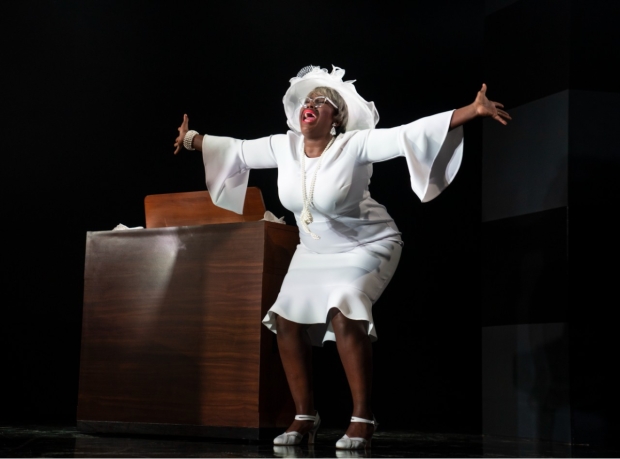
Jordan E. Cooper has a lot to say about Ain’t No Mo’ at the Belasco (photo © Joan Marcus)

AIN’T NO MO’
Belasco Theatre
111 West 44th St. between Sixth & Seventh Aves.
Tuesday – Saturday through December 18, $58 – $318
aintnomobway.com

At the end of the uproarious curtain call at the December 11 matinee of Ain’t No Mo’ at the Belasco, playwright and actor Jordan E. Cooper grabbed a microphone and gave a short speech about “turning the tide” and “changing Broadway,” announcing to the crowd, in case they hadn’t already heard, that the show was closing early, on December 18, after a mere twenty-two previews and twenty-one performances. The news was so sudden and unexpected, following very positive opening reviews, that as of Monday morning, December 13, Telecharge was still selling seats through February 26.

Cooper plays African American Airlines flight attendant Peaches, a boisterously dressed character trying to make sure that every Black person makes it onto the last plane out of the United States, which has offered free one-way reparation flights back to Africa (from gate 1619) to get rid of all the Black people in the country. Peaches tells someone over the phone, “Well, bitch, I don’t know what to tell you ’cause if you stay here, you only got two choices for guaranteed housing and that’s either a cell or a coffin. After this flight, there will be no more Black folk left in this country, and I know ya’ll don’t wanna be the only ones left behind because them muthafuckas will try to put you in a museum or make you do watermelon shows at SeaWorld and shit. Hurry up or I will give your seat to some of the Latinos on stand-by.”

At the curtain call, the twenty-seven-year-old Cooper, the youngest Black American playwright to have a show on Broadway (a designation previously held by Lorraine Hansberry, who was twenty-nine when A Raisin in the Sun opened at the Ethel Barrymore in March 1959 before traveling to the very same Belasco that October), called for the audience to spread the word about Ain’t No Mo’, by mouth and social media. “We won’t go down without a fight,” he declared, also referencing the early closing notice of the Korean musical KPOP, which was playing its final performance that afternoon.

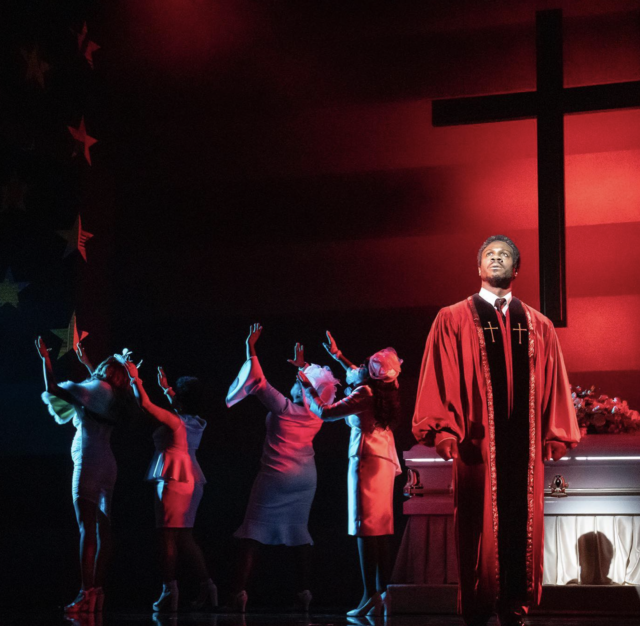
Pastor Freeman and his flock look toward a supposedly bright future in Ain’t No Mo’ (photo © Joan Marcus)

The response to the Ain’t No Mo’ closing notice has been swift (notably, Will Smith and Jada Pinkett Smith bought out a performance, and the line to get in wrapped around Forty-Fifth St. at the matinee I attended), echoing the movement this past May to keep for colored girls who have considered suicide / when the rainbow is enuf running at the Booth after it announced it was closing three months early. The effort earned the show an additional two weeks but no more. While I had raved about the off-Broadway versions of KPOP and for colored girls, I was not a fan of either Broadway iteration, each of which had been changed dramatically, in my opinion not for the better.

Still, these voices need to be heard and these bodies seen, on and off Broadway. In an open letter on Instagram, Cooper wrote, “Ain’t No Mo’ needs your help! Now they’ve posted an eviction notice, we ‘must close’ December 18. But thank God Black people are immune to eviction notices. The Wiz got one on opening night in 1974, but audiences turned that around and it ended up running for four years. . . . We need all hands on deck with urgency. In the name of art, in the name of resistance, in the name of we belong here too, in the name of every storytelling ancestor who ever graced a Broadway stage or was told they never could, please support this production and buy a ticket and come have church with us. Radical Black work belongs on Broadway too.”

https://twitter.com/JordanECooper_/status/1602144592081879040?s=20

Ain’t No Mo’ has been tweaked since its 2019 debut at the Public, with the same wonderful cast and only minor changes to its zany yet poignant narrative, which is divided into interrelated sketches taking place at the aforementioned gate 1619; a funeral service for the dear departed Brother Righttocomplain’ in 2008 upon the election of the first American Black president, Barack Obama; an abortion clinic where millions of Black women are terrified of bringing a son into this dangerous racist world; a television gossip show in which a white woman is transitioning to Black; and a mansion where a wealthy Black family discovers their late patriarch has been keeping a secret in the basement.

Munching on Scott Pask’s imaginatively playful sets are Cooper, Fedna Jacquet, Marchánt Davis (I saw understudy Michael Rishawn in his Broadway debut), Shannon Matesky, Ebony Marshall-Oliver, and Crystal Lucas-Perry, in hysterical and, in one case, terrifying costumes by Emilio Sosa and fab wigs by Mia M. Neal. I wrote about the Public original, and it applies to the Broadway iteration as well (both of which were directed by Stevie Walker-Webb, now making his Broadway debut): “Cooper gets right to the point when a woman at the clinic tells a reporter, ‘The problem is we’re racing against a people who have never had to compete, and people who have never had to compete are fearful of competition and they will annihilate any being that challenges their birth-given promise of a victory.’ As wildly funny, if occasionally over the top and too scattershot, Ain’t No Mo’ can be, it’s also a bitter pill to swallow.”

Since coming out of the pandemic lockdown, there has been an encouraging increase in the number of Broadway shows by BIPOC creators about the Black experience, including Ruben Santiago-Hudson’s Lackawanna Blues, Death of a Salesman, The Piano Lesson, Chicken & Biscuits, Thoughts of a Colored Man, Trouble in Mind, Pass Over, Clyde’s, and Caroline, Or Change, all of which had limited runs. That progress needs to continue apace, with plays running longer.

The hootin’ and hollerin’ on- and offstage is coming to an end at the Belasco (photo © Joan Marcus)

At one point in Cooper’s show, Pastor Freeman proclaims, “Aint no mo’ blueish red light in the rearview mirror when you taking your family to the church picnic and all you got in yo’ trunk is three Dollar Store aluminum pans of sister Threadgill’s chitlins, cornbread, and collard greens. Ain’t no mo’ waiting for FEMA while the Louisiana sun is stabbing at yo’ back on the interstate and your grandmama is backstroking in a river of expired bodies. Ain’t no mo’ massa’ tiptoein’ in yo’ mama’s room to rock the shack into the midnight hour. Aint no mo’ shotdown dreams with its blood soaking the concrete outside room 306. Ain’t no mo’ Riots. Ain’t no mo’ Rosewood. Ain’t no mo’ Jasper, ain’t no mo’ Jiggin’, ain’t no mo’ Shufflin’, ain’t no mo’ Shuckin’, ain’t no mo’ Amos, ain’t no mo’ Andy, ain’t no mo’ Emmett Till, ain’t no mo’ Rodney King, ain’t no mo’ Jena 6, ain’t no mo’ Stop, ain’t no mo’ Frisk. Ain’t no mo’ getting followed around by the tall white lady in the Kmart on Jones Street. There ain’t no mo double locking they car when you walk by, they thinking you gonna hot wire they car and drive it out the parking lot, when they know they just saw you pulling up in a car they can’t even afford. That’s all over . . . that’s all done.”

Sadly, you can add to that list “ain’t no mo’ Ain’t No Mo’,” which isn’t good news for anyone.