featured

QUEENS IN THE HOUSE: SATURDAY CHURCH AT NYTW

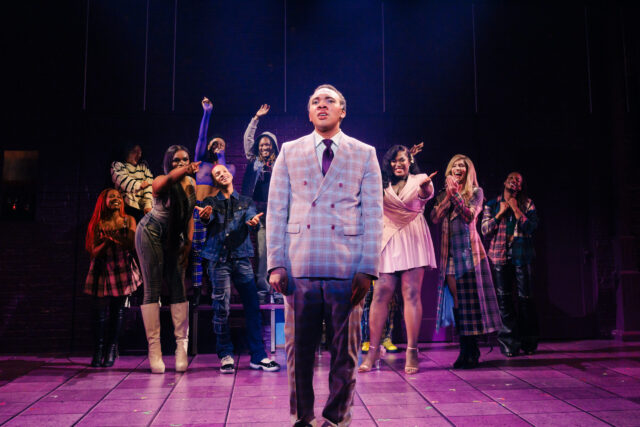
Ulysses (Bryson Battle) finds himself living a double life in Saturday Church (photo by Marc J. Franklin)

SATURDAY CHURCH
New York Theatre Workshop
79 East Fourth St. between Second & Third Aves.
Tuesday – Sunday through October 24, $63-$129
www.nytw.org

Tony winner J. Harrison Ghee is glorious as Black Jesus in the world premiere of Saturday Church at New York Theatre Workshop. The same cannot be said for the rest of the show.

Adapted by Emmy nominee Damon Cardasis from his 2017 film — he has written the book and additional lyrics with Pulitzer winner and Tony nominee James Ijames — Saturday Church feels like something you’ve already seen, Choir Boy filtered through Cats: “The Jellicle Ball” with a heavy dash of The Voice and RuPaul’s Drag Race and a touch of Godspell. Which is to say, there is little new to the story or the production.

Boston Conservatory graduate Bryson Battle makes his professional debut as Ulysses, a teenager grappling with his sexuality shortly after his father’s untimely death. At church, he prays for his mother, Amara (Kristolyn Lloyd), and wishes he could join the choir, where his father excelled, but his aunt Rose (Joaquina Kalukango) thinks he’s “too much.” Ulysses says, “I see the way she looks at me and the way people talk . . . But I feel completely free when I’m singing in church. I just wish I could fit in . . . oh, and I’d love a Gucci belt. Thanks.”

While Amara works crazy hours at the hospital in order to pay the rent and put food on the table, Aunt Rose babysits him and worries that he is too “flouncy.” Ulysses expresses his frustration with his aunt but Amara just says, “I don’t have time for this. You two figure it out.”

Aunt Rose takes the matter up with Pastor Lewis (Ghee), who agrees with her, telling Ulysses, “We expect the men in the choir to comport themselves in a righteous way, like your dad. And I think some of your flamboyance might be distracting.”

On the subway, Ulysses meet-cutes Raymond (Jackson Kanawha Perry), a confident young man who suggests that he come to Saturday Church, where “everyone’s welcome. Gay. Queer. Trans. Straight kids that like queer kids, kids that just want a meal, and kids with no place to live. That’s me.” Ulysses is clearly considering Raymond’s invitation but is not ready to admit that he might be one of them.

At the Christopher Street Pier, Ebony (B Noel Thomas), who runs Saturday Church and is mourning the loss of her close friend Sasha, is dancing at a wild gathering with Heaven (Anania) and Dijon (Caleb Quezon). Dijon suddenly cries out, “Yes, Ebony! Let loose. Just because Sasha died doesn’t mean we have to!” Everyone stops and Heaven says, “Girl. You have the worst timing.” An angry Ebony declares, “You keep living it up, but I’m gonna warn you. Life ain’t a fucking party and by the time you figure that out, shit might be too late. Step up. ’Cause I’m done.” Ebony leaves Saturday Church, placing the much-less-competent Heaven and Dijon in charge.

After being lectured to by Pastor Lewis and getting bullied by classmates on the subway, Ulysses is visited by the majestic Black Jesus, who shows off their fabulous shoes and instills in Ulysses the confidence to contact Raymond and join him at Saturday Church, a kind of makeshift space by the pier. Ulysses is blown away by what he sees, people in outrageous clothing, singing, dancing, rejoicing in being themselves — and making him feel included.

As the Saturday Church ball approaches and Aunt Rose and Pastor Lewis want him to help with the Saturday night youth group, Ulysses finds himself caught in the middle, wanting to please both his family and his new friends while no longer hiding who he is.

“Living a double life takes a toll,” Black Jesus advises him.
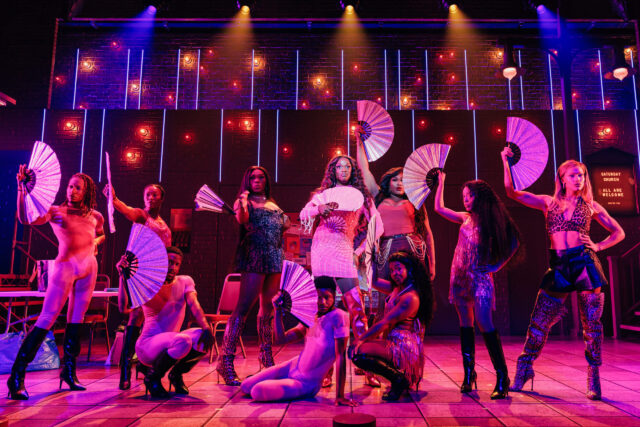
Music and passion are always in fashion at New York Theatre Workshop world premiere (photo by Marc J. Franklin)

Saturday Church is “too much” — but not in the way Aunt Rose meant. At 140 minutes (with intermission), it is too long and too repetitive, overloaded with too many songs (by Sia and DJ Honey Dijon). Clichés abound throughout as the show tries to figure out just what it is, going over the top in attempting to present the story of a teenager, named after the hero of Homer’s Odyssey, trying to figure out who he is.

The diverse cast cuts loose, but Battle is too static in the lead role, his transformation lacking dramatic impact. Inspired by a St. Luke in the Fields program for at-risk LGBTQ youth, the show panders to the audience in self-celebration; it’s more a party than a play, and judging by the enthusiastic crowd the night I went, that’s enough for many. “Are there any queens in the house?” Black Jesus asks, to rapturous applause.

Qween Jean’s costumes are dazzling, David Zinn’s set brings a welcoming intimacy to the proceedings, Adam Honoré’s lighting and Gareth Owen’s sound are appropriately flashy, and Darius Thomas’s hair and wigs are fab, but the festivities run out of surprises too quickly as Cardasis, Ijames (Fat Ham, Good Bones), and director Whitney White (Jaja’s African Hair Braiding, Macbeth in Stride) focus on style instead of substance, preaching to the choir.

At one point, just as Ulysses is about to admit that he is gay, Black Jesus tells him, “I’ll advise but you got free will, baby.”

If only Saturday Church felt the same about its audience.

[Mark Rifkin is a Brooklyn-born, Manhattan-based writer and editor; you can follow him on Substack here.]
BRINGING THE OUTSIDE IN: WEATHER GIRL AT ST. ANN’S

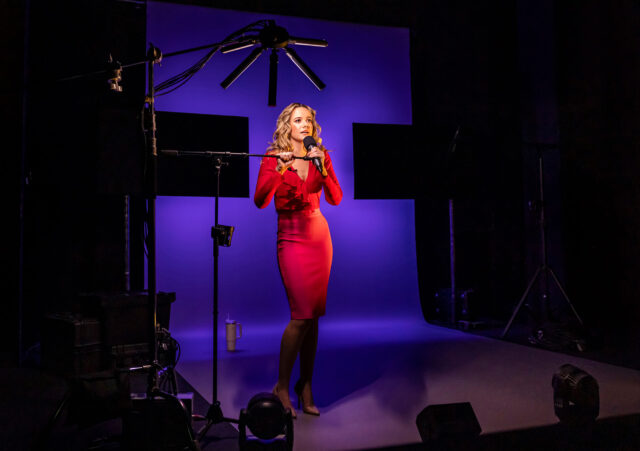
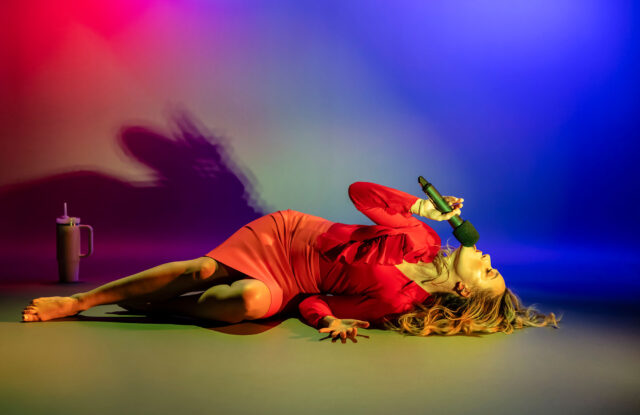
Julia McDermott plays a TV meteorologist on the edge in Weather Girl (photo by Emilio Madrid)

WEATHER GIRL
St. Ann’s Warehouse
45 Water St.
Through October 12
stannswarehouse.org

Julia McDermott is mesmerizing as a Fresno morning show meteorologist desperate to find shelter from the storm in Brian Watkins’s Weather Girl, continuing at St. Ann’s Warehouse through October 12.

“People always said I was destined to become a weather girl . . . That I always ‘had that look.’ I think it might’ve been more that I had a crippling fear of being killed by an act of god,” KCRON’s Stacey Gross (McDermott) says as the solo show begins. She talks about how she has to get up at 4:00 for her job, a time at which, someone once told her, according to the Bible, “sin enters the world. . . . And at a quarter past four you feel all the destroyed things swimming around in the dark and when you do the weather here in California you can sometimes feel the devil’s breath right at your earlobe.”

Standing in a cramped TV-studio green-screen setup with lights and microphones, dressed in a low-cut red blouse, supertight pink skirt, and heels (the costume is by Rachel Dainer-Best), Stacey explains the reason why she thinks we are all here: “to bring the inside outside.” And for the next seventy minutes, she spills her guts, literally and figuratively, in hilarious and heart-wrenching ways.

In her cheery on-air disposition, she reports from the field on the Coalinga wildfire, focusing on a specific house burning in a cul-de-sac, noting that the “wildfire hopped the freeway at 4 am.” Lifting up her ever-present Stanley Quencher, she declares to the anchors in the studio, “They need a few more of these out here!” But it’s not water in the giant cup; she’s drinking Prosecco.

She’s devastated when she learns the next day that a family of five and their two dogs perished in that house fire; moments later, Jerry, the station manager, tells her she is being promoted to the Phoenix gig, a move she is not happy about. “Fuck you, Jerry,” she responds several times, although she is not sure if she actually said it out loud. As her colleagues congratulate her, she says/thinks, “Fuck you guys I’m gonna murder you guys.”

Stacey explains to the audience that the reason she does the weather is because “there’s some things you can’t change,” referring primarily to her difficult childhood with foster parents because her mother, Magdalena, preferred drugs to a house, but also alluding to global warming and environmental disaster. She hasn’t seen her mom, who is homeless, in a while, but wonders how she is doing, “if she’s out there somewhere dying of thirst and heat and smoke.” The California drought serves as a constant metaphor for her life, which is devoid of family, friends, or a significant other. Instead, she has cheap sex with a man she meets online, never bothering to learn his name while getting loaded on wine during a wild night that does not end well.

She does find her mother, who asks her, “Have you said things you didn’t intend to say? Are you always thirsty?” letting her know that she likely has inherited a magical power from her as Magdalena talks about Moses parting the Red Sea and Jesus performing miracles involving water.

But when Stacey asks her mother to teach her, things start getting really weird.

Weather girl Stacey Gross (McDermott) is concerned about climate change and more at St. Ann’s Warehouse (photo by Emilio Madrid)

Winner of a Fringe First Award in Edinburgh, Weather Girl is directed with a fiery fury by Tyne Rafaeli (Becoming Eve, The Coast Starlight), occasionally going over the top as Watkins’s (Epiphany, Evergreens) otherwise tight script goes too far a few times, especially in an overwrought on-air confession. Isabella Byrd’s set and lighting keep it all intimate; curiously, the sound, by Kieran Lucas, features Stacey at the same vocal level whether she uses a microphone or doesn’t.

McDermott (Heroes of the Fourth Turning, Orpheus Descending) expertly portrays the pathos and bathos of Stacey and her mixed-up life, turning the stereotype of the beautiful blond ditzy weather girl on its head. Stacey is a complex woman whose insides are drying out as her exterior continues to be celebrated on its slick surface, even as she falls apart.

But at the center is the miracle of water, which makes up between sixty and seventy percent of the human body and about seventy-one percent of the planet; without water, everything would die.

“Water does not resist. Water flows. When you plunge your hand into it, all you feel is a caress,” Margaret Atwood writes in The Penelopiad. “Water is not a solid wall, it will not stop you. But water always goes where it wants to go, and nothing in the end can stand against it. Water is patient. Dripping water wears away a stone. Remember that, my child. Remember you are half water. If you can’t go through an obstacle, go around it. Water does.”

Words to live by, for Stacey and the rest of us as we watch the world burn.

[Mark Rifkin is a Brooklyn-born, Manhattan-based writer and editor; you can follow him on Substack here.]
EXISTENCE AS RESISTANCE: ART AND THE FIRST AMENDMENT

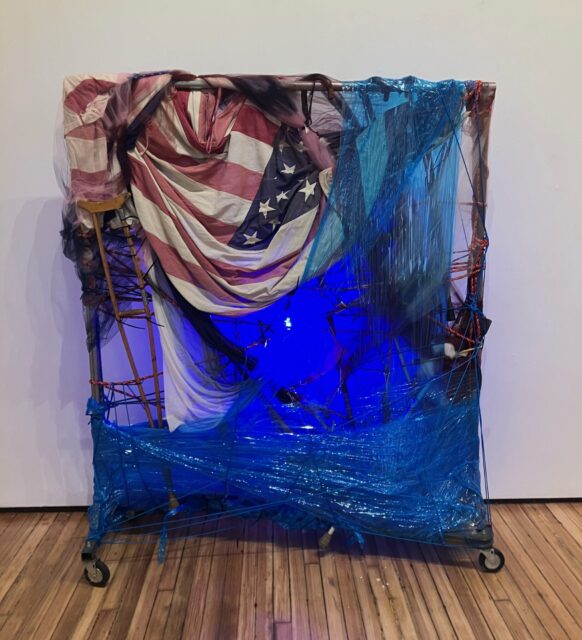
Abigail DeVille’s Libertas (Study in Blue) asks, “How have we fought for the proliferation of truths, not the lies that frame the history and governance of this great republic?” (photo courtesy of the artist and Art at a Time Like This)

DON’T LOOK NOW: A DEFENSE OF FREE EXPRESSION
127 Elizabeth St. between Broome & Grand Sts.
Opening reception Friday, October 10, free, 6:00
Exhibition continues Tuesday – Saturday through October 25, free, noon – 6:00 pm
artatatimelikethis.com

Founded by Anne Verhallen and Barbara Pollack as an immediate response to the pandemic lockdown, the nonprofit Art at a Time Like This is dedicated to the idea that “art can make a difference and that artists and curators can be thought-leaders, envisioning alternative futures for humanity.” Art at a Time Like This has presented nearly two dozen online and in-person exhibitions and programs since March 2020, such as “Dangerous Art, Endangered Artists,” “First Responders,” and “Restoration: Now or Never.”

The organization’s latest is “Don’t Look Now: A Defense of Free Expression,” opening October 10 at 127 Elizabeth St. The show consists of “25 Artists Exercising Their First Amendment Rights,” from Marilyn Minter’s Plush #5, Sari Nordman’s Anxiety River, and Martha Wilson’s Martha Does Donald to Yvonne Iten-Scott’s Origin, Shepard Fairey’s My Florist Is a Dick, and Clarity Haynes’s Big Birth, all of which have been censored in some way.

For example, Jean-Paul Mallozzi’s Ansiedad: I Can’t Get Off had to be partially modified in order to remain in South Florida Cultural Consortium’s “Mangroves to Masterpieces” at Florida Atlantic University, Jessica (Mehta) Doe’s 500 Years Ago was moved to a closed-off room at the University of Notre Dame, and Shey “Ri Acu” Rivera Ríos (Prayers to Nana Buruku) was to be included in the three-artist exhibition “Nothing Living Lives Alone” at Providence College in March 2024, but the exhibit was canceled by the administration, which decided that pieces by Rios (that were not in the Providence presentation) “show contempt for the Catholic faith.”

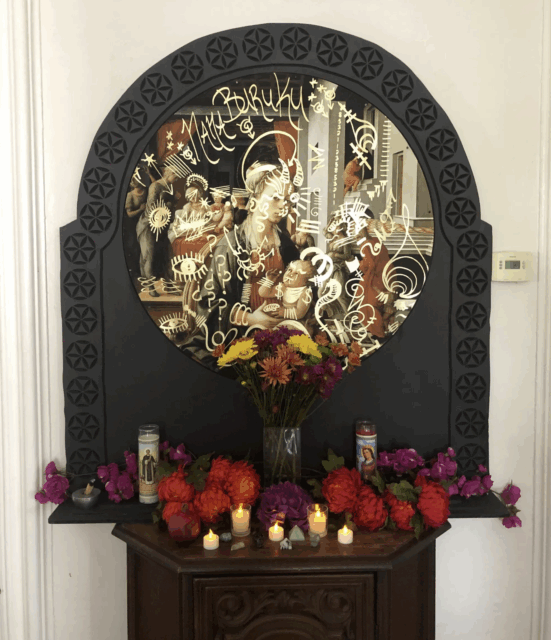
Shey Rivera Ríos, Prayers to Nana Buruku Altar, 2017 (photo © 2025 Shey Rivera Ríos)

I recently asked three of the “Don’t Look Now” participants when they became personally aware of censorship and the importance of the First Amendment; below are their responses.

Susan Silas
Honestly, I don’t remember a time when I didn’t know about censorship and the First Amendment. That may have been part and parcel of growing up in an immigrant household with Holocaust survivor parents.

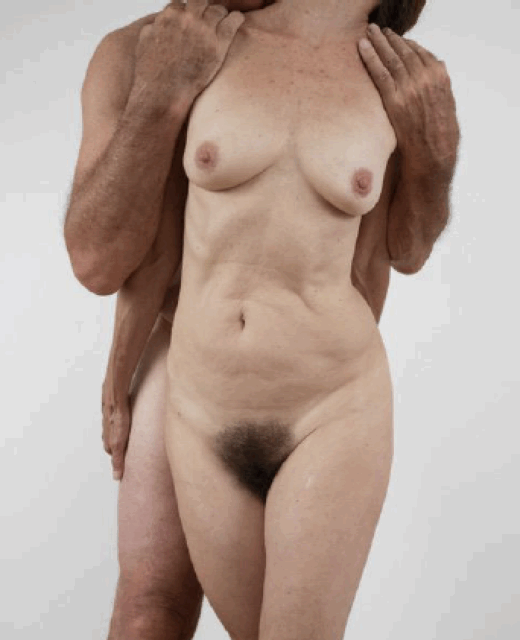
As for my own direct personal experience with Instagram and Facebook, so much of my work contains nudity, it was inevitable. I was already aware that others were being censored, and also of the arbitrary nature of that censorship based on how algorithms search. For example, I had an image from my series “love in the ruins; sex over 50” that depicted actual intercourse stay up because we were one on top of the other, so nipples weren’t exposed, while an image like the one in the exhibition, which is not dissimilar to depictions of Adam and Eve in sixteenth-century paintings, was taken down in twenty seconds for “offending community standards.”

I guess I also object to these platforms deciding who my community is. My community is not offended.

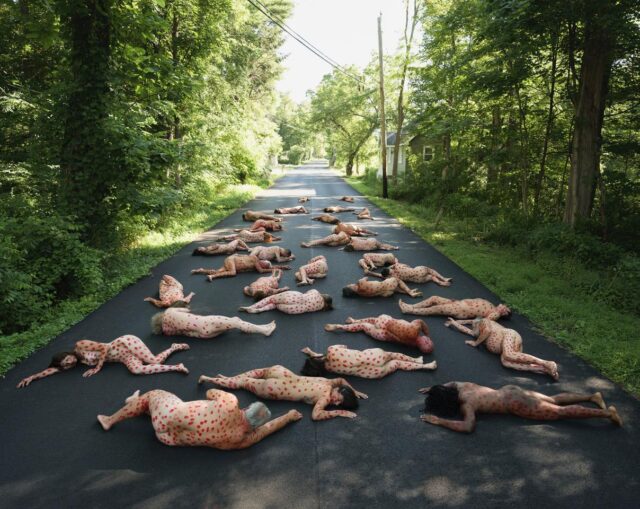
Spencer Tunick’s Remedy, taken in New Paltz, New York, was rejected by Instagram (photo © 2025 Spencer Tunick)

Spencer Tunick
My art censorship started in the mid-’90s when my friend Michael Weiner and I were arrested at Rockefeller Center. My idea was to have him pose nude draped, facedown, on top of the oversized outdoor red Christmas balls. I did get the shot, but we were held afterwards in a jail cell inside 30 Rock. Ron Kuby and William Kunstler represented us and the charges were dismissed.

It’s legal to be nude for art in New York within a time, space, and manner. We were making art before sunrise in the twilight hours on a weekend, when no one was on the street. We were exercising our (visual) First Amendment rights, plus there were no signs that explicitly stated, “Don’t climb the balls.”

This arrest was the beginning of five arrests and a future case that made its way up to the US Supreme Court, where I won and New York City mayor Rudy Giuliani was reprimanded by the federal judges.

As for the present, my work has been censored on social media since 2012, even though I am adhering to their nudity rules, which includes self-censoring frontal nudity and close-ups of buttocks. So even though I am still following their nudity rules, they still find ways to threaten deletion of my accounts and make my accounts unrecommendable. This suppression is too harsh.

In response to social media and online censorship, I helped found the website Don’t Delete Art. I am the cofounding curator; it’s a collaboration with artists and free speech organizations. My recent contribution was the idea of a “tips” page to help artists avoid suppression and deletion.

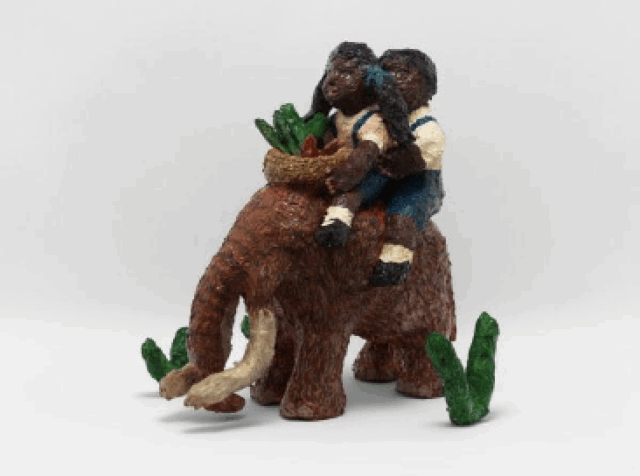
Kelly Sinnapah Mary’s The Fables of Sanbras – Cake and Conquest was part of a canceled show at the Art Museum of the Americas this year (photo © 2024 Kelly Sinnapah Mary)

Danielle SeeWalker
It’s difficult to pinpoint an exact moment or instance that I became aware of censorship and the importance of the First Amendment, but through lived experience and witnessing the silence surrounding my people’s stories it became clear that I was born into a sort of censorship. Growing up Native, I noticed early on how little of our truth was ever told — in school the narrative being taught was very different than what I was being told at home and by my elders. Our languages, our ceremonies, our ways of seeing the world were pushed aside or erased completely through boarding school and colonization. From an early age, I had the realization that what I was being taught in the mainstream world didn’t match what my family and community had lived. That silence — that absence — was/is censorship.

For my people, this isn’t something that happened long ago; it’s something we still live with. Our voices are still dismissed, our issues ignored, our history rewritten. We’ve been fighting for the right to speak, to pray, to tell our own stories since time immemorial. When my grandmother was born, she wasn’t even considered an American citizen, yet she and our ancestors have been on these lands since time immemorial. My father grew up in a time when not all Native Americans were able to legally vote. The First Amendment, to me, isn’t just about freedom of speech — it’s about the right to exist and to be heard in a country that has tried over and over again to silence us (and get rid of us).

When I think about it, I realize how powerful it is just to speak our truth. Every time a Native person shares their story, teaches their language, or corrects a false history, it’s an act of resistance. It’s reclaiming space in a world that once told us we didn’t belong. That’s what the First Amendment means to me — not just words on paper, but a promise we keep alive every time we refuse to be silent. Our existence is our resistance.

Susan Silas, Torsos, from the ongoing series “love in the ruins; sex over 50,” 2017 (photo © 2017 Susan Silas)

On October 18 at 2:00, Art at a Time Like This will host the free panel discussion “Censorship Now: Who Fears Free Expression?” with National Coalition Against Censorship’s Arts/Advocacy Program director Elizabeth Larison, Artnet contributor Brian Boucher, and former Whitney Independent Studies Program associate director Sara Nadal-Melsió, addressing the questions “What’s so scary about freedom of expression? And what do we fear will happen if we fail to respond to the latest challenges?”

[Mark Rifkin is a Brooklyn-born, Manhattan-based writer and editor; you can follow him on Substack here.]
NOT SAFE AT HOME: AMONG NEIGHBORS AT THE QUAD

Among Neighbors explores horrific events that linger in a small Polish town (courtesy of 8 Above)

AMONG NEIGHBORS (Yoav Potash, 2025)
Quad Cinema
34 West 13th St. between Fifth & Sixth Aves.
Opens Friday, October 10
212-255-2243
quadcinema.com
www.amongneighbors.com

“It’s much easier to sell a pleasant history than a difficult history,” professor Dariusz Stola says in Yoav Potash’s remarkable documentary, Among Neighbors.

Ten years in the making, the film is a gripping, deeply emotional murder mystery surrounding the killing of Jews in the small town of Gniewoszów, Poland — months after WWII had concluded. In 2014, Potash was invited by Aaron Friedman Tartakovsky and his mother, Anita Friedman, to film the rededication of a Jewish cemetery in the shtetl where Anita’s father was from, but as Potash spoke with residents, he discovered long-buried, dark secrets involving violence and the whitewashing of what had occurred there.

Nine years earlier, the Friedman family had faced physical threats when they tried to visit the Gniewoszów firehouse, which was formerly the old synagogue. In 2018, the Polish government amended the Act on the Institute of National Remembrance, criminalizing any speech or action that suggested the country was complicit in the Holocaust. In 2020, Stola was forced to resign from his role at the Polin Museum of the History of Polish Jews over disagreements about what the institution could and could not display.

Potash, who wrote, directed, produced, and coedited the film and served as one of the cinematographers, meets with several longtime Polish residents, who will say only so much. Henryk and Sławomir Smolarczyk don’t feel there is anything strange about their collection of dusty Jewish tombstones from the destroyed cemetery. Janina Grzebalska recalls playing with Jewish children, attending Jewish weddings, and enjoying matzah. One unidentified woman who came to Gniewoszów for work in 1953 asks, “Is this about the Jewish issues? It was already silenced.”

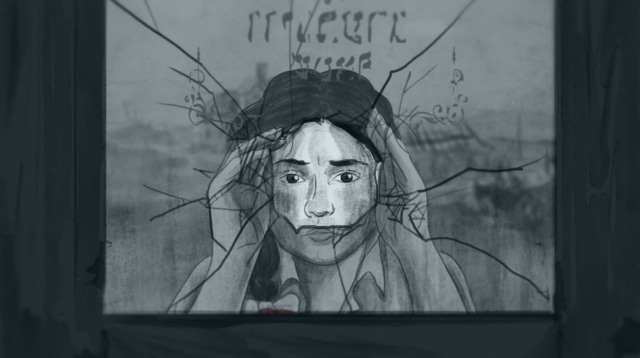
But Potash starts uncovering the truth from Pelagia Radecka, who, for the first time, reveals the story of her relationship with the Weinbergs, the Jewish family who operated a fabric shop across the street from her house and were victims of a horrific tragedy. Haunted by her memories, Radecka has been trying to find out what happened to her friend, Janek Weinberg, for seventy years. Meanwhile, the granddaughters of Gniewoszów painter Harry Lieberman put Potash in touch with Yaacov Goldstein, who was separated from his family during the Holocaust and shares his unforgettable tale of survival. Pelagia’s and Yaacov’s harrowing stories are brought to life through archival footage, photographs, home movies, and spellbinding hand-drawn black, gray, and white animation (highlighted by powerful splashes of blue and yellow) as they narrate their experiences.

“They were our neighbors,” Pelagia says, shocked by what she had witnessed.

Yaacov declares, “I am a survivor of the Holocaust. And to say that Polish people didn’t help the Germans, did not hate, and didn’t kill Jewish people — it’s against the truth!”

Potash (Crime After Crime, Food Stamped) also speaks with matzevot photographer Łukasz Baksik and mass graves investigator Aleksander Schwarz, the latter noting, “We have so many cases, you wouldn’t believe.”; Michael Schudrich, the Chief Rabbi of Poland; journalist Konstanty Gebert, who points out, “This one small town represents what happened in hundreds of small towns. The Germans come in, and it’s the end of normal relations between Jews and non-Jews.”; and historian Magda Teter, who puts it all into perspective, relating it to what is going on in America and around the world: “The assault on history and the criminalization of history in many countries today is part of a larger assault on democracy and democratic values.” Meanwhile, Polish ambassador Piotr Wilczek asserts, “There are only individual, very rare cases of antisemitism in Poland. The problem is really in many countries. So I really don’t know why Poland is singled out in such a way.”

In January 2024, Igor Golyak’s theatrical adaptation of Tadeusz Słobodzianek’s Our Class detailed the real-life 1941 pogrom in the small Polish village of Jedwabne, where Catholic children turned against their Jewish schoolmates, leading to a mass murder that was covered up for decades. In the 2021 documentary Three Minutes — A Lengthening, director Bianca Stigter does a deep dive into one hundred and eighty seconds of vacation footage taken in 1938 in the small town of Nasielsk, Poland, attempting to identify the people in the images and figure out what happened to them; of the three thousand Jews who lived in Nasielsk at the time, fewer than a hundred survived the Nazi invasion.

Meanwhile, antisemitism is on the rise yet again in America, where the current administration is erasing certain parts of our history and rewriting others, especially those concerning minorities and diversity. Immigrants are being vilified with grotesque language and shameful policies. Thus, Among Neighbors is not just about a small village in Poland; it is about respect, dignity, compassion, and the truth everywhere, at any time. When Yaacov says, “It was like we were not human beings,” it is hard not to think that he is referring to the treatment of Black and brown people in the United States. That point strikes a chord when Stola says, “They felt, in Poland, at home, that this is a safe place.”

Are there any safe places anymore?

Among Neighbors, which features an extraordinary ending that requires multiple tissues, runs October 10–16 at the Quad, with Potash participating in Q&As on October 10 at 7:20 (with filmmaker Yael Melamede), October 11 at 7:20 (with actor Simon Feil), and October 12 at 3:30 (with professor Annette Insdorf).

[Mark Rifkin is a Brooklyn-born, Manhattan-based writer and editor; you can follow him on Substack here.]
THEATER ISN’T EASY: SUBSTACK COMES TO LIFE AT THE COFFEE HOUSE

Who: Sara Farrington, Jocelyn Kuritsky, Tony Torn, James Scully
What: Live performance, talkback, and dinner
Where: The Salmagundi Library at the Coffee House Club, 47 Fifth Ave. between Eleventh & Twelfth Sts.
When: Wednesday, October 8, free with advance RSVP (a la carte dinner to follow), 6:30
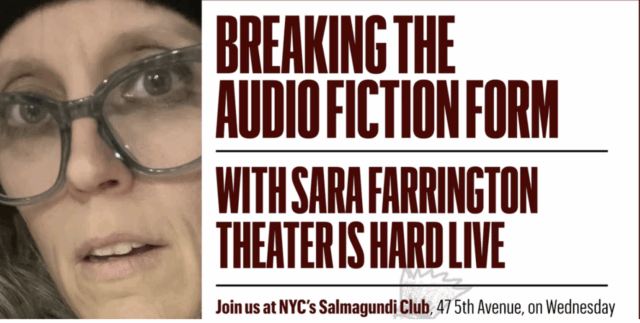
Why: Back in May, Sara Farrington came to the Coffee House Club to discuss her work during a cozy Friday lunch. The playwright and author will be back on October 8, in the Salmagundi Library, for the latest installment of “Breaking the Audio Fiction Form.” Joined by actor and creator Jocelyn Kuritsky (A Simple Herstory) and actor and director Tony Torn (Paul Swan Is Dead and Gone), Farrington will perform several pieces from her fast-growing, no-holds-barred Substack Theater Is Hard, in which she waxes poetic about independent, experimental, and unconventional theater in a way that is “half–Socratic dialogue, half-manifesto.” The performance will be followed by a brief talkback moderated by actor, writer, and director James Scully (Breaking Walls).

“Sara is a cool fit for this series because breaking the audio fiction form means just that — pushing its boundaries and blending it with other mediums,” Kuritsky told twi-ny. “Her work spans both theater — as a playwright and Substack writer — and audio, as a performer. She offers an informed perspective on the current challenges facing theater and has a unique take on how audio can, does, and could further intersect with it.”

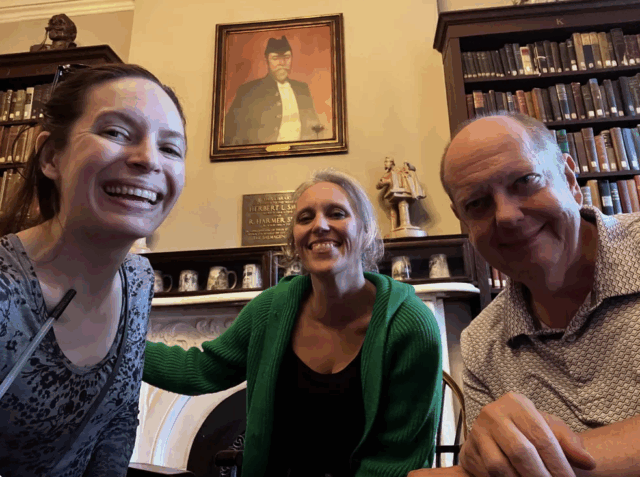
Jocelyn Kuritsky, Sara Farrington, and Tony Torn team up for latest edition of “Breaking the Audio Fiction Form” on October 8

Farrington has collaborated with her husband, Reid, on such multimedia productions as BrandoCapote, CasablancaBox, and The Return while also writing her own plays, including A Trojan Woman, Mickey & Sage, and the forthcoming musical Dr. Uncanny Presents: Moreau ’96, about the making of the infamous 1996 horror disaster The Island of Dr. Moreau. She is also the author of The Lost Conversation: Interviews with an Enduring Avant-Garde, in which she speaks with such legends as Richard Foreman, André Gregory, David Henry Hwang, Bill T. Jones, Adrienne Kennedy, Mac Wellman, and Robert Wilson.

Admission to this first-ever live edition of Theater Is Hard is free with advance RSVP; the evening will conclude with an à la carte dinner with the participants.

[Mark Rifkin is a Brooklyn-born, Manhattan-based writer and editor; you can follow him on Substack here.]
THE MEXICAN EXODUS: A HIP-HOP TALE OF SLAVERY AND FREEDOM

Nygel D. Robinson and Brian Quijada wrote and star in Mexodus (photo by Curtis Brown)

MEXODUS
Audible’s Minetta Lane Theatre
18 Minetta Lane between Sixth Ave. and MacDougal St.
Monday – Saturday through November 1, $56.50-$120.50
mexodusmusical.com
www.audible.com

Between 1829 and the end of the Civil War, several thousand American slaves escaped to Mexico, a kind of Underground Railroad that headed south instead of north, though without the same organized support system. Brian Quijada and Nygel D. Robinson have adapted that story into Mexodus, an exhilarating, funny, and passionate must-see two-person musical that has been extended through November 1 at Audible’s Minetta Lane Theatre.

“Did you know this shit? / We didn’t know this shit!” they declare early on. “In eighteen forty-eight it was America that won the war. / Ten territories from Mexico / Including the behemoth of Texas, yo! / And what would that land be used for? / Oh lord! To pick a bale of cotton / And what was slaves’ most common chore? / To jump down, turn around, and pick a bale a day. / Cotton: America’s original sin / And it’s then and there where our story begins.”

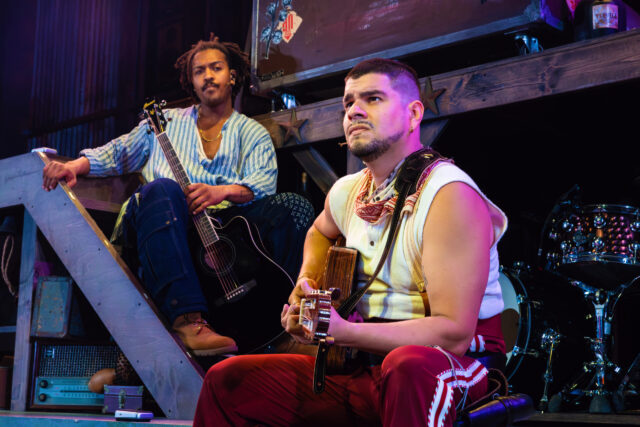
Quijada and Robinson switch between portraying versions of themselves, speaking directly to the audience in the present day, and two tough men from the pre–Civil War era. They also play all the instruments — guitars, keyboards, standup bass, harmonica, accordion, drums, percussion, triangle — creating live loops by recording snippets of music, then layering them electronically so it often sounds like there’s a full band in the theater while allowing them to act with their hands and feet free.

Henry (Robinson) is a Black man who has escaped from a brutal incident on the Texas plantation where he was enslaved, while Carlos (Quijada) is a former Mexican army medic and deserter overwhelmed by guilt, now working on a farm in la Frontera, which he describes as “la mitad — the middle. No laws, no lines, tierra descontrolada,” evoking a kind of middle passage.

Carlos found Henry washed up on the shore of the Rio Grande and is nursing him back to health. Henry is suspicious of Carlos; when Henry asks if it’s safe there, Carlos responds, “It’s not safe anywhere,” adding that he’s seen many “gringos” in the area hunting down runaways.

Both men are in vulnerable positions, alone and on their own, so they’ll need to help each other if they are going to survive while battling the elements and worrying about the slave hunters.

Brian Quijada and Nygel D. Robinson play all the instrument in historical loop musical (photo by Curtis Brown)

Quijada and Robinson met at a conference in February 2020 and decided to team up for the show, which was inspired by a Facebook post Quijada saw in 2017 and is named after this little-known Mexican exodus. The story of how the two strangers came to team up runs parallel to the relationship fostered between Carlos and Henry, who are composites of real figures, bonding through different aspects of looping. During the musical, Quijada and Robinson each share a tale from their childhood involving racism, love, and sacrifice. Robinson, honoring three generations of women in his family, says, “I don’t think I’m their wildest dreams because where we’re from, you don’t get to dream like this.” Quijada, describing a frightening instance of racial profiling at a gas station, explains, “We are taught to separate, we are taught to stick to our own, / Taught how to protect our homes. / We are given reasons to fight and start wars. / But what if / What if / What if we weren’t so quick to lock our doors.”

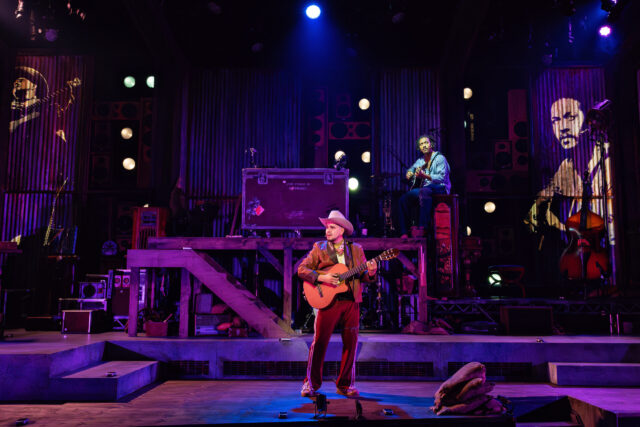
Director and costume designer David Mendizábal (Tell Hector I Miss Him, the bandaged place) expertly blends the multilayered narrative with Mextly Couzin’s lighting, Mikhail Fiksel’s looping and powerful sound, Johnny Moreno’s live projections, and Tony Thomas’s movement choreography on Riw Rakkulchon’s barn set, which includes multiple platforms, doors at either end, a DJ table at the top, and a rear wall of lights and speakers.

Robinson and Quijada, who wrote the book, music, and lyrics, are magnetic as they move across the stage and pause for emotional interludes. The score is influenced primarily by Hamilton, but in this case hip-hop interlaced with country and the blues. Their apprehension is palpable every step of the way — not just as Henry and Carlos but as themselves, Black and brown men in a nation that is rounding up nonwhite people ever more frequently and violently. When the law comes knocking at the barn door, it is hard not to think about what ICE is doing to legal and illegal immigrants — and citizens — in America.

“We’re all in this together,” Henry says. Echoing his words in Spanish, Carlos replies, “Todos estamos juntos en esto.” Henry responds, “Whoa, slow that down.”

The message of Mexodus is clear: We are all in this together — and this is no time to slow down.

[Mark Rifkin is a Brooklyn-born, Manhattan-based writer and editor; you can follow him on Substack here.]
SONIC SENSATION: 11,000 STRINGS AT PARK AVE. ARMORY

Georg Friedrich Haas’s 11,000 Strings envelops Park Avenue Armory’s Wade Thompson Drill Hall in sound and light (photo by Stephanie Berger)

11,000 STRINGS
Park Avenue Armory, Wade Thompson Drill Hall
643 Park Ave. at 67th St.
Through October 7
212-933-5812
www.armoryonpark.org

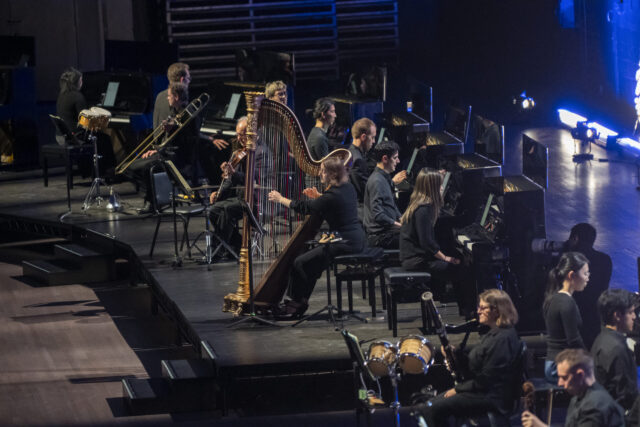
“The idea of this commission did not come from myself because of an easy reason. I never would have dared to make this suggestion. Nobody would have believed that this is possible,” composer Georg Friedrich Haas says about 11,000 Strings, his extraordinary concerto grosso continuing at Park Ave. Armory through October 7. The stirring production encircles the entire audience with fifty specially microtuned upright pianos that face the walls of the fifty-five-thousand-square-foot Wade Thompson Drill Hall, while the twenty-five members of the Klangforum Wien face the audience, playing the harp, saxophone, cello, violin, accordion, and more.

There is no conductor; instead, the pianists, from Juilliard, the Manhattan School of Music, the Mannes School of Music, NYU, and Columbia, play unique scores from individualized iPads while the Klangforum Wien perform with their own hard-copy scores and iPhones that track the time.

Under the music direction of Bas Wiegers and with lighting by Brian H. Scott, the sixty-six-minute piece unfolds in a series of sections that range from whispers to passionate explosions, from glorious cinematic moments to soft melodies evoking bees, birds, and the natural world. Close your eyes and you can get lost in the architecture of the space, as if the building itself is participating in the consonance.

Harpist Miriam Overlach performs with fellow members of Klangforum Wien and emerging and established pianists from New York City (photo by Stephanie Berger)

Since no two musicians are playing the exact same thing, it feels as if there is a wave of motion flowing through the hall and hovering over the audience, a compelling choreography as the pianists gently shift their bodies up and down or to the right and left and the Klangforum Wien members stand up and sit down. The unintended vagaries of live performance in physical space add visual surprises; near me, one of the pianos seemed to be the slightest bit loose, so as the pianist hit the keys, abstract images shook on the top panel, adding a touch of lovely mystery. Everyone is dressed in different all-black outfits; the reflections of each pianist’s face in their instrument’s panel have an otherworldly glow.

I focused on flutist Vera Fischer, violinist Gunde Jäch-Micko, violoncellist Benedikt Leitner, saxophonist Gerald Preinfalk, and percussionist Lukas Schiske, who were closest to where I was sitting, although I made sure to swivel my head around to catch harpist Miriam Overlach, violinist Sophie Schafleitner, trombonist Mikael Rudolfsson, and others. Several times the string musicians stood and dragged their bows against cymbals, offering brief flashes of dissonance that enhance the ritualistic feel of the piece.

11,000 Strings is yet another unusual and fascinating sonic environment that the armory is renowned for housing, following such previous works as Karlheinz Stockhausen’s Inside Light and Tyshawn Sorey’s Monochromatic Light (Afterlife).

You don’t have to understand the details of the music to be swept away by its magic. For example, Haas notes in the program, “When a violin tunes its strings in perfectly intoned fifths, this interval is a tiny fraction (almost exactly one-fiftieth of a semitone) higher than the piano’s fifth. If each of the 50 pianos is tuned higher by this very small interval, then an absolutely perfect fifth is created, for example, between the C of the first piano and the G of the second piano. The same applies between the C of the second and the G of the third piano (one-fiftieth of a semitone higher), between the C of the third and the G of the fourth piano, and so on. After 50 pianos, the circle closes, and the fifth has risen by a semitone.”

What is more important is what he writes later: “11,000 Strings is not an experiment. It is music for the people who play the piece and for the people who hear it. You don’t experiment with people.”

[Mark Rifkin is a Brooklyn-born, Manhattan-based writer and editor; you can follow him on Substack here.]