Dennis Hopper found himself in Hollywood exile after making The Last Movie
EXPERIMENTAL WESTERNS, PART 1: AVANT-GARDE WESTERNS: THE LAST MOVIE (Dennis Hopper, 1971)
Anthology Film Archives
32 Second Ave. at Second St.
Saturday, July 4, 9:00
Saturday, July 18, 6:00
Sunday, July 19, 8:00
Series runs July 3-26 anthologyfilmarchives.org arbelosfilms.com
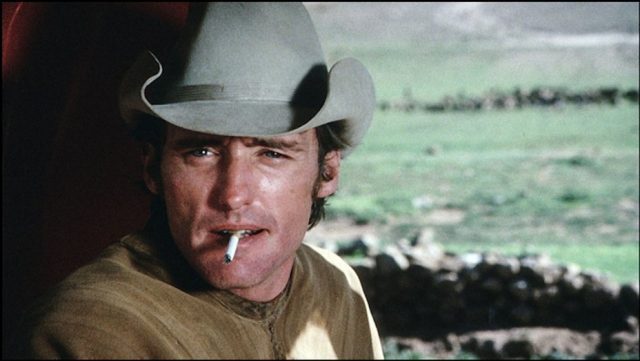
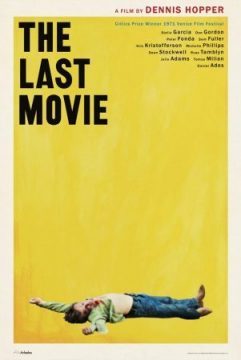
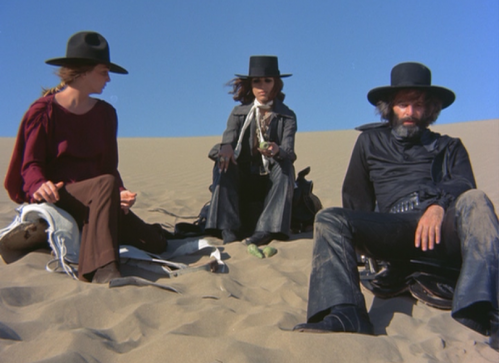
Flying high off his international success with Easy Rider in 1969, cowriter, director, and star Dennis Hopper was given carte blanche by Universal for his next film, 1971’s The Last Movie, a controversial picture that, despite winning the Critics Prize at the Venice Film Festival, led to Hopper’s unofficial exile from Hollywood for nearly a decade. The Last Movie was finally released in 2018 in a gorgeous 4K digital restoration made by Il Cinema Ritrovata from the original 35mm camera negative, screening at Anthology as part of the series “Experimental Westerns, Part 1: Avant-Garde Westerns.” As documented in Nick Ebeling’s 2017 Along for the Ride and elsewhere, The Last Movie was a longtime labor of love for Hopper and his cowriter, Stewart Stern (who had penned Rebel without a Cause, in which Hopper played a key role), but it ended up being a critical and financial flop. Over the years, there have been occasional rare screenings as the film’s legend grew, and the restoration proves that the mythos was fully justified. Hopper stars as Kansas, a movie wrangler working on a Western about Pat Garrett (Rod Cameron) and Billy the Kid (Dean Stockwell) in Chinchero, Peru, directed by one of the toughest auteurs of them all, the great, cigar-chomping Samuel Fuller (Pickup on South Street, Shock Corridor). Kansas is with former prostitute Maria (Stella Garcia), but he is instantly attracted to the fur-wearing Mrs. Anderson (Julie Adams), the wife of a wealthy factory owner (Roy Engel). Kansas’s best friend, Neville Robey (Don Gordon), wants Mr. Anderson to invest in his gold mine while both Anderson and Maria become jealous of Kansas’s romantic interest in Mrs. Anderson. In addition, following the accidental death of a stunt man during a dangerous scene, the local community of Chinchero blames Kansas and begins making their own movie directed by the vengeful Tomas Mercado (Daniel Ades), using real violence and fake equipment, creating a kind of passion play with Kansas at the center, much to the chagrin of the concerned priest (Tomas Milian), who was never in favor of Hollywood bringing its decadence to his town. It all leads to a stunning, unforgettable finale that questions much of what has come before.
Hopper, who was also a photographer and painter, said about the film, “The Last Movie is something that I made in Peru. I won the Venice Film Festival with it, and Universal Pictures wouldn’t distribute it. You should think about [Jean-Luc] Godard a little when you watch it. I made it because I’d read him say that movies should have a beginning, a middle, and an end — but not necessarily in that order. I was trying to use film like an Abstract Expressionist would use paint as paint. I’m constantly reminding you that we’re making a movie — I’m constantly making references to the fact that maybe you’re just being silly sitting in an audience, being sucked into a movie and starting to believe it — and then I jar you out of it. It’s not a very pleasant experience for most audiences.” But things have changed significantly over the last half-century, and audiences are now more attuned to watching nonlinear, more unorthodox films that merge fiction and reality and challenge them with purposely confusing plot twists and character development. Some scenes repeat, while others might have been lost — several times a title card identifies that a scene is missing, but it is impossible to know whether that is true or Hopper is playing with the viewer yet again. (The film was edited by David Berlatsky, Antranig Mahakian, and Hopper.) In fact, Tomas and the priest regularly refer to moviemaking as a game. It’s also not always clear when we’re watching the film, the film-within-a-film, or even a different film as Hopper explodes genre tropes to continually defy expectations. At one point the soundtrack features Kris Kristofferson singing “Me and Bobby McGee,” but the camera soon finds Kristofferson himself, guitar in hand, warbling away. Thus, when we later hear a song by John Buck Wilkin, we look for him as well.
Beautifully photographed by László Kovács, The Last Movie turns Kansas into a kind of Jesus figure. Both text and image often reference various stories from the Bible, directly and indirectly, including Jesus being whipped, his relationship with prostitute Mary Magdalene, a celebration around a golden calf, Jesus rising from a cave, and Christ being led to the cross. All seven deadly sins — gluttony, lust, greed, sloth, wrath, envy, and pride — enter the narrative. The color red plays a significant role, as if staining the land with blood, from fake movie blood to the color of Kansas’s truck. Everyone ends up guilty of something, with some paying a higher price than others; as the original 1971 production notes explain: “Every character in the film is an innocent. Only as they are tarnished by their participation in the games do they become agents of their own destruction. The dreams that they succumb to are all encompassed in or produced by the American dream. Their sin, however, is the movies.” Hollywood has done them in, as it will Hopper himself, who filled the cast with such nonconventional, mostly non-Hollywood actors as Henry Jaglom, Toni Basil, Severn Darden, Sylvia Miles, Warren Finnerty, Peter Fonda, Clint Kimbrough, John Phillip Law, Russ Tamblyn, and Michelle Phillips, who was married to Hopper for eight days. The two-time Oscar-nominated Hopper went on to direct such films as Out of the Blue, Colors, and The Hot Spot and appear in such works as Apocalypse Now, Blue Velvet, Hoosiers, True Romance, and Speed before passing away in May 2010 at the age of seventy-four. His legacy is now cemented with the restoration of The Last Movie, a masterpiece that has, at last, received the due it, and Hopper, deserves.
“Experimental Westerns, Part 1: Avant-Garde Westerns” runs July 3–26 and includes such other gems and rarities as Robert Downey Sr.’s Greaser’s Palace, Adolfas Mekas’s The Double-Barrelled Detective Story, Matthew Barney’s Cremaster 2 with Mary Lucier’s Arabesque, and Andy Warhol’s Horse celebrating a different take on the American genre for the nation’s 250th anniversary.
For cool international Westerns, check out the concurrent Metrograph series “The Worldwide West” here.
[Mark Rifkin is a Brooklyn-born, Manhattan-based writer; you can follow him on Substack here.]
THE WORLDWIDE WEST
Metrograph
7 Ludlow St. between Canal & Hester Sts.
July 3 – August 2 metrograph.com
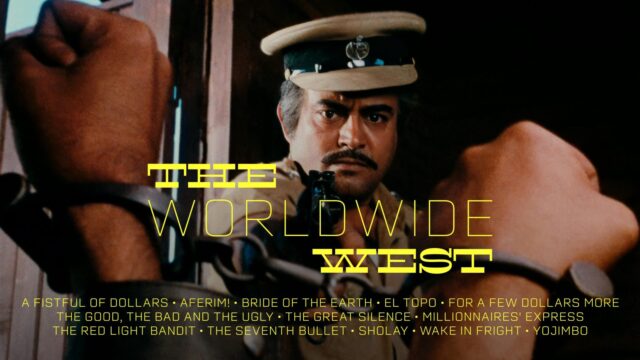
Film doesn’t get much more American than the Western, and Metrograph is paying tribute to the art form with “The Worldwide West,” a celebration of international movies that reimagine the US frontier for their countries. In honor of the 250th birthday of the United States, Metrograph is screening works by Yılmaz Güney (Kurdish), Sammo Kam-Bo Hung (Hong Kong), Alejandro Jodorowsky (Chile and France), Radu Jude (Romania), Ted Kotcheff (Canada), Akira Kurosawa (Japan), Sergio Leone (Italy), Ramesh Sippy (India), Ali Khamraev (Uzbekistan), and Rogério Sganzerla (Brazil).
The thirteen films will be shown July 3 to August 2; below is a look at some of the highlights. For cool avant-garde Westerns, check out the concurrent Anthology series “Experimental Westerns, Part 1: Avant-Garde Westerns” here.
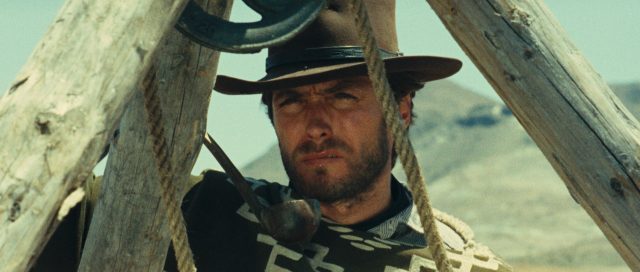
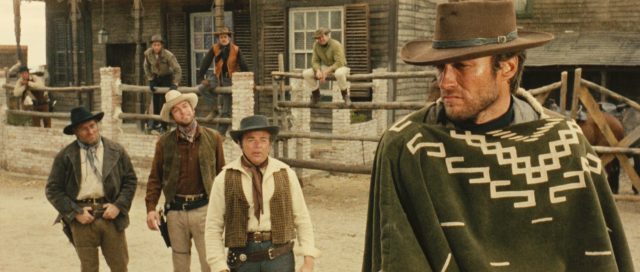
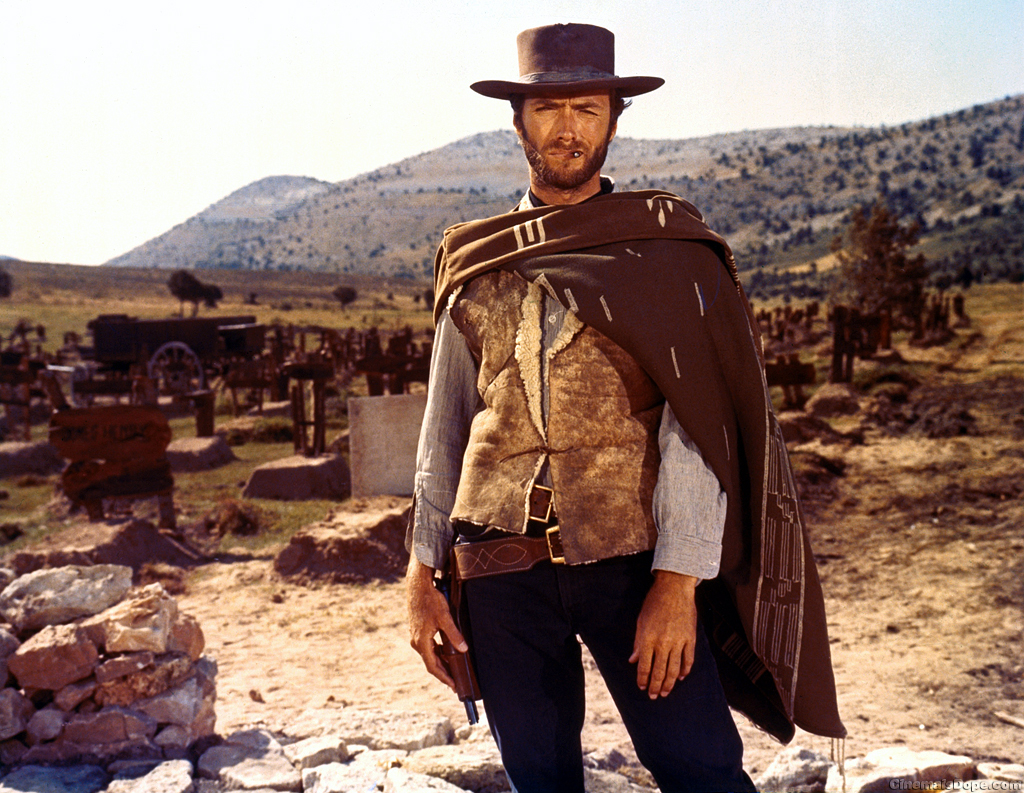
Clint Eastwood introduces the Man with No Name in Sergio Leone’s A Fistful of Dollars (photo courtesy MGM / Cineteca di Bologna / Park Circus)
A FISTFUL OF DOLLARS (PER UN PUGNO DI DOLLARI) (Sergio Leone, 1964)
Friday, July 3, 3:35
Sunday, July 5, 2:00
Wednesday, July 8, 4:00 metrograph.com
Clint Eastwood made a name for himself on the big screen playing the Man with No Name in Sergio Leone’s 1964 spaghetti Western, A Fistful of Dollars. In his first lead movie role, Eastwood, the costar of the television series Rawhide, is a gunslinger draped in a poncho and smoking a small cigar who rides on a mule into San Miguel, a tiny town in the middle of nowhere, home to an ongoing feud between the gun-running Baxters and the liquor-dealing Rojos. The stranger decides to play both sides against the middle, caring only that he earns lots of cash. “Never saw a town as dead as this one,” the stranger tells saloon owner Silvanito (Jose Calvo), who explains, “The place is only widows. Here you can only get respect by killing other men, so nobody works anymore.” The stranger hears the sound of banging outside and says, “Somebody doesn’t share your opinion.” Silvanito opens the window to reveal old man Piripero (Joe Edger) making coffins. “You’ll be a customer,” Silvanito tells the stranger with assurance. The stranger goes back and forth between the Baxters, led by the sheriff (W. Lukschy), and the Rojos, who follow the dangerous, unpredictable Ramón (Gian Maria Volontè). Also caught up in the Hatfield-McCoy battle are the sheriff’s wife, Consuelo (Margherita Lozano), and brother, Antonio (Bruno Carotenuto), along with Rojo brothers Benito (Antonio Prieto) and Esteban (S. Rupp) and their enforcer, Chico (Richard Stuyvesant). Ramón, meanwhile, has his eyes set on Marisol (Marianne Koch), who is married to Julio (Daniel Martín), who does not want to get involved in any fighting. Carefully watching it all is Juan de Díos (Raf Baldassarre), who rings the church bell at every death.
The Italian-German-Spanish production is a remake of Akira Kurosawa’s Yojimbo, which led to legal entanglements when the Japanese auteur demanded, well, a fistful of dollars in financial compensation. According to Christopher Frayling’s Sergio Leone — Something to Do with Death, Leone received a note from Kurosawa that read, “Signor Leone — I have just had the chance to see your film. It is a very fine film, but it is my film. Since Japan is a signatory of the Berne Convention on international copyright, you must pay me.” Frayling also suggests that Leone was influenced by Dashiell Hammett’s Red Harvest and Carlo Goldoni’s Servant of Two Masters and did not feel he was stealing only from Kurosawa. In The BFI Companion to the Western, Frayling quotes Leone as saying, “Kurosawa’s Yojimbo was inspired by an American novel of the serie-noire so I was really taking the story back home again.” (For a montage of similarities between the two films, check out this video.). Regardless, A Fistful of Dollars, made for about two hundred grand, set the standard for the new genre, and Eastwood was its antihero. He and Leone would team up again on the sequel, For a Few Dollars More, which is not a direct remake of Kurosawa’s Yojimbo follow-up, Sanjuro, as well as The Good, the Bad, and the Ugly, the best of the Dollars Trilogy.
Clint Eastwood watches his back in first of the Dollars Trilogy (photo courtesy MGM / Cineteca di Bologna / Park Circus)
Fistful is steeped in violence and death, from Iginio Lardani’s rad title sequence of silhouettes in black, white, and blood red to an early shot of the stranger riding under a noose and giving it a long look. Whereas Toshirô Mifune played the bodyguard in Yojimbo with a devilish glee, Eastwood — in a role that had been previously offered to Henry Fonda, Charles Bronson, James Coburn, and others — is much more serious as the Man with No Name, who would become more sympathetic in future outings. The extremely poor dubbing only adds to the film’s magnificence. To enhance its foreign appeal to American audiences, several members of the cast and crew appear under pseudonyms in the credits, including Leone (Bob Robertson), cinematographer Massimo Dallamano (Jack Dalmas), actor Gian Maria Volontè (John Wells), and composer Ennio Morricone (Leo Nichols or Dan Savio). There is no mention of Kurosawa or Yojimbo anywhere.
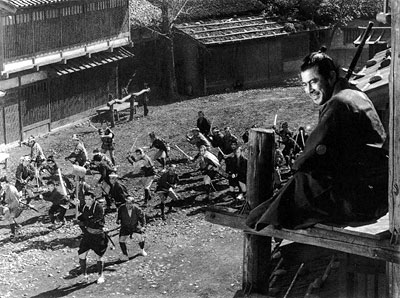
Toshirō Mifune can’t believe what he sees in Akira Kurosawa’s Yojimbo
YOJIMBO (Akira Kurosawa, 1961)
Friday, July 3, 1:15
Sunday, July 5, 11:30 am
Saturday, July 11, 11:30 am metrograph.com
Kuwabatake Sanjuro (Toshirō Mifune) is a lone samurai on the road following the end of the Tokugawa dynasty in yet another of Akira Kurosawa’s unforgettable masterpieces, which was inspired by Dashiell Hammett’s Red Harvest. Sanjuro comes to a town with two warring factions and plays each one off the other as a hired hand. Neo’s battles with myriad Agent Smiths are nothing compared to Yojimbo’s magnificent swordfights against growing bands of warriors that include the evil Unosuke (Tatsuya Nakadai), who is in possession of a new weapon that shoots bullets. Try watching this film and not think of several Clint Eastwood Westerns (including Sergio Leone’s pasta remake, A Fistful of Dollars) as well as High Noon.
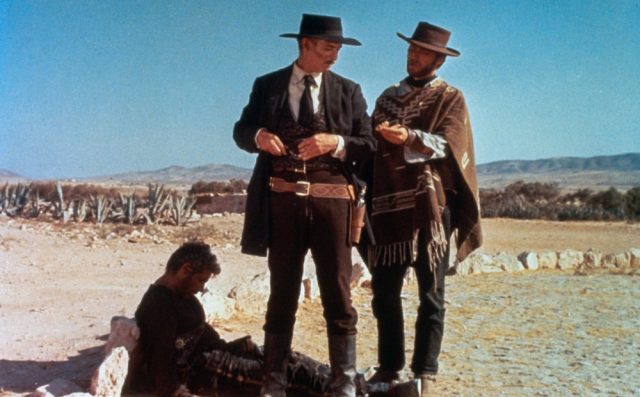
Rival bounty killers colonel Douglas Mortimer (Lee Van Cleef) and Manco (Clint Eastwood) join forces in Sergio Leone’s For a Few Dollars More
FOR A FEW DOLLARS MORE (PER QUALCHE DOLLARO IN PIÙ) (Sergio Leone, 1965)
Saturday, July 4, 1:10
Sunday, July 5, 4:15
Sunday, July 12, 11:15 am metrograph.com
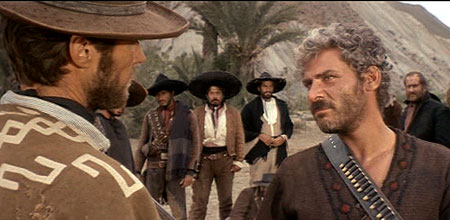
Determined to capitalize on the immediate success of A Fistful of Dollars, director and cowriter Sergio Leone and stars Clint Eastwood and Gian Maria Volonté quickly got back in the saddle to make the initially underrated, now celebrated follow-up, For a Few Dollars More. In the 1965 spaghetti Western, filmed in Almería, Spain, and at Rome’s Cinecittà Studios — and featuring a town doubling as El Paso built by production designer Carlo Simi that still stands today, part of the MiniHollywood theme park in Tabernas — Eastwood is a bounty killer that some call Manco, but he is essentially the Man with No Name again. He travels from wretched place to wretched place with his horse, poncho, cigar, squinty eyes, and guns, shooting criminals and collecting rewards. When he encounters a rival, former Confederate colonel Douglas Mortimer (Lee Van Cleef), they are initially at odds, going after the same trophies, but they ultimately decide to join forces to capture and kill El Indio (Volonté), a murderous psychopath who likes to use a pocket watch that plays a gentle tune when opened when he is getting ready to shoot someone, an element from his past (involving a mystery woman played by Rosemary Dexter) that haunts him. Manco embeds himself with Indio’s mangy gang, which includes Groggy (Luigi Pistilli), Niño (Mario Brega), Cuchillo (Aldo Sambrell), Tomaso (Lorenzo Robledo), Sancho Perez (Panos Papadopulos), Slim (Werner Abrolat), Blackie (Frank Braña), Chico (José Canalejas), Frisco (Antonio Molino Rojo), Hughie (Benito Stefanelli, who was in all three Dollars films), and Wild (the one and only Klaus Kinski). As Indio prepares to rob a bank in El Paso, a series of double crosses and personal vengeance lead to a memorable ending.
Manco (Clint Eastwood) becomes part of Indio’s (Gian Maria Volonté) gang in For a Few Dollars More
Written by Leone and Luciano Vincenzoni with added dialogue by Sergio Donati, For a Few Dollars More fits right in between A Fistful of Dollars and The Good, the Bad, and the Ugly, from its overall look and mood to Ennio Morricone’s stupendous score and Massimo Dallamano’s beautiful cinematography, both veterans of Fistful. Eastwood further established his ability to carry a film as a compelling antihero, Van Cleef (How the West Was Won, Escape from New York) earned one of the three title roles in Ugly, and Volonté, who would go on to make such classics as A Bullet for the General, Investigation of a Citizen Above Suspicion, and Christ Stopped at Eboli, is superbly grimy as a brutal villain hiding a soft spot. Genre tropes abound, highlighted by Leone’s love of close-ups of his characters’ eyes, shifting from one side to the other as they face their destinies.
Clint Eastwood is the Good in classic Sergio Leone operatic oater
THE GOOD, THE BAD AND THE UGLY (Sergio Leone, 1966)
Friday, July 10, 2:30
Sunday, July 12, 2:00 metrograph.com
One of the all-time-great spaghetti Westerns, Sergio Leone’s dusty three-hour operatic oater stars Clint Eastwood as the Good (Blondie), Lee Van Cleef as the Bad (Angel Eyes), and Eli Wallach as the Ugly (Tuco Benedicto Pacifico Juan Maria Ramirez, whose list of criminal offenses is a riot), three unique individuals after $200,000 in Confederate gold buried in a cemetery in the middle of nowhere. Nearly twenty minutes of never-before-seen footage was added to the film several years ago, with Wallach and Eastwood overdubbing brand-new dialogue, so if you haven’t seen it in a while, it might just be time to catch it again. Ennio Morricone’s unforgettable score and Torino delli Colli’s gorgeous widescreen cinematography were also marvelously enhanced; their work in the scene when Tuco first comes upon the graveyard will make you dizzy with delight. And then comes one of the greatest finales in cinema history.
Jean-Louis Trintignant stars as a mute antihero in Sergio Corbucci’s The Great Silence
THE GREAT SILENCE (IL GRANDE SILENZIO) (Sergio Corbucci, 1968)
Friday, July 17, 1:50
Saturday, July 18, 3:35
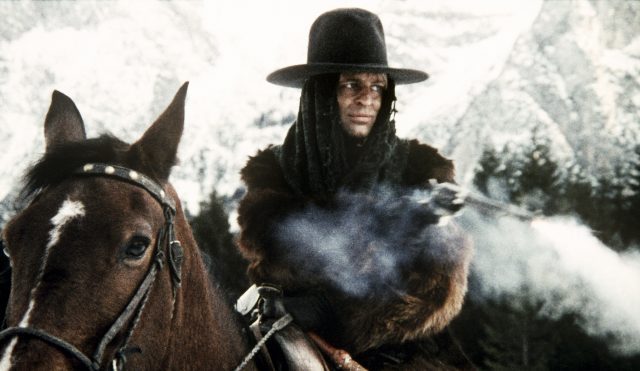
After half a century, Sergio Corbucci’s underseen masterpiece, The Great Silence, was finally released in the United States in 2018, in a gorgeous fiftieth anniversary restoration. Corbucci’s revisionist spaghetti Western was shot by Silvano Ippoliti in the Dolomites in northeastern Italy, where luxurious white snow (actually shaving cream) goes on forever until it is stained with so much blood. French star Jean-Louis Trintignant plays a variation of the quiet hero who lets his guns do his talking; Trintignant, who did not speak English, is Silence, who, as a young boy, witnessed the merciless murder of his parents by bounty killers and is rendered mute with a knife to prevent his testimony. Years later, now an adult, Silence, with his unusual Mauser C96, roams the land in search of bounty killers, getting them to draw first so he can then fire back in self-defense, shooting off their thumbs so they can never use a gun again. It’s 1898, and hard times have come to Snow Hill, leading many average citizens to break laws just to put food on the table. Greedy banker Henry Pollicut (Luigi Pistilli) puts a price on their heads, wanted dead or alive, attracting various bounty killers, including the notorious Loco (German star Klaus Kinski), aka Tigrero, who never brings his targets in breathing, no matter how minor their crimes. Relatively hapless sheriff Gideon Burnett (Frank Wolff) is caught somewhere in the middle, as it’s Loco who is on the right side of the law and Silence who is walking a fine line about what’s legal. After Loco kills James Middleton, his widow, Pauline (Vonetta McGee), hires Silence to gain revenge, setting the stage for one of the most brutal endings in the history of cinema.
Klaus Kinski is a vicious bounty killer on the right side of the law in Corbucci masterpiece
The pairing of Trintignant, who had gained international fame in Claude Lelouch’s A Man and a Woman, and Kinski, who had made such previous Westerns as Damiano Damiani’s A Bullet for the General and Sergio Leone’s For a Few Dollars More, has a dark magic, particularly since their characters are not clear representations of good vs. evil. Each one uses their eyes to intense dramatic effect, with Trintignant particularly effective since he doesn’t speak a word — just wait till you see him scream. In her film debut, McGee (Blacula, Repo Man) brings a stark sensitivity to Pauline; her interracial love scene was shocking for the genre, especially with Corbucci (Django, Navajo Joe) handling it in such a gentle way. Meanwhile, composer Ennio Morricone (Once Upon a Time in the West; The Good, the Bad, and the Ugly) delivers one of his most emotional and wide-ranging scores. Fifty years on, The Great Silence can still be read as a parable attacking rampant injustice in society while also subverting the Western genre itself, a dark and bleak tale about the hopelessness of life. (If the ending is too much for you, you can watch the absurdly ridiculous alternate happy ending made for some foreign markets here.)
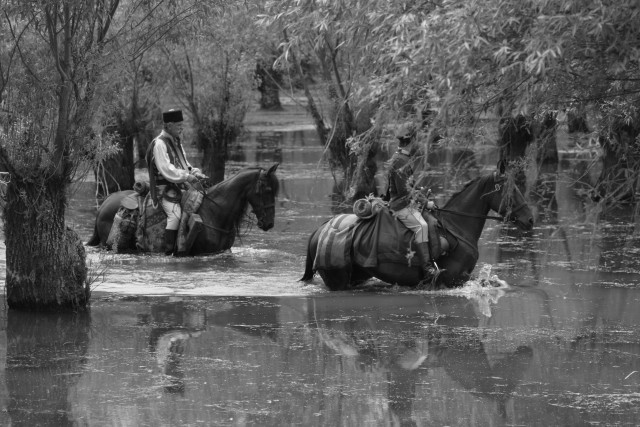
Father (Teodor Corban) and son (Mihai Comānoiu) hunt for a runaway slave in wickedly funny Aferim!
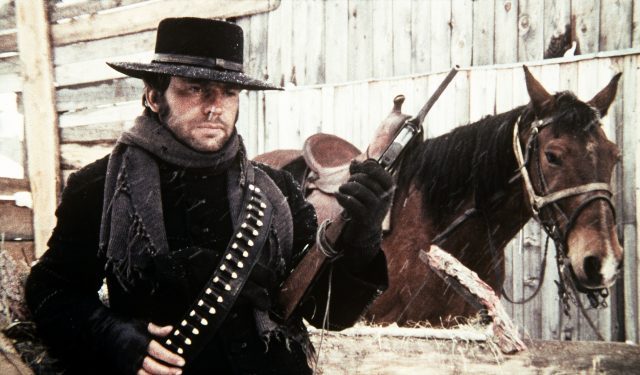
Romanian director Radu Jude won the Silver Bear as Best Director at the 2015 Berlin International Film Festival for Aferim!, his savagely funny blacker-than-black comic Western about bigotry, infidelity, and frontier justice in 1835 Wallachia. Lawkeeper Costandin (Teodor Corban) and his son, Ionitā (Mihai Comānoiu), are galloping through the local countryside, searching for runaway Gypsy slave Carfin (Cuzin Toma), who Boyar Iordache Cindescu (Alexandru Dabija) has accused of having an affair with his wife, Sultana (Mihaela Sîrbu). The surly Costandin leads the hunt, verbally cutting down everyone he meets, from random old women to abbots to fellow lawmen, with wicked barbs, calling them filthy whores, crows, and other foul names while spouting ridiculous theories about honor and religion; he even batters his son, saying he’s “a waste of bread” and that “if you slap him, he’ll die of grief.” It’s a cruel, cholera-filled time in which even the monks beat the poor, where Costandin regales a priest with the telling riddle, “Lifeless out of life, life out of lifeless,” which the priest thinks refers to the coming doomsday.
Cowritten by Jude (The Happiest Girl in the World, Everybody in Our Family) and novelist Florin Lăzărescu (Our Special Envoy, Numbness), who previously collaborated on the short film The Tube with a Hat, and shot in gloriously stark black-and-white by Marius Panduru (12:08 East of Bucharest; Police, Adjective), the Romanian / Bulgarian / Czech coproduction is an absurdist combination of Monty Python and the Holy Grail, Andrei Tarkovsky’s Andrei Rublev, Hal Ashby’s The Last Detail, and John Ford’s The Searchers, skewering everything in its path, either overtly or under its wide-reaching breath. Even Dana Pāpāruz’s costumes are a genuine riot, especially the boyar’s majestically ridiculous hat. But Aferim! is more than just a clever parody of period films and nineteenth-century Eastern European culture and social mores; it is also a brilliant exploration of the nature of racism, discrimination, misogyny, and the aristocracy that directly relates to what’s going on around the world today as well as how Romania has dealt with its own sorry past of enslaving the Romani people. Jude was inspired by real events and historical documents, setting the film immediately after the 1834 Russian occupation, which adds to its razor-sharp observations. “Aferim! is an attempt to gaze into the past, to take a journey inside the mentalities of the beginning of the nineteenth century — all epistemological imperfections inherent to such an enterprise included,” Jude says in his director’s statement. “It is obvious that such an effort would be pointless should we not believe that this hazy past holds the explanation for certain present issues.” Don’t miss this absolute gem of a film, Romania’s submission for the Academy Awards.
Alejandro Jodorowsky takes viewers on quite an acid trip in surreal Western El Topo
EL TOPO (Alejandro Jodorowsky, 1970)
Friday, July 24, 10:40
Sunday, July 26, 1:00 metrograph.com
Chilean-born French filmmaker Alejandro Jodorowsky’s El Topo is a psychedelic head trip, an acid Western that will blow your mind. Jodorowsky stars as the title character, a gunslinger traveling through a deserted landscape accompanied by his naked young son, who already knows his way around a firearm. After coming upon a town that has been decimated by a nasty group of marauders working for the Colonel, El Topo seeks violent revenge, eventually taking off with a woman and leaving his boy behind as he meets four masters on his path to proving he is the best there is. But soon El Topo is praying for redemption with a community of inbred cripples trapped in a cave.
El Topo is a wild and bizarre journey through religious imagery, romance, and vengeance, a surreal spaghetti Western strained through the mad mind of Jodorowsky, widely hailed as the creator of the midnight movie. The film melds Bergman with Leone, Tod Browning’s Freaks with Hiroshi Inagaki’s Samurai Trilogy, filtered through Kazuo Koike and Goseki Kojima’s Lone Wolf and Cub. It’s like nothing you’ve ever seen before and, despite your better instincts, will lure you into the cult of Jodorowsky.
[Mark Rifkin is a Brooklyn-born, Manhattan-based writer; you can follow him on Substack here.]
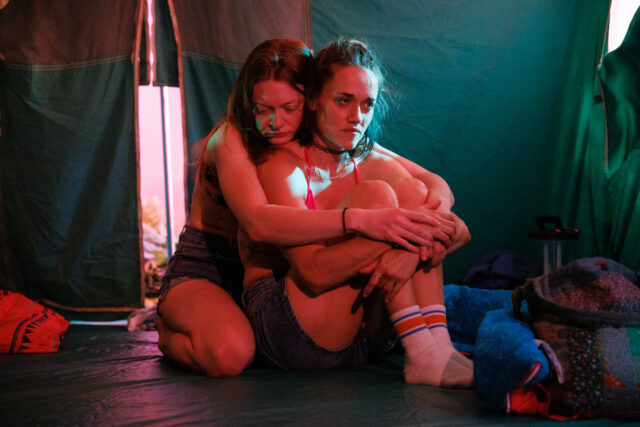
Ari (Colby Minifie) and Brit (Alice Kremelberg) hold on to each other for dear life in Victoria Lynne Barclay’s Camping (photo by Maria Baranova)
CAMPING
HERE Arts Center
Dorothy B. Williams Theatre
145 Sixth Ave.
Tuesday – Sunday through July 11, $10.50-$126 (GA $31.50) here.org coltcoeur.org
My decades of camping with grade school and junior high besties — all guys — were never quite like this.
Victoria Lynne Barclay’s Camping is an intense, exhilarating, frustrating, and moving story of female friendship that unfolds in the same green tent over the course of many years as two women who’ve known each other since infancy share their hopes and dreams, choosing different paths as time progresses and their lives change — or don’t.
The two-character play begins when Ari (Colby Minifie) and Brit (Alice Kremelberg) are fifteen years old, in ninth grade, waiting for two boys to show up to relieve them of their virginity. Ari has brought a ham sandwich, condoms, and a towel for the blood.
“I just want it to be over. I want it to be like two hours from now right now,” Brit says. The girls wrestle, crack jokes, and betray their innocence — Brit admits she has never been kissed — as they contemplate what is about to happen, something that they feel destined to experience together. After it’s over, their conversation is both very funny and unsurprising — they don’t fully understand what just occurred and how they’re supposed to feel. “We should have rescheduled,” Ari says. Brit replies, “‘Hello thank you for coming-or-probably-not-coming-we’re-not-sure-we’re-going-to-check-the-condom-outside but we’re afraid we will need to reschedule.’”
They were expecting fireworks, but instead they are left wondering if sex of any kind will ever be pleasurable.
“I guess I just thought I was supposed to like find something out? Something that wasn’t sore?” Ari explains. “I thought I was supposed to, like, not learn something, just like find this, like . . . unfound part of myself.”
Three years later, they are Girl Scout troop leaders dealing with a thirteen-year-old who demands a party for getting her period, and in anger she threw her bloody towel at Brit, echoing the towel Brit had when first having sex. Not recognizing the similarities between them and the younger girls, Brit asks not so rhetorically, “Can we just leave them here in the woods?” Brit answers, “They’ll kill each other within hours. . . . Tell them it’s how they get their like, their, Wilderness Survival badge. Hunt for your food with the towel. Kill each other in cold blood and clean it up with the towel. Survive, but be forever irreversibly changed because of the towel. Then you get a cute badge.” It’s a none-too-subtle truth about women and original sin.
But soon their relationship takes a major turn when Ari casually mentions that she will be leaving the following month to go to Ohio University, which devastates Brit, who believed their plan was to stay in town and attend Shawnee State together. “Do you hate it here that much?” Brit asks. “You hate it here,” Ari counters, to which Brit argues, “We hate it here. That’s the fucking point. When you leave and I stay I’m just a miserable loser who hates her hometown. I can’t believe you didn’t tell me.”
As time goes on, Ari and Brit return to the tent at significant moments of their lives, examining the choices they’ve made — or were made for them — rehashing old wounds, and trying to find out why and where it all went astray. One choice in particular looms over them like a curse.
“Why didn’t you give your brother his tent back?” Ari asks when they are thirty. “It’s the only place in my life where anything exciting has ever happened,” Brit replies.
Ari (Colby Minifie) and Brit (Alice Kremelberg) share their hopes and dreams, along with their failures and disappointments, in Camping at HERE Arts Center (photo by Maria Baranova)
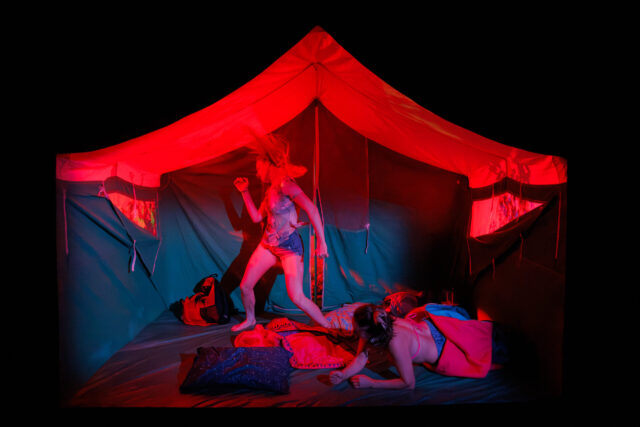
The Colt Coeur production is beautifully directed by Adrienne Campbell-Holt (Still,Eureka Day,Downstairs) in the confined, claustrophobic space of the tent, which is at the center-middle of the stage, darkness on either side, like a window the audience is peering into as if voyeurs. (The set is by Krit Robinson, with clever costumes by Sarita P. Fellows and props by Thomas Jenkeleit.) At ninety minutes, it could use some trimming, although being in the presence of these two young women is continually exciting.
Ari and Brit were born and raised in a trailer park community; the tent serves as an oasis, a hideaway from a bleak, limiting life. Vittoria Orlando’s lighting and Salvador Zamora’s sound regularly remind us, and them, that there is an outside world that the two friends are escaping from, at least temporarily, a place where they can be themselves, talk about sex, drugs, and music, about love, loss, and longing, to hold each other closely.
Kremelberg (Dry Land,& All Our Yesterdays) and Minifie (Long Day’s Journey into Night,Epiphany) have an alluring, fiery chemistry that builds as the years fly by; the time shifts are a bit awkward at first, but the two actors help smooth out the narrative bumps with small tweaks to their characters. When Ari and Brit argue over the former’s leaving, Minifie stands tall, barely fitting into the tent, as if she’ll burst through it. Later, when the latter is lamenting her situation, she practically crawls into a fetal position, almost disappearing.
In a program note, Barclay refers to the show as “a love story. It’s hands that smell of Dolce and Gabbana Light Blue after days spent clutching fistfuls of her hair. It’s the rain hitting the earth in a way that reminds you of blood, that makes you think the world’s holding a knife to your underwear. It’s the spins. It’s running out of air because you gulped too much of it while you were sobbing. It’s waking up hot and sticky. It’s desperately falling in love with your best friend inside a camping tent while everything outside rages.” She adds that she spent a lot of time in tents when she was a young bairn in Scotland, growing up and learning about life, and that’s what happens with Ari and Brit.
Camping might not be like the camping my buddies and I used to do, but it’s a trip well worth taking, one that will have you thinking about the paths you took, and those you didn’t.
[There will be talkbacks with Trans Literacy Project founder Maybe Burke following the June 27 performance and with Colt Ceur founding artistic director Campbell-Holt, Kremelberg, and Minifie after the June 30 show. Mark Rifkin is a Brooklyn-born, Manhattan-based writer; you can follow him on Substack here.]
Concrete tulip pillars welcome visitors to Little Island, which just announced its summer performance season (photo by twi-ny/mdr)
LITTLE ISLAND SUMMER SHOWS
The Amph at Little Island
Pier 55, Hudson River Park at West Thirteenth St.
July 29 – September 6, $15-$25 unless otherwise noted, 8:30 littleisland.org
In 2015, Barry Diller and Diane von Furstenberg cemented their local legacy by donating $113 million to Little Island, a lovely paradise built on the remnants of a ramshackle pier at West Thirteenth St.
Little Island is a warm and welcoming oasis rising more than 60 feet above the Hudson River; it is shaped like a large leaf, bursting with more than 350 species of flowers, trees, and shrubs, a 687-seat amphitheater for live performances known as the Amph, the Play Ground plaza where you can get food and drink, and stage and lawn space called the Glade. More than 66,000 bulbs and 114 trees were initially planted, taking into account the changing seasons and even the differences in light between morning, afternoon, and night. It all sits upon 132 concrete pillars of varying heights that resemble high heels or slightly warped tulip Champagne glasses.
Lovers of the live arts have been waiting impatiently for the announcement of Little Island’s summer schedule, and at last it is here. There are only seven presentations, so it’s not nearly as expansive as previous years, but you better act quickly, because tickets are only $15-$25 (and free for the Summer Legacy Ball). Below is the full schedule.
Wednesday, July 29
Thursday, July 30
Friday, July 31 Justin Vivian Bond: Summer’s Eve, with Justin Vivian Bond, Bernice “Boom Boom” Brooks on drums, Nath Ann Carrera on guitar, Claudia Chopek on violin, Mike Jackson on bass, and Matt Ray on piano
Saturday, August 1 Summer Legacy Ball, hosted by Qween Jean, with honorees Miss Major Griffin-Gracy, Boom Boom Balenciaga, Kiara St. James, and Brenda Continental Milan Soulja, preachers Samora Pinderhughes and Dr. Jehbreal Jackson, MCs Julz Romell and Thunda, performer Haus of Telfar, panelists Luna Luis, Tracey Africa Norman, and Mother Pandora West, ball DJ Blaize, and afterparty DJ DANIRO, free
Wednesday, August 5
through
Sunday, August 9 Anthony Roth Costanzo: Minimalism, with countertenor Anthony Roth Costanzo and different formations of Sandbox Percussion, Bryan Wagorn or Vicky Chow on piano, PUBLIQuartet, and mezzo-soprano Rachael Wilson
Wednesday, August 12
through
Sunday, August 16 Cécile McLorin Salvant: Tin Pan Alley, with different lineups including vocalists Lillias White, Cécile McLorin Salvant, and Mikaela Bennett, Billy Stritch on piano, Kyle Poole or Buddy Williams on drums, George Coleman on sax, Sullivan Fortner on piano, and Paul Sikivie on bass
Wednesday, August 19
through
Sunday, August 23 Louis Cato: The Harlem Renaissance, with bandleader Louis Cato on guitar, vocalist Catherine Russell, Louis Fouché on alto sax, Alphonso Horne on trumpet, Philip Kuehn on bass, Jeffrey Miller on trombone, Tivon Pennicott on tenor sax, Mathis Picard on piano, and Evan Sherman on drums, featuring recorded interviews with Ron Carter, Catherine Russell, and others
Saturday, August 29
and
Sunday, August 30 Julio Torres & Martine Gutierrez: Marina, conceived by Julio Torres & Martine Gutierrez, written and directed by Julio Torres, composed by Lia Ouyand Rusli, choreographed by Ryan McNamara, and starring Martine Gutierrez, River L. Ramirez, Spike Einbinder, Brandon Flynn, Scully James, and more, commissioned for the Whitney Biennial
Wednesday, September 2
through
Sunday, September 6 Thomas Bartlett: Allen Ginsberg at 100, with various configurations including curator Thomas Bartlett on piano, consultant Laurie Anderson, poet Anne Waldman, Oren Bloedow on guitar, Jason Burger on drums, vocalists Jennifer Charles and Davóne Tines, Spencer Murphy on bass, and Douglas Wieselman on sax, featuring special guests Rufus Wainwright on September 2, Bill Frisell on September 3, and others to be announced
[Mark Rifkin is a Brooklyn-born, Manhattan-based writer; you can follow him on Substack here.]
Pianist Min Kwon reimagines “America the Beautiful” at Chelsea Music Festival
CHELSEA MUSIC FESTIVAL: EVERY STORY COUNTS
St. Paul’s German Church and other venues
June 20-27, $65-$150, season pass $500 chelseamusicfestival.org
“This season, our theme, ‘Every Story Counts,’ draws inspiration from the phrase ‘Every Vote Counts,’ where each person’s vote is dignified and counted in a democracy,” 2026 Chelsea Music Festival artistic directors Melinda Lee Masur and Ken-David Masur said in a statement. “This summer, we celebrate the power of music and storytelling to preserve and elevate the voices of people from all walks of life in America. As we contemplate America’s 250th anniversary, we welcome the voices of composers, musicians, artists, chefs, and creators who contribute to the cultural fabric of this country and strive to elevate our shared humanity. Our hope is to continue providing a stage and safe haven for the exchange of ideas and differences, and a fertile ground for artistic collaborations between the performing, visual, and culinary arts.”
The seventeenth annual event, running June 20–27, consists of nine special presentations, with seventeen New York premieres and two world premieres; tickets for some are near capacity or already sold out, so you better hurry if you want to be part of this year’s fest.
Invitation to Love — Opening Night with Clara Osowski
St. Paul’s German Church
315 West Twenty-Second St.
Saturday, June 20, $85, 7:00 chelseamusicfestival.org
Mezzo-soprano Clara Osowski and pianists Dimitri Dover and Melinda Lee Masur lead a six-piece ensemble in an evening of works that explore the American immigrant experience and the poetry of Langston Hughes and Paul Laurence Dunbar, comprising Mark Carlson’s Stars — The Dream Keeper, Aaron Copland’s Three Old American Songs, Erich Wolfgang Korngold’s Three Songs, Libby Larsen’s This Unbearable Stillness: Songs from the Balcony, Reinaldo Moya’s DREAM Songs, Frederick Piket’s The Dream Keeper, Damien Sneed’s All Night, All Day and I Dream A World, and Steven Ward’s Invitation to Love.
Mark Twain–inspired Southern Sunday Brunch
City Winery Bistro
25 Eleventh Ave.
Sunday, June 21, $100, 12:30 chelseamusicfestival.org
Food and drink aren’t the only things on the menu at this City Winery brunch with Melinda Lee Masur and Ken-David Masur, joined by director, writer, and producer Bill Barclay for a talk about the making of Copland & Twain (see below), along with music by violinists Yuyu Ikeda and Carlos Rafael Martinez Arroyo. Oh, yes, there is food and drink as well; the menu features buttermilk biscuits, buttermilk fried chicken and waffle, farm egg scramble, Saratoga potatoes, heirloom tomato, and warm apple pie.
America/Beautiful
St. Paul’s German Church
315 West Twenty-Second St.
Monday, June 22, $65, 7:00 chelseamusicfestival.org
During the pandemic, pianist Min Kwon initiated her America/Beautiful project, in which she asked more than seventy composers around the country, “What is America — is it beautiful, was it ever, or will it ever be?” Some of the results will be heard when she teams up with pianists Timo Andres, Chaihun Kim, and Jorges Tabarés and violinist Claire Bourg to perform America-themed works by Stewart Copeland, Vijay Iyer, Nico Muhly, and others, accompanied by landscape photography by Park Joon.
Verona Quartet at Poets House
Poets House
10 River Terr.
Tuesday, June 23, pay-what-you-wish, 7:00 chelseamusicfestival.org
The Verona Quartet — Jonathan Ong and Dorothy Ro on violin, Abigail Rojansky on viola, and Jonathan Dormand on cello — perform Philip Glass’s String Quartet No. 2 “Company,” George Walker’s Lyric for String Quartet, Jerod Impichchaachaaha’ Tate’s MoonStrike, and arranger Peter Myers’s Twenties Tunes Jazz Suite, with narration by Byron Singleton and poetry from Wayne Koestenbaum, followed by a wine reception.
American Street Food Stories with Chef Hinnerk von Bargen
St. Paul’s German Church
315 West Twenty-Second St.
Wednesday, June 24, $75, 7:00 chelseamusicfestival.org
CIA professor and Street Foods author Hinnerk von Bargen hosts an evening of culinary delights from street food stalls, including sloopy bun, curry wurst, cold Sichuan-style sesame noodles, and fruit sandos.
Aaron Copland and Mark Twain join forces in unique theatrical concert
Copland & Twain — A Theatrical Concert
Open Jar Studios
1601 Broadway, floor 11
Thursday, June 25, $150, 7:00 chelseamusicfestival.org
One of the highlights of the festival is Bill Barclay’s Copland & Twain — A Theatrical Concert, a genius pairing of Brooklyn-born composer Aaron Copland and Missouri-born humorist Samuel Langhorne Clemens, better known as Mark Twain. Their lives barely overlapped — Copland was nine when Twain died in 1910 at the age of seventy-four — but writer-director Barclay and Concert Theatre Works have produced an evening that brings together Copland’s Music for the Movies and Music for the Theater and Twain’s Diaries of Adam and Eve, performed by the Festival Chamber Orchestra, conducted by Ken-David Masur, and actors Caleb Mayo, Chloe McFarlane, Maurice Emanuel Parent, Robert Walsh, and Carson Elrod, in costumes by Arthur Oliver.
“This program began by imagining how to publicly go about celebrating America’s 250th anniversary. How could this event serve such a polarized time in our history? I have always been moved by some of the traditional American tunes and hymns, but the state of our country called for something else, something I couldn’t quite identify at first,” Barclay explains. “I now realize that for some reason or other, I wanted to laugh. I wanted to release energy, not summon it. I wanted the community of joy, not the burden of politics. And it seemed that avoiding politics entirely was ignoring the elephant in the room. A symphony audience today may be one of the last public spaces of American life that is truly politically heterogeneous. Classical music plays to Republicans, Democrats, and Independents alike. This prompts a follow-up question: Is there a way we can laugh about ourselves without excluding people?”
Shelters in the Desert — An Evening with Vu, León, Susman, Smirnóv, Hernández
St. Paul’s German Church
315 West Twenty-Second St.
Friday, June 26, $85, 7:00 chelseamusicfestival.org
Water, memory, and transformation are the underlying themes of Shelters in the Desert, in which the Festival Chamber Orchestra, conducted by Ken-David Masur, plays Ania Vu’s Water Realms, Tania León’s Esencia — I. Agua de Florida for strings, Grigóry Smirnóv’s Impromptu, J. E. Hernández’s Desert Shelter, and William Susman’s Clouds and Flames, the last piece inspired by Philippe Petit’s 1974 tightrope walk between the Twin Towers; a reception follows.
Family Event: Every Storybook Counts
St. Paul’s German Church
315 West Twenty-Second St.
Saturday, June 27, free with RSVP, 10:30 am chelseamusicfestival.org
American composers are celebrated in this interactive family-friendly morning with Paul Collins, the creator of the Unbannable Library.
Jazz Finale: Warren Wolf plays Chick Corea
St. Paul’s German Church
315 West Twenty-Second St.
Saturday, June 27, $85, 7:00 chelseamusicfestival.org
The 2026 Chelsea Music Festival concludes with a jazz finale celebrating the life and career of multi-instrumentalist legend Chick Corea, who died in 2021 at the age of seventy-nine. Vibraphonist Warren Wolf and pianist Alex Brown, joined by the Ivalas Quartet (violinists Tiani Butts and Reuben Kebede, violist Marcus Stevenson, cellist Pedro Sanchez), will perform Brown’s The Old Line and the New York premiere of Corea’s Lyric Suite for Sextet, with a reception to follow.
[Mark Rifkin is a Brooklyn-born, Manhattan-based writer and editor; you can follow him on Substack here.]
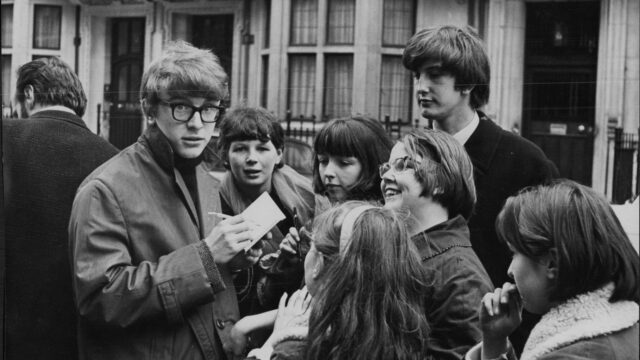
Peter Asher signs autographs with Gordon Waller, as seen in Peter Asher: Everywhere Man
PETER ASHER: EVERYWHERE MAN (Dayna Goldfine & Dan Geller, 2025)
Quad Cinema
34 West 13th St. between Fifth & Sixth Aves.
Opens Thursday, June 18 quadcinema.com thefilmcollaborative.org
Peter Asher: Everywhere Man is so utterly engaging and delightful, so happy-making and surprising, that I actually wanted to crawl inside the screen and enter Peter Asher’s extraordinary life.
In Terry Gilliam’s 1988 film The Adventures of Baron Munchausen, John Neville stars as the title character, who tells a fanciful, impossible-to-believe story based on Rudolf Erich Raspe’s 1785 collection The Surprising Adventures of Baron Munchausen, consisting of heavily embellished tall tales loosely inspired by the real-life eighteenth-century German nobleman Hieronymus Karl Friedrich Freiherr von Münchhausen, whose name was given to the mental disorder Munchausen syndrome, a subtype of factitious illness in part characterized by, according to the National Library of Medicine, “pseudologia fantastica, a pattern of fabricating detailed falsehoods regarding personal history, education, and achievements.”
In the extraordinary documentary Peter Asher: Everywhere Man, the title figure tells his fanciful, impossible-to-believe story — but in this case, it’s all remarkably true, including that his father, endocrinologist Dr. Richard Asher, is credited with introducing the term “Munchausen syndrome.”
Born in England in 1944, Asher has lived a charmed, and charming, life. He and his sisters, Jane and Clare, three redheads, were child actors affectionately known as the Carrots of Wimpole Street. At Westminster School, he met Gordon Waller, a fellow guitarist, and they formed a duo, Peter and Gordon, who joined the British Invasion and scored a series of huge hits, anchored by “A World without Love,” written for them in 1964 by Jane’s boyfriend, Paul McCartney, who was living in the Asher home at the time. Other songs followed: “I Don’t Want to See You Again,” “Woman,” “I Go to Pieces,” and “Nobody I Know,” and they appeared on The Ed Sullivan Show. Asher’s mother, Margaret, was an oboist and professor who taught music to George Martin, the Beatles’ innovative producer.
Asher opened the highly influential Indica bookstore and gallery, where John Lennon met Yoko Ono. After serving as head of A&R for Apple Records, he became producer and then manager of a rising young folk singer named James Taylor, which led to him working with Linda Ronstadt, Carole King, and so many others (Diana Ross, Cher, Neil Diamond, Morrissey, Elton John, Rodrigo y Gabriela, 10,000 Maniacs, Robin Williams). He threw the party at which Mick Jagger and Marianne Faithfull fell in love, even though she was married to one of Asher’s Indica partners, John Dunbar. He put together backing bands with such musicians as King, bassist Leland Sklar, guitarists Danny “Kootch” Kortchmar and Waddy Wachtel, multi-instrumentalist Andrew Gold, and drummer Russ Kunkel, and he listed them on albums, something that previously was not done on pop records. And he did all of it with little or no training, just thriving on improvisation and experience.
“I think that Peter just got better and better at what he did,” Kortchmar says in the film. “Producing is a very broad term. Sometimes it means he’s a musical prodigy, and sometimes it means he’s a social worker or a therapist. And sometimes it means he or she just enables somebody who’s musically gifted to do their thing and get out of the way. And I think he probably can wear any of those hats.”
Directors and producers Dayna Goldfine and Dan Geller structure the documentary around Asher’s cabaret show, A Musical Memoir of the ’60s and Beyond, which they saw in December 2019 with Ronstadt. In the multimedia performance, Asher narrates his story and sings various songs with a band, along with projections of archival photos and videos. Editor Darren Lund intercuts new interviews with Monty Python veteran and The Adventures of Baron Munchausen costar Eric Idle, Steve Martin, Lyle Lovett, McCartney (voice), Twiggy, Kortchmar, Pattie Boyd, Paul Jones (Manfred Mann), Taylor and his sister Kate, Rolling Stone journalist Ben Fong-Torres, Indica cofounders Dunbar and Barry Miles, Natalie Merchant, and Asher’s longtime personal assistant, Chris O’Dell, among others, in addition to clips from a 2006 interview of Waller. They also follow Asher around London as he gives a tour to his daughter, Victoria.
Asher is generous with his time, although every now and then he prefers not to go into deep detail. When he is asked about drugs back in the 1960s and ’70s, he admits that he partook, although Ronstadt points out, “Cocaine was a lot of fun but it ruined everything.” Meanwhile, he had the unique ability to go where the action was, or create it himself.
Peter Asher relaxes in his office surrounded by many of his successes in an extraordinary career
Throughout it all, Asher, with his shock of bright red hair and dapper style, seems to have remained a warm, gentle, and caring individual who would do whatever it takes for his clients and friends, without seeking stardom for himself, at least since Peter & Gordon broke up in 1968. However, Wachtel states, “He’s a ham like the rest of us.”
“I suppose I do have this sort of generally optimistic view of what I set my hand to seems to work out okay, and I don’t think it’s necessarily to my credit at all,” he says humbly. “I think it could all just be a series of fortunate circumstances. But I’ve never really known what I was going to be doing next.”
Asher, a three-time Grammy winner and CBE (Commander of the British Empire), has touched so many people around the world over the last seven decades, whether they realize it or not, and it’s to his credit that he doesn’t get caught up in that, although he is clearly proud of his nearly endless accomplishments, as he should be. The film, to its credit, captures that beautifully. Asher was so often in the room where it happened, and is still happening, and Goldfine and Geller bring audiences into those very rooms.
Peter Asher: Everywhere Man opens June 18 at the Quad, with Goldfine and Geller (The Galapagos Affair: Satan Came to Eden,Hallelujah: Leonard Cohen, a Journey, a Song) participating in Q&As following the screenings on June 18 at 7:15 (moderated by Alan Light), June 19 at 7:00 (Dennis Elsas), June 20 at 7:00 (Joe Neumaier), and June 21 at 2:30 (Neumaier). You can find a Spotify playlist for the film here.
[Mark Rifkin is a Brooklyn-born, Manhattan-based writer; you can follow him on Substack here.]
Four teen girls explore their lives through music in world premiere play by Eisa Davis (photo by Carol Rosegg)
||: GIRLS :||: CHANCE :||: MUSIC :||
Vineyard Theatre
Gertrude and Irving Dimson Theatre
108 East 15th St. between Union Square East & Irving Pl.
Tuesday – Sunday through June 21, $37.80-$106.92 www.vineyardtheatre.org
Eisa Davis’s ||: Girls :||: Chance :||: Music :|| unfolds like an improvisatory jazz theatrical piece, transforming the concept of the creation and playing of music into subtle and not-so-subtle metaphors about growing up and making choices. It explores chaos and empathy, education and impermanence, and building — or not building — family and community, with time jumps and forays into alternate realities.
If you’re one of the first twelve people entering the Vineyard Theatre, you’ll be offered the opportunity of selecting a note on a keyboard chart that will, when done, form a unique tone row for that night’s performance, serving as the underlying musical theme. The cast will develop it at the start of the play, asking the audience to participate, and the tune will make appearances later on as well.
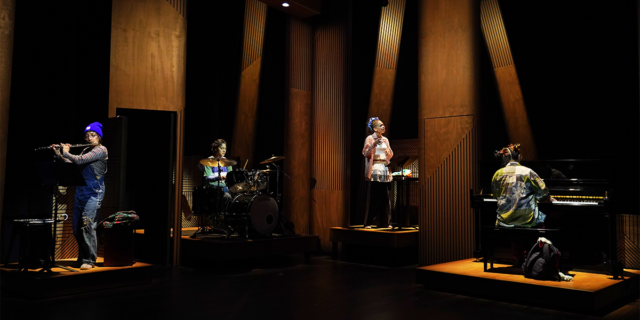
The show follows four teenagers of color as they prepare for their final project at a girls summer music program in Berkeley. Clementine (Gianna DiGregorio Rivera) is a straightforward flutist who mostly stays in the background; Fax (Hillary Fisher) is a vocalist who always prefers to have a plan; Margot (Naomi Latta) is a wildly unpredictable drummer; and Rile (Yeena Sung) is a pianist who enjoys experimenting.
Early on, Rile is playing the end of “Una Voce Poco Fa” from Rossini’s The Barber of Seville when she makes a mistake and improvises around it, completely throwing Fax off. “I mean it’s about being intentional with your juxtaposition,” Fax says, clearly unhappy. Rile responds, “Putting things together that don’t seem like they’ll fit.” Soon after, Fax declares, “Don’t do random shit onstage that’s different from what we practiced.”
Over the course of 105 minutes, the four characters face such issues as race, class, gender, and sexuality as they try to find their place not only in music but in the world itself, one filled with trouble and danger. “I love getting up in the morning to come here — when the world feels like one disaster after another,” Fax says.
Margot later explains, “Quake wasn’t random and it wasn’t planned / just cause and effect from billions of years ago to now / we’re given an effect and we get to make a new cause with it / which makes a new effect and / it’s a chain / a network of exchange.”
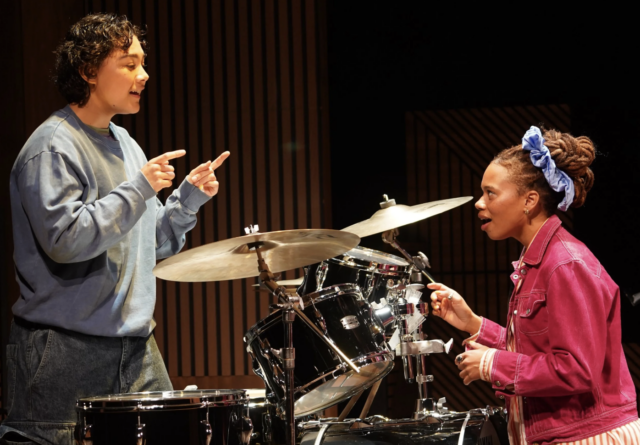
Margot (Naomi Latta) and Fax (Hillary Fisher) form a unique bond in ||: Girls :||: Chance :||: Music :|| (photo by Carol Rosegg)
Nina Ball’s set consists of four small platformed music sections, one for each character, surrounded by angled columns that harken back to Greek tragedy; it evokes how the girls are four distinct individuals who can benefit from working together as a kind of band instead of on their own, like in life. Loneliness is a leitmotif. When Margot and Fax art talking about being artists — and human beings — Margot advises, “We’re supposed to do things we’re not supposed to do . . . you have to go out on a limb to do anything crucial,” but Fax replies, “But then you’re like lonely.” Fax has a home to go back to, one that seems to be growing by the day, while Margot is much more on her own.
Mel Ng’s costumes change often, with cool little touches that at first define the characters by specific color schemes. Russell H. Champa’s lighting gives each of the girls their personal moment to take center stage. It’s a strong, talented ensemble, like a tight-knit jazz quartet, although the narrative does occasionally meander off track, becoming too abstract, but it always finds its way back to the melody. Fisher (The Notebook,Between the Lines) and Latta, in her impressive off-Broadway debut, play off each other with a gorgeous rhythm, with Sung (Mary V,Comfort Women: A New Musical) riling things up just enough as Rile, and Rivera, in her off-Broadway debut, providing the right elements as the ending approaches.
Produced by the Vineyard in conjunction with American Conservatory Theater, ||: Girls :||: Chance :||: Music :|| is conducted — er, directed — with an understanding, guiding hand by Tony winner Pam MacKinnon (Clybourne Park,Who’s Afraid of Virginia Woolf?), who turns Davis’s (Bulrusher,The Essentialist) complex script into a mini-symphony.
It is both a perplexing and rewarding play, weaving in and out of time and reality, expectations and desires, as four teenagers contemplate — or don’t — what’s waiting for them around the corner, and what their role in taking those next steps might be.
[Mark Rifkin is a Brooklyn-born, Manhattan-based writer and editor; you can follow him on Substack here.]