THE DEMOCRACY PROJECT
Federal Hall National Memorial
15 Pine St. at Nassau St.
Tuesday – Saturday through July 22, free
federalhall.org
I had a rather telling kickoff to the long Independence Day holiday weekend.
On July 4, 1776, the Declaration of Independence was ratified by the Second Continental Congress in Philadelphia. It wasn’t until 1870 that it was made an unpaid holiday for federal employees; it became a paid federal holiday in 1938, leading to barbecues, parades, fireworks, and retail sales specials.
The preamble to the document begins, “We hold these truths to be self-evident, that all men are created equal, that they are endowed by their Creator with certain unalienable Rights, that among these are Life, Liberty and the pursuit of Happiness.” For 247 years, that’s been a nonstop roller coaster ride for many Americans.
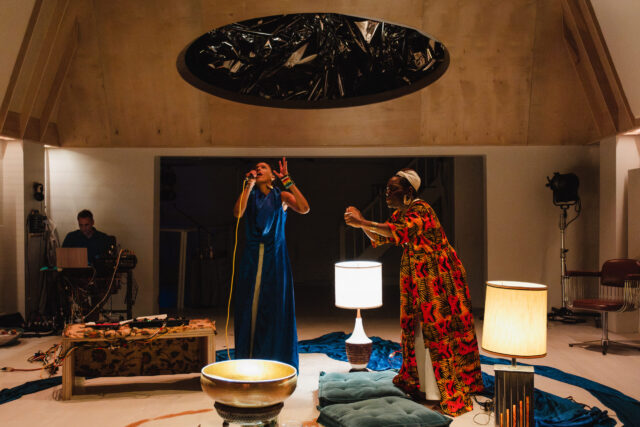
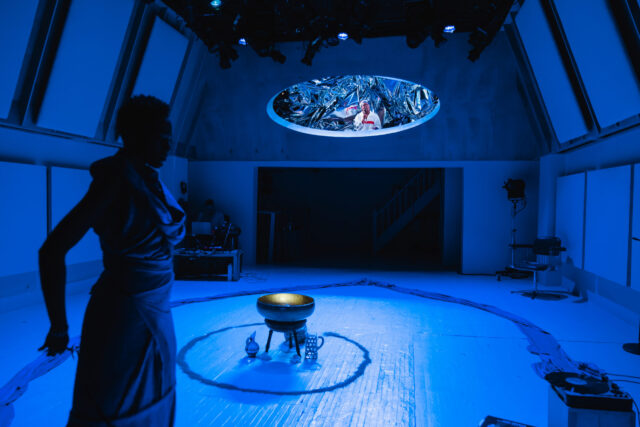
After working half a day on Friday, I went to Federal Hall National Memorial on Pine St. to see The Democracy Project, a new site-specific play written by six award-winning writers. The forty-five-minute show was commissioned by the Federal Hall Conservancy, which brings “together the nation’s finest storytellers and scholars, writers and artists, poets, playwrights, and pundits to probe the ideas and ideals, flaws and contradictions of our democracy, a Constitutional experiment, which began at Federal Hall in 1789.”
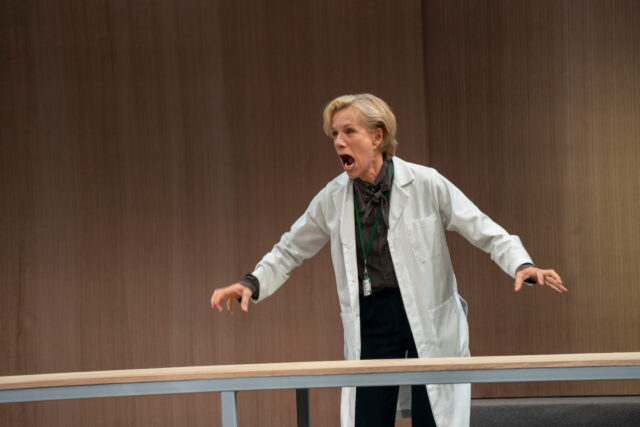
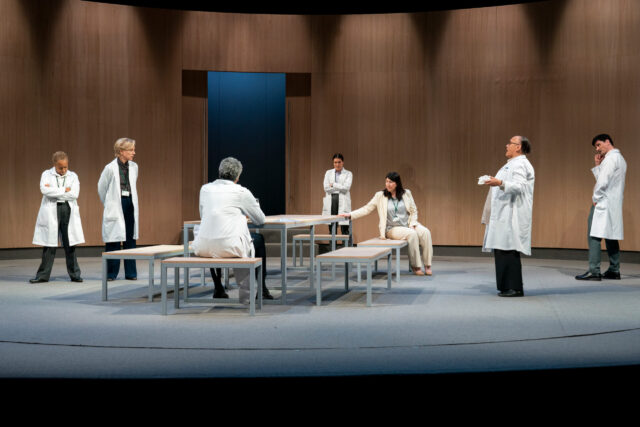
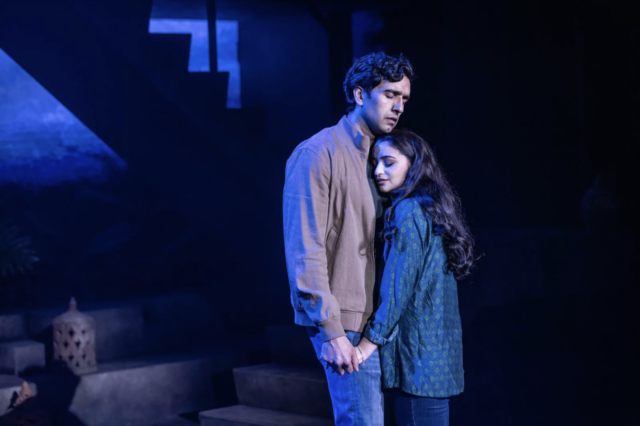
Federal Hall was America’s first capitol building, where George Washington was inaugurated as the first president on April 30, 1789. The story starts just before that, as George (Tom Nelis) debates what he will say in his speech and what he will wear when he delivers it. Also sharing their thoughts are George’s wife, Martha (Erin Anderson); future president James Madison (Anderson); Henry Knox (Anderson), the first secretary of war; Muscogee leader Alexander McGillivray (Jake Hart); Billy Lee (Nathan Hinton), George’s enslaved valet; Ona Judge (Tatiana Williams), Martha’s enslaved maid who was born into slavery at Mount Vernon; and a southern senator (Hart) who talks turkey with George. The cast also portray themselves as a troupe putting on a show about democracy in historic Federal Hall; when it is announced that one actor has just called in sick, an IT employee named Alicia (Williams) is called into action, handed a script, and told to just do her best, which is the American way. Alicia, who is Black, adds sharp commentary throughout regarding the treatment of Blacks since 1619 through to today — literally that day, June 30, 2023.
Deb O’s set includes replicas of George’s, Martha’s, and Madison’s beds, Chief McGillivray’s regalia, a velvet wingback club chair, and the pedestal on which stands the statue of George Washington outside on the steps of Federal Hall; Deb O also designed the period costumes. Among the topics that are raised are ensuring that the new country is not a monarchy like England, that there should be a separation between church and state, how Blacks should count as only three-fifths of a person, the Bill of Rights, and the notion of freedom itself. Around the circular space are various artifacts that are always on display at the historic hall, which was built as a Greek Revival–style Custom House that opened in 1842 following the demolition of the original structure in 1812 when it was no longer needed.
About halfway through the show, shortly after Billy Lee learns that he won’t be freed until George’s death and that Ona won’t gain her freedom until Martha passes — Hinton was rolling a tea cart when a large glass object fell off and shattered in the middle of the floor, shards scattered across a significant portion of the set. The audience — eighty people sitting on five rafters of four wooden benches each — held its collective breath for a moment, wondering whether this was part of the plot. It wasn’t.
One of the stage managers quickly ran to a room in the back, emerging a few minutes later with a broom and dustpan. Meanwhile, the play continued, with each actor bending down to pick up a few pieces of broken glass without pausing the narrative. At one point, it looked like Williams, as Ona, was going to be given the job of sweeping up the breakage, but fortunately that didn’t happen; I couldn’t help but think how awful that would have been, making a Black actress playing an enslaved maid and a modern-day techie clean up the mess.
However, the accident worked within the context of the play, representing the shattering of so many dreams of freedom of Black, brown, and Indigenous people in America. Later, the song “Democracy Is Messy,” by Tony and Pulitzer Prize winner Michael R. Jackson (A Strange Loop), took on an added meaning because of the incident. The show’s other writers, who collaborated on everything together, are WGA Award winner Tanya Barfield (Bright Half Life, Mrs. America), Pulitzer finalist Lisa D’Amour (Ocean Filibuster, Airline Highway), MacArthur Genius Grant recipient Larissa FastHorse (For the People, The Thanksgiving Play), Obie winner Melissa James Gibson (What Rhymes with America, House of Cards), and Tony and Pulitzer winner Bruce Norris (Clybourne Park, Downstate).
With all that talent, it’s a shame the play, directed by Tamilla Woodard (La Ruta, Men on Boats) and Tai Thompson (Dark Star from Harlem, Kleonostium) isn’t more provocative; instead, it caters too much to history aficionados and tourists, avoiding hard-hitting controversy. But it makes its points, and the cast, led by Williams (Confederates, The Legend of Georgia McBride) and Nelis (Girl from the North Country, Indecent) and also including Renata Eastlick and Joel Van Liew, is extremely friendly and likable.
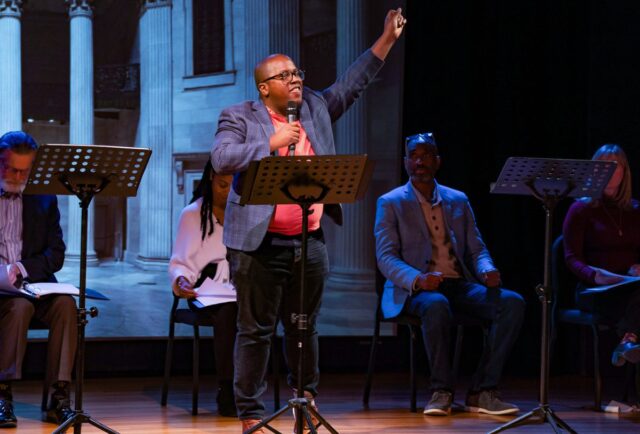
Michael R. Jackson previews “Democracy Is Messy” at Works in Process at the Guggenheim in 2022 (photo by Titus Ogilvie Laing)
When I got home, I was overwhelmed by the news that the Supreme Court had voted 6–3 in favor of Lorie Smith in the case of 303 Creative LLC v. Elenis et al., in which Smith sued in order to allow her to refuse to design wedding websites for same-sex couples — even though the situation had never arisen. In his opinion of the court, Associate Justice Neil Gorsuch wrote, “Like many States, Colorado has a law forbidding businesses from engaging in discrimination when they sell goods and services to the public. Laws along these lines have done much to secure the civil rights of all Americans. But in this particular case Colorado does not just seek to ensure the sale of goods or services on equal terms. It seeks to use its law to compel an individual to create speech she does not believe.”
In her dissent, Associate Justice Sonia Sotomayor, joined by Associate Justices Elena Kagan and Ketanji Brown Jackson, argued, “Around the country, there has been a backlash to the movement for liberty and equality for gender and sexual minorities. New forms of inclusion have been met with reactionary exclusion. This is heartbreaking. Sadly, it is also familiar. When the civil rights and women’s rights movements sought equality in public life, some public establishments refused. Some even claimed, based on sincere religious beliefs, constitutional rights to discriminate. The brave Justices who once sat on this Court decisively rejected those claims.”
The day before, the court had struck down President Biden’s student debt relief plan and ruled in Students for Fair Admissions, Inc. v. President and Fellows of Harvard College in favor of “race-neutral” college admissions, effectively getting rid of affirmative action in higher education. In 1983, future justice Clarence Thomas, who had benefited himself from affirmative action, told the Equal Employment Opportunity Commission that “God only knows where I would be today” without laws that were “critical to minorities and women in this society.” In his Students for Fair Admissions concurring opinion, Thomas asserted, using the term race-neutral several times, “I write separately to offer an originalist defense of the colorblind Constitution; to clarify that all forms of discrimination based on race — including so-called affirmative action — are prohibited under the Constitution; and to emphasize the pernicious effects of all such discrimination.”
In her blistering dissent, Justice Jackson wrote, “No one benefits from ignorance. Although formal race-linked legal barriers are gone, race still matters to the lived experiences of all Americans in innumerable ways, and today’s ruling makes things worse, not better. The best that can be said of the majority’s perspective is that it proceeds (ostrich-like) from the hope that preventing consideration of race will end racism. But if that is its motivation, the majority proceeds in vain. If the colleges of this country are required to ignore a thing that matters, it will not just go away. It will take longer for racism to leave us. And, ultimately, ignoring race just makes it matter more.”
Admission is free to The Democracy Project, but it appears that reserving advance tickets through the website doesn’t matter; when I arrived with my QR code, there was no one checking it. Most of the attendees just walked in and sat down, many clearly without RSVPs. When I asked one of the stage managers what would have happened if I had shown up and there were no seats left, she replied, “You can reserve tickets online?”

EISENHOWER: THIS PIECE OF GROUND
Theatre at St. Clement’s
423 West 46th St. between Ninth & Tenth Aves.
Thursday – Monday through August 20, $55-$125
www.eisenhowertheplay.com
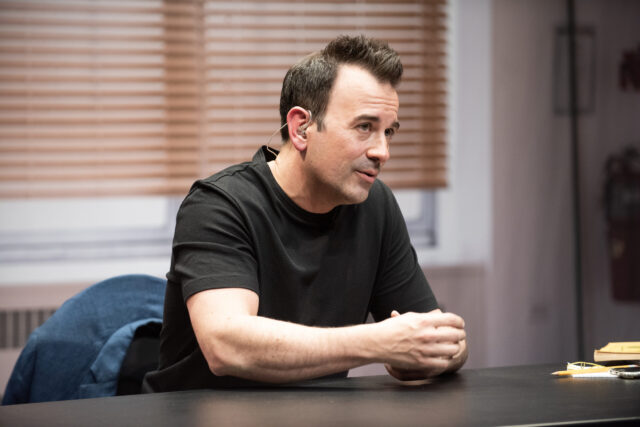
That night I headed to the Theatre at St. Clement’s to see Eisenhower: This Piece of Ground, Richard Hellesen’s new one-man bioplay in which Tony winner John Rubinstein portrays Dwight D. Eisenhower, the thirty-fourth president of the United States. The banner ads for Eisenhower and The Democracy Project are both prominently designed in red, white, and blue, with stars on them. It’s August 1962, and the seventy-one-year-old Eisenhower is at the family farm in Gettysburg working on his next memoir, about his time in the White House (1953–61). The show kickstarts with a prayer — it does take place in a church, after all — in which Eisenhower wishes, “May cooperation be the mutual aim of those who, under our Constitution, hold to differing political faiths, so that all may work for the good of our beloved country. The strength of free people lies in unity; their danger, in discord.”
Eisenhower is furious that the New York Times Magazine has just published the article “Our Presidents: A Rating by 75 Historians. Great, Near Great, Average, Below Average, and Failure,” in which Ike finished twenty-second out of thirty-one. (Some presidents were not included because of length of tenure and other reasons.) For 110 minutes (with intermission), Eisenhower provides a stark rebuttal to the claims made in the article, defending his record and the choices he made in Washington, DC. He quickly points out that when he was asked to run for the office, he was not even a member of a party. “Now, I did everything I could to stay out of politics — didn’t even choose a party. I wasn’t going to be called a Republican or a Democrat ’til I knew that one of ’em, at least, stood for things I thought were important to this country. Whatever the party, if you don’t have your foundation in causes that are right, and moral, you’re not a political party at all — you’re just a conspiracy to seize power.”
Many of his pronouncements, which are adapted from speeches, literature, and letters, are eerily relevant to what is happening in today’s America. He talks about his role in helping the civil rights movement (“Under the law, there cannot be any second-class citizens in this country. Period.”); battling Sen. Joe McCarthy’s hunt for Communists (“It wasn’t about loyalty to the country — it was about using fear to set up loyalty to Joe McCarthy.”) and the America First movement; railing against McCarthy’s “weasel assistant” Roy Cohn, who was in charge of banning books, among other things; meeting with Russian premier Nikita Khrushchev at the farm, seeking to limit nuclear weapons; trying to protect the Little Rock Nine, Black students who had to wind through a violent white mob just to go to school; discussing visiting his first concentration camp and deciding then and there to have it filmed (“So if anyone ever dared to say, oh, those stories of Nazi brutality are just propaganda, we could show ’em the truth.”); surmising that his vice president, Richard Nixon, was probably done after losing the presidency to John F. Kennedy; and attempting to pass a voting rights act that Sen. Lyndon B. Johnson ultimately gutted.
Nearly every one of those points relates directly to twenty-first-century America, as politicians and lobbyists rip up the Civil Rights Act of 1964, US governors make it illegal for certain books and subjects to be taught in schools, anti-Semitism and white nationalism are on the rise, and former president Donald J. Trump, whose heroes include Cohn, calls his haters Communists (and nastier insults), supports Russian president Vladimir Putin, promotes an America First mentality, and has praised and promised to pardon a violent mob that stormed the Capitol on January 6, 2021.
Directed by Peter Ellenstein (Assassins, Rocket to the Moon), the New Los Angeles Repertory Company production maintains a fairly even tone throughout but would benefit from a few more oomph moments; it occasionally gets confusing whenever Eisenhower, who is making an audiotape response to the Times Magazine article, looks out into the audience, as if he knows we are there even though he is actually speaking into the recording machine. In his first solo play, the seventy-six-year-old Rubinstein (Pippin, Children of a Lesser God) is confident and determined as the title character; he might not look and sound exactly like Ike, but he inhabits the role with grace and elegance.
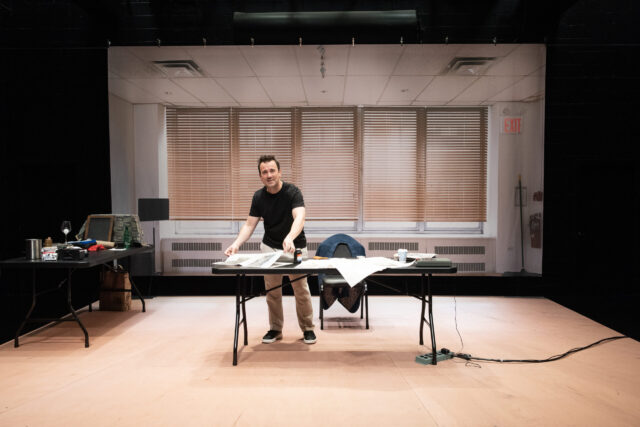
Michael Deegan and Sarah Conly’s set is a re-creation of Eisenhower’s study at the farm, complete with five chairs, a main desk, an easel where Ike painted, and a backdrop that serves as a window to the vast expanse of the family’s land. The projections are by Joe Huppert, who adds archival footage of Eisenhower’s family, from his parents to his siblings to his own children and grandchildren, as well as other historical figures and episodes mentioned in the play.
It was impossible for me not to think about the Supreme Court, racism, anti-Semitism, ethnocentricity, classism, education, and the dismantling of the separation between church and state when Eisenhower, who died in 1969 at the age of seventy-eight, says about the segregated army, “You’d’ve had to be blind not to see how the country was going to have to change after the war, if those words ‘liberty and justice for all’ that we’d just fought for meant anything. We had to work toward a time when there would be no discrimination, of any kind. And I tried to do that, as far as I felt I could.”
Those issues go back to the start of this supposedly “more perfect Union,” when Gen. George Washington was sworn in as the first president of the United States of America, declaring from a balcony at Federal Hall in New York City, “I shall again give way to my entire confidence in your discernment and pursuit of the public good; for I assure myself that whilst you carefully avoid every alteration which might endanger the benefits of an united and effective government, or which ought to await the future lessons of experience, a reverence for the characteristic rights of freemen and a regard for the public harmony will sufficiently influence your deliberations on the question how far the former can be impregnably fortified or the latter be safely and advantageously promoted.”
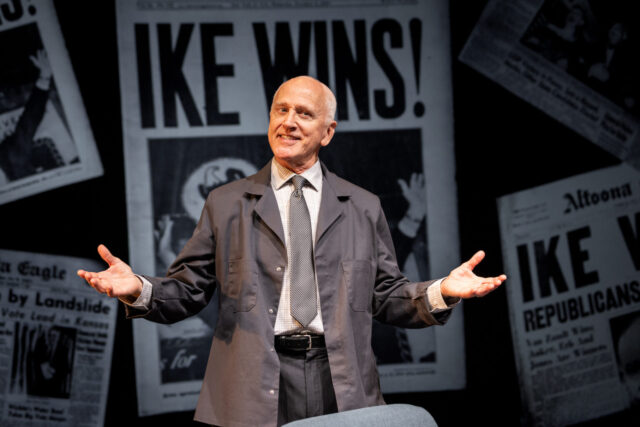
John Rubinstein portrays Dwight D. Eisenhower in new play (photo by Maria Baranova)
Meanwhile, this Fourth of July, the New York government is already circulating an alert regarding the air quality on Independence Day as smoke from the Canadian wildfires descends on the state again. “It is impossible for us to predict what will happen for the holiday celebrations on Monday and Tuesday the Fourth, but, again, we’re asking people to be very, very vigilant before you plan your outdoor activities: Know what the numbers are, know the precautions you can take, because otherwise it may seriously have an effect on you.” The air quality — which many contend has nothing to do with climate change despite mounting evidence to the contrary — also might impact the fireworks themselves. Even though I live only a few blocks from where the barges will be on the East River, I might not be able to see the display at all, only smoke.
As they sing in The Democracy Project, “Democracy is messy / And everybody’s dream is not the same / So we push up the hill / And we do our best to play an unfair game.”
Democracy might be inherently messy and a Sisyphean task, but it’s in serious danger right now as we, the citizens of this republic, having been handed down the responsibilities to keep this Great American Experiment on track, keep insisting instead on ripping it apart, refusing to pick up the pieces and put it back together again. The Democracy Project was commissioned for the New Day at Federal Hall initiative celebrating America’s 250th birthday in 2026, but there’s no guarantee what the country will be like by then, who will be president and what they will stand for, and against.
Happy Fourth, everyone!
[Mark Rifkin is a Brooklyn-born, Manhattan-based writer and editor; you can follow him on Substack here.]