featured

COMING TOGETHER: REAL TALK FROM WOMEN SCULPTORS

Five women sculptors will gather for special discussion at New York Academy of Art on October 28

WOMEN SCULPTORS: REAL TALK
New York Academy of Art
111 Franklin St. between Sixth Ave. & West Broadway
Tuesday, October 28, 6:30
nyaa.edu

On October 28 at 6:30, the New York Academy of Art is hosting the free public forum “Women Sculptors: Real Talk,” a gathering of five women sculptors who will be discussing the state of art in contemporary culture, exploring celebrity commissions, traveling solo exhibitions, social-media uproar, and more.

NYAA sculpture department chair and sculptor Nina Levy will moderate the panel, which includes Vinnie Bagwell, Meredith Bergmann, Donna Dodson, and Barbara Segal. Levy specializes in large-scale realistic depictions of humans (cast clay, polyester resin), Bagwell in figurative African American statuary (bronze), Bergmann in sociopolitical representational works (bronze, plaster, marble, clay), Dodson in the relationship between humans and animals (wood), and Segal in works with a feminist take on consumer culture (marble, steel, onyx, fused glass, aluminum). The artists have been gathering online for the past year to share their observations regarding the state of the contemporary art world.

“In our monthly zoom meetings, our group of five women sculptors, with over two hundred years of collective art world experience, engages in conversations in order to be generous and listen to one another, learns from each other, helps each other network, connects to new technologies, supports one another through tough times, and celebrates our triumphs as we each face the challenges that come with navigating galleries and collectors, municipalities and public art commissions,” Dodson told twi-ny.

It should be fascinating to see these five artists finally in the same room together, speaking face-to-face; admission to what should be a lively event is free.

[Mark Rifkin is a Brooklyn-born, Manhattan-based writer and editor; you can follow him on Substack here.]

WHAT’S GOING ON? GINGER TWINSIES AND HEATHERS THE MUSICAL

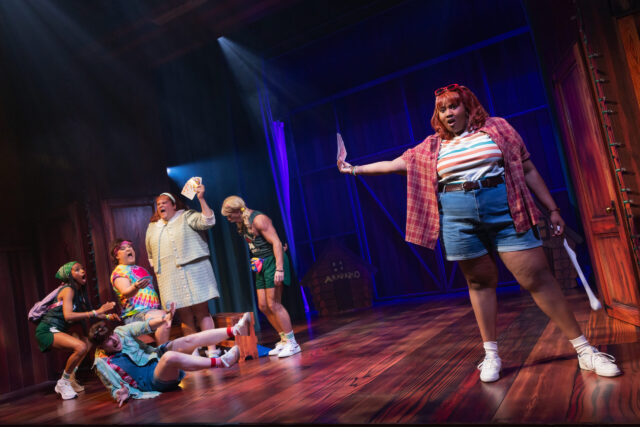
Ginger Twinsies is a parody of the 1998 remake of The Parent Trap (photo by Matthew Murphy)

GINGER TWINSIES
Orpheum Theatre
126 Second Ave. between Seventh & Eighth Sts.
Monday – Saturday through October 25, $49-$149
gingertwinsies.com

In Barry Levinson’s classic 1982 film Diner, Fenwick (Kevin Bacon) says to Boogie (Mickey Rourke), “Do you ever get the feeling that there’s something going on that we don’t know about?”

I get that feeling at times in theater, especially at shows based on books or movies. While you don’t need to have read E. L. Doctorow’s 1975 novel, Ragtime, or seen Miloš Forman’s 1981 film adaptation in order to enjoy the current Broadway revival at Lincoln Center, it doesn’t hurt. However, my knowledge of such films as Some Like It Hot and Sunset Blvd. did negatively impact my enjoyment of the stage musicals; while artistic license must be granted, certain changes from the original just seemed plain awful, altering motivations and important points.

At the curtain call for Sunset Blvd., as most of the audience stood and cheered with wild applause, I turned to my friend and said, “Did they see the same show we did?” She shrugged in agreement.

I had similar experiences at two recent shows, each of which I liked, but not nearly as much as my fellow theatergoers, who were watching them at a different level.

Continuing at the Orpheum through October 25, Ginger Twinsies is a farcical love letter to Nancy Meyers’s 1998 film, The Parent Trap, in which Lindsay Lohan portrayed identical eleven-year-old twins Hallie Parker and Annie James, separated at birth and ignorant of each other’s existence until they meet at summer camp and decide to switch places. It’s a remake of David Swift’s 1961 original, which made a star of Hayley Mills and was based on Erich Kästner’s 1949 children’s book.

The play features a lot of satirical music, inside jokes, and Easter eggs for those in the know; for example, one of the actors portrays Jamie Lee Curtis, who played Lohan’s mother in the body-switching 2003 remake of Freaky Friday, which was based on Mary Rodgers’s 1972 novel. Also appearing as characters in Ginger Twinsies are Shirley Maclaine, who had some choice words about Lohan after the younger actress had to be pulled out of a film they were working on together; Julianne Moore, whose daughter looks like she could be Lohan’s twin; and Demi Moore, who spoke with Lohan at the 2025 Oscars. Whether you get the references or not, the connections are confusing.

Russell Daniels and Aneesa Folds are hilarious as Annie and Hallie, respectively, from the get-go, as they don’t look anything alike. The show works best when it concentrates on the relationship between the two girls; numerous subplots with minor characters are overused as writer-director Kevin Zak attempts to squeeze too much into eighty minutes. I did eventually get into the flow once I realized there was no way I was going to get all of the jokes, but it’s still dispiriting to watch large portions of the audience laughing when you and others are scratching their heads.
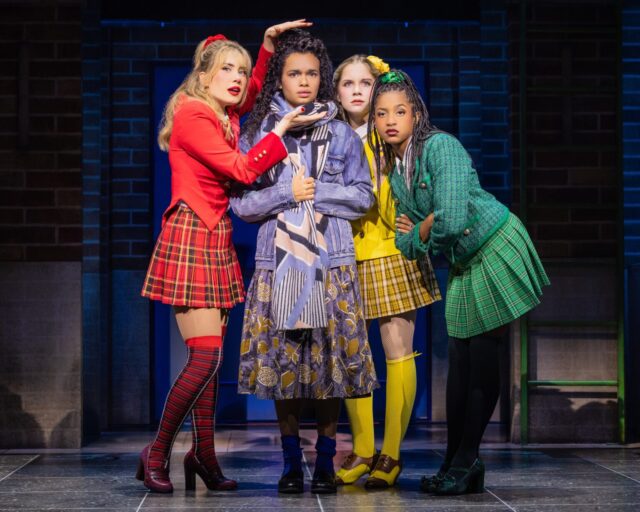
Veronica joins the Heathers in musical adaptation of 1980s cult favorite (photo by Evan Zimmerman)

HEATHERS THE MUSICAL
New World Stages
340 West Fiftieth St. between Ninth & Tenth Aves.
Tuesday – Sunday through September 6, $72-$195
heathersthemusical.com
newworldstages.com

A different kind of cult fandom can be found at Heathers the Musical, a revival of the 2014 show based on Michael Lehmann’s 1988 teen romance-thriller. The iconic film featured Winona Ryder as Veronica Sawyer, a student at Westerburg High who joins the mean girls clique of Heather Duke (Shannen Doherty), Heather McNamara (Lisanne Falk), and Heather Chandler (Kim Walker) while falling for dangerous new guy J. D. Dean (Christian Slater, in his best Jack Nicholson impersonation).

I had seen the film some years back and was looking forward to the musical, which continues at New World Stages through January 25. But what I wasn’t expecting were the shrieks that rattled the theater for two and a half hours (with intermission). Huge screams accompanied the first appearance of many of the characters, and nearly every song, from “Beautiful” and “Candy Store” to “Veronica’s Chandler Nightmare” and “My Dead Gay Son,” turned into a sing-along, as all the young women around me blared the lyrics out loud, wearing huge smiles as they did.

Director Andy Fickman and choreographer Stephanie Klemons capture the essence of the film, although the book, by Kevin Murphy and Laurence O’Keefe (they also wrote the music and lyrics), takes too many liberties with the plot, making changes that didn’t improve on the original, from altering who did what and combining multiple characters into one to commercializing the generic candy store and modifying the ending. However, thank goodness they corrected the spelling of the high school, which is named after Paul Westerberg of the Replacements.

The cast, which includes a terrific Lorna Courtney as Veronica, Casey Likes as J.D., Olivia Hardy as Heather Duke, Elizabeth Teeter as Heather McNamara, McKenzie Kurtz as Heather Chandler, Xavier McKinnon as Ram Sweeney, Erin Morton as Martha Dunnstock, and Tony nominee Kerry Butler as Ms. Fleming and Ms. Sawyer, is first rate, and the music is fun.

The story takes on added meaning in the wake of so many school shootings the past twenty years while also tackling the subject of teen suicide, but it doesn’t dive deep enough and takes off in directions that can drain certain scenes of their potency. But like Ginger Twinsies, despite its flaws, Heathers the Musical is worth seeing, at least in part for watching everyone else in the audience have an absolute ball even when there’s something going on that you don’t know about — a status of exclusion the mean girls of Heathers and cult theater insiders might actually relish.

[Mark Rifkin is a Brooklyn-born, Manhattan-based writer and editor; you can follow him on Substack here.]


LISTENING TO THE WATER: RIVER OF GRASS AT FIREHOUSE CINEMA

River of Grass explores the past, present, and future of the Everglades

RIVER OF GRASS (Sasha Wortzel, 2025)
DCTV Firehouse Cinema
87 Lafayette St.
October 24-30
www.riverofgrassfilm.com
www.dctvny.org

When I was a kid, I was fascinated by the Everglades. I loved Gentle Ben, the television series starring Dennis Weaver, Clint Howard, and a seven-hundred-pound bear, set in and around the Everglades; the show opened with the three of them speeding through swampland on an airboat. When we visited my grandparents in Florida, a trip to the Everglades was often on the agenda, but I did not encounter the cuddly bear.

Thus, I felt a personal connection when watching Sasha Wortzel’s debut feature-length documentary; for the filmmaker, the experience was “profoundly personal.”

Wortzel wrote, directed, narrated, produced (with Danielle Varga), and edited (with Rebecca Adorno Dávila) River of Grass, a poetic work about the battle to preserve the Everglades, the region in Florida where she was born and raised. Eight years in the making, the “project grows out of my process grappling with what it means to be from a place that may cease to exist in my lifetime and with the complexities of ‘home’ in a settler colonial landscape,” she explains in her director statement.

The documentary was inspired by The Everglades: River of Grass, the 1947 book by Marjory Stoneman Douglas, published the same year President Harry S. Truman dedicated the Everglades as a national park. Douglas was a longtime resident of Coconut Grove in Miami — she died there in 1998 at the age of 108, having spent much of her life as an environmental activist. In addition to writing the book, she organized the Friends of the Everglades in 1969, and she is the namesake of the Parkland, Florida, high school where the 2018 Valentine’s Day shooting occurred.

“Man’s life on earth is limited by the conflict between his stupidity and his intelligence,” Stoneman Douglas says in the film, which includes rare archival audio and movie footage that Wortzel was surprised to find. “I think man can prolong his life on the earth for many thousands of years if he is intelligent, but I don’t know whether he’s intelligent enough. I just don’t know.”

All these years later, that intelligence is still up for debate as governments and corporations continue to display little or no respect for the natural environment as they mess with nature’s cycle. Wortzel introduces us to park ranger Leon Howell, who discusses the importance of the alligator to the ecosystem; Donna and Deanna Kalil, a mother and daughter team who spot and catch pythons, who negatively impact the area; two-spirit Miccosukee environmentalist and poet Houston R. Cypress, who talks about the tree islands, where his Native American ancestors would take refuge from soldiers hunting them down (Cypress is also a consulting producer on the film and a member of the Love the Everglades Movement); Kina Phillips, who advocates against the burning of the sugarcane crop, which releases toxic chemicals into the air and water; and the Stokes family, sixth-generation fishers whose livelihood is in jeopardy because of the draining and development of the Everglades.

Most significantly, we meet tireless activist and educator Betty Osceola, who, among many other things, leads prayer walks to protect the water. “I always talk to water, and I listen. Water has life. It has memory. If you slow down and listen and you pay attention, you can actually start hearing it and seeing what it’s trying to tell you,” Osceola, seen navigating in an airboat, says.

The documentary has a choppy, disjointed narrative as it winds between the past and the present. The participants and their affiliations are not identified, and Wortzel speaks only with those seeking to save the Everglades.

However, it is beautifully photographed by cinematographer J. Bennett, who captures gorgeous shots of the moon and sun over the Gulf of Mexico, stunning panoramas of the landscape, and striking vistas of the eight prayer walkers seen far in the distance, dedicated to what might be an impossible task but determined to keep up the fight.

But perhaps the most memorable image is that of Stoneman Douglas’s empty chair, sitting empty amid the destruction wrought by Hurricane Ian in 2022.

River of Grass opens October 24 at DCTV Firehouse Cinema, with Wortzel on hand for six special events: postscreening Q&As with Varga, and Bennett, moderated by Tourmaline, on October 24 at 7:00; with Sierra Pettengill on October 25 at 7:00; with musician Angélica Negron and Keith Wilson on October 26 at 6:00 (Negron will also perform before the showing); with Osceola and Joseph Pierce on October 28 at 7:00; with Osceola and Arielle Angel on October 29 at 6:30; and with Lauren O’Neill Butler and Dominic Davis on October 30 at 7:00.

[Mark Rifkin is a Brooklyn-born, Manhattan-based writer and editor; you can follow him on Substack here.]
PAINTER OF THE FUTURE: VAN GOGH AT NYBG

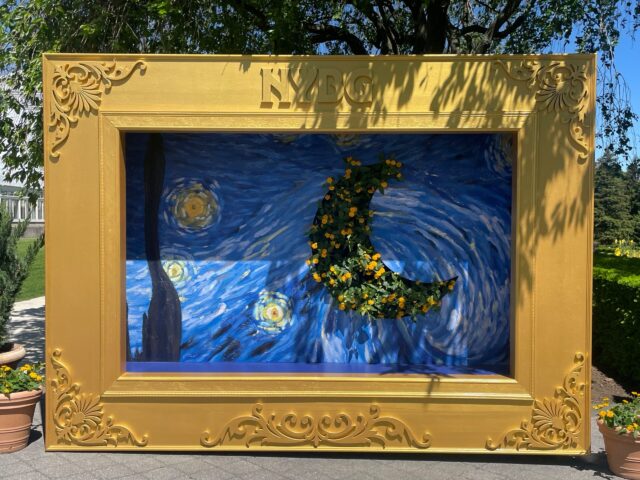
“Van Gogh’s Flowers” continues at the New York Botanical Garden through October 26 (photo by twi-ny/mdr)

VAN GOGH’S FLOWERS
The New York Botanical Garden
2900 Southern Blvd., Bronx
Through October 26, $15-$39, 10:00 am – 6:00 pm
718-817-8700
www.nybg.org
online photo and video slideshow

This is the last weekend to catch the lovely “Van Gogh’s Flowers” exhibit at the New York Botanical Garden, a floral tribute to the post-Impressionist Dutch master who revolutionized painting. The show consists of sculptures, three-dimensional re-creations, quotations, and floral displays celebrating Vincent van Gogh, who died by suicide in 1890 at the age of thirty-seven.

“Considering my life is spent mostly in the garden, it is not so unhappy,” Vincent van Gogh to Theo van Gogh, May 1889.

French artist Cyril Lancelin has created an outdoor pathway of yellow sunflowers made of steel, plywood, eva foam, nylon, 3D printing, cork, and urethane paint, arranged in various settings, highlighted by a walkthrough area of giant blooms.

“The painter of the future is a colorist such as there hasn’t been before,” Vincent van Gogh to Theo van Gogh, 1888.

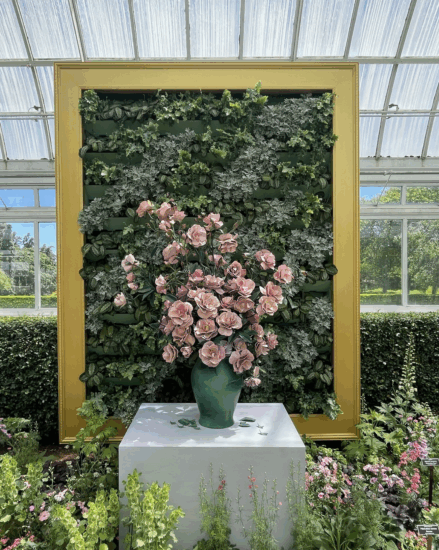
Amie J. Jacobsen contributes four framed sculptures and vases inspired by van Gogh’s unusual technique and floral paintings, featuring irises, roses, oleanders, and imperial fritillaria. “One of the funnest, most energetic parts of this is picking up on his very fast and colorful brushstrokes and getting to do that on a 3-D form — that was my favorite part,” she told twi-ny at the May press opening.

Amie J. Jacobsen has designed four floral installations for van Gogh show (photo by twi-ny/mdr)

“You know that Jeannin has the peony, Quost has the hollyhock, but I have the sunflower, in a way,” Vincent van Gogh to Theo van Gogh, January 22, 1889

Catherine Borowski and Lee Baker of Graphic Rewilding designed colorful, large-scale panel installations covered in floral patterns based on van Gogh’s subjects and palette, including irises in the Enid A. Haupt Conservatory indoor pond and sunflowers, chrysanthemums, buttercups, daisies, cornflowers, forget-me-nots, and birds in and around the circular reflecting pool by the visitors center.

“I’ve been influenced by van Gogh’s work for many years, so it’s really coming full circle for us to be able to make work about his work within the botanical garden,” Baker told me. “I’ve drawn irises for years, so it was a natural progression, but drawing them in this style — if you took the sculptural lines away, you’d have something more akin to my original style. I wanted to take on that and extend my designs through the sculptural feeling of van Gogh’s work. It’s taken me in a new direction. We had to compete with the trees — no, you work with them.”

“The bizarre lines . . . multiplied and snaking all over the painting aren’t intended to render the garden in common, unimportant resemblance but [to] draw it for us as if seen in a dream, in character and yet at the same time stranger than the reality,” Vincent van Gogh to Wilhelmina van Gogh, November 12, 1888.

Of course, there are also plenty of live plants throughout the conservatory, making van Gogh’s works come to life, as the NYBG has done previously with such other artists as Frida Kahlo, Ebony G. Patterson, Claude Monet, Yayoi Kusama, and Roberto Burle Marx.

“It is actually one’s duty to paint the rich and magnificent aspects of nature,” Vincent van Gogh to Wilhelmina van Gogh, September 16, 1888.

[Mark Rifkin is a Brooklyn-born, Manhattan-based writer and editor; you can follow him on Substack here.]
TIME AND MEMORY: JEN TULLOCK DIGS DEEP IN SOLO SHOW

Jen Tullock cowrote and stars in one-person show at Playwrights Horizons (photo by Maria Baranova)

NOTHING CAN TAKE YOU FROM THE HAND OF GOD
Playwrights Horizons, the Peter Jay Sharp Theater
416 West 42nd St. between Ninth & Tenth Aves.
Tuesday-Sunday through November 16, $63.50 – $118.50
www.playwrightshorizons.org

“Do you remember the first time you saw her, or I mean, has writing about it changed your memory of her?” a voice asks author Kristin Frances Reinhardt in Jen Tullock and Frank Winters’s Nothing Can Take You from the Hand of God. Frances doesn’t answer the question in this intense solo show about first love, childhood trauma, forgiveness, and what and how we remember our past, filtered through family and religious dynamics and time.

Tullock performs all eleven roles in the seventy-minute multimedia production, from Frances’s brother, Eli, and mother, Raelynn, to her animated literary agent, Aubrey, and Kenny Weaver, the pastor of the Northeast Missions Church in her hometown. The play begins at a literary event launching Frances’s latest memoir, Never the Twain Shall Meet: Losing God and Finding Myself, the follow-up to Sorry I’m Late, about queer dating in Los Angeles. The new book explores Frances’s battles with her parents and the church over her sexual orientation as they go to extremes to try to force the gay out of her.

The action starts when agent Aubrey informs Frances that an organization discussed in the book, the Northeast Christian Church, got hold of an advance copy and is threatening to sue unless the author removes sections the church deems libelous for “wrongful likeness.” Frances decides to return home, believing she can straighten things out with the people she wrote about, primarily one specific young Polish woman with whom she fell in love, now a single mother who does not want to speak to her.

The narrative weaves in and out of the past and the present as the plot moves to Eli’s Backyard Bible Study class, a talent show audition, a coffee shop, a popular creek, a barbecue at Raelynn’s house, and the church, all the while intercutting discussions between Frances and Aubrey and readings and questions at the book event. For example, at one point the play switches back and forth between the book launch, with the host and audience heard in voiceover, and Pastor Jeremy Young at the church, with Tullock seamlessly shifting from Frances to Jeremy, making it feel like it’s all one conversation:

Jeremy: You know what my dream is? With this place? I want to make it so nobody has to write a book like you did. Not ever again. That’s the work that we’re trying to do.
Host: Wow.
Jeremy: Would you agree with that?
Host: Oh, gosh. That’s beautiful.
Jeremy: Well, I am so glad to hear you say that; I’m relieved, frankly. That means the world to me. Now let me ask you a question. Do you ever worry if you made any of it up?
Frances: Sorry, excuse me?
Host: Do you ever think about who your work is reaching?
Jeremy: Now, I’m not a lawyer — this may come as a shock to you, but I do know that even by the standards of Kentucky Common Law there is something called — let me see if I can get this right — Intentional Infliction of Emotional Distress. I know, it’s wordy.

Nothing Can Take You from the Hand of God is a technical whirlwind (photo by Maria Baranova)

Tullock gives a tour-de-force performance, quickly changing accents and body language while also adjusting several onstage looping stations and small cameras that record real-time visuals of her that are projected onto screens around her, as if each character contains their own multitudes, going beyond stereotypes. The claustrophobic set, featuring two chairs, a small table, and the tech equipment, is by Emmie Finckel, with almost dizzying projections by Stefania Bulbarella, sharp lighting by Amith Chandrashaker, and expertly rendered sound by Evdoxia Ragkou.

The play is furiously directed by Jared Mezzocchi (Russian Troll Farm, On the Beauty of Loss), who previously collaborated with Tullock (On the Head of a Pin, You Shall Inherit the Earth!) on the marvelous site-specific Red Hook show The Wind and the Rain; there is so much going on at any one time that it takes a while to pick up its unique structure, which can get overwhelming and confusing at certain moments.

Inspired by events from her own life and her family’s involvement in the evangelical church, Tullock and cowriter Winters (On the Head of a Pin, Student Body) don’t sugarcoat the story by creating heroes and villains; each character in the play is complicated and well developed, flaws and all. In the book and the show itself, Frances is an unreliable narrator, one who is able to make the audience take a long, hard look at their own past and wonder how many of their memories might have wandered from the truth over the years.

“Do you still believe in anything?” an audience member asks Frances at the book event.

It’s a question many of us should be asking ourselves in these dark, troubled times.

[Mark Rifkin is a Brooklyn-born, Manhattan-based writer and editor; you can follow him on Substack here.]
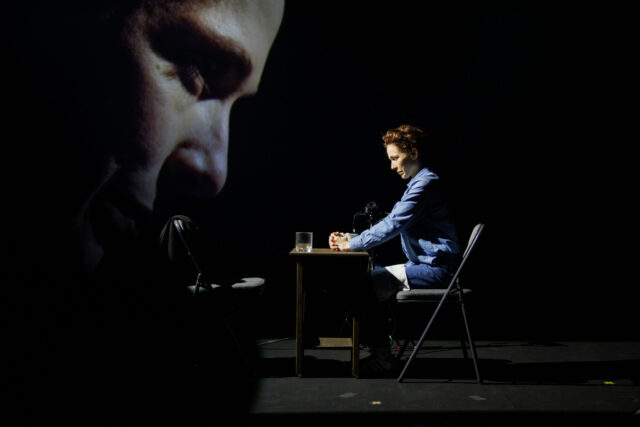
BODIES WITHOUT OUTLINES: EIKO AND WEN AT BAM

Wen Hui and Eiko Otake share personal moments involving war in moving piece at BAM (photo by Maria Baranova)

WHAT IS WAR
BAM Fisher, Fishman Space
321 Ashland Pl.
October 21-25, $55, 7:30
www.bam.org/whatiswar

“Why, eighty years after the end of the Second World War, do we still have wars?” Eiko Otake and Wen Hui’s What Is War posits.

It’s a potent question, one that the two interdisciplinary artists explore in the powerful seventy-minute presentation, continuing at BAM’s Fishman Space through October 25. There’s purposely no question mark after the title because the show does not intend to provide any answers; instead, it’s more about personal experience.

Eiko, who was born and raised in postwar Japan and has lived in New York City since 1976, and Wen, who grew up in China during the Cultural Revolution and is based in Frankfurt, Germany, have been friends for thirty years. During the pandemic, they made the award-winning video diary No Rule Is Our Rule, after Eiko’s visit to China to collaborate with Wen was cut short.

They are now out on the road touring What Is War, which combines text, movement, and film to tell each of their stories and how they overlap. The show begins with a video clip of the two talking, projected on the large back wall. After a few minutes, Eiko humorously checks with Wen to make sure she is recording their conversation, admitting that she sometimes forgets to flip the switch and ends up having to do it all over again. It’s the last laugh of the evening.

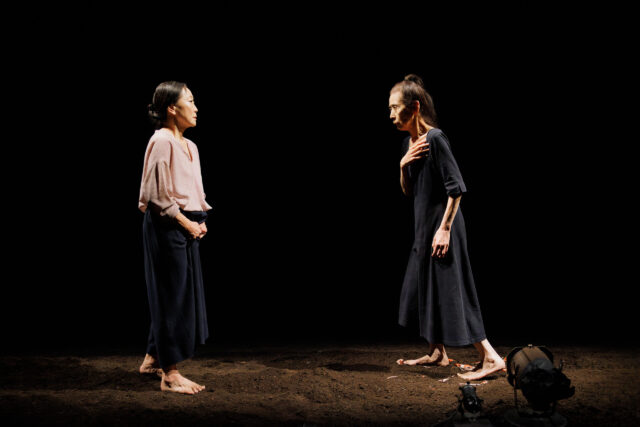
The two women then appear at opposite sides of the black box theater, Eiko in a long, dark dress, Wen in a light blouse and long black skirt. Both barefoot, they walk agonizingly slowly toward each other across a narrow strip of dirt, a kind of graveyard where they meet in the middle, digging up the past. In front of archival footage, Wen explains how her grandmother died during the Japanese bombing of Kunming in December 1941; Wen’s mother was only five at the time. “I never had a chance to meet my grandmother,” she says. “I did not even know her name.”

Eiko Otake and Wen Hui come together and break apart in What Is War (photo by Maria Baranova)

Eiko shows a photo of her parents’ wedding, projected onto an angled hanging cloth at stage right. “They married on August 10th, 1945, one day after the atomic bombing of Nagasaki and five days before Japan’s surrender,” she says, detailing how her father pretended to have tuberculosis to avoid military service. “Wen Hui, when I visited you in China and spent time with your mom, I felt really glad my father lied.”

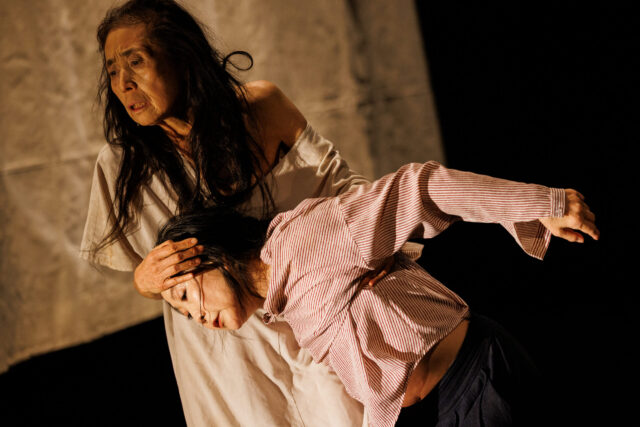
Throughout the piece, which is dramatically lit by David A. Ferri, Eiko and Wen come together and drift apart, sometimes tenderly, sometimes with more force, as Eiko discusses the bombing of Tokyo by America, which killed one hundred thousand Japanese in six hours; Wen goes to a hospital to cheer up wounded soldiers during the Sino-Vietnamese War; Eiko points out the antiwar statements in Japan’s postwar constitution; and Eiko and Wen travel to the Lijixiang Comfort Station in Nanjing, where sex slaves were made available to the Japanese army. (Today the facade of one of the buildings is covered with contemporary photos of the women.)

At times, the performers push a horizontal mirror on wheels around the stage, which provides provocative reflections while also implicating the audience in the action.

In one of the most harrowing moments, Eiko recalls the late Japanese writer Kyoko Hayashi, who grew up in Shanghai, asking her, “Bodies I saw on August 9 had no outlines. Otake-san, when you perform, can you please think of such a body, a body without outlines?”

What Is War is a hard show to watch; Eiko and Wen pull no punches as they bare their souls and their bodies, using the past as a way to try to build a better, safer, more caring future, probably in vain if current events are any evidence. Any metaphors are in the movement itself; everything else unfolds as a bold, direct accusation of man’s seemingly never-ending thirst for battle, power, and domination.

Fortunately, each performance concludes with a catered gathering in the downstairs lounge, where Eiko and Wen are eager to speak with attendees and hear their thoughts on the work and on war, with plenty of smiles and hugs.

[Mark Rifkin is a Brooklyn-born, Manhattan-based writer and editor; you can follow him on Substack here.]
COOL ART CARS: STAYING FROSTY IN HARLEM

STAY FROSTY
BravinLee programs
458 West 128th St. between Amsterdam & Convent Aves.
October 24-26, free
www.bravinlee.com

For thirty years, the Drilling Company has presented Shakespeare in the Parking Lot, staging Bard plays in a Lower East Side municipal parking lot. Troupe founder Hamilton Clancy has referred to it as “an urban wrinkle” compared to traditional productions in theaters.

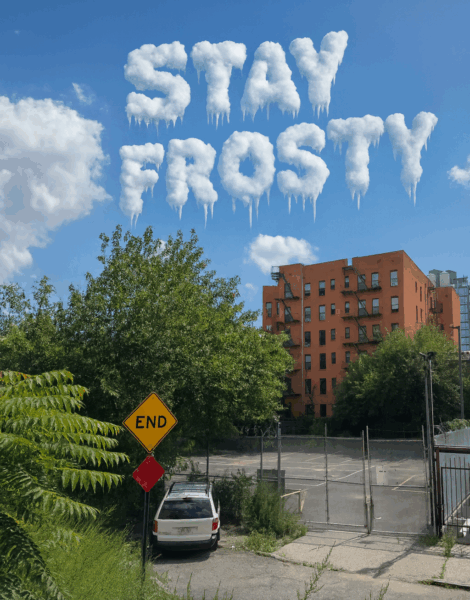
Now Karin Bravin and John Post Lee of BravinLee programs are providing an urban wrinkle alternative to art fairs with “Stay Frosty,” what they call “part tailgate, part trunk show, part festival, and part site-specific exhibition.”

Taking place October 24-26, “Stay Frosty” will feature approximately sixteen galleries displaying their wares in cars within marked parking spaces; among the participants are Willie Cole (H20, Harlem Coupe, made from recycled water bottles), Traci Johnson (a van repurposed into an intimate sanctuary), Field Projects (Kate Corroon Skakel’s sports-related Baller [For Ray]), Debra Simon Consulting (Amy Rose Khoshbin’s Allan Kaprow–inspired Altars to Agency), and Amy Ritter (Mobile Home Archive). Another ten artists will have freestanding works along fences around the perimeter, including Ellie Murphy (Door Arch Gate. Colonnade for a parking lot.), Kate Dodd (Shared Air), and Kumasi J. Barnett (The Question).

“Visitors can anticipate a combination of interactive works, monumental car installations, and a trove of artworks installed in glove compartments, trunks, and dashboards,” Bravin told twi-ny about the show, which will travel to other locations in 2026.

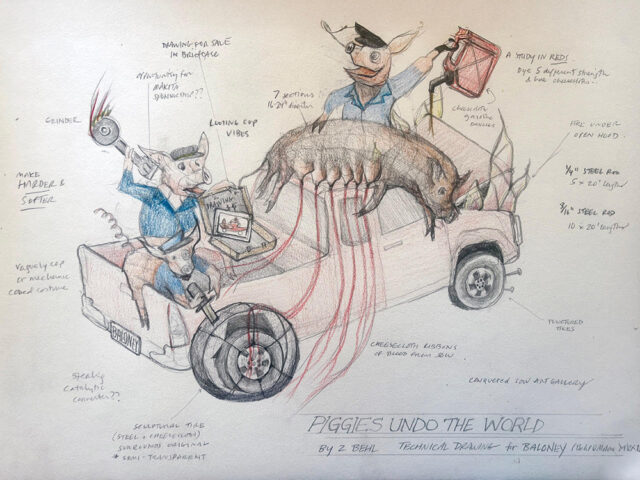
BALONEY (Z Behl and Kim Moloney), Piggies Undo the World (courtesy of the artist and BravinLee programs)

Three early renderings point to how unique and cool “Stay Frosty” can be: Guy Richards Smit depicts a large boulder on a green auto, Laurie De Chiara’s ArtPort Kingston promises a stuffed yellow station wagon from Jeila Gueramian, and Z Behl & Kim Moloney of BALONEY have transformed a pickup into Piggies Undo the World.

Admission is free — for the public and the galleries and artists — and all the art is for sale. There will be several special events on Friday, with Gracie Mansion’s Buster Would Have Loved This offering visitors candy from a limo from 3:00 to 6:00, followed by a performance by Khoshbin, who will also be leading a participatory release ritual each day at noon.

“Let’s spit-the-bit and restore our mental health,” BravinLee advises.

Everyone is invited to come along for the ride for what should be a bevy of very cool cars.

[Mark Rifkin is a Brooklyn-born, Manhattan-based writer and editor; you can follow him on Substack here.]