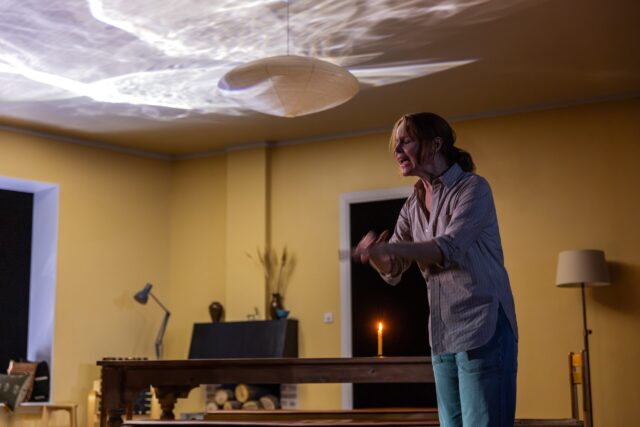
Lauren Ambrose is a whirlwind of emotions as a mother not giving up on her missing son in Nick Payne’s The Unbelievers (photo © Matthew Murphy)
THE UNBELIEVERS
MTC Stage I, New York City Center
131 West 55th St. between Sixth & Seventh Aves.
Tuesday – Sunday through November 29, $79-$126
manhattantheatreclub.com
The Unbelievers is one of the most extraordinary theatrical experiences I’ve ever had.
I was already predisposed to enjoy the play, making its American premiere at MTC’s Stage I at City Center; I am an admirer of the playwright, Olivier and Tony nominee Nick Payne (Constellations, Incognito, A Life), the director, Obie winner and Tony nominee Knud Adams (English, Primary Trust), and the star, Emmy and Tony nominee Lauren Ambrose (My Fair Lady, Exit the King), who have all been part of unusual, challenging, and rewarding productions. But I still wasn’t prepared for what evolved in front of me.
Before leaving for the theater, I confirmed the 7:00 start time and, for some reason, decided to check how crowded it would be that night, which is not something I generally do. I noticed that not only was there onstage seating but there were two vacancies, each in the first row. I’m a sucker for onstage seating, which can be immersive, interactive, or gimmicky. I went to City Center with a bounce in my step, hoping I could snag one of the empty seats. The extremely helpful house manager said, “I got you,” and he did; at about 7:00, I was led through a back hallway and onto the set, where I claimed one of the highly coveted sixty-two stage seats, consisting of two sections of actual church pews. I was on the inside end in the first row, next to an aisle that the actors use during the show. Although each seat had a round cushion, they were uncomfortable, but that only added to the intense drama.
The Unbelievers takes place in contemporary England, where a fifteen-year-old boy named Oscar Wright has gone missing. Over the course of seven years, his father, David Wright (Tom Riley), mother, Miriam (Ambrose), sister, Margaret (Elizabeth Yeoman), half-sister, Nancy (usually Nina Ross but I saw understudy India Shea), and mother’s first husband and Nancy’s father, vicar Karl Khoury (Hadi Tabbal), meet with detectives, mediums, police officers, and others (portrayed by Jaspal Binning, Brittany Bradford, and Tony nominee Marjan Neshat) in desperate attempts to try to find Oscar, all hoping he is still alive. The story does not unfold chronologically; instead, it seamlessly shifts between times with little indication, as some actors calmly walk offstage and others enter. Enver Chakartash’s costumes, Masha Tsimring’s lighting, and Sinan Refik Zafar’s sound barely offer hints when one scene is morphing into another, but the main characters never change clothing; it’s as if they are stuck in that moment when they first learned Oscar had disappeared, unable or unwilling to move on, although David wants to hold a memorial service at the seven-year mark that Miriam is wholly against.
When a major newspaper wants to do a story on the one-year anniversary, David says no, but Miriam is for it. “People have lost interest,” she argues. “The first anniversary is a milestone. We need more coverage. I like coverage. It makes me feel like something is actually happening.” At the seven-year mark, when David suggests the memorial, Miriam succinctly says, “What would be the point?”
Paul Steinberg’s set is a relatively plain, unadorned room with a wooden table and chairs, a fireplace, a piano, and a little nook. A small stained-glass window glows in the dark theater like a promise, and an empty black gothic window offers a peak at the pews, inviting everyone into the temporary community that is theater. Religion is discussed throughout the play, from Karl’s prayers to David’s desire to have hymns sung at the service, although Miriam is quick to remind them that she’s “a massive fucking atheist.”
The cast is excellent, led by Ambrose, who is a battlefield of emotions as Miriam while avoiding clichés, a determined mother ready to do whatever it takes to find her son. At times, Ambrose was mere inches or feet away from me, and it was deeply powerful as I watched her interact with the others, tracking their emotions, fully involved in them as well-drawn characters navigating their way around Miriam’s interior and exterior struggles as well as talented actors devoted to their craft. Riley (Arcadia, Dry Powder) is heart-wrenching as David, who loves Miriam but can no longer be with her, recent Juilliard graduate Yeoman (And Then We Were No More) is touching as Margaret, who may be starting a family of her own with Benjamin (Jack DiFalco), and recent Columbia graduate Shea (A Trojan Woman, The Matchmaker) is mesmerizing as Nancy, who turns to music to deal with her grief and trauma, playing guitar and piano.
I’ve sat on the stage or within a set before, but The Unbelievers took me to the next level, not only appreciating Payne’s stunning drama but marveling at the magic that is theater.
I’m a believer.
[Mark Rifkin is a Brooklyn-born, Manhattan-based writer; you can follow him on Substack here.]