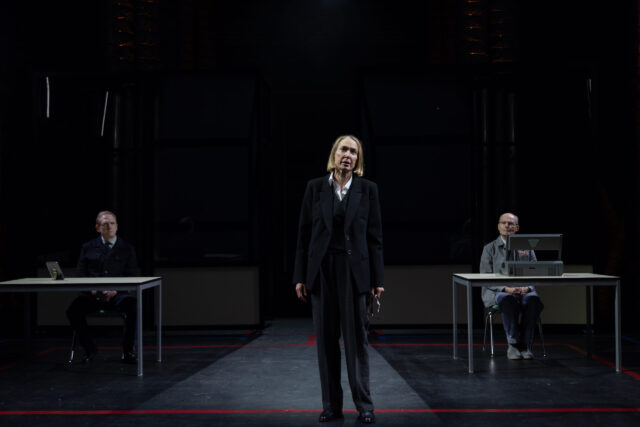
A Lawyer (Elizabeth Marvel) attempts to defend her client in Kafka-esque And Then We Were No More (photo by Bronwen Sharp)
AND THEN WE WERE NO MORE
La MaMa Experimental Theatre Club
The Ellen Stewart Theatre
66 East Fourth St. between Second Ave. & Bowery
Tuesday – Sunday through November 2, $49-$99
www.lamama.org
“‘It’s a remarkable piece of apparatus,’ said the officer to the explorer and surveyed with a certain air of admiration the apparatus which was after all quite familiar to him. The explorer seemed to have accepted merely out of politeness the Commandant’s invitation to witness the execution of a soldier condemned to death for disobedience and insulting behavior to a superior.”
So begins Franz Kafka’s 1918 short story, “In the Penal Colony,” which actor, director, novelist, playwright, and screenwriter Tim Blake Nelson recently read with one of his sons. The existential tale serves as the inspiration for Nelson’s gripping new play, And Then We Were No More, continuing at La MaMa through November 2.
The two-hour show (plus intermission) takes place in the near future, in a privately owned prison in a large complex that has a new machine that apparently can painlessly and efficiently execute those convicted of capital crimes. It’s a Kafka-esque institution where no one has a name and everything has been decided in advance. An Official (Scott Shepherd) goes by the book but likes making an occasional joke, which floats away without a laugh. He has brought in a Lawyer (Elizabeth Marvel) to defend the Inmate (Elizabeth Yeoman), who has been convicted of killing her husband, their two children, and her mother. Often watching the proceedings from a distance is an Analyst (Jennifer Mogbock) representing the corporation’s financial interest in the machine. Meanwhile, the Machinist (Henry Stram) fiercely defends the system and his beloved execution device as he tracks statistics.
The Lawyer reluctantly accepts the job; selected by a computer algorithm she essentially has no choice. At the Lawyer’s first meeting with her client, the Inmate says to her in an irrational manner, “I am not no my name / by name name me by name / but you would say know me / by name / by my name / you would swim / in the muddy of no more name / rise up and see / vapor wickedness / bloom in white sky / rain retreat like lost / far flood / nameless name. . . . smell on you same air / breathe / anger / plague skin crawled / needs swarming / scratch self death.” The Lawyer soon learns that there is no option to delay or cancel the execution based on her client’s possible insanity.
During the trial, the case is made directly to the audience, which serves as a kind of jury; when the verdict is announced, the powerlessness of the individual envelops the room with Kafka-esque grandeur.
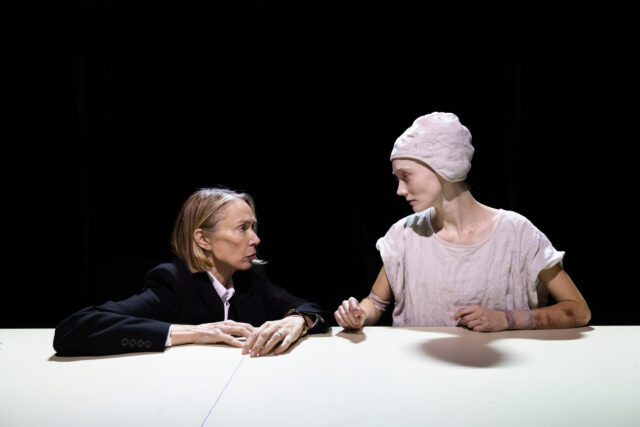
A Lawyer (Elizabeth Marvel) faces impossible odds with her client (Elizabeth Yeoman) in world premiere at La MaMa (photo by Bronwen Sharp)
And Then We Were No More is gorgeously staged by director Mark Wing-Davey (The Hitchhiker’s Guide to the Galaxy, Mad Forest), as the tension, and strangeness, ratchet up scene after scene. David Meyer’s jaw-dropping set features a series of strikingly colored air ducts, bland chairs and tables, and the mysterious machine that supernumeraries move around like automatons. Marina Draghici’s costumes range from office chic to an odd, somewhat deranged outfit worn by those about to be executed. Henry Nelson (one of Tim’s children) and Will Curry’s sound design switches from compelling interstitial music to ominous machine drones to horrific screeches when the Lawyer says the Inmate’s name out loud, in defiance of the rules.
The cast, which also includes William Appiah, E. J. An, Kasey Connolly, and Craig Wesley Divino as the supernumeraries in multiple roles, capture the feeling of the Kafka-esque environment, where so much is not explained. Nelson, who has written two novels and such plays as Socrates, Eye of God, and The Grey Zone (he adapted the last two into films) and has appeared in such movies as The Thin Red Line, Captain America: Brave New World, and O Brother, Where Art Thou?, has created a sinister, foreboding dystopian existence with And Then We Were No More, one that feels all too real given what is happening to the justice system under the current US administration.
Various scenarios are like warning signals, telling us what might be waiting for us right around the corner:
An Analyst: If the work is stymied, if we cannot demonstrate success . . .
An Official: I understand.
An Analyst: Everyone must understand.
An Official: We can do what we can do.
An Analyst: This is a sentiment no longer relevant in our time.
An Official: Or it’s the only relevant sentiment.
“Ready now!” the officer announces after preparing the machine to do its business in Kafka’s tale.
He might be, but are we?
[Mark Rifkin is a Brooklyn-born, Manhattan-based writer and editor; you can follow him on Substack here.]