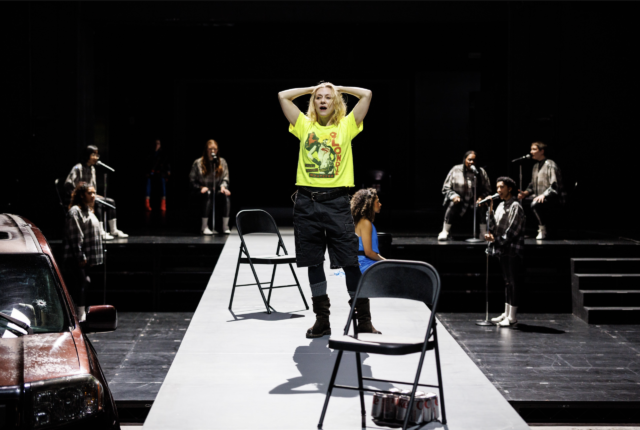
Tina Benko is fierce as the title character in Daniel Fish’s Elektra in Brooklyn (photo by Maria Baranova)
ELEKTRA
Theatre for a New Audience, Polonsky Shakespeare Center
262 Ashland Pl. between Lafayette Ave. & Fulton St.
Tuesday – Sunday through December 13, $77-$132
tfana.org
When I was in London in February 2025, I saw Daniel Fish’s unique take on Sophokles’s Elektra, starring Oscar winner Brie “Captain Marvel” Larson as Elektra and Emmy and Tony winner and Oscar nominee Stockard Channing as her mother, Clytemnestra. I called it “both elektrifying and mystifying”; Fish has completely reimagined the show for its New York City premiere, running at TFANA’s Polonsky Shakespeare Center through December 13, and despite the myriad differences, it is still both elektrifying and mystifying.
At the Duke of York’s Theatre in the West End, the story unfolded on a proscenium stage, which featured a rotating turntable in the center, a hovering miniature blimp, black ooze, and a white fur coat; Larson, her head shaved, in a white Bikini Kill T-shirt, channeled Sinéad O’Connor and Laurie Anderson as she spoke, sang, yelled, and whispered into a microphone.
Scenic designers Jim Findlay, Josh Higgason, and Amy C. Rubin have transformed the malleable Polonsky in Brooklyn into a car wash, with a long, narrow runway/platform in the center, with extremely limited seating on three sides of the action. The cast walks across the platform and into the pit surrounding it or sit on folding chairs. As the audience enters the theater, black mitter curtains go slowly up and down the runway, as if giving the theater a ritualistic cleansing, the ribbon strips coming together at the end to form, in white letters, the ominous pronouncement “The Gods That Always Fail,” the title of Edward Said’s sixth and final 1993 BBC “Representation of the Intellectual” Reith Lectures, which deals with loyalty and the nature of belief in the sociopolitical arena. Also in the pit is an actual 2010 maroon Honda Pilot, a replica of the one Renée Nicole Good was driving when she was murdered by ICE agent Jonathan Ross in Minneapolis on January 7, 2026; there’s even a bullet hole in the front windshield.
The mitter curtains stop, and all eleven cast members take their place, including a musical Greek chorus of six Mycenaen women in sparkling tops (Catherine Brookman, Sophia Rose Byrd, Mingjia Chen, Tina Fabrique, Maya Lagerstam, and Tanner Porter). Tina Benko then appears center stage as Elektra, with shoulder-length blonde hair, dark shorts cut off at the knee, black boots, and a yellow Blondie T-shirt in which Debbie Harry appears as Supergirl above the mantra “Truth, Justice, Whatever,” referencing how the Blondie song “Call Me,” originally written for the 1980 Richard Gere film American Gigolo, was used as an anthem in the 2026 DC movie Supergirl, changing the meaning of the tune, specifically regarding gender.
One thing that is the same between the London and Brooklyn iterations is that Fish uses Nobel laureate Anne Carson’s gorgeous 2001 translation, which begins with a beautiful soliloquy by Elektra: “O holy light! / And equal air shaped on the world — / you hear my songs, / you hear the blows fall. / You know the blood runs / when night sinks away. / All night I watch. / All night I mourn, / in this bed that I hate in this house I detest. / How many times can a heart break? / Oh father, / it was not killer Ares / who opened his arms / in some foreign land / to welcome you. / But my own mother and her lover Aegisthus: / those two good woodsmen / took an axe and split you down like an oak. / No pity for these things, / there is no pity / but mine, / oh father, / for the pity of your butchering rawblood death. / Never / Will I leave off lamenting, / never. No. / As long as the stars sweep through heaven. / As long as I look on this daylight. / No.”
Clytemnestra (Sally Wingert) and her lover, Aegisthus (Michael Rudko), have murdered her husband, Agamemnon, after he sacrificed his and Clytemnestra’s oldest daughter, Iphigenia, to the goddess Artemis in order to access the wind needed for his troops to sail to the Trojan War. While Elektra is seeking revenge against her mother and stepfather, who has returned to the Mycenaean throne, Elektra’s sister Chrysothemis (Rebecca Naomi Jones) is ready to move on. The plot thickens when they the siblings learn that their brother, Orestes (Cricket Brown), has been killed during a chariot race.
“Here you are again at the doorway, sister, telling your tale to the world!” Chrysothemis declares to Elektra. “When will you learn? It’s pointless. Pure self-indulgence.”
Meanwhile, the chorus advises, “Do not breed violence out of violence.”
But Elektra isn’t about to listen to anyone but herself.
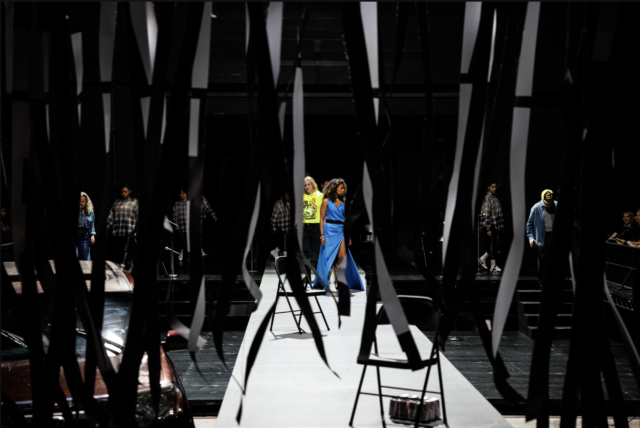
Elektra has been extended at Theatre for a New Audience’s Polonsky Shakespeare Center through December 13 (photo by Maria Baranova)
Broadway veteran Benko (Eureka Day, Fish’s Suddenly Last Summer) is fierce as Elektra, intent on gaining retribution, not about to let anyone get in her way. Wingert (Faith Healer, Entertaining Mr. Sloane), in jeans and a checked flannel shirt, is a worthy adversary as Clytemnestra, who is self-assured and determined to triumph. Jones (Significant Other, Fish’s Oklahoma!) is radiant in a stunning blue gown and white cowboy boots as the nonconfrontational Chrysothemis, evoking the look and style of Beyoncé, which comes into play when the chorus sings Beyoncé’s 2016 hit “Daddy Lessons,” proclaiming, “He held me in his arms and he taught me to be strong / He told me when he’s gone, ‘Here’s what you do / When trouble comes to town and men like me come around’ / Oh, my daddy said, ‘Shoot,’ oh, my daddy said, ‘Shoot.’” (The cool costumes are by Doey Lüthi.)
Brown (Well, I’ll Let You Go, Lobster) is resolute as Orestes, dressed in brightly colored sneakers and a Goodyear Mr. Goodwrench Dale Earnhardt Service Plus jacket covered in product logos. Rudko (Romeo and Juliet, Titus Andronicus) spends most of the show standing against the pit wall in a trucker hat before he enters the fray. Ted Hearne’s music is beautifully rendered by the fabulous chorus, which keeps a close watch on the proceedings. Unfortunately, Scott Zielinski’s lighting, which at first keeps most of the audience illuminated, as if we’re complicit in the treachery and deceit, later shines so bright that we have to look away; meanwhile, if you’re seated on the right or left side of the platform, you won’t be able to see everything at the distant end of the stage.
This being the endlessly inventive Tony and Obie winner Fish (White Noise, Kramer/Fauci), there are a lot of strange elements, some of which, in this case, appear to come out of nowhere and knock the narrative for a loop, not allowing the dialogue to work on its own, without the extra props, which overemphasize the contemporary relevance of Sophokles’s text. The car feels utterly unnecessary, as does the prominence of cans of diet Coke and a late monologue excerpted from Amy Davidson Sorkin’s October 26 New Yorker article “Death Watch” about Christa Pike. There’s also a whole lot of contemptuous spitting.
Fish may be commenting on capitalism, corporate greed, and state-sponsored violence in America in 2026 — at one point, Clytemnestra is sitting far in the back, the US flag wrapped around her lap — but these diversions zap the energy out of the show and compromise what otherwise could have been another brilliant production.
In a statement, he notes that Elektra “is a play one doesn’t finish working on; it keeps speaking to us in new ways.” He kept tinkering with it through previews, making small and big changes, but it could still use more tweaking.
Fish’s work is always mind-blowing, but with Elektra, that is both positive and negative.
[Mark Rifkin is a Brooklyn-born, Manhattan-based writer; you can follow him on Substack here.]