
Thomas Jay Ryan, Jennifer Seastone, Will Brill, and Greig Sargeant bring a C-Span discussion to vivid life in Kramer/Fauci (photo by Maria Baranova)
KRAMER/FAUCI
NYU Skirball Center for the Performing Arts
566 La Guardia Pl.
February 11-21, $60-$90
nyuskirball.org
Daniel Fish again proves his genuine creative genius with the wildly entertaining and unpredictable Kramer/Fauci, running at NYU Skirball through February 21.
On November 30, 1993, C-Span host Steve Scully spoke about the AIDS crisis with Dr. Anthony Fauci, the director of the National Institute of Allergy and Infectious Diseases at the National Institutes of Health, and playwright and activist Larry Kramer, author of the novel Faggots and the play The Normal Heart and cofounder of Gay Men’s Health Crisis and ACT UP (AIDS Coalition to Unleash Power). For sixty minutes, while Fauci was in the studio with Scully and Kramer was beamed in onscreen from New York City, they discussed government funding, drug research, bigotry, public awareness, and more, in addition to taking phone calls from viewers.
Fish has transformed that visually dry program into an exciting, rich theatrical experience with such unusual elements as a woman on roller skates, a hilarious colorful costume, and a whole lot of bubbles.
As audience members enter the auditorium, six rows of nine lights apiece are blazing from the back of the stage, reminding me of a flag too bright to bear looking at — except for a colleague of mine who had (knowingly?) brought sunglasses. The show starts slowly in the empty space: Scully (Greig Sargeant) sits in the middle in a chair, Dr. Fauci (Will Brill), in a crisp suit, stands closer to the front to Scully’s right, and Kramer (Thomas Jay Ryan), in a turtleneck, hovers against the back wall to Scully’s left. The three begin reciting the exact transcript from the interview, as Scully raises a question about President Clinton’s formation of a new task force. Fauci provides a relatively straightforward bureaucratic response, but Kramer gives a hint of what’s to come when he criticizes the technology C-Span is using — he is unable to see Scully or Fauci but can only hear them, although he complains about the earpiece as well — and says, “This is a task force to identify what the stumbling blocks are, we know what they are: a lot of bureaucracy, a lot of red tape, a lot of stupid laws by Congress, and a lot of idiots, uhhhhhhh, putting their two cents worth, uh uhhh, how are you gonna get rid of all of these things is what I want to know and I have yet to hear a task force form to tell me that.”
After several minutes of physical stasis, Fauci and especially Kramer start moving around the stage as they argue over how recent administrations dealt with AIDS, what the real number of people afflicted with the disease are (and will be), how much money is needed for research, and why more is not being done. When Scully brings up the topic of the AIDS epidemic being normalized, Fauci begins, “Larry and I have had conversations about this many, many times over the years, and I a-appreciate it and in many respects, remire . . . admire the, the rage that he has about a very, very difficult problem. But I think you have to . . .” Kramer cuts him off, proclaiming, “Tony, if you start that business about science isn’t done that way, I’m gonna come on there and slap your face.” Fauci peacefully responds, “Nah . . . nah . . . All right, Larry, hang on for a sec. I love you, Larry . . . Uh . . . The fact is that the real solutions will in fact, come from the science.”
Scully occasionally cuts away to play audio footage of news conferences and to take calls, each of which is delivered by Jennifer Seastone in a few different voices, first riding in circles on roller skates and later donning an oddball costume. (The costumes are by Terese Wadden, with set by Jim Findlay, lighting by Scott Zielinski, and sound by Tei Blow.) Movement director Beth Gill soon has Kramer making his way over to Fauci and the roving callers, hugging one of Skirball’s golden pillars, and approaching the audience. It ranges from absurdly comical to substantially confrontational, all of it fascinating and compelling.
And then, the bubbles.
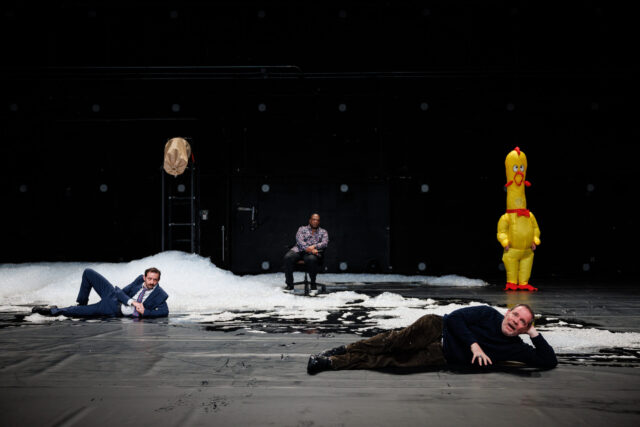
Expect the unexpected in Daniel Fish’s inventive re-creation of a C-Span program on AIDS (photo by Maria Baranova)
In A (radically condensed and expanded) Supposedly Fun Thing I’ll Never Do Again, the New Jersey–born, New York City–based Fish used tennis balls and existing text in a play about the work of Infinite Jest author David Foster Wallace. Fish earned a Tony for his unique staging of Oklahoma!, in which the audience was served chili at intermission. In White Noise, he used bold, giant projections and an actor sitting in a large, dark circle in the middle of a screen to tell part of Don DeLillo’s treatise on consumerism gone mad. And in Elektra, Sophocles’s title character, played by Brie Larson, was a kind of punk goddess spitting out some of Beyoncé’s “Daddy Lessons” while an unexplained blimp floated nearby.
For Kramer/Fauci, the actors wear earpieces that feed them the lines in order to maintain the precise pace and tone of the original program. Tony winner Brill (Stereophonic, Oklahoma!) is cool, calm, and collected as the cool, calm, and collected Fauci, who might not have gained as much fame for his work on AIDS but became a divisive and highly public figure during the Covid-19 pandemic. Two-time Drama Desk Award winner Ryan (Eureka Day, Dance Nation) is sensational as Kramer, a deeply concerned, knowledgeable, and emotional activist who is fed up with the government’s response to what he insists is a plague, not merely an epidemic or crisis.
The play centers on the complex friendship between Fauci and Kramer, who strongly disagree on how to deal with AIDS. It is summed up best in this exchange, which, like everything else, is taken verbatim from the transcript, with every pause and repetition:
Kramer: It’s all of this rhetoric of yours and everybody else in the bureaucracy. You know, I want to say something about, about Tony Fauci because I think the world must think I ha—, I hate him or something the way I’m going on tonight. I love Tony, actually I d—, I think I probably have a more complicated relationship with Tony than anybody in my entire life. He is a man, an ordinary man who was being asked to play God and he is being punished because he cannot be God. And that is a terrible situation to be in to be the lightning rod for all of us. Uhhhh . . . he has had to deal with Reagan and Bush and defend those monsters, for all we know he probably kept the labs open when John Sununu and Gary Bauer, and other awful bigots, probably wanted them closed, and he had to do it at a price, probably uh at a price for his own soul that we’ll never know that that he had to say things that in his heart he never believed. But he is there and he has been the, this this this incredible fighter for us and for AIDS. I just get angry when he puts on this bureaucratic suit and out comes this boilerplate, uhhhhh, that like Donna Shalala said the same, they, all his rhetoric that doesn’t mean anything. Tony, more than anyone in this world, knows how awful everything is, knows what has to be done, knows that he should have been given a lot more money to do it, knows who all these terrible people are, and yet he can never say it in public like I can say it in public.
Scully: Dr. Fauci, let me go back to an earlier question . . .
Kramer: Why don’t you respond to that, Anthony?
Scully: Oh, go ahead, Doctor.
Fauci: I love you, Larry. [Laughs.]
The play is eerily prescient of so much of the ensuing debate about public health. Most of us well remember what happened during Covid-19, when Fauci was at odds with the Trump administration, and today the battle over vaccines rages on with new updates every day, while the LGBTQ community has a growing fight on its hands, about a lot more than just the taking down of a Pride flag. However, Fish doesn’t reference any of that, instead keeping his focus on communicating the drama of this extraordinary debate between two dedicated, extremely intelligent men trying to do what’s best for an ailing population. How he chooses to punctuate and illustrate the power of their conflict with stunning, dumbfounding, and yet somehow near-perfect staging is where his genius lies.
[Mark Rifkin is a Brooklyn-born, Manhattan-based writer; you can follow him on Substack here.]