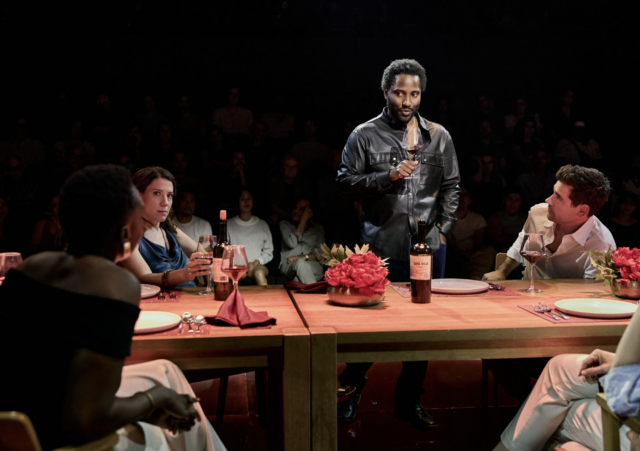
Silicon Valley entrepreneur Nick (John David Washington) offers “the opportunity of a lifetime” to a group of old friends in Disruption (photo by Emilio Madrid)
DISRUPTION
The Pershing Square Signature Center
The Romulus Linney Courtyard Theatre
480 West 42nd St. between Tenth & Eleventh Aves.
Tuesday – Sunday through September 27, $99-$176
www.disruptionplay.com
“To this day, I remain convinced of this basic philosophy: no matter what quandaries we face — business problems, health issues, relationship difficulties, as well as the great scientific, social, and cultural challenges of our time — there is an idea that can enable us to prevail,” American computer scientist Ray Kurzweil wrote in his 2005 book, The Singularity Is Near: When Humans Transcend Biology. “Furthermore, we can find that idea. And when we find it, we need to implement it.”
One of the great fears of this era is the implementation of artificial intelligence and our growing dependence on AI — in addition to grave concerns over the singularity, the potential for AI to develop beyond human control, take over our lives, and, perhaps, ultimately destroy us.
Numerous recent plays have considered where that can lead us, including Matthew Libby’s Data, Olivia Haller’s Loneliness Was a Pandemic, and Tjaša Ferme’s Bioadapted, none of which are comedies with particularly happy endings.
The latest to offer its take on the future of AI technology is Andrew Stein’s engrossing Disruption, making its American premiere at the Pershing Square Signature Center following its 2023 debut in London. But Stein and director Hersh Ellis don’t focus so much on the tech behind AI as on the entrepreneurs and computer scientists who keep expanding it — and the humans who use it. In many ways, it’s a contemporary domestic drama disguised as a high-tech thriller.
Successful Silicon Valley entrepreneur Nick (John David Washington) has gathered his three best friends and their wives for a dinner in a private room in an upscale Tribeca restaurant. Ben (Conrad Ricamora) is a Columbia professor married to Suzie (Shaunette Renée Wilson), a therapist on the Upper West Side; they have no children by choice and are deciding whether their next vacation should be to the Galápagos or Machu Picchu. Barry (Jason Ralph) is a surgeon married to Mia (Irene Sofia Lucio), a photographer; they also have no children and are contemplating buying a brownstone in Park Slope but he is not sure they can afford it. And Paul (Joe Tippett) is an art director at a print magazine married to Jill (Elizabeth Stanley), who believes she sold out by becoming a corporate lawyer; they have two young children they are hoping to get into Fieldston but are also short on funds.
The three women are worried that Nick has come for their husbands, seeking investments in whatever his latest venture is; the three men promise that they just want to see their old friend and hear him out, nothing more.
“Let’s not get seduced by Nick,” Mia says to Barry.
But seduction is the key part of Nick’s charm. And to up the ante, he has brought with him his gorgeous and brilliant new business partner, the younger Raven (Emma Kikue); she is twenty-seven while the others are in their late thirties and early forties.
Nick explains to his friends that he’s not after their money but is instead offering them “the opportunity of a lifetime.” He believes that their involvement will lead to easier, happier lives with fewer challenges. “The world is changing at a rate most people can’t comprehend. Computing capacity doubles every two years, you know what that means?” Nick asks. Raven responds, “People are fucked.” To which Nick adds, “Unless . . . they embrace technology.”
Suzie is having none of it, leading to an exchange with Ben that gets to the heart of the narrative.
Suzie: I hate how technology has made us so connected to everything except ourselves. This obsession with making everything faster and easier. As if that’s inherently better.
Ben: It’s called progress.
Suzie: No. It’s not. It’s not progress. It’s something else. Something insidious.
Ben: It’s life’s speeding up. That’s all.
Suzie: The new shiny object that replaces something tried and true isn’t necessarily better. Disruption for the sake of disruption can’t be the goal.
Ben: When you improve one thing, you eliminate another. That’s life. The herd gets trimmed. . . .
Suzie: Our souls are being gutted. Which isn’t progress. It’s programming. And I know I keep saying this, but no one seems to notice. Or give a shit.
Ben: Except you.
Suzie: I don’t think we have any idea how much we’re being manipulated.
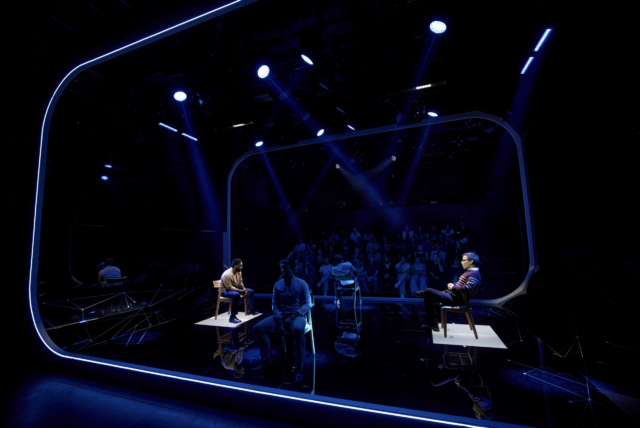
Disruption takes place in a dark, high-tech oblong space with the audience on two sides (photo by Emilio Madrid)
Faust meets The Big Chill in Disruption, a kind of newfangled couples drama in which men and women contemplate their future — personal and professional, individual and as pairs — only this time through the lens of an AI algorithm that may be able to help guide them, or control them. But it deals with more than what Suzie refers to as Nick’s “God Machine” and free will; it’s about how each of us faces the daily trials and tribulations of life and how we go about trying to solve our problems, ignore them, blame them on others, or look for the easy way out. The algorithm is not just a technological advance but a metaphor for how everyone attempts to get a leg up at one time or another, sometimes compromising our ethics and ideals.
Zoë Hurwitz’s set is a dark oblong open on its two long sides, where the audience sits, making us feel complicit in what is happening onstage, as if we’re part of the algorithm. In between scenes, the actors wheel in chairs, tables, and other furniture items while electronic music softly drones and the floor of the oblong lights up with numbers, letters, circles that glow red, and synapses connecting like constellations. The lighting, by Reza Behjat, occasionally reveals a glass-fronted room where Raven operates the algorithm; the sound, which at one point includes creepy echoes, is by Caroline Eng, with contemporary costumes by Hurwitz, with one big surprise at the end.
The ensemble is terrific; each upper-middle-class couple is believable if not wholly unique, with Washington (The Piano Lesson) and Kikue (God Said This, Fruiting Bodies) as their advisers who may or may not have their best interest in mind.
About halfway through the show, Barry tells Nick how his shoelace broke in between patients and, as he was fixing it, he received an ad on his phone for a shoe repair store a block away. “I didn’t say anything. Didn’t search anything . . . it was like someone knew exactly what had happened.” Nick responds, “They probably did.”
Is that a good thing, or a bad thing?
Don’t be surprised if, after reading this review, you get an ad on your phone or on social media for the play, guiding you to get tickets.
Kurzweil also wrote in The Singularity Is Near, “The Singularity will represent the culmination of the merger of our biological thinking and existence with our technology, resulting in a world that is still human but that transcends our biological roots. There will be no distinction, post-Singularity, between human and machine or between physical and virtual reality. If you wonder what will remain unequivocally human in such a world, it’s simply this quality: ours is the species that inherently seeks to extend its physical and mental reach beyond current limitations.”
Be careful what you wish for, especially when it comes to AI.
[Mark Rifkin is a Brooklyn-born, Manhattan-based writer; you can follow him on Substack here.]