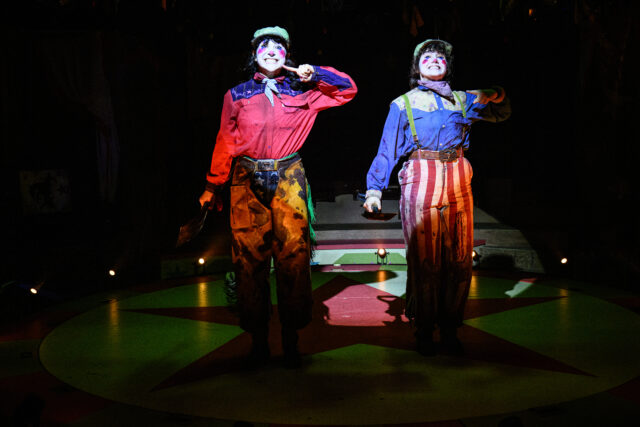
Natasha Roland and Xhloe Rice star in And Then the Rodeo Burned Down at Ars Nova (photo by Ben Arons)
AND THEN THE RODEO BURNED DOWN
Ars Nova
511 West 54th St. between Tenth & Eleventh Aves.
Monday – Friday through July 10, $43.67 – $80.12
arsnovanyc.com
www.xhloeandnatasha.com
“This is the best place in the world,” Dale says several times in Xhloe Rice and Natasha Roland’s enchanting, exhilarating And Then the Rodeo Burned Down. Dale is not just talking about the rodeo, where he is a clown who dreams of becoming a cowboy, but is referring to America itself — and how it may be necessary to burn it down and start all over again.
In 2022, the New York City–based duo known as Xhloe and Natasha won the Edinburgh Fringe First Award for Rodeo, then took home the prize in 2023 for What If They Ate the Baby?, a satire about being a conventional wife in 1950s America, and again in 2024 for A Letter to Lyndon B Johnson or God: Whoever Reads This First, which captures the America of the late 1960s as well as today, as politics, religion, and the military become intertwined and the everyday struggles of the common people are completely misunderstood or purposely ignored.
Last month they received a special Drama Desk Award for Baby?, which ran at SoHo Playhouse in the fall, and Letter to LBJ, which played there last June. They were cited for “their absurdist sensibilities [that] test the parameters of several genres and movement styles . . . and invite new appreciation for all of them.”
Rodeo, which opens today at Ars Nova for a run that has already been extended to July 2, continues their testing of parameters in yet another brilliant, endlessly inventive, and absolutely delightful work of theatrical wonder.
The fun begins with the program itself, which, on one page, identifies Natasha and Xhloe, in clown makeup and western garb, as “prime suspects” in an unnamed crime and offers a reward if they are found alive. “We will not be held liable for any hijinks, shenanigans, or mishaps you may or may not encounter in pursuit of these delinquents,” the poster proclaims.
Emmie Finckel has transformed the space into a welcoming one-ring circus centered by a platform with a star in the middle, a small animal gate, and banners and flags hanging everywhere, some depicting cartoonish wealthy businessmen and ridiculous royalty. The entrance music consists of such songs as Luke Bryan’s “Country Girl (Shake It for Me),” Carrie Underwood’s “Before He Cheats,” and, appropriately setting the stage, Shania Twain’s “Man! I Feel Like a Woman!,” in which the superstar sings, “Let’s go, girls! Come on! / I’m goin’ out tonight, I’m feelin’ alright / Gonna let it all hang out / Wanna make some noise, really raise my voice / Yeah, I wanna scream and shout / No inhibitions, make no conditions / Get a little outta line / I ain’t gonna act politically correct / I only wanna have a good time.”
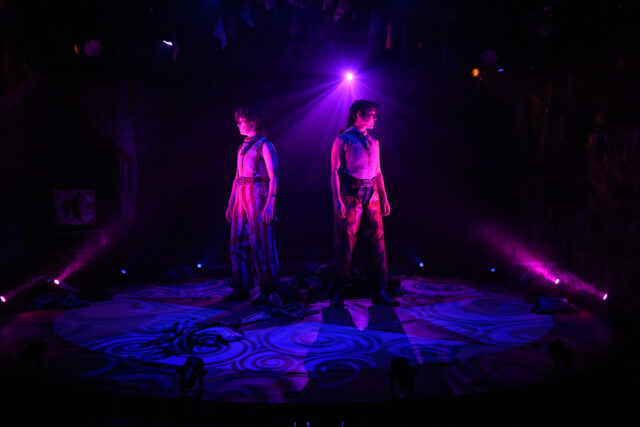
And Then the Rodeo Burned Down is a hilarious excoriation of the American dream (photo by Ben Arons)
Over the course of the next seventy deliriously entertaining minutes, Xhloe and Natasha ostensibly tell the story of Dale (Rice) as he shares his hopes and dreams, often counteracted by his shadow (Roland). “Who are you?” Dale asks the figure that is suddenly sticking close to him. “I’m just like you!” the shadow answers in the first of many instances of mirroring.
Naming the shadow Dilly Dally, Dale explains, “The rodeo is the best place in the world. It’s where cowboys compete in roping calves and wrestling steer and riding bronco and everybody cheers and claps for ’em and everybody comes to see ’em and everybody wants to go to the rodeo and everybody wants to work at the rodeo and I get to live here and be here every day . . . so.” The metaphor of the rodeo — whose fan base leans heavily toward midwestern Republicans — as America is made clear by their relatively ratty costumes: Not only is their makeup red, white, and blue, but Xhloe is wearing pants with red and white stripes, while Natasha’s has a star on her butt. Together, they form their own version of Old Glory.
Soon Dale is being mentored by the rodeo’s macho main attraction, Barnaby (Roland), who Dale considers to be the perfect cowboy and role model. He makes it clear that this is his show and that Dale should be thankful just to be in his presence. “Ya know, you don’t want to confuse the audience on where to look,” he points out. “’Cause I know a thing or two about show business and lesson number one is to never make an audience confused; audiences are notoriously stupid.” (Warning: There is more than one ‘lesson number one.’”)
Barnaby’s tutoring is a subtly effective way of emphasizing classism, power, and misogyny that is enhanced as he teaches Dale how to smoke, endangering his health while hiding the addictive element of cigarettes, and when Arnold the Bull (Roland) escapes from his cage, calling to mind unjustly incarcerated minorities, undocumented immigrants, and American citizens held down by a corrupt, biased, bigoted system. “That thick head of yours not know the rules?” Dale, who is terrified of breaking the written and unwritten laws, says.
Various hilarious episodes deal with freedom, the silencing of women, gun violence, same-sex relationships, poverty, religion, the price of gas, and shoveling shit. But Xhloe and Natasha make sure Rodeo never gets preachy, never wears its heart on its sleeve. Incorporating magic, music (relevant songs by Johnny Cash and Elvis Presley), mime, Marx brothers slapstick, and marvelously simple props, Xhloe and Natasha, with codirector Tom Costello, keep the laughs coming; the two performers’ affection for each other, and, perhaps even more important, for the audience, shines through. That tenderness and warmth are also evident in Angelo Sagnelli’s lighting, which primarily remains bright so everyone can see one another until snapping into a stark darkness.
The show takes a critical shift shortly past the halfway point, turning into a fascinating, no-less-funny treatise on creativity and art in a country that no longer values those fundamental elements as it once did. Defending his profession, Dale says, “It is a really important job. I keep everybody safe.” But from what?
Putting all that aside, at its heart And Then the Rodeo Burned Down is about how we need to learn to love ourselves before we can love others, and even the country itself, the type of love that involves empathy, compassion, faith, trust, hope, and, most definitely, plenty of laughter.
Thus, right now, Ars Nova is one of the best places in the world, wherever Xhloe and Natasha are.
[Mark Rifkin is a Brooklyn-born, Manhattan-based writer; you can follow him on Substack here.]