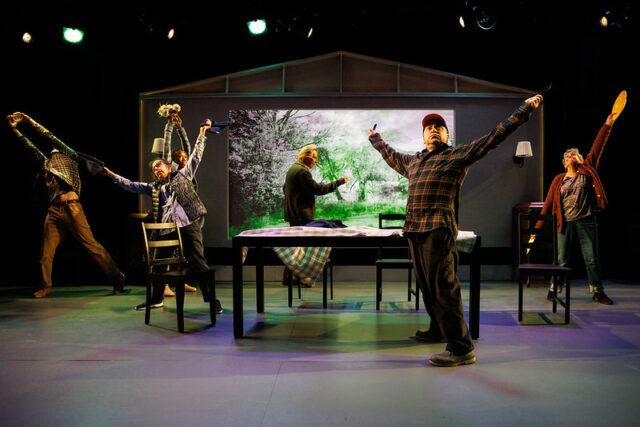
Talking Band explores the magical world of Thomas Mann’s The Magic Mountain in latest production (photo by Maria Baranova)
THE DOOR SLAMS, A GLASS TREMBLES
La MaMa Experimental Theatre Club, the Downstairs
66 East Fourth St. between Second Ave. & Bowery
Wednesday – Sunday through May 9, $35-$40
www.lamama.org
talkingband.org
“All sorts of personal aims, hopes, ends, prospects, hover before the eyes of the individual, and out of these he derives the impulse to ambition and achievement,” Thomas Mann writes in his 1924 novel The Magic Mountain, which serves as the inspiration for Talking Band’s latest play, The Door Slams, a Glass Trembles. He continues, “Now, if the life about him, if his own time seems, however outwardly stimulating, to be at bottom empty of such food for his aspirations; if he privately recognizes it to be hopeless, viewless, helpless, opposing only a hollow silence to all the questions man puts, consciously or unconsciously, yet somehow puts, as to the final, absolute, and abstract meaning in all his efforts and activities; then, in such a case, a certain laming of the personality is bound to occur, the more inevitably the more upright the character in question; a sort of palsy, as it were, which may extend from his spiritual and moral over into his physical and organic part.”
Mann’s intellectual satire about time, love, and tuberculosis at the Berghof sanatorium in Davos in the Swiss Alps, influenced by his wife’s battle with the disease, forms the basis of the new play, written and directed by Paul Zimet and composed by and starring Ellen Maddow, cofounders of Talking Band in 1974 with Tina Shepard, who also appears in the seventy-five-minute intellectual satire.
The Door Slams . . . takes place in and around the Berghof. Marc (Jack Wetherall) and Clara (Maddow) live in the area, where they are visited by their son, Norm (Patrick Dunning), a teacher, and his wife, Jenny (Amara Granderson), who have recently had a baby, Abby. Also stopping by are friends Rick (Steven Rattazzi), a podcaster, and his wife, Rita (Lizzie Olesker), who teaches after-school programs, as well as Oona (Shepard), the town tax collector.
Their movements, particularly when setting the table for a meal, break out into exquisite dances choreographed by Flannery Gregg that make inventive, if repetitive, use of the table- and silverware. As the characters discuss the moon, memory, kairos, hummingbirds, loggers, pencils, tapeworms, and dementia and play charades, Anna Kiraly’s projections on the screen behind them switch from mountains to the forest to the sea. Dream sequences based on scenes from Mann’s novel add a love interest for Marc: his old flame, Anne (Delaney Feener), who becomes the mysterious Clavdia, with Joachim (Norm), Maryusya (Jenny), Dr. Leo Blumenkohl (Rick), Miss Robinson (Rita), Frau Stohr (Oona), and Fraulein Englehart (Clara).
“I used to love to walk along the shore,” Fraulein Englehart tells the doctor. “I could walk for miles with the waves rolling in, the clumps of seaweed on the sand, the vast grey-green water stretching to the horizon. Time drowns in the monotony of space.” The thought matches what Clara later opines: “I never thought we’d be here for so long. But I got used to it. The pace, the quiet, the routine. That’s what worried me. I felt I was becoming . . . dull.”
Meanwhile, Norm is the doomsayer, adding such dark lines as “Just another sign that we’re fucked.” and “I can hardly see the trees. Everything’s about to vanish.” When Oona says that Abby, noticing the baby monitor in her room, knows she is being watched, Norm replies, “Good preparation for the future.”
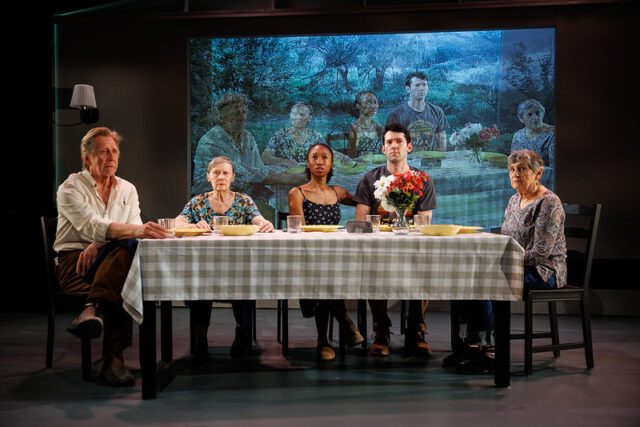
The Door Slams, a Glass Trembles takes place at a sanatorium in the Swiss Alps (photo by Maria Baranova)
Norm’s foreboding highlights the critical part of The Door Slams . . . that doesn’t work: in such recent triumphs as Triplicity, Existentialism, and Lemon Girls or Art for the Artless, Talking Band beautifully danced around didacticism while exploring the human condition. In The Door Slams . . . they make a number of comments about the Trump administration, without mentioning anyone by name, but the clearer they are, the more they stick out and call attention to themselves. For example, at one point Rick argues, “I tell Rose things could get a lot worse if we just sit on our butts and don’t do anything. Rita and I went to jail protesting nuclear weapons. We got teargassed demonstrating against the Iraq War. Rose just says, ‘And look where we are now.’”
In addition, the character of Anne/Clavdia feels out of place, and certain little touches, such as Norm and Rick wearing the same T-shirt, can cause confusion.
The narrative hits its stride whenever it finds its way into the poetic. “At my age there’s a lot of past in front me,” Marc says as the rain falls. When Clara is watching Marc looking out at the world from the porch, she narrates, “He’s watching dark clouds move across the sky from south to north and he thinks that’s curious. Usually they move from west to east, and then he thinks, What will happen if she dies before I do? What will I do to fill my life? He hears the rain approaching and wonders if he should close the windows.” It’s a stunning, gorgeous moment.
Even with its shortcomings, The Door Slams . . . is still unlike anything else on or off Broadway, exemplified by a brief conversation between Anne and Marc. “‘Make it new!’ Ezra Pound. That’s what I want to do, Marc,” she states. He asks, “Make what new?” She replies, “Everything. What I write, what I read, what I see.”
I can’t wait to see what Talking Band has in store for us next.
[Mark Rifkin is a Brooklyn-born, Manhattan-based writer; you can follow him on Substack here.]