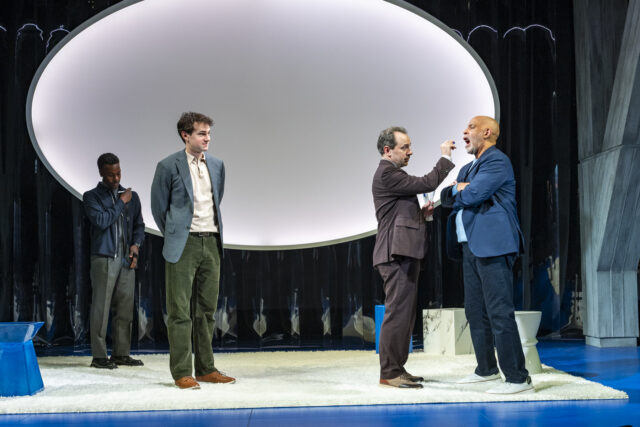
Assistant professor Chris Coffey (Rob McClure) swabs billionaire Zeit Smith (Michael Genet) as grad student Jeffrey Jordan (Matt Walker) watches and Smith assistant Ivan Shelley (Jonny-James Kajoba) checks his phone in Spare Parts (photo by Russ Rowland)
SPARE PARTS
Theatre Row
410 West 42nd St. between Ninth & Tenth Aves.
Tuesday – Sunday through April 30, $39-$89
www.sparepartsplay.com
www.theatrerow.org
In January, Elon Musk told Peter Diamandis on the Moonshots podcast, “You’re preprogrammed to die. And so if you change the program, you will live longer.” A week later, at Davos, he said that aging is a “very solvable problem.”
That’s the concept behind David J. Glass’s gripping biotech thriller, Spare Parts, a true sleeper making its world premiere through April 30 at Theatre Row.
“I want to live,” self-made billionaire Zeit Smith (Michael Genet) tells his assistant, Ivan Shelley (Jonny-James Kajoba), about halfway through the show. “I feel mortality creeping up on me.” Zeit, who is in his early sixties, has dangerously high blood pressure and is at risk of a stroke, motivating him to do something before his time runs out.
Zeit and Ivan recruit Columbia professor Chris Coffey (Rob McClure) and his grad student, Jeffrey Jordan (Matt Walker), to try to make life extension a reality, at any cost. While Jeff is instantly interested, Chris is hesitant, insisting they follow ethical guidelines accepted by the university and scientific community and resist the whims of a rich tech bro, relying on government grants instead — money that is rapidly disappearing. Zeit is all about breaking the rules and doing whatever is necessary to get what he wants. But Chris reconsiders when Zeit offers them salaries of one million dollars apiece and a five-million-dollar budget.
Chris: The money doesn’t mean anything, Jeff, if it stops us from doing what we should be doing. All these great scientists have been taking cash from these guys, and then working on nonsense. Nonsense. I want to work on what really matters — so we’ll make progress.
Jeff: Chris, how can we make progress without any funding at all?
Chris: . . . This is why government funding exists — to keep big money out of things . . . so that scientists can just focus on figuring out the truth.
Jeff: Nice story. How is that working out?
Soon the four men are discussing a two-way plasma exchange in which Zeit would be connected to a younger person so they can exchange blood; the theory is that the younger blood would extend Zeit’s life, but they’re not sure what would happen to the donor — and Zeit doesn’t care.
“This is really the most psychotic thing I’ve ever heard,” Chris tells Jeff privately. But they proceed, attempting to find a match for Zeit and go ahead with the procedure.

David J. Glass’s Spare Parts is a gripping biotech thriller (photo by Russ Rowland)
Novels, movies, and television shows have long explored the issue of longevity and immortality, using science fiction and horror in such works as Oscar Wilde’s The Picture of Dorian Gray, the Twilight Zone episode “The Self-Improvement of Salvadore Ross,” Natalie Babbitt’s Tuck Everlasting, Bram Stoker’s Dracula, and Mary Shelley’s Frankenstein. (Perhaps that’s why Glass gives Ivan the last name “Shelley” in the script, although it is never mentioned in the play itself.) The 2025 Netflix documentary Don’t Die: The Man Who Wants to Live Forever follows tech entrepreneur Bryan Johnson as he spends millions of dollars fighting the aging process.
One of the scariest things about Spare Parts is that the science is real; plasmapheresis and plasma exchange are already happening, but not to make humans live forever — or at least not yet. Glass is a biomedical scientist who is vice president of research at a pharmaceutical company, a senior lecturer at Harvard, an adjunct professor of genetics and development at Columbia, and author of Experimental Design for Biologists. His previous play, Love + Science, was about two gay medical students during the AIDS crisis and also starred Walker, who trained at Juilliard before studying neurobiology at Harvard and pursuing his PhD at Columbia as a National Science Foundation fellow.
Superbly directed by Michael Herwitz (Job, Cold Water), Spare Parts has much in common with Data, Matthew Libby’s chilling play about the ethics surrounding AI. Both ask questions about money, power, government, and technology in an ever-more-precarious world. Just because humans are able to do something never before thought possible doesn’t mean we should.
Scott Penner’s impressive set features two small labs on either side of a central section that has oddly shaped small sculptural chairs, somewhat evoking chess pieces, on a thick white shag carpet in front of a large oval screen on the back wall that gently changes pastel colors, representing Zeit’s all-knowing AI named George; the expert sound, by Ryan Gamblin, includes interstitial techno-drone music; the lighting is by Zack Lobel, with costumes by Amanda Roberge, from casual wear to slapdash professor suits and white lab coats.
Two-time tony nominee McClure (Mrs. Doubtfire Chaplin) is touchingly understated representing the old guard not ready yet to break the mold, Kajoba (Oratorio for Living Things, Twelfth Night) brings a sweet charm to the extremely competent but underappreciated assistant, Genet (A Few Good Men, Choir Boy) is bold and magnetic as the billionaire who thinks the world is his to do with as he wishes, and Walker (The Play That Goes Wrong) is charismatic and engaging as a young man willing to push boundaries, personally and professionally.
Glass takes on current issues with a mix of solemnity and humor without becoming didactic, cleverly hitting his targets, although he can’t help but throw in this one-liner from Zeit, who, like a certain someone, is from Queens: “You hear a guy has some money, so you immediately think he wants to put his name on a building?”
In this case, the billionaire is seeking a very different kind of legacy.
[Mark Rifkin is a Brooklyn-born, Manhattan-based writer; you can follow him on Substack here.]