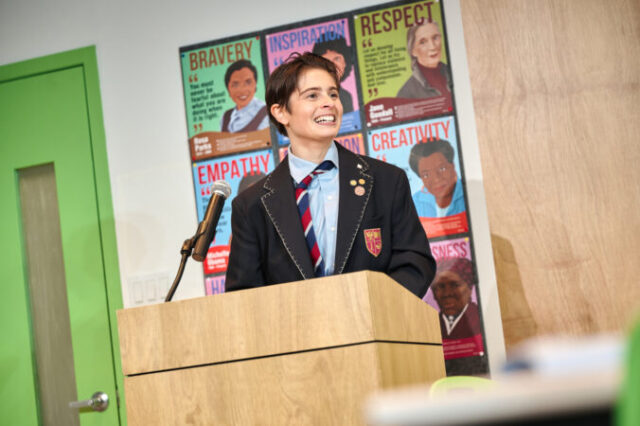
Emmanuelle Mattana wrote and stars in Trophy Boys at MCC (photo by Valerie Terranova)
TROPHY BOYS
Susan & Ronald Frankel Theater
Robert W. Wilson MCC Theater Space
511 West Fifty-Second St. between Tenth & Eleventh Aves.
Through August 3, $64-$114
mcctheater.org
The Breakfast Club meets John Proctor Is the Villain in the US premiere of Emmanuelle Mattana’s Trophy Boys at MCC.
The seventy-minute play takes place in approximate real time as four men from the private boys school Imperium are prepping for a debate against their sister private school, St. Gratia. Owen (Mattana) is a wonk who sees a clear path for himself to become president of the United States. Jared (Louisa Jacobson) is an artist who loves women, and repeatedly reminds everyone of that. Scott (Esco Jouléy) is an athlete who randomly shows off his physical prowess. And David (Terry Hu), the quietest of the team, is determined to become a powerful businessman.
All four roles are portrayed by actors who identify as either female, gender nonconforming, or nonbinary, adding a complicated layer to the argument the high school seniors are given for the debate: “Feminism has failed women — affirmative.”
The humanities classroom is filled with posters depicting famous women, some with one-word descriptions, among them Oprah Winfrey, Amelia Earhart, Ruth Bader Ginsburg, Frida Kahlo, Yoko Ono, Gloria Steinem, Michelle Obama (Empathy), Mother Teresa (Compassion), Katherine Johnson (Hard Work), and Harriet Tubman (Fearlessness). “I am at my most inspired when surrounded by inspiring women,” David says, then calls out excitedly, “Malala!!!” upon seeing a framed picture of Pakistani activist Malala Yousafzai.
The cocky boys, who have had an undefeated season thus far, have one hour to assemble their argument, with Owen putting himself in charge, telling the others, “Trust me. When have I let you down? International politics round you relied on me to know all about the complexities of Pyongyang’s internal power struggle. Technology round I knew all about the ethics of AI in sex dolls. Sports round I knew all the football players with charges of assault. And I don’t even like sports. It’s the same here. I’m on an academic scholarship. I’m smart. Trust me.”
As they proceed, Scott worries about their being accused of mansplaining. Jared doesn’t want to get canceled for accidentally saying something that might be offensive and upset his girlfriend. David complains that he is screwed up because his mother spent more time on the board of eight multinational corporations rather than breast-feeding him. And Owen is not about to let anything get in the way of his political career.
They discuss intersectionalism, pole dancing, the male gaze, the correct word for a woman’s nether region, periods, boobs, women CEOs, the divine feminism, and tradwives, taking potshots at each other’s manhood as if they were in a locker room, complete with a dose of homophobia. Taking notes on the whiteboard, Owen doesn’t realize when he has drawn both a penis and a vagina/vulva.
But when the boys discover that one of them has been accused of sexual assault by a St. Gratia debater, their attitudes about power, gender, and feminism itself begin to morph as they turn on one another, unwilling to jeopardize their futures even as they insist that all women should be believed.
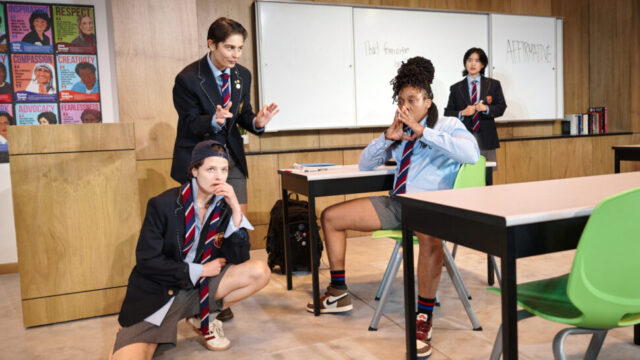
Jared (Louisa Jacobson), Owen (Emmanuelle Mattana), Scott (Esco Jouléy), and David (Terry Hu) have their work cut out for them as final debate nears (photo by Valerie Terranova)
Mattana, who wrote the play when she was twenty-one, quit competitive high school debating “to become an artist and hang out with other queer weirdos who helped me imagine a braver, more radical future.” In the program, she points out, “The very nature of the endeavour — turning argument into sport while believing yourself the smartest in any room — required you fervently argue things you didn’t know enough about or even necessarily believe. Logic was a game, something to be won or lost, and words and arguments were things you could twist at your own whim. If you were articulate and commanding enough you could speak over anyone, or for anyone. It was no wonder this ethos seeped so dangerously into other parts of these boys’ lives. . . . Gender is learnt, which means it is also taught. No more so than to those young men I knew from debate. With this brand of masculinity inhabited onstage by non-cis male bodies, my hope is that it can be revealed for what it truly is — a comical, absurd, and ultimately disturbing performance.”
Trophy Boys is all those things and more. The play is skillfully directed by Danya Taymor, who won a Tony for The Outsiders and was nominated for John Proctor Is the Villain, both of which also deal with toxic masculinity and gender; she and movement director Tilly Evans-Krueger employ full use of Matt Saunders’s realistic set, adroitly lit by Cha See. But Mattana, in their playwriting debut — they have previously appeared in such television series as Mustangs FC and Videoland and cowrote and starred in the feature film Fwends — isn’t about to make anything easy for the audience, providing no simple answers while avoiding genre clichés. In one of the most potent scenes, the four actors strip out of Márion Talán de la Rosa’s school uniform costumes down to their skivvies, a revealing moment that posits that body type does not define gender.
There is plenty of mansplaining, which gets complicated since it’s being delivered by non-cis-male performers, building in an inherent humor and ridiculousness. “Our case has to be more feminist than the pro-feminist side. We believe feminism has failed women from the perspective that we are actually more feminist than the feminists,” Owen declares. David offers, “It’s because they hate us. They hate men. That’s why feminism has really failed. It’s not interested in helping women, it’s interested in denigrating men.” Scott says, “Everyone’s confused about whether Emily Ratajkowski showing her ass on Instagram is feminist or not,” to which Jared, who, as a reminder, really loves women, replies, “Fuck, she’s hot.”
Hu (Never Have I Ever), Jacobson (Lunch Bunch), Jouléy (Merry Me, Wolf Play), and Mattana form a tight-knit, believable quartet of students in a classroom, a setting used for such other recent hard-hitting plays as Donja R. Love’s soft, Sanaz Toossi’s Pulitzer Prize—winning English, and Dave Harris’s Exception to the Rule. They are like a sports team getting ready for the big game, each with their own responsibility, to themselves as well as their team.
Occasionally, the characters, particularly Owen, recognize that the audience is present, making direct gestures at us, but I found those instances perplexing, not sure whether we were supposed to be the crowd watching the eventual debate or the MCC audience, and they seemed to be unnecessary breaks in the fourth wall.
Otherwise, Trophy Boys is a rousing and inventive twenty-first-century battle of the sexes — which is, I imagine, an out-of-date phrase, but please don’t cancel me — that will have you gasping, laughing, and whooping it up, but possibly not always in unison with the rest of the audience.
[Mark Rifkin is a Brooklyn-born, Manhattan-based writer and editor; you can follow him on Substack here.]