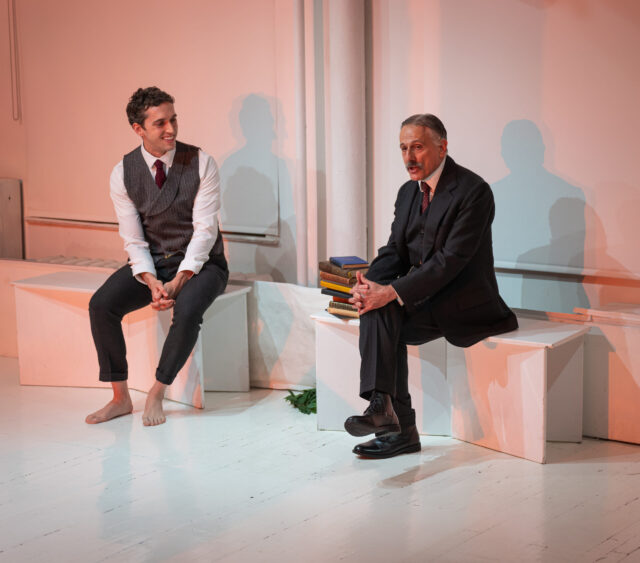
Yaron Lotan and David Greenspan both portray A. E. Housman in Tom Stoppard revival (photo by Paul Lutvak)
THE INVENTION OF LOVE
TheaterLab
357 West Thirty-Sixth St., between Eighth & Ninth Aves., third floor
Through October 3, $44.40-$88.80
theaterlabnyc.com
themaptheater.com
In the the fall of 2000, Tom Stoppard and Daniel Mendelsohn took part in an extraordinary exchange of letters in the New York Review of Books following the latter’s lengthy critical chastising of the former’s The Invention of Love at the Wilma Theater in Philadelphia. The back-and-forth could make for its own fascinating play, although audiences would have to be given extensive notes to catch even a handful of the endless literary and historical references (in the letters and the play). In fact, when the show reached Broadway in 2001, theatergoers were given a thirty-page booklet to help decipher various elements.
Of course, since Stoppard died last November at the age of eighty-eight, I don’t have to worry that he will come after me for this review, at least not in this life. In addition, it is far easier for me to research the language and setting of the play using the internet in a way that was not available a quarter-century ago.
Director Zachary Elkind and his MAP Theater are staging a rare US revival of The Invention of Love, running through October 3 at the nearly blindingly white space at Theaterlab. Stoppard would most likely take no issue with my thoughts on the first act, although he might not go easy on me when it comes to what follows after intermission.
The memory play opens with AEH, exquisitely portrayed by off-Broadway legend David Greenspan in a tight-fitting three-piece academic suit, pristine facial hair, and a slow, careful gait, entering the small room, where an audience of about a hundred sit in two rows on opposite sides. In the middle is a makeshift rowing boat on which Charon (Annabel Capper) will take the late poet and scholar across the River Styx and to the underworld of Hades.
“I’m dead, then. Good,” he says, recognizing the situation he is in, adding matter-of-factly, “And this is the Stygian gloom one has heard so much about.” It’s a brilliant opening that sets the stage for what we’re in for.
As AEH sits on one of the benches on the boat, his years as a student at Oxford start unfolding before his eyes. Sometimes he closes them, deep in thought, and other times he watches closely, as his younger self, identified in the script as Housman (Yaron Lotan), filled with a lust for literature and camaraderie, frolics with his new friends and classmates, A. W. Pollard (Daniel Liu) and Moses John Jackson (José Espinosa), arguing over the merits of Plato, Homer, Aeschylus, Sophocles, and, primarily, the significantly lesser-known Sextus Propertius.
Housman also takes a fancy for Jackson, who is a champion runner, an unrequited love that would haunt him throughout his life and, here, into his death.
Stoppard revels in highfalutin intellectual conversations the three students have, as exemplified by this early exchange, as they are rowing on the Thames:
Housman: False quantities in all around I see, yea we have been forsaken in the wilderness to gather grapes of thorns and figs of thistles.
Pollard: That’s possibly why the College is named for John the Baptist.
Jackson: John the Baptist was locusts and wild honey, actually, Pollard.
Pollard: It’s the Baptist School of Hard Knocks. First the Wilderness, then the head on the platter.
Housman: It was clear something was amiss from the day we matriculated. The statutes warned us against drinking, gambling and hoop-trundling but not a word about Jowett’s translation of Plato. The Regius Professor can’t even pronounce the Greek language and there is no one at Oxford to tell him.
Pollard: Except you, Housman.
Housman: I will take his secret to the grave, telling people I meet on the way. Betrayal is no sin if it’s whimsical.
Jackson: We did the new pronunciation, you know. As an Englishman I never took to the speaking of it. Veni, vidi, vici . . . It was never natural to my mind.
Pollard: That was Latin, actually, Jackson.
Jackson: And “Wennus” the Goddess of Love. I mean to say!
Pollard: Perhaps I don’t make myself plain. Latin and Greek are two entirely separate languages spoken by distinct peoples living in different parts of the ancient world. Some inkling of this must have got through to you, Jackson, at the Vale Academy, Ramsgate, surely.
Housman: But “‘Wennus’ the Goddess of Love,” for a man of Jackson’s venereal pursuits, is a strong objection to the new pronunciation — where is the chemistry in Wennus?
Jackson: I know you and Pollard look down on science.
Pollard: Is it a science? Ovid said it was an art.
Jackson: Oh — love!
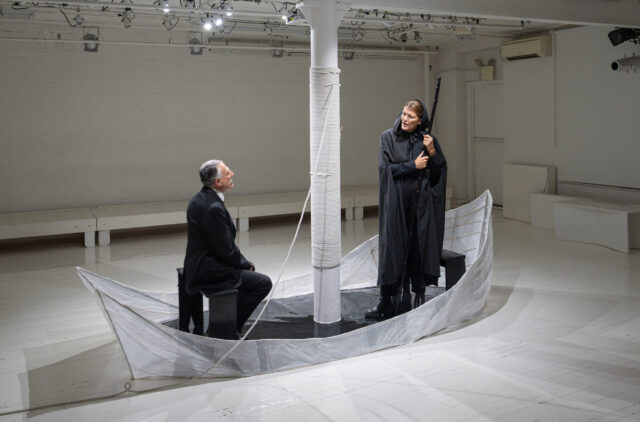
Charon (Annabel Capper) guides A. E. Housman (David Greespan) across the River Styx in The Invention of Love (photo by Paul Lutvak)
It’s not the details that matter so much as the flow of the dialogue, which unfurls in pure poetry.
Later in the first act, AEH gets the opportunity to walk into his earlier life, meeting the young man he was more than half a century ago. While AEH recognizes the strapping lad, Housman does not know he is speaking with his future self. It’s a profoundly touching and evocative scene, distinguishing the hope, and folly, of youth against the reality of a long-lived life of learning. Referring to his Oxford days, AEH says, “I felt as if I had come up from the plains of Moab to the top of Mount Pisgah like Moses when the Lord showed him all the land of Judah unto the utmost sea.” Housman replies, “There’s a hill near our house where I live in Worcestershire which I and my brothers and sisters call Mount Pisgah. I used to climb it often, and look out towards Wales, to what I thought was a kind of Promised Land, though it was only the Clee Hills really — Shropshire was our western horizon.” A. E. Housman would eventually gain international fame for his 1896 poetry collection, A Shropshire Lad.
Stoppard also introduces us to Lincoln College rector Mark Pattison (Sam Bolen), art critics Walter Pater (Abrar Haque) and John Ruskin (Spencer Lutvak), Latin scholar Robinson Ellis (Lutvak), and master of Balliol College Benjamin Jowett (Leland Fowler), who share their views on education, class, and, as Jowett states, “the ideal of morality, art and social order.”
AEH disappears for much of the second act, as the narrative focuses on Housman’s growing fondness for Jackson and what is happening outside the Oxford environs. Journalists Henry Labouchere (Fowler), Frank Harris (Lutvak), and W. T. Stead (Bolen) talk about the power of the press, professor John Percival Postgate recommends Housman for a position despite their disagreement over Propertius, and editor Jerome K. Jerome (Capper), Harris, and Housman’s new friend Chamberlain (Haque) discuss the merits of the imprisoned writer Oscar Wilde (Bolen).
When AEH returns, he exhibits his disdain for the term homosexual to Chamberlain, declaring, “It’s half Greek and half Latin!” He also doesn’t care for the word because he never publicly admitted that he himself was gay, which is brought to the forefront when he meets Wilde, whose lover, Lord Alfred “Bosie” Douglas, coined the phrase “the love that dare not speak its name.” Wilde is everything that AEH was not, but their interaction, which is a complete fiction, as the two men never met, goes on too long, extending an already too long second act.
You don’t have to be a Classics major to fall under the magical spell of The Invention of Love. Five-time Tony winner Stoppard (Rosencrantz and Guildenstern Are Dead, The Coast of Utopia) is in complete control, glorying in the poetry of language and the science of literature, even as he gets carried away in the later moments. Six-time Obie winner Greenspan (Strange Interlude, Four Saints in Three Acts) is mesmerizing as AEH, a proud and resolute man who, sadly, was unable to live life to the fullest. It doesn’t matter that the words he speaks and thoughts he shares are ultracomplicated and often impossible to truly understand, because they roll off his tongue with such grace and beauty that you never want him to stop.
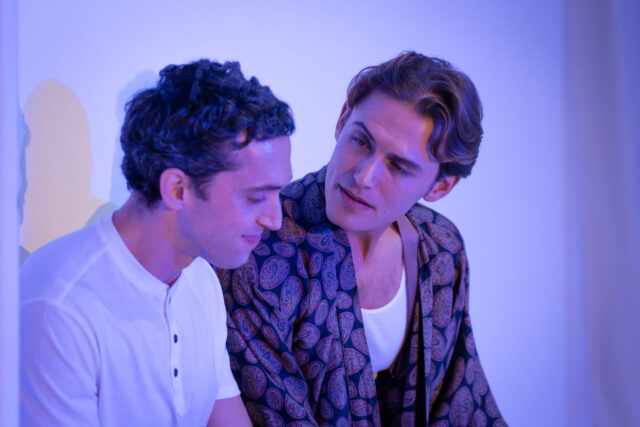
A. E. Housman (Yaron Lotan) is haunted by his love for Moses John Jackson (José Espinosa) in Stoppard play at Theaterlab (photo by Paul Lutvak)
Lotan (You Don’t Have to Do Anything, Dead Poets Society) is charming as the young Housman, holding his own in his scenes with Greenspan and leading the energetic ensemble. Espinosa (Our Class, The Merchant of Venice) exudes sexiness as Jackson, who is in love with life in a way AEH and Housman never will be. (In the 2001 Broadway premiere, Richard Easton won a Best Actor Tony for portraying the elder Housman and Robert Sean Leonard captures a Best Supporting Actor Tony as the young Housman.)
Elkind (James Joyce’s Exiles, If We Kiss) makes excellent use of the intimate space as the plot shifts from rivers and a track meet to a club and the halls of Oxford. Bridget Lindsay’s set, which also features several white benches and cleverly incorporates the pole that stands in the middle of the room, is lit by Paige Seber with soft touches of blue, purple, and yellow. Alyssa Korol’s costumes are appropriately Victorian era, although it is curious that all the men except for AEH are barefoot.
The play also brings added meaning to one of Housman’s most famous poems, “To an Athlete Dying Young.” When Chamberlain quotes from it, Housman gets upset, saying, “This is a revolting habit, Chamberlain — I forbid you.” Despite potentially upsetting both Stoppard and Housman, I will leave you here with the full quatrain that Chamberlain referred to:
Smart lad, to slip betimes away
From fields where glory does not stay,
And early though the laurel grows
It withers quicker than the rose.
[Mark Rifkin is a Brooklyn-born, Manhattan-based writer; you can follow him on Substack here.]