
Noah Galvin displays an infectious charm as Josh in The Reservoir at the Atlantic (photo by Ahron R. Foster)
THE RESERVOIR
Atlantic Theater Company, Linda Gross Theater
336 West 20th St. between Eighth & Ninth Aves.
Tuesday – Sunday through March 22, $56.50-$131.50
atlantictheater.org
As the audience enters the Atlantic’s Linda Gross Theater to see Jake Brasch’s off-Broadway debut, The Reservoir, they are met by an unusual sight: An actor is flat on his back on the floor, as if dead. Next to him is wheeled luggage. There are two empty chairs on either side of the stage, in front of curtains, more of which hang high in the back, above a curving piece of scenery that represents water, as if the young man has washed onshore, perhaps having drowned. The night I went, most of the crowd paid little attention to the actor, instead checking their phones and engaging in conversation, as life goes on without him. It’s an apt metaphor for the play itself, which is an engaging and clever foray into family and addiction until it starts drowning in melodrama in the second half.
The young man is Josh (Noah Galvin), an alcoholic college student on leave because of his blackout benders and subsequent disappearances. After Josh awakes, appreciating the sunrise, a park ranger (Matthew Saldívar) tells him he can’t sleep there. Josh turns to the audience and says, “Focus on the cop, speak to the cop. But how did I get here? Did I get on a plane? A greyhound? Wouldn’t be the first time. One time I went to a club in Brooklyn and woke up three days later at a Chick-fil-a in West Virginia.”
A moment later he adds, “Okay. Focus. Morning. Bleeding. Suitcase. Denver. What’s the last thing I remember? The hot rehab worker breathalyzed me and drove me into Miami and then . . . Here we go. Here comes the sober. I hate this part, when the dam breaks and the questions come pouring in.”
He has mysteriously returned home, where his mother, Patricia (Heidi Armbruster), wants him back in rehab. He begs her for one last chance and she agrees to let him stay in his room if he promises to remain sober, take a job at the independent bookstore she owns, and go back to school in the fall.
For most of the play, the four chairs are occupied by Josh’s grandparents, the easygoing Catholic Irene (Mary Beth Peil) and Hank (Peter Maloney) on Patricia’s side, the talkative Jewish Beverly (Caroline Aaron) and Shrimpy (Chip Zien) on his father’s. Despite being surrounded by family and working for a mellow boss, Hugo (Saldívar), Josh can’t get his life in order, especially when Irene’s dementia gets worse. When she suddenly breaks into a lovely version of “O Come, All Ye Faithful,” he starts understanding that she is seriously ill, telling Beverly about it. Grandma Beverly is very different from Grandma Irene:
Beverly: So this was truly, completely out of nowhere?
Josh: Unprompted. It felt channeled. Like a spirit was moving through her or something.
Beverly: Christ.
Josh: Yeah, maybe, could have been him. I mean really though, it was actually kinda beautiful.
Beverly: Well, if I ever get like that, if I start randomly singing at lunch, you have to shoot me, understand?
Josh: What?
Beverly: I’m serious. It’s not hard. This is Colorado. Use my credit card, go to Walmart, buy a rifle.
Josh: Dark.
Beverly: I’ll tell you what’s dark: old age. That’s why you’ll help your granny when the time is right.
Josh: I won’t.
Beverly: If I’m all but three words into “O Come, All Ye Faithful” —
Josh: I doubt that would be your song of choice.
Beverly: “Mi Chamocha” whatever. Push me off a cliff.
Meanwhile, Shrimpy, long divorced from Beverly, is planning on having his second bar mitzvah, at the age of eighty-three, and wants Josh to help him prepare, but he has a tendency to speak a little too openly, particularly when it comes to sex. Acknowledging that Josh is gay, Shrimpy asks him whether he has ever had a threesome, then explains, “I’m straight. Mostly. But, you know, sometimes I look at dicks on my computer. What can I say? I do. I look at the dicks. Hey, what do you say you help me with my bar mitzvah prayers?”
Josh, who has no friends his own age and is not dating, joins Beverly at her senior aerobics class at the JCC taught by Lenni (Armbruster), who says things like “Okay, my beautiful Jewish women, let’s start with a step touch. . . . And five six seven eight . . . Goyim style!” He spends nearly all his free time with his grandparents, but when Irene takes a turn for the worse, Josh’s life once again spirals out of control.
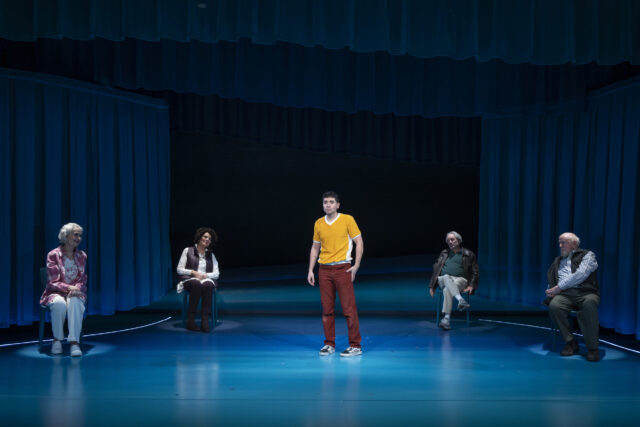
Josh (Noah Galvin) is surrounded by his grandparents in Jake Brasch’s The Reservoir (photo by Ahron R. Foster)
In my recent review of Jacob Perkins’s The Dinosaurs, which just ended its run at Playwrights Horizons, I wrote, “If I never see another play set entirely at an AA or grief counseling meeting consisting of a group of people sitting on folding chairs near some coffee and donuts, it will be too soon.”
A coproduction with Ensemble Studio Theatre and the Alfred P. Sloan Foundation, The Reservoir is not set entirely at an AA or grief counseling meeting, but much of the second half feels like it does as Josh battles to remain sober while all of his grandparents experience health declines. The first act had a sharp, very funny, and relatable tone and mood, but after intermission it all falls apart as Brasch heaps on the soapy melodrama, sucking the life out of the story and hamstringing each of the actors and characters, which also include Josh’s imaginary doctor, Yaakov Stern (Saldívar), a real neuroscientist who discusses the concept of cognitive reserve and offers such advice as “Listen, Joshua. Alcoholism and Alzheimer’s? Not the same thing. You can rebuild, they cannot,” as well as Rabbi Silver (Armbruster), who leads Josh and Shrimpy in a wholly improbable scene in a temple.
Director Shelley Butler (The Scarlet Letter, This Is Fiction) can’t rein in a narrative that gets lost at sea as various pieces of furniture and book carts are wheeled on- and offstage through the sheer curtains, which turn color based on Jiyoung Chang’s lighting shifts. (The set is by Takeshi Kata, with casual costumes by Sara Ryung Clement and sound and incidental music by Kate Marvin.)
Independent Spirit Award nominee Galvin (Waitress, Dear Evan Hansen) is a delight to watch, infusing Josh with a bittersweet complexity that makes you want to root for him in spite of his many serious mistakes. Helen Hayes Award nominee Aaron (A Kid Like Jake, Madwomen of the West) and three-time Drama Desk nominee Zien (Harmony, Caroline, or Change) nearly steal the show as the madcap Jewish relatives, while two-time Tony nominee and Obie winner Peil (Dying for It, Cornelia Street) and Drama Desk nominee Maloney (I’m Revolting, On the Shore of the Wide World) are touching as the gentle old goyim. Armbruster (Boy, Man from Nebraska) and Saldívar (Junk, The Wild Duck) do what they can with underwritten, overly clichéd roles.
Brasch, who describes themself as “a queer, sober, Jewish clown,” was inspired to write the play based on a year in his own recovery during which he reconnected with his grandparents. The Reservoir feels almost too personal, with too many plot holes and too many off-color jokes that start sounding repetitive as the protagonist faces ever-harder truths.
Talking about a metaphorical river, Josh says, “Nothing can get past the dam. And we’ll never know where the water was heading. We’ll never know what lurks beyond. Immense dryness. A great expanse. Terrifying. What do we remember? What have we forgotten? All of the things that we do not know that we do not know. That gnawing feeling that there’s something missing. Something small. Something minor. Or maybe something huge?”
The first half of The Reservoir is rich and free flowing, but there’s too much missing in the second half, preventing it from getting past that dam.
[Mark Rifkin is a Brooklyn-born, Manhattan-based writer; you can follow him on Substack here.]