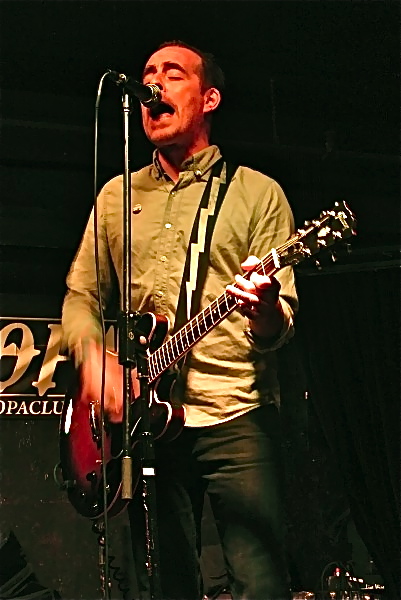
Ted Leo and the Pharmacists and Screaming Females should be a scream tonight at the South Street Seaport (photo by twi-ny/mdr)
South Street Seaport, Pier 17
Saturday, July 9, free, 6:30
www.seaportmusicfestival.com
www.tedleo.com
For the past ten years, indie punk icon Ted Leo has been playing an annual free show in New York City, from Siren and RiverRocks to Castle Clinton, the McCarren Park pool, and the South Street Seaport. Tonight, Leo and his band, the Pharmacists, are back at Pier 17, headlining the official kick-off show for next Saturday’s 4Knots Music Festival, which features the Black Angels, Titus Andronicus, Davila 666, Oberhofer, Mr. Dream, and Eleanor Friedberger. Tonight at the Seaport, Leo will be celebrating the tenth anniversary of The Tyranny of Distance by playing the record in its entirety. “The whole album’s like an Irish wake to me,” he writes on his website about looking back at the making of the disc, “and what happened afterward surprised me more than anybody!” He also explains, “It’s become a bit of an urban legend that we bring ten plagues down upon the city every time we play an outdoor summer show, but it’s really just storms (and a blackout). No locust or Angel of Death. And it’s actually not just limited to New York City. AND it’s actually not true.” In addition to such Tyranny tracks as “Biomusicology,” “Dial Up,” “The Great Communicator,” and “You Could Die (Or This Might End),” Leo will be playing other songs from throughout his solid career. And be sure not to miss the opening band, the great New Jersey outfit Screaming Females, led by wicked guitarist and chief screamer Marissa Paternoster, who joined Leo onstage at last year’s Siren Festival in Coney Island.
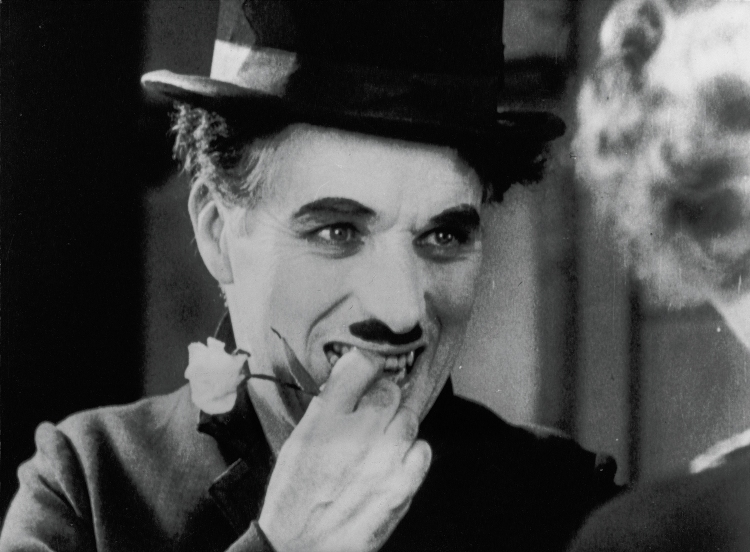
 A genuine American treasure, City Lights is one of Charlie Chaplin’s most thoroughly entertaining masterpieces. Serving as writer, director, editor, producer, and composer, Chaplin also stars as the Little Tramp, a destitute man who instantly falls in love upon seeing a blind Flower Girl (Virginia Cherrill). When she mistakes him for a millionaire with a fancy car, he decides to pretend to be rich so she might like him, but when he actually becomes pals with the business tycoon (Harry Myers), he thinks he might eventually be able to get the money for her to get a new operation that could restore her eyesight. The only problem is that the millionaire, who parties wildly with the Little Tramp every evening, taking him to ritzy nightclubs and even giving him his car at one point, remembers nothing the next morning, and doesn’t want anything to do with him. It all leads to an unforgettable conclusion that pulls at the heartstrings. Despite the availability of sound, Chaplin chose to make City Lights a silent picture, although he did incorporate sound effects and, in one section, distorted speech. Although the film features several hysterical slapstick bits, including the opening, when the Little Tramp is sleeping on a statue entitled “Peace and Prosperity” as it is unveiled, and a scene in which he saves the millionaire from a suicide attempt, virtually every minute comments on the social reality of depression-era America and the widening gap between the rich and the poor. Metaphors abound as the Little Tramp tries his best to maintain a smile and search out love during the bleakest of times. City Lights is screening July 10 and August 7 & 21 at Symphony Space, kicking off its Chaplin series, consisting of eight programs showing Chaplin films in high-definition for the first time ever on the big screen; the weekend series also includes multiple screenings of Monsieur Verdoux, Limelight, Modern Times, The Great Dictator, and other classics.

 During the early Tang Dynasty in the late seventh century, Wu Zetian (Carina Lau sporting some great hairdos) is about to become the first empress of China. In preparation for her ascendance to the throne, architect Shatuo (Tony Leung Ka Fai) is leading the construction of a two-hundred-foot Buddha statue with her face, a massive structure that is like its own city inside. But when people start spontaneously combusting after a pair of amulets in the statue are moved, Wu calls in Detective Dee (Andy Lau sporting some great facial hair), who has been in prison for eight years for previously opposing her, to find out who is behind the horrific deaths. Dee is teamed up with Wu’s right-hand woman, Shangguan Jing’er (Li Bingbing), and albino warrior Donglai Pei (Deng Chao) to get to the bottom of the killings, which many believe is a curse not being perpetrated by humans. As the unlikely threesome gets closer to the answers, they become enmeshed in a series of battles featuring unusual weapons and unexpected twists and turns, not knowing whom they can trust, their lives in constant danger. Nominated for the Golden Lion at the 2010 Venice Film Festival and winner of six Hong Kong Film Awards (including Tsui Hark for Best Director, Carina Lau for Best Actress, and Phil Jones for Best Visual Effects), Detective Dee and the Mystery of the Phantom Flame is a fun and exciting old-fashioned wuxia tale, with exciting if repetitive action scenes directed by Sammo Hung and sumptuous production design by James Chiu. The inner workings of the enormous statue is a thing of beauty that has to be seen to be believed. A mix of actual and invented characters — there really was a Judge Dee (Di Renjie), who was turned into a detective hero in a series of novels by Dutch author Robert van Gulik — the film is a thrilling historical mystery epic that could have used a little more back story but is still a return to form for Hark. Detective Dee and the Mystery of the Phantom Flame will be screening July 11 at 9:00 as part of the Wu Xia Focus at the New York Asian Film Festival at Lincoln Center, and as a special bonus director Tsui Hark will be on hand to talk about the film and receive the Star Asia Lifetime Achievement Award (at 8:30, with all ticket holders welcome).