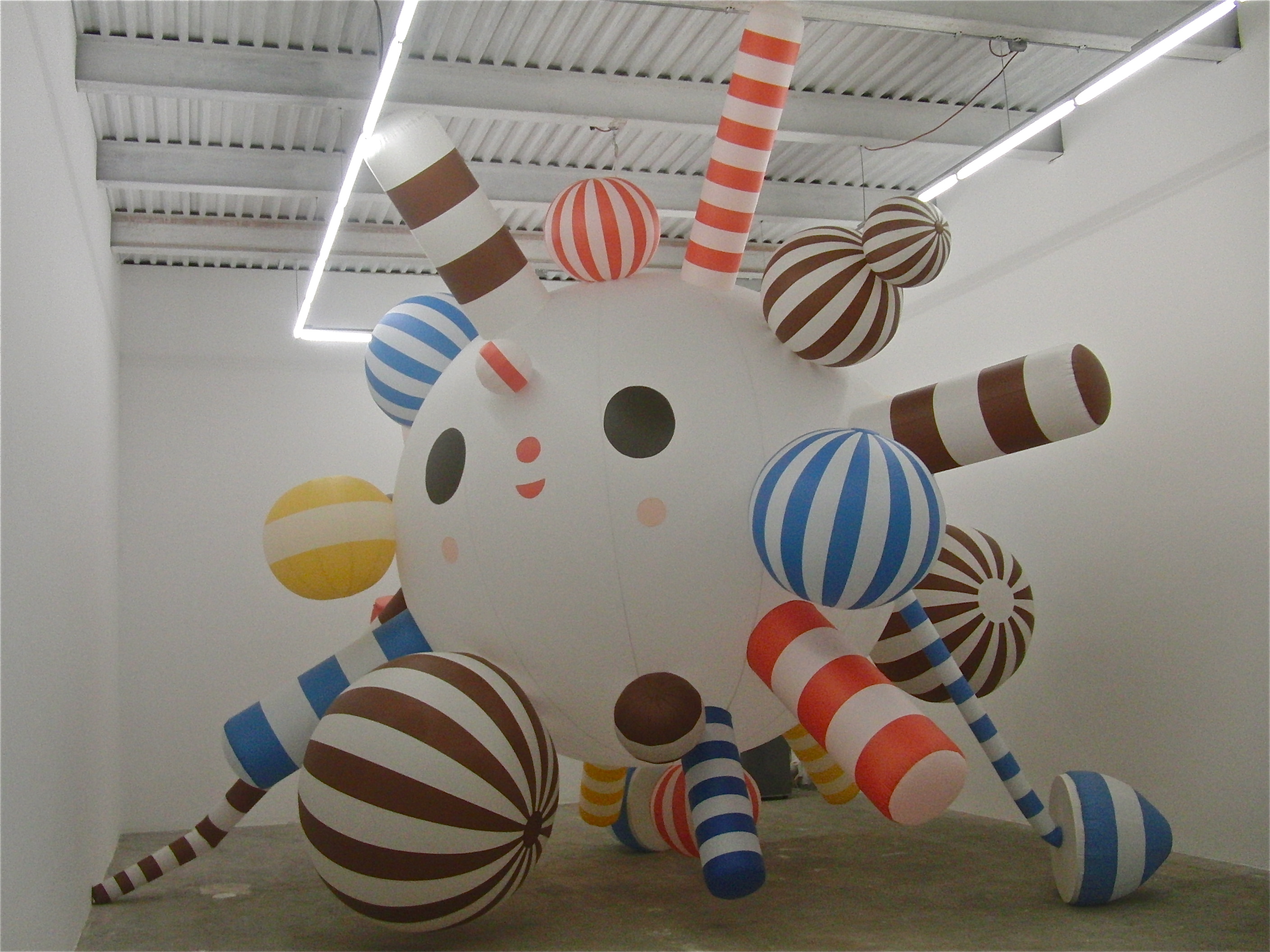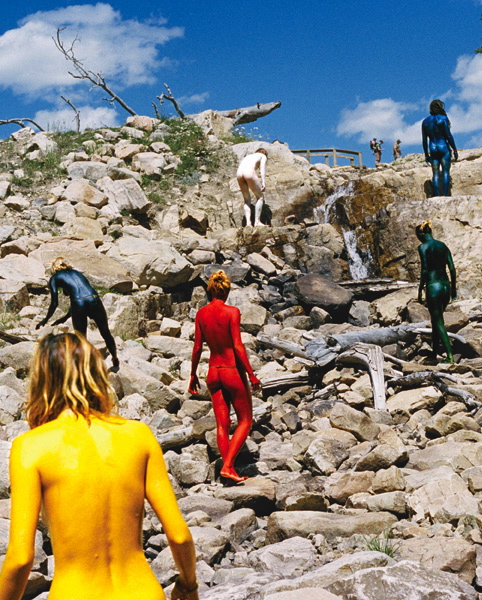
You never know who’s gonna show up at the annual Vice Photo Show and other Lower East Side summer group exhibitions (photo © Jim Mangan)
Summer group shows are in full swing, and it’s often difficult to find the superstars among all the maelstrom. But there are a number of Lower East Side galleries offering up diamonds in the rough. If you’re looking for bigger names, it’s hard to beat Lehmann Maupin (201 Chrystie St., through August 19) right now. At the entrance, you’ll be greeted by Tracey Emin’s twenty-minute looped animation “Those who suffer Love,” which invites you into a woman’s nether regions. In the main gallery, Gilbert & George’s “Urethra Postcard Pictures,” which debuted at the 2011 Armory Show, is joined by four photographs by Juergen Teller, including “Paradis XVIII, 2009,” in which Raquel Zimmerman and Charlotte Rampling pose nude in the Louvre. There are also a few more works by Emin, highlighted by the controversial pink neon “Your Name Try CUNT INTERNATIONAL.” Be sure to go to the upstairs viewing room, where you’ll find multimedia collages by Tony Oursler and the miniature sculptural projection “Interstitial.”
Next door at the Hendershot Gallery (195 Chrystie St., August 18), “Of Memory and Time . . .” examines the two concepts through a series of diverse works that evoke the past, from the dangling wax figures of Julie Tremblay’s “From Memory (Collective Unconscious Unlimited)” to the framed jeans in Marie Vic’s “Les amants R.,” from Richard Bosman’s painting of “Duchamp’s Door” and “Pollock’s Door” to Arman’s violin, “Hommage á Boccioni.” In fact, music plays a central role in the exhibit, as cellist Christopher Lancaster has composed special mesmerizing interludes for a number of the works, while Nick Hooker’s swirling multiscreen video of Grace Jones’s “Corporate Cannibal” keeps thumping in the basement.
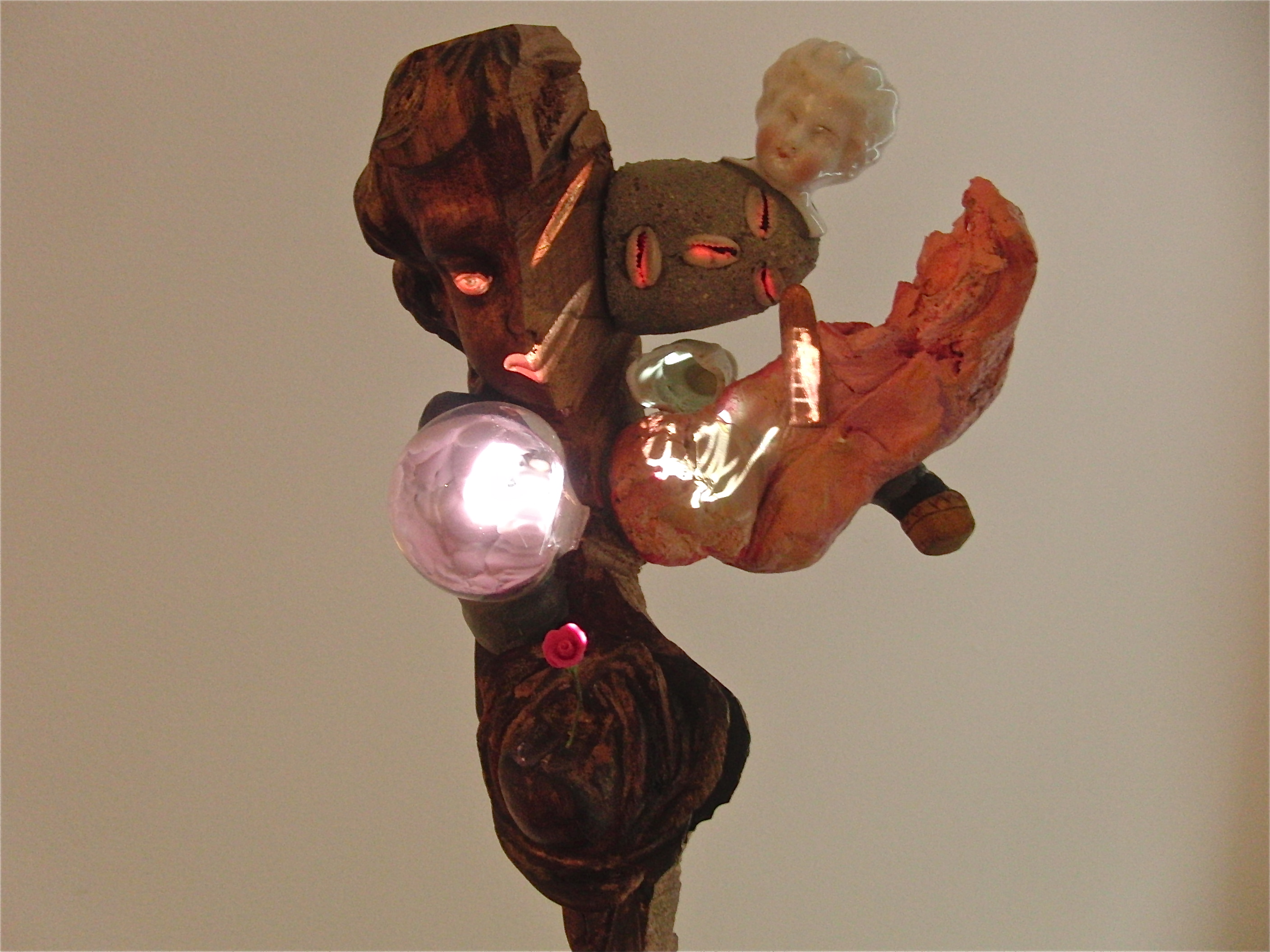
Tony Oursler, “Interstitial,” steel stand, projection, and mixed media, 2011, at Lehmann Maupin (photo by twi-ny/mdr)
Salon 94 Bowery (243 Bowery, July 30) harkens back to the Paul Klee quote “Nothing has to take grand scale, if it can be expressed in a diminutive, delicate and yet no less sophisticated way” in its latest show, the cleverly titled “Paul Clay,” comprising six dozen sculptures squeezed into two floors, in addition to 120 small household items on sale in a small storeroom, ranging from Takuro Kuwata’s $80 porcelain teacups and Lisa Sitko’s $80 ceramic apples to Rob Wynne’s $1,500 “Dirty Plates” and Betty Woodman’s $17,000 “Tray with Two Cups.” Among the other artists represented are Liz Larner, Sterling Ruby, Marilyn Minter, Daniel Buren, and Ken Price. Try not to throw any garbage into Matthias Merkel Hess’s “Brute” trashcan, and be careful where you walk; you break it, you bought it.
Cutting-edge provocateurs Vice magazine, which covers music, fashion, art, and more in their own rather unique wild style, is celebrating the release of its tenth annual photo issue with the 2011 Vice Photo Show (298 Elizabeth St., July 26), consisting of pictures by Jim Mangan, Mick Rock, Terry Richardson, Richard Kern, Martin Parr, Ben Ritter, Jennifer Osborne, Peter Sutherland, Max Merz, and others. We’re particularly taken with Estelle Hanania’s “Happy Purim” series, documenting Hasidic holiday partying in North East London’s Stamford Hill; Vincent Fournier’s “The End of the Future” exploration of the Kennedy Space Center; Chris Nieratko’s “Lost Submissions,” naked Polaroids from his days as the editor of a skateboarding magazine owned by Larry Flynt; Julian Burgin’s “One Flash Bastard” portraits of reformed British gangster Dave Courtney; and Asger Carlsen’s “Hester” series of deformed bodies. RSVP now to tonight’s booze-laden opening party.
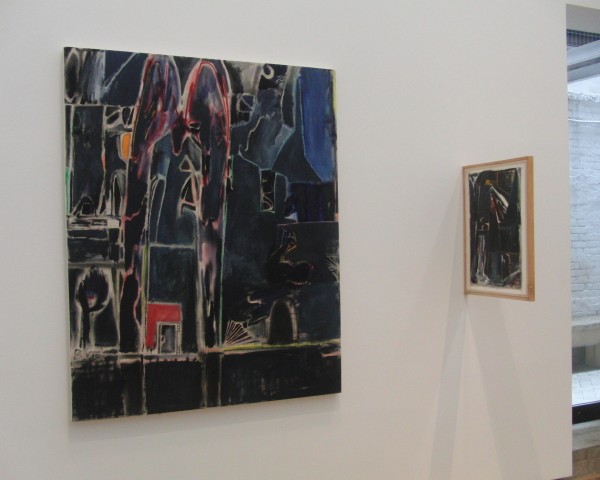
Ted Gahl’s “Sleepwalking” and double-sided “Night Painter” are on view at DODGEgallery (photo by twi-ny/mdr)
As we said earlier, group shows can reveal a diamond in the rough, and we found a shining gem at DODGEGallery’s (15 Rivington St., July 30), “Shakedown,” a fitting way to end the space’s first year in business. Amid works by Dave Cole, Ellen Harvey, Darren Foote, Laurel Sparks, Jason Middlebrook, and others is a series of paintings by the immensely talented Ted Gahl. Still in his late twenties, Gahl, who graduated from Pratt in 2006 and got his MFA from RISD last year, has already developed his own visual language involving doorways, hard-to-decipher human and animal figures, waterborne vessels, and insomnia in tantalizing abstract works that demand extra attention, especially the double-sided “Night Painter,” which sticks out from the wall and gives insight into his creative process.
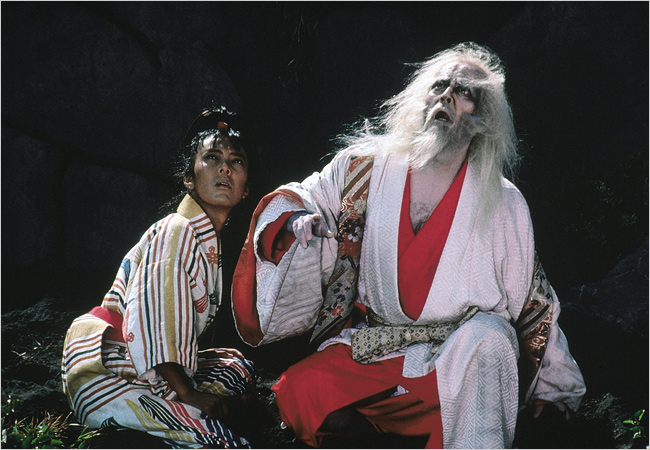
 Inspired by the story of feudal lord Mori Motonari and Shakespeare’s King Lear, Akira Kurosawa’s Ran is an epic masterpiece about the decline and fall of the Ichimonji clan. Aging Lord Hidetora (Tatsuya Nakadai) is ready to hand over his land and leadership to his three sons, Taro (Akira Terao), Jiro (Jinpachi Nezu), and Saburo (Daisuke Ryû). But jealousy, misunderstandings, and outright deceit and treachery result in Saburo’s banishment and a violent power struggle between the weak eldest, Taro, and the warrior Jiro. Hidetaro soon finds himself rejected by his children and wandering the vast, empty landscape with his wise, sarcastic fool, Kyoami (Peter), as the once-proud king descends into madness. Dressed in white robes and with wild white hair, Nakadai (The Human Condition), in his early fifties at the time, portrays Hidetaro, one of the great characters of cinema history, with an unforgettable, Noh-like precision. Kurosawa, cinematographers Asakazu Nakai, Takao Saitô, and Masaharu Ueda, and Oscar-winning costume designer Emi Wada bathe the film in lush greens, brash blues, and bold reds and yellows that marvelously offset the white Hidetaro. Kurosawa shoots the first dazzling battle scene in an elongated period of near silence, with only Tôru Takemitsu’s classically based score playing on the soundtrack, turning the film into a thrilling, blood-drenched opera. Ran is a spectacular achievement, the last great major work by one of the twentieth century’s most important and influential filmmakers. Ran will be screening at 11:00 am on July 22, 23, and 24 as part of the IFC Center’s Weekend Classics — Kurosawa series, which continues with Dreams (July 29-31) and Rhapsody in August (August 5-7); ticket sales benefit
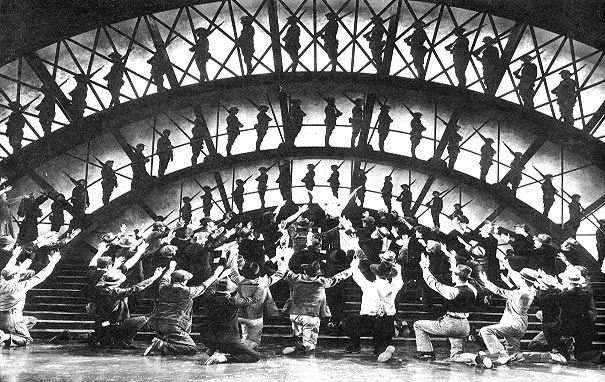
 Hitting a little too close to home these days, Gold Diggers of 1933 is a depression-era musical directed by Mervyn LeRoy (Little Caesar, Mister Roberts) and featuring dance numbers choreographed by Busby Berkeley. Polly Parker (Ruby Keeler), Trixie Lorraine (Aline MacMahon), Carol King (Joan Blondell), and Fay Fortune (Ginger Rogers) are four out-of-work actresses desperate to find a job on Broadway. When cigar-chomping producer Barney Hopkins (Ned Sparks) teams up with newcomer Brad Roberts (Dick Powell) to create a show about the Great Depression itself, the women get excited about the possibility of getting back on the Great White Way, but mistaken identity, financing problems, and class warfare — in the form of wealthy old-money barons Lawrence Bradford (Warren William) and Faneul H. Peabody (Guy Kibbee) — threaten the show and their love lives. Gold Diggers of 1933 is screening at Film Forum on July 22 in a double feature with Frank Tuttle’s Roman Scandals as part of the series “Essential Pre-Code,” which continues through August 11 with films made immediately prior to the enactment of the values-based Hays Code in 1930s Hollywood, including Rouben Moumalian’s Dr. Jekyll and Mr. Hyde, Cecil B. DeMille’s The Sign of the Cross, Josef von Sternberg’s Blonde Venus, Howard Hawks’s Scarface, Ernst Lubitsch’s Trouble in Paradise, and Merian C. Cooper and Ernest B. Schoedsack’s King Kong (bestiality!), nearly all of which are part of double or triple features. Oh, and if you’re wondering why Gold Diggers made the cut here, the “Pettin’ in the Park” number should tell you all you need to know.