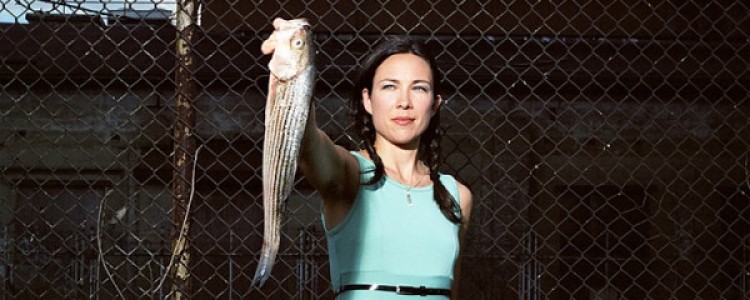
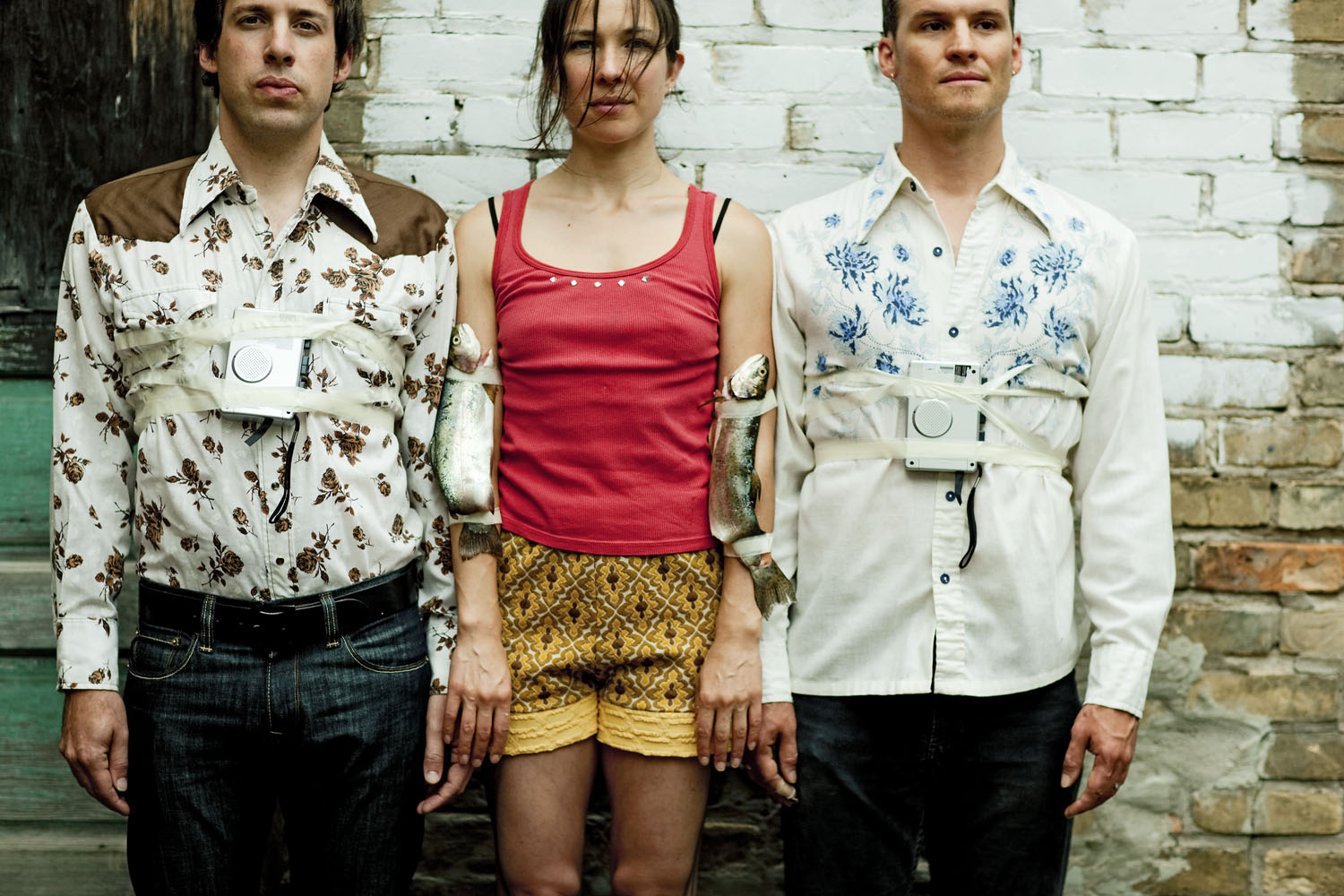
Emily Johnson explores home and heritage in THE THANK-YOU BAR (photo by Cameron Wittig)
THE THANK-YOU BAR
New York Live Arts
Bessie Schönberg Theater
219 West 19th St. between Seventh & Eighth Aves.
November 9-12, $15-$20
212-691-6500
www.newyorklivearts.org
www.catalystdance.com
“I want to make work that looks at identity and cultural responsibility — that is beautiful and powerful — full of myth and truth at the same time,” choreographer Emily Johnson explains in her mission statement. “I want to be grounded in my heritage, supported by my community, and giving back — always.” Born in Alaska of Yup’ik descent and based in Minneapolis, Johnson has been creating site-specific dance installations in collaboration with visual artists and musicians since 1998, exploring ideas of home, identity, and the natural world through different modes of storytelling. Her latest multimedia performance piece is The Thank-you Bar, running at New York Live Arts from November 9 to 12. A collaboration with musicians James Everest and Joel Pickard of BLACKFISH, who will play a special set on the final night, the performance installation also includes beadwork by Karen Beaver and paper sculptures by Krista Kelley Walsh. The extremely eloquent and thoughtful Johnson carefully considered our questions for our latest twi-ny talk; she will also participate in a preshow chat on November 9 with NYLA artistic director Carla Peterson as well as a discussion on November 11 with dancer-choreographer Reggie Wilson following the 9:30 show.
twi-ny: In her Context Notes about The Thank-you Bar on the New York Live Arts blog, Biba Bell is taken by your voiceover “What is becoming more clear to me is what I’m missing,” asking the questions “How many moments are passed, paused or pregnant with the sense of what is missed — something, someone, someplace? What do they sound like, smell like, and how do they feel?” What are some of the things you are missing, and how do they drive your artistic creation?
Emily Johnson: I said that — about the missing — because I am feeling years accumulate. What is absent is becoming an acute pain and it makes me feel old, most simply because of what has already gone by. I have missed my niece and nephew growing up because I was in Minneapolis, making dance, while they were in Alaska. I miss many, many mornings with my grandma — casual mornings of coffee, where we sit around, she doing crosswords until a story comes out. If I’m not around, I simply miss the story and I miss the time. And this creates the yearning — or heightens it, at the very least. I long for these stories. I long for the time with my elders, the time with my niece and nephew and rest of my family. And it points to what might not be: How much longer can I wait to learn the Yup’ik language, helped along by my grandma — the only one in my family who speaks it? How much longer can my body make do without feeling the ground of Alaska beneath my feet on a regular, day in and day out basis? What disservice do I do my life when I let these things pass me by?
Eventually, time runs out. Every summer I go home for the salmon run and I am trying to imprint the process of putting the salmon up (cleaning, smoking, kippuring, freezing . . .) into my brain so that when it comes my time to take charge of making it happen I will be able to do so. These are some of the things I am missing, and the absence and the longing are so real that it creates a new version of life. Biba’s questions about sounds, smell, feel — this is exactly what drives me. As I created The Thank-you Bar, a work very much about missing home/land, I thought about how our bodies miss, how our minds remember — not a scientific how, but a how related to our own perceptions of our experiences. When a thread of a Crystal Gayle song comes on, I am brought back to the jukebox at my grandma’s bar; when I think about the mountains near my Alaskan home, my chest aches and for some reason it also feels like I am diving into a very cold lake, exhilarating my being. And the thoughts about where and when also make me think of the future.
When I make dances, I try to imagine the future. I get curious about what images, reactions, or stories the audience might remember four days after seeing a performance. This leads me to structure dances with a focused attention on the smallest of details: what the audience might walk on as they enter the space, what they might smell during a particular story. . . . It makes me consider what I can leave out of the equation so as to let conjecture and interpretation have a role in the room.

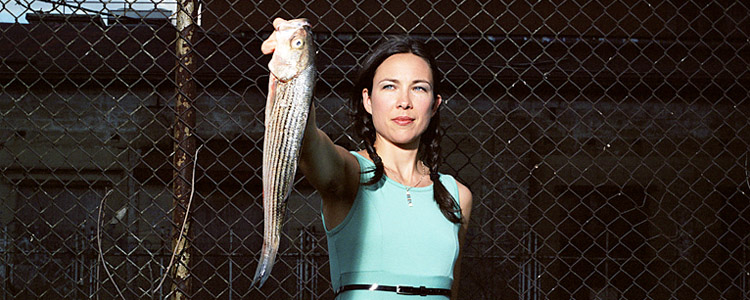
Emily Johnson has teamed up with James Everest and Joel Pickard of BLACKFISH and others in THE THANK-YOU BAR (photo by Cameron Wittig)
twi-ny: The Thank-you Bar and its companion exhibit, “This Is Displacement,” explore the idea of home. You were born in Alaska, you’re based in Minneapolis, and you’re now presenting the New York premiere of a work that has previously been performed in Oklahoma, Houston, and other locations. Where is home for you?
Emily Johnson: The most specific, locating answer is that I have two homes: one in Minneapolis, the other in Alaska. I love both places, and the home in Minneapolis is actually more concrete: it has my stuff in it. The home in Alaska feels expansive and like it goes on for thousands of years, probably because it doesn’t actually have any walls. I don’t have a living space in Alaska, but it’s where I come from and where I continually return to.
To be honest, I try to build another home for myself and audiences in The Thank-you Bar. Does this mean I am searching? Does this mean I believe we can adapt to any longing, and dislocation? I build the home by trying to bring attention to the building we are in and the people who are gathered in the room. I try to imagine the walls gone; I try to imagine what was here before the current incarnation. I want the feeling of “home” to lead to a kind of intimacy so that people feel comfortable, responsible even, for it. I think we tend to look at things as static when, in reality, our bodies and places house past, present, and future, at once. It’s anything but static and it’s kind of exciting to tap into.
twi-ny: You collaborated with James Everest and Joel Pickard of BLACKFISH on The Thank-you Bar, and the duo will be playing a special concert on November 12. What is it about their music that draws you to them and made you want to work with them?
Emily Johnson: BLACKFISH music is dramatically mind altering for me. When James [Everest], Joel [Pickard], and I started work, part of our process was to improvise together in a room, daily. We’ve continued that process, as much as we can when we tour, and out of it James and Joel created their project, BLACKFISH. As BLACKFISH, they perform improvised concerts in conjunction with our tours. I love their concerts — and I love that they’ve developed this entire project out of The Thank-you Bar. On the twelfth, they’re releasing a gorgeous limited edition, letter-pressed, eight-CD collection of some of the concerts they’ve recorded over the past two years. John Scott heard their concert in Vermont this summer and has since worked with them for music for his new work. He very endearingly asked my permission first.
In The Thank-you Bar, they don’t play as BLACKFISH; they play as James and Joel. What I most appreciate about them is their specificity and dedication to improvisation. The music they composed for The Thank-you Bar is set; it came from improvisations, from bouts of memory and discussions of the jukebox I mentioned (that at my grandma’s was filled with classic country). The sound of dislocation and rerouting to find home is what they built for The Thank-you Bar. It makes me want to work with them again and again.
One day, early in the process, I was rehearsing in a separate studio. I came down and they told me to sit on the floor. They proceeded to play music that layered inch by inch and sound by sound, as they appeared and disappeared, until a reverberating chorus echoed off the walls. I remember slapping the floor and exclaiming/laughing at the genius of it. Them: missing. Music: building. We’ve kept it. They basically choreographed the beginning of the dance.

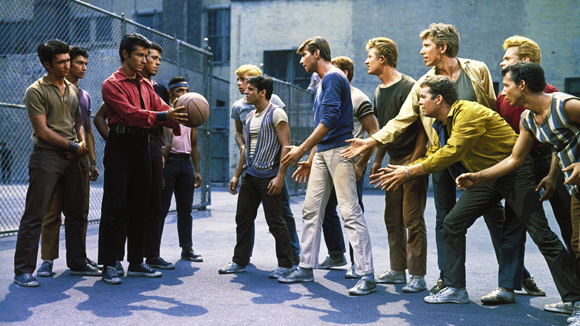
 On September 26, 1957, a new kind of Broadway musical hit the Great White Way, a gritty retelling of Romeo and Juliet set among the world of New York City street gangs. A superstar collaboration between book writer Arthur Laurents, composer Leonard Bernstein, lyricist Stephen Sondheim, choreographer Jerome Robbins, and producer Hal Prince, West Side Story went on to be nominated for six Tony awards, winning three, then was turned into a classic film in 1961, directed by Robbins and Robert Wise. In conjunction with the movie’s fiftieth anniversary restoration and the release of DVD and Blu-ray editions, West Side Story is being presented for one night only in theaters, where you can see it in all its glory on the big screen. The film centers on the forbidden love between Tony (Richard Beymer) and Maria (Natalie Wood), triggering a war between the Caucasian Jets, led by Riff (Russ Tamblyn), and the Puerto Rican Sharks, headed by Bernardo (George Chakiris), a theme that takes on added meaning with the rabid anti-immigrant fervor of the last few years. The wonderful score features a bevy of instantly memorable tunes, including “Something’s Coming,” “Maria,” “Tonight,” “Gee, Officer Krupke,” “I Feel Pretty,” “Somewhere,” and “A Boy Like That,” with Rita Moreno nearly stealing the show as Bernardo’s girl. The film won eleven Academy Awards, with Oscars going to Wise (Picture), Chakiris (Supporting Actor), Moreno (Supporting Actress), Daniel L. Frapp (Cinematography), Irene Sharaff (Costume Design), Thomas Stanford (Editing), Fred Hynes and Gordon E. Sawyer (Sound), Saul Chaplin, Johnny Green, Irwin Kostal, and Sid Ramin (Original Score), Robbins and Wise (Director), and Robbins again (a special award for Brilliant Achievement in the Art of Choreography on Film). The fiftieth anniversary restoration, shown in widescreen format, will be screening on November 9 at 7:00 at the AMC Kips Bay, AMC Empire 25, and Chelsea Cinema in Manhattan in addition to theaters in Queens, the Bronx, Long Island, Connecticut, and New Jersey (and all over the country).
 For The Interrupters, director, producer, and editor Steve James (Hoop Dreams, At the Death House Door) teamed up with journalist Alex Kotlowitz (There Are No Children Here) to hit the dangerous inner-city streets of Chicago with the men and women of CeaseFire, a grass-roots organization of former gang members who are now trying to stop the violence. Inspired by Kotlowitz’s New York Times Magazine article, the two men concentrate on three primary stories. Ameena Matthews, the Muslim daughter of notorious gang leader Jeff Fort, is working with a deeply troubled young woman who’d rather fight than flee, even if it means being sent back to prison. Cobe Williams has his hands full with the angry, recently released Flamo, who thinks the whole world is against him. And Eddie Bocanegra is attempting to come to grips with a cold-blooded revenge murder he committed when he was a teenager by visiting schools and talking about turning his life around. One of the most poignant moments of the film occurs when Williams brings Lil Mikey back to the barbershop he and several of his cohorts robbed at gunpoint as he again faces some of his victims. Matthews, Williams, and Bocanegra are paid employees of CeaseFire, which was founded by Dr. Gary Slutkin, an epidemiologist who believes that violence is a disease that can be treated in similar ways, and is run by Tio Hardman, who handles his extremely tough task with intelligence and dignity as he deals with what he calls “the madness.” But in a society in which “words’ll get you killed,” as Matthews says early on, these tireless violence interrupters put their own lives on the line every day, battling a sickness that seems to have no end in sight. The award-winning film, a hit at numerous film festivals, felt a bit long at its original 144 minutes, but James edited it down to a more streamlined 124 minutes for its recent theatrical release. The Interrupters is screening November 9 at 9:00 as part of the Short List section of the Doc NYC festival, running at the IFC Center through November 10.