Yearly Archives: 2011

TWI-NY TALK: ROBERT BATTLE

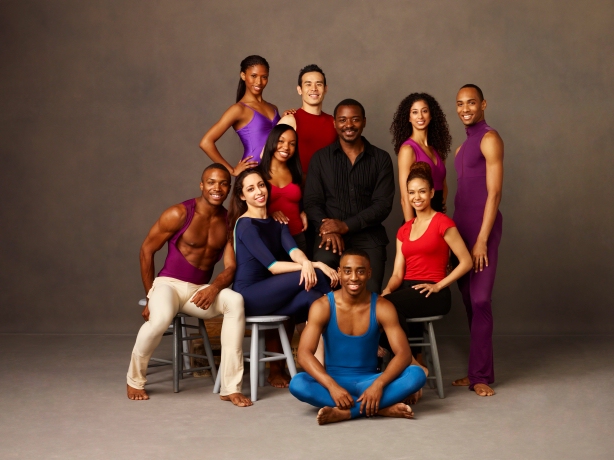
New Alvin Ailey American Dance Theater artistic director Robert Battle (c.) poses with dancers he has invited to join the company (photo by Andrew Eccles)

Alvin Ailey American Dance Theater
New York City Center
130 West 56th St. between Sixth & Seventh Aves.
November 30 – January 1, $25-$150
212-581-1212
www.alvinailey.org
www.nycitycenter.org

Founded in 1958, Alvin Ailey American Dance Theater had only two artistic directors over the course of its first fifty-two years, beginning with Ailey himself, who led the company until his death from AIDS in 1989, followed by Judith Jamison, who continued in the role through this summer, when in July she named her successor, Robert Battle. The thirty-eight-year-old Miami native has had a long affiliation with AAADT, having been an artist-in-residence since 1999, and he has had several works performed by the company, including “The Hunt,” “In/Side,” and “Love Stories,” a collaboration with Jamison and Rennie Harris.

Battle, who studied at Juilliard, danced with Parsons Dance Company, started his own group, Battleworks Dance Company, and was named a “Master of African American Choreography” by the Kennedy Center in 2005, is presenting his inaugural City Center season as AAADT artistic director from November 30 through January 1. The annual five-week event will feature Paul Taylor’s “Arden Court” (in his Ailey debut), Ohad Naharin’s interactive “Minus 16,” Jamison’s “Forgotten Time,” the world premiere of Harris’s AIDS-related “Home,” new productions of Joyce Trisler’s “Journey” and Alvin Ailey’s “Streams,” and several pieces by Battle, most notably the Ailey premiere of “Takademe.” Select performances of a number of works will include live music by such special guests as John Legend, Naren Budhkar, the Knights, and others. With the City Center season just a few weeks away, Battle talked with twi-ny about legacy, responsibility, and the precipice of discovery.

twi-ny: You are now only the third artistic director in the history of Alvin Ailey American Dance Theater. What is your greatest fear?

Robert Battle: I think that’s an unknown. Fear is not for me something that I turn on and off. Anybody, especially an artist, always has a healthy dose of fear mixed with optimism, because those two opposing forces is what creates energy, the energy that is the creative force. So I think it’s a healthy mixture of both of those things.

twi-ny: What are you looking forward to the most?

Robert Battle: I’m looking forward to watching and reveling at the dancers and the delights of the work that is coming in to the repertory and watching and being a part of taking the company into the future. That’s what I look forward to the most.

twi-ny: How did you go about selecting and grouping the dances for this year’s City Center season, which includes the company premiere of your own “Takademe”? Were you looking for an overriding theme?
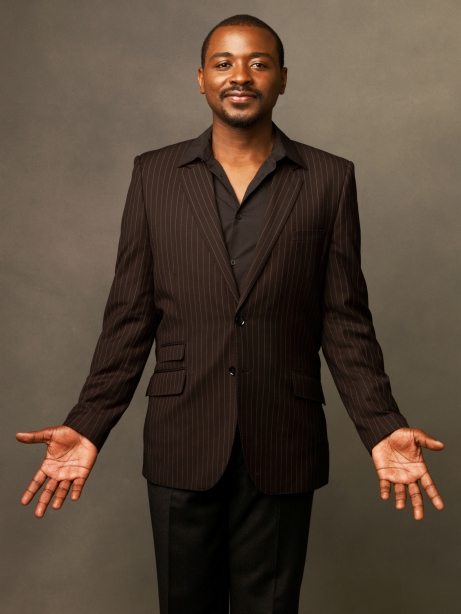
Robert Battle has taken over the reins of Alvin Ailey American Dance Theater from Judith Jamison (photo by Andrew Eccles)

Robert Battle: Yes, the overriding theme is past, present, and future. We’re a repertory company — in a way, we’re a repository for great modern dance works — so, of course, looking back at Mr. Ailey’s work, Joyce Trisler’s “Journey,” created in 1958, all of these works are part of looking back and new productions of those works. Being in the present, looking at Rennie Harris’s work and his commission [“Home”] — he’s a hip-hop choreographer, so he uses hip-hop as his language. That is a part of the present; hip-hop is on everybody’s mind, radio, whatever it may be, but dealing with hip-hop to tell the stories of people who are surviving and thriving with HIV/AIDS is a wonderful tribute because it’s about the celebration of life. And then looking at works to me that echo the future, like Ohad Naharin’s “Minus 16,” which breaks the fourth wall: It invites the audience onto the stage, it has audience participation, it has a whole new way of moving for the dancers. So in that way we’re looking at the future. So we’re looking at all three of those things.

twi-ny: Who are some of the new choreographers you’d like to bring into the extended Ailey family?

Robert Battle: Aha — that, I cannot say [laughs], with deference to all choreographers who may want to be a part of this. I can’t just list one or two, but I really want the work to express the complexity of the world, society. It should be a reflection of that, so that you have choreographers of different races and backgrounds and approaches and themes bringing their voice to our voice. That’s what Mr. Ailey wanted, what Ms. Jamison continued, and what I will continue, to look far and wide, and to keep the audience and the dancers on that precipice of discovery.

twi-ny: With that in mind, how are you balancing the Ailey tradition with, perhaps, the urge to bust things wide open and initiate potential change under your leadership?

Robert Battle: I think that question could have a period at the end. That is what I am doing, balancing the traditional with the sometimes nontraditional. I think the notion of doing something without it having some connection to what is already here is not something I’m interested in. I’m really interested in blending the two. And that’s because this is a repertory company; that’s why I’m able to do that. If it’s one choreographer’s work, it’s harder to do that, but when you’re choosing works from many different choreographers in one season you get the sense of that yin and yang, that stretching forward of busting the whole thing wide open but yet keeping the traditional so that the company stays rooted. That’s why it began in the first place; celebrating the African American tradition and culture and experience in this country but also expanding on that idea is what I’m trying to do.


PROJECT 101′: A VIDEO INSTALLATION BY AMBruno

The LAB Gallery Presents: Project 101 by AMBruno from TheLABGallery

With the holiday season (too) fast approaching, time seems to just be whirling right by, offering no respite for the weary. But you might never have realized just how slow 101 seconds really are until you watch Kurt Johannessen’s video “Snail,” which depicts a snail moving ever so slowly across a white background for 101 seconds. “Snail” is one of 101 works, each 101 seconds long, that comprise “Project 101′: A Video Installation by AMBruno,” on view at the Roger Smith Hotel LAB Gallery through November 25. Running night and day, more than a dozen monitors and one large screen keep the works, longer than clips but less than shorts, made by forty-two multidisciplinary artists from the London-based collective AMBruno, continuously playing in the storefront gallery space at the corner of 47th St. & Lexington Ave. So if you’re one of the approximately twenty-five thousand people who pass by the Roger Smith every day, take a break and check out a bunch of these experimental silent videos, a project that was initiated by Sophie Loss and put together by Loss, John McDowall, Joanna Hill, Judy Goldhill, Claire Deniau, and Steve Perfect, all of whom have works in the show.

THE CONTENDERS 2011: THE TREE OF LIFE

Jessica Chastain, Hunter McCracken, and Brad Pitt star in Terrence Malick’s epic masterpiece, THE TREE OF LIFE

THE TREE OF LIFE (Terrence Malick, 2005)
MoMA Film
Museum of Modern Art
11 West 53rd St. between Fifth & Sixth Aves.
Wednesday, November 23, 7:00
Series runs through January 26
Tickets: $10, in person only, may be applied to museum admission within thirty days, same-day screenings free with museum admission, available at Film and Media Desk beginning at 9:30 am
212-708-9400
www.moma.org
www.twowaysthroughlife.com

Iconoclastic writer-director Terrence Malick has made only five feature films in his forty-plus-year career, but his latest is his very best. Following Badlands (1973), Days of Heaven (1978), The Thin Red Line (1998), and The New World (2005), The Tree of Life is an epic masterpiece of massive proportions, a stirring visual journey into the beginning of the universe, the end of the world, and beyond. The unconventional nonlinear narrative essentially tells the story of a middle-class Texas family having a difficult time coming to grips with the death of one of their sons in the military. Malick cuts between long flashbacks of Mr. and Mrs. O’Brien (Brad Pitt and Jessica Chastain) in the 1950s and 1960s, as they meet, marry, and raise their three boys, to the present, when Jack (Sean Penn), their eldest, now a successful architect, is still searching for answers. The sets by production designer Jack Fisk transport viewers from midcentury suburbia to the modern-day big city and a heavenly beach, all gorgeously shot by cinematographer Emmanuel Lubezki. Every frame is so beautiful, it’s as if they filmed the movie only at sunrise and sunset, the Golden Hour, when the light is at its most pure. The Tree of Life is about God and not God, about faith and belief, about evolution and creationism, about religion and the scientific world. The film opens with a quote from the Book of Job: “Where were you when I laid the earth’s foundation . . . while the morning stars sang together and all the sons of God shouted for joy?” Early on Mrs. O’Brien says in voice-over, “The nuns taught us there are two ways through life: The way of nature, and the way of grace. You have to choose which one to follow.” Malick doesn’t get caught up in those questions, instead focusing on the miracles of life and death and everything in between.
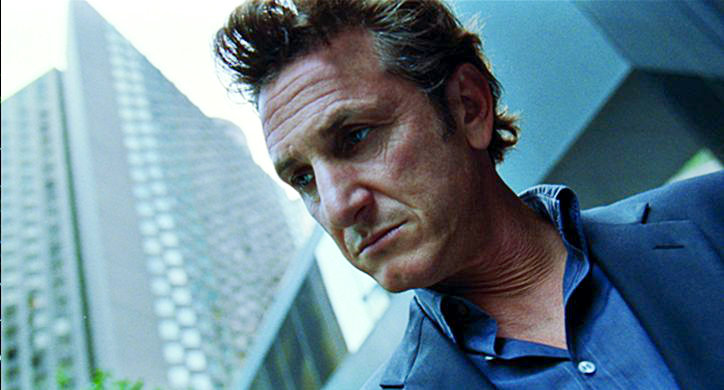
Sean Penn plays an architect searching for answers in THE TREE OF LIFE

With the help of Douglas Trumbull, the special effects legend behind 2001: A Space Odyssey, Blade Runner, and Close Encounters of the Third Kind — and who hasn’t been involved in a Hollywood film in some thirty years — Malick travels through time and space, using almost no CGI. Instead, he employs images from the Hubble telescope along with Thomas Wilfred’s flickering “Opus 161” art installation, which evokes a kind of eternal flame that appears in between the film’s various sections. Malick brings out the Big Bang, dinosaurs, and the planets during this inner and outer head trip of a movie that will leave you breathless with anticipation at where he is going to take you next, and where he goes is never where expected, accompanied by Alexandre Desplat’s ethereal orchestral score. But perhaps more than anything else, The Tree of Life, which won the Palme d’Or at the 2011 Cannes Film Festival, is about the act of creation, from the creation of the universe and the world to the miracle of procreation (and the creation of cinema itself). Mr. O’Brien is an inventor who continually seeks out patents but always wanted to be a musician; he plays the organ in church, but his dream of creating his own symphony has long been dashed. And Jack is an architect, a man who creates and builds large structures but is unable to get his own life in order. In creating The Tree of Life, Malick has torn down convention, coming up with something fresh and new, something that combines powerful human emotions with visual wizardry, a multimedia poem about life and death, the alpha and the omega.

The Tree of Life is screening November 23 at the Museum of Modern Art as part of MoMA’s “The Contenders 2011” series, which focuses on either underlooked films and/or those that MoMA believes will stand the test of time. The series continues through January 26 with such works as Nicholas Winding Refn’s Drive, David Cronenberg’s A Dangerous Method, and Karim Ainouz’s O Abismo Prateado (The Silver Cliff).

PRIVATE LIVES

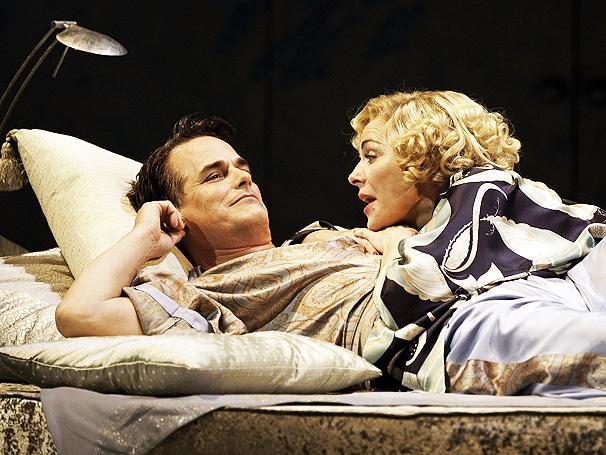
Paul Gross and Kim Cattrall are the latest pair to take on the roles of Elyot and Amanda in Noël Coward’s PRIVATE LIVES (photo by Cylla von Tiedemann)

Music Box Theatre
239 West 45th St. between Broadway & Eighth Aves.
Through February 5, $46.50 – $176.50
www.privatelivesbroadway.com

Following in the footsteps of such Broadway duos as Alan Rickman and Lindsay Duncan (2002), Simon Jones and Joan Collins (1992), Richard Burton and Elizabeth Taylor (1983), and Brian Bedford and Tammy Grimes (1969) — as well as the 1931 cinematic pairing of Robert Montgomery and Norma Shearer — Due South’s Paul Gross and Sex and the City’s Kim Cattrall are now taking on the roles of Elyot and Amanda in Noël Coward’s 1930 battle of the sexes, Private Lives, which opened November 17 at the Music Box Theatre. On a hotel terrace in Deauville, newlyweds Elyot and the younger, somewhat naive Sybil (Anna Madeley) can’t stop talking about his ex-wife, Amanda, who, it turns out, is in the next room, celebrating her marriage to the older and stuffy Victor (Simon Paisley Day), unable to stop talking about her ex-husband. While their initial impulses are to run away, it is clear that Elyot and Amanda belong together — or at least deserve each other — and soon they are flitting off to Paris, hiding away in Amanda’s Art Deco love nest. But in director Richard Eyre’s (Mary Poppins on Broadway, the film Notes on a Scandal) new production, the heat generated in the first act dissipates in the second, as the idea of Elyot and Amanda in love is more electric and exciting than their actual coupling, which quickly becomes tiresome to watch, the earlier promised spark reduced to an occasional flicker. It’s a combination of both a dated script, which includes lighthearted talk of men hitting women, and a lack of physical chemistry between the two leads. Individually, Gross and Cattrall turn in more than respectable performances, but they fizzle in the middle of the play.

Fortunately, things turn around in the third and final act when the slapstick level rises with the return of Sybil and Victor and all heck breaks loose. The show does feature several minor distractions that get in the way: In the first act, David Howe’s lighting of Gross and Madeley on the right side of the stage casts shadows on the left side that sometimes makes it look as if a character is about to enter (when they’re not), and in the second act, a tattoo is evident on one of Gross’s ankles, which does not fit with his character. (There wasn’t much that could have been done about the dead goldfish floating on top of the three-part fishtank, and it certainly wasn’t the production’s fault that an older gentleman in the orchestra continually let out deep throat rumblings that echoed throughout the theater during the entire two-hour-plus show.) Despite the shortcomings of the second act, the current version of this classic comedy of manners — which in 1930 made its London debut with Coward himself as Elyot, Adrianne Allen as Sybil, Gertrude Lawrence as Amanda, and Laurence Olivier as Victor — is a pleasurable and enjoyable experience, if not quite the success it could have been.

SEE YOU NEXT WEDNESDAY: 8 FILMS BY JOHN LANDIS

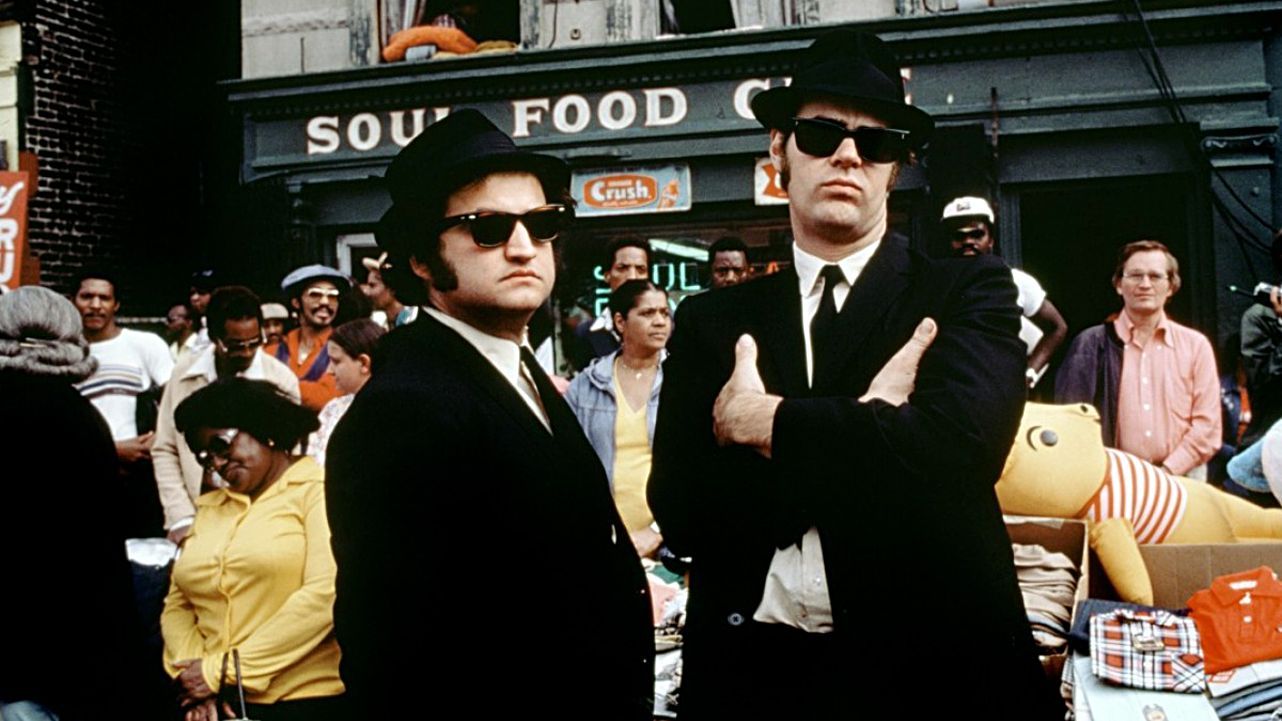
THE BLUES BROTHERS is part of eight-film BAMcinématek tribute to John Landis

BAMcinématek
30 Lafayette Ave. between Ashland Pl. & St. Felix St.
November 21-30
212-415-5500
www.bam.org

Film enthusiast, historian, theorist, actor, and writer-director John Landis made some of the seminal comedies of the 1970s and ’80s, particularly a five-film streak that began in 1977 with The Kentucky Fried Movie and continued with National Lampoon’s Animal House (1978), The Blues Brothers (1980), An American Werewolf in London (1981), and Trading Places (1983), followed by the underrated Into the Night (1985). He’s also made such guilty pleasures as 1986’s ¡Three Amigos! (you know you don’t change the channel when you find it on cable) and the 1992 vampire flick Innocent Blood, but he’s directed only one feature film since 1998, the 2010 comedy Burke and Hare. BAMcinématek is honoring the Chicago-born, L.A.-raised auteur with an eight-film tribute in conjunction with the release of his latest book, Monsters in the Movies (DK Adult, September 2011, $40), that begins today with two screenings of Animal House sandwiching a 6:50 showing of Into the Night that will be followed by a Q&A and book signing with Landis, who will be back tomorrow for a Q&A and signing after the 7:00 screening of The Blues Brothers, which is still a riot after all these years. The tribute continues on Wednesday with the very funny — and currently extremely relevant yet again — Trading Places, with one-percenter-wannabe Dan Aykroyd changing positions with ninety-nine-percenter Eddie Murphy. The series concludes next week with a pair of double features, ¡Three Amigos! and Coming to America (1988) on November 29 and the always welcome An American Werewolf in London and the 1982 documentary Coming Soon on November 30. Oh, and keep an eye out for a reference to “See you next Wednesday,” which makes a Hitchockian appearance in nearly every one of Landis’s films.

CITI POND AT BRYANT PARK

Skaters take to the ice at night at Bryant Park rink (photo by twi-ny/mdr)

Citi Pond at Bryant Park is open for the fall/winter season, which runs through February 26. It’s free to skate, with rentals $14, locks $9, and bag check $7-$10, Sunday through Thursday from 8:00 in the morning to 10:00 at night, extended to midnight on Fridays and Saturdays. Before or after hitting the ice, you can grab a drink at the Celsius club and do some early holiday shopping at the dozens of booths that circle the rink, selling hats, gloves, scarves, and sweaters, warmers, handmade jewelry, chocolate, hot apple cider, and many other items. Among the upcoming special events are caroling on November 23 at noon and the tree-lighting ceremony on November 29 at 7:00. In addition, Bryant Park is participating in the New York Cares Coat Drive, so be sure to go through your closet and donate a new or gently used winter jacket for someone who doesn’t have that kind of choice to make.

CANSTRUCTION

Gruzen Samton • IBI Group’s “QR-CAN: Link to Fight Hunger” won Best Use of Labels at 2011 Canstruction competition (photo by Canstruction/Kevin Wick)

World Financial Center Winter Garden
200 Vesey St.
Sunday, November 20, 10:00 am – 6:00 pm, and Monday, November 21, 10:00 am – 5:00 pm
212-945-0505
www.artsworldfinancialcenter.com
www.sdanyc.org/canstruction

Sponsored by the Society for Design Administration, the annual Canstruction competition believes that “one can make a difference.” For the nineteenth year, design firms have constructed sculptures made out of cans and boxes of food, using no tape, glue, staples, etc., resulting in entertaining, often awe-inspiring installations that are best seen through a camera lens to get the full effect. Among this year’s winners are Gensler / WSP Flack + Kurtz’s “Loaded Dice” pair of die (Juror’s Favorite), Skanska USA’s “Suspending Hunger” suspension bridge (Structural Ingenuity), Dattner Architects’ “Root Against Hunger” tree (Best Meal), and Gruzen Samton • IBI Group’s “QR-CAN: Link to Fight Hunger” QR code (Best Use of Labels). Also be on the lookout for Ferguson & Shamamian Architects’ “Rise Against Hunger” hot-air balloon, Kohn Pederson Fox’s “Alexander McCan” high-heeled shoe, Thornton Tomasetti’s “High-Tops for Hunger” Chuck Taylor sneaker, Robert Silman Associates’ “TICANic” sinking ship, and Langan Engineering / John Fotiadis Architect’s “Time to End Hunger” clock. When the competition at the World Financial Center ends on November 21, all of the food from the twenty-five entries will be given to charity. Although admission is free, it is suggested that everyone bring a can or two (or three or four) to contribute as well (for City Harvest), adding to the more than fifteen million pounds of food Canstruction has raised around the world since 1992.