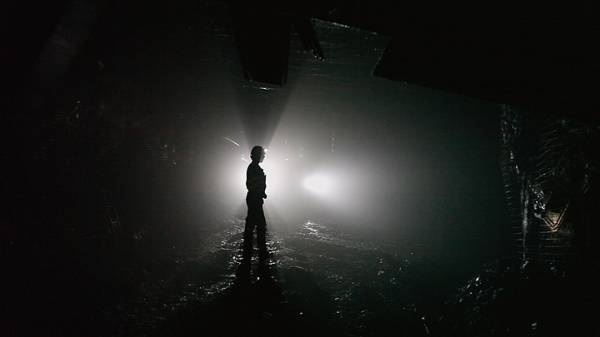
BRIGHTNESS ALL AROUND is one of three stunning videos by Janet Biggs set in the Arctic (photo courtesy Janet Biggs)
JANET BIGGS: THE ARCTIC TRILOGY
Winkleman Gallery
621 West 27th St. between Tenth & Eleventh Aves.
Tuesday – Saturday through March 12
212-643-3152
www.winkleman.com
www.jbiggs.com
New York–based video artist Janet Biggs has traveled around the world capturing remarkable images she pairs with eclectic music, melding physical, often ritualistic movement with investigations into gender identity and the natural environment. Vanishing Point features motorcycle speed-record holder Leslie Porterfield on the Bonneville Salt Flats of Utah and the Harlem Addicts Rehabilitation Center Gospel Choir, Enemy of the Good explores Santiago Calatrava’s City of Arts and Sciences in Valencia, Spain, with concert pianist José Luis Hernández-Estrada, and Duet combines a NASCAR pit crew in Charlotte and an aria from the Léo Delibes opera Lakmé. For her current solo show, continuing at Chelsea’s Winkleman Gallery through Saturday, the former equestrian, who has an undergraduate degree in painting and sculpture and a master’s in glassblowing, has installed “The Arctic Trilogy,” three gorgeous short films that were shot in the vast, isolated Svalbard archipelago: Fade to White cuts between a kayaker and a mournful, operatic song by performance artist John Kelly, Brightness All Around follows the exploits of woman coal miner Linda Norberg along with an original, propulsive dance-floor incantation by Bill Coleman about actual near-death experiences, and In the Cold Edge traces the path of a spelunker emerging from an ice cave. After writing a grant for her next secretive project, Biggs generously answered a series of questions about her creative process for twi-ny.
twi-ny: At Winkleman, Brightness All Around and Fade to White are shown in succession, one after the other, at opposite sides of the main space, creating a sharp contrast between them and a fascinating dialogue that involves performers Bill Coleman and John Kelly as well as a male kayaker and a female engineer. How did that installation choice come about?
Janet Biggs: Brightness All Around and Fade to White are polar opposites in their representations of the Arctic landscape, gender, race, awe and terror, loss and change. I wanted the audience to experience the two videos as counterpoints in their extremes. My decision to project them back-to-back on opposite walls allowed me to place the audience in one immersive, physical space while still emphasizing contrasts. The audience had to physically turn around to view the successive videos, creating both a physical and psychological shift.
In each of these two pieces, I alternate footage of individuals struggling in extreme environments to define their identity with shots of singers performing the music that is heard in the soundtrack. By incorporating performance artist John Kelly and music guru Bill Coleman as both visual and audio elements into my videos, I explore the way these performers’ physical intensity can be interwoven into a narrative to create new meaning.
In Brightness All Around, singer/dancer Bill Coleman, dressed in black leather against a black backdrop, presents a fetishized, macho image as he delivers a demonic chant of near-death experiences. In Fade to White, I integrated the Arctic imagery with countertenor John Kelly, clad in all white, whose age, androgyny, and mournful voice parallel the vanishing Arctic landscape and signal the erasure of male dominance.
I intend to invert the traditional gendered dynamics of heroic exploration by portraying a male explorer as a passive, vulnerable figure, in the white-on-white landscape, while a female Arctic miner aggressively drills, violates, and transforms the black depths of the earth below. The musical performances in the two pieces as well as the juxtaposition of a pristine landscape and the dark, gritty mine interior complicate the power dynamics.
By presenting the two videos back to back I hope to expand the narrative, prompting questions about power hierarchies, social structures, and individual relationships to desire within existential themes.
twi-ny: In many of your videos, including the three in the current exhibition as well as Vanishing Point, Sollipsism Syndrome, and Enemy of the Good, you seem drawn to big, wide-open spaces, usually very bright, with solitary figures primarily in natural environments. Would you consider that a motif of your work, or is it just a coincidence? Like Werner Herzog, would you consider yourself an adventurer as well as a filmmaker?
JB: I tend to revisit elemental and extreme landscapes, from the icy fjord in Glacier Approach, to the broiling hot salt flats of Bonneville in Vanishing Point, to my most recent videos that were filmed in the High Arctic. I am interested in using the landscape as a surrogate character or equal subject to the individuals who struggle to maintain a sense of self within it.
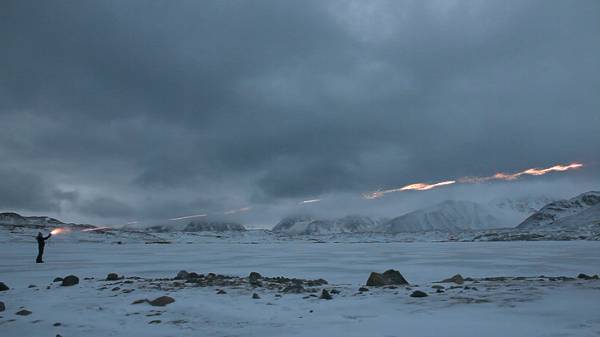
Janet Biggs makes her first on-screen appearance in IN THE COLD EDGE (photo courtesy Janet Biggs)
I am drawn to the ends of the earth. Locations that represent empty lands and blank spaces are ripe for interpretation. Even though these once unknown places have been mapped and surveyed, increased knowledge has not replaced my endless fantasies of discovery in these regions. I am interested in individuals who dedicate themselves to a search for perfection often through athletic pursuits. In their willingness to take risks and endure isolation, they strive to attain an extreme state of being. By filming solitary figures within vast natural environments I am able to focus on both their vulnerable fragility as well as their manifest strength.
I use grand stories and heroic efforts as my point of departure, then slide sideways into small gestures or esoteric tasks as seen from deeply personal perspectives. I am interested in how repetitive or ritualized movements, the incidental, small movements, are as wondrous as the stupefying wild and beautiful landscapes where many of these actions occur.
twi-ny: Seeing humans deep underground in a cave or a mine, the viewer is always aware of your presence as cinematographer, and you get to experience much of what your subjects are experiencing, but in In the Cold Edge, you make a critical appearance at the end. What made you decide to come out from behind the camera at that point?
JB: I’ve hung off the back of trucks in specially made chairs that ride inches above the ground at more than one hundred miles per hour. I’ve paddled kayaks in Arctic weather where water temperatures are so cold you would die of hypothermia in fifteen minutes if you capsized. I have paddled under huge glacial walls, hoping that they wouldn’t calve, and in waters with polar bears swimming nearby. I have squeezed through glacial ice caves so tight that I couldn’t get my head up to see with my headlamp, and I have descended into Arctic coal mines where methane fires ignite with terrifying regularity.
There is clearly a performative side to my work that has to do with me physically and psychologically pushing myself or assuming some kind of risk in order to capture the images and action needed for a piece. I didn’t realize I was such a thrill seeker until I set out to make this kind of work. This part of my process is compelling enough that I often find myself looking for new challenges, although my exploration of the addictive nature of risky behavior is primarily as a witness to someone else’s action and off-camera.
By taking risks and challenging myself in the production of my work, I strive to understand my subjects’ choices and motivations, and also experience some of the thrills that are part of what they do. I hope that this process will translate to the viewer, allowing them a vicarious experience that will become an element in the final reception of the work.
I made my first on-camera appearance at the end of In the Cold Edge. I am seen shooting a flare into an archetypal image of the frozen north. This personal appearance was necessitated by practical considerations (I was the only one of my crew who was certified to shoot a firearm) but also by a personal need to represent my relationship to this haunting location. On my first trip to the Arctic, the landscape kept me in a state of romantic awe. By the second trip, my relationship to the region had changed to include a degree of terror as well as awe. I had a profound sense of displacement in a region that neither needed nor desired human presence. The act of shooting a flare was both an aggressive assertion of self and also a cry for help in a landscape where assumptions about self and reality are radically altered.

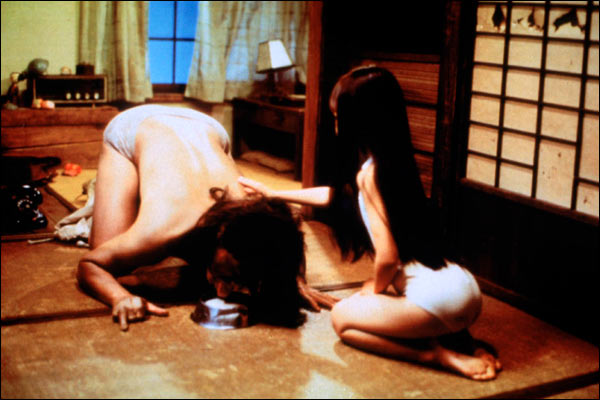
 This is one sick flick. Aoyama (Ryo Ishibashi) has been lonely since his beloved wife died seven years earlier, and on the advice of his best friend (Jun Kunimura) he holds a fake audition to find himself the perfect romantic partner. He is immediately drawn to Asami (Eihi Shiina in her stunning film debut), but after they get together once, various events keep them from going out again, and Asami starts taking it pretty personally. So when they eventually do meet up…. This unconventional Japanese horror film, which won two awards at the Rotterdam International Film Festival, had some people running out of Film Forum faster than they lined up around the block to get in in the first place—the last half hour is so brutal, so grotesque, so disturbing, so violent that you should hang on only at your own risk. Audition was New York’s major introduction to Japanese director Takashi Miike, who has made more than ninety films since the early 1990s, including such fab efforts as The City of Lost Souls (2000), Ichi the Killer (2001), Izo (2004), and The Great Yokai War (2005), all of which are part of “Shinjuku Outlaw: 13 from Takashi Miike,” a five-day Lincoln Center tribute, held in conjunction with Subway Cinema, celebrating the New York premiere of his latest, the brilliant samurai drama 13 Assassins. Most well known for the graphic violence in his films, Miike also has a wild sense of humor and a knack for making audiences think, “Oh no he won’t,” and then he does. Miike will be on hand to introduce several of the Walter Reade screenings as well as the March 15 showing of Dead or Alive (1999) that is part of Japan Society’s