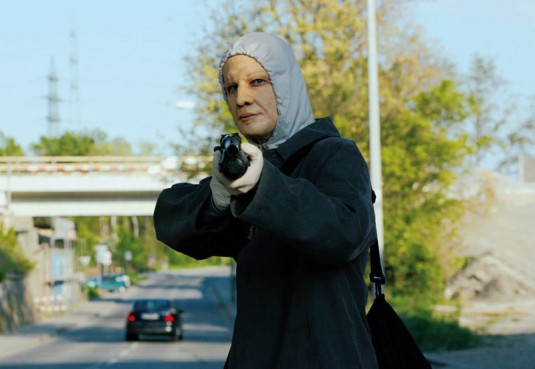
Marathon champion can’t stop his thieving ways in THE ROBBER
DER RAÜBER (THE ROBBER) (Benjamin Heisenberg, 2010)
Cinema Village, 22 East 12th St., 212-924-3363
Lincoln Plaza Cinemas, 1886 Broadway at 63rd St., 212-757-2280
Opens Friday, April 29
www.kino.com/bigscreen

Director Benjamin Heisenberg and star Andreas Lust take viewers on a breathless thrill ride in The Robber. Adapted from Martin Prinz’s novel about real-life 1980s Austrian marathon champion and bank robber Johann Kastenberger, The Robber focuses on Johann Rettenberger (Lust), a grim, ultra-serious man who has just been released from prison after serving six years for armed robbery. Although he tells his parole officer (Markus Schleinzer) that his thieving days are over, Rettenberger seems unable to stop grabbing his shotgun, donning his trademark facemask, and stealing cars and robbing banks. But his motives remain unclear, as he merely stashes the cash under his bed, not using it for himself or giving it away. He initially does not appear prone to violence either, but his cold-blooded stares and inability to really connect with others signal a man threatening to explode at any moment. When not robbing banks, Rettenberger is either training for or running in marathons, a skill that also helps him avoid the police. Despite Rettenberger’s intensely secretive personality, a social worker named Erika (Franziska Weisz) falls for him, putting him up in her house while she imagines he is looking for work and trying to get his life back together. But not even love can warm the frigid heart of this stone-cold thief. The Robber features several exciting, stunningly shot and edited chase scenes (courtesy of cinematographer Reinhold Vorschneider and Heisenberg, who also served as editor and cowrote the screenplay with Prinz) with Rettenberger on foot, especially the long finale, evoking such films as Marathon Man and The Bourne Ultimatum. (Bonus fact: Kastenberger’s story also inspired Kathleen Bigelow’s Point Break.) Lust turns Rettenberger into a complex antihero; even though there is nothing likable about the character, audiences will not be able to stop rooting for him to get away with it all.

 Winner of numerous awards at film festivals all over the country, Earthwork is an uninspiring, uninvolving look at the true story behind one man’s obsession with his unique brand of art. Based in Kansas, crop artist Stan Herd (John Hawkes) — who designs portraits, still-lifes, and corporate logos on the ground using grass, trees, bushes, soil, flowers, rock, and other natural elements, with the final work best seen from high above in airplanes and helicopters — was determined to make a name for himself in the New York art world. In 1994, he submitted a proposal for a public art project on an acre of wasteland on the West Side of Manhattan, part of the old Penn Central rail yards bought by Donald Trump. Herd got the job when he offered to do it for free, financing it himself by forging his wife’s (Laura Kirk) signature on a loan. He ends up working with a motley crew of homeless men who live in the nearby tunnels, consisting of young graffiti artist Ryan (Chris Bachand), elderly poet El-Trac (novelist Sam Greenlee), the mute Cage (Brendon Glad), the mentally unstable Lone Wolf (James McDaniel), and the dapper Mayor (Zach Grenier). As the obstacles continue to mount, Herd perseveres, but writer-producer-director Chris Ordal is unable to get any emotional depth out of the script or the actors. Flat and frustrating, Earthwork comes off more like a reality TV show reenactment than a full-fledged feature-length film. If it never feels like it’s set in New York, that’s because it was mostly shot in Kansas, killing off any chance of building the inherent dramatic tension that exists between the big city and the country and removing the irony of Herd’s creating a beautiful, colorful work of natural art amid a land of towering skyscrapers. Earthwork is like a chapter of a book way off in the corner by itself, desperately in need of the rest of the story. Ordal and Herd will be at the Angelika to talk about the film at several screenings on Friday and Saturday.


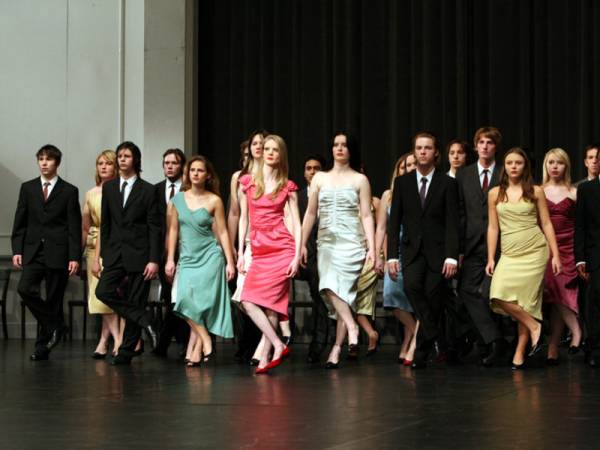
 From 1973 until her death in 2009, legendary dancer and choreographer Pina Bausch ran Tanztheater Wuppertal, the German company that changed the face of dance theater forever with such seminal productions as Rite of Spring, Café Müller, Danzón, Masurca Fogo, and so many more. In 1978 she staged Kontakthof, collaborating with Rolf Borzik, Marion Cito, and Hans Pop, set to music by Juan Llossas, Charlie Chaplin, Anton Karas, Sibelius, and other composers. In 2000, she revisited the piece with a cast of senior citizens, and eight years later she turned the roles over to a group of Wuppertal high schoolers, most of whom had never heard of her and had never danced before. Director Anne Linsel and cinematographer Rainer Hoffmann follow the development of this very different production in Dancing Dreams, speaking with the eager, nervous participants, who talk openly and honestly about their hopes and desires, as well as with rehearsal directors Jo-Ann Endicott and Benedicte Billet, who do not treat the teens with kid gloves but instead are trying to get them to reach deep inside of themselves and hold nothing back. When Bausch shows up to choose the final cast, telling the teenagers that she doesn’t bite, the tension mounts. Dancing Dreams is an intimate look at the creative process, about dedication and determination and what it takes to be an artist. It suffers at times from feeling too much like a reality television show, mixing American Idol and So You Think You Can Dance with the fictional Glee, but it also offers a last glimpse at Bausch, whose final interview is captured in the film. “You might think I’ve had enough of Kontakhtof,” she says at one point. “But every time it’s a new thing.” Dancing Dreams is screening May 1 & 2 as part of MoMA’s KINO 2011: New Cinema from Germany series, which runs April 27 – May 2 and also includes Gereon Wetzel and Jorg Adolph’s How to Make a Book with Steidl, Tom Tykwer’s Drei (Three), Friedmann Fromm’s Weissensee (The Weissensee Saga: A Berlin Love Story), Florian Cossen’s Das Lied in mir (The Day I Was Not Born), Philip Koch’s Picco, and a Next Generation presentation of short works.
 Based on a novel by Ma Shitu, Jiang Wen’s Let the Bullets Fly is a very funny action comedy set during the Warlord Era of the 1920s. After a train robbery doesn’t quite come off as planned, wanted gangster Pocky Zhang (Jiang) and his sidekicks team up with shady swindler Tang (Ge You) and a treasure-hunting woman (Carina Lau) to pose as the new county governor (Zhang) and his team, attempting to take over Goose Town and abscond with its money. But Goose Town already belongs to the crooked Huang Silang (Chow Yun-fat), who is not about to let Zhang take away what’s his. What follows is a goofy battle of wills that involves self-gutting, an idiot body double, some excellent gory violence, and lots of double entendres. A huge critical and commercial success in China, Let the Bullets Fly is way too long at 132 minutes, and the pacing often feels scattershot, perhaps the result of at least six screenwriters having poured out some thirty scripts before Jiang was ready to proceed. Jiang is wonderfully understated as Zhang, while Chow is a hoot as the local mobster whose domain is suddenly threatened. Filled with plenty of sly references and homages to Sergio Leone’s spaghetti Westerns, Let the Bullets Fly is a flawed but entertaining Chinese popcorner.