Tag Archives: yayoi kusama

YAYOI KUSAMA: I SPEND EACH DAY EMBRACING FLOWERS

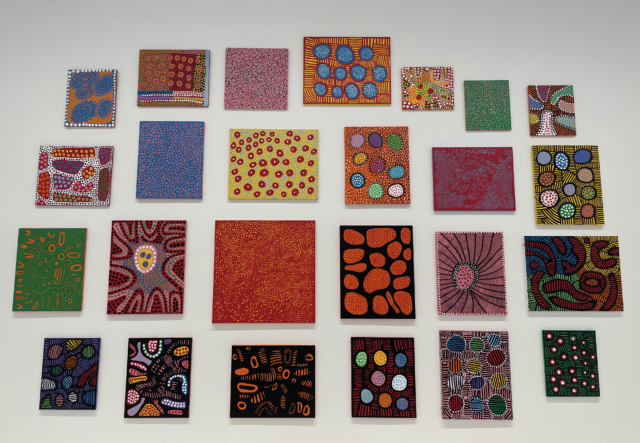
Twenty-five of Yayoi Kusama’s “Every Day I Pray for Love” paintings are part of new show at David Zwirner in Chelsea (photo by twi-ny/mdr)

YAYOI KUSAMA: I SPEND EACH DAY EMBRACING FLOWERS
David Zwirner
519, 525, 533 West Nineteenth St. between Tenth & Eleventh Aves.
Through July 21, free, 10:00 am – 6:00 pm
www.davidzwirner.com
online slide show

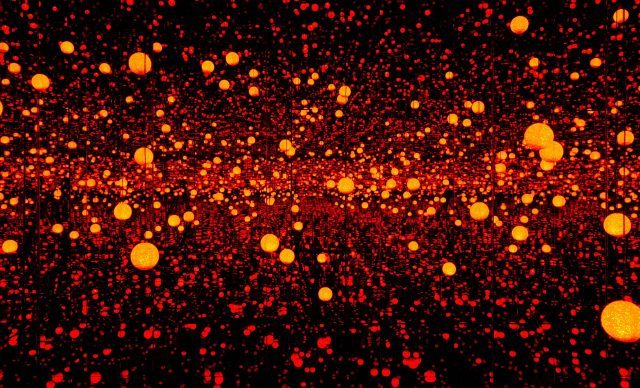
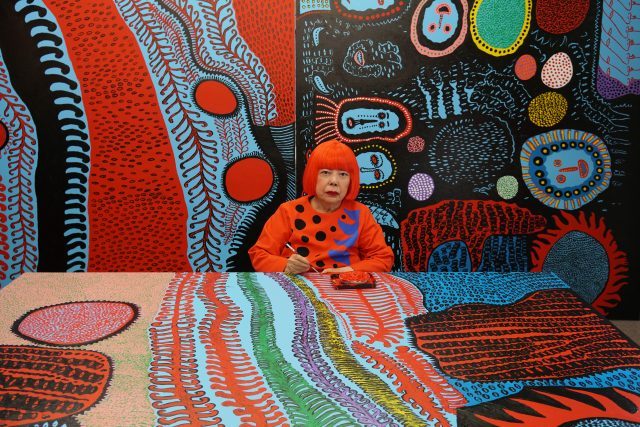
There are only two days left to see Yayoi Kusama’s latest exhibition of new works at David Zwirner, a three-part show entitled “I Spend Each Day Embracing Flowers.” Kusama is ninety-four and has been living voluntarily in the Seiwa Hospital for the Mentally Ill in Tokyo since 1977; every day she gets up and walks over to her studio across the street and works. There are long lines to get into the show on West Nineteenth St., but that is primarily for Dreaming of Earth’s Sphericity, I Would Offer My Love, a Mirror Infinity Room where groups of no more than five people can spend sixty seconds in a seemingly endless space of red, yellow, blue, and green disks; while it’s very cool, it’s not necessarily a must-see if you have to wait online for an hour or more to get inside.

There is less of a line, if any at all, to see the rest of the exhibit, a kind of organic follow-up to her wonderful “Cosmic Nature” display throughout the New York Botanical Garden in 2021. The title piece at Zwirner consists of thee large-scale, colorful, and hugely adorable stainless-steel flower sculptures, a celebration of the beauty of the natural world while also touching on the impermanence of life. In a back room, there are three dozen new acrylic and ink paintings, mostly from her “Every Day I Pray for Love” series, canvases that feature many of her favorite elements, from dots and circles to squiggly lines and abstract geometric shapes; twenty-five of the pieces hang together in a lovely display on one wall.

The highlight is Aspiring to Pumpkin’s Love, the Love in My Heart, a trio of long, undulating, somewhat flattened black and yellow bronze pumpkin sculptures winding their way through their own room. They evoke Richard Serra’s freestanding sets of weatherproof steel plates, only here bright with color and charm; I dare you to try not to smile as you follow the paths in and around the works, which reflect the light and passersby. See if you can find the two areas where Kusama used a camera obscura, resulting in upside-down images

Kusama has also delivered a special message for the show, summing up her world view: “I’ve Sung the Mind of Kusama / Day by Day, / a Song from the Heart. / O Youth of Today, / Let Us Sing Together a Song from / the Heart of the Universe!”

(To receive a digital booklet of select poems from Kusama’s 2023 collection Every Day I Pray for Love, go here.)

DAVID ZWIRNER: PROGRAM

Kerry James Marshall, detail, Black and part Black Birds in America (Red wing Blackbirds, Yellow Bellied Sapsucker, Scarlet Tanager), 2021 (© Kerry James Marshall)

PROGRAM
David Zwirner Online
Thursday, June 10, free, 10:00 am – 7:00 pm
www.davidzwirner.com

One of the most popular and innovative galleries in New York City, David Zwirner, will be kicking off its new online Program with an all-day global livestream event on June 10, consisting of six talks with thirty-five artists in four cities. The festivities begin at ten o’clock in the morning with a video walkthrough of Zwirner’s global galleries, led by directors and partners. At eleven, award-winning director Barry Jenkins (Moonlight, The Underground Railroad) will discuss Kerry James Marshall’s “Black and part Black Birds in America” series. At one, Pulitzer Prize winner Hilton Als delves into Alice Neel’s figuration. At two-thirty, designers Emily Bode of BODE and Aaron Aujla and Benjamin Bloomstein of Green River Project LLC will explore conceptual art and appropriation. At four, 2020 Hugo Boss Prize recipient Deana Lawson examines the legacy of Diane Arbus. And at six, New Yorker art critic Peter Schjeldahl will talk about the state of the art world today. All interactive conversations will be moderated by writer and curator Helen Molesworth.

“Over the last year we realized the traction and engagement that we could create on our own website, without an art-fair moment attached to it,” Zwirner said in a statement. “Because of this, we are establishing Program, a new event series that culminates the art calendar and brings together the energy and excitement we have seen in June, but on a global scale. It will mimic the in-person dialogue and discovery you would experience at a physical opening or an art fair through global livestreaming sessions. For the inaugural presentation of Program, our artists have created significant new artworks that will be seen for the very first time.”

Program will take viewers inside Zwirner’s galleries in New York, London, Paris, and Hong Kong, highlighting historic and brand-new works by such artists as Josef Albers, Francis Alÿs, Carol Bove, Raoul De Keyser, Stan Douglas, Marlene Dumas, Isa Genzken, Barbara Kruger, Yayoi Kusama, Sherrie Levine, Nate Lowman, Kerry James Marshall, Juan Muñoz, Oscar Murillo, Alice Neel, Chris Ofili, Sigmar Polke, Neo Rauch, Thomas Ruff, Dana Schutz, Wolfgang Tillmans, Luc Tuymans, Franz West, and Lisa Yuskavage; Christopher Williams helped design the stream with Deliverable: Video Asset nos. 1–10. To see the works in person, you can make appointments here; currently on view in New York City are Rose Wylie’s “Which One” and Bove’s “Chimes at Midnight,” with Kusama’s “I Want Your Tears to Flow with the Words I Wrote” opening June 17, followed June 24 with “More Life,” solo exhibits from Mark Morrisroe, Silence=Death, Derek Jarman, and Marlon Riggs in conjunction with the fortieth anniversary of the ongoing HIV/AIDS crisis.

YAYOI KUSAMA: EVERY DAY I PRAY FOR LOVE

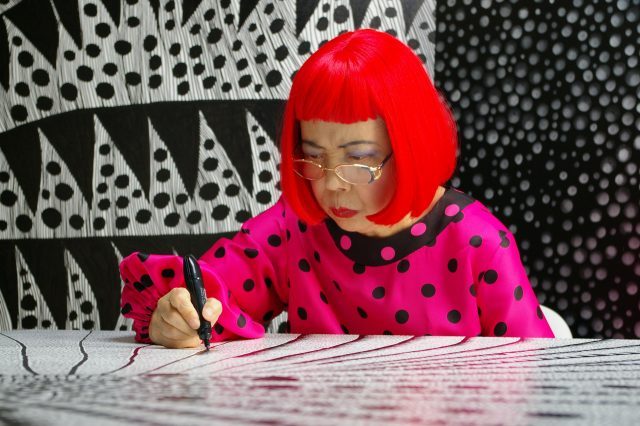
Yayoi Kusama (photo courtesy David Zwirner)

Yayoi Kusama, Infinity Mirrored Room — Dancing Lights That Flew Up to the Universe, mirrored glass, wood, LED lighting system, metal, and acrylic panel, 2019 (photo courtesy David Zwirner)

David Zwirner
537 West 20th St. between Tenth & Eleventh Aves.
Tuesday – Saturday through December 14, free, 10:00 am – 6:00 pm
www.davidzwirner.com
online slideshow & video

What? You’re not on line yet? This is the last week to see Yayoi Kusama’s latest show at David Zwirner, “Every Day I Pray for Love,” another fabulous immersive presentation by the Japanese artist who turned ninety this year. All the furor is specifically for the new Infinity Mirrored Room — Dancing Lights That Flew Up to the Universe, a spectacular closed-in space of mirrors, hanging balls, and changing colored lights that create a beautiful, endless world. But you’ll have to wait upwards of two and a half hours and more to spend thirty seconds in the room, most of which you will spend snapping photos and video instead of experiencing its bountiful wonder. However, there’s much more to “Every Day I Pray for Love,” and you don’t have to line up outside in the freezing cold to see it.

(photo by twi-ny/mdr)

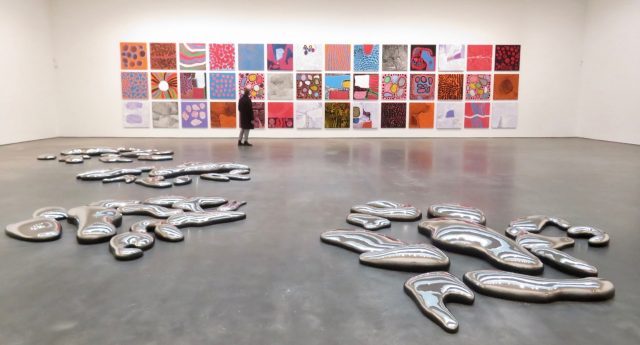
Yayoi Kusama’s Clouds slither toward “My Eternal Soul” paintings at David Zwirner (photo by twi-ny/mdr)

In the main, large gallery, forty-two of Kusama’s “My Eternal Soul” paintings are arranged in three rows, exciting, colorful canvases that feature her trademark faces, circles, dots, eyes, embryos, and abstract geometric shapes and patterns, boasting such positive names as The Beauty of Millions of Love Seekers Flying Infinitely to the Universe, Shapes Full of Love That Have Always Shone in My Heart, Road to Eternal Love and Hope, The Limit of the Endless Beauty That Colours Spoke of Is Infinite, Such a Beautiful Love and Life Found by Us, and Challenge to New Art by I Who Thought the Splendor of the Universe Cannot Be More. On the floor of the room are several conglomerations of Kusama’s stainless-steel with patina and wax Clouds, which resemble dripped mercury taken solid form. Like the spheres in her Narcissus Garden, which people lined up to see in the Rockaways in the summer of 2018, you can walk among them and follow the changing reflections caused by the light from above.

(photo by twi-ny/mdr)

Yayoi Kusama’s cast aluminum “Souls of Women That Continue Forever” hang over garden of soft sculptures as part of “Every Day I Pray for Love” (photo by twi-ny/mdr)

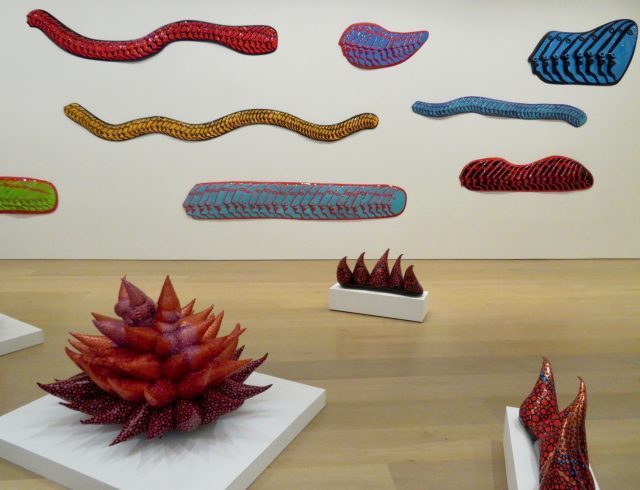
At the base of the stairwell is the black-and-white fiberglass-reinforced plastic and stainless-steel Pumpkin, which you can look into, as its insides have already been scooped out. The upstairs gallery contains a childlike garden of sewn and stuffed soft sculptures with spiky elements and playful faces (for example, I Will Love with All My Heart and The Greatness of This Figure Talking Through Humankind and the Universe); “Souls of Women That Continue Forever,” a wall of cast aluminum shapes with women’s profiles repeated over and over in different colors; and two more acrylic paintings, including one whose title captures Kusama’s ethos: There Is No One Who Is Unmoved by How Amazing It Is to Be Able to See the Beauty of Creation Everyday in This World and Universe We Live In. And finally, be sure to go behind the black curtain to check out the awe-inspiring Ladder to Heaven, twelve LED-lit rungs with round mirrors above and below that make it seem like the ladder is going both deep underground as well as into the heavens as the color shifts like a James Turrell installation.

So don’t get too caught up waiting in line for the infinity room and risk not seeing the rest of this wonderful show, by perhaps the most popular, happy-making, and critically acclaimed living artist in the world. (And, yes, Instagram-friendly as well.) Meanwhile, Kusama — who still works every day, going from the Seiwa Hospital for the Mentally Ill in Tokyo, where she has lived voluntarily since 1977, to her nearby studio — is most likely busy preparing her next batch of paintings, sculptures, and, just maybe, another infinity room that people are already dreaming of lining up for. As she writes on one of the walls of the gallery: “My entire life has been painted in these paintings. / Every day, any day. / I will never cease dedicating my whole life to my love / for the universe. / Oh my dearest art. / With the challenge of creating / new art, I work as if dying / these works are my everything.”

KUSAMA: INFINITY

Artist Yayoi Kusama drawing in KUSAMA - INFINITY. © Tokyo Lee Productions, Inc. Courtesy of Magnolia Pictures.

Documentary explores fascinating life and career of Japanese artist Yayoi Kusama (photo © Tokyo Lee Productions, Inc. / courtesy of Magnolia Pictures)

KUSAMA: INFINITY (Heather Lenz, 2018)
Film Forum
209 West Houston St.
Opens Friday, September 7
212-727-8110
filmforum.org
www.kusamamovie.com

I remember the buzz in the room back in July 2012 at the press preview for the “Yayoi Kusama” retrospective at the old Whitney. Even among all the jaded art critics, there was palpable excitement at the rumor that Kusama herself might be attending the event. Alas, it was not to be. But now everyone can feel like they’re in the same room as the iconoclastic Japanese artist when watching Heather Lenz’s infinitely entertaining documentary, Kusama: Infinity, opening September 7 at Film Forum. Over the course of her seven-decade career, Kusama has explored the concepts of infinity and eternity through painting, sculpture, performance art, film, and installation, highlighted by an obsession with endless circles and mirrored reflections. “I convert the energy of life into dots of the universe. And that energy along with love flies into the sky,” she explains. Traumatic childhood experiences deeply influenced her life and art; she began painting when she was eight years old in rural Matsumoto City, where her unhappy parents ran a wholesale seed business (and her mother would tear up her drawings). Now eighty-nine, she still works every day, going from the Seiwa Hospital for the Mentally Ill, where she has lived voluntarily since 1977, to her studio, which is filled with her captivating works-in-progress. Lenz zooms in for extreme close-ups of the artist surrounded by canvases, as if she is the biggest dot (or seed?) in her universe. “So much of Kusama’s art seeks to re-create that [childhood] experience in one form or another,” notes Alexandra Munroe, senior curator of Asian Art at the Guggenheim. “It is literally an experience of being lost into her physical environment, of losing her selfhood in this space that is moving rapidly, and expanding rapidly.”

Artist Yayoi Kusama in the Orez Gallery in the Hague, Netherlands (1965) in KUSAMA - INFINITY. Photo credit: Harrie Verstappen. Photo courtesy of Magnolia Pictures.

Artist Yayoi Kusama poses in the Orez Gallery in the Hague in 1965 (photo by Harrie Verstappen / courtesy of Magnolia Pictures)

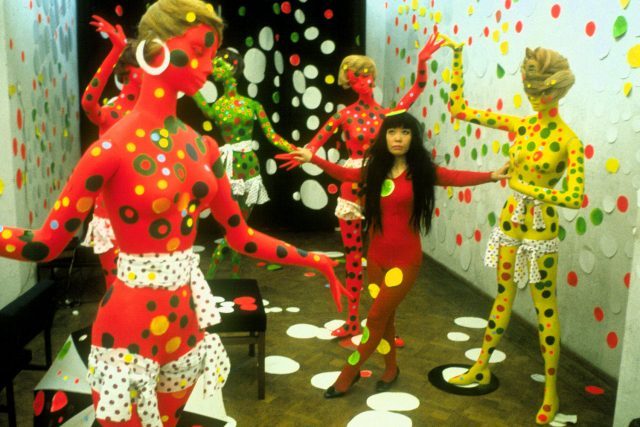
Kusama was determined to be successful and to stand out from the crowd, as shown in dozens of color and black-and-white photographs of her in various kimono, dot-covered outfits, revealing apparel, and great hats, always sporting that unique bang hairstyle. “I promised myself that I would conquer New York and make my name in the world with my passion for the arts and my creative energy,” she explains. She was not about to let anything stop her, least of all her gender and her heritage. She was angry when it appeared that such artists as Andy Warhol, Claes Oldenburg, and Lucas Samaras copied specific aspects of her work and gained greater notice for it. She sought advice from Georgia O’Keeffe. She got involved in an odd relationship with reclusive artist Joseph Cornell. She was shunned in her home country because of her penchant for nudity. She occasionally gets teary looking back at her life. The film features sensational archival video and photographs from some of Kusama’s seminal happenings and exhibitions, from “Aggregation: One Thousand Boats Show” to “Yayoi Kusama: A Retrospective” at CICA, from her “Narcissus Garden” intervention at the 1966 Venice Biennale, where she was selling individual mirror balls she had arranged on a lawn, to 1969’s “Grand Orgy to Awaken the Dead,” in which the fiercely antiwar artist read “Thoughts on the Mausoleum of Modern Art” as eight participants ran around naked in MoMA’s sculpture garden. (This summer, Kusama brought “Narcissus Garden” to New York for MoMA PS1’s biannual Rockaway! show.) There are also clips from the revolutionary 1967 psychedelic art film Kusama’s Self-Obliteration, made by Jud Yalkut and Kusama.

Portrait of Yayoi Kusama in her studio. Image © Yayoi Kusama. Courtesy of David Zwirner, New York; Ota Fine Arts, Tokyo/Singapore/Shanghai; Victoria Miro, London; YAYOI KUSAMA Inc.

At the age of eighty-nine, Yayoi Kusama still works in her studio every day (Image © Yayoi Kusama / courtesy of David Zwirner, New York; Ota Fine Arts, Tokyo/Singapore/Shanghai; Victoria Miro, London; YAYOI KUSAMA Inc.)

Lenz, who will participate in a Q&A at Film Forum on September 7 after the 7:45 screening, talks to a wide range of people who provide intriguing perspectives on the artist and her work, including Kusama dancer Jeanette Hart Coriddi, former Matsumoto City mayor Tadashi Aruga, David Zwirner director Hanna Schouwink, psychoanalyst and art collector Judith E. Vida, MD, longtime best friend Akira Iinuma, artists Carolee Schneemann, Ed Clark, and Frank Stella, curators Marie Laurberg and Lynn Zelevansky, Joshua Light Show founder Joshua White, and Yayoi Kusama Museum director Akira Tatehata. CUNY Kingsborough art history professor Midori Yamamura says, “Her diagnosis is of obsessive-compulsive neuroses. Once something enters into her mind, she cannot get rid of it.” Former art dealer Beatrice Perry of the Gres Gallery adds of Kusama’s Infinity Net series, “I’d never seen anything like it. They had some kind of magic. You couldn’t stop looking at them, and you didn’t know where they were going. They were hypnotic.” And gallery owner Richard Castellane remembers, “She was taking away your ability to focus, breaking all boundaries of space. . . . This was the great breaking point in art. No longer are you the viewer the master; she’s the master.” Kusama’s mastery is still evident today, as prices paid for her artwork continue to skyrocket — she’s recognized as the top-selling woman artist in the world — and fans wait on long lines for hours and hours to spend thirty seconds inside one of her Infinity Mirrored Rooms. In addition, Lenz has done a masterful job giving us a Kusama we have never seen before. Despite her difficult, challenging life, the extraordinary Kusama declares, “I want to live forever.” And in the very personal, intimate, and infinite world she has created and Lenz has masterfully revealed, who’s to say she won’t?

YAYOI KUSAMA: NARCISSUS GARDEN

(photo by twi-ny/mdr)

Yayoi Kusama’s silver spheres glitter in Rockaway (photo by twi-ny/mdr)

ROCKAWAY! 2018
MoMA PS1
Gateway National Recreation
Fort Tilden
Friday – Sunday through September 3 (and Labor Day), free, 12 noon – 6:00 pm
www.moma.org
narcissus garden slideshow

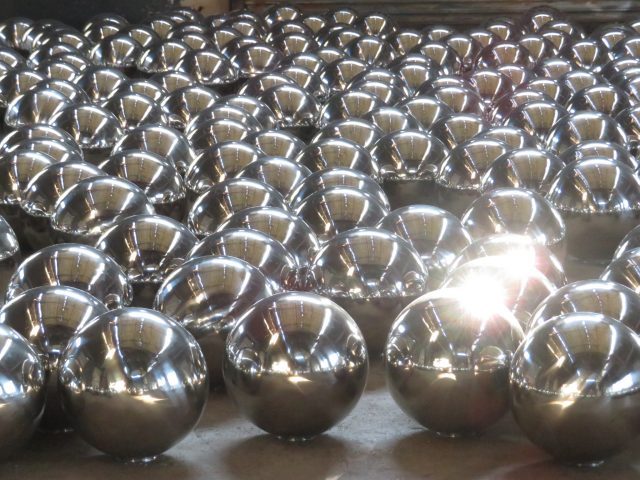
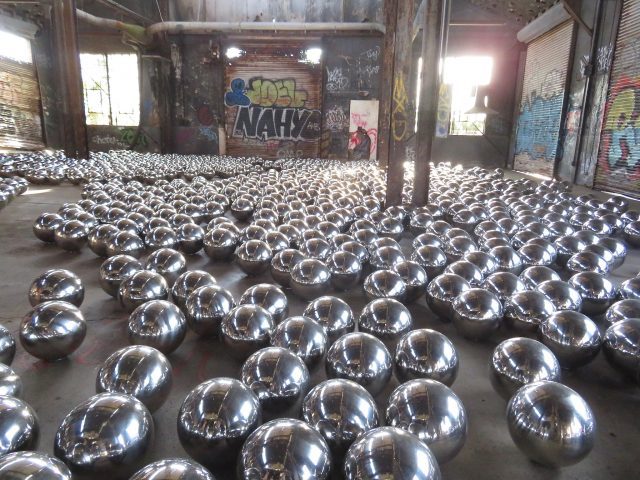
In 1966, Japanese artist Yayoi Kusama invited herself to the Venice Biennale, setting up “Narcissus Garden,” a collection of plastic silver spheres, on the lawn outside the Italian Pavilion; she even sold the mirrored balls for about two dollars apiece before being told to stop the vending. Original footage of the intervention is one of the highlights of the excellent new documentary Kusama: Infinity, which opens September 7. In the meantime, visitors can experience “Narcissus Garden” for themselves Friday through Sunday through Labor Day (including that Monday) as part of MoMA’s biannual “Rockaway!,” the free site-specific exhibition started in 2014 by MoMA PS1 curator-at-large Klaus Biesenbach and multidisciplinary artist Patti Smith, both Rockaway residents who were determined to rebuild the area following the devastation wrought by Hurricane Sandy. Kusama, who lived in New York City from 1958 to 1973 and staged many controversial art happenings here, has placed fifteen hundred mirror balls in a former train garage in Fort Tilden in the Gateway National Recreation Area. Kusama’s popularity has risen dramatically this century, with record prices paid for her works and fans lining up for hours and hours (and hours and hours) to get thirty seconds inside one of her Infinity Mirror Rooms at Chelsea’s David Zwirner gallery, for example. So don’t be surprised when you arrive at the Rockaway building only to find that there’s a wait even in the middle of nowhere.

(photo by twi-ny/mdr)

Yayoi Kusama’s 1966 “Narcissus Garden” is reimagined in abandoned Rockaway building (photo by twi-ny/mdr)

“Narcissus Garden” has been displayed around the world over the years, but it is more relevant than ever in the age of social media and selfies. At Venice, Kusama’s installation included a sign that said, “Your Narcisium [sic] for Sale,” and that is very much still true today. The spheres, each of which rests on a small, barely visible stand to keep them from rolling, reflect not only the surrounding area, consisting of other balls, walls covered in colorful graffiti, blown-out windows, and a high, dilapidated ceiling, but the viewer as well. Thus, people snap photos of themselves in the spheres, ready for posting. Others get so caught up in being photographed within the installation that they don’t listen to security guards telling them not to sit on the ground, not to go past the dangling hook, not to touch the pieces, and not to wander down inviting pathways, which are there to tantalize but not follow. There are even some spheres behind a rusted cage, locked away from the rest, segregated as if imprisoned. When we were there, one man muttered about this not being art and actually kicked one of the spheres, causing it to roll away, after which he was ordered to get out, still mumbling as he exited. Thus, “Narcissus Garden,” a presentation of MoMA PS1, the National Park Service, the Jamaica Bay — Rockaway Parks Conservancy, and the Rockaway Artists Alliance, continues to be a reflection of ourselves, now going back more than half a century, although Kusama, an eighty-nine-year-old firm believer in love and peace who still works every single day, is not condemning anyone or criticizing contemporary culture; she just wants us to enjoy the art. And it’s hard not to love it, especially as sunlight filters in and causes one area to suddenly glow.

The balls also are like three-dimensional manifestations of the dots and infinity lights Kusama has been obsessed with since the beginning of her career. “My desire is to measure and to make order of the infinite, unbounded universe from my own position within it, with polka dots,” Kusama said in a 2016 statement for an exhibition at the Glass House in Connecticut. “In exploring this, the single dot is my own life, and I am a single particle amongst billions. — I work with the principal themes of infinity, self-image, and compulsive repetition in objects and forms, such as the steel spheres of ‘Narcissus Garden’ and the mirrored walls I have created.” Don’t get caught up in taking photographs of the installation; instead, experience it for its many wonders, reflecting on your place and the place of others in the universe, contemplating the circularity of life, enjoying the sheer beauty of what is right in front of you. Then snap a bunch of photos and leave, allowing others to come in and get lost in the infinite joy of “Narcissus Garden.” You can then grab a seat and relax as you watch a screening in the main front space of Jud Yalkut’s 1967 seminal counterculture classic, Kusama’s Self-Obliteration.

YAYOI KUSAMA: FESTIVAL OF LIFE / INFINITY NETS

(photo by twi-ny/mdr)

Be prepared to wait hours to get ninety seconds inside Yayoi Kusama’s 2017 “Infinity Mirrored Room — Let’s Survive Forever” (photo by twi-ny/mdr)

David Zwirner
Festival of Life: 525 & 533 West 19th St. between Tenth & Eleventh Aves., through December 16
Infinity Nets: 34 East 69th St. between Park & Madison Aves., through December 22
Tuesday – Saturday, free, 10:00 am – 6:00 pm
www.davidzwirner.com

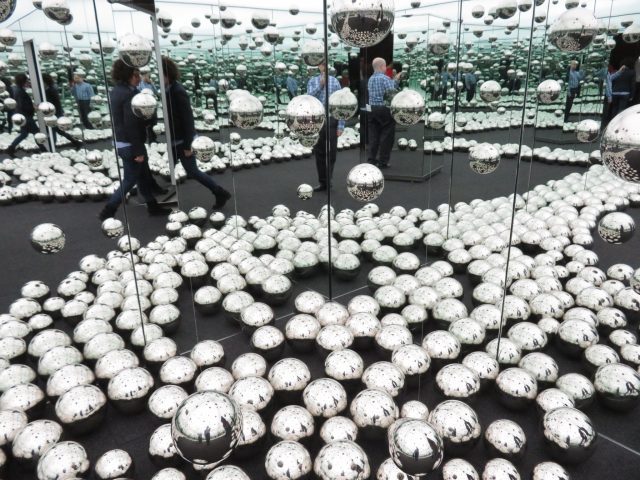
You probably should already be on line if you want to see Yayoi Kusama’s 2017 “Infinity Mirrored Room — Let’s Survive Forever,” part of her wide-ranging “Festival of Life” exhibition, which closes December 16 at David Zwirner’s Chelsea galleries. The wait times have been reaching upwards of six hours, and that will likely only increase as the end of the run approaches; you can stay updated about the line on Zwirner’s twitter feed. The approximately 12x20x20-foot carpeted room features stainless-steel balls hanging on monofilaments from the ceiling and arranged on the floor, with mirrored surfaces on all sides that seem to reflect into infinity. There is also a vertical box with three round viewing panes where visitors can look into a kaleidoscopic wonderland. Kusama, now eighty-eight, has been making the mirrored infinity rooms since 1963, when the Japanese artist was living and working in New York City. Five or six people at a time are allowed to enter the small space and spend ninety seconds there; be sure to actually experience the dazzling, brightly lit room and not just concentrate on taking selfies. In fact, each picture is a selfie because everyone inside is reflected again and again all over the room.
(photo by twi-ny/mdr)

Yayoi Kusama’s “Longing for Eternity” brings people together at David Zwirner (photo by twi-ny/mdr)

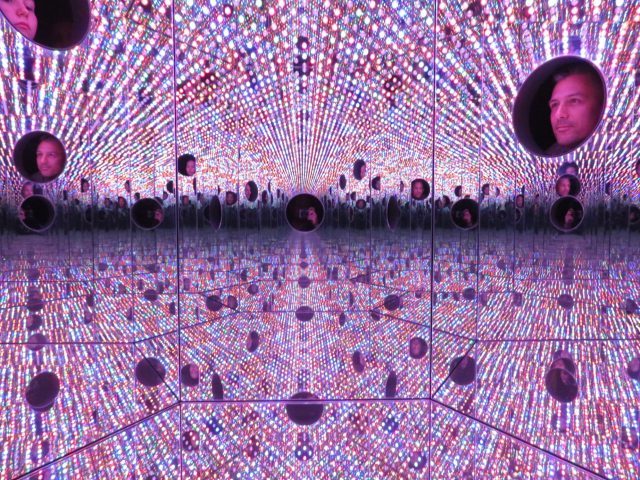
There are three other sections of the exhibit that don’t require standing on line. In a dark room, the new “Longing for Eternity” rises near the center, a vertical box with four viewing holes where visitors can stick their heads inside to see more endless, ever-changing kaleidoscopes of multiple colors made of LED lights; you can also see the other people sticking their heads in the box, at different heights. You cannot put your camera or iPhone through the holes to snap a picture; if you were to drop it inside, it would break and ruin the piece. So again, just let yourself get lost in the awe-inspiring visuals and don’t worry so much about perfect documentation.
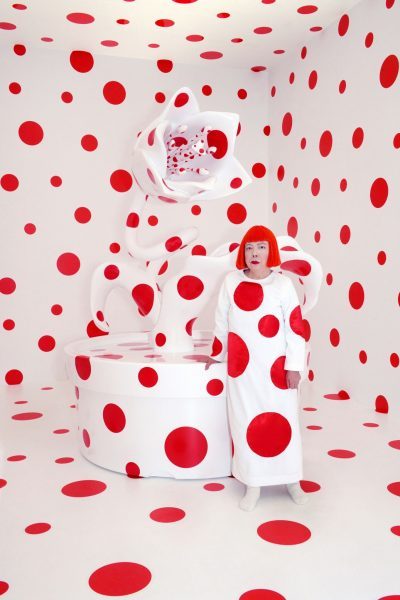
Yayoi Kusama, “With All My Love for the Tulips, I Pray Forever,” installation view, “Yayoi Kusama Eternity of Eternal Eternity,” the National Museum of Art, Osaka, Japan, 2012 (image © Yayoi Kusama; courtesy of David Zwirner, New York; Ota Fine Arts, Tokyo/Singapore/Shanghai; Victoria Miro, London; YAYOI KUSAMA Inc.)

Yayoi Kusama, “With All My Love for the Tulips, I Pray Forever,” installation view, “Yayoi Kusama Eternity of Eternal Eternity,” the National Museum of Art, Osaka, Japan, 2012 (image © Yayoi Kusama; courtesy of David Zwirner, New York; Ota Fine Arts, Tokyo/Singapore/Shanghai; Victoria Miro, London; YAYOI KUSAMA Inc.)

You’ll next enter a captivating paradise known as “With All My Love for the Tulips, I Pray Forever,” a 2011 installation making its U.S. debut. The room is covered from floor to ceiling (including the hallway and the door) in big red polka dots on a white background; it also contains a trio of large-scale fiberglass tulips in planters that evoke the images you see when looking into Magic Eye stereograms. In fact, it can feel like you’re experiencing it through virtual reality glasses, but it’s actually right there, playing with your equilibrium in fun ways. But there’s more to it than just that; as Kusama, who combines Pop Art, Minimalism, and Abstract Expressionism and refers to herself as an Avant-Garde artist, writes in a “Message to the people of the world from Yayoi Kusama”: “Today’s world is marked by heightened anxiety connected to ever growing strife between nations and individuals, and to elusive prospects for peace. In the midst of such turmoil, we must, as human beings, be ever more vigilant and determined to build a better world through strengthened cooperation. . . . My greatest desire is that my vision of a future of eternal harmony among people be carried on.”
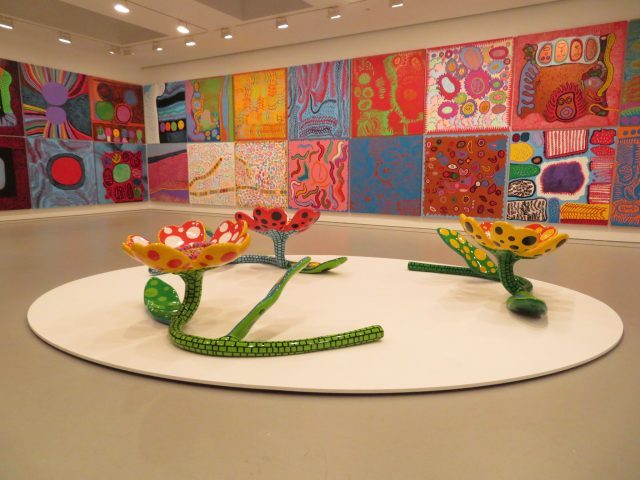
Yayoi Kusama’s “Festival of Life” combines “My Eternal Soul” paintings with “Flowers That Bloom Now” sculpture (photo by twi-ny/mdr)

Yayoi Kusama’s “Festival of Life” combines “My Eternal Soul” paintings with “Flowers That Bloom Now” sculpture (photo by twi-ny/mdr)

Finally, in the vast west gallery, Kusama, who works six days a week, nearly nonstop, has arranged sixty-six new paintings from her “My Eternal Soul” series, which she began in the late 2000s. Each canvas is 76.375 x 76.375 inches square, in two rows across all four walls. The works, which boast such titles as “When I Saw the Largest Dream in Life,” “Women in the Memories,” “Everyone Is Seeking Peace,” “The Far End of My Sorrow,” “A Soul Is Leaving the Body,” “Dear Death of Mine, Thou Shalt Welcome an Eternal Death,” and “Festival of Life,” contain repeated elements such as eyes, profiles, amoebalike organisms, aliens, faces, geometric patterns, and others in an endless array of colors. In the center of the room is a platform with a trio of forty-one-inch-high stainless-steel “Flowers That Bloom Now,” with long, snakelike green stems and polka-dotted petals and pistils, looking like a delightful ride in a children’s playground or amusement park (except it doesn’t rotate and you can’t go on it).
(photo by twi-ny/mdr)

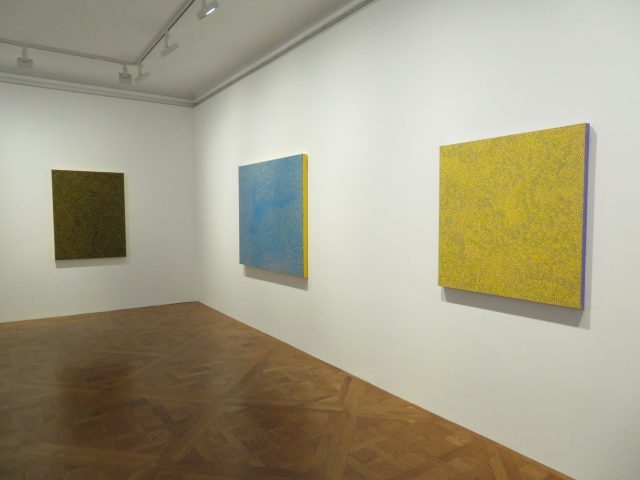
“Yayoi Kusama: Infinity Nets” has been extended at David Zwirner’s uptown space through December 22 (photo by twi-ny/mdr)

There are no lines to see “Yayoi Kusama: Infinity Nets” at Zwirner’s new space on East 69th St., which will afford you plenty of time to breathe in Kusama’s stunning, iconic net paintings, inspired by hallucinations she has experienced since childhood; Kusama suffers from obsessive neurosis and has been voluntarily living at Tokyo’s Seiwa Hospital for the Mentally Ill since 1977. She first prepares the canvas in a solid color, then washes over it in a second color, her impasto brushwork evident, sometimes swirling, sometimes thick with clumps, as she makes hundreds of tiny arcs, like crescent moons or waves, in the background color. (She was influenced by a 1957 plane trip from Tokyo to Seattle, watching the ocean crests below her.) The works look different from every angle, at times offering optical illusions or what appear to be hidden figures, but that’s just your imagination getting in the flow. “My net paintings were very large canvases without compositions – without beginning, end, or center,” Kusama has said. “The entire canvas would be occupied by monochromatic nets. This endless repetition caused a kind of dizzy, empty, hypnotic feeling.” The ten works, which can be seen as traps or safety nets, include random letters in their titles that don’t actually mean anything (for example, WFCOT, BNDBS, and FWIPK), adding to the intrigue. “My desire was to predict and measure the infinity of the unbounded universe, from my own position in it, with dots — an accumulation of particles forming the negative spaces in the net. How deep was the mystery? Did infinities exist beyond our universe? In exploring these questions I wanted to examine the single dot that was my own life,” Kusama has explained. And in her unique universe, each single dot reveals the hand — and heart and mind — of the artist, a rare treat in a digital world.
ZERO: COUNTDOWN TO TOMORROW, 1950-60s

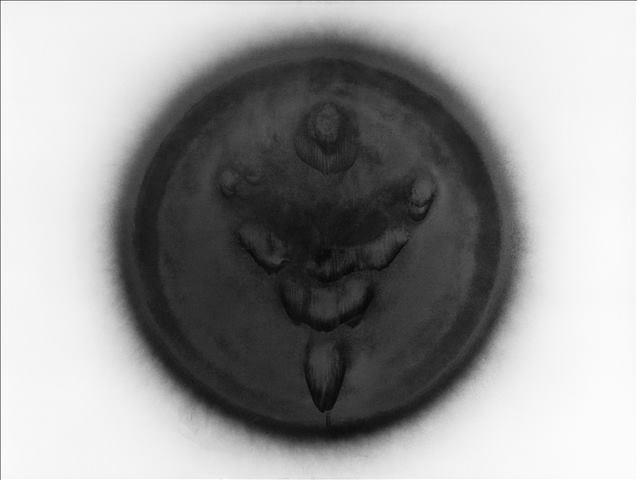
Otto Piene, “Venus of Willendorf (Venus von Willendorf),” oil and soot on canvas, 1963 (© Otto Piene; photo courtesy Stedelijk Museum Amsterdam)

Otto Piene, “Venus of Willendorf (Venus von Willendorf),” oil and soot on canvas, 1963 (© Otto Piene; photo courtesy Stedelijk Museum Amsterdam)

Solomon R. Guggenheim Museum
1071 Fifth Ave. at 89th St.
Friday – Wednesday through January 7, $18-$22 (pay-what-you-wish Saturday 5:45-7:45)
212-423-3587
www.guggenheim.org

The Guggenheim completes its third revelatory group show in a row with “ZERO: Countdown to Tomorrow, 1950s–60s,” coming hot on the heels of “Gutai: Splendid Playground” and “Italian Futurism, 1909–1944: Reconstructing the Universe.” Founded in 1957 by German artists Otto Piene and Heinz Mack, Zero brought together European artists who sought a fresh, optimistic start following the devastation of WWII. “From the beginning we looked upon the term [ZERO] not as an expression of nihilism — or as a dada-like gag, but as a word indicating a zone of silence and of pure possibilities for a new beginning as at the countdown when rockets take off — zero is the incommensurable zone in which the old state turns into the new.” Joined by Günther Uecker in 1961, the collective created monochromatic paintings, kinetic sculptures, and action works that explored light, nature, and space, often removing the hand of the artist. Subtle, complex brushstrokes of multiple colors were not on the agenda; instead, Lucio Fontana slashed his canvases, Uecker hammered in nails, and Piene, Yves Klein, Bernard Auberlin, Piero Manzoni, and Henk Peeters used fire and soot. Numerous pieces, including Gianni Colombo’s “Pulsating Structure,” Klein’s “Space Excavator,” Daniel Spoerri’s “Auto-Theater,” Piene’s “Light Ballet,” and Jean Tinguely’s “Butterfly (Two Points of Stability),” contain mechanically powered elements that move, and in the Guggenheim show they are active only at timed intervals, adding an expectant quality to the viewer’s experience, which echoes the group’s hopefulness for the future. Meanwhile, Mack’s “Silver Dynamo,” Almir Mavignier’s “Convex-Concave II,” and Jesús Rafael Soto’s vibration works play with viewers’ perception in engaging ways.

During the early 1960s, Group Zero’s influence spread to Japan, the Americas, and other parts of Europe; the exhibition features more than 180 works by some forty artists from Belgium (Walter Leblanc, Paul Van Hoeydonck), Romania (Spoerri), Brazil (Almir Mavignie), the Netherlands (herman de vries, Jan Schoonhoven), Japan (Yayoi Kusama), America (Robert Breer, George Rickey), Switzerland (Dieter Roth), and other nations. Curator Valerie Hillings bookends “ZERO: Countdown to Tomorrow, 1950s–60s” with two wonderful rooms, beginning in the High Gallery with an examination of the seminal 1959 Antwerp exhibition “Vision in Motion — Motion in Vision,” which serves as a kind of primer for what visitors can expect as they make their way up the Guggenheim’s Rotunda to the very last room, which contains a re-creation of the 1964 Documenta 3 installation “Light Room: Homage to Fontana,” as light-based kinetic works by Mack, Piene, Ueker, and Fontana turn on and off seemingly randomly, casting shadows on the walls and lighting up the darkness. The exhibition closes on January 7 with the panel discussion “ZEROgraphy: Mapping the ZERO Network, 1957–67” ($12, 6:30), with Antoon Melissen, Johan Pas, and Francesca Pola, moderated by Hillings and followed by a reception and a final viewing.