Tag Archives: Yale Repertory Theatre

HAPPY DAYS

(photo by Gerry Goodstein)

Dianne Wiest stars as Winnie in Yale Rep production of Happy Days at TFANA (photo by Gerry Goodstein)

Theatre for a New Audience, Polonsky Shakespeare Center
262 Ashland Pl. between Lafayette Ave. & Fulton St.
Tuesday – Sunday through May 28, $85-$120
866-811-4111
www.tfana.org

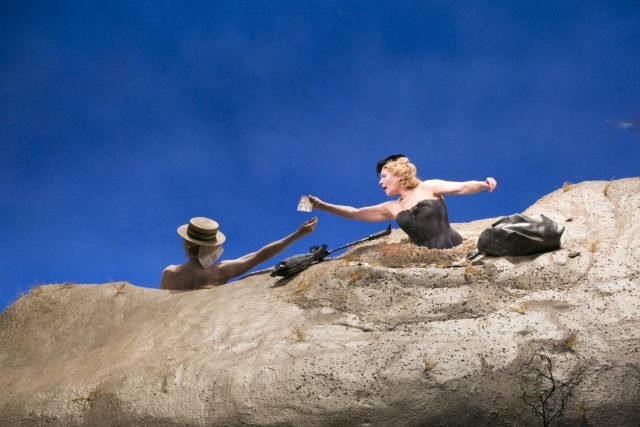
In preparing to play Winnie in Samuel Beckett’s Happy Days, a part she had been waiting thirty years to take on and one she calls “the Hamlet for actresses,” Dianne Wiest worked with a special movement coach in order to deal with the role’s unusual physical demands: She must spend nearly two hours buried in an artificial sand dune, in the first act only able to move her upper body and in the second act even less. Unfortunately, perhaps that’s why the two-time Tony and Emmy winner’s performance can feel overly mannered in the first half of the show, which continues at Theatre for a New Audience’s Polonsky Shakespeare Center through May 28, although she dazzles after intermission. Winnie is first seen in a strapless black dress, her torso and head the only parts of her body sticking out from atop Izmir Ickbal’s large sand dune, behind which is a trompe l’oeil backdrop of white clouds and blue sky. A mysterious bell rings her awake, and Winnie begins her morning ablutions, going through her bag, taking her medicine, brushing her teeth, and getting ready for the day, which pretty much is going to be like every other day in her life, but she is cheery and chipper nonetheless. “Another heavenly day,” she announces with a smile. “So much to be thankful for — no pain — hardly any,” she adds, shining with positivity. To her right, in a crevice, is her husband, Willie (Jarlath Conroy), who is rarely seen and has very little to say aside from reading obituaries and job postings in the paper. Wiest overemotes with her bare arms, drawing too much attention to them, detracting from Winnie’s charmingly abstruse existential ramblings. Every movement, every pause, every emotion was written into the script by Beckett, but here they are just too broad.
(photo by Gerry Goodstein)

Willie (Jarlath Conroy) and Winnie (Dianne Wiest) face life and death in Samuel Beckett revival (photo by Gerry Goodstein)

In the second act, with her arms buried beneath the sand, Wiest (All My Sons, Hannah and Her Sisters) really hits her stride, her high-pitched, singsong voice rising throughout the theater with the dawn of a new day. “Hail, holy light,” she begins. “Someone is looking at me still. Caring for me still. That is what I find so wonderful. Eyes on my eyes,” she says, referring to the rapt audience. “What is that unforgettable line?” We are looking at her indeed; of course, it’s a play in which you have to keep your eyes on her, but you’ll be mesmerized by Wiest’s tantalizing performance in this second half. However, director James Bundy never quite establishes a connection between Winnie and Willie, who is relegated to merely an afterthought. In the 2015 Boston Court production at the Flea, starring real-life husband-and-wife Brooke Adams and Tony Shalhoub, Willie was much more critical to the narrative, which also took on climate change. But Bundy, Conroy, and Wiest still do justice to Beckett’s views on the passage of time, with intriguing references to sex, death, and vaudeville and Winnie regularly championing “the Old Style.”
MARIE ANTOINETTE

(photo by Pavel Antonov)

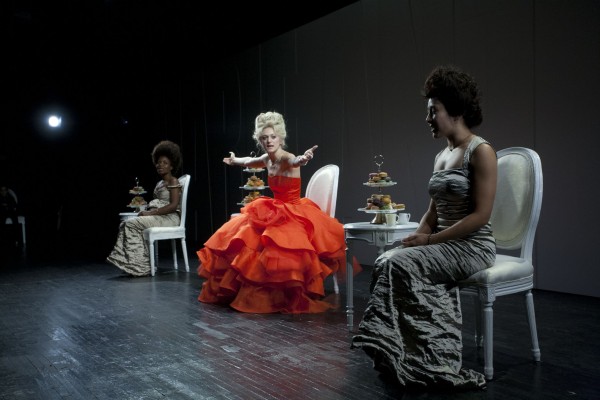
Marie Antoinette (Marin Ireland) discusses the state of her sheltered world in Soho Rep. production (photo by Pavel Antonov)

Soho Rep.
46 Walker St. between Broadway & Church St.
Tuesday – Sunday through November 3, $35-$50; November 5–17, $55-$75; November 19—24, $55-$80; Sunday, October 27, $0.99, first come, first served
212-352-3101
www.sohorep.org

Following more lavish productions at American Repertory Theater and Yale Repertory Theatre, David Adjmi’s Marie Antoinette gets the stripped-down, minimalist treatment at Soho Rep., where it’s just been extended through November 24. The staging is stark; the seventy-three-seat general admission audience sits in two long, horizontal rows of chairs, facing a white wall that announces the name of the play, and its main character. The story begins in 1776, as Marie (the always wonderful Marin Ireland) is gossiping over tea and macarons with her friends Yolande de Polignac (Marsha Stephanie Blake) and Therese de Lamballe (Jennifer Ikeda), discussing Rousseau, revolution, and the height of their hair. “I do like to disport myself,” the Valley Girl-like Antoinette says. “I’m sorry, even buffeted by the outcries of peasants — I’m a queen. I cannot simply forfeit my luxuries.” Among her luxuries is a dazzling red dress designed by Anka Lupes and a fab blonde wig courtesy of Amanda Miller. (The previous productions featured bigger hair and numerous costume changes, but Ireland now remains in the same dress until it’s nearly ripped off of her in act two.) She wants to have children, but her husband, the diminutive and hapless King Louis XVI (Steven Ratazzi), is scared of getting an operation on his member that would help them conceive.

(photo by Pavel Antonov)

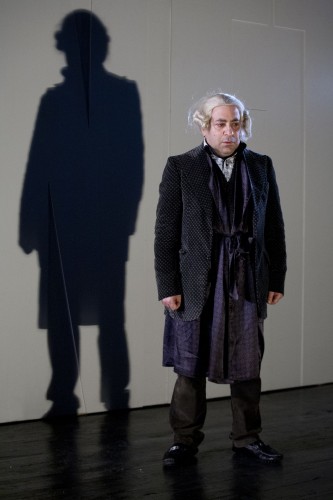
Hapless King Louis XVI (Steven Ratazzi) is at a loss as revolution threatens (photo by Pavel Antonov)

Eventually, the regal Antoinette is singing a very different tune after being imprisoned by revolutionaries. “I wasn’t raised, I was built: I was built to be this thing; and now they’re killing me for it,” she says. Ireland (The Big Knife, Reasons to Be Pretty) has a ball as Antoinette, and her enthusiasm is infectious. She exhibits the queen’s fall from grace with just the right amount of pathos, especially as the peasants start their vicious personal attacks on her, centered around a pseudo-autobiography that declares her a sex-addicted whore. Director Rebecca Taichman’s spare staging turns both wacky and sublime when Antoinette, who thought of herself as a shepherdess, is visited by a talking sheep (manipulated by David Greenspan). The cast also includes Chris Stack as Marie’s would-be lover, Axel Fersen; Aimée Laurence as the dauphin; and Will Pullen as an unsympathetic revolutionary. With its swift and elegant tongue placed firmly in its stylishly made-up cheek, this Marie Antoinette is an engaging, seriocomic look at a legendary historical figure who has become an unlikely pop-culture icon.

(There will be several special events associated with the play. The October 27 show will be followed by the discussion “What Is a History Play?,” the talk “How to Grow a New Play with David Adjmi” is scheduled for October 28 at 6:00, and the 7:30 performance on November 2 will be followed by the program “The Queen’s Room: French Interior Design and the State of the Nation.” In addition, Barbara Schulz will star in the one-woman show Les correspondances de Marie-Antoinette on October 24 at FIAF, and Perrin Stein will lead tours of the Metropolitan Museum of Art’s “Artists and Amateurs: Etching in 18th-Century France” display on October 25 and November 1.)

NOTES FROM UNDERGROUND

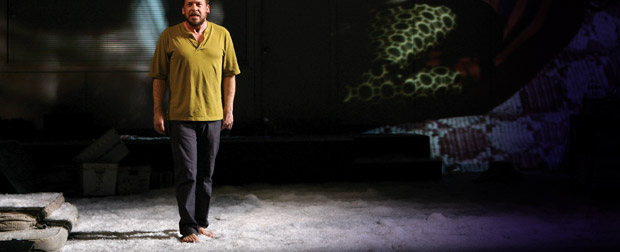
Bill Camp stars as the Underground Man in Dostoevsky adaptation at Baryshnikov Arts Center

Baryshnikov Arts Center
450 West 37th St.
November 7-28, $75
www.bacnyc.org

“I am a sick man. . . . I am a spiteful man. I am an unattractive man. I believe my liver is diseased.” So begins Russian novelist Fyodor Dostoevsky’s 1864 existentialist novella, NOTES FROM UNDERGROUND, which follows the rantings of a bitter, cynical civil servant who retreats from conventional society for myriad reasons. OBIE-winning actor Bill Camp and director Robert Woodruff have adapted Dostoevsky’s classic for the Yale Repertory Theatre, which will be presenting the New York premiere in conjunction with Theatre for a New Audience at the Baryshnikov Arts Center November 7-28. Camp will also star as the Underground Man in the ninety-minute production. The 2:00 performance on November 13 will be followed by a discussion with Wallace Shawn, and Emily Gould will participate in a discussion following the 2:00 performance on November 20.