Tag Archives: william shakespeare

UPTOWN SHAKESPEARE IN THE PARK: CTH IS DETERMINED TO STILL HOLD IT IN HARLEM

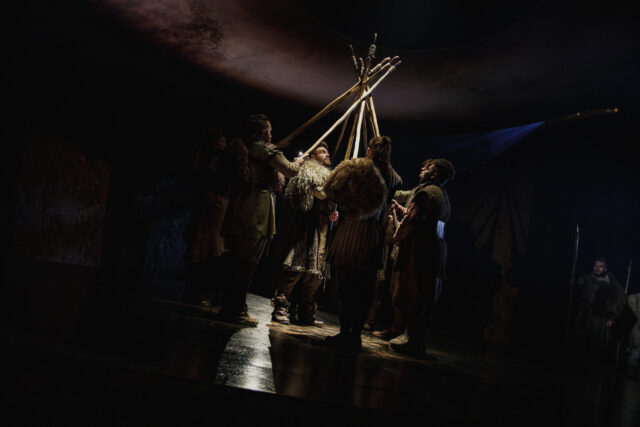
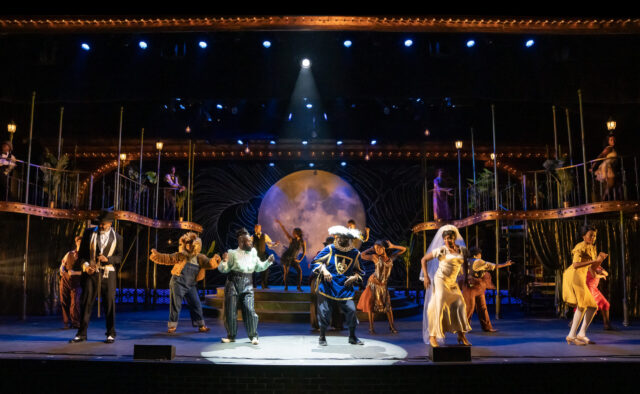
Free CTH summer productions such as A Midsummer Night’s Dream might be no longer possible after NEA withdraws funding (photo © 2024 by Richard Termine)

HOLD ’EM IN HARLEM
Renaissance New York Harlem Hotel Ballroom
233 West 125th St.
Thursday, May 22, $100-$1500, 6:00 – 11:00
Memnon: Marcus Garvey Park, July 5–27, free (tentative)
www.cthnyc.org

On May 22, the Classical Theatre of Harlem (CTH) will have its annual fundraising gala, at the Renaissance New York Harlem Hotel. Tickets for the “Hold ’Em in Harlem” benefit, comprising gambling games, a silent auction, an open bar, passed hors d’oeuvres, celebrity guests, and prizes, start at $100 for nonplayers and go up to $150 per poker player, $1,500 for a full player table, and $50,00 for exclusive sponsorship. The 2025 special guests are Malik Yoba, Grantham Coleman, Laila Robins, Russell Hornsby, Felix Solis, and Kevin “Dot Com” Brown. The money raised helps support CTH’s mission “to maintain a professional theatre company dedicated to returning the classics to the stages of Harlem; to create employment and educational outreach opportunities in the theatre arts; to create and nurture a new, young, and culturally diverse audience for the classics; and to heighten the awareness of theatre and of great art in Harlem.”

One of the highlights of each season is Uptown Shakespeare in the Park, free summer shows put on in Marcus Garvey Park; past years have featured Shakespeare’s A Midsummer Night’s Dream, Twelfth Night, and Macbeth in addition to Betty Shamieh’s Malvolio, Will Power’s Seize the King, and A Christmas Carol in Harlem.

However, this year’s summer production, Power’s Memnon, about an Ethiopian king who travels to Troy to fight for the Trojans, is in danger of being canceled because the National Endowment for the Arts has just started cutting arts funding to New York institutions, including CTH.

The letter from the NEA blatantly states, “Pursuant to the Offer letter, the tentative funding recommendation for the following application is Withdrawn by the Agency and the National Endowment for the Arts will no longer offer award funding for the project. The NEA is updating its grantmaking policy priorities to focus funding on projects that reflect the nation’s rich artistic heritage and creativity as prioritized by the President. Consequently, we are terminating awards that fall outside these new priorities. The NEA will now prioritize projects that elevate the Nation’s HBCUs and Hispanic Serving Institutions, celebrate the 250th anniversary of American independence, foster AI competency, empower houses of worship to serve communities, assist with disaster recovery, foster skilled trade jobs, make America healthy again, support the military and veterans, support Tribal communities, make the District of Columbia safe and beautiful, and support the economic development of Asian American communities. Funding is being allocated in a new direction in furtherance of the Administration’s agenda. Your project, as noted below, unfortunately does not align with these priorities.”

CTH’s free performances result in tens of thousands of audience members, hundreds of jobs, and an economic impact of more than $600,000 on Harlem. CTH also hosts indoor theater, a literary series at Harlem Stage, acting classes for kids, the Behind the Curtain exclusive interview and Icons series, and career development resources. Apparently, those are no longer priorities for the current administration.

“This isn’t just a line item — it’s a devastating blow to the working artists, small businesses, and Harlem families who count on this production every year,” CtH producing artistic director Ty Jones said in a statement. “This is a fight for cultural equity, artistic freedom, and the soul of Uptown.”

In order for the show to go on — Memnon is scheduled to run July 5–27 — donations are needed now. If you can give, please do so; every $60 equals a free seat at the show, while $500 supports a week of rehearsals for one performer.

[Mark Rifkin is a Brooklyn-born, Manhattan-based writer and editor; you can follow him on Substack here.]

DOOM, HOPE, AND THE BARD AT PARK AVE. ARMORY

Anne Imhof reimagines Romeo and Juliet in Doom: House of Hope at the armory (photo by Nadine Fraczkowski / courtesy the artist, Galerie Buchholz, Sprüth Magers, and Park Ave. Armory)

DOOM: HOUSE OF HOPE
Park Avenue Armory, Wade Thompson Drill Hall
643 Park Ave. at 67th St.
March 3–12, $60
212-933-5812
www.armoryonpark.org

“What less than doomsday is the prince’s doom?” Friar Laurence asks Romeo in William Shakespeare’s tragic tale Romeo & Juliet.

Because of its massive 55,000-square-foot Wade Thompson Drill Hall, Park Ave. Armory has been home to numerous unique theatrical productions and art installations, involving such unusual elements as thirty tons of clothing (Christian Boltanski’s No Man’s Land), wooden swings hanging seventy feet from the ceiling (Ann Hamilton’s The Event of a Thread), one hundred bleating sheep (Heiner Goebbels’s De Materie), and a dark, mysterious heath (Kenneth Branagh’s Macbeth).

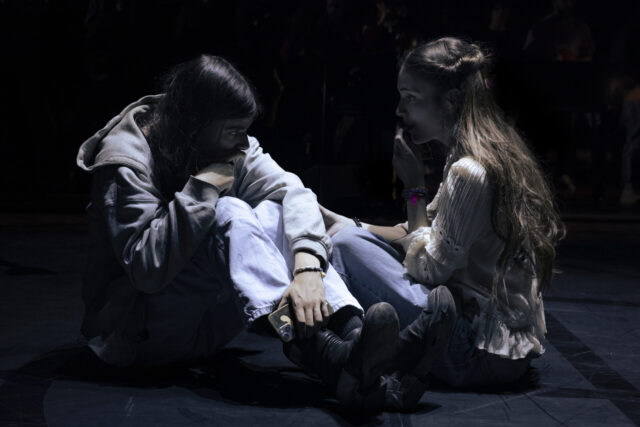
Now Berlin-based Golden Lion winner Anne Imhof has transformed the hall into an enormous prom gym, filling the space with more than fifty actors, dancers (ABT, modern, flexn, line), skateboarders, and musicians, twenty-six Cadillac Escalades, a Jumbotron, and other inspiring elements for Doom: House of Hope, a three-hour multidisciplinary reimagining of Romeo and Juliet, running March 3–12. Curated by Klaus Biesenbach, the durational performance features Sihana Shalaj, Levi Strasser, and Devon Teuscher as Romeo; Talia Ryder and Remy Young as Juliet; assistant director and costumer Eliza Douglas, choreographer Josh Johnson, Cranston Mills, and Connor Holloway as Mercutio; Jakob Eilinghoff, Arthur Tendeng, and Daniil Simkin as Benvolio; and Efron Danzg, vocalist Lia Wang, and Simkin as Tybalt. Among the other characters are Vinson Fraley and Toon Lobach as angels, Perla Haney-Jardine as the critic, Tess Petronio as the photographer, Casper von Bulow as the director and the revolutionary, Coco Gordon Moore as the poet, Tahlil Myth as the storyteller, and Henry Douglas as the gamer, offering yet more twists on the traditional tragedy.

The band, under the musical direction of Ville Haimala, consists of Sharleen Chidiac on guitar, Eilinghoff on bass, Eva Bella Kaufman on drums, and James Shaffer on guitar, with vocals by Lia Wang. The score ranges from Johann Sebastian Bach, Gustav Mahler, Franz Schubert, and Pyotr Ilyich Tchaikovsky to the Doors, Radiohead, and Frank Sinatra, along with original compositions by ATK44, Douglas, Haimala, Imhof, Lia Lia, Jacob Madden, and Strasser. In addition to Shakespeare, the text collects quotes from Jean Genet, Heinrich Heine, and Raymond Moody and writings about George Balanchine, John Cranko, Dieter Gackstetter, Bruce Nauman, Jerome Robbins, Tino Sehgal, and others.

The set is by sub, with sound by Mark Grey and lighting by the masterful Urs Schönebaum, who has dazzled audiences with his work on such previous armory productions as Inside Light and Doppelganger.

As its title states, the immersive show recognizes the doom so many feel now, the increasing anxiety over the state of the planet, while also seeing a potentially bright future.

Romeo (Levi Strasser) and Juliet (Talia Ryder) face doom and hope in Anne Imhof extravaganza at the armory (photo by Nadine Fraczkowski / courtesy the artist, Galerie Buchholz, Sprüth Magers, and Park Ave. Armory)

A few moments after Friar Laurence predicts the worst, Romeo tells him, “Hang up philosophy. / Unless philosophy can make a Juliet, / Displant a town, reverse a prince’s doom.” Perhaps there is a way out of this mess we’re in, although the Bard’s original play does not exactly end happily.

On March 11 at 5:30, Imhof, whose other works include Sex, Natures Mortes, and Angst I–III, will participate in an artist talk about Doom: House of Hope with writer and curator Ebony L. Haynes.

[Mark Rifkin is a Brooklyn-born, Manhattan-based writer and editor; you can follow him on Substack here.]

ROMEO + JULIET ON BROADWAY CONQUERS KING LEAR AT THE SHED

Sam Gold’s Romeo + Juliet is made for Gen Z but can be enjoyed by all (photo by Matthew Murphy and Evan Zimmerman)

ROMEO + JULIET
Circle in the Square Theatre
1633 Broadway at 50th St.
Tuesday – Sunday through February 16, $159-$1002
romeoandjulietnyc.com

Last fall, when I saw Sam Gold’s Romeo + Juliet at Circle in the Square and Kenneth Branagh’s King Lear at the Shed, I was not anticipating being charmed by the former and disappointed in the latter.

Tony and Obie winner Gold has had decidedly mixed results with controversial and often confusing star-driven adaptations of such Shakespeare plays as Macbeth and King Lear on Broadway, Othello at New York Theatre Workshop, and Hamlet at the Public.

Meanwhile, Branagh is widely considered the finest interpreter of the Bard since Laurence Olivier, both onstage, such as his immersive version of Macbeth at Park Ave. Armory and his 1987 and 2016 takes on Romeo and Juliet, and his well-received cinematic adaptations of Henry V and Much Ado About Nothing.

Lear is a personal favorite of mine; Branagh’s is the eighth major production I’ve seen in the last twenty years. I have not had as much luck with R&J, from David Leveaux’s flat 2013 Broadway revival to Hansol Jung’s profoundly perplexing 2023 effort at the Lynn Angelson, although I adored Michael Mayer’s & Juliet, a musical imagining of what might have happened if Juliet had survived.

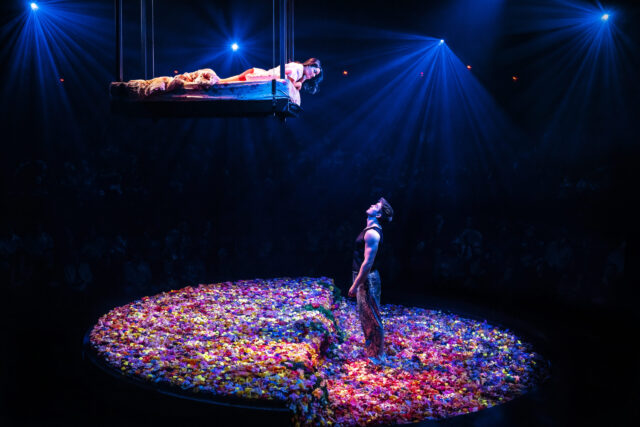
Closing February 16, Gold’s Romeo + Juliet is a plush and lively, radical AMSR presentation tailored for Gen Z, complete with an Insta-friendly plethora of stuffed teddy bears onstage and in the lobby. When the audience enters the theater in the round, the actors are already hanging out, talking, dancing, and dissing with each other, pushing around a shopping cart of stuffed animals, skateboarding, and lounging on plastic furniture. They wear sneakers, hoodies, and a Hello Kitty backpack. On one side, a giant pink teddy bear watches in silence while across the space a DJ spins Jack Antonoff’s thumping music.

The youthful cast features the hot Rachel Zegler as Juliet and the even hotter Kit Connor as Romeo, with Tony nominee Gabby Beans as Mercutio and the friar, Sola Fadiran as both Capulet and Lady Capulet, Taheen Modak as Benvolio, Tommy Dorfman as the nurse and Tybalt, and Gían Pérez as Samson, Paris, and Peter. The doubling and tripling often makes it hard to know who is who, and some actors do better with the tweaked dialogue than others. Two songs are completely unnecessary, and the use of a handheld microphone is baffling, as is the handling of a poison jug.

But much of the staging is dazzling, from Juliet’s bed, which drops slowly from the rafters, to a colorful expanse of flowers that emerges from the floor. Yes, the F-bomb appears twice, but surprises await those who fully invest themselves in this contemporary tale made for this moment in time.

Kenneth Branagh’s ritualistic King Lear goes astray early (photo by Marc J. Franklin / courtesy the Shed)

Unfortunately, Branagh, codirecting with Rob Ashford and Lucy Skilbeck, struggles with his streamlined adaptation, which, at a rushed two hours without intermission, has cut several key scenes and famous lines, and without the proper character development it’s often hard to differentiate among the minor characters, who are played by recent graduates of the Royal Academy of Dramatic Arts and look like survivors from Game of Thrones. Branagh, who is sixty-four, does not portray Lear as an aged, failing man but as a younger warrior, which alters the plot’s narrative center.

Like Gold’s R+J, Branagh’s staging involves a large sphere, in this case an imposing UFO-like disc that hovers over the action, occasionally moving and tilting, onto which ominous weather patterns are projected. (The script identifies the setting as “outer space.”) It also leaves in one of the songs, which feels extraneous given the show’s shortened length.

Thus, my initial thoughts that Gold would pale in comparison to Branagh were misbegotten.

“O teach me how I should forget to think!” Romeo tells Benvolio.

Who woulda thunk it?

[Mark Rifkin is a Brooklyn-born, Manhattan-based writer and editor; you can follow him on Substack here.]

PUNCH TO THE GUT: A CYMBELINE FOR OUR TIME

The pure and passionate love between Princess Imogen (Jennifer Lim) and Posthumus Leonatus (KK Moggie) is challenged in NAATCO’s Cymbeline (photo by Julieta Cervantes)

CYMBELINE
Lynn F. Angelson Theater
136 East Thirteenth St. between Third & Fourth Aves.
Tuesday – Sunday through February 15, $25-$55
https://www.naatco.org

“Context is everything,” according to a phrase attributed to twentieth-century sociologist Alvin Ward Gouldner, author of such books as The Coming Crisis of Western Sociology and Against Fragmentation: The Origins of Marxism and the Sociology of Intellectuals.

That expression was on my mind as I watched the National Asian American Theatre Co.’s (NAATCO) splendid production of William Shakespeare’s Cymbeline, running at the Lynn F. Angelson Theater through February 15.

When I saw Heidi Schreck’s What the Constitution Means to Me at New York Theatre Workshop in 2018, it was the day that the Judiciary Committee had voted to advance the nomination of Brett Kavanaugh for Supreme Court Justice to the Senate floor. The air was thick with that event, which Schreck shrewdly noted without getting specific, but the entertaining show soon had the audience laughing.

I saw Cymbeline the day I learned that President Donald J. Trump had signed an executive order declaring, “It is the policy of the United States to recognize two sexes, male and female. These sexes are not changeable and are grounded in fundamental and incontrovertible reality. . . . Agencies shall remove all statements, policies, regulations, forms, communications, or other internal and external messages that promote or otherwise inculcate gender ideology, and shall cease issuing such statements, policies, regulations, forms, communications or other messages.”

Andrea Thome’s modern-verse adaptation, which identifies itself as “all-femme, all–Asian American,” feels like a punch to the gut of that executive order, which essentially seeks to ban the word “gender” from the English language. It is particularly relevant in a work by Shakespeare, since original productions of his plays featured all-male casts because women were not permitted to perform onstage in Elizabethan times. , as it was considered unladylike and demeaning to their established role in Victorian society.

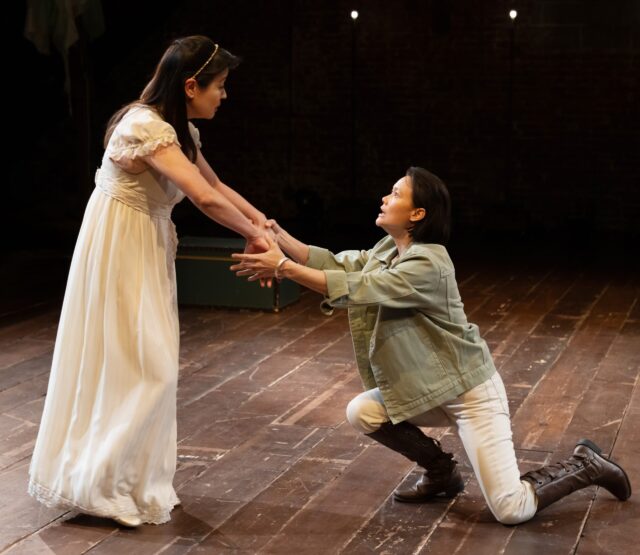
In Ancient Britain, King Cymbeline (Amy Hill) has banished Posthumus Leonatus (KK Moggie), a soldier who has wed his daughter, the princess Imogen (Jennifer Lim), without royal permission, ignoring their deep love for each other. The queen (Maria-Christina Oliveras) is determined that her son from a previous marriage, Cloten (Jeena Yi), will be Imogen’s husband, ensuring he will be the next ruler.

In exile in Rome, Posthumus boasts to a group of men from Italy, the Netherlands, Spain, and France about his true love’s undying fidelity. The Frenchman tells the doubting Iachimo (Anna Ishida) of a conversation he had with Posthumus the night before in which they both were “lavishly praising our beloved mademoiselles back home; this gentleman at the time vouching (and vowing to defend it with his blood) that his lady was more lovely, virtuous, wise, chaste, faithful, praiseworthy and less temptable to seduction than any of the most extraordinary ladies in France.”

Iachimo takes that as a challenge and offers half his estate against Posthumus’s diamond ring, which belonged to Imogen’s mother, that he can seduce the princess and bring back absolute proof of his success. “The goodness of my mistress exceeds the depth of your vulgarity. I dare you to this match,” Posthumus says, agreeing to the bet and adding that they will duel when Iachimo fails.
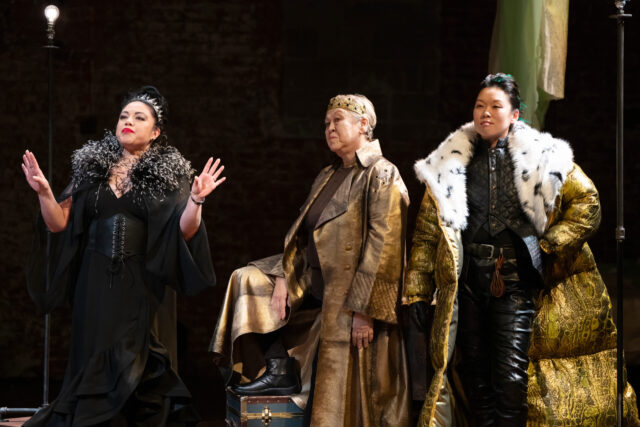
Cymbeline features an “all-femme, all–Asian American” cast (photo by Julieta Cervantes)

Even though Imogen boldly rejects Iachimo’s advances, he tricks Posthumus into believing that the princess did indeed surrender her honor, prompting Posthumus to write to Imogen advising her to meet him in the Welsh town of Milford Haven and commanding his loyal servant, Pisanio (Julyana Soelistyo), to kill her because of her adultery. “Do I seem to the world to lack humanity so much as this crime asks?” Pisanio says, questioning the order.

In addition, the foolish Cloten has decided that he too will head to Milford Haven, to kill Posthumus and “defile” Imogen on his path to becoming next in line for the throne.

Meanwhile, the Roman ambassador Caius Lucius (Purva Bedi) has threatened King Cymbeline with war if he does not pay tribute tax to Augustus Caesar; the queen has acquired poison from the doctor, Cornelius (Narea Kang), that she intends to use on Imogen; and on her way to Wales disguised as a boy named Fidele, Imogen encounters a father and his two boys, who live in a cave, surviving on sheer will. Little does she know that it is actually Belarius (Oliveras), who was wrongly banished by Cymbeline many years before and who absconded with Arviragus (Annie Fang) and Guiderius (Sarah Suzuki), the king’s two young sons and her half brothers, who the ruler believes are dead.

The numerous subplots all come together in a rousingly satisfying finale.

Cymbeline is a problematic play that is far from the Bard’s finest. It feels cobbled together with leftovers from such other works as Twelfth Night, Romeo and Juliet, The Comedy of Errors, Richard III, Hamlet, and Othello. A dream sequence involving the god Jupiter (Soelistyo) is one of Shakespeare’s strangest, most awkward scenes. The dialogue lacks memorable, familiar lines. At nearly three hours (with intermission), it is too long. In New York City, the play has never made it to Broadway; the Public has presented it three times in its Shakespeare in the Park festival, in 1971, 1998, and, most recently, 2015, with Patrick Page as the king, Kate Burton as the queen and Belarius, Hamish Linklater as Posthumus and Cloten, Lily Rabe as Imogen, and Raúl Esparza as Iachomo.

But NAATCO, in partnership with Play On Shakespeare, has breathed new life into the show. Yi-Hsuan (Ant) Ma’s spare, often bare set is highlighted by a multipurpose large stretch of cloth that cleverly morphs from a bedsheet to royal drapery to a cave entrance, evoking what would be considered then women’s work, made by seamstresses. Mariko Ohigashi’s costumes feature lots of black leather and British and Roman finery that stand in contrast to the princess’s white gown. Yiyuan Li’s lighting keeps the audience, sitting on three sides of the action, visible through much of the show, as if we are all part of the kingdom, especially on the several occasions where the fourth wall is broken. Caroline Eng’s sound includes musical chimes that signal various changes.

The banished Belarius (Maria-Christina Oliveras) has raised Arviragus (Annie Fang) and Guiderius (Sarah Suzuki) in a cave in the woods (photo by Julieta Cervantes)

The majority of the cast is exemplary, ably emitting Shakespeare’s poetic iambic pentameter even when Thome’s contemporary translation uses modern language, although Bard purists should not be too worried.

Here is one example of Thome’s (Pinkolandia, A Dozen Dreams) style, with the Folger Library version first, followed by the new adaptation:

Cloten: Was there ever man had such luck? When I
kissed the jack, upon an upcast to be hit away? I
had a hundred pound on ’t. And then a whoreson
jackanapes must take me up for swearing, as if I
borrowed mine oaths of him and might not spend
them at my pleasure.

Cloten: Has there ever been a man with luck like mine? I’d bowled my
ball, just kissed the jack . . . and then was hit away! I had bet a
hundred pounds on that game: and then that damned monkey
son of a whore had to scold me for swearing.

It is important to point out that the ensemble is identified as “all-femme,” not “all-woman”; in real life, not all of the actors use the pronouns “she/her.” In addition, being “all–Asian American” is a strong rejoinder to the Asian and immigrant hate so pervasive in America today and apparently supported by the current administration, which is also seeking to subvert the fourteenth amendment by ending birthright citizenship and to deport Dreamers. Director Stephen Brown-Fried (Misalliance, Awake and Sing!), who does a terrific job guiding the proceedings, does not emphasize any of that, instead letting it all unfurl in an organic and natural way, gender be damned.

“I see a man’s life is a tedious one,” Imogen says in a soliloquy in Act 3, Scene 6, in front of the cave in the Wales forest.

In this wonderful adaptation in these troubled times, that statement speaks volumes.

[There are several special postshow events scheduled: January 29 is AAPINH Night, with a talkback with the director, members of the cast, and the casting company; February 2 is Shakespeare Trivia Night after the matinee; and the February 6 performance will be followed by the panel discussion “Shakespeare in Translation: Body and Verse,” with Lue Douthit, Karen Shimakawa, and Thome.]

[Mark Rifkin is a Brooklyn-born, Manhattan-based writer and editor; you can follow him on Substack here.]

FOOLING AROUND WITH THE BARD: REIMAGINING SHAKESPEARE THROUGH GOOGLE TRANSLATE

Who: Emily Conlon, Sevrin Willinder
What: Shakespeare Translate: The Complete Works
Where: Caveat, 21A Clinton St. between East Houston & Stanton Sts., 212-228-2100
When: Sunday, December 1, $10 livestream, $18 in advance, $23 at door, 2:30
Why: In Hamlet, the title character says about a troupe of traveling actors, “He that plays the king shall be welcome. His majesty shall have tribute of me. The adventurous knight shall use his foil and target, the lover shall not sigh gratis, the humorous man shall end his part in peace, the clown shall make those laugh whose lungs are tickle o’ th’ sere, and the lady shall say her mind freely, or the blank verse shall halt for ’t. What players are they?”

Shakespeare included clowns or fools in most of his works, including Costard in Love’s Labours Lost, Dogberry in Much Ado About Nothing, the two Dromios in The Comedy of Errors, Feste in Twelfth Night, Lavache in All’s Well That Ends Well, Puck in A Midsummer Night’s Dream, and the fool in King Lear. On December 1 at Caveat, clowns Emily Conlon and Sevrin Willinder will present “Shakespeare Translate: The Complete Works,“ in which they will perform their favorite excerpts from every single play by the Bard, using original text that has been filtered through Google Translate fifteen times to give it a more contemporary feel; the show is directed by Melissa Ingle. Conlon describes herself as “a Brooklyn-based actor, singer, voice actor, and goofball,” while Willinder “is a ravishing young lad from Plympton, Massachusetts.” Advance tickets are $18, at the door $23; the performance, from Devon Loves ME! Productions, which was cofounded by Willinder, is also available via livestream for $10.

As Touchstone, the court jester, says in As You Like It, “The fool doth think he is wise, but the wise man knows himself to be a fool.” Find out more at Caveat (or online) on Sunday afternoon.

[Mark Rifkin is a Brooklyn-born, Manhattan-based writer and editor; you can follow him on Substack here.]
A DEVASTATING BLAST: ARLEKIN’S THE MERCHANT OF VENICE COMES TO CLASSIC STAGE

The cast of Arlekin’s Merchant of Venice playfully poses at press rehearsal (photo by twi-ny/mdr)

ARLEKIN IN RESIDENCE: THE MERCHANT OF VENICE
Classic Stage Company, Lynn F. Angelson Theater
136 East Thirteenth St. between Third & Fourth Aves.
Tuesday – Sunday, November 22 – December 22, $59-$129
www.classicstage.org/venice
www.arlekinplayers.com

Introducing a press rehearsal of two scenes from Igor Golyak and Arlekin Players Theatre’s adaptation of The Merchant of Venice at Classic Stage, producer Sara Stackhouse said, “Igor directed a very early iteration of this — this is quite different — but it was the DNA of this version of The Merchant of Venice. It was hilarious, and devastating, in Boston. It was like a punch in the face to antisemitism, and there were a lot of folks at that time who said to us, ‘Why are you doing a play on antisemitism? Why are you doing a Jewish play?’ One of the things that I have found working with incredible artists, Igor being one of them, is the way they feel the undercurrent of what is happening in the world all the time, and often ahead of time, and begin to bring it to the surface in artistic projects. That has been true for all the project I’ve done with Igor and through Arlekin. Unfortunately, it has come further and further and further to the surface not only in the art we’re making but also in the world. So we’re now doing this version of The Merchant of Venice in the context of October 7 and what happened in Amsterdam and the election and a real rise in hatred and antisemitism in the world. That canary in the coal mine — there’s no mine now; it’s like a canary flying out around the world. But one of the ways that actual humans respond to tragedy is they don’t sit and cry; they try to laugh; they try to survive. So this play is a comedy, and it’s a blast until it’s devastating.”

Boston-based Arlekin continues its residency at Classic Stage with The Merchant of Venice, following its highly acclaimed staging of Polish playwright Tadeusz Słobodzianek’s 2008 drama, Our Class, which was inspired by a horrific 1941 pogrom that occurred in the small village of Jedwabne in Poland. Running November 22 to December 22, the uniquely unpredictable work is built around a cable access program that is putting on the play, complete with low-budget foibles, casting controversies, and technical glitches. T. R. Knight stars as the host of The Antonio Show, with Richard Topol as Shylock, Alexandra Silber as Portia, Gus Birney as Jessica, Tess Goldwyn as Nerisa, José Espinosa as Bassanio, Stephen Ochsner as Launcelot Gobbo, and Noah Pacht as Lorenzo. At one point, Shylock puts on a Dracula costume, a funny yet incisive way to demonize the character who famously declares, “If you prick us, do we not bleed?”

“The first Quarto published in 1600 titled this play The most excellent historie of the merchant of Venice with the extreame crueltie of Shylocke the Jewe towards the sayd merchant, in cutting a just pound of his flesh: and the obtayning of Portia by the choyse of three chests. That’s a mouthful,” Golyak, who was born in Kyiv and came to America as a Jewish refugee when he was eleven, said in a statement. “It casts Shylock as a cruel villain and sets the expectation of a love story, a comedy, and a ruinous tragedy all wrapped into one. We are true to this in our production and we deliver all of it — an undercurrent of bias, a comedy, romance, action, and escapades — a real romp of a performance. But antisemitism is a light sleeper, and as the story plays out, it inevitably awakens and the result is devastating. It mirrors who we are, the times we live in, and how quickly the tides can turn.”

Rich Topol stars as Shylock and José Espinosa is Bassanio in Arlekin’s Merchant at Classic Stage (photo by twi-ny/mdr)

Golyak and Arlekin have previously presented such innovative virtual successes as Witness, State vs. Natasha Banina, and chekhovOS /an experimental game/ in addition to the hybrid The Orchard with Jessica Hecht and Mikhail Baryshnikov.

“The more antisemitism rises in the world, the more people are hating on the Jews, the more Jewish I feel,” Golyak, whose great-grandparents were killed at Babi Yar, recently wrote. “But the play, and Jewish life, and this world are devastating. I’m shattered like glass. In sooth, as an artist, as a parent, as a Jew, and as a human, I guess I do know why I am so sad.”

“It’s a wild ride,” Golyak also noted about the play.

Judging from what I saw at the rehearsal — you can get a sneak peek here — it’s a wild ride we all need to take.

[Mark Rifkin is a Brooklyn-born, Manhattan-based writer and editor; you can follow him on Substack here.]
AXIS COMPANY ENCORE ENGAGEMENT: TWELFTH NIGHT

Axis puts a dark spin on Shakespeare’s Twelfth Night (photo by Pavel Antonov)

TWELFTH NIGHT
Axis Theatre Company
One Sheridan Sq. between West Fourth & Washington Sts.
Wednesday – Saturday, September 25 – October 26, $11-$44, 8:00
866-811-4111
www.axiscompany.org

Following its initial run earlier this year, Axis’s dark and involving theatrical adaptation of Twelfth Night is back at the company’s Sheridan Square home for an encore engagement running September 25 to October 26. Below is twi-ny’s original review from May.

I described the last two productions I saw of William Shakespeare’s 1601–02 Twelfth Night as “light and lively,” “ecstatic,” “a joy to behold,” and “a pure delight.” I would not use any of those words to describe Axis Theatre Company’s streamlined new production, but that won’t stop me from heartily recommending it.

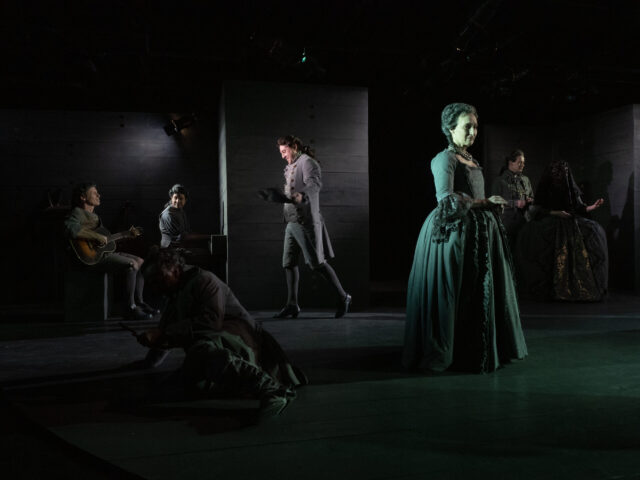
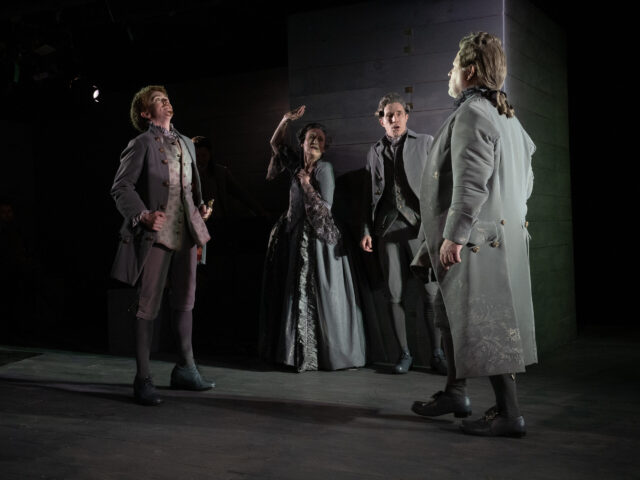
Shakespeare professor Marc Palmieri’s adaptation focuses on the darker side of this mistaken-identity romantic comedy about unrequited love, which has been trimmed to a fast-paced ninety minutes. David Zeffren’s lighting remains dim throughout on director Randall Sharp’s haunting stage, where actors are surrounded by large rectangular blocks and shadowy entrances; in one corner, guitarist and sound designer Paul Carbonara and pianist Yonatan Gutfeld (the keyboards are embedded in one of the blocks) perform Carbonara’s subtle Baroque-like score. Karl Ruckdeschel’s costumes — men’s suits and long coats, women’s gowns — are muted grays, lavenders, and earth tones; even Malvolio’s socks are a subdued yellow, not as garishly ridiculous as usual.

“If music be the food of love, play on / Give me excess of it,” Duke Orsino (Jon McCormick) declares as the show begins. The story is familiar to Shakespeare aficionados: In faraway Illyria, the wealthy countess Olivia (Katy Frame) rejects all suitors, including Orsino, who is in love with her. Her loyal steward, Malvolio (Axis producing director Brian Barnhart), also harbors a secret passion for the noblewoman. Twins Viola (Britt Genelin) and Sebastian (Eli Bridges) survive a shipwreck and wash up onshore, each ignorant that the other is still alive. One of the duke’s gentlemen, Curio (Robert Ierardi), explains to Viola, who has now disguised herself as a man named Cesario, that Olivia keeps repulsing Orsino’s advances. Viola quickly decides that she will convince Olivia to see Orsino in order to secure a place for herself in the duke’s employ.

Sebastian was rescued by Antonio (Jim Sterling), a sea captain who requests to be his servant. Believing his sister to be dead, Sebastian disguises himself as Roderigo and heads to the court of Orsino, where Antonio is not welcome.

Meanwhile, a group of conniving drunks hover around Olivia: her uncle, the raunchy Sir Toby Belch (George Demas); Sir Toby’s friend, the faux-elegant squire Sir Andrew Aguecheek (Andrew Dawson), who Sir Toby presents to Olivia as a potential suitor; Olivia’s chambermaid, Maria (Dee Pelletier); Olivia’s fool, Feste (Spencer Aste); and her servant Fabian (Brian Parks). “You must confine yourself within the modest limits of order,” Maria warns Sir Toby, who replies, “Confine! I’ll confine myself no finer than I am: these clothes are good enough to drink in; and so be these boots too.”

Axis Theatre Company’s Bard adaptation is back for an encore engagement (photo by Pavel Antonov)

After Malvolio chastises them for their ill behavior, Sir Toby, Sir Andrew, Feste, and Fabian, under Maria’s lead, concoct a plan to embarrass Malvolio in front of everyone. Maria explains, “Marry, sir, sometimes he is a kind and affectioned ass / the best persuaded of himself, so crammed, as he thinks / with excellencies, that it is his grounds of faith / that all that look on him love him / and on that vice in him will my revenge find / notable cause to work.”

It all comes to a head in a grand finale that, while not as boisterous as in other iterations, is as satisfying in its exactitude.

Axis refers to Twelfth Night as “Shakespeare’s most painful comedy,” and that’s just what Sharp, Palmieri, and the superb cast deliver. The company’s dungeonlike space on Sheridan Square is tailor-made for eerie, chimeric stories bathed in gloom, doom, and gothic and apocalyptic humor. In such previous works as High Noon, Dead End, Last Man Club, and Worlds Fair Inn, Axis founding artistic director Sharp has presented stark, compelling productions heavy in dark atmosphere but not without comic moments.

In this Twelfth Night, Olivia is fretful, often edgy with anxiety. She has no friends, only those who want her wealth or favor. Many of the characters, from Malvolio and Olivia to Feste and Sir Toby Belch, have a slightly pathetic bent to them. When Sir Andrew proclaims, “Shall we set about some revels?” and Sir Toby replies, “What shall we do else?,” the revelries that follow are not exactly a fanciful, fun frolic. Feste sings “O Mistress mine where are you roaming?” and “When that I was and a little tiny boy (With hey, ho, the wind and the rain)” and Carbonara and Yonatan Gutfeld’s music ramps up, accompanied by Lynn Mancinelli’s period choreography, but it’s not quite a royal ball. A subtle cloud of desperation hangs over the festivities. In fact, sometimes it feels like a night on the Bowery. Even the revelation scenes are kept relatively low key.

Twelfth Night demonstrates precisely what Sharp and Axis do best, whether offering an original play or a fresh take on an old chestnut. As always, they also include a related window display at the bottom of the theater entry stairs, this time providing added ambience and some shipwreck Easter eggs but no cakes and ale.

[Mark Rifkin is a Brooklyn-born, Manhattan-based writer and editor; you can follow him on Substack here.]