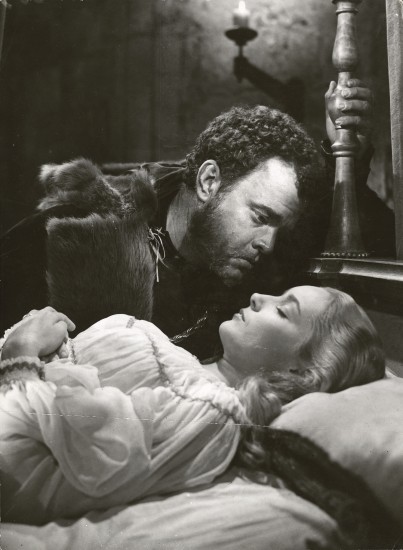
A new restoration of Orson Welles’s OTHELLO is running at Film Forum through May 8 (courtesy Carlotta Films)
OTHELLO (Orson Welles, 1952)
Film Forum
209 West Houston St.
Daily through May 8
212-727-8110
www.filmforum.org
www.carlottafilms-us.com
 Filmed in black-and-white over three years in multiple locations and ultimately employing five cinematographers, four editors, three Desdemonas, and two scores, it’s rather amazing that Orson Welles’s 1952 independent production of William Shakespeare’s Othello was ever completed — of course, many Welles projects were not. That the final work turned out to be a masterpiece that won the Palme d’Or at Cannes speaks yet more to Welles’s genius. A newly restored version of Othello is in the midst of a two week-run at Film Forum, in conjunction with “Celebrate Shakespeare 2014!,” a worldwide festival honoring the Bard’s 450th birthday. Welles, who directed the picture and plays the title character, streamlined the story into ninety-five minutes, getting to the heart of the most intense tale of jealousy and betrayal ever told. The film opens with shadowy shots of the dead Othello and his deceased wife, Desdemona (Suzanne Cloutier), carried aloft on biers at their dual funeral, to the sounds of an ominous piano and a mournful vocal chorus. The credits soon follow, after which Welles returns to the beginning, as the villainous ensign Iago (Micheál MacLiammóir) plots with Roderigo (Robert Coote) to convince Othello that his loyal and devoted wife is actually in love with the heroic soldier Michael Cassio (Michael Laurence).
At first Othello brushes away Iago’s concerns, but soon he is caught in Iago’s trap and starts to question the fairy-tale love he shares with his beautiful and trusting bride. As the story proceeds, characters are shown in extreme close-up, in narrow passages and doorways, amid medieval rooms with large columns and intricately designed windows, shadows looming everywhere; the stunning architecture, shot at disorienting angles, is a character unto itself. Welles did whatever it took to finish the film, including using his own funds from acting jobs and filming a scene in a bathhouse when costumes were unavailable, lending the proceedings a fragmented feel that evokes the mirrors in the finale of The Lady from Shanghai. Unfortunately, the syncing of the dialogue track is still often off and numerous cuts are too shaky, but they detract only a bit from the overall power and majesty of the film, a bold and brave take on a familiar Shakespeare tale given a dark new life by a master auteur.
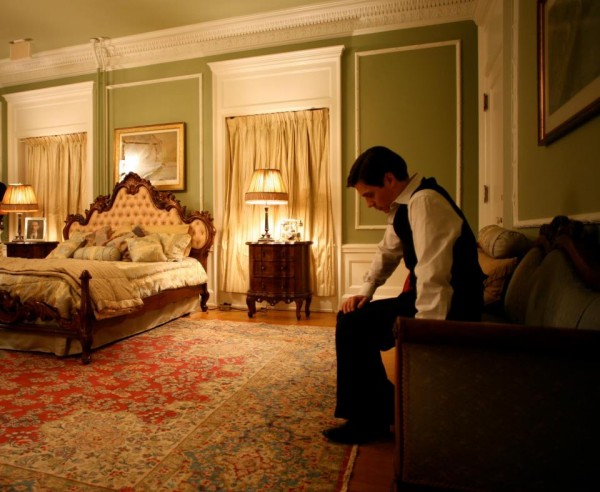
 Director and star Bruce Ramsay strips down and condenses the Bard in his 1940s-set noirish update of Hamlet, but in doing so he also drains one of Shakespeare’s most powerful tragedies of all its poetry and emotion. Trimming the tale down to a far-too-lean eighty-seven minutes, Ramsay cuts out characters and reinterprets scenes to focus on the family-related aspects of the story of betrayal, madness, murder, and revenge, using the original text for the most part while setting the entire film in one large house (actually the University Women’s Club in Vancouver). He fills the cast with veterans of Canada’s Bard on the Beach series, including Gillian Barber as Gertrude, Duncan Fraser as Polonius, Haig Sutherland as Laertes, Martin Sims as Guildenstern, Russell Roberts as the ghost of Hamlet’s father, and Lara Gilchrist as Ophelia; Welsh actor Peter Wingfield plays Claudius, with Stephen Lobo as Horatio and Bret Stait as Rosencrantz. The bare-bones film was shot in three days (for a mere — and rather admirable — $27,000), but it’s taken nearly three years for it to get a U.S. theatrical release, and it’s easy to see why. Ramsay’s Hamlet is more like a failed episode of Masterpiece Theatre, sort of Agatha Christie meets Downton Abbey in postwar London, than a fresh new look at the extremely familiar play, though it is a noble attempt. Indeed, “I must be cruel to be kind. Thus bad begins and worse remains behind.” Hamlet opens at Cinema Village on January 10, with Ramsay taking part in Q&As following the 7:10 screenings on Friday and Saturday night.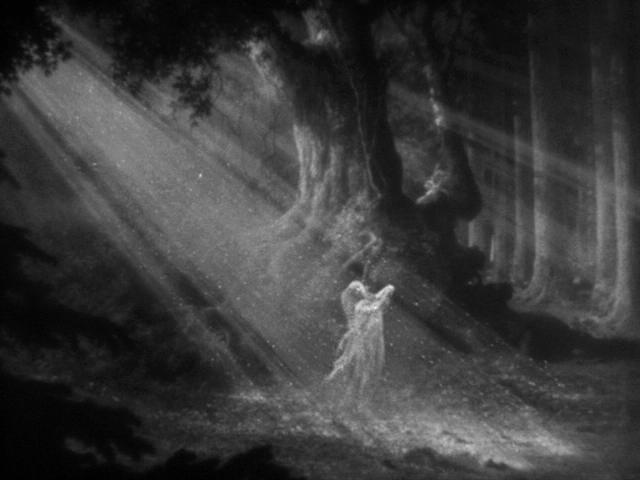
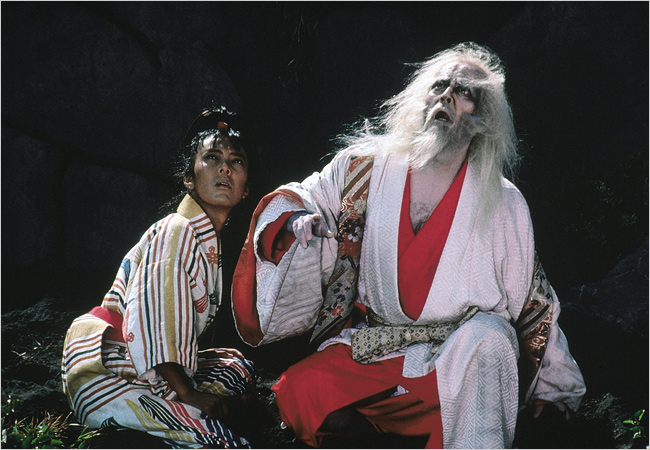
 Max Reinhardt and William Dieterle’s 1935 adaptation of Shakespeare’s A Midsummer Night’s Dream is one freakishly weird flick. In a misty forest, fairies go around sprinkling love potions on sleeping humans, creating mixed-up relationships that even venture out into the realm of bestiality. “The course of true love never did run smooth,” Lysander tells Hermia, and that sums up this star-studded screwball comedy of a sort. Warner Bros. put together quite a lineup for this big-time production, with plenty of strange casting choices that end up working rather splendidly. James Cagney prances about as Bottom, Dick Powell plays Lysander, Olivia de Havilland makes her film debut as Hermia, Joe E. Brown is Flute, Billy Barty plays Mustardseed, and a teenage Mickey Rooney offers a delirious take on Puck, howling at the moon with sheer glee. The wacky movie also features Ian Hunter, Arthur Treacher, Victor Jory, and Anita Louise as the fairy queen Titania. A Midsummer Night’s Dream, which was nominated for four Oscars, including Best Picture, and won for Best Cinematography and Best Film Editing, will be screening November 25 & 26 as part of the Anthology of Film Archives series “The Middle Ages on Film: Shakespeare,” consisting of ten cinematic adaptations of several of the Bard’s history plays, set in the Middle Ages, including Grigori Kozintsev’s King Lear, Bela Tarr’s Macbeth, and Akira Kurosawa’s Ran and Throne of Blood. The twelve-day festival was curated in collaboration with professor and scholar Martha Driver, who notes about A Midsummer Night’s Dream, “In Reinhardt’s enchanted forest, the fairies, gnomes, and elves are inspired by German folk tradition. While the bewildered young lovers and the rude mechanicals are imported intact from Shakespeare’s original, the spinning of Titania’s wedding veil (before she beds Bottom) to the Wedding March of Felix Mendelssohn, a modest addition to Shakespeare’s play, remains surreal and haunting. Jimmy Cagney is a crackjack Bottom and Pyramus while Joe E. Brown inhabits the twin roles of Flute and Thisbe with panache.”