Tag Archives: walter reade theater

BAD LUCK BANGING OR LOONY PORN: A SKETCH FOR A POSSIBLE FILM

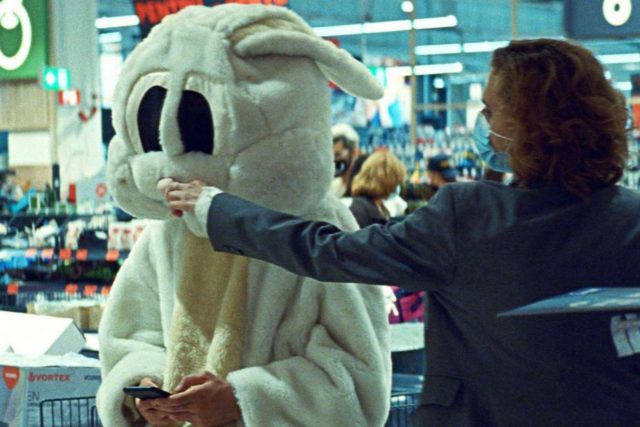
Emi (Katia Pascariu) goes on a strange journey in Rade Jude’s Bad Luck Banging or Loony Porn

BAD LUCK BANGING OR LOONY PORN: A SKETCH FOR A POSSIBLE FILM (BABARDEALA CU BUCLUC SAU PORNO BALAMUC) (Radu Jude, 2021)
Film at Lincoln Center, Walter Reade Theater, Francesca Beale Theater
144/165 West Sixty-Fifth St. at Amsterdam Ave.
Film Forum, 209 West Houston St.
Opens Friday, November 19
www.filmlinc.org
filmforum.org

Radu Jude’s brilliantly absurdist Bad Luck Banging or Loony Porn lives up to its title, a wildly satiric takedown of social mores that redefines what is obscene. Winner of the Golden Bear for Best Film at the 2021 Berlinale, the multipart tale begins with an extremely graphic prologue, a XXX-rated homemade porn video with a woman and an unseen man holding nothing back. In the first main section, the woman, a successful teacher named Emi (Katia Pascariu), is distressed to learn that the video is threatening to go viral. She determinedly walks through the streets of Bucharest, buying flowers (which she holds upside down), discussing her dilemma with her boss, the headmistress (Claudia Ieremia), and calling her husband, Eugen, trying to get the video deleted before her meeting with angry parents at the prestigious private school where she teaches young children.

Jude and cinematographer Marius Panduru follow the masked Emi — the film was shot during the pandemic, so masks are everywhere — on her journey, the camera often lingering on the scene well after Emi has left the frame, focusing on advertising billboards, couples in the middle of conversations, people waiting for a bus, and other random actions, before finding Emi again. She sometimes fades into the background, barely seen through the windows of a passing vehicle or amid a crowd crossing at a light. She gets into an argument with a man who has parked on the sidewalk, blocking her way; she insists that he move the car, but he unleashes a stream of misogynistic curses. Swear words are prevalent throughout the film, mostly adding poignant humor.

The second segment consists of a montage of archival and new footage that details some of Romania’s recent history, involving the military, the government, religion, fascism, Nazi collaboration, patriotism, the two world wars, the 1989 revolution, Nicolae Ceaușescu, domestic violence, jokes about blondes, and the value of cinema itself. The bevy of images also points out which NSFW word is most commonly looked up in the dictionary, as well as which is second. (The film is splendidly edited by Cătălin Cristuțiu, with a fab soundtrack by Jura Ferina and Pavao Miholjević.)

It all comes together in the third section, in the school garden, where Emi faces a few dozen masked, socially distanced, very angry parents and grandparents who want her fired immediately, while the headmistress demands a calm discussion. The masked Emi is a stand-in for all of us, facing the wrath of the unruly mob forcing its sanctimonious platitudes on others when it really needs to look at itself. It’s a riotously funny sitcomlike debate in which Jude roasts many common, hypocritical beliefs held by Romanians (and people all over the world) that have not necessarily changed much from the news clips shown in the previous part.

The cartoonish cast, which includes Olimpia Mălai as Mrs. Lucia, Nicodim Ungureanu as Lt. Gheorghescu, Alexandru Potocean as Marius Buzdrugovici, and Andi Vasluianu as Mr. Otopeanu, really gets to strut its stuff while making sure their masks are properly covering their mouths and noses. They argue about beloved national poet Mihai Eminescu and Russian writer Isaac Babel, delve into various sexual positions, repeat Woody the Woodpecker’s trademark call, and quote long, intellectual passages from the internet as Jude (I Do Not Care If We Go Down in History as Barbarians, Aferim!) reveals where society’s true obscenities lie. It’s an irreverent tour de force that offers three distinct endings to put a capper on the strangely alluring affair, turning a scary mirror on the sorry state of twenty-first-century existence.

Playfully subtitled A Sketch for a Possible Film in a reference to André Malraux’s description of Eugène Delacroix’s belief that his sketches could be of the same quality as his paintings, Bad Luck Banging or Loony Porn, Romania’s official Oscars submission, opens November 19 at Lincoln Center and Film Forum.
NYFF59 MAIN SLATE: TITANE

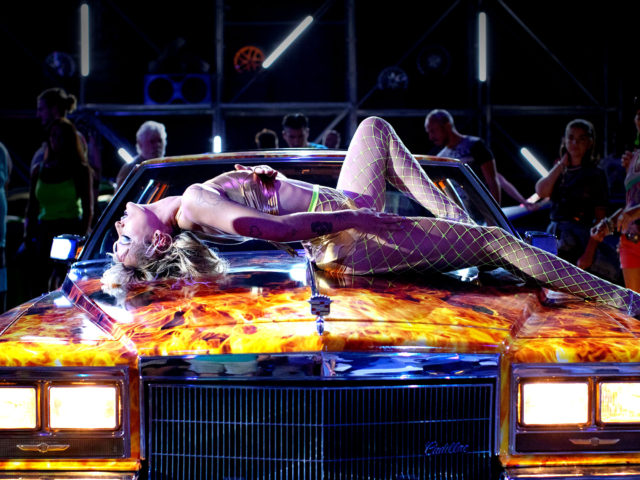
Agathe Rousselle makes a sizzling debut in Julia Ducournau’s Titane

TITANE (TITANIUM) (Julia Ducournau, 2021)
New York Film Festival
Sunday, September 26, Alice Tully Hall, 9:00
Monday, September 27, Alice Tully Hall, 8:45
Wednesday, September 29, Walter Reade Theater, 3:45
www.filmlinc.org

Julia Ducournau’s Titane is a dark, disturbing body horror thriller about family, fetishization, and obsession, a pulse-pounding, high-octane mash-up of David Cronenberg’s Crash, Donald Cammell’s The Demon Seed, and Mervyn LeRoy’s The Bad Seed.

Winner of the Palme d’Or at the 2021 Cannes Film Festival, Titane features newcomer Agathe Rousselle in a revved-up performance as Alexia, a young woman whose life changed dramatically after getting seriously hurt in a car accident when she was a little girl (Adèle Guigue), having a titanium plate put in her head, an odd scar left over her right ear. The teenage Alexia is drawn to raging fires and the cool, metallic smoothness of cars. She has become somewhat of a star at auto shows, where she dances alluringly, touching and mounting cars like they are lovers, attracting a fan base of men who would do just about anything for an autograph, a selfie, or a kiss, and is befriended by fellow dancer Justine (Garance Marillier). But she’s also prone to taking out her long, sharp hairpin and stabbing people to death.

With the cops closing in, she radically changes her appearance — just try not to look away when she purposely breaks her nose — and pretends to be Adrien, a boy who has been missing for more than ten years. Adrien’s fire-captain father, Vincent (a stoic Vincent Lindon), takes her in, overjoyed that he has his son back. Alexia stops speaking and hides her breasts and stomach from Vincent — a belly that is growing by the day, leaking oil instead of blood, as something unusual seems to be developing in her womb. Despite her PTSD and addiction, Alexia tries to have a normal life, but danger lurks around every corner.

Writer-director Ducournau burst onto the scene with her 2016 debut, the FIPRESCI Prize–winning Raw, which involved vegetarianism, blood galore, and, like Titane, main characters named Adrien, Alexia, and Justine. (In fact, Marillier has played women named Justine in these two films as well as Ducournau’s 2011 short, Junior.). Body metamorphosis is a continuing theme in Ducournau’s oeuvre, and it is at the center of Titane. At first, Alexia is a tall blond with a body to die for and rad tattoos — one on her chest proclaims, “Love is a dog from hell” — but as time goes on, she is barely recognizable, her breasts sagging, her skin breaking open, motor oil leaking out. Alexia is often seen naked as Ducournau documents her change.

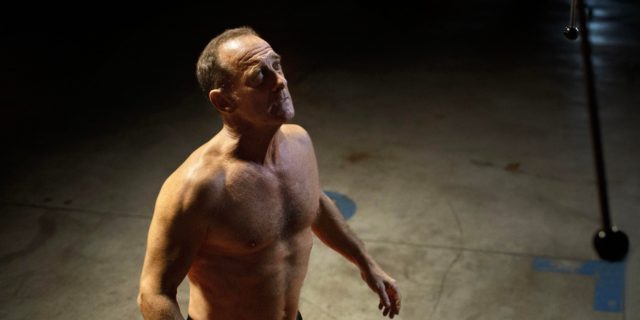
Vincent London shows off his bod and his acting chops in body horror thriller Titane

Award-winning French star Lindon (Welcome, The Measure of a Man), in a role specifically created for him, gets to show off his (dad) bod as well; he worked out for a year to get into great shape to play a haunted man obsessed with his abs, shooting hormones into his bruised butt every night to help him keep up with the younger generation. Where Alexia hides her body, Vincent enjoys being bare-chested any chance he gets.

Titane won the People’s Choice Award for Midnight Madness at the 2021 Toronto International Film Festival, and it’s easy to see why. But there’s a method to its madness; Ducournau, whose parents were both doctors, is not just shocking the audience but making it look at things it usually would turn away from or think differently about, pulling back the curtain on gender and body issues and the relationship between parents and children. The fierce soundtrack by Jim Williams is bookended by two versions of the folk gospel standard “The Wayfaring Stranger,” about a lost soul on the road home to Jordan, to meet their mother and father.

Despite the nastiness that Alexia does, and she does a whole lot of nastiness, we continue to root for her, and not merely out of sympathy for her past. (We also forgive Ducournau her plot holes and extended dance scenes.) In a man’s world, she’s been forced to give up who she is. She refuses to be yet another classic car to be gazed upon, an inanimate metal object to be worshipped. In the end, all she’s really looking for is to be loved and understood.

Titane is screening September 26, 27, and 29 at the New York Film Festival, with Ducournau, only the second female director to win the Palme D’Or — Jane Campion, whose new western, The Power of the Dog, is the centerpiece selection for NYFF59, won the award in 1993 for The Piano — participating in Q&As after the first two show, before opening theatrically October 1.

NYFF59: THE FIFTY-NINTH NEW YORK FILM FESTIVAL

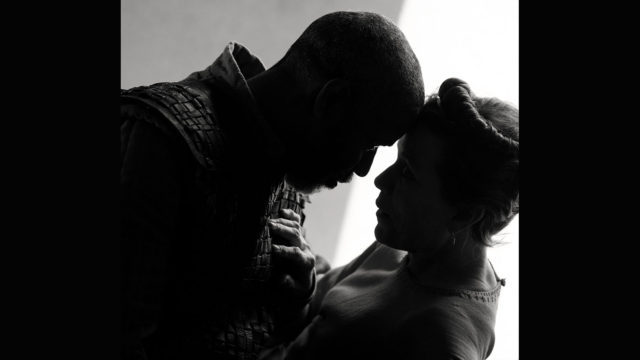
Denzel Washington and Frances McDormand star in Joel Coen’s NYFF59 opener, The Tragedy of Macbeth

FIFTY-NINTH NEW YORK FILM FESTIVAL
Film Society of Lincoln Center
Walter Reade Theater, Howard Gilman Theater, Francesca Beale Theater, Alice Tully Hall, Damrosch Park, and other venues
September 24 – October 10, $17-$25
www.filmlinc.org/nyff2021

For its fifty-ninth year, the New York Film Festival, running September 24 through October 10, returns in person, primarily at five venues at Lincoln Center but also with a handful of satellite screenings at Anthology Film Archives downtown, BAM Cinemas in Fort Greene, the Maysles Documentary Center in Harlem, and the Jacob Burns Film Center in Pleasantville.

The opening-night selection is the hotly anticipated The Tragedy of Macbeth, Joel Coen’s Shakespeare adaptation starring Denzel Washington and Frances McDormand as the ambitious couple seeking power at all costs. Jane Campion’s The Power of the Dog, a neo-Western based on a cult novel by Thomas Savage and with Kirsten Dunst, Jesse Plemons, and Benedict Cumberbatch, is the centerpiece choice. The closing-night selection is festival favorite Pedro Almodóvar’s Parallel Mothers, in which two women, played by Penélope Cruz and Milena Smit, meet in a maternity ward in a story about pain and trauma.

The main slate features a wide range of works from international directors; among the highlights are Mia Hansen-Løve’s Bergman Island, which takes place on Fårö, where Ingmar Bergman lived and worked; Gaspar Noé’s tender Vortex; Futura, an Italian omnibus by Pietro Marcello, Francesco Munzi, and Alice Rohrwacher; Paul Verhoeven’s Benedetta, about a real-life seventeenth-century nun; Radu Jude’s Golden Bear winner Bad Luck Banging or Loony Porn; Ryûsuke Hamaguchi’s Drive My Car, inspired by a Haruki Murakami short story; Rebecca Hall’s Passing, an adaptation of Nella Larsen’s 1929 Harlem Renaissance novel; Céline Sciamma’s Petite Maman, in which an eight-year-old girl deals with loss; Saul Williams and Anisia Uzeyman’s sci-fi punk musical Neptune Frost; and Hit the Road, the debut of Panah Panahi, son of fest fave Jafar Pahanhi.

Fans of Lou Reed can check out Todd Haynes’s new documentary, The Velvet Underground, about the revolutionary band, as well as Songs for Drella, Ed Lachman’s 1990 concert film of Reed and John Cale’s song cycle for Andy Warhol. Apichatpong Weerasethakul is back at the festival with Memoria, starring Tilda Swinton as an ex-pat botanist, and the short film Night Colonies, part of Currents Program 7: New Sensations. And unstoppable South Korean auteur Hong Sangsoo has a pair of Main Slate films, In Front of Your Face and Introduction.

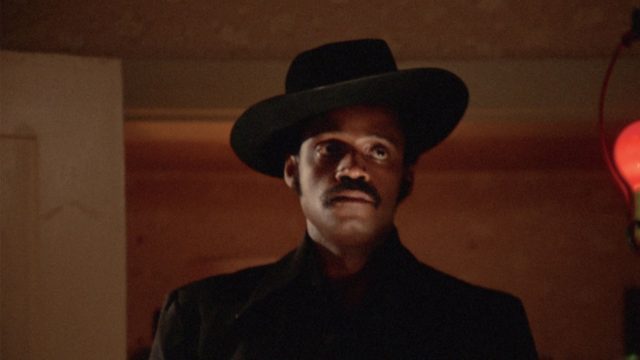
Melvin Van Peebles’s Sweet Sweetback’s Baadasssss Song is part of NYFF59 Revivals

Among the other works in the Currents section, focusing on socially relevant fiction and nonfiction films, are Wang Qiong’s All About My Sisters, Denis Côté’s Social Hygiene, Shengze Zhu’s A River Runs, Turns, Erases, Replaces, and Claire Simon’s I Want to Talk About Duras. Revivals include Joan Micklin Silver’s Hester Street, Lynne Ramsay’s Ratcatcher, Melvin Van Peebles’s Sweet Sweetback’s Baadasssss Song, Miklós Jancsó’s The Round-Up, Mira Nair’s Mississippi Masala, Wendell B. Harris Jr.’s Sundance winner Chameleon Street, Jack Hazan and David Mingay’s Rude Boy starring the Clash, and Christine Choy’s Who Killed Vincent Chin?

Denis Villeneuve’s Dune leads the Spotlight section, along with Marco Bellocchio’s Marx Can Wait, Maggie Gyllenhaal’s directorial debut The Lost Daughter, Wes Anderson’s The French Dispatch, and Mike Mills’s C’mon C’mon, with Joaquin Phoenix. And finally, NYFF59 pays tribute to the centenary of cofounder Amos Vogel’s birth with a seven-program Spotlight sidebar consisting of cutting-edge, avant-garde, experimental shorts and features Vogel brought to Cinema 16 from 1947 to 1963 and the New York Film Festival between 1963 and 1968.

BIG SCREEN SUMMER NYFF58 REDUX: FLOWERS OF SHANGHAI

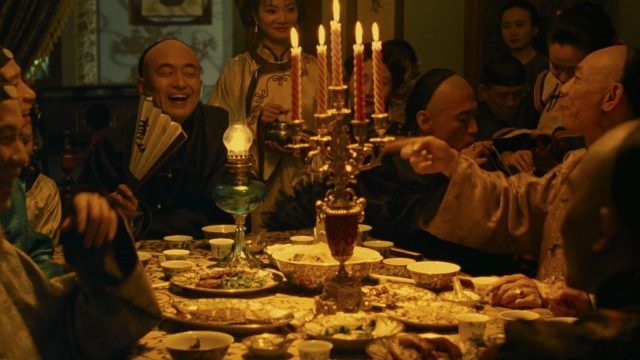
Hou Hsiao-hsien gem Flowers of Shanghai explores complex relationships between wealthy patrons and courtesans

FLOWERS OF SHANGHAI (HAI SHANG HUA) (Hou Hsiao-hsien, 1998)
Walter Reade Theater
165 West 65th St. between Broadway & Amsterdam Aves.
July 2-20, $15
www.filmlinc.org

Taiwanese New Wave master Hou Hsiao-hsien might be the best filmmaker whose work you’ve never seen. For more than thirty-five years, he has been telling intimate, meditative stories about life, family, and relationships with a gentle, deeply intuitive style, infused with gorgeous visuals and subtly beautiful soundtracks. Film at Lincoln Center’s wide-ranging “Big Screen Summer: NYFF58 Redux” continues with one of the New York Film Festival staple’s most elegant tales, Flowers of Shanghai. The 1998 film, being shown in a dramatic 4K restoration, is set in brothels, known as flower houses, in 1884 in the British Concession, where men and women congregate for social interaction and develop long-term bonds and responsibilities to one another based on much more than just sex. The men play drinking games, smoke opium, and buy the women gifts. The story, told in a series of vignettes as Mark Lee Ping Bin’s camera slowly moves through dark, lush, reddish gas-lit interiors, focuses on Master Wang (Tony Leung Chiu-wai), who has promised to be the sole patron of Crimson (Michiko Hada) but who has also been secretly seeing the younger Jasmin (Vicky Wei) and lavishing her with presents. The elder Master Hong (Luo Tsai-erh) and Auntie Huang (Rebecca Pan), the madam, discuss the situation, bringing up issues of responsibility and honesty, attempting to come to some kind of understanding in an exchange that shows respect for both the men and women who are a far cry from the Western conception of johns and prostitutes.

Most scenes end by fading quietly to black, then introducing the woman protagonist of the next section — Crimson, Jasmin, Pearl (Carina Lau), Jade (Shuan Fang), and Emerald (Michelle Reis) — as the women gossip and Crimson and Hong, and other pairs, try to figure out what they want out of life and from one another. In Flowers of Shanghai, Hou explores class differences, gender roles, the Asian notion of saving face, and intimacy with grace and sophistication. When the film fades out for the final time, viewers are left knowing they’ve just experienced something special, a stunning work that uses the technologies of cinema to delve into the very nature of humanity.

“Big Screen Summer: NYFF58 Redux” runs through August 26 with such other 2020 film festival favorites as Joyce Chopra’s Smooth Talk, Eugène Green’s Atarrabi and Mikelats, John Gianvito’s Her Socialist Smile, William Klein’s Muhammad Ali, the Greatest, Nuria Giménez’s My Mexican Bretzel, Philippe Lacôte’s Night of the Kings, and Orson Welles’s Hopper/Welles, an epic conversation between Welles and Dennis Hopper.

BIG SCREEN SUMMER NYFF58 REDUX: SMALL AXE

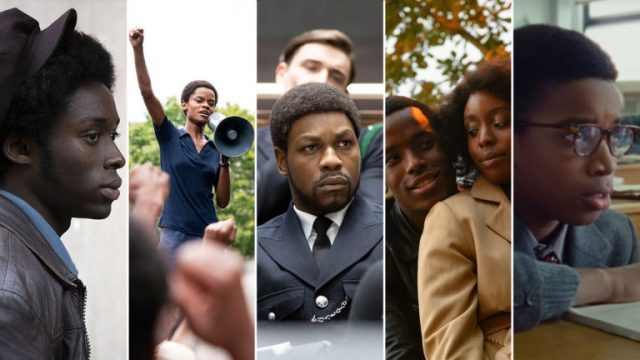
Steve McQueen’s Small Axe consists of five powerful stories of racism and harassment of West Indian immigrants in London from the 1960s to the 1980s (photo courtesy BBC One)

BIG SCREEN SUMMER NYFF58 REDUX
Elinor Bunin Munroe Film Center / Walter Reade Theater
144 / 165 West 65th St. between Broadway & Amsterdam Aves.
June 11 – August 26, $10-$15
www.filmlinc.org

One of the joys of fall, and the signal that the summer blockbuster movie blitz is over, is the New York Film Festival. Since 1963, the NYFF has been presenting a wide range of works from around the world, often with postscreening discussions with members of the cast and crew. The 2020 edition was completely virtual because of the pandemic lockdown, so Film at Lincoln Center (FLSC) is bringing much of the festival back with “Big Screen Summer: NYFF58 Redux,” featuring nearly three dozen films now being shown the way they’re supposed to be seen, on large screens at the Elinor Bunin Munroe Film Center and the Walter Reade Theater. Running June 11 to August 26, “NYFF58 Redux” gets under way with two weeks of Steve McQueen’s mammoth five-part epic about West Indian immigrants in London from the 1960s through the 1980s, Small Axe, which was actually made for television; it screens with a newly recorded interview with McQueen, who started as an experimental filmmaker and has made such previous films as Hunger, Twelve Years a Slave, and Shame, and FLSC director of programming Denis Lim.

The multi-award-winning anthology, which premiered on BBC One in the UK and Amazon in the US, begins with Mangrove (June 11-17), the true story of Frank Crichlow (Shaun Parkes) and the Mangrove Nine, Trinidadian immigrants who were harassed mercilessly by Notting Hill police for establishing a peaceful community at Crichlow’s Mangrove café. The second film, one of the best of 2020, is the exhilarating Lovers Rock (June 11-24), a seventy-minute reggae house party in London in 1980, where a group of men and women dance, sing, and fall in love in a cramped space to such songs as Dennis Bovell’s “Silly Games.” (If you’re wondering who the lone old man is, it’s Bovell himself, making a cameo.) But even as Martha (Amarah-Jae St. Aubyn) and Franklyn (Micheal Ward) hit if off, the spectre of racism is not far away. Intimately photographed by Shabier Kirchner, Lovers Rock is an unforgettable experience.

In Red, White and Blue (June 11-17), John Boyega stars as the real-life Leroy Logan, a frustrated West Indian man who joins the London Metropolitan Police department, hoping to change its fundamental racism from the inside, much to the chagrin of his father (Steve Toussaint). Boyega is riveting as Logan discovers that achieving his goal is going to be a lot harder than he ever imagined. Sheyi Cole makes his film debut in the true story Alex Wheatle (June 12-16) as the title character, a teenager caught in England’s discriminatory social services structure and then arrested for participating in the 1981 Brixton uprising, a protest against poor socioeconomic conditions for the African-Caribbean community that included “Bloody Saturday.” The remarkable anthology concludes with Education (June 11-17), an hourlong exploration of institutionalized segregation in the British school system through the eyes of Kingsley (Kenyah Sandy), who is sent to a “special” school where West Indians are purposely kept undereducated, their potentials squashed early in life. A grand achievement by a master filmmaker, Small Axe is no mere historical document of what happened in London decades ago; it is a powerful examination of systemic racism and anti-immigrant biases that is still alive and well in the twenty-first century, especially here in America.

“Big Screen Summer: NYFF58 Redux” continues through August with such other 2020 film festival favorites as Hou Hsiao-hsien’s Flowers of Shanghai, Joyce Chopra’s Smooth Talk, C. W. Winter’s The Works and Days (of Tayoko Shiojiri in the Shiotani Basin), Eugène Green’s Atarrabi and Mikelats, Cristi Puiu’s Malmkrog, William Klein’s Muhammad Ali, the Greatest, Raúl Ruiz and Valeria Sarmiento’s The Tango of the Widower and Its Distorting Mirror, Jia Zhangke’s Xiao Wu, and Orson Welles’s Hopper/Welles, an epic conversation between Welles and Dennis Hopper.

NEW YORK JEWISH FILM FESTIVAL: BROKEN BARRIERS (KHAVAH)

Broken Barriers

Alice Hastings stars as lovestruck Khavah in rediscovered Broken Barriers

BROKEN BARRIERS (KHAVAH) (Charles E. Davenport, 1919)
Walter Reade Theater, Film at Lincoln Center
165 West 65th St. between Broadway & Amsterdam Aves.
Sunday, January 19, 12:30
Festival runs January 15-28
212-875-5050
www.filmlinc.org
thejewishmuseum.org

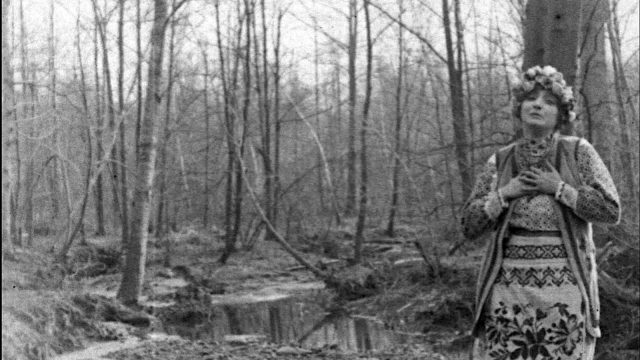
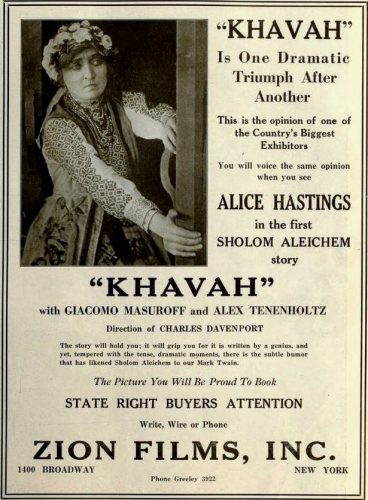
The New York Jewish Film Festival pulls out a special treat on January 19, the world premiere of the National Center for Jewish Film’s restoration of the long-lost Broken Barriers, aka Khavah, the first cinematic adaptation of one of Sholem (Sholom) Aleichem’s Tevye the Dairyman stories. The tale will be familiar to fans of Fiddler on the Roof, although there are significant narrative distinctions. In a small Ukraine village, the Jewish Khavah (Alice Hastings), daughter of Tobias the Milkman (Giacomo Masuroff) and Golde (Billie Wilson), falls for the Russian Orthodox Fedka (Alexander Tenenholtz), son of Ivan (Phil Sanford), the chief constable, and Parasha (Sonia Radin), after one of Fedka’s friends (Raymond Friedgen) drunkenly assaults Khavah’s younger sister Tzeitel (Hanna [Ganna Kehlmann] Kay). As Fedka and Khavah consider marriage, Tobias (an alternate pronunciation of Tevye) grows angrier and forbids their relationship. But when a devastating government decree is delivered to Ivan, everyone reconsiders their future.

khava 2

Billed as “a love drama of the Ukraine” in the opening credits, Broken Barriers features actors from Maurice Schwartz’s Yiddish Art Theater on Irving Place (Schwartz would go on to famously play “Tevya” on stage and screen) and the Russian Opera Company; only Sanford had any cinematic experience, and it shows, as the acting is heavy-handed, especially by Hastings, who seems to be attempting to break barriers with her overemoting. (“Broken shall be the barriers that stand between me and happiness!” Khavah declares to her father.) But director Charles E. Davenport tells a tight little tale, limiting the amount of dialogue intertitles and including such poetic statements as “Conscience has a way of bringing us all to the realization that paternal efforts in our behalf are too lightly valued.” Cinematographers Irving B. Ruby and Jack Young shot the film outdoors in the New Jersey wild and in a Manhattan studio, effectively capturing the strife of a poor Ukrainian village while using superimposition to evoke memories. At the heart of the story is whether religious beliefs trump family; the reaction of Fedka’s parents and Khava’s are very different, as is the ending of this rediscovered nugget. The screening will be accompanied by live music by Donald Sosin. A joint presentation of Film at Lincoln Center and the Jewish Museum, the festival continues through January 28 with such other works as Elise Otzenberger’s My Polish Honeymoon, Rachel Rusinek and Eyal Ben Moshe’s I Was Not Born a Mistake, and Dror Zahavi’s closing night selection, Crescendo, about an attempt to establish an Israeli-Palestinian youth orchestra.

NEW YORK JEWISH FILM FESTIVAL OPENING NIGHT SELECTION: AULCIE

Aulcie

The life and times of Aulcie Perry on and off the court are documented in New York Jewish Film Festival opener

AULCIE (Dani Menkin, 2019)
Walter Reade Theater, Film at Lincoln Center
165 West 65th St. between Broadway & Amsterdam Aves.
Thursday, January 16, 8:30
Festival runs January 15-28
212-875-5050
www.filmlinc.org
thejewishmuseum.org

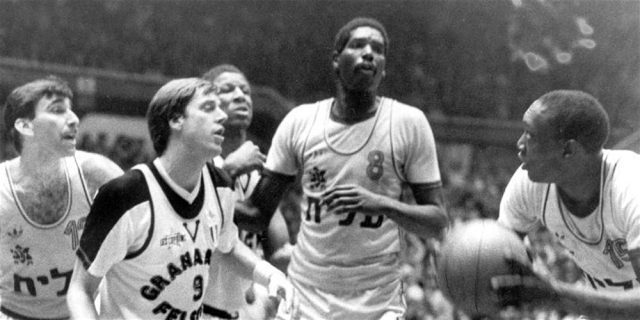
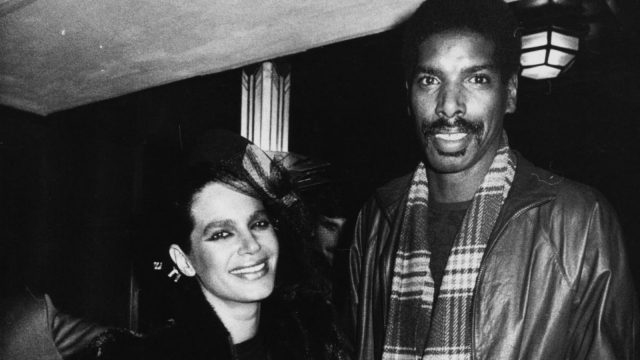
Israeli director Dani Menkin follows up his 2016 documentary, On the Map, about Maccabi Elite Tel Aviv’s unlikely victory in the 1976-77 European Champions Cup, with an inside look into the life of one of its stars in Aulcie, the opening night selection of the New York Jewish Film Festival. After being the last man cut from the New York Knicks in 1976, Newark native Aulcie Perry was recruited to play for Maccabi in Israel, where the 6-10 black man — an unusual sight in the Land of Milk and Honey — quickly became a superstar, helping the team to championships, falling in love with top model Tami Ben Ami, and hanging out in hot clubs, living the high life. But it all came tumbling down in a haze of drugs, and Menkin traces Perry’s attempt to put it all back together, primarily by finding the daughter he has not seen since she was a baby.

The film is set up as Perry’s confession to that daughter, Cierra Musungay. “I always knew one thing: that I wanted to tell you my story, the way it is, with the good and the bad,” he says at the beginning. “So where do I start? People say you start at the beginning. But I wanted to start at the end, or when I thought the end was coming.” He was inspired to track her down after facing a serious health scare. “I think, that only when I almost died, I started to really live. And that’s when I wanted to find you and, maybe in some ways, find myself,” he adds.

Aulcie

Top model Tami Ben Ami and basketball superstar Aulcie Perry are shown as the hot couple in Aulcie

Menkin goes back and forth between archival footage, animation by Assaf Zellner, and interviews with Aulcie’s sister Bernadine Lewis, his friends Wayne Tyre and Roy Young, his ex-girlfriend Juanita Jackson, his son Aulcie Perry Jr., and many men from his Maccabi family, including former teammates Earl Williams and Tal Brody, team president Shimon Mizrahi, co-owner Oudi Recanati, coach Zvi Sherf, and manager Shamluk Maharovsky, who was like a father to him. “In Israel, there wasn’t that much prejudice against black players, and he felt at home here,” NBA commentator Simmy Reguer says. “Aulcie came in like a blessing from the gods,” fellow Jersey native and team captain Brody recalls. And Sports Illustrated writer Alexander Wolff explains, “At Maccabi Tel Aviv, Aulcie Perry was Michael Jordan, Kareem Abdul-Jabbar rolled into one.”

Now sixty-nine, Perry is honest and forthright thorughout, admitting his failings and wanting to make up for lost time. He makes no excuses for his precipitous fall, and he’s not seeking sympathy. He’s a man who made mistakes and wants a chance to set things right. Aulcie is a cautionary tale of redemption with heart and soul, focusing on the need to be part of a family, no matter how different and unexpected it may be. Aulcie is having its New York City premiere January 16 at 8:30 at the Walter Reade Theater, with Perry, Menkin, and producer Nancy Spielberg (brother of Steven) participating in a Q&A. Aulcie might be the opening selection of the New York Jewish Film Festival, but the twenty-ninth annual fest actually kicks off a day earlier with Picture of His Life, a documentary codirected by Menkin and Yonatan Nir about Yom Kippur War veteran and underwater photographer Amos Nachoum, showing on January 15 at 1:00, with Menkin, Spielberg, and Nachoum present. A joint presentation of Film at Lincoln Center and the Jewish Museum, the festival continues through January 28 with such other works as Marceline Loridan-Ivens’s centerpiece The Birch Tree Meadow, starring Anouk Aimée and August Diehl, a fiftieth anniversary presentation of Vittorio De Sica’s The Garden of the Finzi-Continis, and Dror Zahavi’s closing night selection, Crescendo, about an attempt to establish an Israeli-Palestinian youth orchestra.