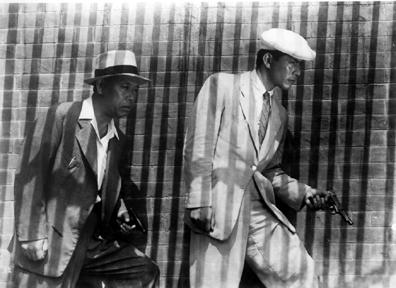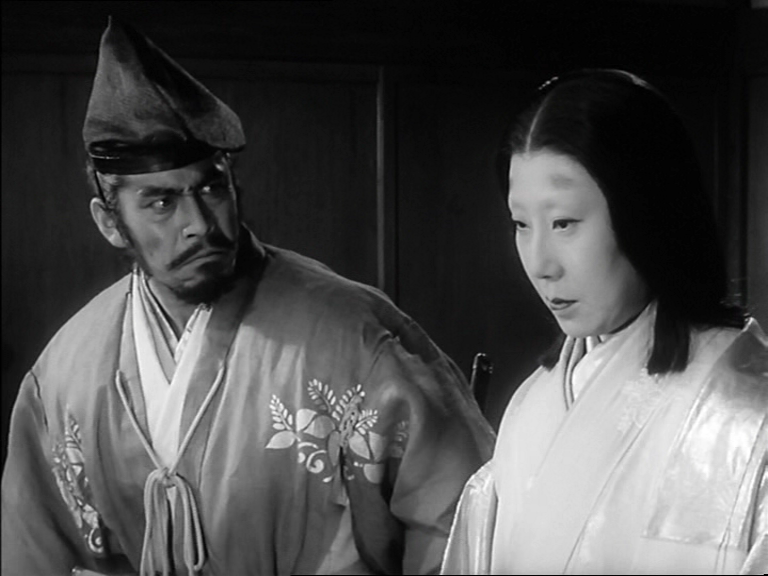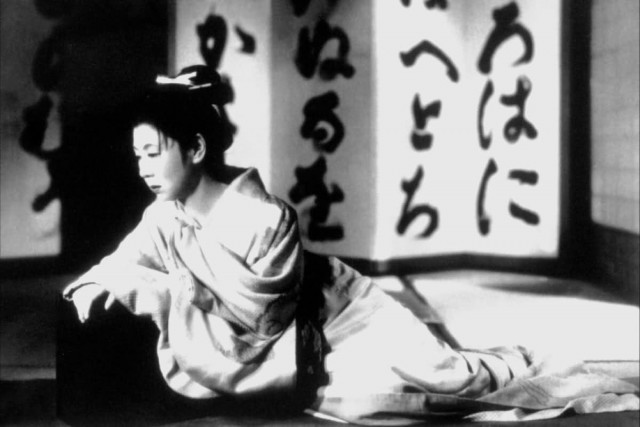
Oharu (Kinuyo Tanaka) lives a life filled with misery after misery in Mizoguchi melodrama
THE LIFE OF OHARU (SAIKAKU ICHIDAI ONNA) (Kenji Mizoguchi, 1952)
MoMA Film, Museum of Modern Art
11 West 53rd St. between Fifth & Sixth Aves.
Tuesday, September 3, 4:30
Tickets: $12, in person only, may be applied to museum admission within thirty days, same-day screenings free with museum admission, available at Film and Media Desk beginning at 9:30 am
212-708-9400
www.moma.org
 We used to think that Aki Kaurismäki’s The Match Factory Girl was the saddest film ever made about a young woman who just can’t catch a break, as misery after misery keeps piling up on her ever-more-pathetic existence. But the Finnish black comedy has nothing on Kenji Mizoguchi’s The Life of Oharu, a searing, brutal example of the Buddhist observation of impermanence and the role of women in Japanese society. The film, based on a seventeenth-century novel by Ihara Saikaku, is told in flashback, with Oharu (Kinuyo Tanaka) recounting what led her to become a fifty-year-old prostitute nobody wants. It all starts to go downhill after she falls in love with Katsunosuke (Toshirô Mifune), a lowly page beneath her family’s station. The affair brings shame to her mother (Tsukie Matsuura) and father (Ichiro Sugai), as well as exile. The family is redeemed when Oharu is chosen to be the concubine of Lord Matsudaira (Toshiaki Konoe) in order to give birth to his heir, but Lady Matsudaira (Hisako Yamane) wants her gone once the baby is born, and so she is sent home again, without the money her father was sure would come to them. Over the next several years, Oharu becomes involved in a series of personal and financial relationships, each one beginning with at least some hope and promise for a better future but always ending in tragedy. Nevertheless, she keeps on going, despite setback after setback, bearing terrible burdens while never giving up. Mizoguchi (Sansho the Bailiff, The 47 Ronin, Street of Shame) bathes much of the film in darkness and shadow, casting an eerie glow over the unrelentingly melodramatic narrative. Tanaka, who appeared in fifteen of Mizoguchi’s films and also became the second Japanese woman director (Love Letter, Love Under the Crucifix), gives a subtly compelling performance as Oharu, one of the most tragic figures in the history of cinema. Winner of the International Prize at the 1952 Venice International Film Festival, The Life of Oharu is screening September 3 at 4:30 as part of MoMA’s “An Auteurist History of Film Reprise,” which gives film enthusiasts a second chance to catch works that have previously been shown at MoMA at earlier hours in the day, when many people cannot see them.
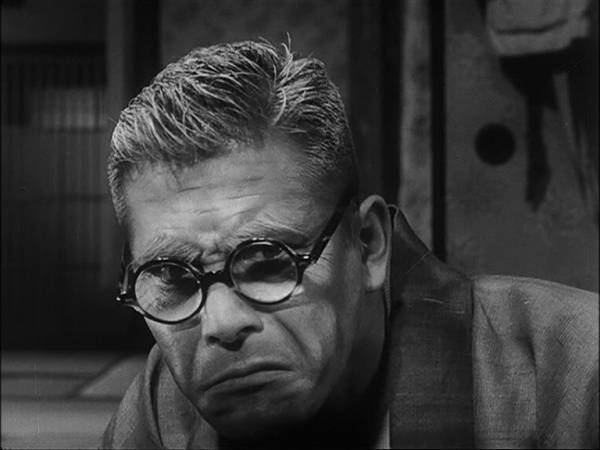
 Akira Kurosawa’s powerful psychological drama begins with a jazzy score over shots of a bustling Japanese city, people anxiously hurrying through as a Theremin joins the fray. But this is no Hollywood film noir or low-budget frightfest; Kurosawa’s daring film is about the end of old Japanese society as the threat of nuclear destruction hovers over everyone. A completely unrecognizable Toshirô Mifune stars as Nakajima, an iron foundry owner who wants to move his large family — including his two mistresses — to Brazil, which he believes to be the only safe place on the planet where he can survive the H bomb. His immediate family, concerned more about the old man’s money than anything else, takes him to court to have him declared incompetent; there he meets a dentist (the always excellent Takashi Shimura) who also mediates such problems — and fears that Nakajima might be the sanest one of all. Also known as Record of a Living Being, I Live in Fear is screening July 12, 18, and 20 as part of the Anthology Film Archives series “agnès b. selects,” consisting of ten films chosen by the Versailles-born fashion designer that, she explains, “taught me to appreciate other points of view, seen from a different angle, showing passion and the wounds, of every sort, that left their mark on me forever.” Among her other selections are Lindsay Anderson’s If, Luchino Visconti’s Rocco and His Brothers, Miloš Forman’s Loves of a Blonde, Bernardo Bertolucci’s The Conformist, and Ken Russell’s Women in Love.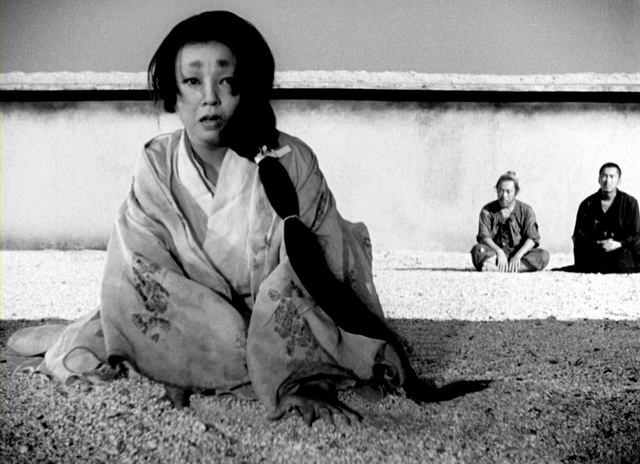
 One of the most influential films of all time, Akira Kurosawa’s 1950 masterpiece stars Toshirô Mifune as a bandit accused of the brutal rape of a samurai’s wife (Machiko Kyo) and the murder of her husband (Masayuki Mori). However, four eyewitnesses tell a tribunal four different stories, each told in flashback as if the truth, forcing the characters — and the audience — to question the reality of what they see and experience. Kurosawa veteran Takashi Shimura — the Japanese Ward Bond — plays a local woodcutter, with Minoru Chiaka as the priest. The mesmerizing work, which won an Oscar for Best Foreign Language Film, is beautifully shot by Kazuo Miyagawa; Rashomon is nothing short of unforgettable. (What is forgettable is the English-language remake, The Outrage, directed by Martin Ritt and starring Edward G. Robinson, Paul Newman, Laurence Harvey, Claire Bloom, and William Shatner.) Rashomon is screening March 1 at 9:30 as part of the Rubin Museum Cabaret Cinema series “Illusions Revealed,” consisting of films that address misperception, and will be introduced by neuroscientist John J. Sakon. The series continues with such films as Rosemary’s Baby, Cinema Paradiso, Black Moon, and Cross of Iron through April 26.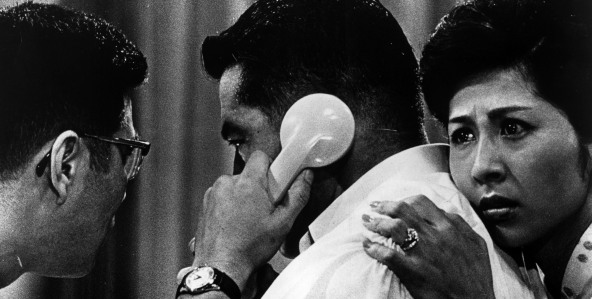
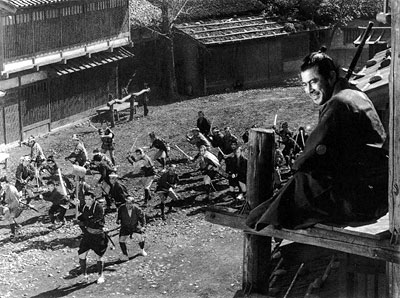
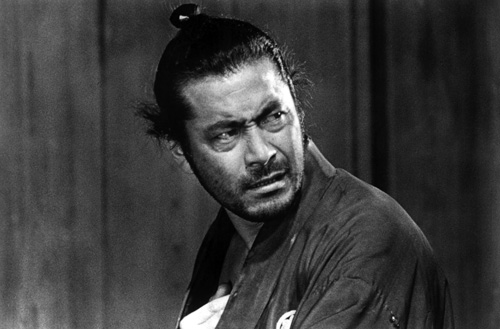
 In this Yojimbo-like tale, Toshirō Mifune shows up in a small town looking for food and fast money and takes up with a rag-tag group of wimps who don’t trust him when he says he will help them against the powerful ruling gang. Funnier than most Kurosawa samurai epics, the film is unfortunately brought down a notch by a bizarre soundtrack that ranges from melodramatic claptrap to a jazzy big-city score. Sanjuro will be screening at 11:00 am September 9-11 as part of the IFC Center’s Weekend Classics — Kurosawa series, with half of the proceeds from all festival screenings benefiting