Tag Archives: Thomas J. Lax

JUDSON DANCE THEATER: THE WORK IS NEVER DONE

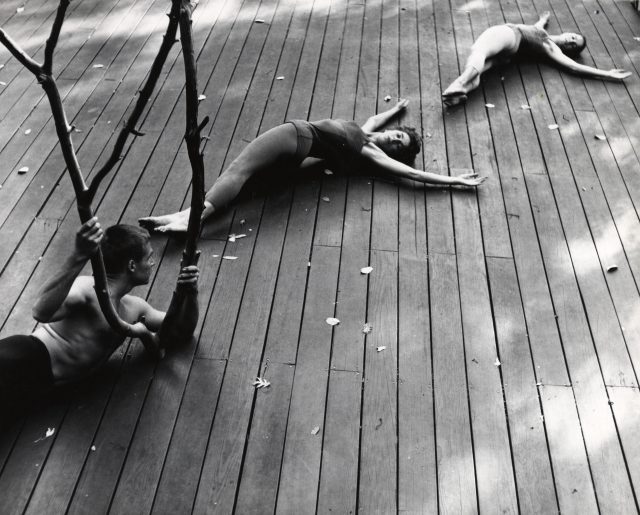
Anna Halprin. The Branch. 1957. Performed on the Halprin family’s Dance Deck, Kentfield, California, 1957. Performers, from left: A. A. Leath, Anna Halprin, and Simone Forti. Photo: Warner Jepson. Courtesy of the Estate of Warner Jepson

Anna Halprin, “The Branch,” 1957. Performed on the Halprin family’s Dance Deck, Kentfield, California, 1957. Performers, from left: A. A. Leath, Anna Halprin, and Simone Forti (Photo by Warner Jepson. Courtesy of the Estate of Warner Jepson)

MoMA, Museum of Modern Art
11 West 53rd St. between Fifth & Sixth Aves.
Through February 3, $25
212-708-9400
www.moma.org

On April 24, 2010, I was observing revolutionary dancer and choreographer Anna Halprin lead a workshop at Judson Memorial Church when she saw me sitting by myself, came over to me, grabbed my hand, and playfully demanded that I participate. Soon I was making a drawing, running around in circles, and sliding across the floor. Halprin, who is ninety-eight, is one of numerous artists being celebrated in the wonderful MoMA exhibition “Judson Dance Theater: The Work Is Never Done,” which continues through February 3. The wide-ranging show consists of approximately 275 photographs, videos, posters, scores, sketches, instructions, programs, announcements, audio clips, newspaper articles, and other ephemera detailing the history of the arts institution that began in the lovely and historic Judson Memorial Church, located on Washington Square South, in 1962, five years after the church started hosting gallery shows by such artists as Robert Rauschenberg and Claes Oldenburg. Throughout the run of the show, there have also been live performances in MoMA’s Marron Atrium.
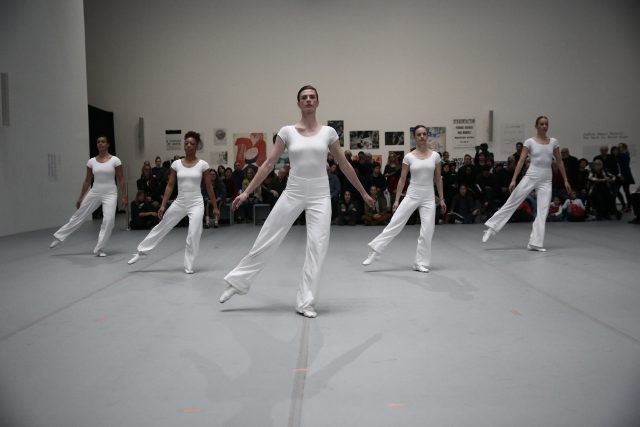
Lucinda Childs. Interior Drama. 1977. Performed in Lucinda Childs: Early Works, 1963–78, as part of Judson Dance Theater: The Work Is Never Done, The Museum of Modern Art, New York, September 16, 2018–February 3, 2019. Performers: Katie Dorn, Sarah Hillmon, Sharon Milanese, Caitlin Scranton, Shakirah Stewart. Digital image © 2018 The Museum of Modern Art, New York. Photo by Paula Court)

Lucinda Childs, Interior Drama, 1977. Performed in “Lucinda Childs: Early Works, 1963–78,” as part of “Judson Dance Theater: The Work Is Never Done,” performed by Katie Dorn, Sarah Hillmon, Sharon Milanese, Caitlin Scranton, and Shakirah Stewart (Digital image © 2018 the Museum of Modern Art, New York. Photo by Paula Court)

“So, what was Judson? It was a place. It was a group of people. It was a movement,” MoMA media and performance art curator Ana Janevski says on the audio guide. Associate curator Thomas J. Lax adds, “Judson was a group of emerging choreographers, visual artists, composers, and filmmakers. A new kind of avant-garde. They rehearsed, experimented, argued, collaborated, and in the process transformed the world of dance together.” The exhibition highlights choreographers Lucinda Childs, Merce Cunningham, Yvonne Rainer, Steve Paxton, Trisha Brown, Simone Forti, David Gordon, and James Waring, composers La Monte Young, John Cage, and Philip Corner, dancers Fred Herko, Rudy Perez, and Judith Dunn, visual artists Carolee Schneemann, Stan Vanderbeek, Robert Morris, Robert Whitman, Rosalyn Drexler, Fred McDarrah, Oldenburg, and Rauschenberg, and dance critic Jill Johnston. There’s an entire section devoted to Halprin and her architect husband, Lawrence Halprin, including photographs, exercises, a letter from Young, a Cunningham lecture, and more centered around their Dance Deck summer workshop.
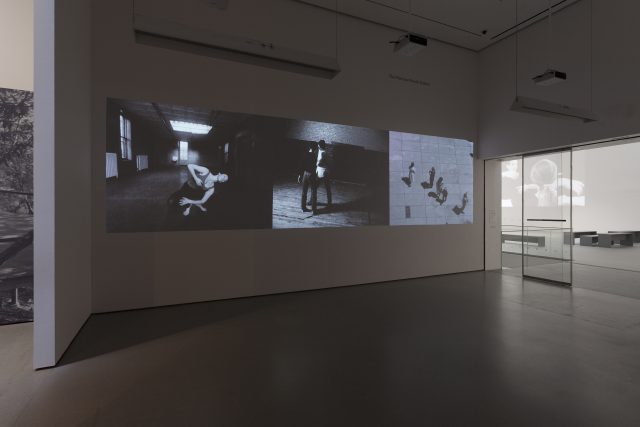
nstallation view of Judson Dance Theater: The Work Is Never Done, The Museum of Modern Art, New York, September 16, 2018–February 3, 2019. © 2018 The Museum of Modern Art. Photo: Peter Butler

Installation view of “Judson Dance Theater: The Work Is Never Done” (© 2018 the Museum of Modern Art. Photo by Peter Butler)

Just as I took part in one of Halprin’s workshops at Judson Memorial Church, you can participate in a class or workshop in MoMA’s atrium being taught by Movement Research, which has been based at the church since 1991. There will be morning classes taught by Nial Jones, Joanna Kotze, Bebe Miller, and Paloma McGregor, afternoon somatics classes with mayfield brooks, iele palooumpis and Jaime Ortega, Bradley Teal Ellis, and K. J. Holmes, and workshop manifestations with Ellis, brooks, and Jennifer Monson, in addition to a reading group, the “Tracing Beyond” Studies Project with panelists Ambika Raina, Miguel Gutierrez, Parijat Desai, Tara Aisha Willis, and David Thomson on January 24, and Fun Friday on January 25 with Antonio Ramos. All events are free with advance registration and will give you an inside look at what has made Judson Dance Theater so influential and critical in the history of dance and performance in New York City and around the globe. “Judson is Open Arms, Judson is Big Momma,” dancer, choreographer, and teacher Aileen Passloff explains on the audio guide. “Judson is come in whatever you need we’re gonna try to give it to you. You will need a shower, come here. There’s a shower, there’s a toilet, there’s a place to eat your lunch. You want to practice, there’s a place to practice. You know the thing about those guys is, well, they believed in us, and they believed in the world.”
GREATER NEW YORK

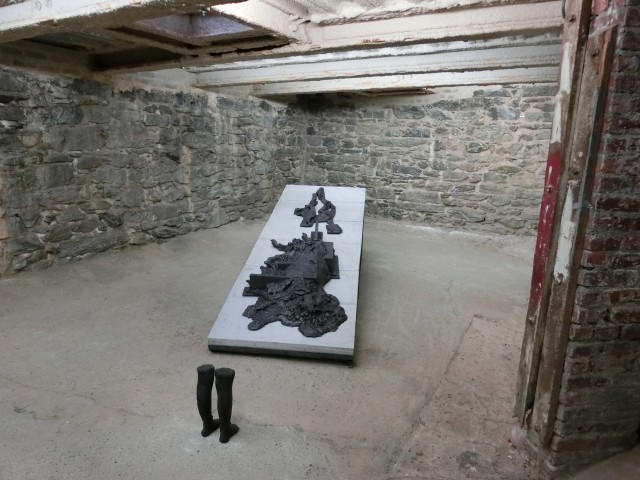
Lionel Maunz’s “Fertilize My Mouth” emphasizes feeling of absence at “Greater New York ”show at MoMA PS1 (photo by twi-ny/mdr)

Lionel Maunz’s “Fertilize My Mouth” emphasizes feeling of absence at “Greater New York ”show at MoMA PS1 (photo by twi-ny/mdr)

MoMA PS1
22-25 Jackson Ave. at 46th Ave.
Thursday – Monday through March 7, suggested donation $5-$10 (free with MoMA ticket within fourteen days of MoMA visit), 12 noon – 6:00 pm
718-784-2084
momaps1.org

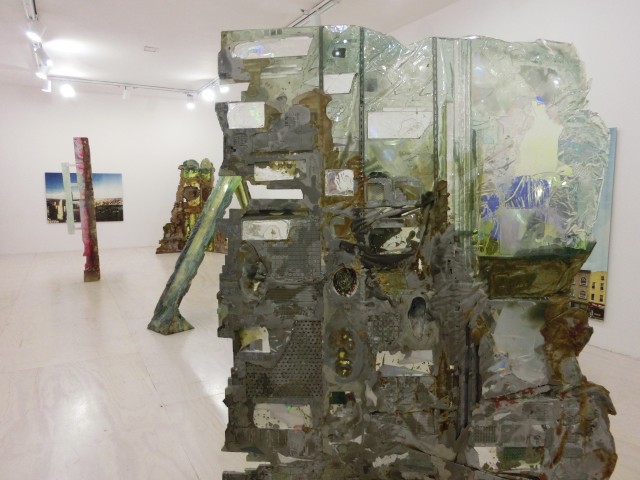
The fourth iteration of MoMA PS1’s quinquennial exhibition, “Greater New York,” is very much about absence and presence, what is not there as well as what is. Instead of focusing primarily on up-and-coming artists, curators Peter Eleey, Douglas Crimp, Thomas J. Lax, Mia Locks, Mark Beasley, and Jenny Schlenzka have included works by nearly 150 artists, more than 60 of whom are over 50 (or would have been if they were still alive), resulting in a wide-ranging look at how New York City and the art market have changed over the last generations. James Nares’s 1976 Super 8 video “Pendulum” shows a wrecking ball ominously swinging in an empty Tribeca alley but not actually knocking anything down — yet. Amy Brener encases such found objects as watches, motherboards, and calculators into colorful resin, foam, glass, and plaster sculptures that harken back to a long-gone era. Alvin Baltrop’s silver gelatin prints remind us what the piers were like prior to renovation and gentrification and what gay life was like before AIDS. Liene Bosquê uses found souvenirs from around the world to construct imaginary cities in “Recollection.” Henry Flynt’s SAMO© Graffiti Portfolio photographs from 1979 reintroduce us to Jean-Michel Basquiat. A large gallery of lifelike sculptures by Tony Matelli, Elizabeth Jaeger, John Ahearn, Judith Shea, and others create a false sense of reality and investigate the human figure and physical relationships. Joy Episalla’s photos of motel bedrooms reflected in television sets fill viewers with personal memories. Fierce Pussy’s “For the Record” features backward text about the AIDS crisis, repeating such sentences as “he would be at this opening if she were alive today” (sic).

Amy Brener repurposes found items into memory sculptures  at “Greater New York ”show at MoMA PS1 (photo by twi-ny/mdr)

Amy Brener repurposes found items into memory sculptures at “Greater New York ”show at MoMA PS1 (photo by twi-ny/mdr)

Glenn Ligon’s silkscreened “Housing in New York: A Brief History” details the various places he lived between 1960 and 2007 and reveal how the neighborhoods changed. In the boiler room, Lionel Maunz’s cast iron and concrete “Fertilize My Mouth” consists of a pair of disembodied legs standing in front of a tilted slab of concrete on which something bad appears to have happened. Louise Lawler’s “Not Yet Titled (adjusted to fit)” is a stretched photo of Gordon Matta-Clark’s “Bingo” sculpture of a derelict house. And photographs of Matta-Clark’s “Building Cuts” into the walls of PS1 back in 1976 bring the exhibition full circle. Among the other artists in the show are Chantal Akerman, Richard Artschwager, Dara Birnbaum, Mel Bochner, Rudy Burckhardt, John Giorno, William Greaves, Yvonne Rainer, Ugo Rondinone, Lorna Simpson, Kiki Smith, and Sergei Tcherepnin. If you were around in the 1970s, you know that New York City was not exactly a paradise — and “Greater New York” takes us back there while also putting it all in a contemporary now you see it, now you don’t context.

Sound comes and goes in Christine Sun Kim’s visitor-operated “Game of Skill 2.0” (photo by twi-ny/mdr)

Sound comes and goes in Christine Sun Kim’s visitor-operated “Game of Skill 2.0” (photo by twi-ny/mdr)

The exhibition will be on view through March 7, and there are still a handful of programs left on the schedule. On February 21 at 4:00, Hayley Aviva Silverman’s live-action “Twister” casts dogs as characters from Charles Dickens’s Oliver Twist and Jan de Bont’s 1996 disaster film, Twister; Shirley Clarke’s The Cool World is being shown February 21-27; on February 25 at 7:00, Fia Backström will perform “Aphasia as a visual shape of speaking – A-production and other language syndromes”; on February 28 at 1:00, Naturally Occurring Cultural Districts New York will host participatory activities; on February 28 at 4:00, Devin Kenny will deliver the performance essay “Love, the Sinner”; short films by Ken Jacobs, Jack Smith, Ira Sachs, and others are screening February 28 through March 7; on March 3 & 4 at 7:00, Geo Wyeth will present “Storm Excellent Salad”; and on March 6, you can catch Stewart Uoo’s “It’s Get Better III” at 3:00 and Angie Keefer’s roundtable “What Is Authority?” at 4:00.

MARIA HASSABI: PLASTIC

(photo by Julieta Cervantes / (c) Museum of Modern Art)

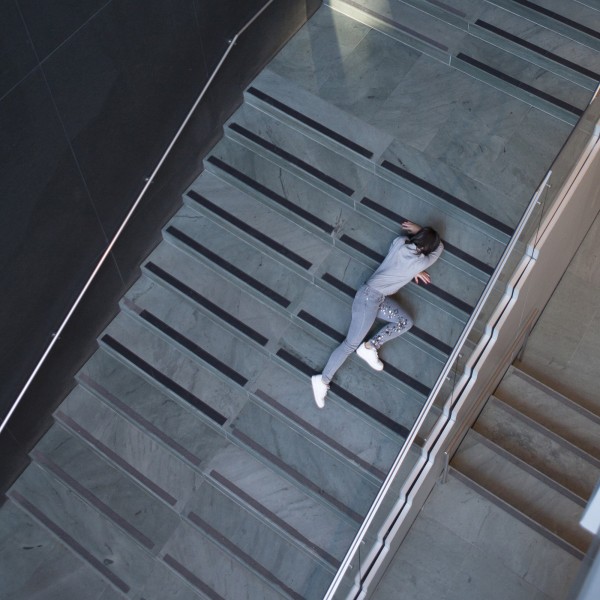
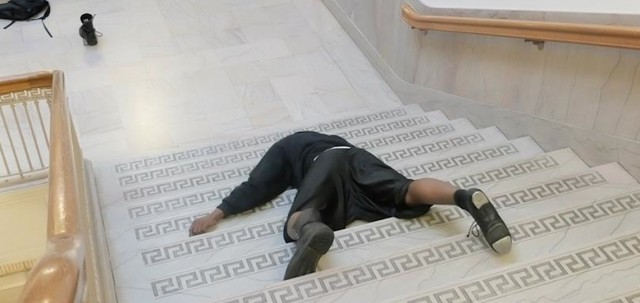
Maria Hassabi rehearses PLASTIC at MoMA on October 30, 2015 (photo by Julieta Cervantes / © Museum of Modern Art)

Museum of Modern Art
11 West 53rd St. between Fifth & Sixth Aves.
February 21 – March 20, free with museum admission ($14-$25)
212-708-9400
www.moma.org
mariahassabi.com

In a 2011 twi-ny talk, Cyprus-born, New York City–based dancer and choreographer Maria Hassabi declared, “I was born flexible!” That statement is true not only of the remarkable things she can do with her body but also of where she performs her impressive, often painfully slow movement. We’ve seen her wrestle with a carpet at PS122, maneuver through a packed house seated on the floor at the Kitchen, and crawl down the cobblestoned path of Broad St. Ever investigating the relationship between performer and audience as well as dance and object — in 2012, Hassabi collaborated with Lutz Bacher and Tony Conrad on “Chandeliers,” in which more than a dozen light fixtures descended from floor to ceiling over the course of the day at the Centre d’Art Contemporain Genève — Hassabi next will set up shop at the Museum of Modern Art, where she will present Plastic for one month. Every day from February 21 to March 20, Hassabi and her team of dancers will be at several locations in MoMA, moving among the visitors, so watch out where you walk, because there will be no barriers separating them from you. You’ll find Simon Courchel, Jessie Gold, Neil Greenberg, Elizabeth Hart, Kennis Hawkins, Niall Jones, Shelley Senter, RoseAnne Spradlin, and David Thomson in the Donald B. and Catherine C. Marron Atrium, Hassabi, Hristoula Harakas, Molly Lieber, Paige Martin, and Oisín Monaghan on the Marron Atrium and Agnes Gund Garden Lobby staircase, and Jones, Michael Helland, Tara Lorenzen, and Mickey Mahar on the staircase between the fourth- and fifth-floor galleries. The sound design is by Morten Norbye Halvorsen, with song fragments by Marina Rosenfeld. “Taking place underfoot in the transitional spaces of a museum known for its crowds, the work can be seen from multiple vantage points and inverts the typical relationship between performer and viewer so that it is the dancer who appears static and the onlooker who moves,” writes MoMA associate curator Thomas J. Lax in the brochure for the living installation, which was co-commissioned by MoMA, the Hammer Museum in Los Angeles, and the Stedelijk Museum in Amsterdam. On February 24 at 7:00 ($8-$12) in the atrium, Hassabi will discuss the work with Philip Bither of the Walker Art Center.

AMERICAN REALNESS

(photo by Duncan Gray)

Keyon Gaskin’s IT’S NOT A THING is part of American Realness festival at Abrons Arts Center (photo by Duncan Gray)

Abrons Arts Center and other venues
466 Grand St. at Pitt St.
January 7-17, $20 unless otherwise noted
212-598-0400
www.americanrealness.com
www.abronsartscenter.org

The seventh American Realness festival consists of twenty cutting-edge theatrical presentations ($20 each), a movement workshop ($90), and four free lectures and discussions over the course of eleven days, January 7-17, almost exclusively at Abrons Arts Center. There’s so much going on that every day features between six and ten events spread throughout the venue, which includes the Experimental Theater, the Playhouse, the Underground Theater, and room 201. Two performances take place at other venues: The great Jack Ferver, who has a well-deserved rabid fan base for his deeply personal and intimate, often confessional multidisciplinary works, returns to American Realness with Mon, Ma, Mes (Revisité) at Gibney Dance (January 13-16), an updated version of a piece that debuted in 2012 at FIAF’s Crossing the Line Festival and in which the audience becomes part of the action. And Danish choreographer Mette Ingvartsen also employs interactivity in her multimedia 69 Positions (January 15-17, $15), which connects sexuality and public space in MoMA PS1’s VW Dome. Back at Abrons, the New York premiere of Heather Kravas’s dead, disappears (January 7-11) integrates Richard Serra’s Verb List into a solo work about words and movement, woman and object. In choreographer Larissa Velez-Jackson’s Star Crap Method (January 9-17), performers Tyler Ashley, Talya Epstein, and Velez-Jackson and lighting designer Kathy Kaufman improvise as they examine the role of sound, light, music, and movement. In the world premiere of Erin Markey’s A Ride on the Irish Cream (January 13-17), Markey and Becca Blackwell bring to life the love between a girl and a pontoon boat/horse. M. Lamar’s Destruction (January 13-16) investigates the white supremacist world order using Negro spirituals. Sadness is at the heart of the New York premiere of Ligia Lewis’s Sorrow Swag (January 7-10), performed by Brian Getnick with live musical accompaniment by George Lewis Jr. Antonija Livingstone, Jennifer Lacey, Dominique Pétrin, Stephen Thompson, Dana Michel, and Brendan Dougherty collaborate on Culture Administration & Trembling (January 7-8), which explores the nature of spectatorship.

The festival also includes Jaamil Olawale Kosoko’s #negrophobia (January 8-17), Keyon Gaskin’s it’s not a thing (January 8-11), Fernando Belfiore’s AL13FB<3 (January 9-12), Keith Hennessy and Jassem Hindi’s future friend/ships (January 9-12), Sara Shelton Mann, Hennessy, and Norman Rutherford’s Sara (The Smuggler) (January 11-13), Yvonne Meier’s Durch Nacht und Nebel (January 11-16), Antonio Ramos and the Gang Bangers’ Mira El! (January 12-15), choreographer Milka Djordjevich and composer Chris Peck’s Mass (January 13-15), the world premiere of the Bureau for the Future of Choreography’s Score for a Lecture, and James & Jen | McGinn & Again’s Over the River | Through the Woods diptych (January 16-17). In addition, Kravas, Lewis, Jenn Joy, and Kelly Kivland will discuss “Melancholia and Precarious Virtuosity” on January 8 at 3:30, Claudia La Rocco, Lane Czaplinski, Annie Dorsen, Yelena Gluzman, Katherine Profeta, and others will explore the question “How Should the Present Think About the Future?” on January 9 at noon, Joshua Lubin-Levy, Thomas J. Lax, Soyoung Yoon, and Cassie Mey will delve into “A Charming Uproar: On Documenting Dance” on January 10 at 3:30, Professor Thomas F. DeFrantz will lecture on “I Am Black (You Have to Be Willing to Not Know)” on January 17 at 11:00 am, and Movement Research will host the workshop “Creative Differences” with La Rocco on January 7, 10, and 12 ($90).