Tag Archives: Thomas Bradshaw

ADDING IT UP: AN EXPERIMENTAL REVIVAL FROM THE NEW GROUP

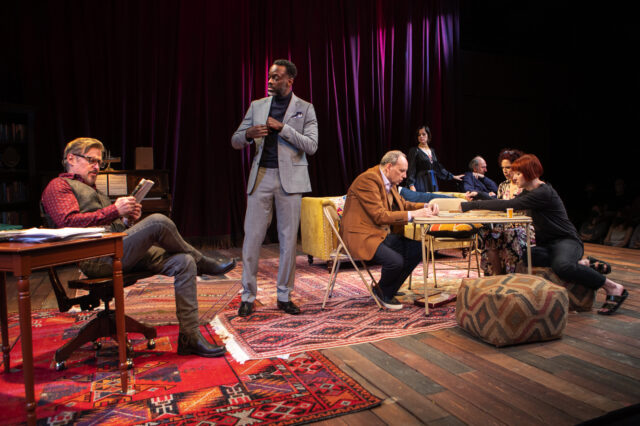
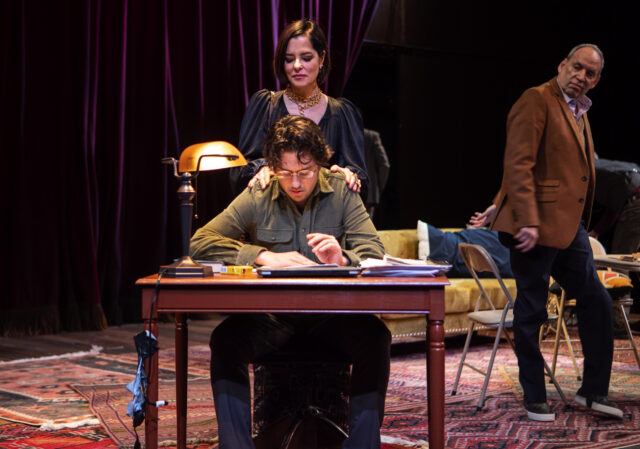
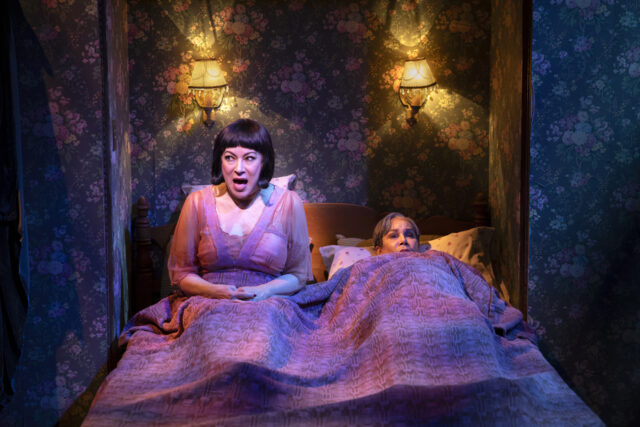
Mrs. Zero (Jennifer Tilly) has a lot to say to Mr. Zero (Daphne Rubin-Vega) in New Group experimental revival (photo by Monique Carboni)

THE ADDING MACHINE
Theatre at St. Clement’s
423 West 46th St. between Ninth & Tenth Aves.
Tuesday – Sunday through May 17, $39-$135; livestream May 7, $39.99, 7:00
thenewgroup.org

At the heart of the New Group’s revival of Elmer L. Rice’s 1923 satire, The Adding Machine, extended at the Theatre at St. Clement’s through May 17, is humanity’s fear of displacement and extinction — not by another species but by our own creations.

Ten years ago, Israeli theoretical computer scientist Moshe Vardi said, “We are approaching a time when machines will be able to outperform humans at almost any task. I believe that society needs to confront this question before it is upon us: If machines are capable of doing almost any work humans can do, what will humans do?”

Technological unemployment has been on the minds of humans since ancient times; warnings about robots and machinery taking over have been posited by Aristotle, John Maynard Keynes, Isaac Asimov, Rod Serling, Philip K. Dick, and Stanley Kubrick.

Pulitzer Prize winner Rice’s (Street Scene) prescient work now features “experimental” revisions by Thomas Bradshaw that make it relevant to the current day, as AI threatens not only the future of a wide range of workers but of humanity itself.

As the audience enters the theater, a light shines down on an adding machine that boldly sits center stage; a sign of progress, it may not appear threatening, but to many it can be seen as a villain whose presence, in this case, will lead to violence and a journey into the afterlife.

Among the most important changes Bradshaw has made is the addition of a friendly narrator (Michael Cyril Creighton) who announces at the beginning, “You are about to witness a heart-warming tale about modern life crushing the human spirit. This isn’t a place where life is ‘lived,’ but rather ‘endured.’ A world of worn-out routines, frayed tempers, and dreams so thoroughly flattened that no one even remembers having them. . . . Listen, I know this all might sound depressing and why the hell would you even want to endure this, let alone pay for it, but fear not! I promise there’s plenty of humor in watching humans try to navigate a society that keeps nudging them toward becoming polite and obedient. You may even recognize a few things from your own life. If so, I apologize in advance.”

That opening is followed by a long, biting monologue in which Mrs. Zero (Jennifer Tilly), in bed with her husband, Mr. Zero (Daphne Rubin-Vega), lets loose a verbose diatribe about going to the pictures, getting older, and their failed marriage, exacerbated by Mr. Zero’s attraction to a young woman who lives in their complex, his inability to get promoted at his accounting job, and how “Captain Standish doesn’t stand at attention for me anymore.” Tucked under the covers, Mr. Zero barely moves, as if he’s dead, ignoring his wife, who is tired of playing second fiddle.

“What about me? Where do I come in?” she argues. “You think I don’t know what it’s like — going to that office every day, adding numbers till you feel like one. But I do. My office is this house, these same four walls. And I been adding, too. Adding the days, my gray hairs, and the silences you could bury a life inside. Adding and adding until the total’s too much to bear.”
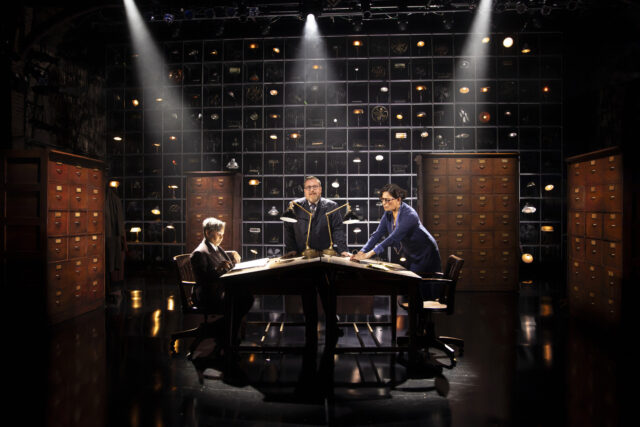
Humans performing office work are doomed in The Adding Machine (photo by Monique Carboni)

The next day, Mr. Zero believes he is going to be celebrated at work for his twenty-fifth anniversary. He earns his salary writing down numbers that his longtime colleague, the efficient Daisy Diana Dorothea Devore (Sarita Choudhury), reads aloud from receipts. He talks down to her, making her angry.

“You make me sick,” he says. She opines, “I wish I was dead.” They bicker like an old couple. He admits that maybe he would marry her, while she notes that it might be too late for them to have kids. He cuts her off, declaring, “Can’t you slow up? What do you think I am — a machine?”

When the cold-hearted boss (Creighton) tells Mr. Zero that he’s being replaced by an adding machine, the disgruntled employee murders him. At a dinner party that night, during which the host Zeros discuss sports, health, voting, immigrants, and other topics with the Ones, Twos, Threes, Fours, Fives, and Sixes (all played by Creighton), Mr. Zero is arrested, unapologetic for what he has done. At his trial, he delivers a numbers-laden, racist, misogynistic tirade about the societal ills that led him to kill his boss. Soon he finds himself in the Elysian Fields, where he is met by a series of surprises.

In The Adding Machine, life is a boring numbers game that can’t be won. As Lt. Charles (Creighton) explains to Mr. Zero, “Before there were numbers, there was counting. Before there was meaning, there was routine.”

There is little that is routine about the play, directed by New Group founding artistic director Scott Elliott, who has previously collaborated with Bradshaw on Intimacy, Burning, and The Seagull/Woodstock; they are not afraid to take chances and challenge the audience. Although not everything works — several of the afterlife scenes are awkward — what does succeed takes things from the sublime to the ridiculous, or, perhaps, the ridiculous to the more ridiculous.

It begins with casting. In the long-forgotten, misguided 1969 film, Milo O’Shea played Mr. Zero, Phyllis Diller was Mrs. Zero, and Billie Whitelaw portrayed Daisy Devore. In the play, Tilly (Don’t Dress for Dinner, The Women) is like a one-woman band as Mrs. Zero, her alternately squeaky, gravelly voice littered with musical grunts and sighs. Choudhury (the New Group’s Roar, The Flatted Fifth, and Rafta, Rafta . . .) is elegant and alluring as Daisy, an excellent foil to Mr. Zero, portrayed as a short, squat, angry man by two-time Tony nominee Rubin-Vega (Rent, the New Group’s Everything’s Turning into Beautiful) in a bulky suit and mustache. Creighton (The Amateurs, Stage Kiss) is warm and welcoming as the narrator, a tour guide, a man who has committed matricide, the boss, the lieutenant, Judy O’Grady, and other characters.

Derek McLane’s set consists of file cabinets that turn into other pieces of furniture, a back wall with dozens of lamps and fans in their own cubbies, and an electric chair that takes the place of the adding machine. The costumes are by Catherine Zuber, with stark lighting by Jeff Croiter and sharp sound by Stan Mathabane.

There is plenty of debate on how AI will affect people’s jobs. According to Authentic Ventures partner Robin Bordoli, “I think what makes AI different from other technologies is that it’s going to bring humans and machines closer together. AI is sometimes incorrectly framed as machines replacing humans. It’s not about machines replacing humans but machines augmenting humans.”

Journalist Kevin Drum counters, “Sometime in the next forty years, robots are going to take your job. I don’t care what your job is. If you dig ditches, a robot will dig them better. If you’re a magazine writer, a robot will write your articles better. If you’re a doctor, IBM’s Watson will no longer ‘assist’ you in finding the right diagnosis from its database of millions of case studies and journal articles. It will just be a better doctor than you.”

In the play, the fixer (Creighton) from the claims department tells Mr. Zero, “The machine is quicker, it never makes a mistake, it’s always on time. It presents no problems of housing, traffic congestion, water supply, sanitation.”

That’s something that is going to keep being heard as long as humans are on this earth.

[Mark Rifkin is a Brooklyn-born, Manhattan-based writer; you can follow him on Substack here.]

DARK DISABLED STORIES

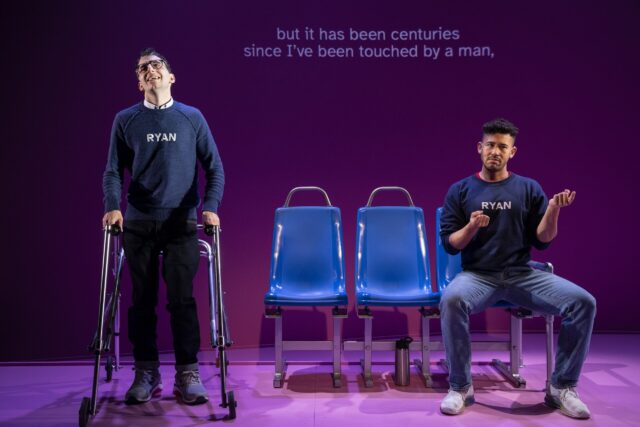
Dickie Hearts and Ryan J. Haddad both portray Ryan in Dark Disabled Stories (photo by Joan Marcus)

DARK DISABLED STORIES
The Shiva Theater at the Public Theater
425 Lafayette St.
Tuesday – Sunday through April 2, $60
212-539-8500
publictheater.org

In Thomas Bradshaw’s The Seagull/Woodstock, NY, a modern-day adaptation of the Chekhov classic for the New Group currently running at the Signature Center, wannabe playwright Kevin tells Samuel, “I’m developing a new type of theater. A theater that’ll be of interest to people under eighty. Mother wants everything neat and pretty. That’s not who I am.”

Disabled actor, playwright, and autobiographical performer Ryan J. Haddad delivers an exhilarating new type of theater with Dark Disabled Stories, which opened a nearly sold-out run at the Public’s small and intimate Shiva Theater last night. Produced with the Bushwick Starr, the seventy-five-minute show features a series of vignettes in which Haddad, who has cerebral palsy and uses a metallic, posterior walking frame, shares his real-life adventures seeking companionship and traversing the city, particularly on buses and subways, where he encounters difficulties specific to his disability. The tales range from hysterically funny and touching to heartbreaking and passionate, but he’s not angling for any sympathy.

“Now, if you’re gonna look at me as sad or pitiable . . . If you came here to pity me, you can leave. We’re only one story in, you can leave. And don’t ask for a refund. I am not here to be pitied and I am not a victim, is that clear?” he says early on. “I try to make disability funny so that nondisabled people can understand it and open themselves to it and realize that it’s not so scary, so dark. And make it more accessible for them. Not tonight. I don’t feel like it. I’m not saying I won’t make you laugh at all. I’ll probably make you laugh a lot. I’m a naturally comedic person, but . . . not everything is accessible to us, so why should we try to make our experiences accessible to you?”

I’ve seen several shows that use ASL interpreters and open captioning in clunky, distracting ways that detracted from the overall narrative, the exception being Deaf West Theatre’s 2015 Broadway revival of Spring Awakening. But Haddad and director Jordan Fein have ingeniously integrated multiple inclusive techniques that make Dark Disabled Stories that much more powerful and involving while remaining wholly organic.

Ryan (Ryan J. Haddad and Dickie Hearts) share personal, poignant stories in world premiere at the Public (photo by Joan Marcus)

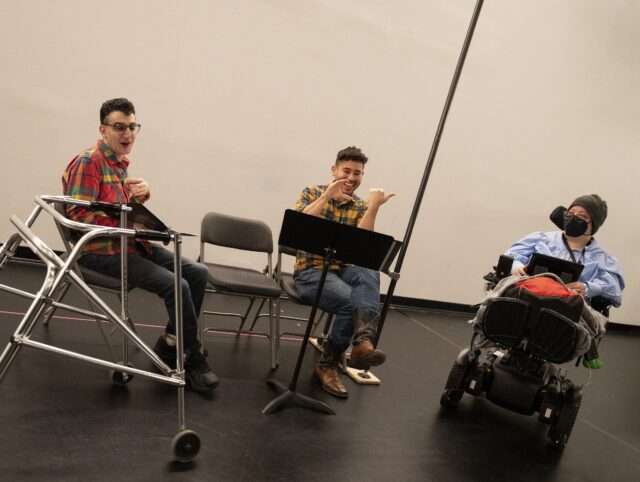
Haddad wears a long crew-neck sweatshirt that says “Ryan” on it, as does Deaf actor Dickie Hearts, who signs everything Ryan speaks. Meanwhile, just offstage by a ramp, disabled actor Alejandra Ospina, who uses a motorized wheelchair, provides audio description of what is happening, detailing the Ryans’ movements, shifts in the set, and the projections on the back wall, which range from color changes — shocking pink is a favorite — to large words.

“I’m not Ryan, I’m Dickie, and I’ll be playing ‘Ryan’ alongside Ryan, who will also be playing ‘Ryan,’” Dickie explains. “Ryan has cerebral palsy, CP, and I do not. I am Deaf and Ryan is not. I’m not an interpreter, I’m an actor.” His words are both described by Alejandra and projected on the screen. In addition, there is an open space off to the side where audience members can go if anything is making them uncomfortable, where they can still watch the show and touch a soft-sculpture wall hanging. A handout in the program advises, “We invite you to react as you need, make sounds, and move around in ways that feel comfortable to your body. People may have different reactions and ways of expressing themselves. This is exciting and welcome.”

The set, by dots, the collective that also designed the costumes, is a shallow rectangular pink box with three blue bus seats, a pair of metal columns wrapped in magenta sequin fabric, and the title of the play spelled out in pink pillowlike bubble letters at the top and bottom (where it is upside down). The lighting is by Oona Curley, with sound by Kathy Ruvuna and video by Kameron Neal, all meshing in a smooth harmony that allows the audience of about ninety-nine, in risers and expanded wheelchair and mobility disability seating, to experience the play as they need/want to. Andrew Morrill is the director of artistic sign language, with Alison Kopit serving as access dramaturg.

Haddad’s previous works include the solo show Hi, Are You Single?; a multimedia installation about swimming as part of Lynn Nottage and Miranda Haymon’s The Watering Hole at the Signature; and My Straighties, Noor and Hadi Go to Hogwarts, and Falling for Make Believe at such venues as Ars Nova, Joe’s Pub, Dixon Place, and La MaMa. He presented a sneak peek of Dark Disabled Stories in August 2021 for Lincoln Center’s Restart Stages program.

He takes a giant leap forward with this full version of Dark Disabled Stories, a bold and daring play in which he is as funny as he is brutally honest. The first vignette deals with a sexual encounter in a gay bar with a stranger in Cleveland. Haddad holds nothing back, except the name of the man, a high school English teacher, as he gives extremely graphic details about what they fif together. Haddad is not doing this merely to shock the audience but to reveal, right from the start, that disabled people have the same fears and desires as everyone else. “I am not a victim, is that clear? That was a completely consensual encounter,” he says. “Hot. Passionate. With just the right hint of scandal. Only without the happy ending I would have hoped.”

Ryan J. Haddad, Dickie Hearts, and Alejandra Ospina rehearse Dark Disabled Stories (photo by Joan Marcus)

Haddad’s stories take place on public transportation, at an important business meeting, coming home from the grocery store, and crossing the street, as he faces situation after situation in which well-meaning samaritans, inaccessibility to certain locations, and his own pride thwart his everyday life.

As he’s being offered “a fuckton of money” by a man from a major university to present one of his solo plays there, he suddenly has to go to the bathroom but he sees that he won’t be able to fit his walker through the narrow space between tables at the restaurant they’re at. “I can’t possibly ask this handsome gentleman to help me. How on earth will he take me seriously if he sees me as a disabled person who needs help to get to the bathroom?” Haddad admits. “Even though he’s offering me money to do an autobiographical show about being disabled, I can’t let him see that I’m disabled. I’ll just pee on my own time.” It doesn’t end well.

Alejandra (Claire’s Broom Detective Agency: The Mystery of the Missing Violin, Emily Driver’s Great Race Through Time and Space!) and Dickie (The Deaf vs the Dead, Tamales de Puerco) each get to share a story of their own, which lends insight to who they are as individuals. Dickie’s tale is particularly chilling, as it involves his losing access to his hands temporarily. “My hands are how I communicate,” he explains with great worry.

Among the many appealing aspects of Dark Disabled Stories are how and what it communicates. Is it the future of theater? It certainly holds the promise of the future of a specific type of theater, one that would make The Seagull’s Kevin/Konstantin happy, if not necessarily his vainglorious actress mother.

THE SEAGULL/ WOODSTOCK, NY

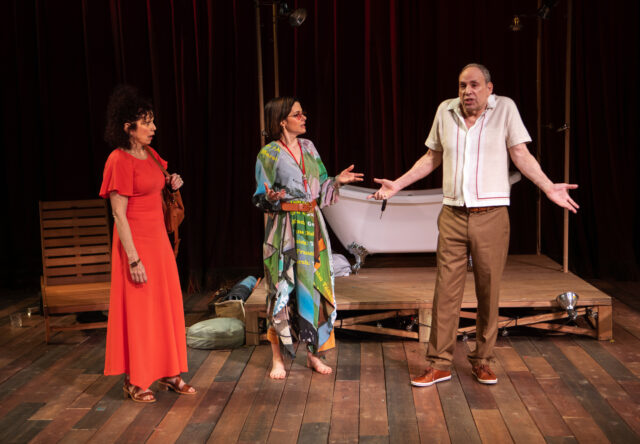
Thomas Bradshaw moves Anton Chekhov’s The Seagull to modern-day Woodstock in New Group world premiere (photo by Monique Carboni)

THE SEAGULL/ WOODSTOCK, NY
The New Group at the Pershing Square Signature Center
The Romulus Linney Courtyard Theatre
480 West 42nd St. between Tenth & Eleventh Aves.
Tuesday – Sunday through April 9, $38-$107
212-244-7529
thenewgroup.org
www.signaturetheatre.org

While sitting in the first row watching Thomas Bradshaw’s outrageously funny and psychologically insightful modern-day adaptation of Anton Chekhov’s The Seagull, called The Seagull/Woodstock, NY, I was reminded that I have never seen a traditional version of the play, one that uses the original dialogue and time period. And that’s just how the Russian playwright wanted it.

In John J. Desmond’s relatively serious and straightforward 1975 Williamstown production, which went straight from stage to film, Konstantin (Frank Langella), a young playwright whose mother, Irina (Lee Grant), is an aristocratic star, tells his uncle, landowner Sorin (William Swetland), about Irina, “She knows of course I haven’t got any use for the theater. She loves the theater. Seems to her she’s working for humanity and the sacred cause of art. But to me her theater today is nothing, nothing but a mass of routine and stale conventions.” Sorin responds, “Well, we can’t do without the theater, my dear boy.” A fanciful dreamer, Konstantin declares, “We need new forms, Uncle! New forms we must have. And if we can’t have those, we shall have nothing at all.”

Thus, Chekhov himself essentially demands new interpretations, and in New York City we have received them with such challenging works as Elevator Repair Service’s 2022 Seagull at Skirball and Aaron Posner’s 2016 Stupid Fucking Bird at the much-lamented Pearl.

Bradshaw tears down conventions in his 160-minute version (with intermission) for the New Group, in which the action has been moved from a late-nineteenth-century Russian country estate to a contemporary riverfront home in artsy Woodstock in Ulster County. The play begins with the actors warming up on a wooden proscenium platform, doing physical and vocal exercises; the audience sits on three sides of the stage as they get an advance glimpse of the cast and try to figure out who’s portraying who. After several minutes, everyone joins in a singalong of Crosby, Stills, Nash & Young’s 1970 classic “Our House,” the lyrics of which will run counter to what we are about to experience: “Our house is a very, very, very fine house / With two cats in the yard / Life used to be so hard / Now everything is easy ’cause of you.” (CSNY appeared at the 1969 Woodstock festival but did not sing that song; the next year, however, they released the song “Woodstock,” written by Joni Mitchell, in which they proclaim, “Got to get back to the land / Set my soul free.”)

A close-knit, motley crew is gathering by the river on Darren (Daniel Oreskes) and Pauline’s (Amy Stiller) property to see a new play by Kevin (Nat Wolff), a twenty-six-year-old ne’er-do-well living in the shadow of his narcissistic mother, Irene (Parker Posey), a star of the stage. Before she says hello to her friends and relations, she is already loudly complaining that there is no soy milk for her coffee. Kevin has written the one-person, two-hour show for Nina (Aleyse Shannon), a twentysomething with no boundaries. Kevin is in love with Nina, who will soon take a liking to the older William (Ato Essandoh), a well-known writer who is Irene’s current partner. Meanwhile, Pauline and Darren’s daughter, Sasha (Hari Nef), pines away for Kevin. Also on hand are Sasha’s teacher husband, Mark (Patrick Foley), brain surgeon Dean (Bill Sage), and retired lawyer Samuel (David Cale), Irene’s best friend.

Mother (Parker Posey) and son (Nat Wolff) have an awkward relationship in The Seagull/Woodstock, NY (photo by Monique Carboni)

When Sasha ridicules Kevin’s set, which consists solely of a cast-iron bathtub and a curtain that goes around it, Mark needles her, saying, “Tonight their artistic souls will unite on this very stage.” Right before Kevin’s play starts, Samuel tells Nina, who lives nearby and whose banker father is not a fan of her interest in theater, “Woodstock nurtures the artistic soul. Bob Dylan and Van Morrison wrote some of their best music here. [Your father] should have bought a place in the Hamptons if he wanted you to be a banker.”

Bradshaw fills the show with contemporary references, from Dylan and Morrison to viagra, #metoo, Alec Baldwin, wokeness, the Wailers, Donald Trump, Bertrand Russell, Instagram, Stephen Colbert, Tracy Letts, dramadies, and Paula Vogel’s How I Learned to Drive. He also takes on race, class, sexual identity, and truth but in subtler ways than he has in such previous works as Southern Promises, Intimacy, and Burning, or at least more subtle for him.

But Bradshaw and director Scott Elliott’s central target is art itself. “Hi, I’m Nina. I’m not a character in Kevin’s play. I’m me,” Nina says as the play-within-a-play kicks off. “Kevin hates artifice. So do I. I am myself, or I am no one. Who are you? Are you, you? Or are you hiding from yourself?” She adds, “The fourth wall tonight is broken. So that means I can see you just as clearly as you can see me. I can see everything about you. I can see things even you can’t see.” The fourth wall of Bradshaw’s play was broken immediately as well, when the actors got onstage and we all sang, and the lights stay at a level that allows us to see everyone in the audience.

Nina, who is biracial, then discusses “the N word,” actually saying it in full several times, which confronts her audience as well as Bradshaw’s, a writer who often strives to make his audience squirm in their seats. “I get that the historical legacy of the word is offensive. But does the word itself have any power?” she asks. Then, in true Bradshaw fashion, she switches to one of his favorite topics. “We recently went through a long period of isolation. Everyone in our society did. It was a period of intense loneliness for me. And for many of you, I bet. And what were we all doing during that time? Masturbating. Why can’t we talk about it? We all do it. I’d rather discuss masturbating than the weather.” Bradshaw understands that theater itself can be a kind of masturbation; in fact, in Intimacy, a character not only pleasures himself (using a prosthetic) in view of the audience but launches a sticky white substance into the crowd, some of which landed on the head of a major critic, who was none too happy. (One friend joked to me that Anton’s last name should be “Jackhov,” pronounced “jackoff.”)

Irene (Parker Posey) gets in the middle of Pauline (Amy Stiller) and Darren (Daniel Oreskes) in New Group world premiere at the Signature (photo by Monique Carboni)

After Kevin’s play ends, Irene tells Nina, “You were very good, in spite of my son exploiting you.” Nina replies, “Oh no. It was my choice. And he totally respected me, as an actress, and as a woman of color.” Irene says, “So you didn’t feel the least bit weird pretending to, uh, touch yourself, onstage?” Nina explains, “Oh, I wasn’t pretending. I had to really do it, in order to crack the artifice of normal theatrical conventions. There’s nothing real about realism. That’s Kevin’s philosophy. He believes in hiding nothing.” That is Bradshaw’s philosophy as well.

Throughout the show, the actors and stage crew bring chairs and tables on and off Derek McLane’s intimate set, which includes a narrow lower level around the platform where people in the first row can get comfy and put up their feet — until some of the actors walk across it. At times Elliott choreographs the play like it’s a dance, expertly guiding the cast of ten in the small space, who enter and exit through the aisles.

The cast seems to be having a lot of fun, and that feeling is infectious; the play moves at such an intoxicating pace that you might be disappointed when it’s over, wanting to spend more time with these well-developed, endearing, annoying, and frustrating people. “I think my character would feel more authentic if we knew more of her backstory. Right now the play feels abrupt,” Nina tells Kevin, who argues, “It is abrupt. That’s the point. We’re subverting typical American Theater. We’re getting right to the heart of the matter instead of making our audience suffer through an hour of incredibly dull backstory.”

Posey (Hurlyburly, Fifth of July) is a burst of summer sunshine as Irene, in flowery dresses, bobbed hairdo, and gloriously fake smiles. (The costumes are by Qween Jean, with lighting by Cha See and sound by Rob Milburn and Michael Bodeen that keep the audience immersed in the show.) Wolff (Buried Child, The Naked Brothers Band) wonderfully captures the constant nervous wreck that is Kevin, while Shannon (Charmed, Black Christmas) glistens as a strong young woman ready to take charge of her life, especially sexually, and Nef (Des Moines, “Daddy”) is a bundle of fear as the disillusioned Sasha. Cale, Essandoh, Foley, Nef, Oreskes, Sage, and Stiller round out the uniformly solid cast.

Bradshaw (Thomas & Sally, Fulfillment) and New Group artistic director Elliott (Mercury Fur, Sticks & Bones) also take a hard look at aging, not just in theater but in life. Irene is well aware that it is getting more difficult for her to find roles because she is in her fifties, and Samuel is facing serious health issues that affect the elderly.

“Is there anything new anymore? Are there any new stories? New forms? Or is everything just a new spin on something old? A reinvention of the comfortable and familiar?,” Kevin asks William. The Seagull/Woodstock, NY provides just the right answers to those questions.

THE NEW GROUP OFFSTAGE: TWO BY WALLACE SHAWN

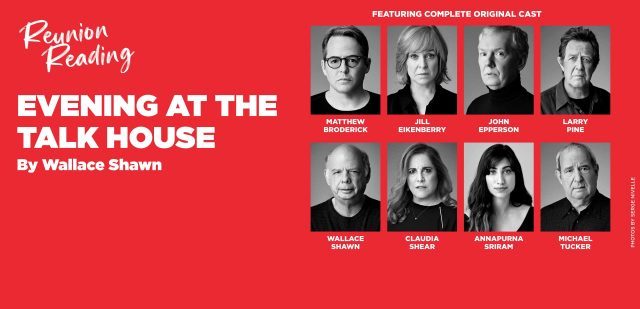
Who: Matthew Broderick, Jill Eikenberry, John Epperson, Larry Pine, Wallace Shawn, Claudia Shear, Annapurna Sriram, Michael Tucker; Kristen Johnston, Lili Taylor, Marsha Stephanie Blake, Thomas Bradshaw, Liam Craig, Melissa Errico, Carlos Leon, Emily Cass McDonnell, Maulik Pancholy, Stephen Park, Bill Sage
What: The New Group reunion readings of two plays by Wallace Shawn
Where: “The New Group Off Stage”
When: Wednesday, October 28, $25, 7:00, and Thursday, October 29, $25, 7:00 (available for viewing through November 29)
Why: In his 2011 essay “Why I Call Myself a Socialist: Is the World Really a Stage?,” beloved playwright, actor, and voice artist Wallace Shawn explains, “We are not what we seem. We are more than what we seem. The actor knows that. And because the actor knows that hidden inside himself there’s a wizard and a king, he also knows that when he’s playing himself in his daily life, he’s playing a part, he’s performing, just as he’s performing when he plays a part on stage. He knows that when he’s on stage performing, he’s in a sense deceiving his friends in the audience less than he does in daily life, not more, because on stage he’s disclosing the parts of himself that in daily life he struggles to hide. He knows, in fact, that the role of himself is actually a rather small part, and that when he plays that part he must make an enormous effort to conceal the whole universe of possibilities that exists inside him.”

It’s inconceivable that you’re unfamiliar with the cuddly, adorable, shaggy-haired Shawn, who has appeared in more than one hundred films, including numerous Woody Allen movies, as well as voicing Rex in the Toy Story franchise and portraying a fictionalized version of himself in Louis Malle’s reality-busting My Dinner with Andre, in which he shares a meal with theater director Andre Gregory. Shawn’s most famous performance is, no doubt, as Sicilian mastermind Vizzini in Rob Reiner’s 1987 fairy-tale classic, The Princess Bride. The scenes between Shawn as Vizzini and wrestling legend Andre the Giant as his cohort Fezzik are among the film’s most treasured. (My Movie with Andre?) Shawn, the son of famed New Yorker editor William Shawn and journalist Cecille Shawn, is also an esteemed playwright, winning an Obie in 1974 for Our Late Night and earning kudos galore for 1996’s The Designated Mourner, which, in several productions, was directed by Gregory, with Shawn playing Jack in stage and radio iterations.

In the age of coronavirus, with theaters shuttered, Shawn reunited last month with the cast of The Princess Bride for a virtual reading and discussion benefiting the Wisconsin Democratic Party. Now the New Group is celebrating him with “The New Group Off Stage: Two by Wallace Shawn,” a pair of live, virtual readings of productions the company has previously staged. First up, on October 28, is 2017’s Evening at the Talk House, which in my review I said was an “utterly delightful, deliciously wicked black comedy, one of the most gregarious shows you’re ever likely to see, despite its dark undertones.” As you walked into the Signature’s Romulus Linney Courtyard Theatre, the actors were circulating on the set at the center, and the audience was invited to speak with them, joining a small, intimate cocktail party before the main event. The original all-star cast is back for the reading — Matthew Broderick, Jill Eikenberry, John Epperson, Larry Pine, Claudia Shear, Annapurna Sriram, Michael Tucker, and Shawn — but that preliminary interaction will be gone, changing the dynamic between audience and performer even more than in most Zoom renditions.

The next night, October 29, the New Group will present Shawn’s 1985 play, Aunt Dan and Lemon, which the company revived in 2004 at the Acorn Theatre; back for the virtual show are Kristen Johnston as Aunt Dan and Lili Taylor as Lemon along with Maulik Pancholy, Marcia Stephanie Blake, Liam Craig, Melissa Errico, Carlos Leon, Bill Sage, Emily Cass McDonnell, Stephen Park, and Thomas Bradshaw replacing Isaach De Bankole and Layla Khoshnoudi stepping in for Brooke Sunny Moriber. Ten percent of the proceeds of the Talk House reading will go to City Harvest, while the same amount of the Aunt Dan proceeds will go to the Center for Constitutional Rights. (Both readings will be available for viewing through November 29.) The New Group’s virtual pandemic programming has featured excellent reunion readings of The True and The Jacksonian in addition to the ongoing “Why We Do It” interview series with such alums as Cynthia Nixon, Bobby Cannavale, Edie Falco, Suzanne Vega, and Natasha Lyonne; here’s hoping that Shawn soon tells us why he does it. (My Dinner with Wallace, anyone?)

COLOR BRAVE: SOUTHERN PROMISES

(photo by Joan Marcus)

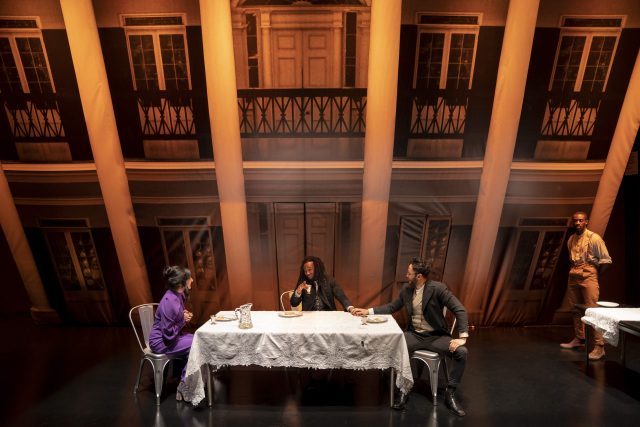
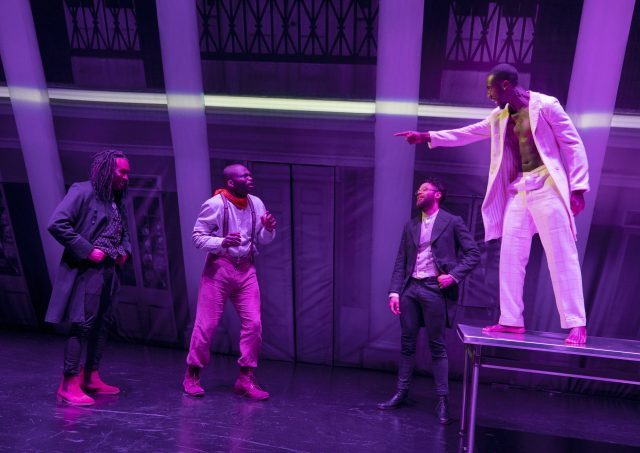
A plantation facade threatens to crush slaves and slave owners alike in Flea reboot of Thomas Bradshaw’s Southern Promises (photo by Joan Marcus)

Flea Theater, the Sam
20 Thomas St. between Broadway & Church St.
Thursday – Monday through April 18, $15-$50
theflea.org

The Flea’s 2018-19 “Color Brave” season, comprising plays examining race by Todd Solondz, Geraldine Inoa, Idris Goodwin, Kristiana Rae Colón, and Nick Gandiello, comes to an incendiary close with a reboot of Thomas Bradshaw’s Southern Promises, which premiered in 2008 at the IRT in Greenwich Village. Bradshaw has updated the show, including changing the ending, for this run, which continues at the Sam through April 18. The cast consists of twelve nonwhite members of the Bats, the Flea’s resident company. “People of color in America don’t really have a tradition where we confront and investigate the legacy of slavery on our own terms. This legacy is the root of all societal racism in this country, and we as a society are just starting to dig our way out,” one actor explains in a prologue in which several of the Bats share an aspect of personal history involving race. Another says, “I’m just as much slave owner as I am slave. Both the oppressor and the oppressed. This contradiction is an essential part of who I am, and I choose to embrace it all. Every character in this show is me. Every one of these characters are my ancestors.”

(photo by Joan Marcus)

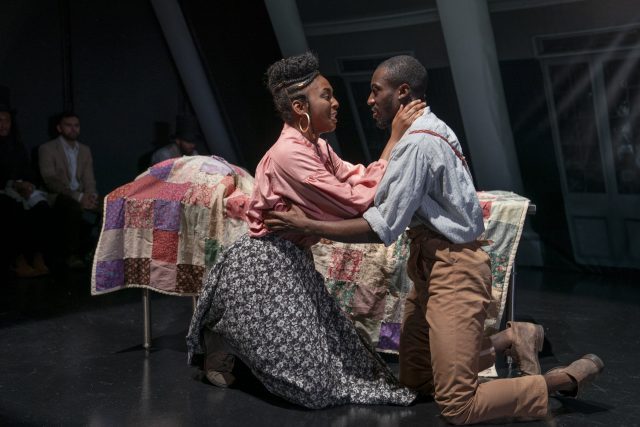
Benjamin (Shakur Tolliver) and Charlotte (Yvonne Jessica Pruitt) think freedom is near in Southern Promises (photo by Joan Marcus)

Inspired by the book The Great Escapes: Four Slave Narratives, which tells the story of fugitive slaves Daphne Brooks, William W. Brown, Henry Box Brown, and William and Ellen Craft, Southern Promises is set on a Virginia plantation in 1848, where Isaiah (Darby Davis), the master, is on his deathbed and tells his slave Benjamin (Shakur Tolliver) that all the slaves will be emancipated when he passes. “You know, Ben, I’ve always thought of you as a brother. I want you to know that,” Isaiah says. “I’m honored, massa. I’ve always loved you,” Benjamin responds. But when Isaiah dies, his widow, Elizabeth (Brittany Zaken), whom he told about his plan to free the slaves, changes his will so that none of the slaves will be given their freedom. “It always seems to me such a cruel thing to turn ni–ers loose to fend for themselves, when there are so many good masters to take care of them,” she complains to Isaiah’s brother, David (Jahsiah Rivera), who was aware of Isaiah’s final wish. “I care nothing for the ni–ers, on my own account, for they are a great deal more trouble than they are worth; I sometimes wish that there was not one of them in the world, for the ungrateful wretches are always running away.” Also entering the fray is Elizabeth’s brother, John (Marcus Jones), a preacher who believes that the widow should now marry David. A toxic mix of greed and unholy desire ensues, and David becomes a vicious taskmaster, as both he and Elizabeth abuse Benjamin and his wife, Charlotte (Yvonne Jessica Pruitt), leading to a surprising, tragic finale.

(photo by Joan Marcus)

Thomas Bradshaw uses slavery to explore modern-day racism in Southern Promises (photo by Joan Marcus)

Jason Sherwood’s set is dominated by a mounted large-scale photograph of the front of the plantation estate, tilting forward as if it is about to fall over and crush everyone. Tables and chairs are moved on- and offstage as lighting designer Jorge Arroyo illuminates individual windows to indicate where a scene takes place. At moments his lighting casts shadows on the facade that resemble Kara Walker’s silhouettes of slave owners raping and torturing black men, women, and children. (The play’s marketing image, which includes the tagline “We’re Finally Free,” uses silhouetted art by Walker as well.) In between scenes, snippets of southern rock songs by such superstars as Bob Dylan, the Band, Janis Joplin, the Allman Brothers, Neil Young, Lynyrd Skynyrd, and others play. In such works as Intimacy, Mary, and Burning, Bradshaw makes audiences feel uncomfortable as he explores issues of race and sex, and Southern Promises is no exception.

It’s unsettling to watch the play, directed with a poignant immediacy by Flea artistic director Niegel Smith (Take Care, A 24-Decade History of Popular Music) and featuring Timothy Park as a doctor, Adrain Washington as Emmanuel and an imaginary slave, Selamawit Worku as Sarah, and Adam Coy as Atticus; the actors are all of African, Latin American, or Asian descent. This revised version of Southern Promises is like a mini-Roots, going beyond the systemic racism that has been America’s shame for four hundred years to reveal how the concept of race and its power corrupts even the seemingly most well meaning of people. The night I attended, an awkward, uneasy moment at the curtain call uncovered society’s continuing pain, as most of the people of color in the primarily white audience did not applaud at all while several white people gave a standing ovation. But as we know, from the daily news to plays such as Southern Promises, no matter how woke many of us white people may try to be, this country still has a lot of work to do.

THEATRE FOR ONE: I’M NOT THE STRANGER YOU THINK I AM

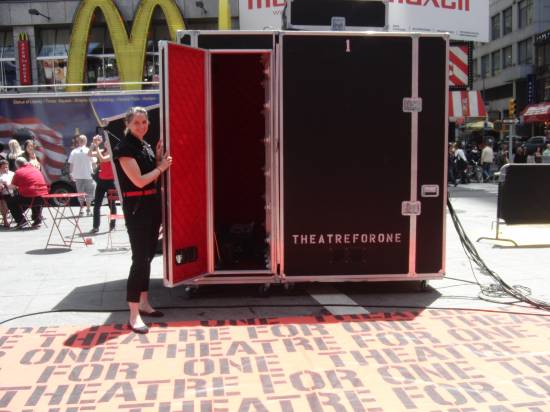
Christine Jones’s mobile Theatre for One will present short plays by major playwrights in three locations May 18 - June 6 (photo by twi-ny/mdr)

Christine Jones’s mobile Theatre for One will present short plays by major playwrights in three locations May 18 – June 6 (photo by twi-ny/mdr)

Winter Garden at Brookfield Place, Zuccotti Park, Grace Building
May 18 – June 6, free, 12 noon – 7:00 pm
www.artsbrookfield.com
www.theatreforone.com

Theater can be an intimate experience, and it doesn’t get much more intimate than Christine Jones’s Theatre for One, which is exactly that: performances by one actor for one audience member at a time, inside a mobile four-by-eight-foot theater. TFO will feature new five-minute works by award-winning playwrights Craig Lucas (Prelude to a Kiss), Will Eno (The Realistic Joneses), Lynn Nottage (Ruined), José Rivera (Marisol), Thomas Bradshaw (Intimacy), Zayd Dohrn (Sick), and Emily Schwend (Take Me Back). The mobile theater is a collaboration between the architecture firm LO-TEK and the Tony-nominated Jones, who has designed the sets for such shows as Spring Awakening, American Idiot, and Coraline and is the director of the current immersive hit Queen of the Night. The short plays, which together are being called I’m Not the Stranger You Think I Am, will be performed by six actors and are directed by Jones, Rivera, Jenny Koons, and Brian Mertes; the mobile theater will be at the Winter Garden at Brookfield Place May 18-24; Zuccotti Park May 27-31; and the Grace Building June 2-6. Admission is first come, first served, and free, with each person able to see one of the plays, between 12 noon and 7:00 pm.

OFF BROADWAY WEEK 2014

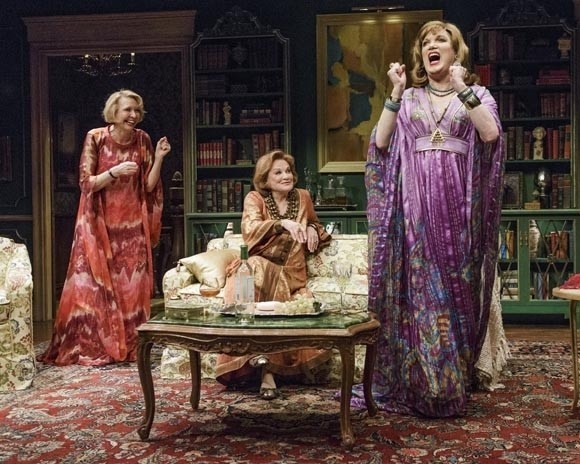
Charles Busch’s THE TRIBUTE ARTIST is among off Broadway shows offering two-for-one tickets (photo © James Leynse)

Charles Busch’s THE TRIBUTE ARTIST is among off Broadway shows offering two-for-one tickets (photo © James Leynse)

February 17 – March 2
Tickets 2-for-1
www.nycgo.com

As such theater promotions as 20at20 and Broadway Week wind down, Off Broadway Week is just getting started. Two-for-one tickets are now on sale for nearly fifty off Broadway productions, from old favorites to shows still in previews. Among the old-timers are Blue Man Group at the Astor Place Theatre, The Fantasticks at the Snapple Center, and Stomp at the Orpheum. Twofers are also available for the highly touted Buyer & Cellar at Barrow Street, about a struggling actor who gets a job as an assistant to Barbra Streisand; Riding the Midnight Express at the Players Theatre, in which the real Billy Hayes tells the true story of his Turkish imprisonment; the New Group’s world premiere of Thomas Bradshaw’s extremely graphic Intimacy at the Acorn; Caryl Churchill’s Love and Information at the Minetta Lane; Craig Lucas’s Ode to Joy at the Cherry Lane; Bikeman: A 9/11 Play at Tribeca Performing Arts Center; Charles Busch’s The Tribute Artist at Primary Stages, starring Busch and Julie Halston; the new musical Transport at the Irish Rep; John Van Druten’s London Wall at the Mint; and the AA play Bill W. and Dr. Bob at SoHo Playhouse. There’s also plenty of family friendly shows, including The Berenstain Bears in Family Matters, the Musical; Piggy Nation: The Musical; The Amazing Max and the Box of Interesting Things; and The Greatest Pirate Story Never Told!