Nobuhiko Obayashi’s beautifully told tale, Seven Weeks, is part of Japan Society online tribute
TRAGEDIES OF YOUTH — NOBUHIKO OBAYASHI’S WAR TRILOGY: SEVEN WEEKS (NO NO NANANANOKA) (Nobuhiko Obayashi, 2014)
Japan Society virtual cinema
Available on demand through August 6, seven-day rental $10 per film, $24 for all three
japansociety.org
In December 2015, Japan Society presented the two-weekend, ten-film series “Nobuhiko Obayashi: A Retrospective,” which revealed that the Japanese auteur was so much more than just the director of the 1977 cult classic House. In commemoration of the recent death of the iconoclastic, eclectic writer-director, who passed away in April 2020 from lung cancer at the age of eighty-two, Japan Society is hosting a special monthlong online screening of his War Trilogy, consisting of 2012’s Casting Blossoms to the Sky, set in the aftermath of the devastating 2011 Tōhoku earthquake and tsunami, 2017’s Hanagatami, an adaptation of Kazuo Dan’s 1937 novella about a group of students falling in and out of love in prewar Japan, and the 2014 epic family drama Seven Weeks.
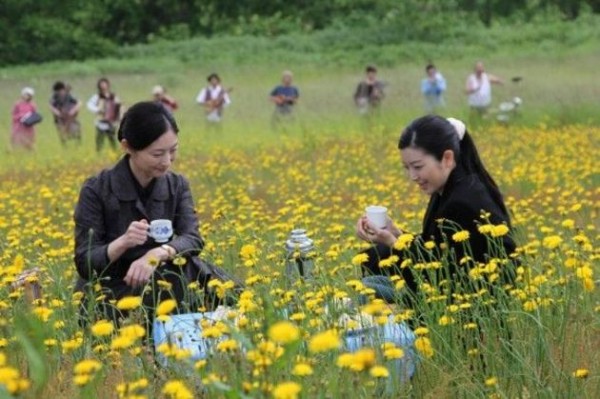
A tribute to Obayashi’s late friend and colleague Hyoji Suzuki, who started an independent film workshop in Ashibetsu in 1993 and died of pancreatic cancer four years later at the age of thirty-six, Seven Weeks was shot in and around that Hokkaido village over the course of five weeks. Ninety-two-year-old patriarch Mitsuo Suzuki (Toru Shinagawa), a local retired doctor who now runs the Starry Cultural Center gift shop (a nod to Suzuki’s Hoshi no Furusato Ashibetsu Eiga Gakko, or Starry Beautiful Home Ashibetsu Film School), is on his deathbed, and various relatives are arriving to say goodbye and participate in the nanana no ka Buddhist ritual, in which they will hold memorials once a week for seven weeks following his death. The mourners include Mitsuo’s sister, Eiko (Tokie Hidari), grandchildren Fuyuki (Takehiro Murata), Haruhiko (Yutaka Matsuhige), Akito (Shunsuke Kubozuka), and Kanna (Saki Terashima), and great-granddaughter Kasane (Hirona Yamazaki), in addition to his nurse, Nobuko Shimizu (Takako Tokiwa). During the seven weeks, family members relive the past, uncovering surprising secrets about the young Mitsuo (Shusaku Uchida), his harmonica-playing friend Ono (Takao Ito), and the woman they both admire, Ayano (Yumi Adachi), as Obayashi weaves together past and present through flashbacks, the appearance of dead characters, and painting and poetry (several of the characters share a love of the poems of Nakahara Chuya).
But the film, shot in lush, fairy-tale-like colors by cinematographer Hisaki Mikimoto and featuring a sweeping score by Kôsuke Yamashita and a kind of Greek chorus embodied by the unusual Japanese band the Pascals, is not merely about the travails of one extended family; it is also very much about the rebuilding of Japanese society in the wake of WWII, the earthquake and tsunami of March 11, 2011, and the ensuing Fukushima nuclear disaster. In fact, all of the clocks and watches in Seven Weeks are perpetually stopped at 2:45 pm, the exact time the horrific 3/11 events began. Obayashi also investigates the Soviet invasion of Sakhalin Island in August 1945 and the abuse of Korean migrant workers in Japanese mines as he explores the complex issue of the meaning of home. Seven Weeks is a beautifully told tale of memory and loss, of art and war, a summing up not only of Obayashi’s career but of twentieth-century Japan, with plenty of the director’s unique trademark style. “How do I paint the world?” Mitsuo asks at one point, something Obayashi has achieved in this deeply involving and wonderfully mysterious film. Fortunately for all of us, Obayashi was not quite done painting the world, continuing a legacy that is at last being celebrated here in the West.
TRAGEDIES OF YOUTH — NOBUHIKO OBAYASHI’S WAR TRILOGY: CASTING BLOSSOMS TO THE SKY (KONO SORA NO HANA: NAGAOKA HANABI MONOGATARI) (Nobuhiko Obayashi, 2014)
japansociety.org
“If people made pretty fireworks instead of bombs, there wouldn’t have been any wars,” says journalist Reiko Endō (Yasuko Matsuyuki), quoting wandering artist Kiyoshi Yamashita at the start of Nobuhiko Ōbayashi’s Casting Blossoms to the Sky. The first of the eclectic Japanese auteur’s War Trilogy, the film, based on actual experiences, is essentially an audiovisual essay, “Reiko Endō’s Wonderland: A Journey of Emotions to Nagaoka,” detailing Endō’s trip to Nagaoka in Niigata Prefecture, as the local citizenry share true tales of WWII and the 2011 Tōhoku earthquake and tsunami. (Nagaoka took in more than a thousand evacuees from Fukushima.) Ōbayashi goes back and forth between the past and the present, from the summer in 1945 when Nagaoka was bombed by the United States to the latest edition of the city’s annual fireworks display, which honor the victims of Pearl Harbor, the bombings of Nagaoka, Hiroshima, and Nagasaki, and the 2011 disaster.
With the day of the fireworks show approaching, Endō rides with wise cabdriver Akiyoshi Muraoka (Takashi Sasano), as she, and we, discover the city’s history of war and remembrance. Endō meets with her ex-boyfriend, Kenichi Katayama (Masahiro Takashima), who is in charge of the school play at Chuetsu High and chooses There’s Still Time Until a War by a mysterious girl named Jana Motoki (Minami Inomata) who rides a unicycle through the halls and down the streets of the neighborhood. Endō learns from the inhabitants themselves, including military history researcher Takashi Mishima (Akiyoshi Muraoka) and triathlete and potato farmer Goro Matsushita (Toshio Kakei), who built a memorial using a fragment from one of the incendiary bombs dropped on Nagaoka; war veteran and local fireworks legend Seijiro Nose (Akira Emoto); reporter Wakako Inoue (Natsuka Harada), who walks Endō through important parts of the city; Yoshie Yamafuji, who lost much of her family in the bombings; artist Yasunari Honmura, who uses his paintings as reminders of the horrors of war; and numerous other survivors and relatives of the dead.
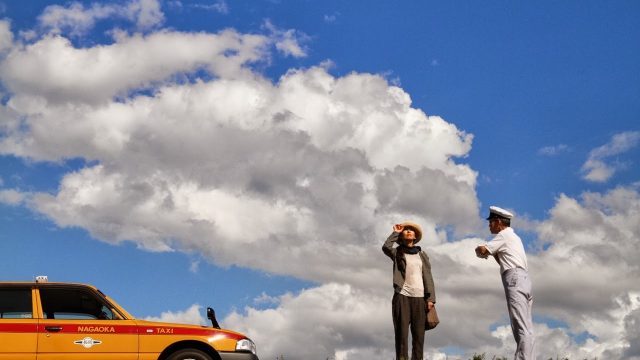
Journalist Reiko Endō (Yasuko Matsuyuki) goes on quite a ride with cabdriver Akiyoshi Muraoka (Takashi Sasano) in Nobuhiko Ōbayashi’s Casting Blossoms to the Sky
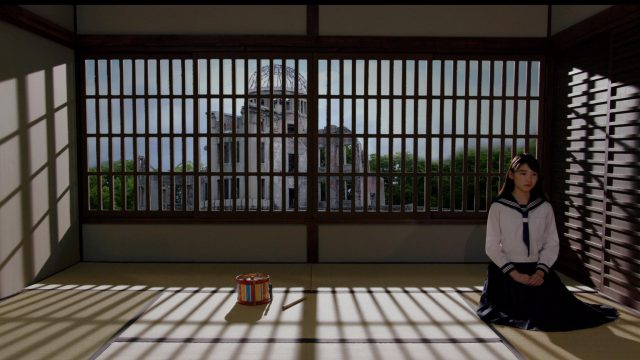
Casting Blossoms to the Sky is made in Obayashi’s unique style, with visually stunning backdrops (real and green-screened), bright, brash color schemes, professional and nonprofessional actors, and computer-generated imagery that can feel rather goofy. The film was imaginatively shot by Yûdai Katô and Hisaki Sanbongi, with lovely, often garishly beautiful production design by Kôichi Takeuchi and playful editing by Obayashi and Hisaki Sanbongi, using cute cinematic techniques. The characters sometimes turn and speak directly into the camera, further establishing the film as a cautionary tale.
“I don’t know anything about war and it’s never crossed my mind,” a young student named Ryo says to Katayama, who replies, “It’s the citizens’ duty to tell the story. There are adults who think war is necessary but not the children. That’s why it’s up to the children to make peace.”
In one of the most moving scenes, a black-and-white flashback to 2009 during a fierce storm, Endō’s mother (Shiho Fujimura) says to her, “Life is connected,” a statement that is at the heart of Obayashi’s message. But no matter how didactic some of the dialogue is and how silly the visuals can get, accompanied by Joe Hisaishi’s emotional score, Casting Blossoms to the Sky has an innate charm that is so endearing you will forgive its flaws. At one point Katayama explains, “The fireworks are a prayer.” So is Casting Blossoms to the Sky, which, like fireworks, is quite a sight to behold.
 Japan Society’s two-weekend, ten-film series “Nobuhiko Obayashi: A Retrospective,” which has revealed the Japanese auteur to be so much more than just the director of the 1977 cult classic House, comes to a close December 6 at 7:00 with Obayashi’s latest, the 2014 epic family drama Seven Weeks. A tribute to Obayashi’s late friend and colleague Hyoji Suzuki, who started an independent film workshop in Ashibetsu in 1993 and died of pancreatic cancer four years later at the age of thirty-six, Seven Weeks was shot in and around that Hokkaido village over the course of five weeks. Ninety-two-year-old patriarch Mitsuo Suzuki (Toru Shinagawa), a local retired doctor who now runs the Starry Cultural Center gift shop (a nod to Hyoji Suzuki’s Hoshi no Furusato Ashibetsu Eiga Gakko, or Starry Beautiful Home Ashibetsu Film School), is on his deathbed, and various relatives are arriving to say goodbye and participate in the nanana no ka Buddhist ritual, in which they will hold memorials once a week for seven weeks following his death. The mourners include Mitsuo’s sister, Eiko (Tokie Hidari), grandchildren Fuyuki (Takehiro Murata), Haruhiko (Yutaka Matsuhige), Akito (Shunsuke Kubozuka), and Kanna (Saki Terashima), and great-granddaughter Kasane (Hirona Yamazaki), in addition to his nurse, Nobuko Shimizu (Takako Tokiwa). During the seven weeks, family members relive the past, uncovering surprising secrets about the young Mitsuo (Shusaku Uchida), his harmonica-playing friend Ono (Takao Ito), and the woman they both admire, Ayano (Yumi Adachi), as Obayashi weaves together past and present through flashbacks, the appearance of dead characters, and painting and poetry (several of the characters share a love of the poems of Nakahara Chuya).