Tag Archives: Sylvie Yntema

THE WETSUITMAN

Five actors portray more than two dozen characters in the Cherry’s hybrid production of The Wetsuitman

THE WETSUITMAN
The Cherry Artists’ Collective
The Cherry Artspace, Ithaca
March 31 – April 3, livestream $20, in-person $25-$35
www.thecherry.org

“It’s only a case,” a detective says in the Cherry’s English-language world premiere of Freek Mariën’s The Wetsuitman. Of course, in police procedurals, especially Scandiavian ones, it’s never only a case.

The Cherry continues its exemplary live and livestreamed productions with The Wetsuitman, running March 31 through April 3 from the Cherry Artspace in Ithaca, directed by Samuel Buggeln. Inspired by a magazine article by Norwegian journalist Anders Fjellberg and translated by David McKay, the hundred-minute crime thriller begins when a decaying body in a wetsuit is found by an old architect in a cove.

It’s 2015, and Inspector Westerman and criminology intern Magnussen are on the case, which has similarities to a previous unsolved murder. Again, evidence is scarce; the dour medical examiner states something many of us have learned by streaming Scandinavian crime dramas during the pandemic: “Norway is a country made for / accidents / we have cliffs / we have storms / we have big ships / we have big rocks / we have all those people / on drilling platforms / and god-knows-where in the Arctic / we freeze to death / we have train crashes / we have plane crashes / we have shipwrecks / terrorists / and remember half the time / this is in total darkness / so whatever can break down / will break down / and if no one else does it to us / we do it to ourselves / Norway / land of alcoholism and suicide / it’s not what the brochures say / but it’s true / we beat the world in drinking and depression / we beat each other to a pulp in the darkness / drunk and depressed / we fall off cliffs / that’s if we don’t get blown up / flattened / sucked into a propeller / which is all to say / we’re the best at identifying bodies / got it down to a science / give me a body / I’ll give you a name / I’m the medical examiner / I smell like formaldehyde / and have a hard time getting into relationships / because women seem to think / ‘those hands of his / were just inside a corpse.’”
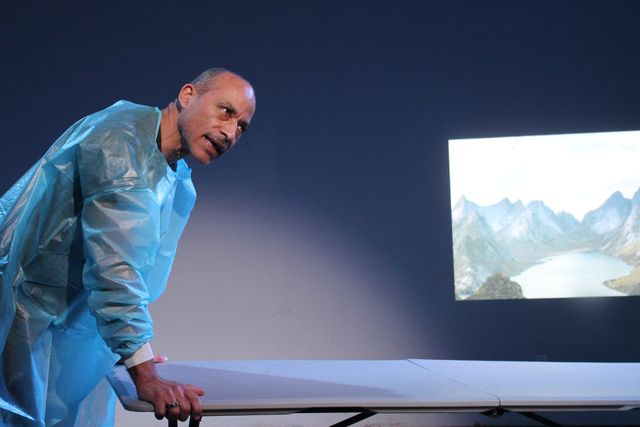
The medical examiner (Marc Gomes) discusses death in Norway in The Wetsuitman

When Westerman asks him what the cause of death was, he essentially throws his hands up, admitting, “I couldn’t even tell you / if he’s been dead three days or three weeks.”

Westerman and Magnussen are joined by another detective, Hustvedt, as they interview anyone who might have information on the missing person, but red herrings keep being dangled in front of them. The investigation goes from Norway and France to Syria and the Netherlands as the cops and a journalist speak with Customs and tourism officials, salespeople, a scientist, a lifeguard, a corporate spokesperson, a beachcomber, refugees, and others, trying to figure out who the Wetsuitman is and how he died.

Eric Brooks, Marc Gomes, Karl Gregory, Amoreena Wade, and Sylvie Yntema do a terrific job portraying more than two dozen characters, with only minimal costume changes; sometimes they even argue over who is going to play whom at any moment, taking over a role in the middle of a scene. They often introduce themselves or each other so the audience knows who is who; for example, Hustvedt explains, “I’m on the case now / Hustvedt / head of missing persons / I’m taking over the investigation / bald spot / big mustache / clenching a cigarette / in my gold teeth.”
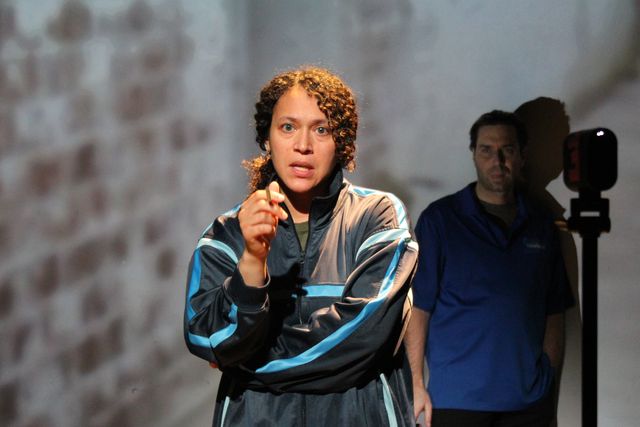
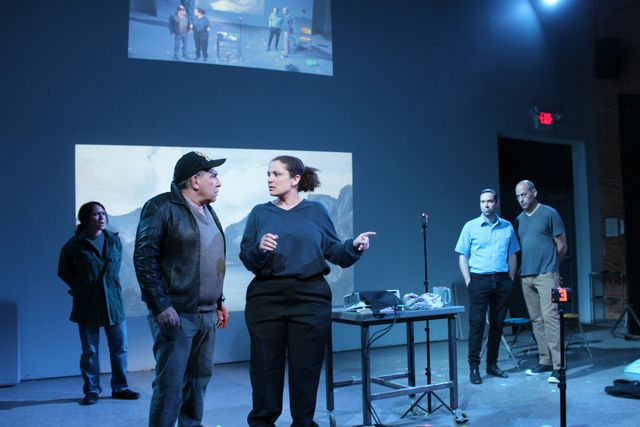
Sylvie Yntema makes a point in English-language premiere of Freek Mariën’s The Wetsuitman

The actors move folding tables and chairs on and off the set to indicate changes of time and space; still photos are projected onto a back screen to add detail to the story, including the geographic location. The livestream is designed by Karen Rodriguez, with multiple cameras offering closeups as well as views from the audience; several attempts at using split screens are not quite successful, but otherwise it definitely feels like a play and not a movie. And for the record, the comment about Renée Zellweger feels out of place, unnecessarily mean-spirited in an otherwise spirited production.

The narrative starts out as a murder mystery but turns into so much more as such issues as race, corruption, and immigration come into focus. During the lockdown, the Cherry presented such fine works as A Day, And What Happens if I Don’t, Hotel Good Luck, and Felt Sad, Posted a Frog (and other streams of global quarantine); I’m glad to see the company is continuing to stream its productions from its upstate home to give us city folk a chance to see it as well.
THE CHERRY: A DAY

The Cherry Artists’ Collective will present English-language world premiere of A Day online

Who: The Cherry Artists’ Collective
What: English-language world premiere
Where: Livestream from the State Theatre of Ithaca
When: November 13-14, 19-21, $15-$45, 7:30; live Zoom discussion Monday, November 16, free with RSVP, 4:00
Why: While theaters are still closed to audiences, many companies are using their spaces to perform works onstage and stream them live and/or recorded online. I’ve seen Yasmina Reza’s ‘Art’ from the San Francisco Playhouse, Albert Camus’s The Fall from FIAF, and Sarah Kane’s Crave from the Chichester Festival Theatre in England (with a masked audience before the new lockdown was announced). From November 13 to 21, the Ithaca-based Cherry Artists’ Collective will present the English-language world premiere of Québecoise playwright Gabrielle Chapdelaine’s 2018 award-winning A Day (Une journée) from the friendly confines of the State Theatre of Ithaca.

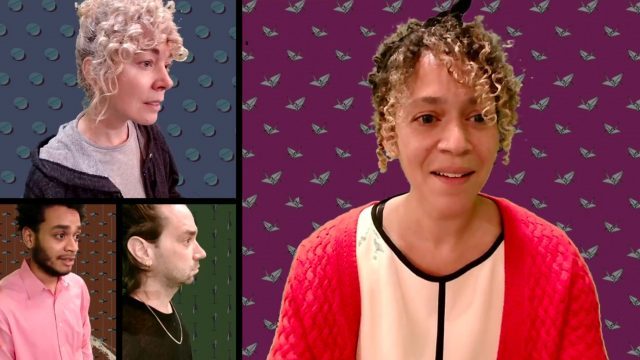
Translated by Josephine George, the ninety-five-minute play covers twenty-four hours in the ordinary life of four mysteriously interconnected characters, portrayed by Karl Gregory, Jahmar Ortiz, Erica Steinhagen, and Sylvie Yntema. The actors will be performing in multicamera green-screen booths at the theater, directed by Wendy Dann, with video mise en scène by Cherry artistic director Samuel Buggeln, mixing live and prerecorded audio and video that features other members of the collective as well. Performances take place November 13-14 and 19-21 at 7:30; tickets are $15 (minimum), $25 (recommended), or $45 (supporter). For a sneak peek, you can check out a short clip from a Zoom rehearsal above. In addition, Chapdelaine and Buggeln will take part in a live Zoom discussion moderated by Mat Fournier on November 16 at 4:00.

FELT SAD, POSTED A FROG (and other streams of global quarantine)

(screenshot by twi-ny/mdr)

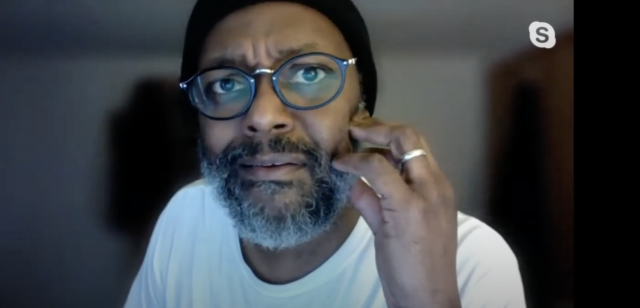
A man (Godfrey L. Simmons Jr.) in Berlin shares his thoughts and fears during the pandemic in six-part online play (screenshot by twi-ny/mdr)

FELT SAD, POSTED A FROG (and other streams of global quarantine)
May 7-8, 7:30, and May 9, 2:30, $15-$35 (depending on what you can afford and how many people are watching with you)
www.thecherry.org

“Why does catastrophe turn me on so much?” asks one of the characters in the Cherry Artists’ Collective’s Felt Sad, Posted a Frog (and other streams of global quarantine). The new play, which premiered last weekend and continues May 7–9, was created specifically for these difficult times; it consists of six interwoven tales related to the coronavirus pandemic, written by playwrights from around the world and performed by actors in their homes, where they are sheltering in place.

I wouldn’t say that catastrophe turns me on; the Covid-19 crisis has been a rocky rollercoaster ride and will be for quite some time to come, eliciting an ever-changing onslaught of emotional (and physical) upheaval. For the first several weeks following the March 12 shutdown, I was in a quandary. As someone who has been covering art and culture in New York City since May 2001, I didn’t know what to do with myself, with no plays, art exhibitions, concerts, films, dance programs, food festivals, or book launches to attend and write about. I’ve always focused on events that require people to get off their couches and leave their residence, and now we were all stuck inside. While Netflix bingeing can serve its purpose, it’s not a replacement for live entertainment.

My last post prior to the shutdown was, ironically enough, a March 11 review of a stirring production of Young Jean Lee’s We’re Gonna Die at Second Stage. For the next month, I wrote only a few pieces about public sculpture; I usually post two or three times a day, but I didn’t have anything to cover while creators were dealing with the shuttering of their outlets. Part of me reveled in the newfound freedom I had, even though I was trapped at home, but I could also feel my motivation fading away. And then came Zoom (and Instagram Live and Facebook Watch Parties) and a whole new approach to livestreaming — which brings us back to the Ithaca, NY–based Cherry.

(screenshot by twi-ny/mdr)

A single woman (Erica Steinhagen) gets virtual dating advice from WikiHow (Dean Robinson) in brightness of the screen warming our skin (screenshot by twi-ny/mdr)

I watched a seven-minute prerecorded short film about a Zoom meeting. I checked out new dance performances, unfiltered celebrity interviews. I saw a live fifteen-minute Zoom opera about a Zoom meeting. Prior to the pandemic, I was obsessed with FOMO, a fear of missing out on a cool event when I was already at a different cool event. Before arts organizations started figuring out what to do during the shutdown, my life actually got a bit more peaceful and calm, if not necessarily exciting. But what was initially a trickle of livestreaming arts turned into a barrage, and the conflicts were unnerving me. Should I watch experimental theater or a conversation and viewer Q&A with a favorite artist, which were happening at the same time? I needed, craved live stimulation, watching something with other people simultaneously. And then I was invited to Felt Sad, Posted a Frog (and other streams of global quarantine), a live two-hour show about how various men and women were dealing with sheltering in place, written by six playwrights from around the world, performed by actors in their homes. I was giddy with anticipation, ready to experience live theater again, prepared to sit down at my computer and pretend that I was at the venue. Even though I could pause the show and come back to it later, I was determined to make it through the entire play without getting up to get a drink, without checking Facebook, without going to the bathroom, without answering the telephone, as if I were in my seat on the aisle and not alone in my home office. It turned out to be so much harder than I imagined.

Directors Samuel Buggeln and Beth F. Milles shift back and forth among six distinct tales. In German playwright Rebekka Kricheldorf’s Felt Sad, Posted a Frog, a man in Berlin (Godfrey L. Simmons Jr.) is keeping a video diary, making short statements about what he is going through. He keeps going to the open closet behind him, as if it might contain some answers. In Argentine film director Santiago Loza’s Buenos Aires, a recently separated older couple (Nora Susannah Berryman and Rafael Eric Brooks) deal with their sudden isolation after having been together for so long; it’s the only section that contains visual, cinematic elements involving light and color.

Romanian-American writer, poet, and journalist Saviana Stanescu’s Zoom Birthday Party gathers Oana (Helen T. Clark), a college student in New York, her brother, Radu (Joseph D’Amore), who is with their grandparents in Oești, Romania, and their mother, Lia (Elizabeth Mozer), who is taking care of a handsy elderly man in Milan; Oona’s online birthday celebration doesn’t go quite as planned. In Salvadoran playwright Jorgelina Cerritos’s After, a woman in San Salvador (Natasha Lorca Yannacañedo) worries about her family while a narrator (Jeffrey Guyton) watches over her from above. A man from WikiHow (Dean Robinson) in a small frame at the top right gives advice to a single woman (Erica Steinhagen) obsessed with dating in Iva Brdar’s brightness of the screen warming our skin, which is set in the playwright’s native Belgrade. And in National Book Award finalist Lyrae Van Clief-Stefanon’s untitled segment, Jamie (Amoreena Wade), Chelle (Cynthia Henderson), and Coretta (Sylvie Yntema) are in Upstate New York, hopeful for the future.

(screenshot by twi-ny/mdr)

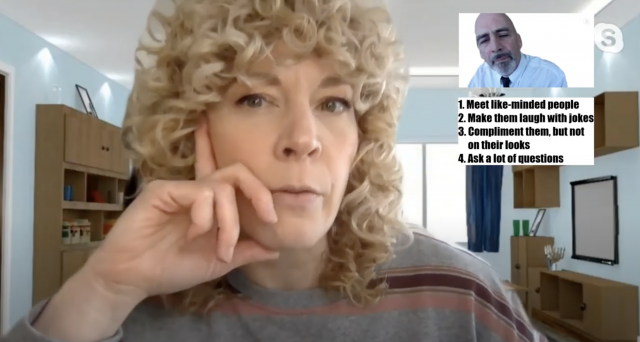
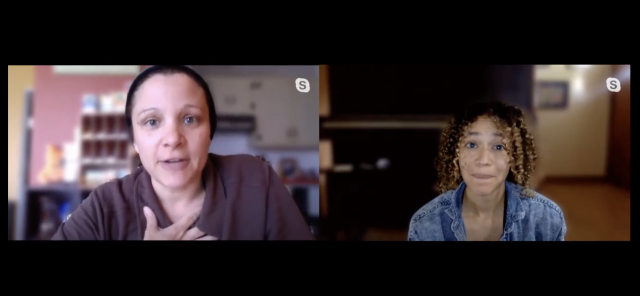
Jamie (Amoreena Wade) and Coretta (Sylvie Yntema) have an online confab in Lyrae Van Clief-Stefanon’s segment of Felt Sad, Posted a Frog . . . (screenshot by twi-ny/mdr)

The six sections explore a potpourri of pandemic problems, from toilet paper, essential services, cats, and misinformation to bats, race, alcohol, and salvation. Some of the vignettes are more successful than others, with the work of Simmons Jr., Yntema, and Steinhagen standing out. Noah Elman effectively handles the live video mixing and design. (Be prepared to see a lot of nostrils.)

Although I did indeed view the show straight through, uninterrupted, it was not easy. At more than two hours, it is too long; it just kept going and going, eventually making me angry, although I enjoyed it overall. But at least part of that reaction might have been more of my FOMO; throughout the play, the temptation to check my email, post something on Facebook, look for news updates about the virus, see what my family was up to, etc., was simply overwhelming. It’s not even about the quality of the production; I’ve been unable to sit through all of the National Theatre Live presentation of Frankenstein with Benedict Cumberbatch and Jonny Lee Miller, and it took me three days to finish Albert Serra’s extraordinary film Liberté. I was able to read a short story in the New Yorker by Haruki Murakami but am making ridiculously slow progress on his latest novel.

I feel like Jimmy Stewart in Alfred Hitchcock’s Rear Window, whose character, photographer L. B. Jefferies, is stuck in his New York City apartment, confined to a wheelchair as he recovers from a broken leg. The antsy Jeff hangs out by the window, using binoculars to peer into the rooms across the courtyard; they used to represent different television channels, each depicting a different genre, but now they mimic a Zoom meeting screen or the endless websites that offer alternative forms of entertainment these days. We’ve trained our brains to jump from window to window, whether browser or app, with no small amount of help from clever advertising tech fiends eager for precious seconds of our attention. Jeff eventually focuses on one specific apartment, where a murder might have taken place. Now I have to figure out a way that I can do the same, concentrate on one play, dance, concert, interview, art tour, etc., at a time and not wilt under the barrage. And yes, I did post a frog.