Tag Archives: Susan Pourfar

NOT JUST BLACK AND WHITE: MEET THE CARTOZIANS AND ARMENIAN AMERICAN HERITAGE

Lawyer Wallace McCamant (Will Brill) seeks to help Armenian immigrants gain US citizenship in Meet the Cartozians (photo by Julieta Cervantes)

MEET THE CARTOZIANS
Second Stage Theater at the Pershing Square Signature Center
The Irene Diamond Stage
305 West 43rd St. between Eighth & Ninth Aves.
Tuesday – Sunday through December 14, $69-$125
2st.com/shows

Talene Yeghisabet Monahon makes a giant leap forward with her exquisitely rendered new play, Meet the Cartozians, a timely and sensitive tale of immigration, assimilation, racial profiling, and culture. The first act takes place in 1923–24 in Portland, Oregon, as Tatos Cartozian (Nael Nacer), an Armenian-born Christian, and his family must fight to prove he is white to prevent the US government from canceling his naturalization. The second act occurs one hundred years later in Glendale, California, as four American-born Armenians prepare to share stories celebrating their heritage on a reality show hosted by an immensely popular celebrity influencer (Tamara Sevunts) who is a descendant of that family.

“We are all trying to uh, let’s say, make sense? Of why this is happening now,” Hazel (Obie winner Susan Pourfar), Tatos’s daughter, says to their well-heeled lawyer, Wallace McCamant (Tony winner Will Brill), in 1923, a sly reference to the treatment of immigrants and people of color today.

A century later, Alan O’Brien (Brill), a production tech on the TV program Meet the Cartozians, tells the guests, “So let me get this straight. The original Cartozians fought to be white so that Armenians could have privileges, right? And now, it sort of feels like Armenians are fighting to not be white . . . so you can like, get more privileges. Am I right about that?”

In 1923, Tatos, a soft-spoken man who speaks heavily accented broken English, lives in a lovely home with his wife (Sevunts), their daughter, Hazel, and his mother, Markrid (two-time Tony winner Andrea Martin). While Hazel and her brother, the impeccably attired Vahan (Raffi Barsoumian), are adapting to the American way of life, the stern Markrid is trying to preserve as much Armenian tradition as she can. After insisting that Wallace take a piece of her homemade kadayif, a sweet dessert, and seeing that he has not finished it, she is offended. Hazel asserts, “I’m sorry. In Armenia, it is a bit rude not to eat. But in America, I think maybe it is rude to force someone to eat.” When Markrid brings out a plate of the sesame-based simit, Wallace declines to taste one, further upsetting Markrid.

Talking about the case, Wallace says, “In 1790, the good men who founded this country extended the offer of naturalized citizenship to all ‘free white persons of good character.’ That was who they felt oughta become American citizens.” Vahan, who works with his father, sister, and naturalized uncle in the family’s successful oriental rug business, proclaims that they are solid white Christians, but Wallace explains that other factors are involved, including skin and hair color, eye and face shape, and “the terrific tendency of Armenians to intermingle and procreate with white populations all over the world.” Wallace commiserates with the Cartozians, pointing out that his paternal grandfather emigrated from Ireland during the potato famine and experienced bigotry when he first came to America.

They also refer several times indirectly to the genocide of approximately 1.5 million Armenians at the hands of the Ottoman Empire during WWI, leaving them without a nation. “It is no longer a place,” Tatos says. Hazel counters, “I think it is fine to say Armenia still. I say Armenia when I speak of home.” Tatos responds, “This is our home. Portland. America.”

The cast of Meet the Cartozians portrays different characters in 1924 and 2024 (photo by Julieta Cervantes)

In 2024, Robert Zakian (Nacer), Rose Sarkisian (Martin), and Nardek Vartoumian (Barsoumian) are in the home of Leslie Malconian (Pourfar), which features a Christmas tree, a rack of clothes, film equipment, an oriental rug, and an empty chair facing a table and a couch. The four TV guests, who have never met before, select over-the-top costumes that are supposed to represent their heritage, but they have become so Americanized that they don’t really know that much about where they came from.

When Leslie brings out two plates of homemade simit, one gluten-free, Rose starts an argument about Armenian cuisine, which she is not fond of. “I miss the food Mama made,” Robert says wistfully, a potent comment since the actors portraying Robert and Rose played Tatos and Markrid in the first act. Alan, whose family, like Wallace’s, emigrated from Ireland, tries to commiserate with the Armenians, pointing out that his paternal grandfather experienced bigotry when he first came to America and was not considered to be white; Brill plays both Alan and Wallace.

As the characters await the arrival of the host, they get into heated discussions about Armenian history, cultural appropriation, skin color, politics, and the genocide. Praising an episode of the series in which the host visited Armenia, Rose notes, “Most people in the world never knew what the Armenian genocide was before that. Many people didn’t even know that Armenia was a country before that.” Nardek adds, “A lot of people still don’t, sadly.”

They certainly will know after seeing Meet the Cartozians.

The play was inspired by the pop-culture phenomenon Keeping Up with the Kardashians, the reality show that detailed the lives of the Armenian American Kardashian clan for twenty seasons, and the actual 1925 court case United States v. Cartozian, in which the Portland firm of McCamant & Thompson represented rug dealer Tatos Osgihan Cartozian in his quest to gain American citizenship.

Monahon, a Massachusetts-born, New York City–based actor and playwright of Armenian and Irish descent, has previously explored historical fiction in The Good John Proctor (the Salem witch trials), Jane Anger (the 1606 London plague), and How to Load a Musket (Revolutionary and Civil War reeanactors). In Meet the Cartozians, Monahon has superbly melded fact and fiction, expertly linking the two different time periods and relating the action in both eras to today’s arrest, deportation, and murder of legal and illegal immigrants, often based on racial profiling. Tatiana Kahvegian’s sets and Enver Chakartash’s costumes further delineate the differences Armenians experienced in 1924 and 2024.

Monahon and Tony-winning director David Cromer (Prayer for the French Republic, A Case for the Existence of God) have created believable characters involved in convincing situations that, although they are specifically about Armenian Americans, also relate to so many others who have come to the United States in search of a better life. The outstanding cast includes three actors of Armenian descent, Barsoumian, Sevunts, and Martin, whose name adorns the Andrea Martin Performing Arts Auditorium in Armenia.

As funny as Meet the Cartozians is, it also tackles ongoing complex sociopolitical issues that are pervasive in modern-day America, under the current administration; even Kim Kardashian herself went public with criticism of President Donald Trump’s immigration policies, particularly how ICE is tearing families apart. Somewhere, the Cartozians are smiling down on her and Monahon as the battle continues.

[Mark Rifkin is a Brooklyn-born, Manhattan-based writer and editor; you can follow him on Substack here.]

MOTHERS DAY ON BROADWAY: MARY JANE / MOTHER PLAY

Jessica Lange is mesmerizing as a troubled matriarch in Mother Play (photo by Joan Marcus 2024)

MOTHER PLAY
Helen Hayes Theater
240 West 44th St.
Tuesday – Sunday through June 16, $108-$270
2st.com/shows

Mothers and motherhood have always taken center stage on Broadway, from Rose in Gypsy, Fantine in Les Misérables, and Heidi in Dear Evan Hansen to Mary Tyrone in Long Day’s Journey into Night, Amanda Wingfield in The Glass Menagerie, and Canteen Anna in Mother Courage and Her Children. This Mother’s Day is an ideal time to pay tribute to two extraordinary semiautobiographical plays now on Broadway, each focused on a unique mom.

At the Helen Hayes through June 16, Tony, Oscar, and Emmy winner Jessica Lange is starring as Phyllis Herman in Paula Vogel’s Mother Play — A Play in Five Evictions. As the audience enters the theater, a soundtrack is playing mother-related pop songs, from the Beatles’ “Your Mother Should Know” to the Mothers of Invention’s “Mother People,” getting everyone in the mood.

The story takes place from 1962 to the present as Phyllis and her two children, Carl (Jim Parsons) and Martha (Celia Keenan-Bolger), keep moving apartments, going up a floor each time, trying to improve their lot in life. Phyllis is a supreme diva, laying out on a fancy chair and having her kids light her cigarettes and serve her martinis. Her husband left years before and is out of the picture; Phyllis works in a typing pool but imagines herself enrobed in haute couture like Audrey Hepburn.

The memory play is narrated by Martha, who tells the audience at the beginning, “By age eleven, I had already moved seven times. My father had a habit of not paying rent. My mother, brother, and I could pack up our house in a day. A very useful skill. To know what household goods are in every box so one can also unpack in a day. Family in, family out. When I packed up my brother Carl’s apartment after he died, everything he loved fit into one medium size U-Haul box. There is a season for packing. And a season for unpacking.”

There’s a lot of packing and unpacking in the play, literally and figuratively. Whenever the family moves, they rearrange David Zinn’s set, using the same furniture, although different lighting fixtures come down from above. Phyllis insists on listening to old songs on the radio — her favorite is “Moon River,” which Hepburn sang in Breakfast at Tiffany’s — while her children attempt to listen to more modern music but are unable to get their mother out of the past.

Early on, Carl asks, “It’s over, isn’t it?” Martha replies, “What?” Carl answers, “Childhood.”

Carl and Martha have to grow up fast, catering to their mother’s needs, as opposed to her taking care of theirs. She does have a magic purse from which she can suddenly pull out a bag of McDonald’s, but she lacks almost any kind of mothering instinct. It gets worse when Carl tells her he is gay, as she angrily banishes him from their home. And she has little hope for Martha, who she calls “unremarkable,” believing the best she can do is “find an unremarkable man who doesn’t have enough imagination to cheat and drink and whore himself around town like her father does. After a year of learning how to cook, Martha will get a bun in the oven, and give me a grandchild. Because, honey, you are never a true woman until you have children.”

Phyllis might not win any Mother of the Year contests, as she admits herself, but she is not a monster. She works hard to keep a roof over their head, even if there are occasional roach problems, but she doesn’t help matters when she says she never wanted to have children, coldly explaining to Martha, “It’s a life sentence.”

The closing scenes are emotionally gut-wrenching, avoiding genre clichés as some threads are resolved and others remain packed away in boxes, perhaps never to be opened again.

Phyllis (Jessica Lange) seeks solace from her son (Jim Parsons) and daughter (Celia Keenan-Bolger) in new Paula Vogel play (photo by Joan Marcus 2024)

Pulitzer Prize winner and three-time Tony nominee Vogel (How I Learned to Drive, Indecent) based Mother Play in part on her life. Vogel, who has been married to author and professor Anne Fausto-Sterling since 2004 and does not have any children, had a brother named Carl who died of AIDS; her other brother is Mark. Their parents divorced when she was eleven, the same age as Martha in 1962, and Vogel’s mother was a secretary for the United States Postal Service, a job that Phyllis gets in the play.

But Vogel is such a potent writer that Mother Play feels intimate and personal but never overly confessional or didactic. Except for one out-of-place scene, the narrative flows with a natural sensibility that is transfixing, directed by Landau (SpongeBob SquarePants Big Love) with a powerful fluency.

Keenan-Bolger (A Parallelogram, The Glass Menagerie) and Parsons (A Man of No Importance The Boys in the Band) are exceptional as the siblings, who are caught up in a seemingly unwinnable existence but refuse to give up. As psychologically tortured as they are by their mother, they still know when to do the right thing for the family. Keenan-Bolger, Parsons, Vogel, and Lange all received well-deserved Tony nominations.

Lange is magnificent as Phyllis; she gives a grand dame performance that you can’t take your eyes off of. At seventy-five, Lange, who has three children, continues to hone her craft with grace and elegance while not being afraid to reach deep inside her. She has previously portrayed Mary Tyrone (Long Day’s Journey into Night) and Amanda Wingfield on Broadway, and Mother Play completes a kind of unofficial trilogy in style.

Rachel McAdams is sensational as the mother of a seriously ill child in Mary Jane (photo by Matthew Murphy)

MARY JANE
Samuel J. Friedman Theatre
261 West Forty-Seventh St. between Broadway & Eighth Ave.
Tuesday – Sunday through June 16, $80-$328
www.manhattantheatreclub.com

The concept of Mother’s Day goes back to before the Civil War, but it began to take shape in 1868 when Ann Reeves Jarvis started Mothers’ Friendship Day as a way to bring together Union and Confederate families, and then in 1870 when abolitionist and suffragist Julia Ward Howe, author of “The Battle Hymn of the Republic,” presented the Mother’s Day Proclamation for Peace. In 1904, Fraternal Order of Eagles Past Grand Worthy President Frank E. Hering called for a day to honor mothers everywhere; he later became known as the Father of Mother’s Day. President Woodrow Wilson, who had fought against women’s right to vote, proclaimed Mother’s Day a national holiday in May 1914.

On this Mother’s Day, Phyllis Herman may understand that she is not going to be named Mother of the Year, but Mary Jane has a much better shot at it.

In Amy Herzog’s exquisitely rendered Mary Jane, continuing at MTC’s Samuel J. Friedman Theatre through June 16, Rachel McAdams makes a sensational stage debut as the title character, a single mother raising a seriously ill child who requires round-the-clock care. Mary Jane is a kind of saint; she navigates through her complicated circumstances with a smile even as she sacrifices her career and personal life to devote nearly every minute to Alex, who is essentially being kept alive by machines.

Mary Jane does not complain about her husband’s leaving shortly after Alex’s premature birth. She refuses to report one of Alex’s nurses for falling asleep on the job and endangering him. She gives important advice to a woman (Susan Pourfar) who has just had a child like Alex. And she finds the time to listen to other people’s problems and concerns, not concentrating solely on her situation.

Mary Jane lives in a one-bedroom apartment in Queens, where she sleeps on a foldout bed in the living room/kitchen. She is friendly with her most dependable nurse, Sherry (April Matthis), as well as with her dedicated super, the tough-talking, straight-shooting Ruthie (Brenda Wehle). She encourages Sherry’s shy, neurodivergent niece, Amelia (Lily Santiago), who would like to meet Alex.

While fixing a clog in the kitchen sink, Ruthie tells Mary Jane, “You seem to be someone who’s carrying a lot of tension in her body. . . . You’re very nice, very pleasant, you’re very pleasant and with what you’re dealing with I wonder if you have an outlet for expression or if you’re absorbing that all in your body. It’s just a thought. It might not be a useful thought. . . . Because that’s how my sister got cancer.” It’s an astute observation that is all too true.

Mary Jane’s job, and health insurance, is in jeopardy when Alex is hospitalized for months after a seizure. At the hospital, Mary Jane speaks with Chaya (Pourfar), a Hasidic woman with seven kids, including one in the same situation as Alex. Chaya has a more practical point of view with more hope for the future; it’s no coincidence that her name means “life” in Hebrew and that her sick daughter’s name, Adina, means “delicate” or “gentle.” In the Bible, Adina is the mother of two of the matriarchs, Rachel and Leah.

At the hospital, Mary Jane speaks with Dr. Toros (Matthis), who strongly advises she get some rest. “I’ve seen a lot of parents come through here. It’s important to take care of yourself. Sleep in your own bed, take a bubble bath,” the doctor says, but Mary Jane insists she’s okay. Dr. Toros calls Mary Jane “mom,” perhaps because she knows Mary Jane will never hear that word from Alex. But the cracks start showing up when Kat (Santiago), the music therapist, has not shown up yet to sing to Alex.

Mary Jane (Rachel McAdams) and Chaya (Susan Pourfar) share their stories while on the pediatric floor of a Manhattan hospital (photo by Matthew Murphy)

Pulitzer finalist and three-time Tony nominee Herzog (A Doll’s House, 4000 Miles) based Mary Jane in part on her life. Herzog and her husband, Tony-winning director Sam Gold — the partners collaborated for the first time on the current Tony-nominated adaptation of Henrik Ibsen’s An Enemy of the People at Circle in the Square — had two daughters, but their eldest, Frances, died from nemaline myopathy in 2023 at the age of eleven.

In Mother Play, the set remains the same but the furniture is moved around for each scene. In Mary Jane, Lael Jellinek’s set undergoes a major change when the action shifts to the pediatric ICU of a Manhattan hospital; what happens to Mary Jane’s living room/kitchen is pure genius, adding an extra level of insight to the story.

Herzog and director Anne Kaufman (The Sign in Sidney Brustein’s Window, The Nether) premiered the play at Yale Repertory Theatre in April 2017, then brought it to 2017 at New York Theatre Workshop that September, with Carrie Coon as Mary Jane, Liza Colón-Zayas as Sherry and Dr. Toros, and Danaya Esperanza as Amelia and Kat. Pourfar (Mary Page Marlowe, Tribes) and Wehle (The Big Knife) do a fine job reprising their roles on Broadway, with Obie winner Matthis (Primary Trust, Toni Stone) excelling as Sherry and Dr. Toros, and Santiago (King Lear, Mac Beth) making a fine Broadway debut as the curious Amelia.

Making her New York City theatrical debut at forty-five, Oscar nominee McAdams (The Notebook, Mean Girls) is magnificent as Mary Jane, commanding the stage and the audience’s attention as if she were a seasoned theater pro. McAdams, who has two children, imbues her character with a positive attitude that belies, deep down, her carefully controlled anxiety. Mary Jane wants to do all the right things as a mother, but, as with Phyllis, finances get in the way, and the definition of “a life sentence” is very different. However, there is a key moment when Mary Jane wonders if what she’s doing is right for Alex himself, something that never occurs to Phyllis.

The play, which earned four Tony nods, for McAdams, Herzog, Kaufman, and sound designer Leah Gelpe, concludes with a fascinating scene that seems to unfold in its own time and space, in which Mary Jane finally opens up. It’s funny, strange, and heart-wrenching, a moving coda to a powerful, emotional experience.

[Mark Rifkin is a Brooklyn-born, Manhattan-based writer and editor; you can follow him on Substack here.]

MARY PAGE MARLOWE

(photo by Joan Marcus)

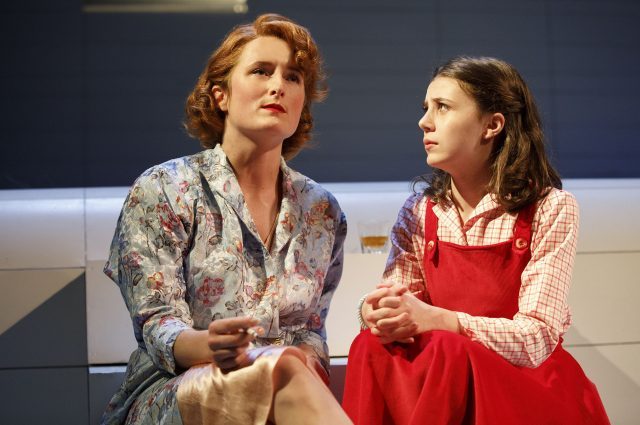
Twelve-year-old Mary Page (Mia Sinclair Jenness) looks up to her mother (Grace Gummer) in extraordinary Tracy Letts play (photo by Joan Marcus)

2econd Stage Theater
Tony Kiser Theater
305 West 43rd St. between Eighth & Ninth Aves.
Tuesday – Sunday through August 19, $30-$89
2st.com/shows

“I am unexceptional,” the title character tells her shrink in Mary Page Marlowe, Pulitzer Prize winner Tracy Letts’s exceptional play, which opened tonight at 2econd Stage’s Tony Kiser Theater. The best play I’ve ever seen about the life and times of a woman written by a man, Mary Page Marlowe follows the protagonist, born in 1946, through eleven nonchronological stages of her rather ordinary existence, portrayed by six terrifically talented actresses and one doll (as the infant). Each scene reveals small but significant details about the character as she goes about her days as a daughter, a wife, a mother, a patient, an employee, and a retiree, trying to find her identity as her relationships — and her name — change. Whether she ever finds her true self — if there even is such a thing — is the question of the play. Mary Page is wonderfully performed by Mia Sinclair Jenness at twelve, Emma Geer at nineteen, Tatiana Maslany (in her New York stage debut) at twenty-seven and thirty-six, Susan Pourfar at forty and forty-four, Kellie Overbey at fifty, and Blair Brown at fifty-nine, sixty-three, and sixty-nine. The nonlinear time shifts are indicated primarily by the character’s clothing (the simple but effective costumes are by Kaye Voyce) and hairstyle as such basic props as beds, tables, couches, and chairs slide on and off Laura Jellinek’s intimate two-level set, making it clear this is about one woman’s interior and exterior changes, not about a changing America.

(photo by Joan Marcus)

Fifty-nine-year-old Mary Page (Blair Brown) gets some bad news as Ray (Brian Kerwin) looks on in masterful production at 2econd Stage (photo by Joan Marcus)

From childhood to senior citizenship, Mary Page faces illness, divorce, alcoholism, infidelity, displacement, and more, all with the same attitude, as if various key moments in her life are no different from the rest of her days; sometimes the choices aren’t hers, but even when they are, she is often a spectator, much like the audience. “What do you want?” her teenage daughter, Wendy (Kayli Carter), asks at a Denny’s as her younger brother, Louis (Ryan Foust), plays with a map. “Why can’t you just say what you want?” Wendy repeats when her mother avoids the question. Throughout the ninety-minute intermissionless play, Mary Page says “I don’t know” two dozen times, although she also does provide some answers. When her shrink (Marcia DeBonis) asks her why she hasn’t brought up what she believes to be a certain important issue previously, Mary Page says, “Because it’s not relevant, that’s what I’m telling you, it feels like a different person who was going through that,” eliciting a laugh from the audience since each Mary Page is played by a different actress. She then adds, “I still live life even when you’re not watching me,” as if reminding the audience that there is even more to Mary Page than what is revealed onstage, just as there is more to any woman we see in real life. But even when she does — or doesn’t — take action for her own benefit, she shows a resilience to persist, a well-earned survival instinct that keeps her going despite what are sometimes formidable odds.

(photo by Joan Marcus)

Thirty-six-year-old Mary Page (Tatiana Maslany) faces off against her shrink (Marcia DeBonis) in dazzling New York premiere (photo by Joan Marcus)

Letts (August: Osage County, Superior Donuts) and director Lila Neugebauer, who has excelled helming such ensemble pieces as The Antipodes, Everybody, The Wolves, and The Wayside Motor Inn, do a beautiful job moving from scene to scene; even though events happen out of order, Mary Page is in a constant state of progression. We might not ever see them together (at least not until the curtain call), but the six amazing women who play Mary Page flow into one another seamlessly, helping make her one person with many distinct aspects. The large cast also includes Grace Gummer as Mary Page’s mother and Nick Dillenburg as her father; Audrey Corsa and Tess Frazer as her high school friends, Connie and Lorna; David Aaron Baker and Brian Kerwin as significant others Ray and Andy; Maria Elena Ramirez as her nurse; Gary Wilmes as one of her lovers; and Elliot Villar as her dry cleaner, who wraps everything up as they talk about fixing a quilt in which “different women would sew the different panels and then stitch them all together,” just as Letts, Neugebauer, and the cast have so remarkably done in this extraordinary work.

MARY JANE

(photo by Joan Marcus)

Sherry (Liza Colón-Zayas) and Mary Jane (Carrie Coon) check Alex’s meds in moving, bittersweet drama (photo by Joan Marcus)

New York Theatre Workshop
79 East Fourth St. between Second & Third Aves.
Tuesday – Sunday through October 29, $79
www.nytw.org

The audience never gets a good look at Alex, a seriously ill child, in Amy Herzog’s heart-wrenching and bittersweet Mary Jane. That’s because he’s more than just a chronically sick boy; in the beautifully rendered play, running at New York Theatre Workshop through October 29, he’s representative of the many fears, real and imagined, that haunt us all. Carrie Coon is extraordinary as Mary Jane, a thirtysomething single mother living in a small apartment in Queens with her two-and-a-half-year-old son, Alex, who was born prematurely and requires machines and full-time supervision to keep him alive. A former teacher, Mary Jane works as an administrative assistant for a real estate developer to get health insurance, but the demands of caring for Alex constantly jeopardize that job. As the play opens, the building super, Ruthie (Brenda Wehle), is trying to fix a clog in the sink when she notices that Mary Jane has removed the window guard, which is against the law. “It’s just that he loves looking out the windows, especially when he’s sick and I can’t take him outside?” Mary Jane says. “And it seems like such a small thing but the bars actually do bother him.” We don’t know whether they really bother Alex or not, or whether Mary Jane is projecting her feelings of entrapment in the immensely difficult situation. Alex has several at-home nurses, but the most dedicated is Sherry (Liza Colón-Zayas), who has practically become part of the family; one afternoon she brings over her niece, college student Amelia (Danaya Esperanza), who wants to meet Alex but is taken aback when he doesn’t even seem aware of her presence. A naturally upbeat and helpful person, Mary Jane is also guiding Brianne (Susan Pourfar), a friend of a friend who has a child with similar health issues as Alex. Mary Jane wants to keep Alex out of the hospital, but she has no choice after he suffers a bad seizure and deteriorates. At the hospital, she speaks with the abrupt and direct Dr. Toros (Colón-Zayas); Chaya (Pourfar), a Hasidic woman with a daughter in the same room as Alex; and Tenkei (Wehle), a former teacher and newly ordained Buddhist monk. Meanwhile, she’s on the lookout for Kat (Esperanza), the mysterious music therapist. “There is no more normal,” Sherry tells Mary Jane early on. No, nothing is normal, anywhere, in this brilliantly realized world created by Pulitzer Prize finalist Herzog and two-time Obie-winning director Anne Kauffman.

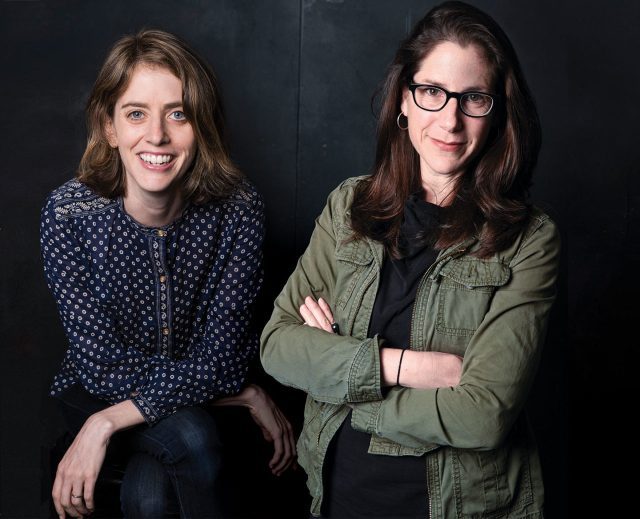
Amy Herzog and Anne Kaufman

Amy Herzog and Anne Kaufman have teamed up on the beautiful, heart-wrenching Mary Jane at NYTW

Mary Jane is primarily about a single mother caring for her seriously ill child, yet it is also about so much more, particularly fear and faith. Alex spends nearly the entire play unseen by the audience while Laura Jellinek’s (The Nether, The Wolves) set magically morphs from apartment to hospital before our very eyes. The clever setup takes a cue from her recent Broadway design for Marvin’s Room, in which the aging, ill Marvin is onstage for much of the show but is also essentially unseen, in bed in the back, only occasionally visible in silhouette. It’s a key choice in Mary Jane, as Alex is more than just one specific sick boy; instead, he’s symbolic of the personal crises and potential disasters so many of us face every day. In fact, the word “disaster” is used numerous times throughout the show; Brianne works in disaster management, Mary Jane blames an indecipherable note on her phone as an “autocorrect disaster,” Chaya speaks of the need not to get too overwhelmed by disaster, and Amelia mentions having recently visited the 9/11 Museum with her aunt. Meanwhile, faith becomes a critical topic. “Does my faith make it easier?” Chaya, whose name means “life” in Hebrew, asks Mary Jane, continuing, “I don’t think having a sick child is less painful for me than for people without religion, I don’t think so.” Mary Jane is also very much about women in contemporary society and the problematic health-care system. It’s an all-female cast, and the crew is predominantly made up of women as well. Tony nominee Coon (The Leftovers, Who’s Afraid of Virginia Woolf?) plays Mary Jane with an intoxicating warmth, an everywoman desperately trying to keep on a happy face in extremely difficult times, while the rest of the excellent actors each take on two roles that cleverly relate to each other: Wehle as the philosophical Queens super and the philosophical monk, Colón-Zayas as a nurse and a doctor, Esperanza as a college student and a music therapist, and Pourfar as two very different mothers. “Everybody has stuff,” Mary Jane tells Chaya, who replies, “That’s not true. Some people don’t have stuff. I know a lot of people, in fact, without any stuff at all.” In Mary Jane, there’s certainly a lot of “stuff”: the stuff of life, the stuff of death, and the pain in-between.

WOMEN OR NOTHING

(photo by Joan Marcus)

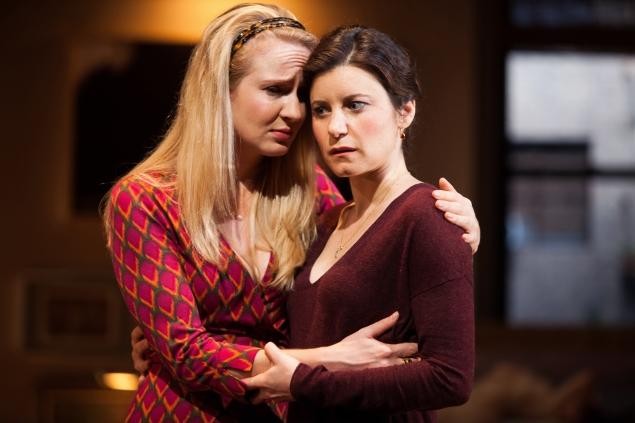
Gretchen (Halley Feiffer) and Laura (Susan Pourfar) come up with a crazy way to have a child in Ethan Coen’s WOMEN OR NOTHING (photo by Joan Marcus)

Atlantic Theater Company
Linda Gross Theater
336 West 20th St. between Eighth & Ninth Aves.
Extended through October 13, $20-$65
866-811-4111
www.atlantictheater.org

Despite a sitcom-y plot and a trio of severely affected female characters who take a while to warm up to, Ethan Coen’s first full-length play, Women or Nothing, manages to be mildly entertaining and pleasantly amusing. Lawyer Gretchen (Halley Feiffer) and concert pianist Laura (Susan Pourfar) want to have a baby, but they don’t want to adopt or go to a clinic and use an anonymous sperm donor; instead, Gretchen has researched a coworker, Chuck (Robert Beitzel), and decided that Laura, a gold-star lesbian who has never been with a man, should sleep with him in order to get inseminated by someone with desirable genes. “Believe me, this man’s semen is superb,” Gretchen tells her girlfriend. “You’re a wine taster now?” Laura responds. Gretchen comes up with a wacky, somewhat devious, and fairly ridiculous plan that she is positive will land the unknowing Chuck in bed with Laura; unfortunately for the audience, things don’t seem so crystal clear, one of many leaps of faith that Coen and director David Cromer (who directed Pourfar in Tribes, Beitzel in Our Town, and Feiffer in The House of Blue Leaves) ask the audience to accept in this uneven but ultimately likable production. The scene between the easygoing Chuck and the pent-up, elitist, and self-deprecating Laura is a gem, with razor-sharp dialogue and outstanding performances as she tries to get him drunk and not give away the reason behind their carefully arranged meeting. The following morning, Laura’s nosy mother, Dorene (Deborah Rush in a star turn), arrives, and the situation gets even more complicated, as each woman learns surprising things about the other.

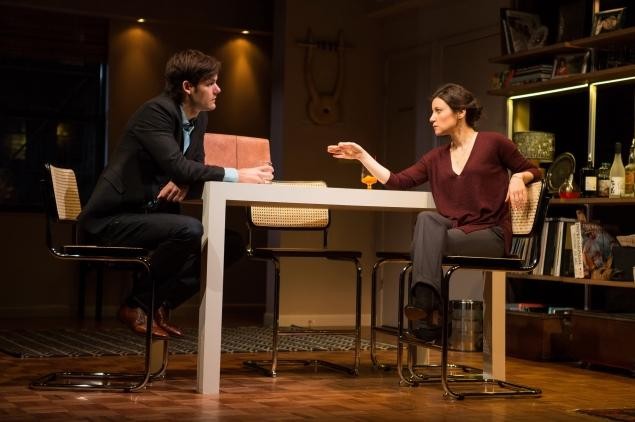
Chuck (Robert Beitzel) has no idea what Laura (Susan Pourfar) has in store for him in WOMEN OR NOTHING (photo by Joan Marcus)

Chuck (Robert Beitzel) has no idea what Laura (Susan Pourfar) has in store for him in WOMEN OR NOTHING (photo by Joan Marcus)

But unanswered questions abound, preventing Women or Nothing from reaching the next level. There are no mentions of condoms or ovulation, and there are numerous red herrings, from a poorly hidden group of family photos to a fancy piano on an upper platform that is never brought into play in any manner whatsoever, toying with the audience’s expectations. Coen, who with his brother, Joel, has made such award-winning films as Barton Fink, Fargo, and No Country for Old Men, has also published a book of short stories and a collection of poetry and has written several one-act plays, including Talking Cure, which was one of three works, along with Elaine May and Woody Allen, that made up the 2011 Broadway flop Relatively Speaking. Thus, on his own, Ethan Coen specializes in the short form, and he has trouble sustaining Women or Nothing for its one-hundred-minute running time, with a brief intermission (even though the program says there will not be one). He and Cromer just can’t quite get past the R-rated Three’s Company set-up, though they try their best, resulting in an amiable, if not wholly satisfying, rendezvous, which has been extended through October 13 at the Atlantic Theater Company’s Linda Gross Theater.

TRIBES

TRIBES examines language and communication in a severely dysfunctional family

Barrow Street Theatre
27 Barrow St. at Seventh Ave. South
Through September 2, $75-$95
barrowstreettheatre.com

Nominated for Outstanding Play and Outstanding Director by the Drama Desk, Nina Raine’s Tribes is an intimate examination of communication, language, and family. Originally presented at London’s Royal Court Theatre in 2010, Tribes delves into the trials and tribulations of a wildly dysfunctional family that emerge when prodigal son Billy (Russell Harvard) suddenly returns home. Although Billy was born deaf, his parents, Christopher (Jeff Perry) and Beth (Mare Winningham), tried not to raise him differently, deciding not to have him learn sign language or be treated as if he has a handicap. Back home, Billy reconnects with his brother, Daniel (Will Brill), a bitter, ne’er-do-well wannabe writer, and his sister, Ruth (Gayle Rankin), who has dreams of becoming an opera singer, while his father spouts off against the establishment and his mother attempts to improbably keep the peace. But when Billy meets Sylvia (Susan Pourfar), a young woman who is slowly losing her hearing because of a genetic condition, he takes a closer look at his upbringing and doesn’t like what he sees. Tribes is a searing, poignant drama that takes place around a central table surrounded on all four sides by the audience, as if the crowd is part of the characters’ extended family. Director David Cromer (Orson’s Shadow, When the Rain Stops Falling) makes excellent use of the tiny space, which subtly references the claustrophobic nature of this rather unwelcoming, extremely selfish and self-absorbed family, then takes things to another level in a series of later scenes that ingeniously explore the world of the deaf. Tribes is a splendid achievement, one of the best plays of the year on or off Broadway.