Tag Archives: Stephanie Berry

OEDIPUS REIMAGINED: THE GOSPEL AT COLONUS ON LITTLE ISLAND

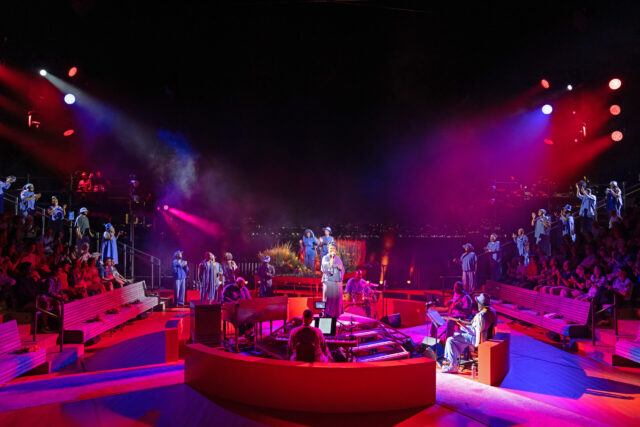
Revival of The Gospel at Colonus on Little Island tells story of redemption and retribution (photo by Julieta Cervantes)

THE GOSPEL AT COLONUS
The Amph at Little Island
Pier 55, Hudson River Park at West Thirteenth St.
July 8-26, $10 standing room, $25 seats sold out, 8:30
littleisland.org

One of the grandest theatrical events of the summer is taking place on Little Island, Shayok Misha Chowdhury’s rousing, impassioned adaptation of Lee Breuer and Bob Telson’s The Gospel at Colonus, a spirited, spiritual retelling of the Oedipus and Antigone myths.

In 1983, Obie winner and Mabou Mines founding co-artistic director Breuer (Mabou Mines DollHouse, Peter and Wendy) teamed up with composer Telson (Chronicle of a Death Foretold, Bantú) to reimagine Robert Fitzgerald’s version of Sophocles’s Oedipus at Colonus as a Pentecostal revival meeting. The show debuted at BAM’s Next Wave Festival and was mounted on Broadway five years later, with Morgan Freeman as the Messenger; Oedipus was portrayed by Clarence Fountain and the Five Blind Boys of Alabama.

A tale of witness and testimony, of redemption and retribution, The Gospel at Colonus is a revelation at the Amph, where it begins each night amid the glow of sunset over the Hudson. David Zinn’s set is bathed in red; much of the action occurs in a broken circle in the center surrounding a four-step platform, in front of a yellow foot bridge running between high grass. Stacey Derosier’s lighting, switching from red to green to blue, illuminates Montana Levi Blanco’s loose-fitting purple and sackcloth gray costumes, a combination of Greek togas and Sunday finest. Garth MacAleavey’s sound design allows nature to mingle with the crisp, clear music and dialogue.

Stephanie Berry (On Sugarland, Déjà Vu) is sensational as the Preacher, serving as a kind of narrator and oracle. “Think no longer that you are in command here, / But rather think how, when you were, / You served your own destruction / Welcome, brothers and sisters, / I take as my text this evening the Book of Oedipus,” she announces at the start. “Oedipus! Damned in his birth, in his marriage damned, / Damned in the blood he shed with his own hand! / Oedipus! So pitifully ensnared in the net of his own destiny.”

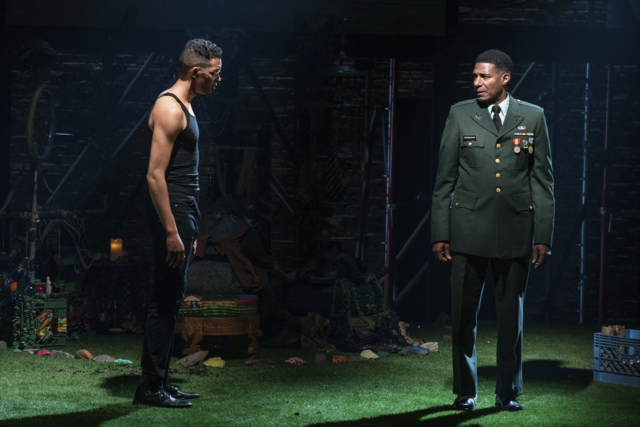
Stephanie Berry, Davóne Tines, and Frank Senior portray different aspects of Oedipus (photo by Julieta Cervantes)

Oedipus — portrayed as a group by blind jazz vocalist Frank Senior, opera bass-baritone Davóne Tines, and Berry — has already blinded himself for having unknowingly killed his father and married his mother, Jocasta, who then hanged herself, and fathered four children with her, two sons, Eteocles and Polyneices, and two daughters, Antigone (Samantha Howard) and Ismene (Ayana George Jackson). Eteocles is a traitor and Polyneices (Jon-Michael Reese) a usurper, taking opposite sides in an upcoming battle, while Antigone and Ismene seek peace.

“Let every man in mankind’s frailty / Consider his last day; and let none / Presume on his good fortune until he find / Life, at his death, a memory without pain. / Amen,” Evangelist Antigone says.

On his journey, Oedipus encounters Jocasta’s brother, Deacon Creon (Dr. Kevin Bond), the former king, who has been tasked with returning Oedipus to Thebes; a friend (falsetto Serpentwithfeet), who welcomes him to Colonus; Pastor Theseus (Kim Burrell), who vows never to drive him away; and the Balladeer (Brandon Michael Nase), who initially refuses Oedipus and Antigone entry into his church and later questions Testifier Polyneices’s attempt to get back in his father’s good graces.

Kim Burrell rips the roof off the joint several times at Little Island (photo by Julieta Cervantes)

Pulitzer finalist Chowdhury (Public Obscenities, Rheology) beautifully flows Breuer’s poetic dialogue (his book earned him a Tony nomination) into Telson’s gospel, blues, and R&B score, featuring Breuer’s potent, emotional lyrics. (Breuer, who died in January 2021 at the age of eighty-three, and Telson, who at seventy-six is still making music, also collaborated on such other projects as Sister Suzie Cinema, The Warrior Ant, and Bagdad Cafe — The Musical.) “Who is this man? What is his name? Where does he come from?” a choragos (Brandon Michael Nase) demands, as if he could be addressing any of us. “Child, I’m so glad you’re here / There’s hope for me / There’s a prophecy . . . I’ve been waiting for a sign / to ease my troubled mind,” Oedipus (Senior and Tines) sings in “Through My Tears.” Oedipus (Tines) later tells Polyneices, “Once you held the power / And when you did you drove me out / Made me a homeless man / You are no son of mine.” But soon Serpentwithfeet is praying, “Let not our friend go down / In grief and weariness / Let some just God spare him / Any more distress” in “Eternal Sleep.”

Burrell tears the roof off the joint — or she would have if the Amph had a roof — in a pair of rip-roaring numbers, “Jubilee (Never Drive You Away)” and “Lift Him Up,” that gets the crowd moving and grooving, hooting and hollering. Among the other notable songs are “Live Where You Can,” “You’d Take Him Away,” and “Evil,” although the finale, “Let the Weeping Cease,” feels unnecessary. Music directors Dionne McClain-Freeney and James Hall lead a terrific band, consisting of McClain-Freeney on piano, Butch Heyward on organ, Bobby Bryan on guitar, Booker King on bass, Jackie Coleman on trumpet, Taja Graves-Parker on trombone, Jason Marshall and Isaiah Johnson on baritone sax, Kevin Walters on alto sax, and Clayton Craddock on drums; the horns perform on high scaffolds at the corners of the stage nearest the river; the superb James Hall Worship & Praise choir includes Pastor Charles, Schanel Crawford, Jaqwanna Crawford, Jacquetta Fayton, Angie Goshea, Robyn McLeod, TJ Reddick, Teddy Reid, Vischon Robinson, Lenny Vancooten, Eugene Marcus Walker, and Darlene Nikki Washington.

In the closing hymn, Serpentwithfeet declares, “There is no end.” That statement is certainly true of the Greek myth of Oedipus; there is no end to the myriad ways this twisted, heart-wrenching can be told, and The Gospel at Colonus on Little Island is among the most inventive, nourishing the soul for ninety glorious minutes.

[Mark Rifkin is a Brooklyn-born, Manhattan-based writer and editor; you can follow him on Substack here.]
STAFF MEAL

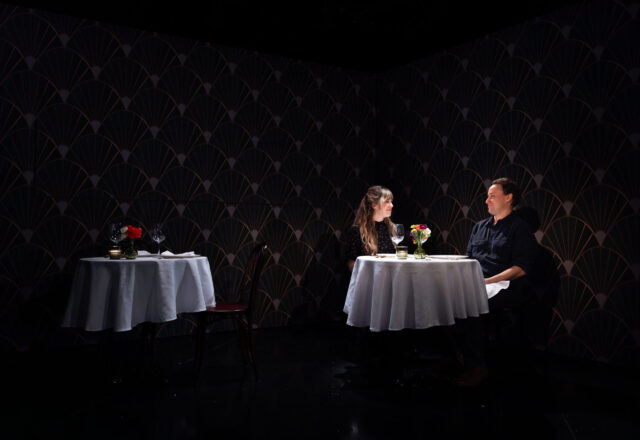
Mina (Susannah Flood) and Ben (Greg Keller) explore a possible relationship as doomsday approaches in Staff Meal (photo by Chelcie Parry)

STAFF MEAL
Playwrights Horizons, Peter Jay Sharp Theater
416 West 42nd St. between Ninth & Tenth Aves.
Tuesday – Sunday through May 24, $71-$91
www.playwrightshorizons.org

Abe Koogler’s Staff Meal kicks off with a tasty amuse bouche, continues with a delicious appetizer, then serves up a tantalizing main course before getting off track with a few awkward sides and an erratic dessert. But that doesn’t mean it ultimately isn’t a meal worth savoring.

Written between January and April 2020, just as the pandemic was starting to take hold of the world, Staff Meal is set in an absurdist time and place where lonely people are desperate for connection. Mina (Susannah Flood) and Ben (Greg Keller) meet-cute in a coffee shop, where they slowly begin speaking with each other while working on their laptops. The first day, Ben says, “Hey,” and Mina answers, “Hey.” The second day, Ben says, “Hey!” and Mina answers, “Hey!” The third day, Ben says, “Hey,” and Mina answers, “Oh hey!,” adding, “All’s well?”

Their less-than-scintillating conversation — Ben: “We had a dog who I used to throw the ball to a lot.” Mina: “Hey, I had a dog too! We used to throw the ball to him too.” — gets a little longer each day until Ben doesn’t show up, which worries Mina. On a trip to the bathroom, she asks an audience member to keep an eye on her computer. A nattily dressed vagrant (Erin Markey) appears from the theater aisle and tries to snatch the laptop just as Mina returns and stops her, shooting the audience member/guard a nasty look. The fourth wall has been broken — and will be again and again — in a nontraditional play overstuffed with convention-defying moments that range from brilliant and hilarious to baffling and confusing.

Ben and Mina decide to grab a bite and wander into a strange restaurant where no one comes to take their order as they delve deeper into who they are. Discussing past lives, Ben says he believes he was a passenger on a ship like the Titanic, but definitely not the Titanic, that sunk around the same time, while Mina thinks she was the rat in the animated film Ratatouille. The waiter (Hampton Fluker) eventually shows up, but only to deliver a monologue to the audience about the restaurant’s mysterious owner, Gary Robinson, and the expansive wine cellar, which is far away in a kind of hellish basement dungeon.

The action then shifts into the past, to the waiter’s first day, when he sat down with two other servers (Jess Barbagallo and Carmen M. Herlihy) to have a staff meal made specially by the chef, Christina (Markey). They rave poetically about the fabulous spread, even though it is clearly only green grapes.

The servers give the waiter advice on how to do his job, including not offending Christina — oops, too late — while the waiter wants to know why everything takes so long to happen in the restaurant, especially the journey to the wine cellar. The servers explain that the establishment is based on Flights of Fancy followed by Acts of Service dedicated to making connections, clear metaphors for life itself with indirect references to the Bible. Gary Robinson is referred to as a “legend” no one ever sees, like a supreme being, with Christina — it’s unlikely the first six letters of her name are mere coincidence — as the earthbound figure precisely following the recipes in his books.

In fact, the servers call out iterations of “Oh god” four times while partaking of the duck, which is actually grapes, the biblical fruit about which Jeremiah said, “But every one shall die for his own iniquity; every man who eats the sour grapes, his teeth shall be set on edge.” It also evokes how the public can lift a chef to godlike status and their restaurant to a kind of holy space, complete with scallop shell wallpaper, the emblem of St. James that relates to the physical and spiritual aspects of the human condition.

In case you’re getting lost at this point, Rita (Stephanie Berry) declares, “I’m sorry, WHAT IS THIS PLAY ABOUT???????!?!?!?!?!”

Things only get more bizarre and existential as the characters seek “sweet relief” in a city endangered by e-commerce, empty streets, and the breakdown of the social contract as everything literally falls apart around them.

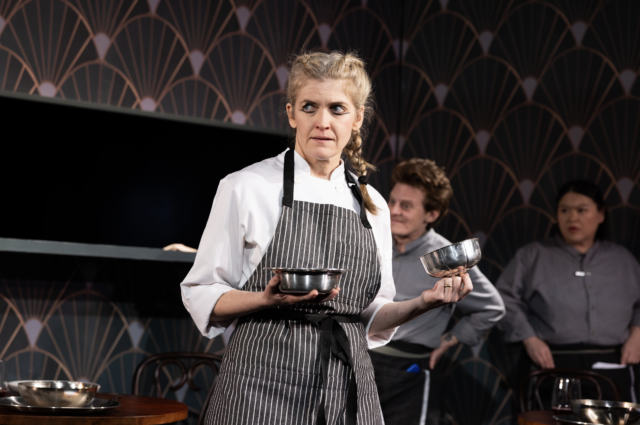
Chef Christina (Erin Markey) serves up a meal of biblical proportions in Playwrights Horizons production (photo by Chelcie Parry)

Early on, Ben asks Mina if she eats out a lot. She responds in a way that captures how so many people feel all the time about going out anywhere — to a restaurant or even the theater itself — and not just during a pandemic: “I do!” she says. “I mean, no not really; it’s often hard to hear, and the food is often overpriced, and I often feel disappointed, and a big part of me honestly wishes we were just at someone’s house being hosted warmly by someone who was making us all different kinds of food and there was sort of a fire and wine was passed around to the sound of laughter and I was sort of sandwiched on the couch after dinner between two close friends and there was a third kneeling in front of me who I could rustle their hair.”

Jian Jung’s set morphs from the spare coffee shop to the fancy restaurant to an apocalyptic scenario as Masha Tsimring’s lighting grows ever darker and Tei Blow’s sound becomes more ominous, with illusions by Steve Cuiffo. Kaye Voyce’s costumes include everyday casual wear, restaurant uniforms, and the vagrant’s ratty clothing.

Koogler (Deep Blue Sound, Fulfillment Center) and director Morgan Green (School Pictures, Minor Character) keep the audience on its proverbial toes for most of the hundred-minute show before going haywire in the end, overfilling the plate with an abundance of effluvia. When Rita asks, “Do you ever get this feeling with young writers, or early writers, writers who are developing . . . do you ever wonder: When will they develop?” Koogler is an established playwright, but Staff Meal could benefit from some further development.

Keller (The Thanksgiving Play, Shhhh) and Flood (Make Believe, The Comeuppance) are adorable as the young couple who may be falling in love, while Barbagallo (The Trees, Help) and Herlihy (The Apiary, Scene Partners) are cryptic and charming as the servers, Markey (Dr. Ride’s American Beach House, A Ride on the Irish Cream) chews up the scenery in her two roles, Berry (On Sugarland, Sugar in Our Wounds) devours her soliloquy, and Fluker (All My Sons, Esai’s Table) is cool and calm as the waiter, who is a stand-in for the audience’s psyche.

Although dealing with issues that were exacerbated during the coronavirus crisis, Staff Meal is not a pandemic play. It’s a funny and frightening satire about attempting to make connection and build community even when the planet might be in a doom-spiral, about humans needing nourishment by being with others, in coffee shops, restaurants, or a theater. Like life, it’s not perfect, with its ups and downs, but it provides fine fare that may not go down easy but feeds the soul in these harried times.

[Mark Rifkin is a Brooklyn-born, Manhattan-based writer and editor; you can follow him on Substack here.]

SIGSPACE X THEATRE FOR ONE: DÉJÀ VU

Kareem M. Lucas portrays a man sharing a terrible moment from his past in Lynn Nottage’s #Five (photo by Jonathan George)

SIGSPACE X THEATRE FOR ONE: DÉJÀ VU
The Pershing Square Signature Center
480 West 42nd St. between Tenth & Eleventh Aves.
Thursday – Sunday through June 26, free with advance RSVP
www.signaturetheatre.org
theatreforone.com

“It’s déjà vu all over again,” Yogi Berra famously said. But that’s not necessarily a bad thing, as evidenced by the welcome return of Theatre for One.

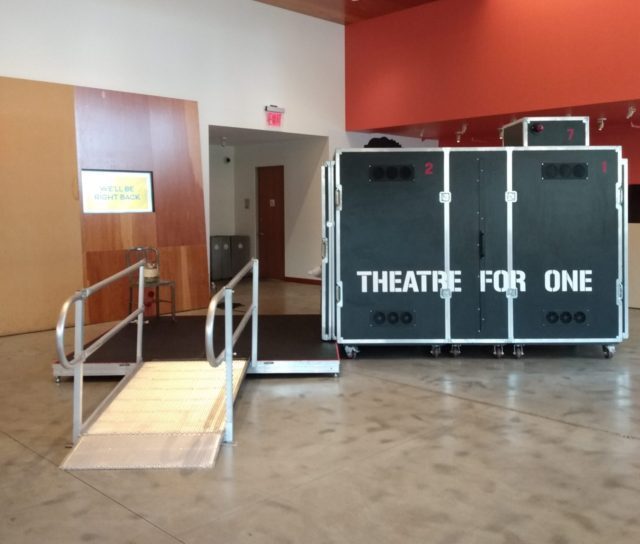
Since 2010, Christine Jones’s Theatre for One has been on the move in New York City, offering microplays performed by one actor (“performer”) for one audience member (“audiencer”) at a time in a mobile four-by-eight-foot repurposed equipment container (with the addition of a floor-to-ceiling plexiglass barrier added because of the pandemic). The specially commissioned works, generally running between five and seven minutes each, have been presented in Times Square, Brookfield Place, the Signature Theatre, and Manhattan West Plaza (“Here Is Future”) as well as at the University of Arkansas, Princeton, Fairfield University, Cork in Ireland, the Abbey Theatre in Dublin, and NYU Abu Dhabi. During the pandemic, “Here We Are” provided a thrilling, much-needed live, online connection between performer and audiencer, both able to see and hear the other and interact.

Theatre for One is now back at the Signature with its latest iteration, “Déjà Vu,” featuring five previously presented short works and one world premiere that can be experienced June 23–26; reservations can be made starting June 21, but you won’t know which play you’ll see until you arrive. (If you’ve already seen at least one play, the friendly staff will try to make sure you see something different if at all possible.) The small booth is bathed in red, with red flowers behind the performer, who often is seated in a chair. (The sets and costumes are by Camilla Dely, with lighting by Domino Mannheim and sound by Matt Stine.) There are no rules, as there are at Broadway and off-Broadway houses; if you want to interact with the performer, you can do so, within limits, of course, always respecting the actor and the playwright.

Stephanie Berry is electric as Pearl in Regina Taylor’s Déjà Vu, an expansion on Taylor’s previous Vote! (The Black Album). “You ever get the feeling that you’ve been here before,” Pearl says. She relates that feeling to the history of women’s voting rights in America after learning that her twenty-one-year-old great-great-granddaughter chose not to cast a ballot in the 2020 presidential election. She recalls the struggle to achieve the right to vote for women, then Blacks, and puts that in context with other societal ills that discriminate against women and people of color. “Time is funny,” she says. “It moves forward and sideways and bends back — over and around again — and again.” Director Tiffany Nichole Greene can barely keep Berry inside the small space as the actor’s voice echoes into the lobby.

“Do you remember the first time you understood the significance of voting? I’m not talking about the first time you voted, but the first time the weight of it hit you?” Sequoyah Jolene Sevenstar (Wyandotte writer, fundraiser, and consultant Maddie Easley) asks in DeLanna Studi’s Before America Was America, an earlier version of which was part of the online “Here We Are.” Directed by Rudy Ramirez, the play discusses women’s rights and equality going back to the Cherokees in the eighteenth century.

Tony winner and two-time Pulitzer finalist David Henry Hwang revisits a terrifying moment from his past, which he also dealt with in his 2019 play Soft Power, in My Anniversary, smartly directed by Greene. Ariel Estrada portrays Hwang, who shares what happened to him on November 29, 2015, and the harrowing aftermath. “I turned around, and thought I saw the shadow of someone, across the street, on the better-lit corner running away,” he remembers. “But as I started in that direction, I noticed something strange. I couldn’t walk straight. . . . I put my hand up to where I’d been hit. When I pulled it away, I saw my palm covered in blood.” The play is particularly potent with the current rise in anti-Asian hate crimes in New York City.

Two-time Pulitzer Prize winner Lynn Nottage also deals with an unprovoked act of horrific violence in #Five, directed by Greene with a tense foreboding. Kareem M. Lucas portrays an unsteady man on a job interview, clarifying why there are five unaccounted-for years on his resume. “I just wanna be upfront,” he says to the audiencer, who is a stand-in for the interviewer. “Things happen, sometimes with little explanation, but I promise you I’m a worker. And to be straight, I’m unhoused, but not for the reasons you probably imagine. I’m telling you, cuz folks are quick to jump to crazy conclusions.” You’re likely to jump to conclusions as well until you hear the full, captivating story.

Theatre for One welcomes one audience member at a time to a live microplay at the Signature (photo by twi-ny/mdr)

José Rivera’s Lizzy, directed by Ramirez, puts you opposite the title character (Sara Koviak) at a restaurant as you both prepare to order. “A lot’s happened that you missed,” she says. “I’m not blaming you for missing anything, I know it’s not your fault, but, you know, it was so sudden. No one told me how sick she really was. Not for a long time.” Although she never specifically mentions Covid-19, it is a potent reminder of how many older people have been lost during the coronavirus crisis. Lizzy focuses on her mother’s hands, on the human need for physical touch, which was not permitted during the height of the pandemic — and, of course, is not allowed between performer and audiencer.

Samuel D. Hunter follows up his extraordinary A Case for the Existence of God, which ran at the Signature this past spring, with the brand-new, gentle Brick, directed by SRĐA. Peter Mark Kendall plays Brick, who holds up an old photograph from the 1940s as he recalls his time in the army and when he found out that Hunter was gay. He self-referentially explains why the microplay exists: “I’m just saying it now in this monologue that my grandson Sam wrote, trying his best to remember how I talked, ’cause I always believed that when you go through something bad you just never talk about it and eventually you feel better — which, this is Sam talking now, is a multigenerational toxic trait that I hope to end with my own daughter.” Kendall delivers the lines in a near-whisper, emphasizing how unsure the character is of wanting to share his personal tale. But Sam and Brick leave you with a final, compassionate thought about how we all should approach life in these difficult times.

In his 2001 novel, Choke, Chuck Palahniuk wrote, “There’s an opposite to déjà vu. They call it jamais vu. It’s when you meet the same people or visit places, again and again, but each time is the first. Everybody is always a stranger. Nothing is ever familiar.” In many ways, this iteration of Theatre for One is a kind of unique melding of déjà vu and jamais vu, offering an unforgettable experience, like the best of theater can do.

ON SUGARLAND

Aleshea Harris’s On Sugarland takes place in a southern cul-de-sac amid wartime (photo by Joan Marcus)

ON SUGARLAND
New York Theatre Workshop
79 East Fourth St. between Second & Third Aves.
Tuesday – Sunday through March 20, $55-$75
www.nytw.org

“We got to holler,” Staff Sergeant Saul Greenwood (Billy Eugene Jones) declares in Aleshea Harris’s electrifying On Sugarland, continuing at New York Theatre Workshop through March 20. He and the Sugarland cul-de-sac of mobile homes, a poor neighborhood trapped inside circular train tracks that promise to take them nowhere, holler in unison to mourn lost members of their community and to honor their ancestors, but the screams resound against generations of socioeconomic injustice and systemic racism emanating from the military industrial complex and its reliance on a fervent nationalism above all else.

Brilliantly filtering Sophocles’s Philoctetes through a bit of Tennessee Williams, Harris tells the vivid, haunting story of the four-hundred-year war fought by Blacks in America for their humanity. The play opens as the people of Sugarland gather to holler for Sergeant Iola Marie Eagle Eye, who the army has finally declared Presumed Killed in Action after her body had gone missing for years. Her fourteen-year-old daughter, Sadie (Kiki Layne), hasn’t spoken in all that time, her voice as well as her mother taken from her, but the narrative is punctuated with her long, poignant monologues to the audience about the matriarchs of her family, generation by generation, back to her great-great-great-grandmother, a freed slave who carried messages to Union soldiers during the Civil War. Each of her stories ends with bloodshed.

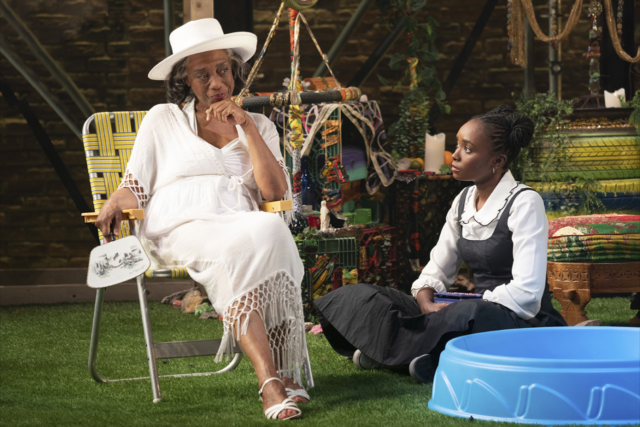
Evelyn (Stephanie Berry) and Tisha (Lizan Mitchell) are elderly sisters who can’t stop squawking at each other. Evelyn is like Blanche DuBois, living in a fantasy world; she takes her time overdressing for Iola Marie’s funeral, hoping to attract a suitor. Tisha tends to an outdoor shrine where she collects items from the men, women, and children who have died, paying special attention to her late son’s belongings, which she talks to as if he were there. “It’s time. You’re gonna make us late,” Tisha complains. “The only ‘late’ a lady ever needs to worry about is when her monthly hasn’t shown itself. And since your basement is sealed shut, you good,” Evelyn responds. “When they send you to hell, Ima be in Heaven waiting,” Tisha says.

Saul leads the service in honor of Iola Marie, proclaiming, “We got to holler / They ain’t sent her body home / ’Cause there ain’t nothin left to send / The War has taken the flesh of our dear sister / but the soul is intact / And we are gathered here to reach into / the next world / the world that now holds Iola / We are gathered here to knock on that world’s door / with a singing and a praise / We are gathered here to holler so she can hear us from where she’s at and know that she was loved.” It’s a powerful memorial for all fallen Black people, not just one lost soldier.

Addis (Caleb Eberhardt) and his father, Saul (Billy Eugene Jones), face different kinds of battles in searing new play (photo by Joan Marcus)

But Evelyn is having none of it. “That War can kiss the black off my ass. Fuck that War. Fuck burying boxes. Fuck hollering,” she tells her sister. “I am not cursing the doing of things. I am cursing their necessity. I am cursing the conditions which have led to what have become our customs. Little girls burying boxes for their dead mothers. Our front yard looking like some kind of horrifying carnival graveyard. Calling it Sugarland don’t make it sweet.”

Saul’s seventeen-year-old son, Addis (Caleb Eberhardt), wants to be a warrior like his father; too young and addled for the military, he guards Sugarland as if he were a soldier. He’s in love with Iola Marie’s sister, Odella (Adeola Role), a woman his father’s age. He tells Sadie, “Uh huh Busy being a soldier if you must know I’m already in Junior Cadets Almost Cadet First Sergeant If The War come to this cul-de-sac Ima show out Gon be the last one standing Ima carry the flag and plant that mug on a hilltop They gon make a statue of ya boy Ima be a hero They gon call my name.” Addis regularly shaves his father with a straight razor and helps tend to Saul’s damaged, foul-smelling foot, which oozes blood. Addis wants to join the army, while Saul wants to return to duty, despite his mental and physical injuries.

Meanwhile, the Rowdy (Thomas Walter Booker, Xavier Scott Evans, Mister Fitzgerald, Josh Fulton, Charisma Glasper, Kai Heath, Shemar Yanick Jonas, and Mariyea), a group of eight male, female, and nonbinary teenagers, serve as the Greek chorus, wandering around on the periphery, parading through the space, blasting music, harassing Addis, and commenting on what they’re seeing and occasionally interacting with the others as the biggest holler of all is to come.

On Sugarland is a brilliant, Pulitzer-worthy play deserving of a Broadway transfer and a wide audience. Harris (Is God Is, What to Send Up When It Goes Down), a former spoken-word performer whose mother is a Trinidadian immigrant who spent twenty years in the army, captures the heart and soul of a community too long unheard and unseen. Sadie talks often in her monologues of how her female ancestors were invisible. “White men ain’t in the business of seeing little black girls / you know / we invisible,” she says. Saul says a similar thing about Iola Marie. Their hollers echo through the theater until you can feel it in your bones. Harris makes it clear that a reckoning is coming, so everyone better start opening their eyes and ears. “It was a goddamn beautiful massacre,” Sadie says of an ancestor’s act of vengeance.

Obie-winning director Whitney White (Our Dear Dead Drug Lord, Semblance), who previously collaborated with Harris on the ritualistic healing production What to Send Up When It Goes Down, maintains a furious pace, a relentless assault on the senses that is superbly choreographed by Raja Feather Kelly (Hurricane Diane, The House That Will Not Stand); there is nary a wasted word or movement during the play’s intense and passionate 160 minutes (with intermission).

Evelyn (Stephanie Berry) remembers the past as Sadie (Kiki Layne) listens intently (photo by Joan Marcus)

The play is set in what the German-born, Kentucky-raised Harris describes as “a time of war. yesterday, today, and, unfortunately, tomorrow.” Adam Rigg’s confining set tempts the characters with a potential freedom that seems to always be just out of reach. Qween Jean’s costumes run from elegant to street-savvy, while Mikaal Sulaiman’s sound design and his and Starr Busby’s original music pound and pulsate.

At several points, the recording of a bugle can be heard. The onstage characters stop what they’re doing and salute a nonexistent flag. Despite how this country has treated them and their ancestors over the last four centuries, they still believe in what it has to offer. “Iss all kinda massacres, ain’t it?” Sadie says after a bugle plays the anthem. “All kinds. They got all kinds.”

DRACULA / FRANKENSTEIN

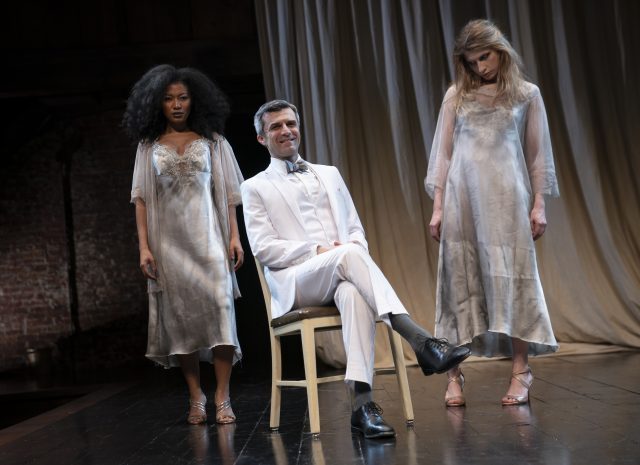
(photo by Joan Marcus)

Kate Hamill wrote and stars in gender-flipping Dracula at Classic Stage, playing Renfield (photo by Joan Marcus)

Classic Stage Company, Lynn F. Angelson Theater
136 East 13th St. between Third & Fourth Aves.
Tuesday – Sunday through March 15, $82-$127
classicstage.org

In 1971, Al Adamson’s Dracula vs. Frankenstein movie pit the Transylvanian count against the lab-created Creature, both introduced to film audiences in 1931 in separate horror films that started long-running franchises. The pair of ghouls, along with the Wolf Man, also appeared together in Charles Barton’s 1948 comedy Abbott and Costello Meet Frankenstein. And now Dracula and Frankenstein’s Monster are not face-to-face but back-to-back in Classic Stage’s creepy double feature, new adaptations of each running in repertory through March 15.

Kate Hamill, whose previous literary adaptations include wonderfully imaginative versions of Little Women, Pride and Prejudice, Sense and Sensibility, and Vanity Fair, has had a helluva lotta fun with Bram Stoker’s 1897 Gothic horror novel. She calls it “a bit of a feminist revenge fantasy, really,” infusing it with a healthy dose of Buffy the Vampire Slayer and a somewhat Marxist view of class struggle while keeping the plot firmly in the bloodline of the original.

Dracula (Matthew Amendt) is put in the background of this version; in fact, all the men are secondary to the women. Hamill’s great invention is gender-switching the characters, beginning with the mad Renfield (Hamill) and most spectacularly with the vampire hunter Van Helsing (Jessica Frances Dukes); the first is now a husband-murdering woman in a lunatic asylum, the second a powerful, leather-clad female punk cowboy (think Faith from Buffy and Angel). The plot proceeds mostly according to Stoker, with a few condensations and sly alterations: Renfield is cared for by the boringly plain Doctor George Seward (Matthew Saldivar), who’s engaged to the mischievous Lucy Westenra (Jamie Ann Romero), whose BFF is the pregnant Mina Harker (Kelley Curran). Mina’s husband, solicitor Jonathan Harker (Michael Crane), has gone to Transylvania on business. The conversation sounds contemporary from the outset, albeit couched in semi-Victorian diction as when Lucy teases Mina that Jonathan probably has “some Bavarian hausfrau. Some Slovakian slattern. Some Czech chippy” there. “I cannot blame him, Mina. You have gone rather to seed,” Lucy says, poking at Mina’s belly. “That’s the baby, you cow,” Mina responds. “Excuses, excuses,” Lucy says. Mina: “I’ll remind you how amusing that is when you are in the same condition.” Lucy: “One step at a time, please.” Mina: “It happens faster than you think. One day, you’re a schoolgirl, the next —” Lucy: “A hideous bloated old broodmare —” Mina: “— condemned to a life with no greater excitement than visiting a horrible little trollop on the seaside!”

(photo by Joan Marcus)

Jonathan Harker (Michael Crane) has no idea what’s in store for him from Drusilla (Laura Baranik) and Marilla (Lori Laing) in new Dracula adaptation (photo by Joan Marcus)

Dracula is essentially a minor character, dressed in white instead of the traditional black (the costumes are by Robert Perdziola), not as demonic as he is often depicted; rather, his strength is frankly sexual and class-based. He is protected by two henchwomen, the lustful vampires Drusilla (Laura Baranik), named after a Buffy character, and Marilla (Lori Laing), perhaps named after the spinster from Anne of Green Gables. As Dracula slowly turns Mina into the walking dead, Dr. Seward refuses to believe in any such nefarious doings, and intrepid vampire hunter Dr. Van Helsing arrives on the scene, ready to fight, quickly winning the formerly meek Mina to her side as they team up to rescue Jonathan and kill the count.

Directed by Sarna Lapine (Sunday in the Park with George, Little Women), this Dracula is a bit scattershot, all over the place as it investigates feminist themes from the Victorian era to today, as well as the emergence of working- and middle-class power versus the landed aristocracy. Renfield is a woman dealing with daddy issues, projecting her lust and religious zeal onto the unavailable Dracula, while the heroes are Mina, a twist on Buffy sweetly played by Curran (The Winter’s Tale, ‘Tis Pity She’s a Whore), and Dr. Van Helsing, portrayed with fearless panache by Dukes (By the Way, Meet Vera Stark, Yellowman). Classic Stage artistic director John Doyle’s sparse set is often empty except for when beds are rolled onstage, keeping the focus on the characters themselves.

Hamill’s sense of humor shines through as she toys with genre conventions across two hours and twenty minutes with intermission. When Jonathan first meets the count upon arriving at Dracula’s deserted mansion, he says, “I was beginning to think there wasn’t a soul in the place!” This Dracula also is more aware of class warfare than usual, telling Jonathan, “If control is shifting to the masses, than I must be of the masses. I must not rule from the castle on the hill anymore. Instead, I must become a common man, anonymous; — welcomed everywhere, and remembered nowhere. A man — rather — like you.” It’s a battle of the sexes in which men, whether supernatural or human, don’t stand a chance.

(photo by Joan Marcus)

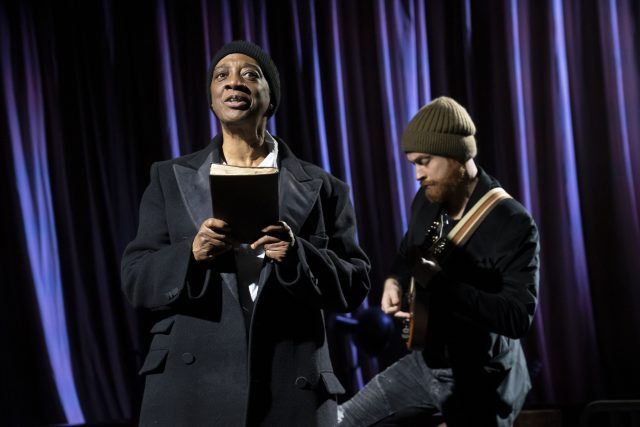
Stephanie Berry and Rob Morrison star in Tristan Bernays’s Frankenstein at Classic Stage (photo by Joan Marcus)

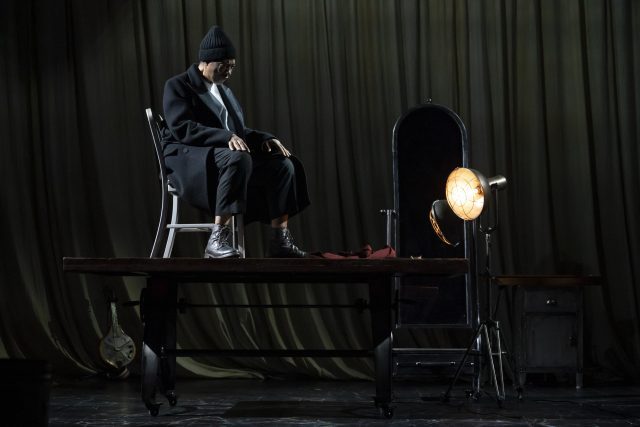
Tristan Bernays is far more faithful to the original story in his stark adaptation of Mary Wollstonecraft Shelley’s anonymously published 1818 epistolary novel Frankenstein; or, the Modern Prometheus. The streamlined production features two actors, Stephanie Berry as Victor Frankenstein and the Creature, and Rob Morrison singing songs, playing guitar, contributing sound effects, narrating sections, and moving around the furniture, which includes a long table, a large mirror, and several small pails. (This set also is designed by Doyle.) As with Hamill’s Dracula, Bernays’s Frankenstein plays with gender identity as it explores issues of God versus man as creator. Shortly after being brought to life, the Creature starts learning language and finding its place in the world, like a child quickly growing into adulthood. But the more it understands, the less it likes.

(photo by Joan Marcus)

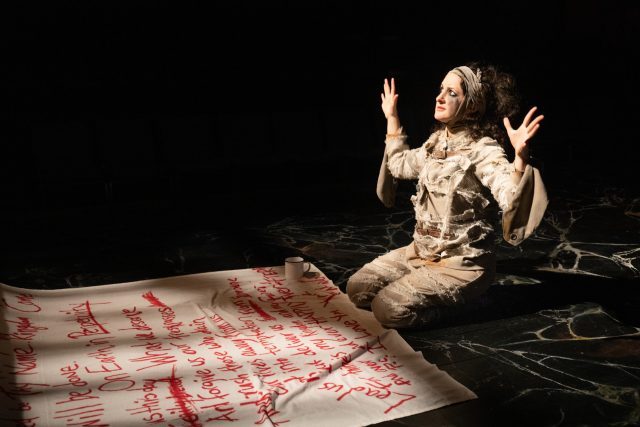
The Creature (Stephanie Berry) grows more and more curious in Classic Stage adaptation of Gothic novel (photo by Joan Marcus)

The narration is taken directly from the source material, with added dialogue. “What if — What if I failed to speak to him in gentle tongue? What if though blind he sensed withal my horrid shape? What if his children came back swift and ruined all my plans? What if — What if —” the Creature says as he enters the home where a blind man lives. Shortly after leaving the house, the Creature looks up at the stars and screams out, “Why? Why did you mould me but for misery? Am I to never feel a friendly touch? A kindly look? Love? Compassion? Why did you make me so? Why?” The Creature ultimately confronts Dr. Frankenstein, his wife, Elizabeth, and their son, William, and declares his need for a companion, leading to a tragic conclusion.

Even at a mere eighty minutes, the play, directed by Timothy Douglas (Radio Golf, Etiquette of Vigilance), drags on. The scenes don’t flow easily into one another, feeling ragged and disjointed. Berry (Gem of the Ocean, For All the Women Who Thought They Were Mad) has some fine moments as the Creature, but the story and pace can get confusing, while Morrison (Avenue Q, Nevermore), clearly an excellent musician, seems mostly unnecessary. It ends up being more of a curiosity, which is not enough to sustain it, whether seen as a Gothic tale or a contemporary parable.