Tag Archives: Samora la Perdida

“I AM MUSIC”: ANTHONY ROTH COSTANZO CHANNELS MARIA CALLAS IN GALAS

Anthony Roth Costanzo is sensational as a fictionalized version of Maria Callas in Galas at Little Island

GALAS: A MODERN TRAGEDY
The Amph at Little Island
Pier 55, Hudson River Park at West Thirteenth St.
September 6-28, $10 standing room, $25 seats, 8:30
littleisland.org

The first half of Eric Ting’s exciting version of Charles Ludlam’s rarely revived 1983 downtown hit, Galas: A Modern Tragedy, is everything you want it to be: hilariously campy, with fabulous singing, outrageous staging, and delicious costumes. The second half veers far off course until righting itself for a thrilling finale.

Ludlam, who founded the highly influential Ridiculous Theater Company in 1967, wrote, directed, and starred in the original, portraying the title character, Maria Magdalena Galas, an opera diva based on American-born Greek soprano Maria Callas. Today, the use of the word “tragedy” in the subtitle is twofold: the revered Callas died in 1977 at the age of fifty-three, while the beloved Ludlam passed away in 1987 when he was just forty-four, of AIDS.

Despite the inspired lunacy of the acting and plot, Galas is surprisingly faithful to Callas’s life and career. The show begins at the Verona train station, where successful brick industrialist Giovanni Baptista Mercanteggini (Carmelita Tropicana) is waiting to pick up Galas (Anthony Roth Costanzo), who is scheduled to perform the lead role in Amilcare Ponchielli’s La Gioconda at the Arena di Verona. They meet at a café, where they have a delightful and meaningful exchange.

Galas: You are an opera lover?
Mercanteggini: Yes, I’m a real aficionado. Now there’s something we have in common, eh?
Galas: What’s that?
Mercanteggini: We are both music lovers.
Galas: I am not a music lover. I am a musician.
Mercanteggini: But surely you love music.
Galas: I am a musician. And because I am a singer I am a musical instrument. A music lover, no. I am music.
Mercanteggini: But you don’t love it? Not even a little bit?
Galas: I wouldn’t dare. Art is so great it frightens me sometimes.
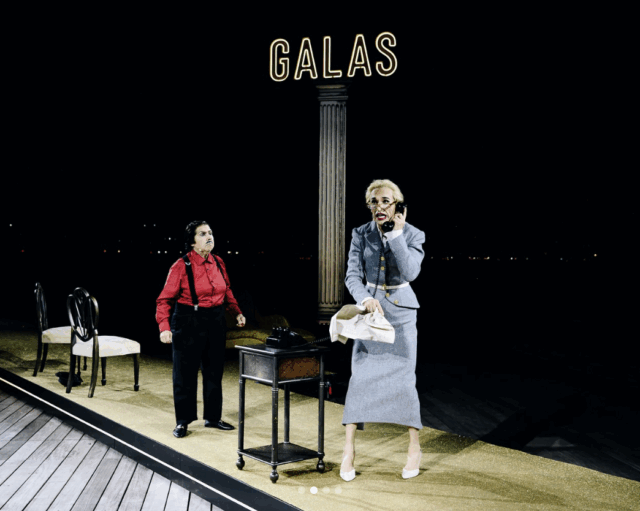
Carmelita Tropicana and Anthony Roth Costanzo make a fine comic duo in Galas

Mercanteggini offers her a deal: He will serve as her manager and benefactor for one year; she agrees, moving into his home, where she encounters his brusque housekeeper, Bruna Lina Rasta (Mary Testa), a former soprano based on Lina Bruna Rasa, who had a meltdown onstage and, because of mental illness, stopped singing.

Soon Galas and Mercanteggini are married, and she experiences success on tour but it’s not enough; she desperately wants to become a company member of La Scala. Fritalini (Samora la Perdida) and Ghingheri (Austin Durant) of La Scala offer her a onetime slot as a guest-artist replacement for the ill Baldini to sing La Gioconda, which she reluctantly does after some fabulous prima donna fits of pique. Later, after a tough negotiation, Galas does become a company member, agreeing to appear in I Vespri Siciliani, Norma, and Don Carlo on the condition that she sing La Traviata as well, an occasion for even more entertaining diva displays.

While the feverish Italian press offers ever-more outré explanations for her significant weight loss, which made her a svelte femme fatale, Galas has a contentious audience with Pope Sixtus VII (la Perdida), with whom she argues about the value of Wagner’s operas, and later has to cut short her performance of Norma at La Scala because she has lost control of her voice.

Giving up singing, she heads out with Mercanteggini and Bruna on a yacht owned by wealthy womanizer Aristotle Plato Socrates Odysseus (Caleb Eberhardt), who is traveling with his wife, Athina (Erin Markey); his former mistress, Hüre von Hoyden (Patricia Black); and gossip columnist Ilka Winterhalter (la Perdida); and takes an instant liking to Galas, not hiding his desire. (After ten years of marriage, Callas left Mercanteggini for Aristotle Onassis.) A final conversation between Galas and Bruna reveals a desperate Maria trying to hold on to something, anything.

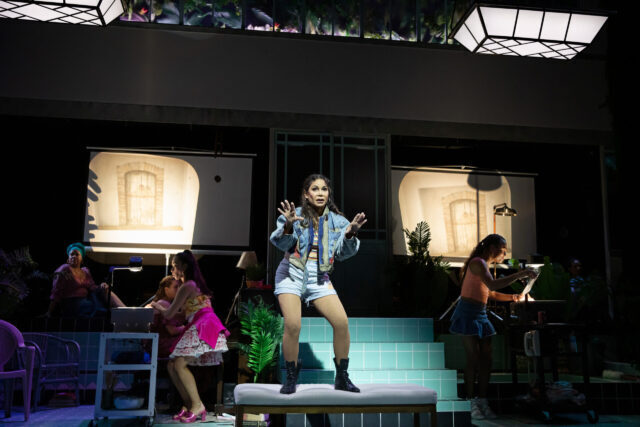
Tony and Obie winner Mimi Lien’s set features a long, movable catwalk, some furniture, and a tall Greek column with the word Galas at the top in neon lights that change color. Jackson Wiederhoeft’s costumes for Galas are spectacular, from an elegant red gown to a tight-fitting business dress. The other costumes, by Hahnji Jang, are fun and frolicsome, especially the getups for the pope. Jiyoun Chang’s lighting and Tei Blow’s sound work well in the outdoor setting. Raja Feather Kelly’s choreography is way too over the top during the yacht scene.
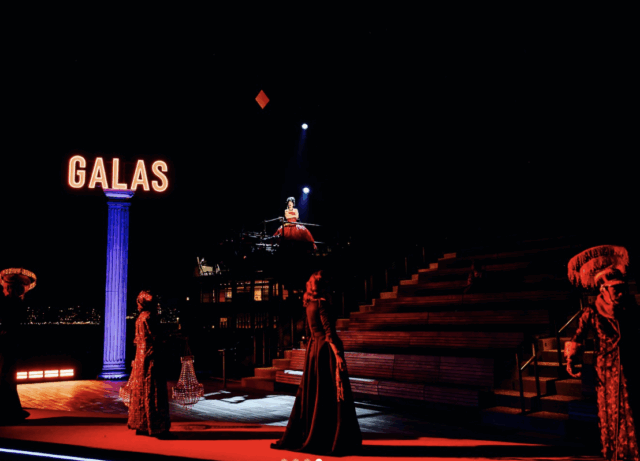
Rare revival of Charles Ludlam’s Galas continues through September 28

Countertenor Costanzo, who has appeared in lead roles for the Metropolitan Opera, the English National Opera, the Teatro Real Madrid, and other international companies and is the general director and president of the innovative Opera Philadelphia, has become Little Island’s breakout star; last year he performed all the live singing parts in an almost-solo version of Mozart’s The Marriage of Figaro, and he is outstanding here as Galas, wearing fanciful outfits, dishing dirt, and luxuriating in the high life but understanding that it could all go away in the blink of an eye. The role was originally played by Ludlam, then by the late Ludlam’s longtime partner, Everett Quinton, in the first-ever revival in 2019. (Quinton designed the costumes and played Bruna in the 1983 staging.)

Obie winner Testa (On the Town, Oklahoma!) serves as the anchor for the show, balancing pathos with physical comedy and her lovely singing voice. Tropicana (With What Ass Does the Cockroach Sit?/Con Que Culo Se Sienta la Cucaracha, Memorias de la Revolucion) is a hoot as the short and stout Mercanteggini, and la Perdida sparkles as the nonbinary pontiff.

Obie-winning director Ting (The Comeuppance, Between Two Knees), who helmed Alina Troyano and Branden Jacobs-Jenkins’s Give Me Carmelita Tropicana!, guides numerous delightful moments in the first half, particularly with his interpretation of a train arriving at a station and his later use of chandeliers, but the yacht scenes drag on, feeling like a Fellini movie that was never released. And the way the characters say “La Scala” with their tongues sticking out is humorous at first but eventually dries up.

Galas is at its best when Costanzo is singing, whether an aria from Carmen, “Casta Diva” from Norma, or additional selections he made. But even with its troubled center section, it’s a triumphant tribute to a downtown theater legend, an eternal opera diva, and the cost of living for art.

[Mark Rifkin is a Brooklyn-born, Manhattan-based writer and editor; you can follow him on Substack here.]
MY BROKEN LANGUAGE

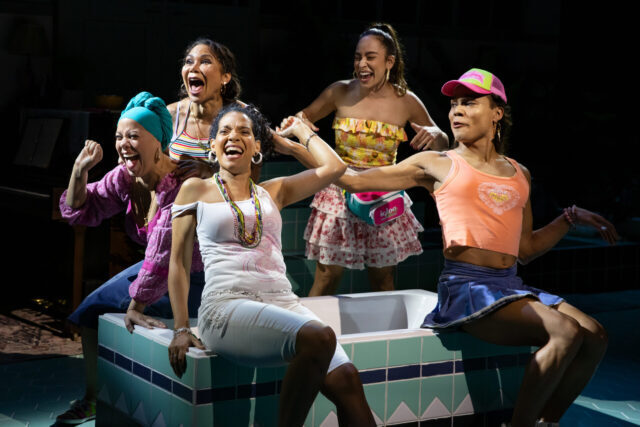
A cast of five extraordinary women share roles in Quiara Alegría Hudes’s My Broken Language (photo by Julieta Cervantes)

MY BROKEN LANGUAGE
The Pershing Square Signature Center
The Romulus Linney Courtyard Theatre
480 West 42nd St. between Tenth & Eleventh Aves.
Tuesday – Sunday through November 27, $49-$159
212-244-7529
www.mybrokenlanguage.net

Quiara Alegría Hudes’s My Broken Language is an exhilarating ninety minutes of love and loss among a close Puerto Rican family in North Philly over the course of sixteen years.

During the pandemic, Hudes, who won the Pulitzer Prize in 2012 for her play Water by the Spoonful, about an Iraq War veteran returning to his home in Philadelphia, published a memoir, My Broken Language, detailing her childhood from 1988, when she was ten, to 2004, when she went to the Brown University Grad School for Playwriting. The book is divided into four parts: “I Am the Gulf between English and Spanish,” “All the Languages of My Perez Women, and Yet All This Silence . . . . ,” “How Qui Qui Be?,” and “Break Break Break My Mother Tongue.” At a public reading, Hudes, also known as Qui Qui, invited a group of actors to read different chapters, which sparked the development of the book into a play with multiple women sharing the lead role. The stirring result is at the Romulus Linney Courtyard Theatre at the Signature, where it opened tonight for a limited run through November 27. Get your tickets now.

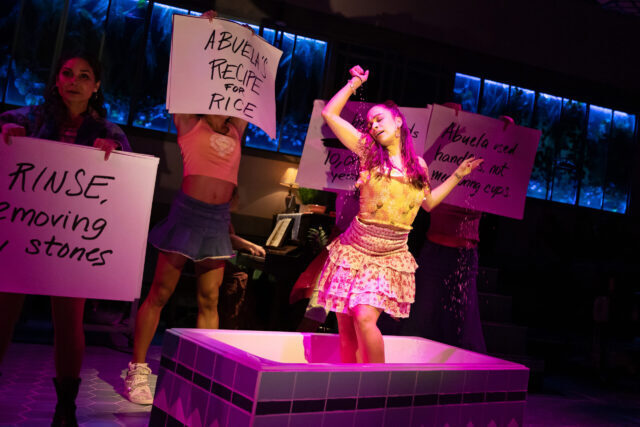
The audience sits on three sides of Arnulfo Maldonado’s beautifully bright, intimate set, a tiled courtyard with three porcelain bathtubs filled with plants, a shower, and steps leading to the door of a house with a facade of two long rows of windows, behind which is greenery, as if life is growing inside. Tucked next to the steps is a piano where Ariacne Trujillo Duran occasionally plays Chopin and original music by Alex Lacamoire.

The play, which Hudes calls “a theater jawn,” begins with Zabryna Guevara, Yani Marin, Samora la Perdida, Daphne Rubin-Vega, and Marilyn Torres declaring in unison, “My Broken Language. North Philly. 1988. I’m ten years old.” Each “movement” of the jawn kicks off with similar declarations as time passes, with a different actor taking over the lead role of Qui Qui, complete with singing, dancing, and poignant and prescient monologues; the rest of the cast play other roles as well.

Daphne Rubin-Vega plays the ten-year-old author in Signature world premiere (photo by Julieta Cervantes)

“Cousinhood in my big-ass family was a swim-with-the-sharks wonderland,” ten-year-old Qui Qui says on the way to an amusement park in New Jersey. “When Cuca invited me to Six Flags with the big cousins, I was Cinderella being invited to the ball. These weren’t the rug rats of the family, my usual crew. Five to ten years my elder, my big cousins were gods on Mount Olympus, meriting study, mythology, even fear.” A moment later, she adds, “Cuca, Tico, Flor, and Nuchi. Saying their names filled me with awe. They had babies and tats. I had blackheads and wedgies. They had curves and moves. I had puberty boobs called nipple-itis. They had acrylic tips in neon colors. I had piano lessons and nubby nails. They spoke Spanish like Greg Louganis dove — twisting, flipping, explosive — and laughed with the magnitude of a mushroom cloud.”

As 1988 becomes 1991 in West Philly, 1993 in North Philly, 1994 in Center City, 1995 back in West Philly, and 2004 in Providence, Qui Qui, identified as “Author” in the script, has her period, is fascinated by her mother’s mysterious Yoruba religious rituals, discovers great literature (Flannery O’Connor, Ralph Ellison, Toni Morrison, Lawrence Ferlinghetti, Sandra Cisneros, Esmeralda Santiago) and art (Marcel Duchamp’s Bicycle Wheel, Nude Descending a Staircase No. 2, Fountain), and learns too much too quickly about death.

“One day I would dream of a museum, a library I might fit into. One with space to hold my cousins, my tías, my sister, mi madre. An archive made of us, that held our concepts and reality so that future Perez girls would have no question of our existence or validity,” sixteen-year-old Qui Qui fantasizes. “Our innovations and conundrums, our Rashomon narratives could fill volumes, take up half a city block. Future Perez girls would do book reports amid its labyrinthine stacks, tracing our lineages through time and across hemispheres. A place where we’d be more than one ethnic studies shelf, but every shelf, the record itself. And future Perez girls would step into the library of us and take its magnificence for granted. It would seem inevitable, a given, to be surrounded by one’s history.”

That soliloquy gets to the heart of My Broken Language, which is an inclusive celebration of who the Perez family is and what they can be. Despite the constant adversity, Hudes focuses on the individuality of the characters and the author herself, portrayed by five distinct women who represent the vast range of Puerto Rican women, in mind and body, washing away ethnic and gender stereotypes. Even as “asterisks” point out future tragedy, the play is life-affirming as the actors stand firm and bold, singing Lacamoire’s “La Fiesta Perez” and “Every Book, a Horizon,” Ernesto Grenet’s “Drume Negrita,” and Joni Mitchell’s “Hejira” and moving to Ebony Williams’s engaging choreography in Dede Ayite’s colorful, dramatic costumes that trace the development of young women. (Yes, that’s Daphne Rubin-Vega in pigtails!)

Tiled bathtubs figure prominently in My Broken Language (photo by Julieta Cervantes)

In her directorial debut, Hudes allows each actor the freedom to incorporate their own realities into their characters, including a wonderful moment in which all five line up on the steps and, one by one, grab the person next to them in their own way. Although a scene about Qui Qui’s favorite books feels didactic — the listing in the digital program, which also includes a glossary of terms and pop-culture references, would have sufficed — everything else flows together organically, immersing the audience in the story of the Perez family. Jen Schriever’s lighting never goes completely dark, allowing the audience to see the actors, the actors to see the audience, and audience members to see themselves, all part of an intimate, caring community.

The cast, led by the fabulous Rubin-Vega, who has also appeared in Hudes’s Daphne’s Dive at the Signature and Miss You Like Hell at the Public, and Guevara, who starred in the playwright’s Water by the Spoonful at Second Stage and Elliot, a Soldier’s Fugue at 45 Below, revels in the flexibility Hudes gives them; in the script, she notes, “No need for them to act, speak, or move like one cohesive character. The point is a multiplicity of voices, bodies, and vibez.” That advice works for the audience as well, during the play and as they exit back into real life.

[On November 13 at 5:00, the Bushwick Book Club will hold a special free event at the Signature, hosted by Guevara and featuring readings from Hudes’s memoir along with original music and movement by spiritchild, Patricia Santos, Anni Rossi, Susan Hwang and Troy Ogilvie.]