Tag Archives: Rudy Burckhardt

FREE TIME / UNDER THE BROOKLYN BRIDGE

Free Time

Manfred Kirchheimer’s Free Time is having its virtual premiere at Film Forum beginning November 11

FREE TIME (Manfred Kirchheimer, 2019) and UNDER THE BROOKLYN BRIDGE (Rudy Burckhardt, 1953)
Film Forum Virtual Cinema
Opens November 11, $12 for three-day rental
filmforum.org/film/free-time
grasshopperfilm.com

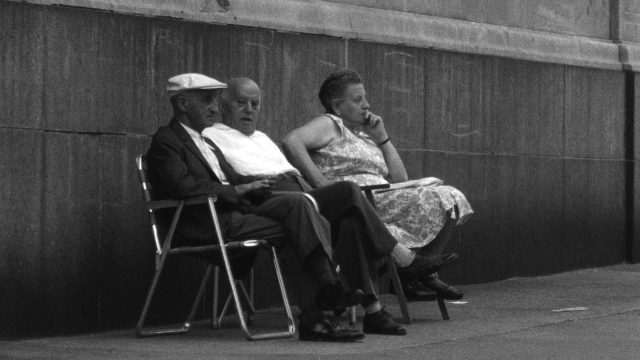
In 2019, eighty-eight-year-old Manfred Kirchheimer was at Lincoln Center’s Francesca Beale Theater to screen and discuss his latest work, the subtly dazzling Free Time, which had its world premiere in the Spotlight on Documentary section of the fifty-seventh annual New York Film Festival. The German-born, New York-raised Kirchheimer has taken 16mm black-and-white footage he and Walter Hess shot between 1958 and 1960 in such neighborhoods as Hell’s Kitchen, Washington Heights, Inwood, Queens, and the Upper East Side and turned it into an exquisite city symphony reminiscent of Helen Levitt, Janice Loeb, and James Agee’s classic 1948 short In the Street, which sought to “capture . . . an image of human existence.” Kirchheimer does just that, following a day in the life of New York as kids play stickball, a group of older people set up folding chairs on the sidewalk and read newspapers and gossip, a worker disposes of piles of flattened boxes, laundry hangs from clotheslines between buildings, a woman cleans the outside of her windows while sitting on the ledge, a fire rages at a construction site, and a homeless man pushes his overstuffed cart.

Kirchheimer and Hess focus on shadows under the el train tracks, gargoyles on building facades, smoke emerging from sewer grates, old cars stacked at a junkyard, and grave markers at a cemetery as jazz and classical music is played by Count Basie (“On the Sunny Side of the Street,” “Sandman”), John Lewis (“The Festivals,” “Sammy”), Bach (“The Well Tempered Klavier, Book 1 — Fugue in B flat minor”), Ravel (Sonata for Violin & Cello), and others, with occasional snatches of street sounds. The title of the film is an acknowledgment of a different era, when people actually had free time, now a historical concept with constant electronic contact through social media and the internet and the desperate need for instant gratification. Kirchheimer, whose Dream of a City was shown at the 2018 NYFF and whose poetic Stations of the Elevated was part of the 1981 fest (but not released theatrically until 2014), directed and edited Free Time and did the sound, and it’s a leisurely paced audiovisual marvel. The only unfortunate thing is that it is only an hour long; I could have watched it for days. The film is opening virtually at Film Forum on November 11, preceded by Rudy Burckhardt’s 1953 classic fifteen-minute black-and-white short Under the Brooklyn Bridge, in which kids go for a swim under the iconic landmark and demolition goes on, set to music by Claude Debussy and Francis Poulenc performed by pianists Arthur Gold and Robert Fizdale.

THE NEW MoMA

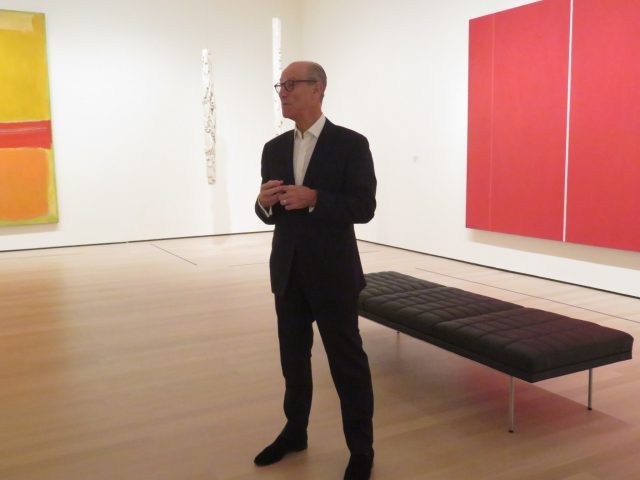
MoMA director Glenn D. Lowry shows off the new museums curatorial (photo by twi-ny/mdr)

MoMA director Glenn D. Lowry shows off museum’s ambitious new approach (photo by twi-ny/mdr)

MoMA, Museum of Modern Art
11 West 53rd St. between Fifth & Sixth Aves.
Opens Monday, October 21, $14-$25 (sixteen and under free)
212-708-9400
www.moma.org

Perhaps no single work of art encapsulates the newly renovated, revamped, and expanded Museum of Modern Art as much as Richard Serra’s 2015 Equal, which gets its own room on the fourth floor. Eight forged weatherproof steel blocks are stacked in pairs, four on four. Despite their title, they are not the same: the random patterns on their sides are not consistent, the light that gleams through gaps in the stacks reveals the blocks are not exact replicas of each other, and they are positioned on different sides. It announces a new MoMA, reopening today with much fanfare after closing on June 16 for four months of reinstallation, a reimagination and reevaluation of how to display items from its ever-growing collection of more than two hundred thousand works. At an intimate press preview, museum director Glenn D. Lowry used all the right words and phrases to bring MoMA into 2019 and beyond, including “a more global perspective,” “pluralism,” “dialogues,” and “diversity.”

He was standing in gallery 404, “Planes of Color,” carefully chosen as representative of the institution’s updated curatorial approach. Instead of being essentially chronological, the room combines painting and sculpture in a more complex way, creating what Lowry said is a “conversation through time and space.” Thus, brought together are an obvious grouping of Russian-born American artist Mark Rothko’s No. 10 and No. 5/No. 22, American artist Ad Reinhardt’s Number 107, and American artist Barnett Newman’s Abraham and Vir Heroicus Sublimis, along with the less-expected choices of Ukraine-born American artist Louise Nevelson’s Hanging Column from Dawn’s Wedding Feast and Indian artist Vasudeo S. Gaitonde’s exquisite Painting, 4. “I hope that my painting has the impact of giving someone, as it did me, the feeling of his own totality, of his own separateness, of his own individuality, and at the same time of his connection to others,” Newman said in a 1965 interview with David Sylvester. “If a meeting of people is meaningful, it affects both their lives.” The same goes for this meeting of artworks.
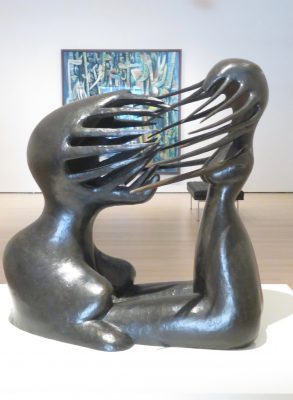
(photo by twi-ny/mdr)

Maria Martins’s The Impossible, III tears apart conventional ideas of curation (photo by twi-ny/mdr)

In gallery 503, “Around Les Demoiselles d’Avignon,” thirteen works by Pablo Picasso from 1905 to 1912 are joined by Louise Bourgeois’s 1947-53 Quarantania, I sculpture and Faith Ringgold’s 1967 painting American People Series #20: Die 1967, a Guernica-inspired canvas about race, class, and violence. One of the museum’s greatest hits, Les Demoiselles d’Avignon, hangs in a corner, given no special prominence. Similarly, Vincent van Gogh’s The Starry Night and Henri Rousseau’s The Sleeping Gypsy, two other perennial favorites, are side by side on a far wall in gallery 501, along with turn-of-the-twentieth-century earthenware by George Ohr. The works on display will rotate every six months, although the classics will most likely always be on view, but not necessarily in the same place. “My ambition is to get past worrying about the canon,” Lowry said. “We’re shaking it up.”

The Worlds to Come gallery on the second floor was inspired by Jack Whitten’s Atopolis: For Édouard Glissant, an eight-panel acrylic canvas depicting a tattered America as if seen from space; it is accompanied by Trisha Donnelly’s Untitled video, Kara Walker’s ink and pencil on paper Christ’s Entry into Journalism, Michaela Eichwald’s Duns Scotus on artificial leather, Deana Lawson’s pigmented inkjet print Thai, and Nairy Baghramian’s styrofoam, aluminum, and cork Maintainers A, a wide range of disciplines and artists that the wall text puts in context of MoMA’s new curatorial decision-making: “Employing a range of forms and materials, some of these works address historical traumas and their present-day echoes, while others imagine a more hopeful future rooted in multiplicity and diversity. Purposefully open-ended, this grouping of works refuses a tidy summation of the art of our time.”
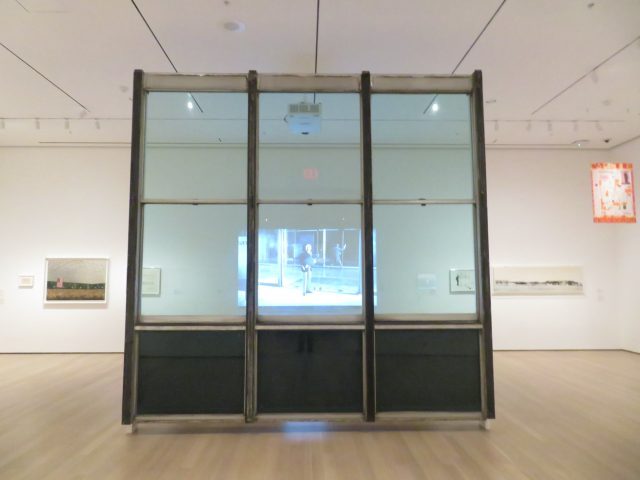
(photo by twi-ny/mdr)

MoMA mixes artistic disciplines in revamped galleries (photo by twi-ny/mdr)

You can find the unexpected everywhere. An excerpt from Jacques Tati’s 1967 comedy Playtime can be viewed in gallery 417 through a piece of the facade from the 1952 UN Secretariat Building in a space dedicated to architecture. Alma Woodsey Thomas’s Fiery Sunset is in a gallery otherwise filled with paintings and sculptures by Henri Matisse. (Matisse’s The Swimming Pool gets its own room, as do Rosemarie Trockel’s Book Drafts and Joan Jonas’s Mirage.) The “Picturing America” gallery includes photographs by Dorothea Lange, Aaron Siskind, Rudy Burckhardt, Edward Weston, Walker Evans, and others alongside paintings by Edward Hopper, another example of the cross disciplines MoMA is now emphasizing.

Visitors to the second-floor contemporary galleries are greeted by Dara Birnbaum’s Technology/Transformation: Wonder Woman video, complete with explosion; to the right are two dozen of Cindy Sherman’s Untitled Film Stills, while to the left is Louise Lawler’s Does Andy Warhol Make You Cry?, a photo of Andy Warhol’s Gold Marilyn Monroe from a 1988 Christie’s auction. It’s a bold, if cheeky, way for MoMA to exclaim its dedication to women artists, blowing up the past.
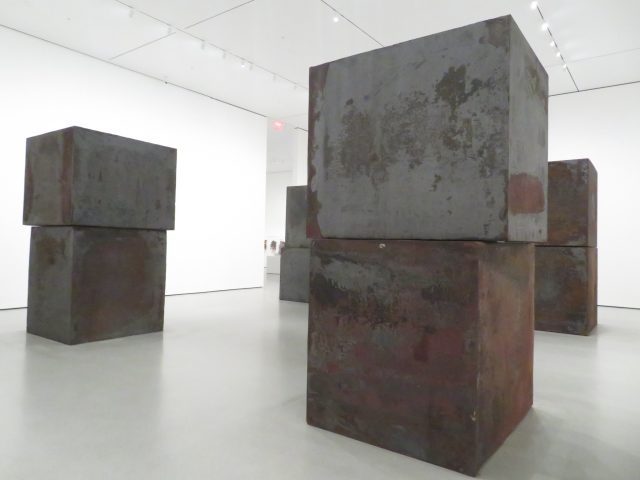
(photo by twi-ny/mdr)

Richard Serra’s 2015 Equal gets its own room in new MoMA (photo by twi-ny/mdr)

Among what’s new are the Paula and James Crown Creativity Lab, where adults can learn about process and create their own art (kids can still drop in at the Samuel and Ronnie Heyman Family Art Lab in the Education and Research Building), and the fourth-floor Marie-Josée and Henry Kravis Studio, which will host live and experimental programming beginning with David Tudor’s immersive audio installation Rainforest V (variation 1); Tudor’s Forest Speech will be performed in the space October 24, 26, and 27 ($10-$15, 8:00) by Phil Edelstein, Marina Rosenfeld, Stefan Tcherepnin, Spencer Topel, and Jeremy Toussaint-Baptiste as well as three days each in November and December by different sets of musicians.

The museum’s initial exhibitions are all culled from the collection, furthering MoMA’s goal of making more of it available to the public: “Taking a Thread for a Walk,” “The Shape of Shape Artist’s Choice: Amy Sillman,” “Energy,” “Projects 110: Michael Armitage,” “Haegue Yang: Handles” (which will be activated daily at 4:00), “Private Lives Public Spaces” (home movies from dozens of artists and filmmakers), “Surrounds 11: Installations,” “Sur moderno: Journeys of Abstraction ― The Patricia Phelps de Cisneros Gift,” “member: Pope.L, 1978–2001,” and “Betye Saar: The Legends of Black Girl’s Window.” Philippe Parreno’s immersive, site-specific Echo provides sound, light, and movement in the entries on both West Fifty-Third and Fifty-Fourth St., yet more evidence that art is everywhere, in this case putting the visitor at the very center. “It is nearly impossible to make people understand each other,” explained Maria Martins, whose spiky 1946 bronze sculpture The Impossible, III greets people in gallery 401, the theme of which is “Out of War.” With its focus on diversity, juxtapositional dialogues, rotating works, and reconsidered approach to curation, MoMA is trying to get people to understand art, and each other, a whole lot better, in ways that make sense in our current era.

GREATER NEW YORK

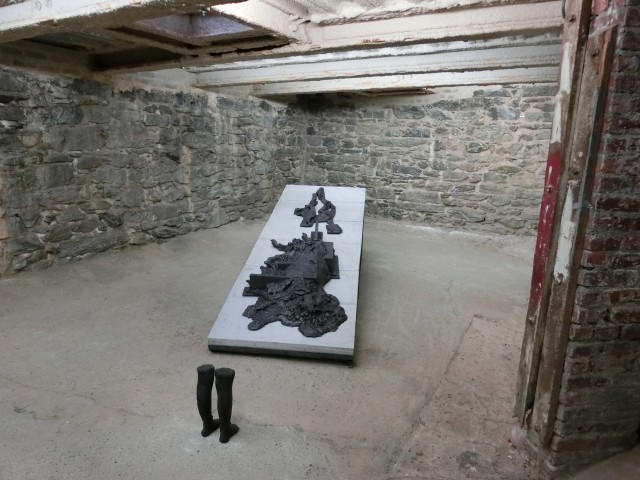
Lionel Maunz’s “Fertilize My Mouth” emphasizes feeling of absence at “Greater New York ”show at MoMA PS1 (photo by twi-ny/mdr)

Lionel Maunz’s “Fertilize My Mouth” emphasizes feeling of absence at “Greater New York ”show at MoMA PS1 (photo by twi-ny/mdr)

MoMA PS1
22-25 Jackson Ave. at 46th Ave.
Thursday – Monday through March 7, suggested donation $5-$10 (free with MoMA ticket within fourteen days of MoMA visit), 12 noon – 6:00 pm
718-784-2084
momaps1.org

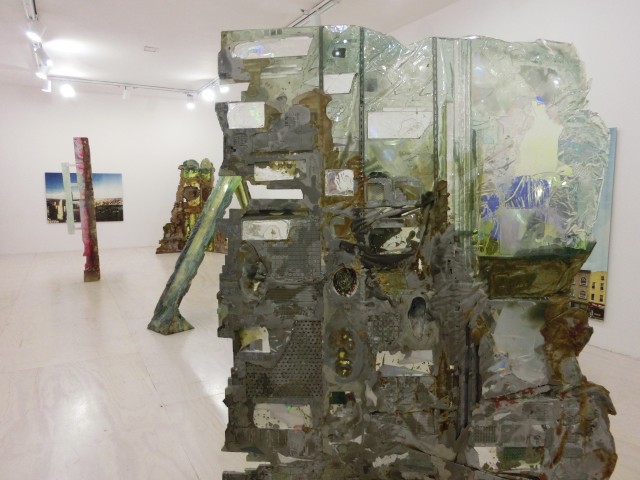
The fourth iteration of MoMA PS1’s quinquennial exhibition, “Greater New York,” is very much about absence and presence, what is not there as well as what is. Instead of focusing primarily on up-and-coming artists, curators Peter Eleey, Douglas Crimp, Thomas J. Lax, Mia Locks, Mark Beasley, and Jenny Schlenzka have included works by nearly 150 artists, more than 60 of whom are over 50 (or would have been if they were still alive), resulting in a wide-ranging look at how New York City and the art market have changed over the last generations. James Nares’s 1976 Super 8 video “Pendulum” shows a wrecking ball ominously swinging in an empty Tribeca alley but not actually knocking anything down — yet. Amy Brener encases such found objects as watches, motherboards, and calculators into colorful resin, foam, glass, and plaster sculptures that harken back to a long-gone era. Alvin Baltrop’s silver gelatin prints remind us what the piers were like prior to renovation and gentrification and what gay life was like before AIDS. Liene Bosquê uses found souvenirs from around the world to construct imaginary cities in “Recollection.” Henry Flynt’s SAMO© Graffiti Portfolio photographs from 1979 reintroduce us to Jean-Michel Basquiat. A large gallery of lifelike sculptures by Tony Matelli, Elizabeth Jaeger, John Ahearn, Judith Shea, and others create a false sense of reality and investigate the human figure and physical relationships. Joy Episalla’s photos of motel bedrooms reflected in television sets fill viewers with personal memories. Fierce Pussy’s “For the Record” features backward text about the AIDS crisis, repeating such sentences as “he would be at this opening if she were alive today” (sic).

Amy Brener repurposes found items into memory sculptures  at “Greater New York ”show at MoMA PS1 (photo by twi-ny/mdr)

Amy Brener repurposes found items into memory sculptures at “Greater New York ”show at MoMA PS1 (photo by twi-ny/mdr)

Glenn Ligon’s silkscreened “Housing in New York: A Brief History” details the various places he lived between 1960 and 2007 and reveal how the neighborhoods changed. In the boiler room, Lionel Maunz’s cast iron and concrete “Fertilize My Mouth” consists of a pair of disembodied legs standing in front of a tilted slab of concrete on which something bad appears to have happened. Louise Lawler’s “Not Yet Titled (adjusted to fit)” is a stretched photo of Gordon Matta-Clark’s “Bingo” sculpture of a derelict house. And photographs of Matta-Clark’s “Building Cuts” into the walls of PS1 back in 1976 bring the exhibition full circle. Among the other artists in the show are Chantal Akerman, Richard Artschwager, Dara Birnbaum, Mel Bochner, Rudy Burckhardt, John Giorno, William Greaves, Yvonne Rainer, Ugo Rondinone, Lorna Simpson, Kiki Smith, and Sergei Tcherepnin. If you were around in the 1970s, you know that New York City was not exactly a paradise — and “Greater New York” takes us back there while also putting it all in a contemporary now you see it, now you don’t context.

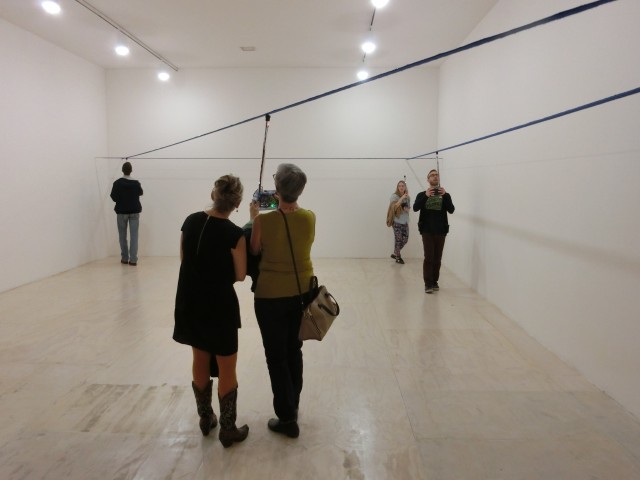
Sound comes and goes in Christine Sun Kim’s visitor-operated “Game of Skill 2.0” (photo by twi-ny/mdr)

Sound comes and goes in Christine Sun Kim’s visitor-operated “Game of Skill 2.0” (photo by twi-ny/mdr)

The exhibition will be on view through March 7, and there are still a handful of programs left on the schedule. On February 21 at 4:00, Hayley Aviva Silverman’s live-action “Twister” casts dogs as characters from Charles Dickens’s Oliver Twist and Jan de Bont’s 1996 disaster film, Twister; Shirley Clarke’s The Cool World is being shown February 21-27; on February 25 at 7:00, Fia Backström will perform “Aphasia as a visual shape of speaking – A-production and other language syndromes”; on February 28 at 1:00, Naturally Occurring Cultural Districts New York will host participatory activities; on February 28 at 4:00, Devin Kenny will deliver the performance essay “Love, the Sinner”; short films by Ken Jacobs, Jack Smith, Ira Sachs, and others are screening February 28 through March 7; on March 3 & 4 at 7:00, Geo Wyeth will present “Storm Excellent Salad”; and on March 6, you can catch Stewart Uoo’s “It’s Get Better III” at 3:00 and Angie Keefer’s roundtable “What Is Authority?” at 4:00.

STEPHEN WESTFALL ON NEIL WELLIVER

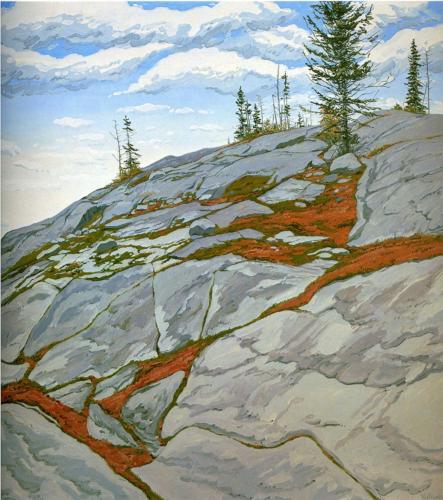
Neil Welliver, “Blueberries in Fissures,” oil on canvas, 1983

Neil Welliver, “Blueberries in Fissures,” oil on canvas, 1983

National Academy Museum
1083 Fifth Ave. at 89th St.
Tuesday, November 26, $15, 6:30
212-369-4880
www.nationalacademy.org

The National Academy’s current exhibition, “See It Loud: Seven Post-War American Painters,” on view through January 26, examines a lesser-known group of U.S. artists who, in the years following World War II, walked the fine line between representation and abstraction. “There was very nearly a moral dimension to the opposition between the two aesthetics,” notes senior curator Bruce Weber. The seven artists featured in the exhibition are Leland Bell, Paul Georges, Peter Heinemann, Albert Kresch, Stanley Lewis, Paul Resika, and Neil Welliver. On November 26 at 6:30, Schenectady-born painter, critic, professor, and National Academician Stephen Westfall, a 2007 Guggenheim Fellow and winner of a 2009 Rome Prize in the visual arts, will discuss the work of Welliver (1929-2005), whose large-scale landscapes, including the beautifully composed and somewhat dizzying “Blueberries in Fissures,” are a highlight of the show. The talk will be followed by a screening of artist and collector Rudy Burckhardt’s half-hour documentary, Neil Welliver Painting in Maine. (Also in conjunction with the exhibition, Lewis will be teaching the “Working from the Masters” painting class on December 5; tuition is $200.)

AN AUTEURIST HISTORY OF FILM: IN THE STREET / UNDER THE BROOKLYN BRIDGE / ON THE BOWERY

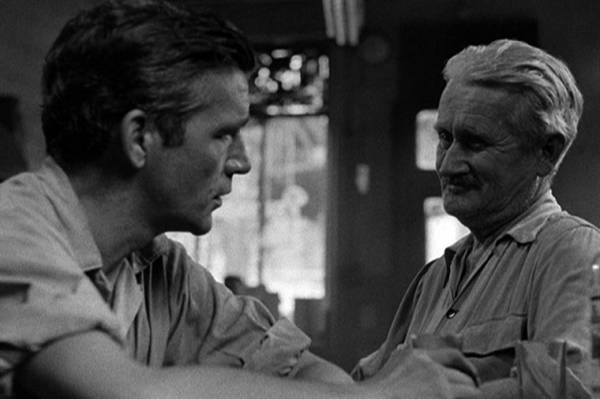
Ray Salyer and Gorman Hendricks are two of the forgotten men in Lionel Rogosin’s unforgettable ON THE BOWERY

ON THE BOWERY (Lionel Rogosin, 1956)
MoMA Film, Museum of Modern Art, Education and Research Building
11 West 53rd St. between Fifth & Sixth Aves.
Thursday, November 29, and Friday, November 30, 1:30
Tickets: $12, in person only, may be applied to museum admission within thirty days, same-day screenings free with museum admission, available at Film and Media Desk beginning at 9:30 am
212-708-9400
www.moma.org
www.ontheboweryfilm.com

One of the greatest documentaries ever made about New York City can now be seen in a recently restored 35mm print, offering a new look at an underground classic. Lionel Rogosin’s On the Bowery caused quite a stir upon its release in 1956, winning prizes at the Venice Film Festival while earning criticism at home for daring to portray the grim reality of America’s dark underbelly. After spending six months living with the poor, destitute alcoholics on Skid Row as research, idealistic young filmmaker Rogosin spent the next four months making On the Bowery, a remarkable examination of the forgotten men of New York, ne’er-do-wells who can’t find jobs, sleep on the street, and will do just about anything for another drink. Rogosin centers the film around the true story of Ray Salyer, a journeyman railroad drifter stopping off in New York City seeking temporary employment. Salyer is quickly befriended by Gorman Hendricks, who not only shows Salyer the ropes but also manages to slyly take advantage of him. Although the film follows a general structure scripted by Mark Sufrin, much of it is improvised and shot on the sly, in glorious black and white by Richard Bagley. The sections in which Bagley turns his camera on the streets, showing the decrepit neighborhood under the El, set to Charles Mills’s subtle, jazzy score and marvelously edited by Carl Lerner, are pure poetry, yet another reason why On the Bowery is an American treasure. The film is screening November 28 & 29 at 1:30 as part of MoMA’s continuing series “An Auteurist History of Film,” along with a pair of seminal silent shorts also set in New York City, Rudy Burckhardt’s 1953 Under the Brooklyn Bridge and Helen Levitt and James Agee’s 1952 In the Street; interestingly, Rogosin tried unsuccessfully to get Agee to work on On the Bowery and fired Levitt as the film’s editor.

TWI-NY TALK: MOLLY SURNO — CINEMA 16 AT THE MET

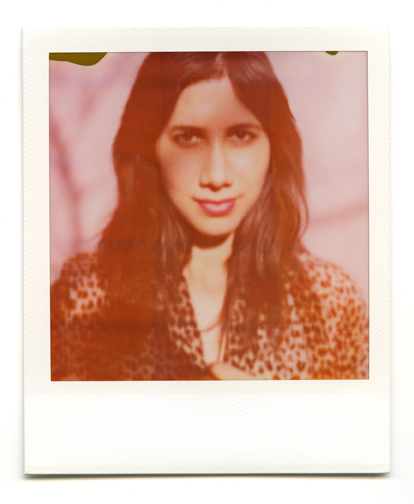
Molly Surno is keeping the spirit of experimental and avant-garde film alive by bringing back Cinema 16

Metropolitan Museum of Art
1000 Fifth Ave. at 82nd St.
Friday, June 3, 7:00
Free with recommended admission of $20
212-570-3828
www.mollysurno.wordpress.com
www.metmuseum.org/collegegroup

In 1947, Amos Vogel founded Cinema 16 as an art community where film devotees could see and discuss experimental celluloid works. Vogel, who turned ninety this past April, later cofounded the New York Film Festival with Richard Roud, serving as its first director in 1963; the NYFF still features the “Views from the Avant-Garde” showcase every year. Since April 2008, photographer and curator Molly Surno has taken up the reins of Vogel’s initial call to arms, answering his question “Shall this audience continue unaware of these hundreds of thought-provoking, artistically satisfying, and socially purposeful films?” by bringing back Cinema 16. The L.A.-born, Brooklyn-based Surno puts together monthly programs that combine classic and contemporary avant-garde films with cutting-edge bands providing live scores. On June 3 at 7:00, she is presenting her latest gathering, being held at the Metropolitan Museum of Art in conjunction with the exhibition “Guitar Heroes: Legendary Craftsmen from Italy to New York.” Introduced by Met associate curator Jayson Kerr Dobney, the evening, part of the Met’s College Group initiative, will feature films by Andy Warhol, Rudy Burckhardt, Edgar Varèse and Le Corbusier, Gina Carducci, Herbert Kosower, and Francis Thompson and live music by Nick Zinner and Brian Chase of the Yeah Yeah Yeahs, Shahin Motia of Oneida, and MV Carbon. As she prepared for the event, Surno was able to sneak in a few minutes to discuss experimental cinema and more with twi-ny.

twi-ny: You’ve held previous editions of Cinema 16 at such venues as the Kitchen, Smack Mellon, Galapagos, the Bell House, and MoMA/PS1, but your next edition is taking place June 3 at the Met, in conjunction with the “Guitar Heroes” exhibition. How did that come about? Did the location impact how you curated the program?

Molly Surno: To my amazement the Metropolitan Museum contacted me to do a performance as part of the programming for the “Guitar Heroes” exhibit. Humbled and inspired, I tailored this program entirely to the current show. The band is composed of some of Brooklyn’s most incredible string players, echoing the three centuries of string instruments on display. The films I selected are all based on the idea of a cityscape being a muse for artistic expression. “Guitar Heroes” shows the journey of string instruments from Southern Italy to New York and the way the luthiers drew from their environments. I took that same premise and selected films that used one’s surroundings as the platform for creative influence. Francis Thompson’s film N.Y., N.Y. quite literally examines the day in a life of a New Yorker but through a kaleidoscope-type lens; Andy Warhol’s Screen Test of Salvador Dalí expresses the culture of an artistic community congregating in New York; Gina Carducci’s Stone Welcome Mat journeys from the Sicily of her grandfather’s home super-8 films to her own return to Southern Italy decades later from the eye of a New York–based artist, among other tales of our surroundings informing and motivating creative works.

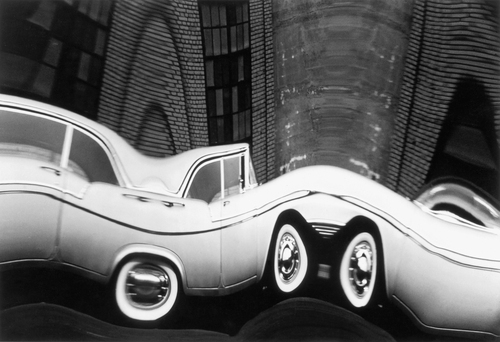
Francis Thompson’s “N.Y., N.Y.” is among the avant-garde films Molly Surno will be presenting at the Met on June 3

twi-ny: What do you choose first when putting together a program, the films or the musicians?

MS: The selection process entirely depends on the commission. For the Met the “Guitar Heroes” exhibition completely dictated both the musical and film curation.

twi-ny: Where did your love of experimental films come from? Was there a “Eureka!” moment? For us, the Eureka! moment, for example, was taking a class with Amos Vogel back in college. Is he familiar with what you’re doing?

MS: I am actively trying to find my way uptown so that I can meet Amos and potentially do a program together. It’s on the wish list.

twi-ny: Are there certain films out there that you’ve been searching for but have been unable to find or gain access to? Who are the new artists making experimental films today who have a similar spirit to those made by such innovators as Maya Deren, Bruce Conner, Shirley Clarke, and Stan Brakhage?

MS: Certainly films are hard to access because they weren’t preserved properly. For example, I wanted to show some Italian experimental film for this program, but there is so little that was properly archived (or archived at all). There is a community that is vibrant and active around the preservation of experimental films, and through them I have met some incredible contemporary avant-garde artists, including Joel Schlemowitz, Gina Carducci, MM Serra, and Mark Street, to name a few. A few years back I showed a piece by an artist named Ezra Johnson, who also works with animation. His work blows my mind.

twi-ny: You’re constantly surrounded by avant-garde film and music. Do you ever just push it all to the back of your mind and spend a Saturday night checking out The Hangover Part II, Thor, or the latest Twilight or Pirates of the Caribbean flick?

MS: This might be my favorite question any journalist has ever asked me. Oddly enough, the more experimental films I watch, the harder it is for me to sit through big-budget films. I mean, let’s put it this way: For me, a Saturday night spent among purely escapist entertainment would include The Godfather or The French Connection. . . . That is about as mainstream as I like to get.