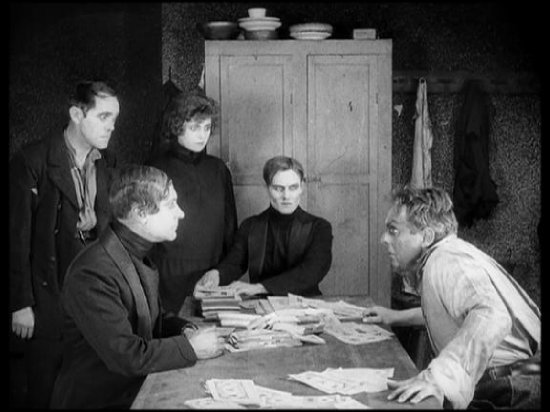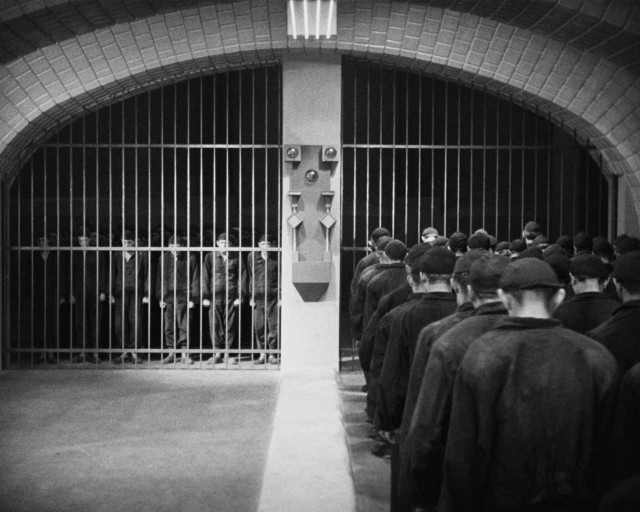
Workers change shifts in the lower depths in Fritz Lang’s futuristic masterpiece, Metropolis
METROPOLIS (Fritz Lang, 1927)
New School Tishman Auditorium
63 Fifth Ave. at Fourteenth St.
Wednesday, April 10, free with advance RSVP, 7:30
www.newschool.edu
Fritz Lang’s 1927 silent epic, Metropolis, has been shown over the years in various versions and with different music, most famously Giorgio Moroder’s 1984 score. On April 10, the New School’s College of Performing Arts will present the world premiere of a new score by Mannes School of Music student Amir Sanjari, performed live to the film by the Mannes Orchestra, conducted by Robert Kahn. “Among the many things that are magical about masterpieces of the silent film era is the possibility of creating new musical sound worlds for extraordinary moving images. This is just what our student composer Amir Sanjari has done with Fritz Lang’s legendary Metropolis, where the brilliant young composer of 2024 joins forces with the 1927 thunderbolt of silent film history,” executive dean Richard Kessler said in a statement. The event is part of the (Un)Silent Film series, which has featured new scores for such works as Charlie Chaplin’s The Gold Rush and The Immigrant and Buster Keaton’s Sherlock Jr., with such hosts as Matthew Broderick, Bill Irwin, and Rob Bartlett.
Set one hundred years in the future, Metropolis pits man vs. machine, the corporation against the worker, and sin vs. salvation in a technologically advanced society run by business mogul Joh Fredersen (Alfred Abel). While Fredersen rakes in the big bucks on the surface, the workers are treated like slaves way down below, in a dark, dank hell where they perform their automaton-like jobs. When Fredersen’s son, Freder (Gustav Fröhlich), starts feeling sympathy for the workers and falls for Maria (Brigitte Helm), an activist who is trying to convince the men, women, and children of the lower depths that they deserve more out of life, Fredersen has mad inventor Rotwang (Rudolf Klein-Rogge) create a man-machine version of Maria to steer his employees to a revolution that will lead them to self-destruct, although things don’t quite turn out as planned. Written by Lang and his wife, Thea Von Harbou, Metropolis is a visual marvel, featuring jaw-dropping special effects by Eugen Schüfftan (who was developing his Schüfftan process of using miniatures) and a stunning man-machine designed by sculptor Walter Schulze-Mittendorff.
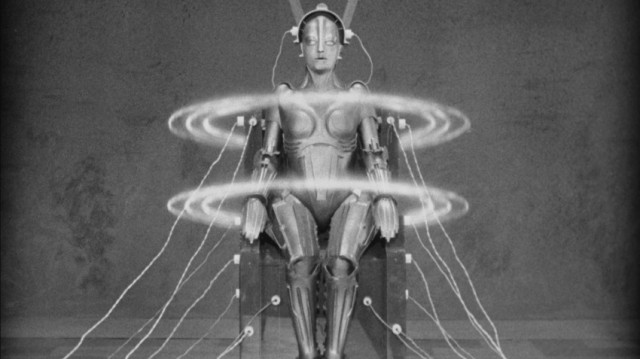
Walter Schulze-Mittendorff’s man-machine stirs up plenty of trouble among the workers in 2026
The complex story incorporates biblical elements, from direct references to the Tower of Babel to other allusions, including fire and flood, while focusing on the relationship between father and prodigal son that evokes both God and Jesus and Abraham and Isaac. A parable that also relates to the battle between employers and unions, the film features a series of doppelgängers: There are two Marias, the real one, who is loving and genuine, and the cold and calculating man-machine; Freder and worker 11811, Georgy (Erwin Binswanger), who temporarily switch places; and Fredersen’s wife, Hel, who died while giving birth to Freder but has been revived into the initial man-machine by Rotwang, who was also in love with her. The massive achievement was shot by Karl Freund (Dracula, Key Largo) with Günther Rittau and Walter Ruttmann, who give it a dazzlingly dramatic look in every scene, accompanied by a soaring score by Gottfried Huppertz that incorporates snippets of Claude Joseph Rouget de Lisle’s “La Marseillaise.” The film declares, “The mediator between head and hands must be the heart!” Lang explores all three in this remarkable film.
“Fritz Lang got the idea for Metropolis when he was in Manhattan in the 1920s promoting another movie of his. Knowing this, I took inspiration from the city itself,” Sanjari said in a statement. “The buildings, the art, and many other things in New York City inspired me to write the score. In addition, I was very inspired by minimalism and the repetition of musical ideas, so I tried to incorporate that.” Admission is free with advance RSVP.
[Mark Rifkin is a Brooklyn-born, Manhattan-based writer and editor; you can follow him on Substack here.]
 Film Forum master programmer Bruce Goldstein has made quite a scheduling choice for Labor Day, screening the 153-minute definitive reconstruction of Fritz Lang’s epic silent masterpiece Metropolis as part of the “Son of Summer Sci-Fi, Fantasy & Horror” series. Set one hundred years in the future, Metropolis pits man vs. machine, the corporation against the worker, and sin vs. salvation in a futuristic society run by business mogul Joh Fredersen (Alfred Abel). While Fredersen rakes in the big bucks on the surface, the workers are treated like slaves way down below, in a dark, dank hell where they perform their automaton-like jobs. When Fredersen’s son, Freder (Gustav Fröhlich), starts feeling sympathy for the workers and falls for Maria (Brigitte Helm), an activist who is trying to convince the men, women, and children of the lower depths that they deserve more out of life, Fredersen has mad inventor Rotwang (Rudolf Klein-Rogge) create a man-machine version of Maria to steer his employees to a revolution that will lead them to self-destruct, although things don’t quite turn out as planned. Written by Lang and his wife, Thea Von Harbou, Metropolis is a visual marvel, featuring jaw-dropping special effects by Eugen Schüfftan (who was developing his Schüfftan process of using miniatures) and a stunning man-machine designed by sculptor Walter Schulze-Mittendorff.