Tag Archives: Rebecca Haden

STRIKING CHOICES: THE WASH AT WP THEATER

A group of Black laundresses prepares to strike in Kelundra Smith’s The Wash (photo by Hollis King)

THE WASH
WP Theater
2162 Broadway at 76th St.
Tuesday – Sunday through June 29, $30-$45
www.newfederaltheatre.com

The real Atlanta Washerwomen’s Strike of 1881 is the setting of Kelundra Smith’s moving if earnest The Wash, making its New York premiere at the WP Theater. A production of Woodie King Jr.’s New Federal Theatre, the fictionalized story is an account of one of first workers’ strikes in American history, all too often left out of our national narrative. Smith powerfully reclaims Black history, as well as her own; the seven characters all carry the names of Smith’s actual female ancestors and family members.

The play begins as a kind of symphony, as five Black women go about their business, washing and drying white people’s clothes using buckets, irons, and washboards, in front of two movable walls onto which are projected colorful abstract images that evoke the work of Georgia-born African American artist Alma Thomas.

The walls are soon spun around to reveal the inside of a double barrel shotgun house where the women gather to clean, gossip, and share their personal stories. The home is rented by Anna (Eunice Woods), a practical widow who runs a sort of workers’ cooperative, washing laundry collected from white Atlanta households. Anna wants to make sure everyone working there gets paid, although their clients aren’t paying them, evading their bills and paying in beans and rice instead of cash. Among the women is Anna’s closest friend, the god-fearing Jeanie (Bianca LaVerne Jones), who lives upstairs. Anna dreams of having her own bakery where she can sell her honeycomb cornbread and Jeanie’s “oh my” pies.

Jeanie: We been over this a thousand times. We ain’t answerin’ to white folks. We done got us a system. We only gots to talk to dem when we pick up they dirty clothes and drop off the clean ones. Dey pissed about it.
Anna: War been over almost twenty years. We oughta be past dis by now.
Jeanie: Dem crackers just killed the president. It ain’t over to dem.
Anna: It’s getting worse. I don’t know how much longer we can go on like this. No mo rice, beans, and hand-me-downs.

Jeanie has just found out that her son and daughter-in-law are going to have a baby, so she needs to make enough money to afford a bus ticket to Rochester. Thomasine (Margaret Odette), who has four young children, is married to an abusive husband. The newly married and madly in love Charity (Alicia Pilgrim) is looking forward to having kids. And Jewel (Kerry Warren) is in college, where she is very good friends with another woman student. The women are fed up with doors being slammed in their faces when they ask for payment, so they start considering striking, and a heated discussion ensues.

Anna: What else are we gonna to do? We tried waiting. We tried asking. We supposed to go the police?
Charity: They’ll arrest us for callin ’em.
Jewel: We wouldn’t be the first. Remember a few years ago in Galveston and Jackson? They did it.
Thomasine: They tried that here last year and the year before. Police pulled washerwomen’s hair out in the street.
Charity: But this a new day. Mrs. Anna say the Cotton Expo comin’.
Jewel: Plus, after they stole the election from that Negro alderman last year, I think folks will hear us out.
Anna: Jeanie, we did say —
Jeanie: We was just talkin’.
Anna: That’s the problem. It’s a lot of talkin’ ’round here, but now it’s time to demand. No pay, no wash.
Jeanie: Strike? If we ain’t workin’, how we gonna pay the property tax?
Thomasine: I got four kids comin’ up like dandelions. Somethin’ is better than nothin’.
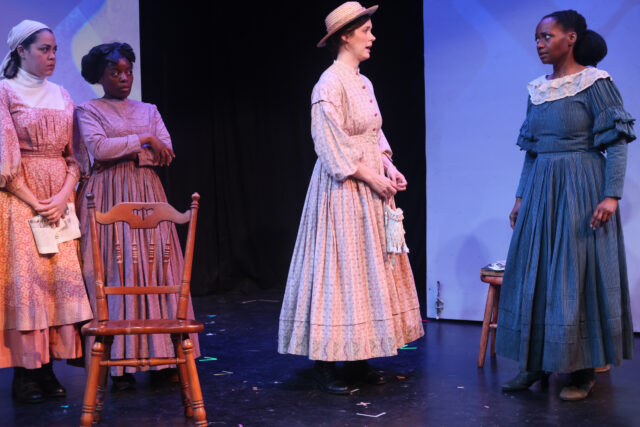
The real Atlanta Washerwomen’s Strike of 1881 inspired play making NYC premiere at WP Theater (photo by Hollis King)

Anna: Something ain’t paying my property taxes. Matter of fact, we not even gettin’ something. We’re gettin’ anythang, and that’s worse. If we can set our own rates, I can pay my taxes ’fore the law come.
Jeanie: Think about this, Anna. What good it’ll do if we strike? It’s plenty of washerwomen in this city. Folk’ll take dey laundry to somebody else, and we’ll have a stain on us.
Jewel: She’s right. It’ll only work if everyone does it. We have to get more women to join us.
Jeanie: More womens? This Atlanta. Dem crackers will have us swingin’ from a Georgia pine.
Jewel: Times are changing. Negroes comin’ up around here.

They gather in a church basement, where they establish their makeshift headquarters for the strike, forming a union called the Washing Society. They are surprised and suspicious when Mozelle (Rebecca Haden), a single white mother, shows up, offering to help get the white laundry women in Castleberry to join the fight. As the number of strikers increases dramatically and the newspapers pick up the story, Anna, Jeanie, Thomasine, Charity, and Jewel reexamine what they want out of their lives, as individuals and as Black women.

The Wash is the conclusion of Smith’s Reconstruction Trilogy, following The Vote and The Knot. She and director Awoye Timpo (In Old Age, Good Grief) build a heartwarming portrait of community among the women, six unique characters who come together while facing their complicated personal situations. The narrative becomes repetitive, and the continual turning around of Jason Ardizzone-West’s set is time consuming and grows a bit tedious; perhaps the play would benefit from being streamlined from 135 minutes with intermission to a more concise 90 minutes without a break.

Gail Cooper-Hecht’s period costumes capture the look of the time, while Belynda M’baye’s wide-ranging props fill the shelves of Anna’s kitchen and workspace. Abhita Austin’s projections include shots of actual newspaper articles weighing in on the strike. Choreographers Adesola Osakalumi and Jill Vallery create scenes with movement that are like dances, all lit by Victor En Yu Tan, achieving what Smith explains in the script: “This play is meant to move like the wind; it’s gentle and breezy in some moments and swift and sharp in others.”

Pulling no punches, The Wash might wear its heart on its sleeve, but it tells an important, little-known story in a way that makes it relevant today, rather than just another episode from America’s shameful past.

[Mark Rifkin is a Brooklyn-born, Manhattan-based writer and editor; you can follow him on Substack here.]

WEDDING BAND: A LOVE/HATE STORY IN BLACK AND WHITE

Brittany Bradford is sensational as a Black woman in love with a white man in Alice Childress’s Wedding Band (photo by Henry Grossman)

WEDDING BAND: A LOVE/HATE STORY IN BLACK AND WHITE
Theatre for a New Audience, Polonsky Shakespeare Center
262 Ashland Pl. between Lafayette Ave. & Fulton St.
Tuesday – Sunday through May 15, $90-$125
866-811-4111
www.tfana.org

Alice Childress is finally having her moment. Born in South Carolina in 1916 and raised in Harlem, the playwright, actress, columnist, and novelist made her posthumous Broadway debut last fall with Trouble in Mind, which was heading for the Great White Way in 1957 until producers pulled it after Childress would not make any changes. A rare revival of her 1966 play, Wedding Band: A Love/Hate Story in Black and White, opens tonight at Theatre for a New Audience’s Polonsky Shakespeare Center. While it’s exciting to see Childress at last receive acclaim, both productions turned out to be disappointing.

The back story as to why these plays had nearly disappeared is primarily that Childress ultimately stood by her scripts, refusing to touch a single word. However, after having now seen both of them, I’m of the belief that each could have used at least a little revision in certain places to avoid repetition and overwrought melodrama; Childress is a master at building characters, but too many of her scenes languish. You can read my take on Trouble in Mind here; my thoughts on Wedding Band continue below.

First staged at the New York Shakespeare Public Theater in 1972 (and not seen again in the city till now), codirected by Joseph Papp and Childress (Papp initially insisted that the author direct but he stepped in, giving them both credit) and starring Ruby Dee and James Broderick (with Albert Hall, Polly Holliday, and Clarice Taylor), Wedding Band centers on the controversial relationship between a Black seamstress, Julia Augustine (Brittany Bradford), and her partner of ten years, a white baker named Herman (Thomas Sadoski). Julia has to move around a lot to avoid the racism the two of them encounter when their situation becomes known, no matter how careful they try to hide it.

It’s the summer of 1918, just a few months till the end of WWI and a year before Red Summer, during which white mobs of civilians and veterans attacked Blacks in twenty-six cities, at least in part because of the Great Migration. Julia has rented a small house in a tiny community for Blacks on the outskirts of Charleston, South Carolina, run by Fanny Johnson (Elizabeth Van Dyke), a faux-elegant landlord who keeps a close watch on her handful of down-on-their-luck tenants.

TFANA’s Wedding Band features a gorgeous open set (photo by Hollis King)

Jason Ardizzone-West’s gorgeous set is a long, open rectangular space with a bed and night table at one end leading to a dirt path flanked by rows of tallgrass; the audience sits on opposite sides behind the knee-high grass. There are no actual doors, so all the characters can see one another whenever they are onstage, entering through the aisles, or wandering across the upper levels of the theater. Stacey Derosier’s lighting keeps most of the audience at least partially illuminated at all times, and Rena Anakwe’s sound design immerses the small crowd in the goings-on. It’s a powerful effect, particularly since the audience members are predominantly white and wearing masks, while onstage the 1918 influenza pandemic is raging across the country.

Among those at Mrs. Johnson’s establishment are Mattie (Brittany-Laurelle), a candy maker who is waiting for her husband, October, to come back from the Merchant Marine with much-needed funds, and their delightful eight-year-old daughter, Teeta (Phoenix Noelle), who plays with the white girl, aptly named Princess (Sofie Nesanelis), whom Mattie cares for; and the widowed Lula Green (Rosalyn Coleman), whose adopted son, Nelson (Renrick Palmer), is home from the war to march in a parade and chase down some women.

When Julia first arrives, she begs for peace and quiet, but Mrs. Johnson and the other residents want to find out everything about her, thumping the Bible as they seek out her sins. Childress points out their poverty from the very beginning; Teeta has lost something, and Mattie is desperate to find it. “Gawd, what’ve I done to be treated this way! You gon’ get a whippin’ too,” Mattie tells her. She explains to Mrs. Johnson, “Dammit, this gal done lost the only quarter I got to my name.”

Julia introduces herself to her new, nosy neighbors, who are taken aback when she quickly reaches into her purse and gives Teeta twenty-five cents. A few moments later the Bell Man (Max Woertendyke) shows up with his traveling salesman’s suitcase of random items; Lula owes him three dollars and ten cents but can’t pay anything now. Julia asks if he has any sheets, and soon the Bell Man, who recognizes her and knows that she is with a white man, is sitting on her bed, implying that she should fulfill his needs if she wants him to remain silent.

She throws him out, saying to the others, “I hate those kind-a people.” Lula responds, “You mustn’t hate white folks. Don’tcha believe in Jesus? He’s white.” Julia replies, “I wonder if he believes in me.”

When her lover, Herman, shows up, Julia is excited to see him. He’s upset because his mother (Veanne Cox) and sister, Annabelle (Rebecca Haden), are being harassed because they’re German, even though they’re American citizens. “It’s the war. Makes people mean,” Julia, who is always understanding of everyone, says. But Herman knows the truth about his family. “A poor ignorant woman who is mad because she was born a sharecropper . . . outta her mind ’cause she ain’t high class society. We’re red-neck crackers, I told her, that’s what.”

When Herman falls ill, it’s not as easy as simply calling a doctor, for their interracial relationship, in an era of anti-miscegenation laws, complicates everyone’s situation.

Bradford (Fefu and Her Friends, Bernhardt/Hamlet, Mac Beth) is spellbinding as Julia, her every move filled with the constant heavy weight on her heart. She portrays her with a gentle compassion until she explodes during Julia’s unforgettable confrontation with Herman’s racist mother.

Herman (Thomas Sadoski) battles illness as his sister (Rebecca Haden), mother (Veanne Cox), and longtime partner (Brittany Bradford) look on (photo by Hollis King)

The stage setup allows every audience member to follow Bradford’s riveting eyes, depicting the pain of being an independent-thinking Black woman in love with a white man, a relationship that nearly everyone looks down on. It takes on additional meaning as privacy rights are under attack again in the United States in 2022.

The rest of the cast is solid, but director Awoye Timpo (In Old Age, The Loophole, Carnaval), who so smoothly guided the show through the first half, gets too caught up in the mawkishness of the later plot developments, leading to a head-scratching magic-realist finale that feels as tacked on as it is.

Wedding Band is part of TFANA’s CLASSIX residency, which was founded by Timpo with Bradford, A. J. Muhammad, Dominique Rider, and Arminda Thomas to focus on Black performance and works by Black writers across the African diaspora. On May 14 at 4:30, TFANA will host the panel discussion “CLASSIX: In Search of Alice Childress,” with the CLASSIC collective, moderated by Jonathan Kalb. And on May 15 at 4:30, the TFANA Talk “Reflections, with Bianca Vivion Brooks” pairs Bradford with Juliana Canfield, who starred in Adrienne Kennedy’s He Brought Her Heart Back in a Box at TFANA in 2018, a show that also deals with interracial relationships.

I hope to see more plays by Childress, who died in New York City in 1994 at the age of eighty-one and also wrote such novels as A Hero Ain’t Nothing but a Sandwich, Like One of the Family, and A Short Walk. Even in productions that fall short, there are compelling, prescient moments and important, beautifully drawn characters.

As she wrote in a letter to Dee, “Wedding Band is about yesterday and today . . . far away and right at hand . . . old and ever present. It is the past, present, and future . . . recollection, attention, and anticipation . . . It is about the humiliation of an entire nation . . . not a tale of star-crossed lovers. My play is about manless women. Women in need of love, name, protection. It concerns itself with love and the seeking of love in a racist society . . . the love of country, the love of material things, and spiritual love.” Childress is clearly a playwright for these troubled times.