
YUKIO MISHIMA CENTENNIAL SERIES: EMERGENCES
Japan Society
333 East 47th St. at First Ave.
September 11 – December 6
japansociety.org
“Only art makes human beauty endure,” Yukio Mishima wrote in his 1959 novel Kyoko’s House.
In his short life — Mishima died by suicide in 1970 at the age of forty-five — the Japanese author and political activist penned approximately three dozen novels, four dozen plays, five dozen story and essay collections, ten literary adaptations, and a libretto, a ballet, and a film.
Japan Society is celebrating the hundredth year of his birth — he was born Kimitake Hiraoka in Tokyo in January 1925 — with “Yukio Mishima Centennial Series: Emergences,” comprising six events through December 6. The festival begins September 11–20 with Kinkakuji, SITI company cofounder Leon Ingulsrud and Korean American actor Major Curda’s theatrical adaptation of Mishima’s intense 1956 psychological novel The Temple of the Golden Pavilion, based on the true story of extreme postwar actions taken by a young Buddhist monk. Creator and director Ingulsrud cowrote the script with Curda, who stars in the play. The stage design is by Japanese visual artist Chiharu Shiota, whose international installations, featuring red and black yarn structures, include “In the Light,” “My House Is Your House,” and “Memory of Lines.” Her latest, “Two Home Countries,” runs September 12 through January 11 in the Japan Society gallery, consisting of immersive, site-specific works created in commemoration of the eightieth anniversary of the end of WWII.
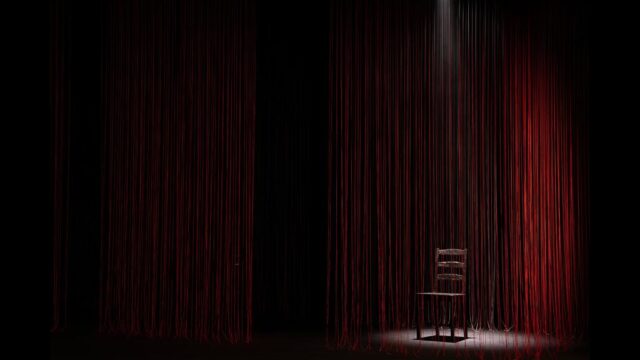
There are unlikely to be many empty seats at Japan Society for Kinkakuji and other Mishima events (photo © Ayako Moriyama)
There will be eleven performances of Kinkakuji, with a gallery-opening reception following the September 11 show, a separate gallery talk on September 12, a lecture preceding the September 16 show, and an artist Q&A on September 17. Each ticket comes with free same-day admission to “Two Home Countries.”
On September 27, Japan Society, as part of the John and Miyoko Davey Classics series, will screen Kon Ichikawa’s 1958 film, Conflagration, based on The Temple of the Golden Pavilion and starring Raizo Ichikawa, Tatsuya Nakadai, and Ganjiro Nakamura.
In conjunction with L’Alliance New York’s Crossing the Line Festival, Japan Society will present Le Tambour de Soie (The Silk Drum) on October 24 and 25, Yoshi Oida and Kaori Ito’s adaptation of Mishima’s 1957 Noh play Aya no Tsuzumi, a dance-theater piece about love and aging featuring downtown legend Paul Lazar and choreographer Ito, with music by Makoto Yabuki. The second show will be followed by an artist Q&A. On November 6, Japanese novelist and cultural ambassador Keiichiro Hirano (Nisshoku, Dawn) and Tufts University Mishima scholar Dr. Susan J. Napier will sit down for a conversation discussing Mishima’s life and legacy.
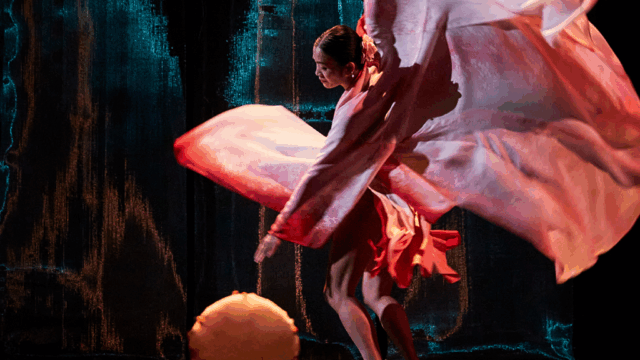
Le Tambour de Soie (The Silk Drum) will be performed October 24 and 25 at Japan Society (photo © courtesy of the Maison de la Culture d’Amiens)
On November 15 and 16, the Tokyo-based company CHAiroiPLIN brings The Seven Bridges (Hashi-zukushi) to Japan Society, a visually arresting adaptation for all ages of Mishima’s short story about four women seeking wishes during a full moon. The series concludes December 4–6 with the US debut of Hosho Noh School and Mishima’s Muse – Noh Theater, three unique programs of noh and kyogen theater comprising performances of works that inspired Mishima: Shishi (Lion Dance), Busu (Poison), Aoi no Ue (Lady Aoi), Kantan, and Yoroboshi. The December 4 performance will be followed by a ticketed soirée, and there will be an artist Q&A after the December 5 show with Kazufusa Hosho, the twentieth grand master of Hosho Noh School, which dates back to the early fifteenth century. In addition, members of Hosho Noh School lead a workshop on December 6.
“This series revitalizes Mishima’s contributions to the world of the arts through a slate of brand new commissions and premieres adapting his writings, as well as a historic US debut for a revered noh company,” Japan Society artistic director Yoko Shioya said in a statement. “This series recognizes not only Mishima’s critical legacy but the ongoing current influence of this essential postwar author on artists today.”
That legacy can be summed up in this line from his 1963 novel Gogo no Eikō (The Sailor Who Fell from Grace with the Sea): “Of course, living is merely the chaos of existence, but more than that it’s a crazy mixed-up business of dismantling existence instant by instant to the point where the original chaos is restored.”
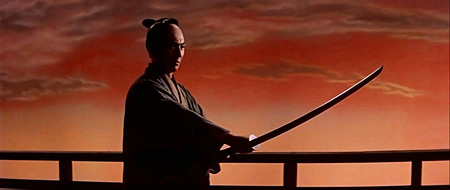
 When local official Tange Tanzen (Raizo Ichikawa) comes upon a battle between two schools of sword fighting, including his own, he chooses not to get involved as rogue samurai Yasubei Nakayama (Shintaro Katsu) displays his discipline’s superiority by killing several members of Tange’s school. After Tange is expelled from his school for turning his back on his brothers, Yasubei is expelled from his as well as an act of honor and enmity. Soon the two ronin are helping each other while also falling in love with the same woman, Chiharu (Chitose Maki). But blood and betrayal await them as they set off on new paths that continue to cross. Inspired by the classic story of the 47 Ronin, SAMURAI VENDETTA is an entertaining period piece despite its overt cheesiness, especially the fight scenes shot on a bridge with a ridiculously fake sunset in the background. Although there’s not nearly enough sword play – there are long periods of sentimental melodrama – the finale in the snow is a doozy. The screening will be followed by a reception and book signing with Chris D., author of OUTLAW MASTERS OF JAPANESE FILM.