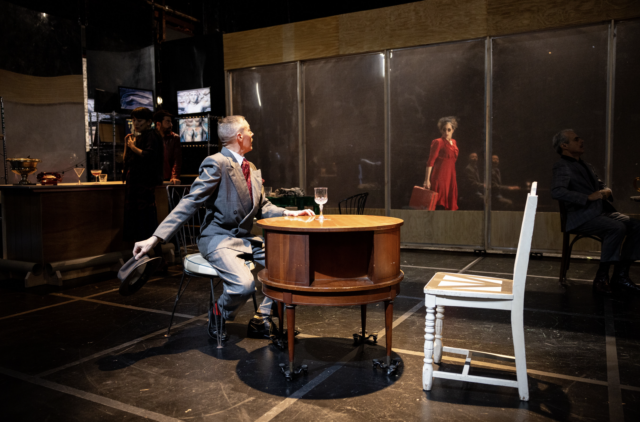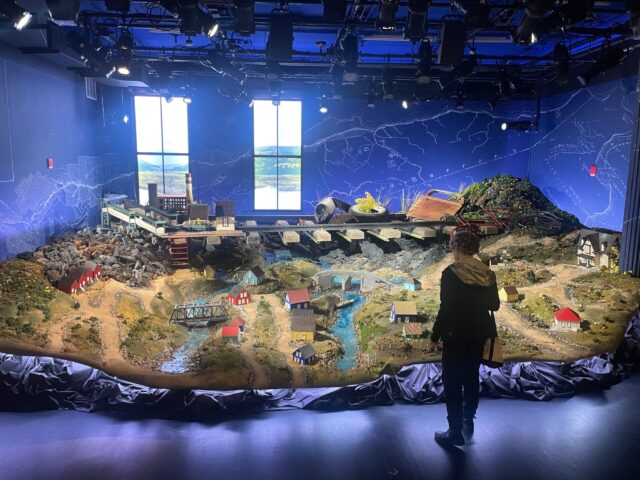
There are no actors on hand but the Mabou Mines production of All That Fall boasts a magnificent set (photo by twi-ny/mdr)
“Space is the place,” Sun Ra sang on the title track of his 1973 album, Space Is the Place. “There’s no limit to the things that you can do. . . . And your life is worthwhile.”
The jazz legend might have been referring to the cosmos, but one of the (many) things that makes my life worthwhile is entering a theater with no idea what to expect visually. I’m not talking about standard setups where the proscenium stage is in front of rows of affixed seats but rooms that can be reshaped and reconfigured in multiple ways. For example, I am filled with anticipation every time I walk into Park Ave. Armory’s Wade Thompson Drill Hall, TFANA’s Polonsky Shakespeare Center, the Shed’s McCourt, BAM Fisher, and the Signature’s Romulus Linney Courtyard Theatre, all of which can be transformed into fascinating rearrangements.
Below are four recent shows I’ve seen that offered unique spatial experiences.

The cast of All That Fall does not appear in person at the 122 Community Center (photos by Jeri Coppola)
UNDER THE RADAR: ALL THAT FALL
Mabou Mines@122CC
150 1st Ave. at Ninth St.
January 8–25, $20-$50
www.maboumines.org
utrfest.org
Since 1970, the experimental avant-garde Mabou Mines troupe has been challenging the boundaries of theater, and they do it again with their adaptation of Samuel Beckett’s 1957 radio play, All That Fall. When audience members get off the elevator at the 122 Community Center, they encounter a series of objects in the hallway and a side room that prepare them for the show: a photo of the Orangedale train station next to a radio playing a Big Band–era instrumental; a poster of a railway man’s “hand, flag and lamp signals” with an actual rusty lamp; a photo of the train station interior, with empty benches, which hints at what we’ll soon see; horse-racing information; and a piece of paper with the opening quote from Beckett’s 1938 novel, Murphy, “The sun shone, having no alternative, on the nothing new,” along with a drawing of a tree by Harry Bliss with the caption “A tree greeting the morning sun, because it has no choice.”
Inside the theater, the seats are arranged in a traditional manner, but the set is like an art installation, a large model of a miniature town with tiny houses, bumpy hills, rocky streets, a river, two bridges, hens near the tracks, and an elevated train station, all surrounded by a map on the walls; in the back are regular-size remnants, an abandoned bicycle and parts of some kind of moving vehicle. In front of the model, a man is projecting slides on an old carousel of costumed men and women — the characters the actors will be portraying. Shortly after the projections stop and the man leaves, we realize that there will be no actors for us to watch; in true radio-play fashion, they will only be heard, prerecorded, but we now know what they look like.
The narrative is fairly straightforward: Mrs Maddy Rooney (Randy Danson) is worried when her blind husband, Dan (Tony Torn), is late getting home. She finds out that the ever-dependable train has not arrived yet, and she is concerned why. Along her journey, she meets up with Christy the carter (Jesse Lenat), Mr Barrell the station master (Lenat), Mr Tyler the retired bill collector (Steven Rattazzi), Mr Slocum the racecourse manager (Torn), Tommy the railway porter (Tẹmídayọ Amay), the pious Miss Fitt (Wendy vanden Heuvel), the little girl Dolly (Lila Blue), and the little boy Jerry (Sylvan Schneiderman). They have absurdist conversations about dung, the Matterhorn, damnation, sex, bicycles and vans, the Titanic and the Lusitania, and “the horrors of home life.”
Mrs Rooney’s dialogue is filled with lovely snippets about human existence: “What kind of a country is this where a woman can’t weep her heart out on the highways and byways without being tormented by retired bill-brokers!” she complains to Mr Tyler. “Christ what a planet,” she declares to Miss Fitt. “I do not exist,” she says to Tommy. “I am not half alive nor anything approaching it,” she explains to Mr Tyler. “Have you no respect for misery?”
The breathtaking set is by Thomas Dunn, lit by Jennifer Tipton, with a bevy of sound effects by Bruce Odland, from animal noises to a storm that shakes your seat almost like Sensurround. Mabout Mines cofounder JoAnne Akalaitis directs with a wry sense of humor.
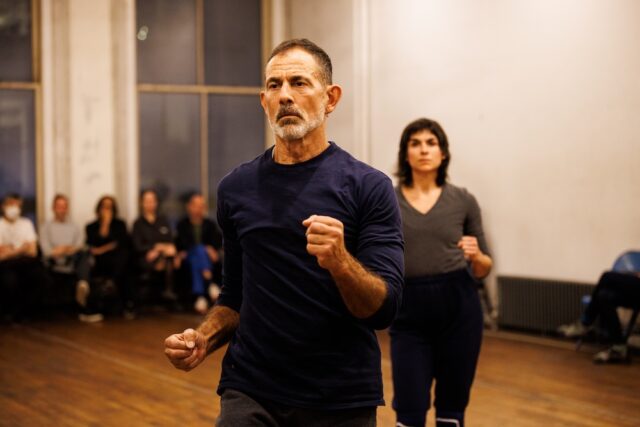
Wally Cardona and Molly Lieber revive David Gordon’s Times Four for its fiftieth anniversary (photo by Maria Baranova)
LIVE ARTERY: TIMES FOUR / DAVID GORDON: 1975/2025
New York Live Arts / Pick Up Performance Co. Studio
541 Broadway between Spring & Prince Sts.
January 11–13, $33.85
newyorklivearts.org
In May 1977, husband-and-wife dancers David Gordon and Valda Setterfield performed their 1975 piece, Times Four in the SoHo loft where they lived and worked. Their son-in-law, Wally Cardona, has brought their little-seen pas d’deux back for a fiftieth-anniversary tribute, teaming up with Molly Lieber to re-create it from a video rehearsal, Setterfield’s handwritten notes, photographs, and other ephemera, taking place in the same loft. It is like a 1960s happening: The limited seating is a single row of folding chairs around the periphery of the otherwise empty room; in addition, the night I attended, there were numerous familiar choreographers and dancers in the audience, all greeting one another. There is no score; the only sounds are Cardona’s (Interventions, The Set Up) and Lieber’s (Rude World, Gloria) breathing and their feet and other body parts touching the floor, sometimes landing softly, sometimes hard. They stare at the walls and windows, rarely making eye contact with the audience, as they glide primarily in unison to four beats, then deleting one move and replacing it with another.
Concentrating mostly on their legs and feet, they move forward, backward, sideways, lifting here, pounding there, almost always in unison. They fall to the ground, extend their bodies, come within inches of the audience. When slight differences occur, you can feel it in your bones. You never know which direction they are going to turn in, resulting in a thrilling suspense to it all.
They both exert remarkable strength as they perform difficult maneuvers, their muscles rippling, sweat forming. It’s a compelling feat of human endurance that last about sixty tense, exhilarating minutes. A poem associated with the dance explains, “well worn wood floor / smooth burnished brown / the kind of floor that begs to be danced on / that wants to seduce me out of my shoes and socks. . . . I face my back to the windows / I imagine 1975.”
Consider me seduced.
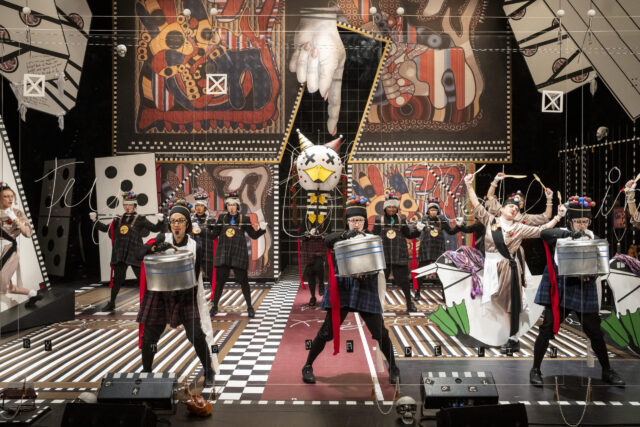
Paul Lazar and Annie-B Parson stage first revival of Richard Foreman’s What to wear at BAM (photo by Stephanie Berger)
PROTOTYPE: WHAT TO WEAR
Brooklyn Academy of Music
BAM Strong Harvey Theater
651 Fulton St. at Ashland Pl.
January 15-18
www.bam.org
www.prototypefestival.org
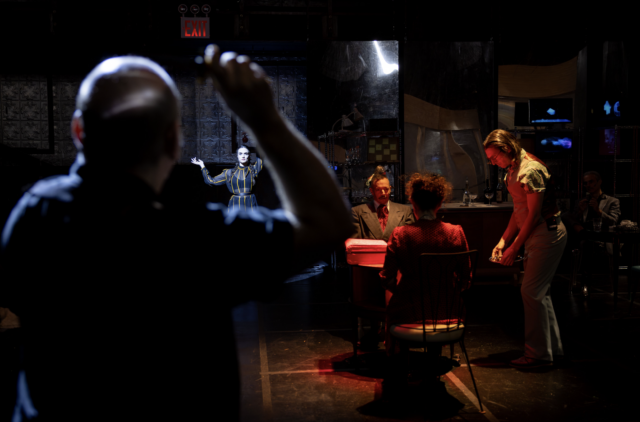
In September 2006, experimental avant-garde legend Richard Foreman and composer Michael Gordon debuted their surreal post-rock opera, What to wear, at the Redcat in LA. It took twenty years, but the show has finally made it to New York at the BAM Strong Harvey Theater as part of the Prototype festival, in its first-ever revival. To prepare everyone for what awaited inside the theater, in the lobby was Foreman’s detailed original concept design model for the complex, fabulously overstuffed stage, a kind of mind-blowing melding of Monty Python, Pablo Picasso, and Alice in Wonderland. It is thrilling to walk into the Harvey and see how that set has been painstakingly re-created at full size by Michael Darling, like magic; Darling also did the props, and the wild costumes are again by E. B. Brooks. Big Dance Theater’s Paul Lazar and Annie-B Parson direct, honoring the 2006 production, which you can watch online here.
The show begins with fancy lighting coming down from the ceiling as a giant cartoonish duck emerges from a doorway and the deep voice of Richard Foreman booms from the heavens: “As of this moment, this ugly duckling is now effectively banished from the realm of the oh so beautiful people.” The duck exits, and sopranos Sarah Frei and Sophie Delphis, mezzo Hai-Ting Chinn, and tenor Morgan Mastrangelo sing, “This is Mad’line X” eight times, then adding, “In a terrible world / One unpleasant world / Such a bad, bad world.” Over the next sixty-plus minutes, those four are joined by St. Vincent, an ensemble of more than a dozen vocalists and dancers, and the seven-piece Bang on a Can orchestra caged in one corner as the story goes through such chapters as “Mad’line X, who understands now,” “So sad but I reject you,” and “When a duck enters a fine restaurant.”
Marchers in kilts hold signs with a big X on them, a pointing finger drops down from above like the hand of G-d, skulls abound, headpieces feature little colored balls on top, a character walks around in a barrel, golf clubs become weapons, a head is locked in a box, and cool wizardry occurs just about everywhere. The unsatisfying ending does not diminish the triumph of this engaging revival. We are told that “Madeline X lives in this terrible world,” but any world that includes works by Foreman can’t be all bad.
AN ARK
The Griffin Theater at the Shed
The Bloomberg Building at Hudson Yards
545 West 30th St. at Eleventh Ave.
Tuesday – Sunday through March 1, $45
theshed.org
“Don’t panic. Don’t be scared. This must feel strange to you. It felt strange to me,” an unnamed character played by Sir Ian McKellen says at the beginning of British playwright Simon Stephens’s An Ark, continuing at the Shed through March 1.
Too late.
In the summer of 2021, Stephens’s Blindness was reimagined for the pandemic, presented at the Daryl Roth Theatre in Union Square, where a maximum of eighty-six masked and blindfolded people were seated in chairs in pods of two, either facing the same or opposite directions, each couple at least six feet away from other pairs. Everyone listened to the play, about a spreading virus that leads to chaos, through individual binaural headphones; the prerecorded narrative was performed by Juliet Stevenson.
In the summer of 2023, Tin Drum brought Kagami to the Shed’s Griffin Theater, which began with a historical multimedia installation that led to a mixed-reality concert in which everyone put on specially designed optically transparent devices that made it appear that the late pianist Ryuichi Sakamoto was playing live, enveloped in augmented reality art. In actuality, the room was completely empty except for a row of chairs along the perimeter where audience members could sit and watch, although it was much better to walk around and get up close and personal with Sakamoto — you could even go right through him.
So I was beyond excited when I heard that Tin Drum had teamed up with Stephens (Sea Wall, Heisenberg, The Curious Incident of the Dog in the Night-Time) and the Shed for An Ark. The play features McKellen (Waiting for Godot, King Lear), Golda Rosheuvel (A Christmas Carol, Not Your Superwoman), Arinzé Kene (Misty, Get Up, Stand Up!), and Rosie Sheehy (Machinal, The Brightening Air) as four futuristic humans in a kind of intergalactic weigh station.
The prep for the show is mind-bogglingly annoying. The audience is encouraged to arrive at least fifteen or twenty minutes before showtime in order to check their coats and bags, which is mandatory; however, the line was so long when we go there that we were advised to just bring our stuff in with us. At the Griffin, a sign announced, “wipe your feet / check your glasses / store your shoes / enter through the curtain / find a seat / put on your headset / sit back / enjoy the ride.” There was no curtain; the open doorway revealed a large room with plush red carpeting, a giant glowing orb hanging in the center from the ceiling, and three circular rows of chairs with a pathway through the middle. While my guest waited for corrective lenses — glasses won’t work with the headset — I took off my shoes and jacket, placed them on the floor, and tried to grab a specific seat, then come back and store my garb in one of the small cubby-hole benches, but I was told by a guide that I couldn’t do that; first I had to put the shoes and coat away, then someone would guide me to a chair. The shoes fit in the little cubby, but I had to really force the coat into another slot, only to be told that I had placed them in the wrong bench and had to move them. By then, my guest was already seated — with her jacket, which she was allowed to keep on her lap, and bag, which she could put under her chair.
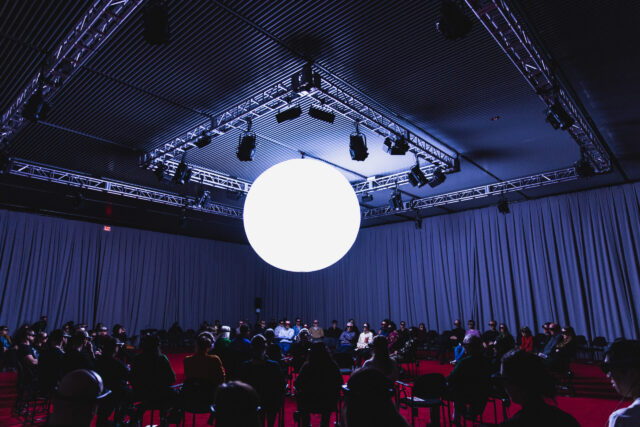
Mixed reality An Ark at the shed is a confusing jumble (photo by Marc J. Franklin)
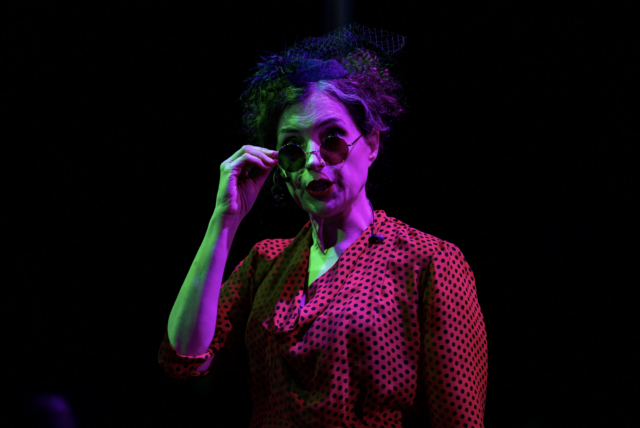
Next, you put on the headsets, and four white holographic chairs appear in front of you; mine had to be adjusted by a guide because the chairs were enormous and floating in the ether. I was disappointed that I could also see everyone else in the room, which detracted from the personal nature of the show, even though theater is usually meant to be a communal experience. Then, guides wheeled the cubby benches straight through the middle of the theater and out the curtain on the other side of the room, further disturbing the alternate reality that was being created. As the play proper began, with the four characters, all barefoot and wearing white, entering the space and sitting down, it was hard not to wonder why the floor had to be carpeted and why we had had to take off our shoes; perhaps it was some kind of ASMR thing.
For forty-seven minutes, the actors perform just for you, making intense direct eye contact, reaching out with their hands, and using the second person as they recount multiple versions of a life, from birth, childhood, and adolescence to adulthood, the senior years, and death. For example: “At school you work hard but you never really feel like you belong,” “You’ll want to tell people about the things that have happened to you in here,” and “You get on first name terms with your pharmacist.” The dialogue is filled with detailed descriptions of objects and scenarios that involve all five senses; while poetic, they don’t propel the plot, which remains mysterious through the end.
Recorded in one take and directed by Sarah Frankcom (Our Town, Punk Rock) with sound by Ben and Max Ringham, set and costumes by Rosanna Vize, and lighting by Seth Reiser, An Ark has numerous beautiful moments, and the interaction between the characters and you can be utterly chilling (Sir Ian McKellen is only a few feet away!); when Sheehy reached a hand out to me, I reached back, attempting to grasp it.
But too much of it was confusing and unnecessary; I’m eager to see where the technology goes. Hopefully the kinks will be smoothed out and creators will have more faith in the story itself, without all the bells, whistles, and rules.
As McKellen says early on, “When this is over . . . things will have changed forever.” Well, hopefully not too much.
[Mark Rifkin is a Brooklyn-born, Manhattan-based writer and editor; you can follow him on Substack here.]