Tag Archives: this week at the new york film festival

WHEN IS A FILM NOT A FILM: CELEBRATING JAFAR PANAHI AT METROGRAPH

NOT A FILM: FILMS OF JAFAR PANAHI
Metrograph
7 Ludlow St. between Canal & Hester Sts.
July 12 – August 5
metrograph.com

“The hope of creating again is a reason for existence,” Iranian filmmaker Jafar Panahi said in a statement at the 2022 New York Film Festival, where his latest work, No Bears, was screening. Panahi could not attend the festival because he had been arrested again and sentenced to six years, a political prisoner of the regime that had banned him from making films. But that has never stopped Panahi, who was released following a hunger strike in February 2023.

In anticipation of the October release of his newest film, It Was Just an Accident, another illegal, banned-in-Iran production and winner of the Palme d’Or at Cannes, Metrograph is presenting “Not a Film: Films of Jafar Panahi,” consisting of eight of his eleven features, from his 1995 debut, The White Balloon, cowritten by his mentor, Abbas Kiarostami, through 2000’s Golden Lion–winning The Circle, the 2003 thriller Crimson Gold, and the 2015 Golden Bear–winning Taxi Tehran, one of several films in which Panahi plays a fictionalized version of himself.

It’s worth reading the full NYFF statement from this masterful auteur:

“We are filmmakers. We are part of Iranian cinema. For us, to live is to create. We create works that are not commissioned. Therefore, those in power see us as criminals. Independent cinema reflects its own times. It draws inspiration from society. And cannot be indifferent to it. The history of Iranian cinema witnesses the constant and active presence of independent directors who have struggled to push back censorship and to ensure the survival of this art. While on this path, some were banned from making films, others were forced into exile or reduced to isolation. And yet, the hope of creating again is a reason for existence. No matter where, when, or under what circumstances, an independent filmmaker is either creating or thinking about creation. We are filmmakers, independent ones.”

The Metrograph series runs July 12 to August 5; below are select reviews.
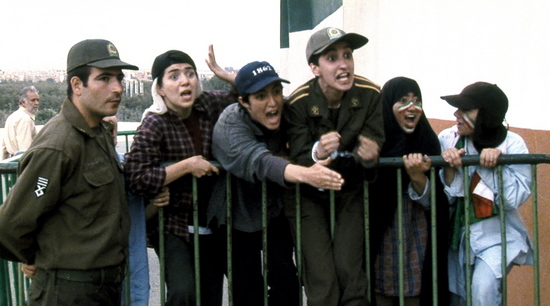
The unscripted Offside is part of Metrograph tribute to Iranian filmmaker Jafar Panahi

OFFSIDE (Jafar Panahi, 2006)
Saturday July 19, 2:10
Sunday July 20, 1:50
metrograph.com
www.sonyclassics.com/offside

Filmed on location in and around Tehran’s Azadi Stadium and featuring a talented cast of nonprofessional actors, Jafar Panahi’s Offside is a brilliant look at gender disparity in modern-day Iran. Although it is illegal for girls to go to soccer games in Iran — because, among other reasons, the government does not think it’s appropriate for females to be in the company of screaming men who might be cursing and saying other nasty things — many try to get in, facing arrest if they get caught. Offside is set during an actual match between Iran and Bahrain; a win will put Iran in the 2006 World Cup. High up in the stadium, a small group of girls, dressed in various types of disguises, have been captured and are cordoned off, guarded closely by some soldiers who would rather be watching the match themselves or back home tending to their sheep. The girls, who can hear the crowd noise, beg for one of the men to narrate the game for them. Meanwhile, an old man is desperately trying to find his daughter to save her from some very real punishment that her brothers would dish out to her for shaming them by trying to get into the stadium.

Despite its timely and poignant subject matter, the unscripted, Silver Bear–winning Offside — which was banned in Iran before it was released — is a very funny film, with fine performances by Sima Mobarak Shahi, Shayesteh Irani, Ida Sadeghi, Golnaz Farmani, Mahnaz Zabihi, and Nazanin Sedighzadeh as the girls and M. Kheymeh Kabood as one of the soldiers.
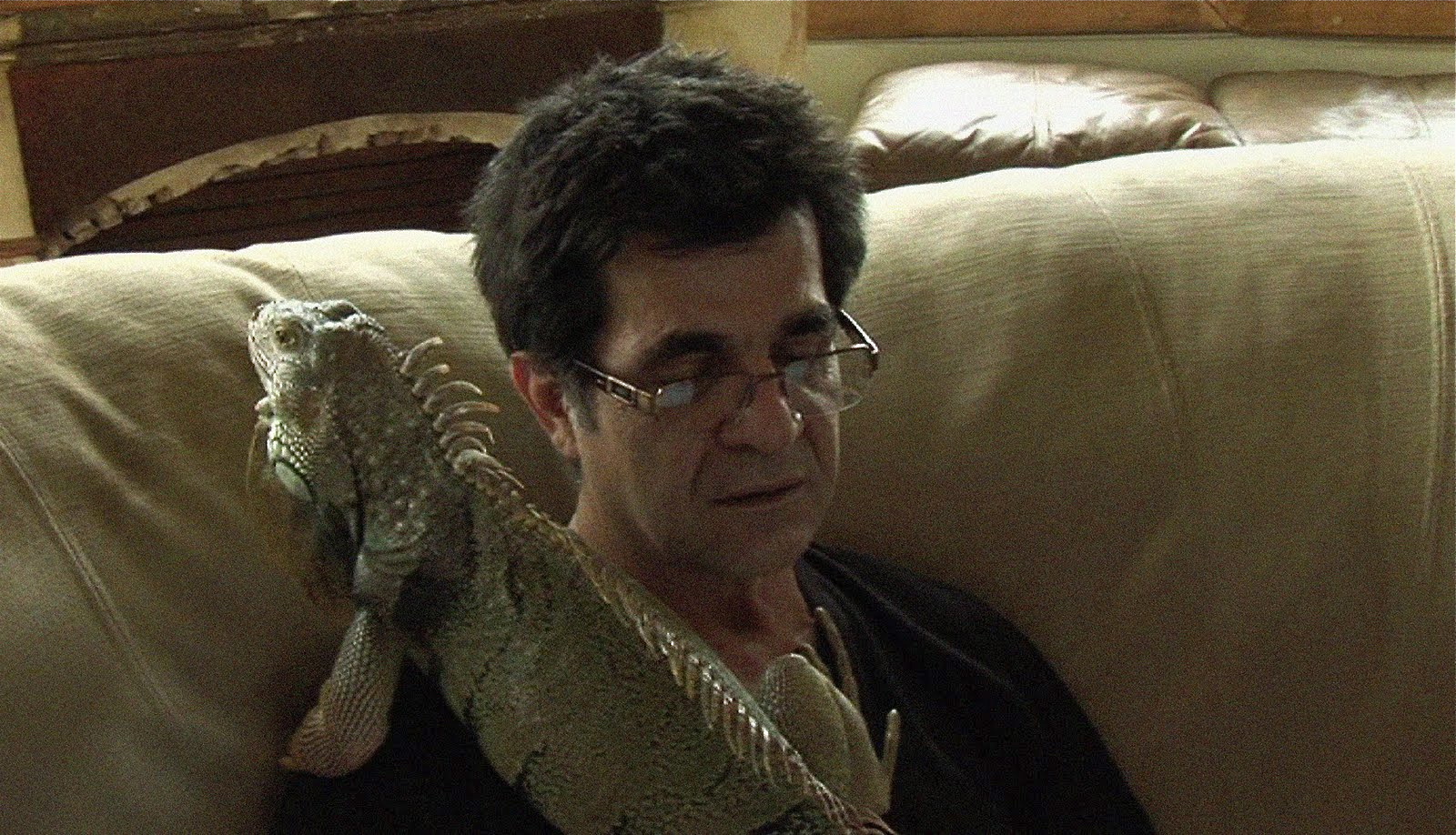
Even house arrest and potential imprisonment cannot stop Iranian auteur Jafar Panahi from telling cinematic stories

THIS IS NOT A FILM (IN FILM NIST) (Jafar Panahi & Mojtaba Mirtahmasb, 2011)
Saturday July 26, 12:15
Sunday July 27, 2:25
metrograph.com

“You call this a film?” Jafar Panahi asks rhetorically about halfway through the revealing 2011 documentary This Is Not a Film. After several arrests beginning in July 2009 for supporting the opposition party, highly influential and respected Iranian filmmaker Panahi was convicted in December 2010 for “assembly and colluding with the intention to commit crimes against the country’s national security and propaganda against the Islamic Republic.” Although facing a six-year prison sentence and twenty-year ban on making or writing any kind of movie, Panahi is a born storyteller, so he can’t stop himself, no matter the risks. Under house arrest, Panahi has his friend, fellow director Mojtaba Mirtahmasb (Lady of the Roses), film him with a handheld DV camera over ten days as Panahi plans out his next movie, speaks with his lawyer, lets his pet iguana climb over him, and is asked to watch a neighbor’s dog, taking viewers “behind the scenes of Iranian filmmakers not making films.” Panahi even pulls out his iPhone to take additional video, photographing New Year’s fireworks that sound suspiciously like a military attack. Panahi is calm throughout, never panicking (although he clearly does not want to take care of the barking dog) and not complaining about his situation, which becomes especially poignant as he watches news reports on the earthquake and tsunami disaster in Japan.

“But you can’t make a film now anyhow, can you?” Mirtahmasb — who will later be arrested and imprisoned as well — asks at one point. “So what I can’t make a film?” Panahi responds. “That means I ask you to take a film of me? Do you think it will turn into some major work of art?” This Is Not a Film, which was smuggled out of Iran in a USB drive hidden in a birthday cake so it could be shown at Cannes, is indeed a major work of art, an important document of government repression of free speech as well as a fascinating examination of one man’s intense dedication to his art and the creative process. Shortlisted for the Best Documentary Academy Award, This Is Not a Film is a mesmerizing experience from a genius who has since gifted the world with Closed Curtain, Taxi Tehran, 3 Faces, and No Bears, defying the government while constantly looking over his shoulder.
3 Faces

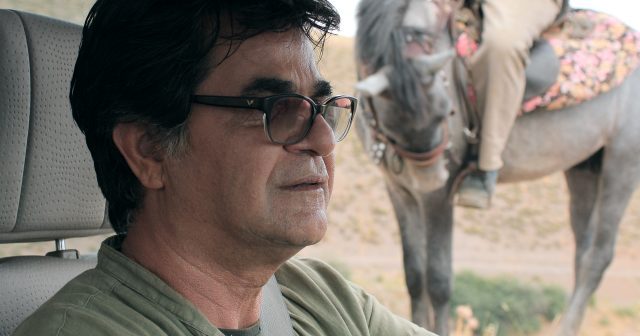
Iranian auteur Jafar Panahi plays a version of himself in gorgeously photographed and beautifully paced 3 Faces

3 FACES (SE ROKH) (Jafar Panahi, 2018)
Saturday, August 2, 4:30, and Sunday, August 4, noon
metrograph.com

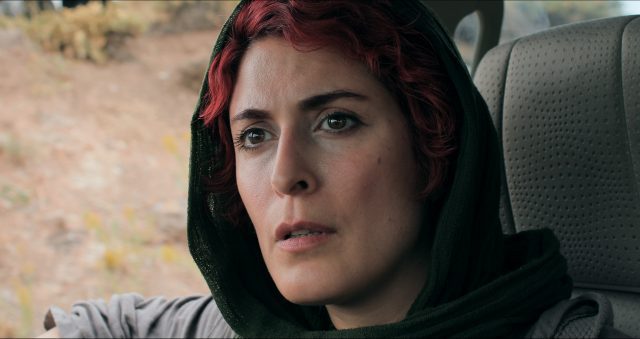
One of the most brilliant and revered storytellers in the world, Iranian auteur Jafar Panahi proves his genius yet again with another cinematic masterpiece, the tenderhearted yet subtly fierce road movie 3 Faces. The film made its US premiere at the New York Film Festival, won the Best Screenplay prize at Cannes, and was shown in IFC’s inaugural Iranian Film Festival New York. As with some of Panahi’s earlier works, 3 Faces walks the fine line between fiction and nonfiction while defending the art of filmmaking. Popular Iranian movie and television star Behnaz Jafari, playing herself, has received a video in which a teenage girl named Marziyeh (Marziyeh Rezaei), frustrated that her family will not let her study acting at the conservatory where she’s been accepted, commits suicide onscreen, disappointed that her many texts and phone calls to her hero, Jafari, went unanswered. Deeply upset by the video — which was inspired by a real event — Jafari, who claims to have received no such messages, enlists her friend and colleague, writer-director Panahi, also playing himself, to head into the treacherous mountains to try to find out more about Marziyeh and her friend Maedeh (Maedeh Erteghaei). They learn the girls are from a small village in the Turkish-speaking Azeri region in northwest Iran, and as they make their way through narrow, dangerous mountain roads, they encounter tiny, close-knit communities that still embrace old traditions and rituals and are not exactly looking to help them find out the truth.
3 Faces

Iranian star Behnaz Jafari plays herself as she tries to solve a mystery in Jafar Panahi’s 3 Faces

Panahi — who is banned from writing and directing films in his native Iran, is not allowed to give interviews, and cannot leave the country — spends much of the time in his car, which not only works as a plot device but also was considered necessary in order for him to hide from local authorities who might turn him in to the government. He and Jafari stop in three villages, the birthplaces of his mother, father, and grandparents, for further safety. The title refers to three generations of women in Iranian cinema: Marziyeh, the young, aspiring artist; Jafari, the current star (coincidentally, when she goes to a café, the men inside are watching an episode from her television series); and Shahrzad, aka Kobra Saeedi, a late 1960s, early 1970s film icon who has essentially vanished from public view following the Islamic Revolution of 1978-79, banned from acting in Iran. (Although Shahrzad does not appear as herself in the film, she does read her poetry in voiceover.) 3 Faces is gorgeously photographed by Amin Jafari and beautifully edited by Mastaneh Mohajer, composed of many long takes with few cuts and little camera movement; early on there is a spectacular eleven-minute scene in which an emotionally tortured Jafari listens to Panahi next to her on the phone, gets out of the car, and walks around it, the camera glued to her the whole time in a riveting tour-de-force performance.
3 Faces

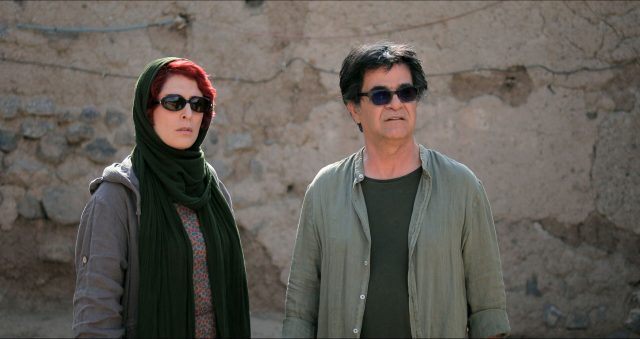
Behnaz Jafari and Jafar Panahi encounter culture clashes and more in unique and unusual road movie

3 Faces was Panahi’s fourth film since he was arrested and convicted in 2010 for “colluding with the intention to commit crimes against the country’s national security and propaganda against the Islamic Republic”; the other works are This Is Not a Film, Closed Curtain, and Taxi Tehran, all of which Panahi starred in and all of which take place primarily inside either a home or a vehicle. 3 Faces is the first one in which he spends at least some time outside, where it is more risky for him; in fact, whenever he leaves the car in 3 Faces, it is evident how tentative he is, especially when confronted by an angry man. The film also has a clear feminist bent, not only centering on the three generations of women, but also demonstrating the outdated notions of male dominance, as depicted by a stud bull with “golden balls” and one villager’s belief in the mystical power of circumcised foreskin and how he relates it to former macho star Behrouz Vossoughi, who appeared with Shahrzad in the 1973 film The Hateful Wolf and is still active today, living in California. Panahi, of course, will not be at Metrograph for the series, as his road has been blocked, leaving him a perilous path that he must navigate with great care.

[Mark Rifkin is a Brooklyn-born, Manhattan-based writer and editor; you can follow him on Substack here.]

NYFF62 HOT PICKS

Ivan (Mark Eydelshteyn) and Ani (Mikey Madison) set off on a frenetic romance in Anora

MAIN SLATE: ANORA (Sean Baker, 2024)
Film at Lincoln Center
Saturday, September 28, 6:15
Sunday, September 29, noon
www.filmlinc.org

The sixty-second edition of the New York Film Festival is under way, and the first standout is Sean Baker’s Anora.

Winner of the Palme d’Or at Cannes, Anora is a nonstop wild ride through the frenetic, unpredictable relationship between a stripper and the scion of a Russian oligarch. It starts out luridly but quickly morphs into a touching and surprisingly human tale.

Mikey Madison, who starred in the 2022 Scream sequel, shows off her mighty pipes in the film, making a career breakthrough as Ani, a stripper living in a Brighton Beach railroad apartment who catches the eye of Ivan Zakharov (Mark Eydelshteyn), who buys her for a week, lighting up the nights in a cavalcade of sex and drugs while developing what appears to be turning into a real relationship. But when his parents, Nikolai (Aleksei Serebryakov) and Galina (Darya Ekamasova), find out about it, they sic their guard dogs, Igor (Yura Borisov), Toros (Karren Karagulian), and Garnick (Vache Tovmasyan), on them, leading to hilariously violent scenes as Ani sets out to prove that she is not a hooker and is not ashamed of being a sex worker.

Written, edited, and directed by Baker, whose previous work includes Take Out, Tangerine, The Florida Project, and Red Rocket, Anora is an aggressive, in-your-face trip that races from Coney Island to Las Vegas, with lush cinematography by Drew Daniels, a pulsating score by Matthew Hearon-Smith, and fanciful costumes by Jocelyn Pierce.

Madison, a regular on Better Things and Lady in the Lake, is fearless as Ani, a determined young woman who knows what she wants and is not afraid to say it out loud and fight for it. The coda is disappointing — it would have been much better if the film ended before the final moments in the car — but otherwise Anora is a thrilling cinematic experience.

Anora is screening September 28 and 29, with Baker and Madison on hand for Q&As. The ferocious film will then return to Lincoln Center for a theatrical run in mid-October, with Baker and Madison participating in Q&As October 16 and 18. Keep watching this space for more reviews from NYFF62.

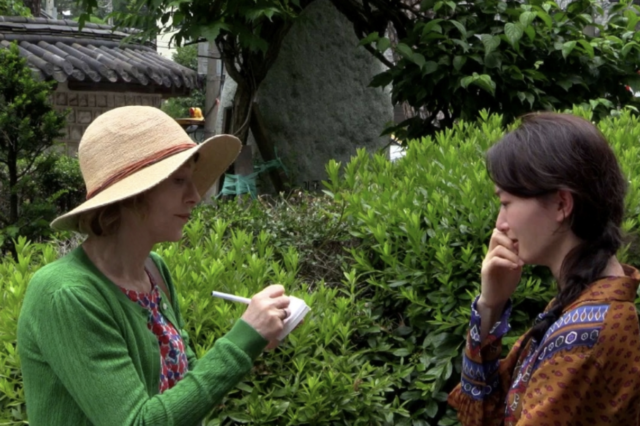
Iris (Isabelle Huppert) takes notes while teaching Isong (Kim Seungyun) French in Hong Sangsoo’s A Traveler’s Needs

MAIN SLATE: A TRAVELER’S NEEDS (Hong Sangsoo, 2024)
Film at Lincoln Center
Wednesday, October 2, 9:00
Thursday, October 3, 6:15
www.filmlinc.org

Longtime New York Film Festival favorite Hong Sangsoo returns to Lincoln Center with two touching works for NYFF62. For nearly thirty years, the South Korean Hong has been making contemplative, character-driven films in which writers or directors develop different kinds of relationships with actors, fans, students, and other admirers amid a lot of drinking, eating, and smoking as they discuss art, love, human nature, and film itself.

In such gems as Oki’s Movie, The Day He Arrives, Yourself and Yours, Like You Know It All, and Right Now, Wrong Then, Hong constructs slow-paced, intriguing philosophical narratives in which not much necessarily happens but nearly every minute is imbued with meaning.

In A Traveler’s Needs, Isabelle Huppert, in her third Hong film (following 2012’s In Another Country and 2017’s Claire’s Camera), stars as Iris, a mysterious Frenchwoman who seems to just appear and disappear; we know almost nothing about her or why she is in Seoul.

When we first encounter her, she is teaching French to a young pianist, Isong (Kim Seungyun), asking her questions using index cards and an old cassette recorder that looks almost like a toy. We soon find out that Iris is not a trained teacher but someone who only recently developed her unique method, which involves asking her students how they feel deep inside, and that she has no idea if it will actually work.

Iris, who dresses like she is on vacation, wearing a flowery dress, green sweater, and wide-brimmed hat, next visits Wonju (Lee Hyeyoung) and her husband, Haesoon (Kwon Haehyo), to teach them French. Wonju is suspicious of Iris and her technique, but as they partake of more of the milky rice wine known as makgeolli, everyone loosens up a bit.

Later, Iris returns home, to an apartment she shares with Inguk (Ha Seongguk), a younger man who is not quite ready to introduce her to his mother, Yeonhee (Cho Yunhee), although the relationship between Inguk and Iris is unclear.

So how does A Traveler’s Needs make you feel? Like many of Hong’s films, it’s a calm tale featuring lots of conversation and long takes, highlighted by another superb performance by Huppert. It might be best exemplified by a scene in which Iris approaches a tiny river, takes off her shoes, steps into the water, looks around while humming, and drops one of her shoes. It’s hard to tell if it was supposed to happen, but Huppert lets out an adorable sigh, picks it up, shakes it out, and carries on.

Hong also incorporates an oddly endearing repetition in the film, in dialogue, character traits, and Iris’s movement, particularly how she walks when she exits a scene. She practically floats in and out of her world, innocent and carefree, like a child. Hong’s camera loves her — he wrote, directed, photographed, produced, and edited the film in addition to composing the score — and so will you.

A Traveler’s Needs is screening October 2 at 9:00 and October 3 at 6:15, with Huppert participating in Q&As after each show; she will also return to Lincoln Center November 21 for a Q&A when the film opens at the Walter Reade Theater.

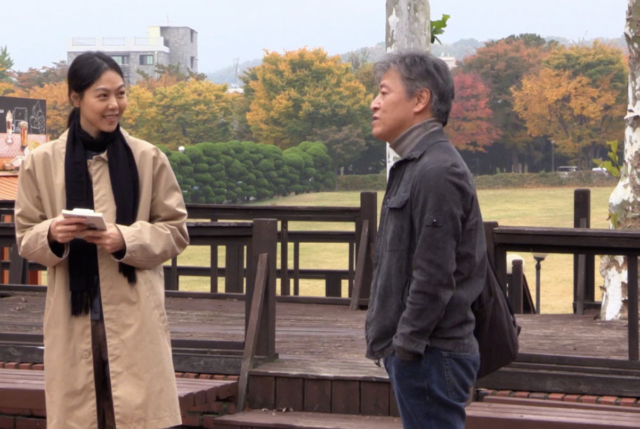
Jeonim (Kim Minhee) and her uncle, Chu Sieon (Kwon Haehyo), reunite at a university in By the Stream

MAIN SLATE: BY THE STREAM (Hong Sangsoo, 2024)
Film at Lincoln Center
Friday, October 4, 9:00
Friday, October 11, 6:45
www.filmlinc.org

“I’ll light the smallest lamp in the corner and protect it until I die,” a college student tells Chu Sieon (Kwon Haehyo) when he asks four young women what they want to do in the future in Hong Sangsoo’s By the Stream. It’s a subtle admission in a subtle film filled with small lamps in corners, literally and figuratively.

Hong wrote, edited, produced, directed, photographed, and composed the score for the film, another intimate, eloquent drama about people just going about their daily lives, eating, drinking, and talking about creativity and love. It takes place on a lovely campus at a woman’s university in Seoul, where it’s time for the annual skit contest, when the various departments put on ten-minute shows. Art professor Jeonim (Kim Minhee) is in a jam when the director in charge of the script for her department has been kicked out after sleeping with three of the students.

Jeonim makes a desperate call to her uncle, Chu, a onetime popular actor who was canceled for unstated reasons and has been running a small bookstore on a remote lake for decades. Niece and uncle have not spoken for ten years, but Sieon accepts the offer, returning to the school where he got his start forty years before. While the four art students are not exactly psyched about the script he has written for them, the head of the department, Jeong (Cho Yunhee), is instantly smitten with him, an adoring fan who wants to spend more and more time with him — and he doesn’t seem to mind all the attention.

With skit night approaching, Jeonim, Sieon, and Jeong do a lot of eating, talking, and drinking, enjoying eel and the milk rice wine known as makgeolli, as relationships grow more complicated and characters reexamine who they are and what they want.

By the Stream is Hong’s thirty-second film since his debut, 1996’s The Day a Pig Fell into the Well. It’s also the thirteenth Hong film Kim has starred in; they began an affair in 2015 — they are both separated from their spouses, with whom they have children, which caused a scandal in South Korea — and Kim, an award-winning international star, has not worked for another director since Park Chan-wook’s 2016 The Handmaiden. Hong is twenty-two years older than Kim; Kwon is seventeen years older than Cho. That is not to imply that By the Stream is autobiographical, but it appears to have personal elements that add intrigue to the gentle magic of the storytelling and characterization.

Kim won the Best Performance award at Locarno for her role as Jeonim, who spends much of her time drawing the ripples in a stream, the water ever changing and constantly moving, like life. She then re-creates the patterns on her loom, finding solace in making art. Chu is reenergized by his decision to direct the skit, interacting with people as he hasn’t since isolating himself at his bookstore. And Jeong shows a different side of herself as she becomes a fan girl forming a connection with the object of her affection.

Hong often leaves his camera fixed as the action unfolds, particularly when the three protagonists are at tables, eating, drinking, and talking, composing a kind of flowing, ever-changing portrait. Water has been a leitmotif throughout Hong’s career; several of his films have the words water, river, beach, and stream in them, and in others, water plays a part, like the beautiful scene in A Traveler’s Needs when Iris (Isabelle Huppert) steps into a small stream.

As in so many of Hong’s works, By the Stream proceeds at its own hypnotic pace, offering profound if understated treatises on the little things in life, like that small lamp in the corner.

Larry Cotton (Andrew Robinson) and his daughter, Kirsty (Ashley Laurence), have their hands full in Hellraiser

REVIVALS: HELLRAISER (Clive Barker, 1987)
Saturday, October 5, 9:15
Wednesday, October 9, 1:00
www.filmlinc.org

“What’s your pleasure?” an unseen character asks at the beginning and end of Clive Barker’s Hellraiser, now screening at NYFF62 in a 4K restoration. Adapted from his novella The Hellbound Heart, the horror film made quite a splash when it was released in 1987, and its legacy as a genre classic has only grown over the years, despite, not because of, nine sequels, none of which Barker wrote or directed. The film faced bans and censorship, so Barker had to make some concessions, editing certain ultraviolent and S&M scenes, but there are still plenty in there to justify its cult status.

“We did a version which had some spanking in it and the MPAA was not very appreciative of that,” Barker said in the DVD audio commentary. “[They also] told me I was allowed two consecutive buttock thrusts from Frank but a third would be deemed obscene.”

The film begins with Frank Cotton (Sean Chapman) in Morocco acquiring a puzzle box and, upon solving it in his suburban American home, getting sent to a hell realm where pain mixes with pleasure, a decadent take on the hot nightclub scene of the 1980s. Years later, Frank’s brother, Larry (Andrew Robinson), returns to the family homestead with his second wife, Julia (Clare Higgins), who unbeknownst to him had a torrid affair with Frank. Larry’s daughter, Kirsty (Ashley Laurence), shows up to provide support, but it’s instantly clear that she and Julia are not besties.

When Larry severely cuts his hand while helping the creepy movers bring a bed upstairs, the blood oozes into the floorboards and awakens Frank, who is a skinless terrifying creature (portrayed by Oliver Smith). Frank reveals to Julia, who still has the hots for him, that he can regain his skin and they can have a life together if she feeds him other human beings, so she hits the bars, bringing men home to be devoured by her lover. Larry is completely oblivious to what is going on right under his nose, but Kirsty grows suspicious, leading to an appropriately blood-soaked, out-of-this-world climax.

Hellraiser is most remembered and revered for the Cenobites, ghoulish S&M characters known as the Chatterer (Nicholas Vince), Butterball (Simon Bamford), the unnamed female (Grace Kirby), and their leader, Pinhead (Doug Bradley), who became a breakout star. The general plot is derivative and the acting has a heavy dose of soap opera attitude, but Barker pushes it all beyond the limits of standard genre fare, toying with cliché so you won’t always know what’s coming. Christopher Young’s score, Michael Buchanan’s production design, Jocelyn James’s art direction, and Aileen Seaton’s hair stylings capture the ’80s sensibility and look better than ever in the restoration, as do the special effects and intense makeup and costumes.

All in all, this version of Hellraiser provides the answer to the question “What’s your pleasure?”

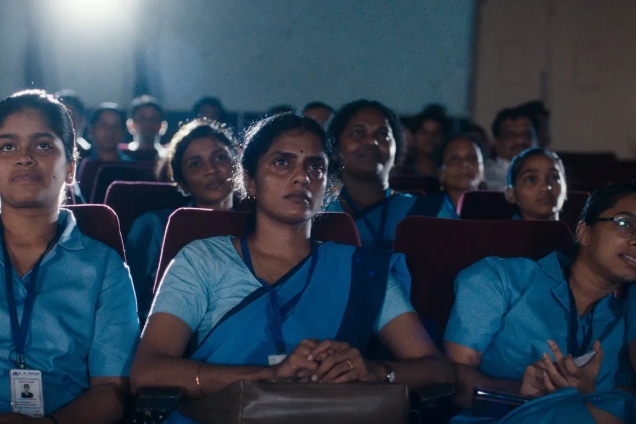
Prabha (Kani Kusruti) takes a new look at her life in All We Imagine as Light

MAIN SLATE: ALL WE IMAGINE AS LIGHT (Payal Kapadia, 2024)
Film at Lincoln Center
Monday, October 7, 6:00
Tuesday, October 8, 9:15
Free talk Wednesday, October 9, 4:00
Thursday, October 10, 3:30
www.filmlinc.org

Indian filmmaker Payal Kapadia won the Golden Eye at Cannes in 2021 for best documentary for A Night of Knowing Nothing, a film that mixes fact and fiction while telling the story of two lovers trying to stay connected via letters amid student protests in India. Kapadia mixes fact and fiction again in her follow-up, the tender and deeply poignant All We Imagine as Light, which won the Grand Prix at Cannes earlier this year.

The new work opens with gritty shots of the streets of Mumbai, as unseen people share their difficulties trying to make a new life for themselves after migrating from the country. “There’s always the feeling I’ll have to leave,” one person says. Another opines, “The city takes time away from you.” A third argues, “Why would anyone want to move back?”

Kapadia, who was born in Mumbai, then shifts to the fictional tale of two nurses and a third hospital employee fighting loneliness as they care for sick people. Prabha (a heart-wrenching Kani Kusruti) and the younger Anu (Divya Prabha) live together in an apartment in the city. Prabha, who is in an arranged marriage, has not seen her husband, who is working in Germany, for more than a year. Anu, whose family is Hindi, is in love with a Muslim man, Shiaz (Hridhu Haroon), keeping their relationship secret for fear of being discovered and shunned. And Parvaty (Chhaya Kadam) is a recent widow who is being evicted from her home of twenty-two years because her name is nowhere on the paperwork left behind by her husband.

When Prabha receives a brand-new German rice cooker in the mail, she assumes it is from her spouse, perhaps a message that he is not coming back and that she should proceed with her life. But she is tentative to start dating, even as she is pursued by the goofy but sweet Dr. Manoj (Azees Nedumangad), who writes poetry for her.

The three women decide to hit the road, taking a trip to Parvaty’s seaside Maharashtrian hometown, where they take stock of their lives, particularly after a man washes up onshore.

All We Imagine as Light is sensitively shot by cinematographer Ranabir Das, with a soft, jazzy score by Topshe as soft rain falls, trains pass by in the background, and Prabha and Parvaty throw stones at a billboard for a pending skyscraper that proclaims, “CLASS is a privilege reserved for the PRIVILEGED.”

All We Imagine as Light is an engaging and touchingly lyrical look at womanhood in contemporary Mumbai, as the city threatens three women with potential isolation and alienation until they bind together. The youngest, Anu, instills new energy into the others to reevaluate their situations and take action. “Do you ever think of the future?” Anu asks.

The film appropriately provides no firm answers in the end, but it is clear that Kapadia’s future is a bright one.

All We Imagine as Light is screening at NYFF62 on October 7, 8, and 10, with the writer-director participating in Q&As following the first two showings. She will also be at the Amphitheater at the Elinor Bunin Munroe Film Center on October 9 at 4:00 for a free talk with Portuguese director Miguel Gomes, whose Grand Tour is screening October 8, 9, and 11 at the festival.

[Mark Rifkin is a Brooklyn-born, Manhattan-based writer and editor; you can follow him on Substack here.]
TALK TO ME: FREEBIES AT NYFF62

NYFF62: FREE TALKS
New York Film Festival
Elinor Bunin Munroe Amphitheater
144 West Sixty-Fifth St. between Broadway & Amsterdam Ave.
September 28 – October 11, free tickets available one hour before showtime (unless otherwise noted)
www.filmlinc.org

The sixty-second annual New York Film Festival kicks off today, with more than ninety feature films and shorts, from US premieres to unexpected revivals. The opening night selection is RaMell Ross’s Nickel Boys, the centerpiece Pedro Almodóvar’s The Room Next Door, and the closing night choice Steve McQueen’s Blitz. Many screenings will be followed by Q&As with members of the cast and crew, including Saoirse Ronan, Sean Baker, Mikey Madison, Adrien Brody, Felicity Jones, Jia Zhangke, Mike Leigh, Marianne Jean-Baptiste, Paul Schrader, David Cronenberg, Isabelle Huppert, Elton John, Selena Gomez, Zoe Saldaña, Naomi Watts, and Bill Murray.

In addition, there are free talks nearly every day in the Elinor Bunin Munroe Amphitheater that will go behind the scenes of numerous films at the festival; no advance RSVP is required except for a few special events.

Saturday, September 28, 7:30
Sunday, September 29, 8:00
Monday, September 30, 7:30
Tuesday, October 8, 7:30

Cinephile Game Night: NYFF62 Edition, including movie trivia, Six Degrees, a card game, prizes, and special guests, hosted by Jordan Raup, Conor O’Donnell, and Dan Mecca, Amphitheater, free with advance RSVP

Sunday, September 29
Deep Focus: RaMell Ross (Nickel Boys), in conversation with Barry Jenkins, Amphitheater, 6:00

Monday, September 30
Roundtables: New Asian Auteurs, with Neo Sora (Happyend), Trương Minh Quý (Việt and Nam), and Yeo Siew Hua (Stranger Eyes), Amphitheater, 4:30

Tuesday, October 1
Deep Focus: No Other Land, with directors Basel Adra, Yuval Abraham, and Rachel Szor, Amphitheater, 6:00

Wednesday, October 2
On exergue – on documenta 14, with director Dimitris Athiridis, curator Adam Szymczyk, D14 artist Naeem Mohaiemen, and curator and writer Serubiri Moses, moderated by Rachael Rakes, Amphitheater, 5:00

Thursday, October 3
Crosscuts: Alex Ross Perry (Pavements) & Andrei Ujică (TWST / Things We Said Today), Amphitheater, 6:00

Saturday, October 5
Deep Focus: Sigrid Nunez (The Friend, The Room Next Door), moderated by A. O. Scott, Amphitheater, 1:00

Film Comment Live: Collective Protagonists, with Rob Nilsson and John Hanson (Northern Lights), Brett Story and Stephen Maing (Union), moderated by Devika Girish and Clinton Krute, Amphitheater, 7:00

Sunday, October 6
Crosscuts: Zeinabu irene Davis (Compensation) & Madeleine Hunt-Ehrlich (The Ballad of Suzanne Césaire), Amphitheater, 6:00

Monday, October 7
IndieWire Presents: Screen Talk Live, with Anne Thompson and Ryan Lattanzio, Amphitheater, 4:00

Tuesday, October 8
The 2024 Amos Vogel Lecture: Jia Zhangke (Caught by the Tides), interpreted by Vincent Cheng, Walter Reade Theater, $12.50-$17.50, 5:00

Wednesday, October 9
Crosscuts: Miguel Gomes (Grand Tour) & Payal Kapadia (All We Imagine as Light), moderated by Devika Girish, Amphitheater, 4:00

Crosscuts: Julia Loktev (My Undesirable Friends: Part I — Last Air in Moscow) & Roberto Minervini (The Damned), moderated by Madeline Whittle, Amphitheater, 6:00

Friday, October 11
Film Comment Live: Festival Report, with Devika Girish and Clinton Krute, Amphitheater, 7:00

[Mark Rifkin is a Brooklyn-born, Manhattan-based writer and editor; you can follow him on Substack here.]
NYFF60 MAIN SLATE: ALL THAT BREATHES

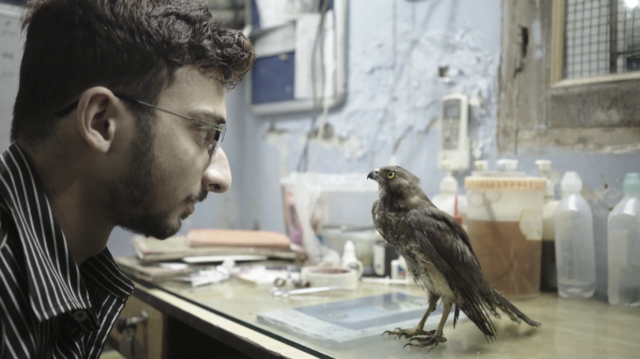
All That Breathes explores the fate of black kites in India as representative of so much more

ALL THAT BREATHES (Shaunak Sen, 2022)
New York Film Festival, Film at Lincoln Center
Tuesday, October 11, Walter Reade Theater, 6:30
Wednesday, October 12, Howard Gilman Theater, 9:00
www.filmlinc.org
www.allthatbreathes.com

Shaunak Sen’s All That Breathes opens with a long shot of rats scurrying about a filthy New Delhi area, then follows a man carrying four boxes with holes in them into a dingy, crowded basement garage. One starts to rock and falls awkwardly to the floor. The man walks over and takes out an injured bird. As Mohammad Saud, Nadeem Shehzad, and Salik Rehman examine the injured creature, they speak of a possible nuclear war between India and Pakistan.

“What’ll happen to the birds if there’s a nuclear war?” Rehman asks. “We’ll all die. Where will they go?”

A moment later, a young boy searches for a bullet, an announcement from the street advises, “We don’t want any harm to any public property,” and a black kite, a bird of prey that migrates to New Delhi every year, grips a small branch and then accusingly stares directly into the camera. Later street announcements declare, “This is a fight for empathy and unity! The Constitution has to be saved!” regarding the treatment of Islamic citizens.

For several decades, Indian Muslim brothers Saud and Shehzad have been rescuing and healing kites that have fallen from the sky, victim to pollution and the cotton threads of kites that slice their wings. “When we got our first kite . . . I’d stay up at night staring at it,” Shehzad says in voiceover as a lone kite soars in the air, the moon at its left. “It looked like a furious reptile from another planet. It’s said that feeding kites earns ‘sawab’ [religious credit]. When they eat the meat you offer, they eat away your difficulties. And their hunger is insatiable.”

When the brothers were teenage bodybuilders, they encountered their first injured kite. A bird hospital refused to help because the species is not vegetarian, so they used their own knowledge of flesh, muscles, and tendons to repair it. They’ve been rescuing and repairing hurt birds in their highly unsanitary quarters ever since.

Amid the social unrest and their legitimate fears of being turned into refugees because of their religion, Saud and Shehzad continue to fix the birds, as if fixing themselves as they worry about losing their freedom. Over one dinner they discuss with their families what they might do if the government kicks them out of the country. Meanwhile, the brothers are desperate to get a grant to keep their Wildlife Rescue operating.

“I’ve devoted my entire life to this. But this doesn’t feel enough to me,” Shehzad explains. “Things are getting from bad to worse here. Birds are plummeting from the sky. Delhi is a gaping wound. And we’re a tiny Band-Aid on it.”

Cinematographer Ben Bernhard focuses in on nature, from an icy river to an owl to dozens and dozens of kites filling the sky, set to a gentle yet ominous score by Roger Goula. Director and producer Sen (Cities of Sleep) is not just making a film about kites in India; he is accusing the world as a whole of misusing resources in ways that threaten the existence of such living creatures as kites and damage the planet’s ecological system.

“Man is the loneliest animal,” Saud says.

Winner of the Grand Jury Prize for Best Documentary (World Cinema) at Sundance and the L’OEil d’or for Best Documentary at Cannes, All That Breathes is screening at the New York Film Festival on October 11 and 12, with Sen on hand for Q&As after both shows. The film opens theatrically October 21 at Film Forum, with Sen participating in Q&As following the 7:00 shows on October 21 and 22.

NYFF60 MAIN SLATE: AFTERSUN

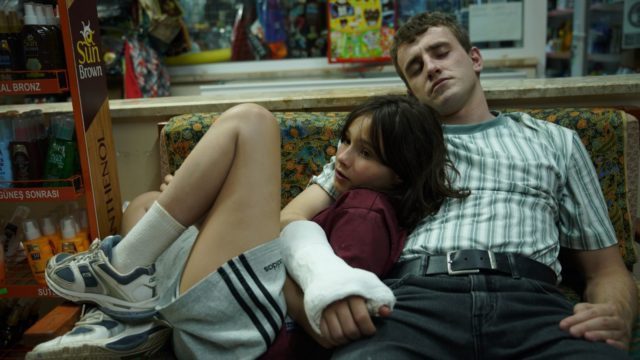
A father (Paul Mescal) and daughter (Francesca Corio) bond in Charlotte Wells’s Aftersun

AFTERSUN (Charlotte Wells, 2022)
New York Film Festival, Film at Lincoln Center
Saturday, October 8, Alice Tully Hall, 12:00
Sunday, October 9, Alice Tully Hall, 9:00
Monday, October 10, BAM Cinemas, 7:00
212-355-6160
www.filmlinc.org

At one point in Charlotte Wells’s hauntingly beautifully debut feature, Aftersun, a divorced father, Calum (Paul Mescal), and his eleven-year-old daughter, Sophie (Francesca Corio), are standing in the mountains, arms stretched to the sky as if the world is limitless for them, but nearby is an old, rotting sign that announces, “We know the perfect place,” once upon a time offering visitors “paradise.” The two are on vacation on the Mediterranean coast of Turkey, a bonding trip during which Calum assures Sophie, “You can live wherever you want to live. Be whoever you want to be.”

It is apparent that Calum and Sophie have not spent a lot of time together of late, as Calum has left their home country of Scotland following the divorce. In Turkey, they experience a warm and loving bond, as Calum learns how to be a father again and Sophie begins her transition into adolescence, neither one knowing exactly what comes next. Calum is watching his daughter grow up right in front of him, and he doesn’t always know quite how to react; as Sophie hangs out with a group of older teens as well as a boy her own age who has a crush on her, Calum allows her a freedom that threatens to be too much, sometimes acting more like a big brother or friend than a father. But as we discover, Sophie is an extraordinary capable young girl, coming of age in a world that is not a paradise for everyone.

Aftersun is a captivating adventure in which Scottish NYU grad Wells plays with genre tropes, gently turning them inside out as she makes the audience reevaluate their expectations from both real life and fictional drama. Many of the scenes are set up in a way that you anticipate a certain outcome — usually a dangerous one — but the bad result never happens, and we are disappointed in ourselves for having imagined a different conclusion.

The film is very much an extension of Wells’s early shorts, Blue Christmas, Laps, and Tuesday, in which she deals with such subjects as sexual abuse, the loss of a parent, and mental illness that threatens to tear a family apart. Wells favors a realistic pace, moving at the speed of life, with an expert sense of composition and a knack for avoiding unnecessary dialogue or explication while often using a handheld camera to keep things slightly off balance. We also get to see brief hints of Sophie as an adult (Celia Rowlson-Hall), thinking back on this critically formative vacation.

In Aftersun, Wells and cinematographer Gregory Oke incorporate pixelated digital shots and occasional grainy textures amid gorgeous images of the Turkish coast, lovingly edited by Blair McClendon and accompanied by a wistful score by Oliver Coates. The Irish Mescal (Normal People, The Lost Daughter) fully embodies the role of a father trying to redefine what’s important to him, while Corio, in her first film, having been chosen from a casting call of more than eight hundred actresses, is charming and delightful as Sophie; her eyes light up the screen with their sense of wonder at what awaits her, and us.

Aftersun is screening October 8-10 at the New York Film Festival with Wells participating in Q&As after the noon screening on October 8 (joined by Corio) and the October 9 show at 9:00; Wells will also take part in a free talk with Mia Hansen-Løve (One Fine Morning) on October 8 at 4:00 at the Elinor Bunin Munroe Film Center amphitheater. The film opens at Lincoln Center on October 21.

NYFF60 SPOTLIGHT: BONES AND ALL

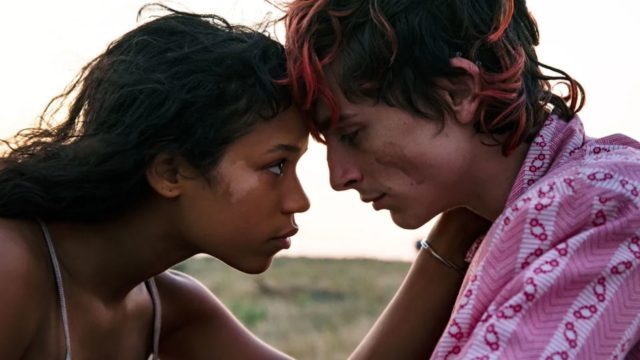
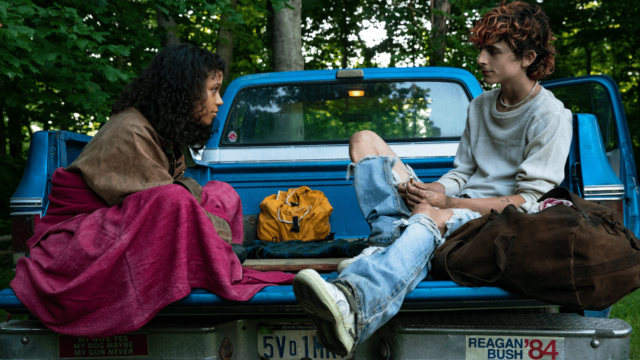
Maren (Taylor Russell) and Lee (Timothée Chalamet) try to find love among so much blood in Bones and All

BONES AND ALL (Luca Guadagnino, 2022)
New York Film Festival, Film at Lincoln Center
Thursday, October 6, Alice Tully Hall, 9:00
Saturday, October 8, Alice Tully Hall, 2:45
Tuesday, October 11, Alamo Drafthouse Staten Island, 6:00
Sunday, October 16, Walter Reade Theater, 5:45
www.filmlinc.org

Luca Guadagnino won the Silver Lion for Best Director at the Venice Film Festival for his horror/road movie/romance Bones and All, a Spotlight selection of NYFF60. The Italian director evokes Bonnie and Clyde and Dirty Mary, Crazy Larry in the tale of two young people who were born with a taste for human flesh. But they’re not vampires; they don’t come out only at night, and they don’t just suck out their victims’ blood but go for a much heartier meal.

At a sleepover with a few girls from her new high school, Maren Yearly (Taylor Russell) desperately wants to fit in, but things go astray when she starts munching on one of the girls’ fingers. Her father (André Holland), who has been shuttling her to small towns for years because of her needs, takes off, believing that he cannot protect her anymore, but he leaves behind a cassette tape in which he details her life; she listens to parts of the tape every day as her full story emerges.

On the run, she meets up with fellow cannibal and extremely creepy Sully (Mark Rylance), who is happy to have a companion and wants to become her mentor. But she eventually is back out on the road, hungry and desperate, not wanting to kill, when she meets up with cannibal drifter, Lee (Timothée Chalamet), who provides her with companionship, food, and love as they try to stay alive and not get caught.

Maren (Taylor Russell) and Lee (Timothée Chalamet) take a rare break in new horror romance

Russell (Lost in Space, Waves), who won the Marcello Mastroianni Award for emerging actor at Venice, is captivating as Maren, who just wants to have a normal life. Her eyes are filled with both fear and wonder at the world that awaits her. Chalamet (Call Me by Your Name, Dune) is compelling as the raggedy would-be hero with puppy-dog eyes. Oscar and Tony winner Rylance (Bridge of Spies, Wolf Hall) nearly steals the movie as Sully, until a misbegotten late scene, while Tony and Emmy nominee Michael Stuhlbarg (A Serious Man, Dopesick) is nearly unrecognizable as the wickedly devilish Jake. The film also features Oscar nominee Chloë Sevigny (Boys Don’t Cry, Big Love) as Maren’s mother, Anna Cobb as Kayla, Lee’s sister, Jessica Harper (Suspiria, My Favorite Year) as Maren’s grandmother, and filmmaker David Gordon Green (George Washington, Pineapple Express) as Brad, Jake’s friend.

Adapted by David Kajganich from Camille DeAngelis’s 2015 novel, Bones and All is riddled with plot holes and inconsistencies, asking the audience to suspend disbelief all too often, and its final scenes become clichéd and melodramatic, but it’s worth seeing for Russell’s performance alone, as well as the developing relationship between Maren and Lee, which is like a 1980s version of Bonnie Parker (Faye Dunaway) and Clyde Barrow (Warren Beatty) or Mary (Susan George) and Larry (Peter Fonda), although bloodier in its own way. The soundtrack is a blast, with a score composed by Trent Reznor and Atticus Ross and such songs as Leonard Cohen’s “You Want It Darker.” Guadagnino, Russell, and Sevigny will be at Alice Tully Hall on October 6 for a Q&A following the 9:00 screening.

NYFF60 REVIVALS: THE MOTHER AND THE WHORE

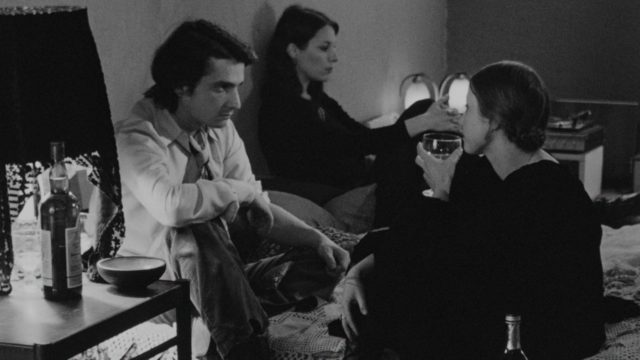
Jean-Pierre Léaud stars in Jean Eustache’s New Wave epic The Mother and the Whore, screening in a new 4K restoration at the New York Film Festival

THE MOTHER AND THE WHORE (LA MAMAN ET LA PUTAIN) (Jean Eustache, 1973)
New York Film Festival, Film at Lincoln Center
Wednesday, October 5, Walter Reade Theater, 6:15
Thursday, October 6, Howard Gilman Theater, 6:30
212-355-6160
www.filmlinc.org

Jean-Pierre Léaud gives a bravura performance in French auteur Jean Eustache’s Nouvelle Vague classic, The Mother and the Whore, about love and sex in Paris following the May 1968 cultural revolution. Léaud stars as Alexandre, a jobless, dour flaneur who rambles on endlessly about politics, cinema, music, literature, sex, women’s lib, and lemonade while living with current lover Marie (Bernadette Lafont), obsessing over former lover Gilberte (Isabelle Weingarten), and starting an affair with new lover Veronika (Françoise Lebrun), a quiet nurse with a rather open sexual nature. The film’s three-and-a-half-hour length will actually fly by as you become immersed in the complex characters, the fascinating dialogue, and the excellent cast. Much of the movie consists of long takes in which Alexandre shares his warped view of life and art in small, enclosed spaces, the static camera focusing either on him or his companion. “I’m convinced all recent happenings in the world were meant against me,” he narcissistically says.

Léaud previously appeared in Eustache’ss Le Père Noël a les yeux bleus; the director also made My Little Loves, Numéro zéro, and Une sale histoire in a career cut short by his death in 1981 at the age of forty-two. A new 4K restoration of the nearly fifty-year-old film is being shown October 5 at 6:15 and October 6 at 6:30 as part of the Revivals section of the sixtieth New York Film Festival; Lebrun and restoration producer Charles Gillibert will be at the Walter Reade for a Q&A following the October 5 screening, while Lebrun will introduce the October 6 screening at the Howard Gilman.