Tag Archives: maurizio cattelan

EDWARD REVISITED: INTERACTIVE SOLO SHOW TOURS CITY BOOKSTORES

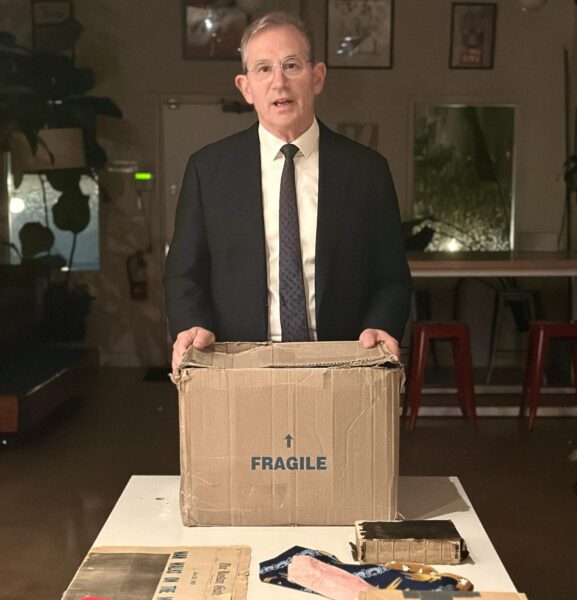
Ed Schmidt’s Edward is back for a bookstore run this winter (photo by Sophie Blackall)

EDWARD
Multiple bookstores including the Strand, Rizzoli, PowerHouse Arena, the Mysterious Bookshop, McNally Jackson, and Books Are Magic
January 22 – March 1, $40
edschmidttheater.com

Last May, I saw Ed Schmidt’s Edward at the All Street Gallery on the Lower East Side. It is now back for a tour of New York City bookstores in Brooklyn and Manhattan, running January 22 through March 1. Below is my original review; please note that tickets go fast to this unique theatrical experience.

Ed Schmidt knows about endings. His 2010 solo show, My Last Play, was ostensibly his swan song, written two years after the death of his father and a transformative rereading of Our Town, concluding a twenty-year career that had also featured Mr. Rickey Calls a Meeting, The Last Supper, held in his Brooklyn kitchen, and the monthly variety show Dumbolio. Nevertheless, in 2015, Schmidt, at the time a professor and basketball coach at Trinity on the Upper West Side, wrote and performed the high school basketball drama Our Last Game, staged in an actual high school locker room.

Thankfully, Schmidt is back again with the superb Edward, the poetic, graceful, intimate tale of one Edward O’Connell, an unspectacular but respectable and enigmatic divorced father and educator. The hundred-minute play takes place at All Street Gallery on Hester St., with the audience of between twelve and eighteen people sitting around a long white table covered with twenty-seven objects and an empty box. Fortunate ticket holders are encouraged to arrive early and examine each piece, to pick them up and scrutinize them closely: A Brooks Robinson baseball glove. Four neckties. Mr. Potato Head. A copy of The Catcher in the Rye. A “Goose Girl” Hummel. An ashtray. A jazz CD. A postcard of a boy on a lake. A business card.

“Edward O’Connell died twelve years ago, at the age of seventy-three, and left behind this box, and all that it contained,” Schmidt, resembling a mild-mannered Kevin Costner and sounding like a toned-down Albert Brooks, begins. “With these twenty-seven objects, there are over ten octillion ways to tell Edward’s story. Ten octillion. That’s a one followed by twenty-eight zeroes. That’s the number of grains of sand on the Earth. Multiplied by the number of stars in the Milky Way. In other words, an unfathomable number. Tonight, we will tell one of those ten octillion versions.”

Wearing a dark suit and white shirt, Schmidt then serves as an Our Town–style Stage Manager, going through the objects in random order, each one a way into Edward’s life, directly or indirectly. He speaks in the third person although it feels like he’s channeling O’Connell, delving deep into his being. We learn about Edward’s wife, Angela, and their children and grandchildren; his love of the Celtics and Red Sox; his battles with department head Nona and headmaster Renée Marsh at his school, Enright Academy; his first car; his favorite word; the vacation when he thought his son had drowned; where he was at seminal moments in US history; his multiple regrets.

Many passages unfurl with a quiet majesty. “He likened her transformation to watching a sunset: you can sense a change coming — the air cools, the light fades, the sky pinkens, and then, all of a sudden, you realize, ‘It’s dark. When did that happen?’ Or perhaps the proper metaphor was a sunrise, and darkness slowly, suddenly turning to day,” he muses.

Others are experiences that everyone can relate to. “You know how, on every To Do List, there’s that one task that never gets done? It’s the one item that, for whatever mysterious reason, you can’t cross off, and it ends up getting transferred to the next list and the next and the next, and, in the end, you either complete the task or you just let it slip away and forget, but, in either case, your inability to follow through feels like a moral failure. Why did it take me so long to clean out the gutters? Or send that thank-you note? Or throw away that box of stuff in the attic? What is wrong with me?”

But each helps us learn who Edward O’Connell was and, in turn, who Ed Schmidt is — and who we are. As you walk around the table, examining the objects, several almost certainly will stand out to you personally, bringing up your own memories; for me, the baseball glove, The Catcher in the Rye, the small rock, and the Hummel figurine sent me back. The friend I attended with had actually completed the very jigsaw puzzle that was on the table. Schmidt’s writing is so evocative that the stories will also remind you of similar situations you got tangled up in as a child and an adult.

In Francesco Bonami’s newly updated semifictional Stuck: Maurizio Cattelan — The Unauthorized Autobiography, about the Italian artist and prankster, Bonami writes, “Here is my story of his story. You can believe it or not — it doesn’t matter, just as long as you enjoy it, that’s enough. If cultivating ‘doubt’ is essential to life . . . well, Maurizio Cattelan harvests doubts like nobody else.” Schmidt has accomplished a similar feat with Edward.
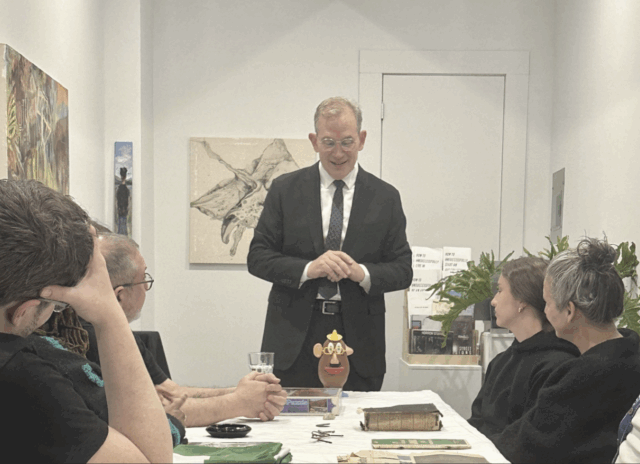
Ed Schmidt’s Edward is an intimate and poetic tale of an ordinary man’s life (photo courtesy Ed Schmidt)

Spoiler alert: The next two paragraphs give information about the show that you might not want to know before seeing it but was a critical part of my connecting with the work. The objects are chosen one at a time by the audience, going around in a clockwise circle. I thought long and hard about the two that I selected, wanting to impress Schmidt, hoping they would lead to great anecdotes that I would feel partly responsible for, and imagining that I could have shared my own reminiscence about them.

It seems impossible for Schmidt to know O’Connell as well as he does, especially since Edward did not leave behind a memoir or journal. But as real as O’Connell’s life appears to be, did he even exist? Did Schmidt make it all up, or perhaps use elements from his own life in crafting the play? Going on an intense Google search, I found that there is very little on the internet about Schmidt, and there seems to be no Edward O’Connell who died in 2012 at the age of seventy-three. However, I did find facts about other Edward O’Connells and various Schmidts that pop up in Edward, from names to professions to family relationships. For example, Schmidt talks about a skiing accident that Edward’s brother, Steven, had. I discovered a Substack post by political pundit Steve Schmidt about a skiing accident as well as a news story about a man named Steve Schmit who survived a life-threatening skiing mishap. Coincidence? Maybe — but maybe not.

Spoilers over, it’s also clear that Schmidt has some prankster in him too, as well as a wicked sense of humor, which emerges in his official bio, where he calls himself a “Playwright, Performer, Director, Producer, Genius,” lists the many rejections his plays have received from “some of the most and least venerable theater companies in America,” and explains that “none of Mr. Schmidt’s work has been made possible, in part or in whole, by the generous support of the National Endowment for the Arts, the New York State Council on the Arts, or the New York City Department of Cultural Affairs, or of any corporate foundation or charitable institution, though it’s not for lack of trying.”

As Bonami posits about Cattelan, “It doesn’t matter, just as long as you enjoy it, that’s enough.” For one thoroughly enjoyable evening in a Lower East Side gallery, it was enough to believe in Edward O’Connell, to believe in Ed Schmidt, and just maybe to believe in oneself.

[Mark Rifkin is a Brooklyn-born, Manhattan-based writer and editor; you can follow him on Substack here.]
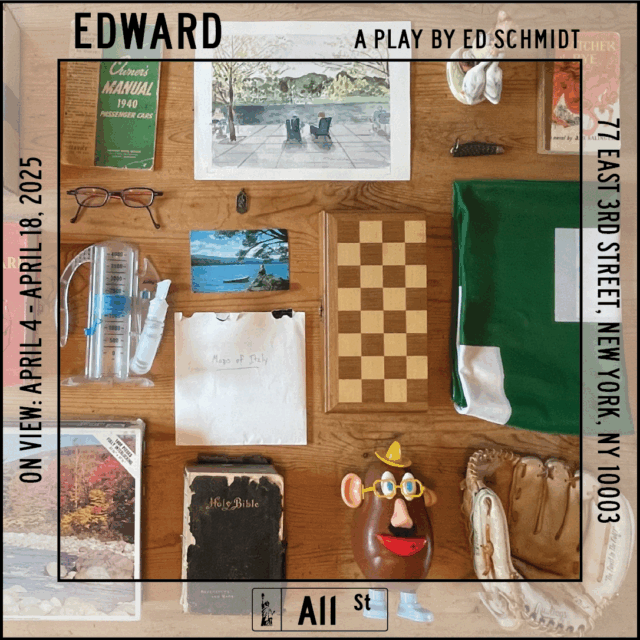
COLLECTING AND CONNECTING MEMORIES: ED SCHMIDT’S EDWARD

Ed Schmidt’s Edward is an intimate and poetic tale of an ordinary man’s life (photo courtesy Ed Schmidt)

EDWARD
All Street Gallery
119 Hester St. between Forsyth & Eldridge Sts.
Through May 18
edschmidttheater.com
allstnyc.com

Ed Schmidt knows about endings. His 2010 solo show, My Last Play, was ostensibly his swan song, written two years after the death of his father and a transformative rereading of Our Town, concluding a twenty-year career that had also featured Mr. Rickey Calls a Meeting, The Last Supper, held in his Brooklyn kitchen, and the monthly variety show Dumbolio. Nevertheless, in 2015, Schmidt, at the time a professor and basketball coach at Trinity on the Upper West Side, wrote and performed the high school basketball drama Our Last Game, staged in an actual high school locker room.

Thankfully, Schmidt is back again with the superb Edward, the poetic, graceful, intimate tale of one Edward O’Connell, an unspectacular but respectable and enigmatic divorced father and educator. The hundred-minute play takes place at All Street Gallery on Hester St., with the audience of between twelve and eighteen people sitting around a long white table covered with twenty-seven objects and an empty box. Fortunate ticket holders are encouraged to arrive early and examine each piece, to pick them up and scrutinize them closely: A Brooks Robinson baseball glove. Four neckties. Mr. Potato Head. A copy of The Catcher in the Rye. A “Goose Girl” Hummel. An ashtray. A jazz CD. A postcard of a boy on a lake. A business card.

“Edward O’Connell died twelve years ago, at the age of seventy-three, and left behind this box, and all that it contained,” Schmidt, resembling a mild-mannered Kevin Costner and sounding like a toned-down Albert Brooks, begins. “With these twenty-seven objects, there are over ten octillion ways to tell Edward’s story. Ten octillion. That’s a one followed by twenty-eight zeroes. That’s the number of grains of sand on the Earth. Multiplied by the number of stars in the Milky Way. In other words, an unfathomable number. Tonight, we will tell one of those ten octillion versions.”

Wearing a dark suit and white shirt, Schmidt then serves as an Our Town–style Stage Manager, going through the objects in random order, each one a way into Edward’s life, directly or indirectly. He speaks in the third person although it feels like he’s channeling O’Connell, delving deep into his being. We learn about Edward’s wife, Angela, and their children and grandchildren; his love of the Celtics and Red Sox; his battles with department head Nona and headmaster Renée Marsh at his school, Enright Academy; his first car; his favorite word; the vacation when he thought his son had drowned; where he was at seminal moments in US history; his multiple regrets.

Many passages unfurl with a quiet majesty. “He likened her transformation to watching a sunset: you can sense a change coming — the air cools, the light fades, the sky pinkens, and then, all of a sudden, you realize, ‘It’s dark. When did that happen?’ Or perhaps the proper metaphor was a sunrise, and darkness slowly, suddenly turning to day,” he muses.

Others are experiences that everyone can relate to. “You know how, on every To Do List, there’s that one task that never gets done? It’s the one item that, for whatever mysterious reason, you can’t cross off, and it ends up getting transferred to the next list and the next and the next, and, in the end, you either complete the task or you just let it slip away and forget, but, in either case, your inability to follow through feels like a moral failure. Why did it take me so long to clean out the gutters? Or send that thank-you note? Or throw away that box of stuff in the attic? What is wrong with me?”

But each helps us learn who Edward O’Connell was and, in turn, who Ed Schmidt is — and who we are. As you walk around the table, examining the objects, several almost certainly will stand out to you personally, bringing up your own memories; for me, the baseball glove, The Catcher in the Rye, the small rock, and the Hummel figurine sent me back. The friend I attended with had actually completed the very jigsaw puzzle that was on the table. Schmidt’s writing is so evocative that the stories will also remind you of similar situations you got tangled up in as a child and an adult.

In Francesco Bonami’s newly updated semifictional Stuck: Maurizio Cattelan — The Unauthorized Autobiography, about the Italian artist and prankster, Bonami writes, “Here is my story of his story. You can believe it or not — it doesn’t matter, just as long as you enjoy it, that’s enough. If cultivating ‘doubt’ is essential to life . . . well, Maurizio Cattelan harvests doubts like nobody else.” Schmidt has accomplished a similar feat with Edward.

Spoiler alert: The next two paragraphs give information about the show that you might not want to know before seeing it but was a critical part of my connecting with the work. The objects are chosen one at a time by the audience, going around in a clockwise circle. I thought long and hard about the two that I selected, wanting to impress Schmidt, hoping they would lead to great anecdotes that I would feel partly responsible for, and imagining that I could have shared my own reminiscence about them.

It seems impossible for Schmidt to know O’Connell as well as he does, especially since Edward did not leave behind a memoir or journal. But as real as O’Connell’s life appears to be, did he even exist? Did Schmidt make it all up, or perhaps use elements from his own life in crafting the play? Going on an intense Google search, I found that there is very little on the internet about Schmidt, and there seems to be no Edward O’Connell who died in 2012 at the age of seventy-three. However, I did find facts about other Edward O’Connells and various Schmidts that pop up in Edward, from names to professions to family relationships. For example, Schmidt talks about a skiing accident that Edward’s brother, Steven, had. I discovered a Substack post by political pundit Steve Schmidt about a skiing accident as well as a news story about a man named Steve Schmit who survived a life-threatening skiing mishap. Coincidence? Maybe — but maybe not.

Spoilers over, it’s also clear that Schmidt has some prankster in him too, as well as a wicked sense of humor, which emerges in his official bio, where he calls himself a “Playwright, Performer, Director, Producer, Genius,” lists the many rejections his plays have received from “some of the most and least venerable theater companies in America,” and explains that “none of Mr. Schmidt’s work has been made possible, in part or in whole, by the generous support of the National Endowment for the Arts, the New York State Council on the Arts, or the New York City Department of Cultural Affairs, or of any corporate foundation or charitable institution, though it’s not for lack of trying.”

As Bonami posits about Cattelan, “It doesn’t matter, just as long as you enjoy it, that’s enough.” For one thoroughly enjoyable evening in a Lower East Side gallery, it was enough to believe in Edward O’Connell, to believe in Ed Schmidt, and just maybe to believe in oneself.

[Mark Rifkin is a Brooklyn-born, Manhattan-based writer and editor; you can follow him on Substack here.]
MAURIZIO CATTELAN: “AMERICA”

(photo by twi-ny/mdr)

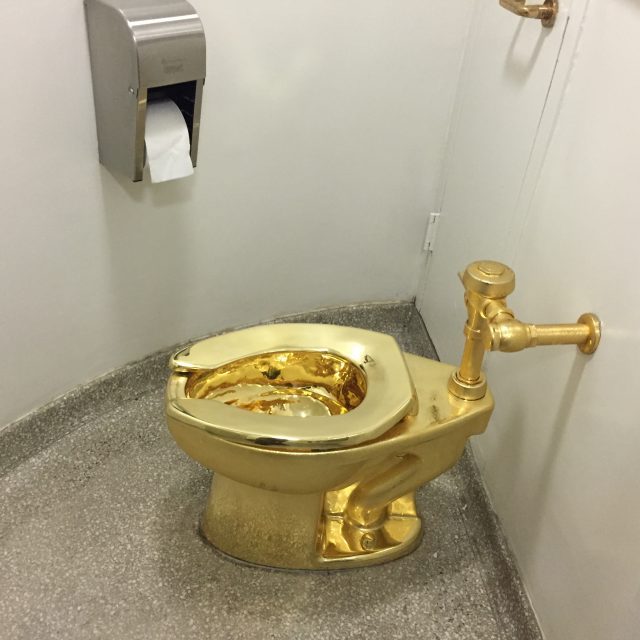
Maurizio Cattelan has replaced the Guggenheim’s fifth-floor toilet with a golden throne called “America” (photo by twi-ny/mdr)

Solomon R. Guggenheim Museum
1071 Fifth Ave. at 89th St.
Friday – Wednesday (ongoing), $18-$25 (pay-what-you-wish Saturday 5:45-7:45)
212-423-3587
www.guggenheim.org
“america slideshow”

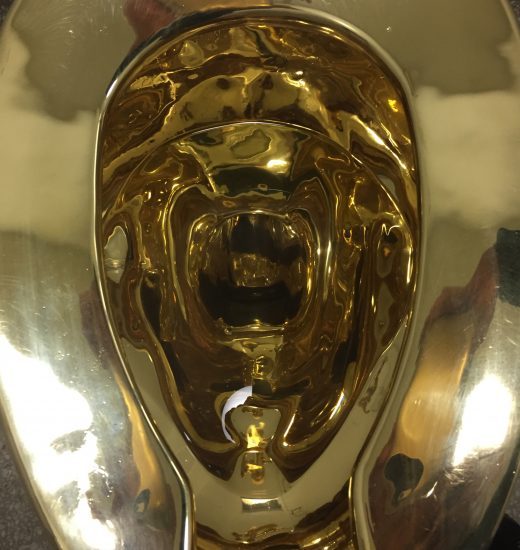
In November 2011, Italian artist and prankster Maurizio Cattelan held a very public execution of his career, literally hanging his works from the Guggenheim’s skylight ceiling in a unique and extremely popular retrospective, called “All,” that he said marked his retirement from the art world, at the age of fifty-one. But five years later, the provocateur who drowned Pinocchio (“Daddy Daddy”), dropped a meteor on the pope (“La Nona Hora”), made a gentle, kneeling sculpture of Adolf Hitler (“Him”), taped his gallerist to a wall (“A Perfect Day”), constructed the famous Hollywood sign on a garbage dump in Palermo (“Hollywood”), and placed a giant marble middle finger in front of the Milan stock exchange (“L.O.V.E.”) is back with his first new piece in five years, “America.” In the Guggenheim’s fifth-floor single-occupancy restroom, Cattelan has installed an exact replica of the museum’s standard toilet, cast in glittering eighteen-karat solid gold — and yes, it’s fully functional. Since September 2016, museumgoers have been waiting anywhere from a few minutes to a few hours for the privilege of going number one or number two on the majestic throne, which is obsessively cleaned every fifteen minutes. You must sit on it; the seat should not be lifted, as one unlucky male user discovered early on after breaking it. Although the piece was created before Donald Trump won the presidential election, “America” certainly references his preference for gold objects, particularly when his name is involved; Cattelan has called it “one-percent art for the ninety-nine percent.” (Death might be the great equalizer, but so is the basic human need to evacuate waste; everybody poops.) The piece is also intrinsically linked with Toilet Paper magazine, a publication run by Cattelan and Pierpaolo Ferrari. In addition, the work is an homage to Marcel Duchamp’s “Fountain,” the upside-down porcelain urinal, credited to “R. Mutte,” that was rejected on April 10, 1917, from a supposedly all-inclusive exhibition; the ready-made urinal, which forever changed the art world, is currently celebrating its centennial, with special events and shows being held around the world.

(photo by twi-ny/mdr)

You can do a lot more than just touch this work of art at the Guggenheim (photo by twi-ny/mdr)

“America” is also reminiscent of the scene in Mel Brooks’s History of the World, Part One when a caveman (Sid Caesar) creates the first known work of art, a painting of an animal on a cave wall — and then the first critic (Andréas Voutsinas) comes along and urinates on it. Cattelan has been met with much criticism during his thirty-year career — along with, of course, high praise and works going at auction for millions of dollars — but he’s probably reveling in the thought that so many people are happily relieving themselves on his usable sculpture. In fact, people are so used to being told not to touch art that many of those on line don’t initially understand that “America” is fully participatory; it is not meant to merely be gawked at and photographed. The “Guggen-head,” as Cattelan dubbed it, has also been added to the second edition of the “All” catalog, with former Guggenheim curator Nancy Spector explaining that it offers “unprecedented access to something of unquestionable value.” To find out more about Cattelan, who loves playing games with virtually every aspect of his life and career, check out Maura Axelrod’s documentary Maurizio Cattelan: Be Right Back, which opened April 14 at the Quad; although it is named for Cattelan’s first major show, in which he locked the door of a gallery and put a sign on it that read “Be Right Back” (in Italian), it could also refer to his return to the art world with “America,” which is on long-term view at the Guggenheim; however, there’s been no word whether it’s a onetime thing or the beginning of a new phase of his career, and even if there was, that doesn’t mean it’s real. In the meantime, head over to the Guggenheim and make full use of “America,” coming up with whatever metaphor you’d like as you relieve yourself of at least part of your daily burden. Or just simply enjoy the rare privilege of having private time with a rather beautiful and expensive work of art.

MAURIZIO CATTELAN: BE RIGHT BACK

MAURIZIO CATTELAN: BE RIGHT BACK explores career of controversial Italian artist and provocateur

MAURIZIO CATTELAN: BE RIGHT BACK explores career of controversial Italian artist and provocateur

MAURIZIO CATTELAN: BE RIGHT BACK (Maura Axelrod, 2016)
Quad Cinema
34 West 13th St. between Fifth & Sixth Aves.
Opens Friday, April 14
212-255-2243
www.quadcinema.com
www.mauriziocattelanfilm.com

Italian artist and prankster extraordinaire Maurizio Cattelan has built his wildly successful career out of controversy, provocation, and mystery, taking on the very art world that has made him a superstar. Documentarian Maura Axelrod includes the same elements in her vastly entertaining film, Maurizio Cattelan: Be Right Back. The title refers to both the beginning of Cattelan’s career, a Milan solo show in which he locked the gallery door and hung a sign on it that said “Torno Subito” (Be Right Back) as well as what might or might not be the end, as he announced his retirement following the brilliant 2011 retrospective at the Guggenheim, “All,” in which he hung all of his works from the Guggenheim ceiling, as if signaling their death. “His career is based on anecdotes and lies and imaginary stories,” Milan gallerist Massimo De Carlo says in the film. “Some people are suspicious that Maurizio is pulling the wool over their eyes and he is some kind of flamboyant artistic con man,” adds art historian Sarah Thornton. “I think he’s probably one of the greatest artists that we have today, but he could also be the worst. It’s gonna be one or the other; it’s not gonna fall in the middle,” cracks one of his collectors. Axelrod also speaks with former Guggenheim artistic director Nancy Spector, former Public Art Fund director Tom Eccles, Cattelan archive director Victoria Armutt, Guggenheim curator Katherine Brinson, gallerists Marian Goodman and Emmanuel Perrotin, art critics Calvin Tomkins and Dodie Kazanjian, and Cattelan’s sister, Giada, former fiancée Victoria Cabello, and current girlfriend Victoria Yee Howe. They share stories about Cattelan’s working methods and proclivities, delving into such pieces as “Daddy Daddy,” a facedown Pinocchio in a pool of water that was inspired by Cattelan’s childhood; “La Nona Ora” (The Ninth Hour), a lifelike sculpture of the pope knocked down by a meteorite; “Another Fucking Readymade,” in which he stole the inventory of another artist’s show and claimed them as his own; “Him,” a rendering of a kneeling child who turns out to be Adolf Hitler; and “L.O.V.E.” (Libertà, Odio, Vendetta, Eternità), a marble sculpture of a giant middle finger in Milan’s financial district. He even staged his own pseudo–Caribbean Biennial, featuring such artists as Wolfgang Tillmans, Elizabeth Peyton, Gabriel Orozco, Pipilotti Rist, Chris Ofili, and Mariko Mori gathered together on the island of St. Kitts. (The critics were not amused.)
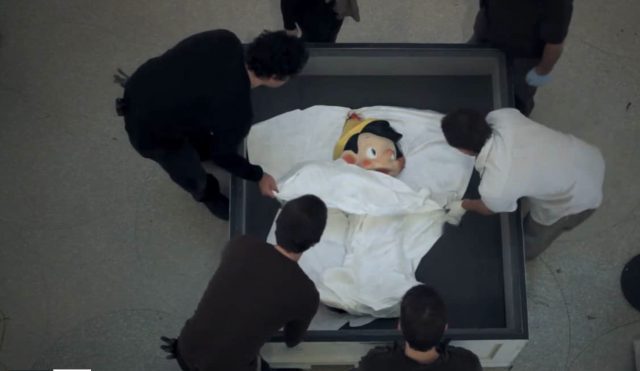
holds one of the keys to the mystery that is Maurizio Cattelan

“Daddy Daddy” holds one of the keys to the mystery that is Maurizio Cattelan

Meanwhile, the artist speaks profusely on camera, sharing such insights as “I knew what was expected of me and I decided I was going to be something else” and “I’ve always been very good at faking things.” Indeed, about two-thirds of the way through the film, there is a fabulous twist that only art-world insiders are likely to have guessed, as Axelrod takes a page from Orson Welles’s magical F for Fake. Writer, producer, and director Axelrod incorporates home movies, family photographs, playful animation, and new and old footage to try to figure out just what makes Cattelan tick, what he’s really like, but she lets viewers in only so far, like his tiny elevator installation in which no one can fit. Among the many words used to describe the iconoclastic artist and his oeuvre are “tasteless,” “profound,” “funny,” “tragic,” “disrespectful,” “vulnerable,” and “uncanny beauty,” as people also point out that he is anxious, very demanding to live and work with, and, while seeing art as commodity, uses the vanity of collectors against themselves. Of course, all of those are true, in one way or another. His art can be as thrilling as it is offensive, as silly as it is prescient as he explores such themes as failure, alienation, mortality, and personal identity. “You need to go pretty far, otherwise the piece doesn’t exist,” he says. “You need to push your friends and enemies and collaborators further, and you have to be uncomfortable about it. The further you go, the more satisfaction is created by the level of discomfort in which all the participants were put.” The last section of the film details “All,” which a clearly uncomfortable Spector had her doubts about but insisted that “the risk had to be real,” worrying that it would cause the Guggenheim to collapse within itself but they had to proceed. And as far as Cattelan’s retirement is concerned, this past September he installed “America” at the Guggenheim, an eighteen-karat-gold fully functional toilet, the first new piece he has exhibited since “All.” Maurizio Cattelan: Be Right Back opens April 14 at the newly renovated Quad Cinema, with Axelrod participating in Q&As on April 14 (with Spector and New Museum artistic director Massimiliano Gioni) and April 15 at 7:45 and April 16 at 5:30.

FRIEZE ART FAIR HIGHLIGHTS

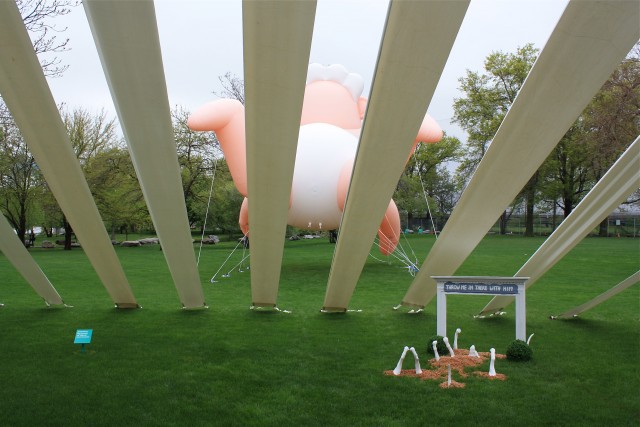
Alex Da Corte’s giant floating baby and part of Heather Phillipson’s “100% Other Fibres” greet Frieze visitors (all photos by twi-ny/mdr)

Alex Da Corte’s giant floating baby and part of Heather Phillipson’s “100% Other Fibres” greet Frieze visitors (all photos by twi-ny/mdr unless otherwise noted)

FRIEZE ART FAIR
Randall’s Island Park
May 5-8, $29-$49 per day
friezenewyork.com

On a cold, rainy Friday afternoon, Frieze was about as comfortable and manageable as any major international art fair can get. You could take your time looking at the art, easily procure a table at one of the restaurants, and not have to wait on long lines to use the rest rooms. At the fifth annual Frieze New York, held on Randall’s Island, video, contemporary photography, and outdoor sculpture are out while large-scale painting, mid-to-late-twentieth-century photography, and performance are in. Below are our recommended highlights, in no particular order; also be on the lookout for works by Carolee Schneeman, Liz Magic Laser, Rieko Otake, Bernd and Hilla Becher, John Divola, Nancy Holt, Frank Bowling, and reverse pickpocket David Horvitz.

anthea hamilton

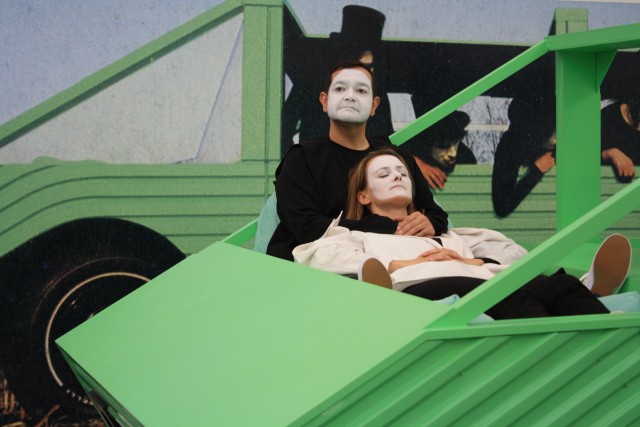
A troupe of mimes moves throughout the fair in a green vehicle in Anthea Hamilton’s “Kar-A-Sutra (After Mario Bellini)”

instructions from the sky

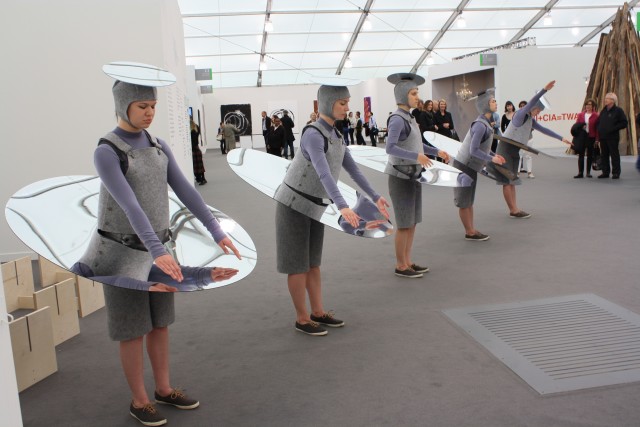
Eduardo Navarro’s “Instructions from the Sky” remained indoors because of the weather

maurizio cattelan

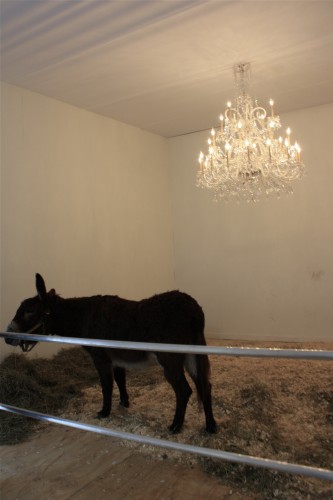
Maurizio Cattelan pays tribute to the Daniel Newburg Gallery by restaging his 1994 U.S. debut, “Warning! Enter at Your Own Risk. Do Not Touch, Do Not Feed, No Smoking, No Photographs, No Dogs, Thank you.” complete with chandelier and Gabriel the donkey, who recently appeared at the Met in La Bohème.

mika rottenberg

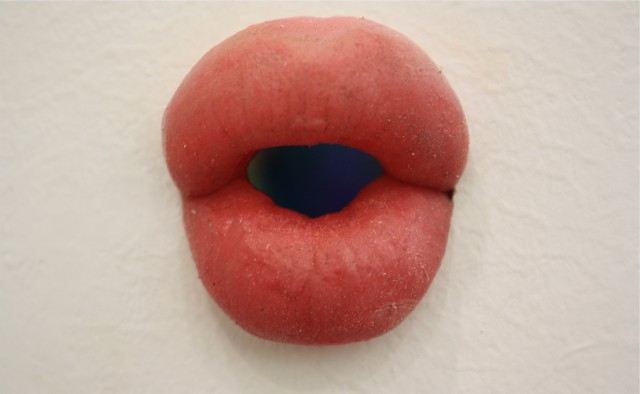
Look inside Mika Rottenberg’s “Lips” for a surprise video, right next to her sizzling “AC Trio”

roni horn

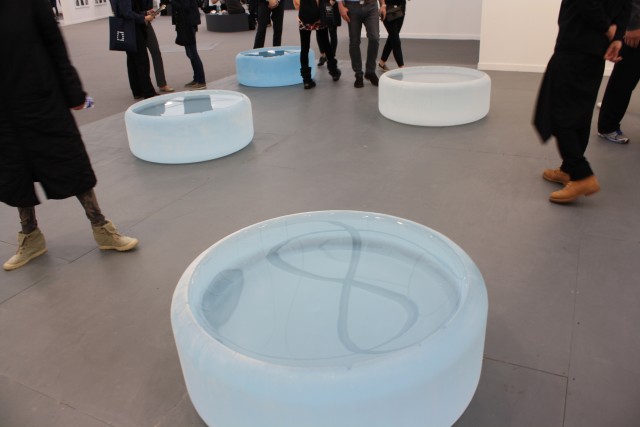
Hauser & Wirth’s staff have a tough time stopping people from touching Roni Horn’s untitled glass pieces

n dash

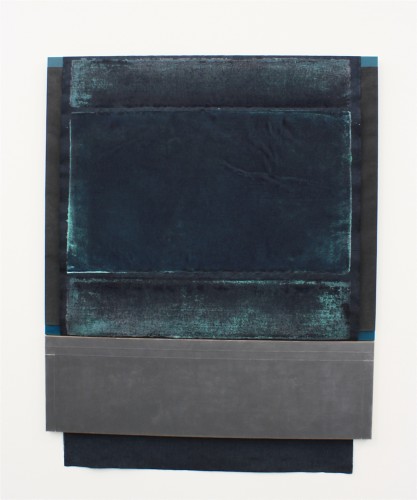
You can see more of N. Dash’s beautiful works of adobe, acrylic, gesso, string, canvas, and jute at Casey Kaplan in Chelsea

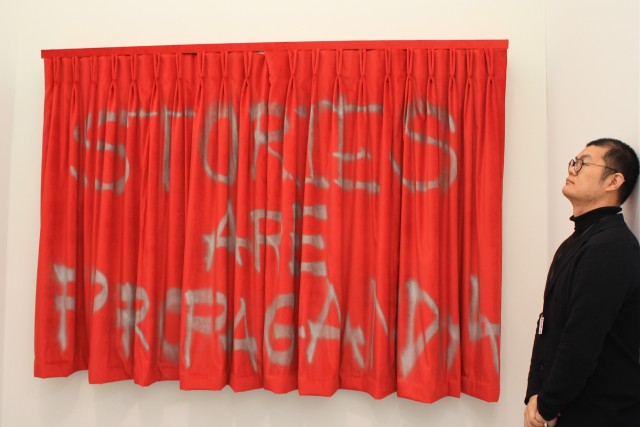
stories are propaganda

Philippe Parreno and Rirkrit Tiravanija collaborated on eight-minute video installation “Stories Are Propaganda”

spencer lowell

Spencer Lowell’s “New York, New York, New York” provides unique look at Queens Museum Panorama (photo courtesy Queens Museum)

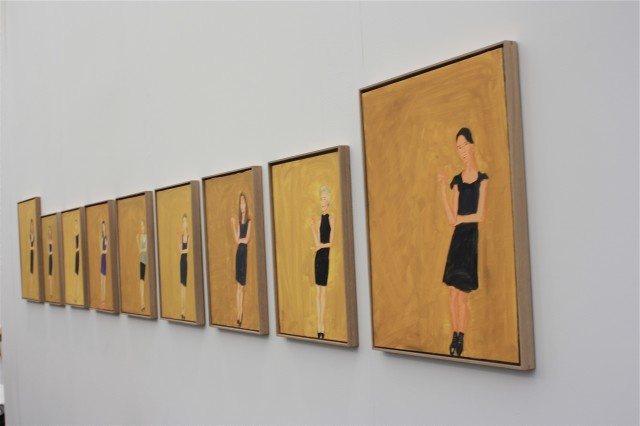
alex katz nine women

Alex Katz’s “Nine Women” is significantly smaller than 1982 Times Square mural

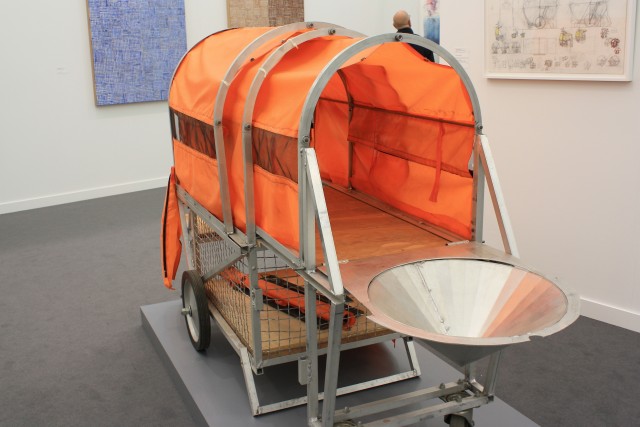
homeless vehicle project

Perhaps Krzysztof Wodiczko’s twenty-five-year-old “Homeless Vehicle Project” could still help New York City’s homeless crisis

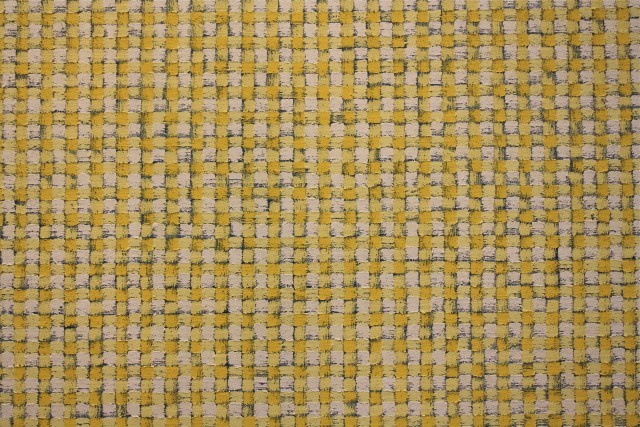
michelle grabner

Michelle Grabner’s untitled enamel on panel painting is a bright standout

francois morellet

François Morellet turns Galerie Herve Bize space into a dizzying experience

david schnell

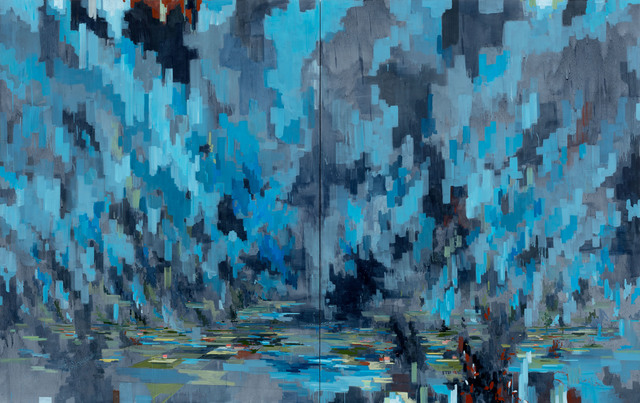
Perennial favorite Galerie Eigen + Art features new works by David Schnell, including “Becken” (above) and “Pakt” (photo courtesy Galerie Eigen + Art)

fred wilson

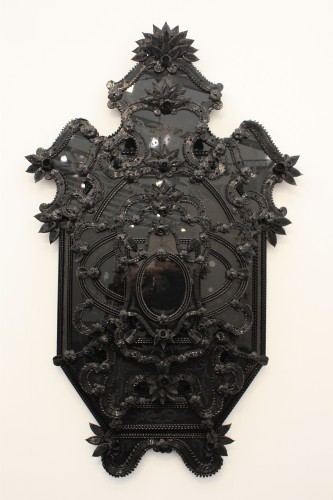
Fred Wilson’s “Emilia’s Mirror — Act 5, Scene 2” is part of Pace installation

dewar and gicquel

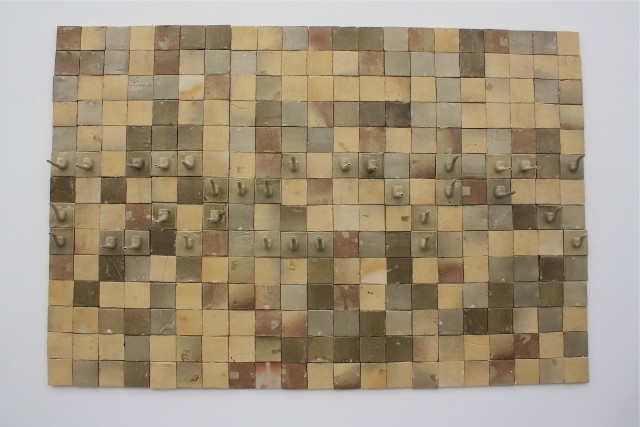
Daniel Dewar and Grégory Gicquel’s “Stoneware Mural with Pipes n°4” is part of Frame Stand Prize-winning installation “Truth and Consequences”

A SECRET AFFAIR: SELECTIONS FROM THE FUHRMAN FAMILY COLLECTION

(photo by twi-ny/mdr)

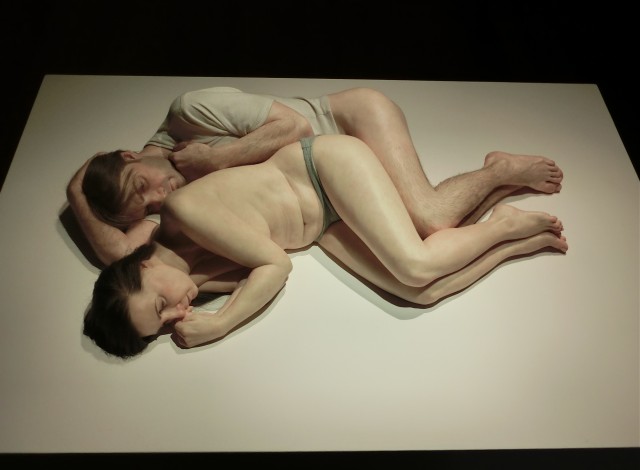
Ron Mueck’s ultra-realistic “Spooning Couple” is part of “A Secret Affair” at FLAG (photo by twi-ny/mdr)

The FLAG Art Foundation
545 West 25th St. between Ninth & Tenth Aves.
Wednesday through Saturday through May 16, free, 11:00 am – 5:00 pm
212-206-0220
flagartfoundation.org

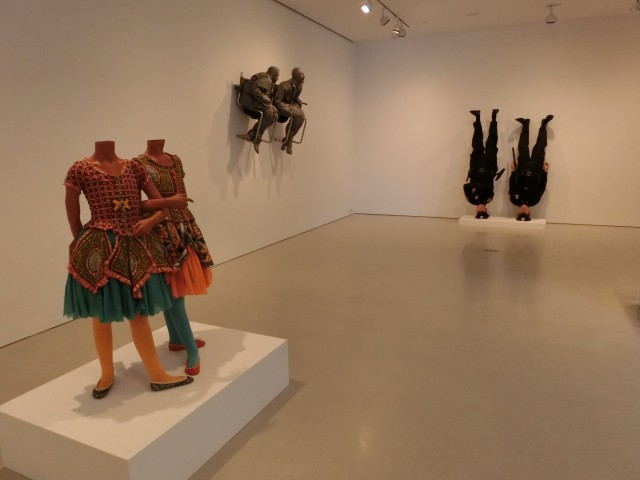
The name of the current exhibit at the FLAG Art Foundation, “A Secret Affair,” conjures thoughts of clandestine coupling. Indeed, the show, which continues through May 16, features works that explore, both as physical objects and conceptual ideas, the notion of pairs, of the double, built around what senior curator Heather Pesanti refers to in her catalog essay, “The Subversive Body,” as “meditations on the most primal and basic emotional need in life: that of human connection.” Spread across two floors of the Chelsea gallery, “A Secret Affair: Selections from the Fuhrman Family Collection” consists primarily of sculptures, along with several C-prints, that are either partnered within themselves or with another piece, by the same or a different artist. The subjects in Ron Mueck’s ultra-realistic but miniature “Two Women,” a pair of older women in heavy coats standing together but looking away, might recall fondly, or jealously, the nearby “Spooning Couple,” in which a partially naked man and woman spoon each other on a hard surface representing a bed. Meanwhile, not far away, Subodh Gupta offers a counterpart, “Spooning,” a sculpture of two large-scale stainless-steel spoons one on top of the other. In Juan Muñoz’s “Two Laughing at Each Other,” a pair of men sit in chairs halfway up a wall, not far from Maurizio Cattelan’s “Frank and Jamie,” two life-size wax figures of New York City policemen standing on their heads. In Louise Bourgeois’s “Couple,” a naked and armless man and woman, in pink fabric, face each other in a vitrine, belly to belly, while Yinka Shonibare’s “Girl Girl Ballerina” depicts a pair of headless female figures wearing colorfully patterned fabrics, hiding guns behind their backs. Gillian Wearing’s lifelike “Olia,” a topless model in jeans, finds its counterpoint in Marc Quinn’s “Sphinx (Fortuna),” a painted bronze sculpture of Kate Moss in a seemingly impossible pose. And Thomas Schütte’s patinated bronze and steel busts, “Wicht (4)” and “Wicht (7),” are on plinths next to each other, a pair of mysterious, already fading figures.

(photo by twi-ny/mdr)

Fuhrman Family Collection exhibition focuses on doubling and human connection (photo by twi-ny/mdr)

Even the single pieces in the exhibition, curated by Louis Grachos, deal with pairs. “I decided that the exhibition would focus on interrelated themes concerning the body and the figure, as well as coupling and conversation,” Grachos explains in his catalog foreword. In Charles Ray’s “Light from the Left,” the artist offers flowers to a woman, trying to make a connection. In Katharana Fritsch’s “Oktopus,” an orange cephalopod mollusc holds aloft a faceless human figure in black in one of its tentacles. Felix Gonzalez-Torres’s 1995 untitled work comprises two silver-plated brass rings flat against a wall, touching each other, evoking the magician’s trick as well as the prize one can win on a merry-go-round. Anish Kapoor’s “Blood Solid,” a red balloon-like sculpture that resembles a huge drop of blood, invites viewers to see their reflection in it, their own double. There are also works by Matthew Barney, Kiki Smith, Robert Gober, Jim Lambie, David Hammons, and Jim Hodges that provide yet more insight on the theme. In conjunction with Frieze week’s Chelsea Night, Hodges, whose “picturing: my heart” dual skulls and “First Light (Beginning of the End)” mirrored glass pieces are on display at FLAG, will be at the gallery on May 16 at 5:00 for a special closing conversation with FLAG founder Glenn Fuhrman, who owns the collection with his wife, Amanda.

KRIS PERRY: INDUSTRIAL EVOLUTION

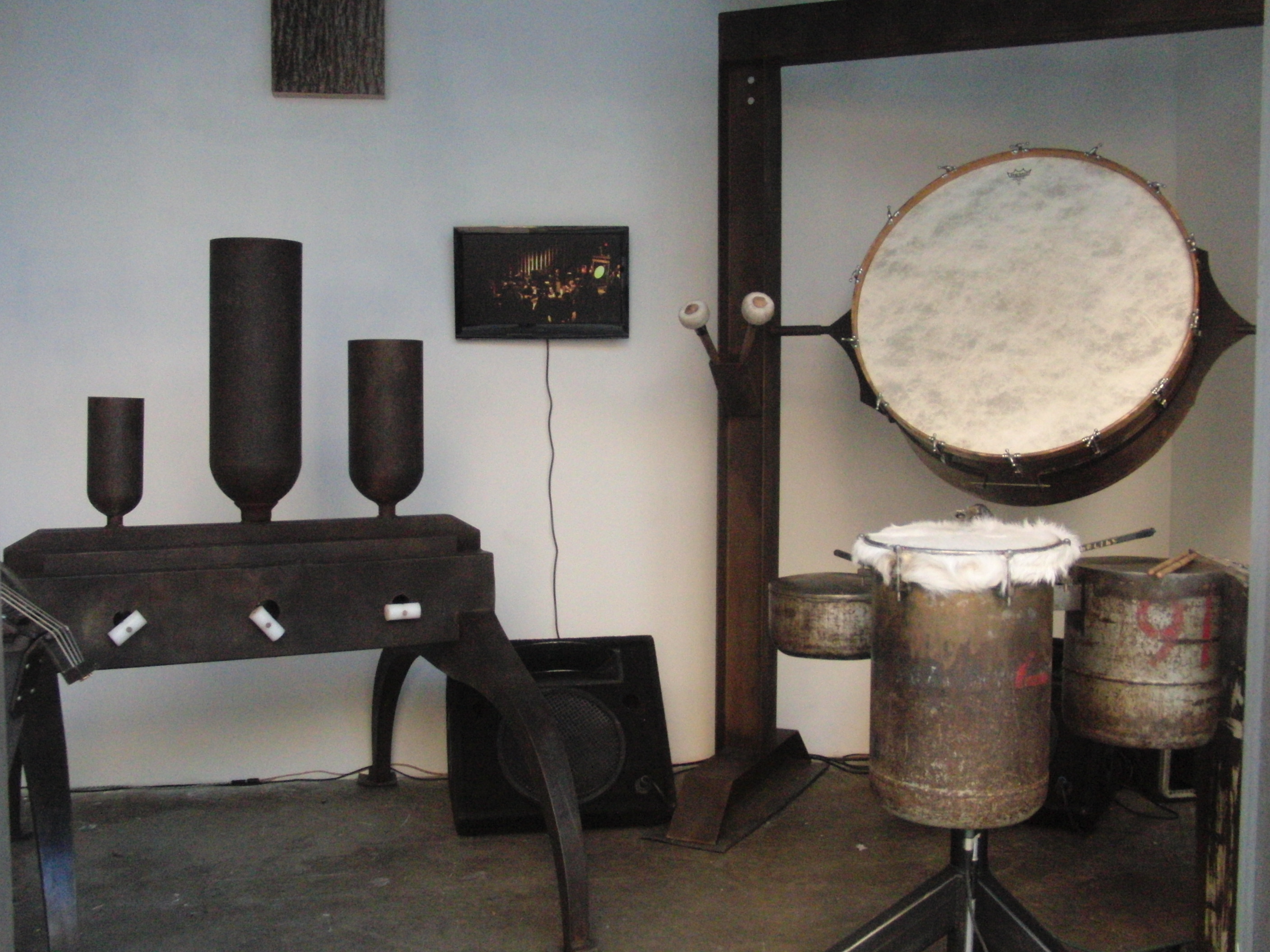
Kris Perry’s “Industrial Evolution” will close September 29 with an evening of free music (photo by twi-ny/mdr)

Family Business
520 West 21st St. between Tenth & Eleventh Aves.
Saturday, September 29, free, 6:00, 7:00, 8:00
www.familybusiness.us
www.krisperry.com

For most of the run of Kris Perry’s “Industrial Evolution” installation in Maurizio Cattelan and Massimiliano Gioni’s tiny storefront Family Business space in Chelsea that opens out onto Twenty-first St., visitors have come and pounded on the drums and played various other percussion and stringed instruments, made from found machine parts and other materials. But in a grand finale on September 29, a group of professional musicians and artists will take over the reins from six to eight o’clock in the evening. The miniconcerts, beginning on the hour, will feature drummer Chris Turco, composer and editor Ben Fundis, multidisciplinary audiovisual artist Brian Dewan, Nashville musician and engineer John Rosenthal, folk rocker Elvis Perkins, and Replacements and Guns N’ Roses bassist Tommy Stinson improvising on the metal machines. The Hudson-based Perry, who was born in Berkeley and is the founder of Fantastic Fabrication, specializes in creating kinetic sculptures and unusual instruments, several of which are on view in the fanciful “Industrial Evolution,” which was curated by culture writer Linda Yablonsky and also includes video components.