Tag Archives: Mariko Ohigashi

STOPPING BY A DINER ON A SNOWY EVENING: WILLIAM INGE AT CLASSIC STAGE

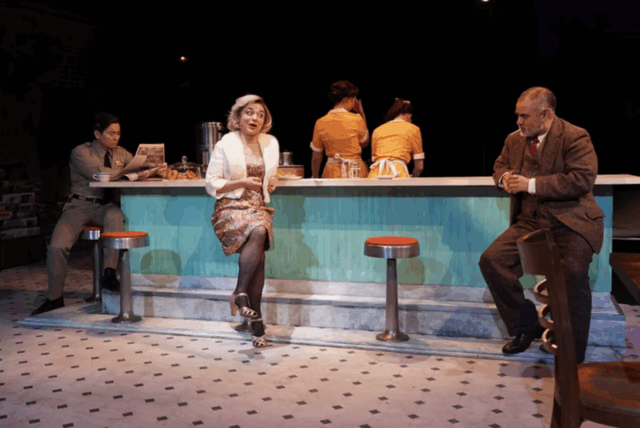
Bus Stop takes place in a comfy diner in small-town Kansas during a snowstorm (photo by Carol Rosegg)

BUS STOP
Classic Stage Company, Lynn F. Angelson Theater
136 East Thirteenth St. between Third & Fourth Aves.
Through June 8, $76-$132
www.classicstage.org

This is the last weekend to see Jack Cummings III’s ravishing adaptation of William Inge’s Bus Stop, the 1955 play that was expanded into a popular film in 1956 — famously starring Marilyn Monroe — and turned into a musical, Cherry, in 1972.

A coproduction of Classic Stage Company, the National Asian American Theatre Company (NAATCO), and Transport Group, the story takes place in a small-town Kansas diner, where a bus has been sidelined because of road closures during a March storm. Working the night shift are Elma (Delphi Borich), a high school student saving money for college, and the older Grace (Cindy Cheung), who needs a jolt of excitement in her life.

The local sheriff, Will (David Lee Huynh), prepares them for the bus’s arrival, letting them know that it will be at least several hours before the roads are cleared. Soon the bus driver, Carl (David Shih), enters, followed by Dr. Lyman (Rajesh Bose), a professor attracted to literature, alcohol, and Elma; Cherie (Midori Francis), a nightclub chanteuse; Bo (Michael Hsu Rosen), a twenty-one-year-old Montana rancher determined to marry Cherie; and his right-hand man, the loyal Virgil (Moses Villarama), who travels with his guitar.

Over the course of one evening, the men approach the women and a variety of encounters ensue: couplings motivated by convenience, lechery, and thunderstruck first love that would raise a few questions about consent today. With deft artistry, the company makes the story work without raising the hackles of every woman in the audience, which it could well do. The characters rhapsodize about love and loss, sex and grief, either looking back at where their life went wrong or gazing into a future they hope will be filled with something better.

Peiyi Wong’s diner set is realistic and charming, while Mariko Ohigashi’s costumes evoke midcentury America. As the narrative focuses on various pairs having conversations, R. Lee Kennedy’s lighting shifts on them but keeps the others in clear view. Cummings III, who previously directed Inge’s Picnic, The Dark at the Top of the Stairs, and Come Back, Little Sheba, maintains an even flow during the show’s two hours, including one pause and one intermission. The all-Asian ensemble is excellent, although it takes time for one of the key plots to heat up.

The diner might not have rye bread, cheese, or booze, but it’s still a lovely place to settle in for a few hours, especially when you need a break from what’s going on outside.

[Mark Rifkin is a Brooklyn-born, Manhattan-based writer and editor; you can follow him on Substack here.]

BODY POSITIVITY AND NEGATIVITY: SUMO AT THE PUBLIC

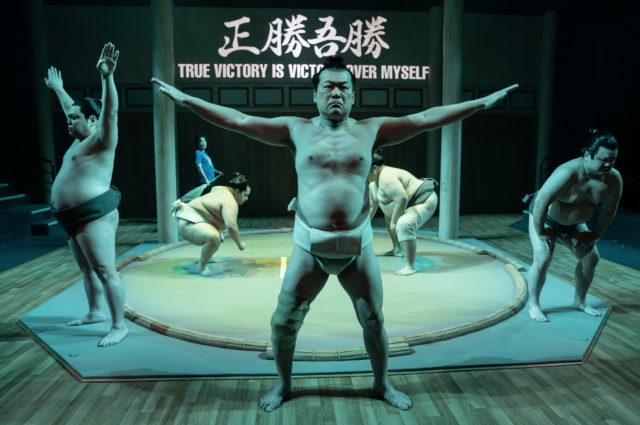
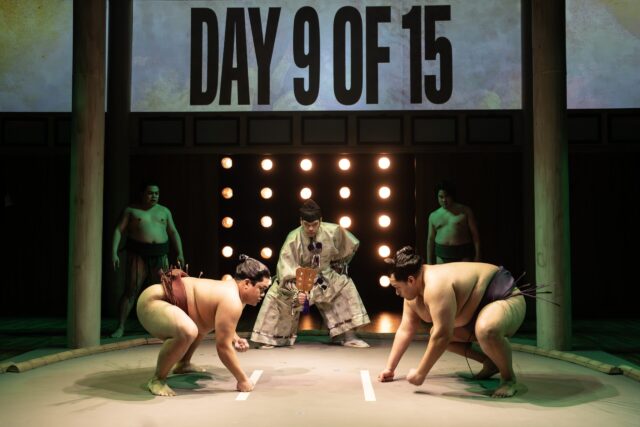
Wrestlers known as rikishi get ready to do battle in Lisa Sanaye Dring’s Sumo (photo by Joan Marcus)

SUMO
Anspacher Theater, the Public Theater
425 Lafayette St. at Astor Pl.
Tuesday through Sunday through March 30, $65-$93
212-539-8500
publictheater.org

Lisa Sanaye Dring’s Sumo takes audiences inside the ancient Japanese sport and sacred Shinto ritual of sumo, in which large-sized wrestlers known as rikishi do battle in a dohyo, or ring, attempting to push their opponent to the mat or out of the circle. Each competitor wears only a mawashi, or silk belt, around their waist, leaving little to the imagination, as they seek to climb the ladder of success through such san’yaku, or ranks, as the lower jonokuchi, jonidan, and sandanme to the higher sekiwake, ōzeki, and the ultimate yokozuna. Most matches are over in a few seconds, although some can last upwards of a minute.

The tense Ma-Yi Theater Company drama, which premiered in 2023 at La Jolla Playhouse and is now at the Public’s Anspacher Theater through March 30, is too long at two hours and twenty minutes (with intermission), and in its second act it gets caught up in treacly melodrama, but it is still a compelling exploration of dedication, honor, tradition, and respect in a sport Americans know little about, in a changing world that is redefining masculinity and conceptions about the human body.

Mitsuo (David Shih) is an ōzeki known as Kōryū, or Exalted Dragon, who runs a heya, or stable of wrestlers, that consists of the stalwart jūryō Ren (Ahmad Kamal), the makushita Shinta (Earl T. Kim), the sandanme Fumio (Red Concepción), the jonidan So (Michael Hisamoto), and the maezumo Akio (Scott Keiji Takeda), an overeager eighteen-year-old newcomer who is not ready to pay his dues, which includes sweeping up, remaining silent, and pouring tea before earning his way into the dohyo. A trio of kannushi, or Shinto priests (Kris Bona, Paco Tolson, Viet Vo), serve as a Greek chorus as well as the gyoji, or referees, and sponsors who scour the tournaments and practices deciding who they will bankroll.

Speaking directly to the audience early on, they explain, “Rikishi were once gods. Kami! Who fought for ownership of Japan. There were two deities: Takeminakata-no-Kami, god of wind and water, who fought on behalf of the humans. And Takemikazuchi-no-Kami, god of thunder, who fought on behalf of the divine. The imperial family supposedly descends from Takemikazuchi, and if Takeminakata had won instead of Takemikazuchi, Japan wouldn’t have been ruled for centuries by emperors and instead would have been governed by commoners — people like you. Ok, maybe not you.”

Mitsuo starts working Akio hard, seeing promise in him, which rankles the others, who nonetheless sneak in little lessons for Akio when no one else is around; they will be punished if Mitsuo catches them breaking the rules, which Akio doesn’t want to follow. “There is a saying: Before enlightenment, chop wood, carry water. After enlightenment, chop wood, carry water,” So tells Akio, who shoots back, “I’m not here to be enlightened.” A moment later, So, explaining how good they all have it, adds, “In here, we are free. But you have to learn to trust us.”

The rikishi compete in a series of matches, employing such kimarite, or techniques, as harite (a slap), henka (a sidestep), and tachiai (initial charge); train in their heya, where no one else, especially women, are permitted; and, in the case of two of the men, grow extremely close. At one point Akio shares his doubts with Shinta, asking, “Do you think I can do this?” Shinta responds, “I have no idea. Can your body? Probably. It depends.” Akio: “On what?” Shinta: “On if the gods want it.” Akio: “Who?” Shinta: “Whoever you pray to.” Akio: “I don’t pray.” Shinta: “Yes you do.” Shinta poetically discusses what’s at the heart of sumo: “Our bodies are so big, so alive, that we wake everyone who sees. . . . It’s a service. It’s all an offering to her.” Akio repeats, “Her,” to which Shinta says, “Yes. The spirit of sumo is a woman.”

As the heya participates in several tournaments, friendships and relationships get tested and Akio needs to look deep inside himself to figure out who he truly is.

David Shih leads a strong cast in Lisa Sanaye Dring’s Sumo at the Public (photo by Joan Marcus)

Although I’ve never been to a wrestling or sumo tournament, I have seen several boxing bouts, sitting ringside as well as in the upper decks; unsurprisingly, the closer you are to the action, the more exciting it is. The same is true for Sumo; from my second-row aisle seat, I seemed to have a different experience from some of my colleagues, who were in the last row. Every foot stomp, or shiko, gave me a tingle. Wilson Chin’s dramatic set turns two of the Anspacher’s pillars into a prop around the dohyo; when the actors are not in the ring, they are practically in the audience’s lap.

Paul Whitaker’s lighting features five rows of nine lights behind sliding doors that open and close to indicate time and space changes. Hana S. Kim’s lively projections announce details of the matches on the back wall and floor, occasionally fitting neatly within the dohyo. Mariko Ohigashi’s costumes go beyond the miwashi to include elegant kimono, traditional gyoji wear, and contemporary clothing. Fabian Obispo’s sound design and original compositions enhance the atmosphere, setting the pace with Japanese hip-hop before the show and at intermission, blasting out such tunes as Denzel Curry’s “Sumo | Zumo,” ¥ellow Bucks’s “My Resort,” and Yuki Chiba’s “Dareda?”

Be prepared to see a lot of flesh; these are big men who might not win any bodybuilding contests but have sacrificed conventional notions of physical attractiveness for the cause, to be the best at what they do, knowing that when they are done, they will have trouble reconnecting to society, as this exchange details:

Shinta: You can’t leave.
So: I’ve given my whole body.
Fumio: There’s this pus that comes from my feet.
Shinta: Someone got my right ear — no more sound.
So: I miss my brothers.
Ren: We just do this.
Fumio: I could have learned to sail.
So: I have no skills.
Fumio: It’s just this.
Akio: How did you come here?
Fumio: My father trained me from when I was a boy.
Ren: Because my body needs it.
So: My family had too many mouths to feed.
Shinta: This was the path that opened before me, so I walked it.
Mitsuo: Because I’ve always been the best.
All: But only here.
Ren: And when I leave here /
Shinta: When I retire from here /
So: I’ll never leave here.
Fumio: When I get kicked out of here, I’ll be /
All: Screwed.
Akio: Then why do you do it?
Ren: Hatakikomi. Because I can.
Fumio: Tsuppari. Need.
Shinta: Tsuri-otoshi. Beauty.
So: Kote-nage. Devotion.
Mitsuo: Uwate-nage: You do it to win.

The strong cast is a mix of established actors, such as Shih (Once Upon a (korean) Time, KPOP) and Tolson (The Knight of the Burning Pestle, The Wind and the Rain), and performers making their New York City debuts; all handle themselves well, with a bonus nod to Kamal as Ren, perhaps the most complex of the characters. Shih-Wei Wu provides thrilling live taiko drumming throughout.

As the story continues, it occasionally resembles a special episode of Cobra Kai, the entertaining streaming series that is an extension of the Karate Kid movies, but while that show, in which Ralph Macchio and William Zabka reprise their 1980s roles, has its tongue in its cheek while dealing with teen issues, Sumo takes itself too seriously. Ultimately, Dring (Hungry Ghost, Kairos) and Obie-winning director Ralph B. Peña (The Romance of Magno Rubio, The Chinese Lady) paint themselves into a corner, throwing too much information at the audience and getting bogged down in exposition.

But that doesn’t mean there isn’t much to admire in the play, especially if you are sitting ringside.

[Mark Rifkin is a Brooklyn-born, Manhattan-based writer and editor; you can follow him on Substack here.]

PUNCH TO THE GUT: A CYMBELINE FOR OUR TIME

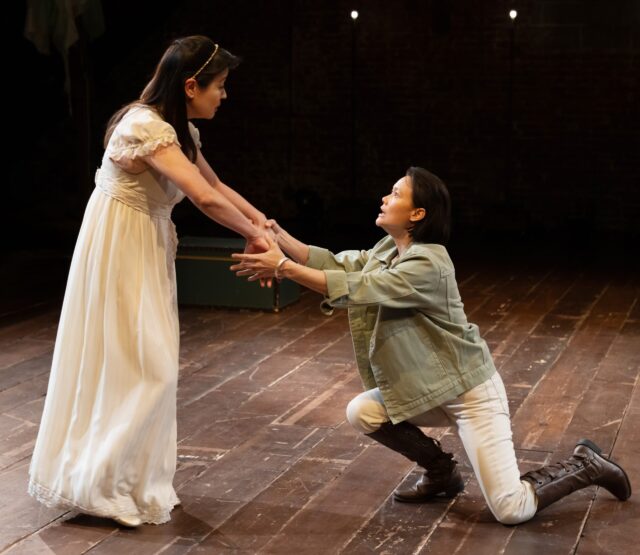
The pure and passionate love between Princess Imogen (Jennifer Lim) and Posthumus Leonatus (KK Moggie) is challenged in NAATCO’s Cymbeline (photo by Julieta Cervantes)

CYMBELINE
Lynn F. Angelson Theater
136 East Thirteenth St. between Third & Fourth Aves.
Tuesday – Sunday through February 15, $25-$55
https://www.naatco.org

“Context is everything,” according to a phrase attributed to twentieth-century sociologist Alvin Ward Gouldner, author of such books as The Coming Crisis of Western Sociology and Against Fragmentation: The Origins of Marxism and the Sociology of Intellectuals.

That expression was on my mind as I watched the National Asian American Theatre Co.’s (NAATCO) splendid production of William Shakespeare’s Cymbeline, running at the Lynn F. Angelson Theater through February 15.

When I saw Heidi Schreck’s What the Constitution Means to Me at New York Theatre Workshop in 2018, it was the day that the Judiciary Committee had voted to advance the nomination of Brett Kavanaugh for Supreme Court Justice to the Senate floor. The air was thick with that event, which Schreck shrewdly noted without getting specific, but the entertaining show soon had the audience laughing.

I saw Cymbeline the day I learned that President Donald J. Trump had signed an executive order declaring, “It is the policy of the United States to recognize two sexes, male and female. These sexes are not changeable and are grounded in fundamental and incontrovertible reality. . . . Agencies shall remove all statements, policies, regulations, forms, communications, or other internal and external messages that promote or otherwise inculcate gender ideology, and shall cease issuing such statements, policies, regulations, forms, communications or other messages.”

Andrea Thome’s modern-verse adaptation, which identifies itself as “all-femme, all–Asian American,” feels like a punch to the gut of that executive order, which essentially seeks to ban the word “gender” from the English language. It is particularly relevant in a work by Shakespeare, since original productions of his plays featured all-male casts because women were not permitted to perform onstage in Elizabethan times. , as it was considered unladylike and demeaning to their established role in Victorian society.

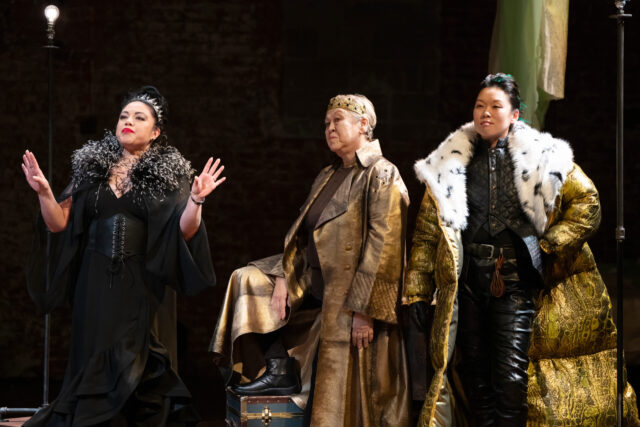
In Ancient Britain, King Cymbeline (Amy Hill) has banished Posthumus Leonatus (KK Moggie), a soldier who has wed his daughter, the princess Imogen (Jennifer Lim), without royal permission, ignoring their deep love for each other. The queen (Maria-Christina Oliveras) is determined that her son from a previous marriage, Cloten (Jeena Yi), will be Imogen’s husband, ensuring he will be the next ruler.

In exile in Rome, Posthumus boasts to a group of men from Italy, the Netherlands, Spain, and France about his true love’s undying fidelity. The Frenchman tells the doubting Iachimo (Anna Ishida) of a conversation he had with Posthumus the night before in which they both were “lavishly praising our beloved mademoiselles back home; this gentleman at the time vouching (and vowing to defend it with his blood) that his lady was more lovely, virtuous, wise, chaste, faithful, praiseworthy and less temptable to seduction than any of the most extraordinary ladies in France.”

Iachimo takes that as a challenge and offers half his estate against Posthumus’s diamond ring, which belonged to Imogen’s mother, that he can seduce the princess and bring back absolute proof of his success. “The goodness of my mistress exceeds the depth of your vulgarity. I dare you to this match,” Posthumus says, agreeing to the bet and adding that they will duel when Iachimo fails.

Cymbeline features an “all-femme, all–Asian American” cast (photo by Julieta Cervantes)

Even though Imogen boldly rejects Iachimo’s advances, he tricks Posthumus into believing that the princess did indeed surrender her honor, prompting Posthumus to write to Imogen advising her to meet him in the Welsh town of Milford Haven and commanding his loyal servant, Pisanio (Julyana Soelistyo), to kill her because of her adultery. “Do I seem to the world to lack humanity so much as this crime asks?” Pisanio says, questioning the order.

In addition, the foolish Cloten has decided that he too will head to Milford Haven, to kill Posthumus and “defile” Imogen on his path to becoming next in line for the throne.

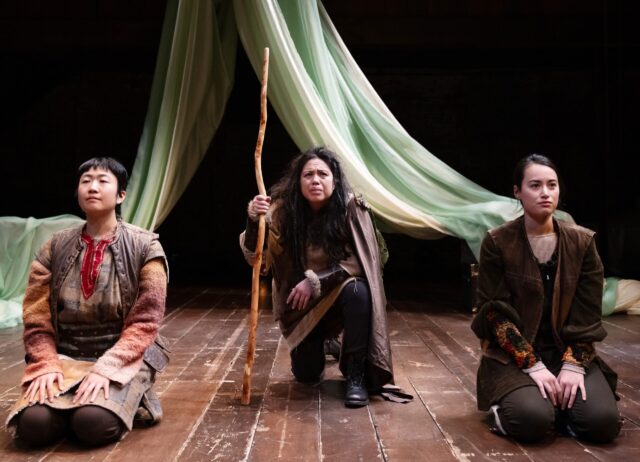
Meanwhile, the Roman ambassador Caius Lucius (Purva Bedi) has threatened King Cymbeline with war if he does not pay tribute tax to Augustus Caesar; the queen has acquired poison from the doctor, Cornelius (Narea Kang), that she intends to use on Imogen; and on her way to Wales disguised as a boy named Fidele, Imogen encounters a father and his two boys, who live in a cave, surviving on sheer will. Little does she know that it is actually Belarius (Oliveras), who was wrongly banished by Cymbeline many years before and who absconded with Arviragus (Annie Fang) and Guiderius (Sarah Suzuki), the king’s two young sons and her half brothers, who the ruler believes are dead.

The numerous subplots all come together in a rousingly satisfying finale.

Cymbeline is a problematic play that is far from the Bard’s finest. It feels cobbled together with leftovers from such other works as Twelfth Night, Romeo and Juliet, The Comedy of Errors, Richard III, Hamlet, and Othello. A dream sequence involving the god Jupiter (Soelistyo) is one of Shakespeare’s strangest, most awkward scenes. The dialogue lacks memorable, familiar lines. At nearly three hours (with intermission), it is too long. In New York City, the play has never made it to Broadway; the Public has presented it three times in its Shakespeare in the Park festival, in 1971, 1998, and, most recently, 2015, with Patrick Page as the king, Kate Burton as the queen and Belarius, Hamish Linklater as Posthumus and Cloten, Lily Rabe as Imogen, and Raúl Esparza as Iachomo.

But NAATCO, in partnership with Play On Shakespeare, has breathed new life into the show. Yi-Hsuan (Ant) Ma’s spare, often bare set is highlighted by a multipurpose large stretch of cloth that cleverly morphs from a bedsheet to royal drapery to a cave entrance, evoking what would be considered then women’s work, made by seamstresses. Mariko Ohigashi’s costumes feature lots of black leather and British and Roman finery that stand in contrast to the princess’s white gown. Yiyuan Li’s lighting keeps the audience, sitting on three sides of the action, visible through much of the show, as if we are all part of the kingdom, especially on the several occasions where the fourth wall is broken. Caroline Eng’s sound includes musical chimes that signal various changes.

The banished Belarius (Maria-Christina Oliveras) has raised Arviragus (Annie Fang) and Guiderius (Sarah Suzuki) in a cave in the woods (photo by Julieta Cervantes)

The majority of the cast is exemplary, ably emitting Shakespeare’s poetic iambic pentameter even when Thome’s contemporary translation uses modern language, although Bard purists should not be too worried.

Here is one example of Thome’s (Pinkolandia, A Dozen Dreams) style, with the Folger Library version first, followed by the new adaptation:

Cloten: Was there ever man had such luck? When I
kissed the jack, upon an upcast to be hit away? I
had a hundred pound on ’t. And then a whoreson
jackanapes must take me up for swearing, as if I
borrowed mine oaths of him and might not spend
them at my pleasure.

Cloten: Has there ever been a man with luck like mine? I’d bowled my
ball, just kissed the jack . . . and then was hit away! I had bet a
hundred pounds on that game: and then that damned monkey
son of a whore had to scold me for swearing.

It is important to point out that the ensemble is identified as “all-femme,” not “all-woman”; in real life, not all of the actors use the pronouns “she/her.” In addition, being “all–Asian American” is a strong rejoinder to the Asian and immigrant hate so pervasive in America today and apparently supported by the current administration, which is also seeking to subvert the fourteenth amendment by ending birthright citizenship and to deport Dreamers. Director Stephen Brown-Fried (Misalliance, Awake and Sing!), who does a terrific job guiding the proceedings, does not emphasize any of that, instead letting it all unfurl in an organic and natural way, gender be damned.

“I see a man’s life is a tedious one,” Imogen says in a soliloquy in Act 3, Scene 6, in front of the cave in the Wales forest.

In this wonderful adaptation in these troubled times, that statement speaks volumes.

[There are several special postshow events scheduled: January 29 is AAPINH Night, with a talkback with the director, members of the cast, and the casting company; February 2 is Shakespeare Trivia Night after the matinee; and the February 6 performance will be followed by the panel discussion “Shakespeare in Translation: Body and Verse,” with Lue Douthit, Karen Shimakawa, and Thome.]

[Mark Rifkin is a Brooklyn-born, Manhattan-based writer and editor; you can follow him on Substack here.]

A TALE OF TWO SHAKESPEARE ADAPTATIONS: THE COMEDY OF ERRORS / ROMEO AND JULIET

A fab cast sings and dances its way through exuberant production of The Comedy of Errors (photo by Peter Cooper)

PUBLIC THEATER MOBILE UNIT: THE COMEDY OF ERRORS
Multiple locations in all five boroughs
Through May 21, free (no RSVP necessary)
Shiva Theater, May 25 – June 11, free with RSVP
publictheater.org

Last Saturday, I did a Shakespeare doubleheader. In the afternoon, I saw the Public Theater’s Mobile Unit touring production of The Comedy of Errors, followed in the evening by NAATCO’s off-Broadway premiere of Hansol Jung’s Romeo and Juliet. The former turned out to be the most fun I’ve ever had at a Shakespeare play. The latter, by a writer whose previous show was wildly exhilarating and utterly unforgettable, started strong but couldn’t quite sustain it, ending up being not so much fun.

The Mobile Unit is now in its twelfth year of bringing free Shakespeare to all five boroughs, presenting works in prisons, shelters, and underserved community centers as well as city parks. On May 13, it pulled into the Richard Rodgers Amphitheater in Marcus Garvey Park, where part of the audience sat on the stage, on all four sides of a small, intimate square area where the action takes place; attendees could also sit in the regular seats, long concrete benches under the open sky.

Emmie Finckel’s spare set features a wooden platform and a bright yellow stepladder that serves several purposes. Lux Haac’s attractive, colorful costumes hang on racks at the back, where the actors perform quick changes. Music director and musician Jacinta Clusellas and guitarist Sara Ornelas sit on folding chairs, performing Julián Mesri’s Latin American–inspired score; Ornelas is fabulous as a troubadour and musical narrator, often wandering around the space and leading the cast in song. The lyrics, by Mesri and director and choreographer Rebecca Martínez, who collaborated on the adaptation, are in English and Spanish and are not necessarily translated word for word, but you will understand what is going on regardless of your primary tongue. As the troubadour explains, “I should mention that most of / this show will be performed in English / though it’s supposed to / take place in two states in Ancient Greece. / But don’t be surprised / if these actors switch their language.”

Trimmed down to a smooth-flowing ninety minutes, the show tells the story of a pair of twins, Dromio (Gían Pérez) and Antipholus (Joel Perez), who were separated at birth. In Ephesus, Dromio serves Antipholus, a wealthy man married to the devoted Adriana (Danaya Esperanza) but cheating on her with a lusty, demanding courtesan (Desireé Rodriguez). The other Dromio and Antipholus arrive in Ephesus and soon have everyone running around in circles as the mistaken identity slapstick ramps up.

Adriana (Danaya Esperanza) and Dromio (Gían Pérez) are all mixed up in The Comedy of Errors (photo by Peter Cooper)

Meanwhile, the merchant Egeon (Varín Ayala) is facing execution because he is from Syracuse, whose citizens are barred from Ephesus, per a decree from the Duchess Solina (Rodriguez); the goldsmith Angelo (Ayala) has made a fancy gold rope necklace for Antipholus but gives it to the wrong one; the Syracuse Dromio is confounded when Adriana’s kitchen maid claims to be his wife; the Syracuse Antipholus falls madly in love with Luciana (Keren Lugo), Adriana’s sister; and an abbess (Rodriguez) is determined to protect anyone who seeks sanctuary.

In case any or all of that is confusing, the troubadour clears things up in a series of songs that explain some, but not all, of the details, and the Public also provides everyone with a cheat sheet. Again, the troubadour: “In case you missed it / or took a little nap / Here’s what’s been happening / since we last had a chat / We’ll do our best / but we confess / this plot is really putting our skills to the test.”

It all comes together sensationally at the conclusion, as true identities are revealed, conflicts are resolved, and love wins out.

Martínez (Sancocho, Living and Breathing) fills the amphitheater with an infectious and supremely delightful exuberance. The terrific cast interacts with the audience, as if we are the townspeople of Ephesus. Gían Pérez (Sing Street) and Joel Perez (Sweet Charity, Fun Home) are hilarious as the two sets of twins, who switch hat colors to identify which brother they are at any given time. Esperanza (Mary Jane, for colored girls . . .) shines as the ever-confused, ultradramatic Adriana, Lugo (Privacy, At the Wedding) is lovely as Luciana and the duchess, Rodriguez is engaging as Emilia and the courtesan, and Ayala (The Merchant of Venice, The Taming of the Shrew) excels as Angelo, Egeon, and Dr. Pinch.

But Ornelas (A Ribbon About a Bomb, American Mariachi) all but steals the show, switching between leather and denim jackets as she portrays minor characters and plays her guitar with a huge smile on her face, words and music lifting into the air. Charles Coes’s sound design melds with the wind blowing through the trees and other people enjoying themselves in the park on a Saturday afternoon. There are no errors in this comedy.

The Mobile Unit continues on the road with stops at A.R.R.O.W. Field House and Corona Plaza in Queens and Johnny Hartman Plaza in Manhattan before heading home to the Shiva Theater at the Public for a free run May 25 through June 11.
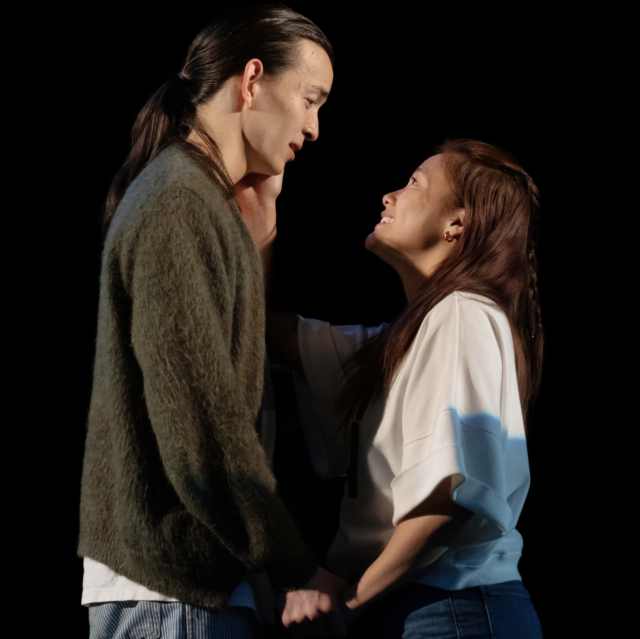
Romeo (Major Curda) and Juliet (Dorcas Leung) have a tough time of it at Lynn F. Angelson Theater (photo by Julieta Cervantes)

ROMEO AND JULIET
Lynn F. Angelson Theater
136 East Thirteenth St. between Third & Fourth Aves.
Monday – Saturday through June 3, $40
naatco.org

In February, I called Hansol Jung’s Wolf Play at MCC “the most exhilarating hundred minutes you will spend in a theater right now.” Alas, her follow-up, a profoundly perplexing adaptation of Romeo and Juliet making its off-Broadway premiere at the Lynn F. Angelson Theater through June 3, is unable to decide whether it is a wacky farce or a serious drama, ending up as its own kind of comedy of errors.

The confusion starts as the audience enters the space, where a handmade sign says to pick one side; the stage is a circular platform cut in half by a muslin curtain. Every person stops to consider which of the two sides might be better, asking the usher and looking back and forth at the possibilities. I watched as one woman, after selecting one side, got up several times to question whether she had chosen correctly. In this case, assigned seating might have been better, or instead dividing the sections into “Montague” and “Capulet.”

The play, a collaboration between the National Asian American Theatre Company and the Oregon Shakespeare Festival’s Play On Shakespeare Project that debuted at Red Bank’s Two River Theater, begins with some funny slapstick as Daniel Liu fumbles with opening the curtains, which are tied by thick white rope to opposing scaffolds. Liu provides comic relief throughout the two-and-a-half-hour show, portraying multiple characters, including Lady Capulet in a white gown. (She’s later played by a coatrack.)

While a chorus delivers the prologue — “Two households, both alike in dignity / (In fair Verona, where we lay our scene), / From ancient grudge break to new mutiny, / Where civil blood makes civil hands unclean. / From forth the fatal loins of these two foes / A pair of star-cross’d lovers” — Capulet servants Sampson and Gregory engage in a conversation that makes sure we realize that this is not going to be a traditional production. “Gregory, I swear, man, we can’t be no one’s suckers,” Sampson says. “There’s some people I’d be happy to suck on,” Gregory responds. “Well, they can suck my cum and then succumb to my sword,” Sampson adds. The wordplay may be in the spirit of ribald Elizabethan theater, but it can feel like a pretty harsh divergence from the actual text. Jung and codirector Dustin Wills aren’t able to balance the juxtapositions as the story meanders; this adaptation assumes that the audience essentially knows what’s going to happen so necessary plot development can be skipped.

Juliet’s father has picked Count Paris (Rob Kellogg) to be her husband, but she has fallen head-over-heels for Romeo (Major Curda), scion of the Capulets’ sworn enemy, the Montagues. A swordfight between Romeo’s cousin, Mercutio (Jose Gamo), and Juliet’s cousin, Tybalt (Kellogg), lays the groundwork for more blood to follow, along with heartbreak and a classic finale that has never made complete sense.

But Jung (Wild Goose Dreams, Cardboard Piano, Human Resources) and Wills (Montag, Plano) get so caught up in theatrical hijinks — the actors climb the scaffold to operate spotlights, random props that had been tucked under the circular platform are suddenly crowding the stage, a soundboard spits out digital beats (the music is by Brian Quijada), the fourth wall is inconsistently broken — that it is hard for the audience to maintain focus and care about the characters. Junghyun Georgia Lee’s set also echoes NAATCO’s recent production of Edward Albee’s A Delicate Balance, in which rows of hundreds of glasses and books were visible underneath the stage but were not used in the play.
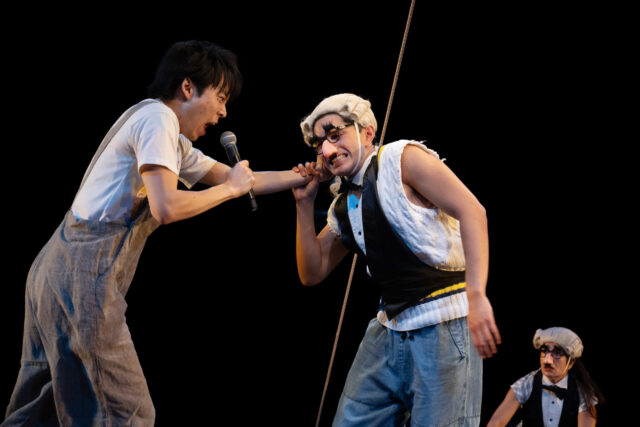
Peter (Daniel Liu), Potboy (Jose Gamo), and Servingman (Purva Bedi) engage in some silliness in Hansol Jung’s adaptation of Romeo and Juliet (photo by Julieta Cervantes)

The mood goes from an irreverent send-up with contemporary language to a serious interpretation using Shakespeare’s original words; it’s like Jung is unable to decide which way to go, much like the audience entering the theater. It’s a shame, because the show has its clever moments of inspiration. Mariko Ohigashi’s random costumes include Juliet’s sweatshirt that says “Abbondanza” on two lines, while Romeo’s T-shirt proclaims, “Count Your Fucking Rainbows”; Juliet wears cute and fluffy animal slippers; Friar Laurence (Purva Bedi) is dressed in oversized pants with suspenders; and Mercutio is styled like a boy band star. (However, the Groucho glasses are confounding.) Two trapdoors allow Romeo and Juliet to escape from everyone else. When things get tense, Romeo often strums a few notes on his guitar, which elicits laughter.

Even with a makeout scene, Leung (Miss Saigon, Snow in Midsummer) and Curda (KPOP!) never catch fire. Kellogg (Red Light Winter, Twelfth Night) is stalwart as Paris, Bedi (Dance Nation, India Pale Ale) is an adorable Friar Laurence, and Lee Huynh (War Horse, A Clockwork Orange) is fine as Capulet, but NAATCO cofounder Mia Katigbak (Awake and Sing, A Delicate Balance) seems to be in an alternate version of the play, Gamo (The Great Leap, The Heart of Robin Hood) overdoes it as Mercutio and Potboy, and Zion Jang is too goofy as Benvolio, while poor Liu’s (You Will Get Sick, GIRLS) shtick grows repetitive by the second act as he alternates between Lady Capulet and Peter and screams in agony a lot.

The play completely loses its already tenuous focus when Peter inexplicably insists that the musicians play “Purple Rain,” which is more than just head-scratchingly bizarre but downright annoying. It’s as if Jung and Wills were so phenomenally successful with Wolf Play that nobody wanted to just tell them no, that the Prince song makes no sense in the context of this Romeo and Juliet. Unfortunately, it’s all too representative of what ends up being a lost opportunity, a would-be comedy of too many errors.
EDWARD ALBEE’S A DELICATE BALANCE

Tobias (Manu Narayan), Claire (Carmen M. Herlihy), and Agnes (Mia Katigbak) are stuck with Harry (Paul Juhn) and Edna (Rita Wolf) in Albee revival (photo by Carol Rosegg)

EDWARD ALBEE’S A DELICATE BALANCE
Connelly Theater
220 East Fourth St. between Aves. A & B
Thursday – Sunday through November 19, $35-$75
transportgroup.org

When I let a friend know that I was going to see the first-ever off-Broadway production of Edward Albee’s 1966 Pulitzer Prize–winning A Delicate Balance, he responded that he felt he didn’t need to see it because Pam MacKinnon’s 2015 2015 Broadway revival, starring John Lithgow, Glenn Close, Lindsay Duncan, Martha Plimpton, Bob Balaban, and Clare Higgins, was “perfection.” That’s a shame, because this new adaptation, a collaboration between Transport Group and the National Asian American Theatre Company (NAATCO), continuing through November 19 at the Connelly Theater, is definitely worth a visit.

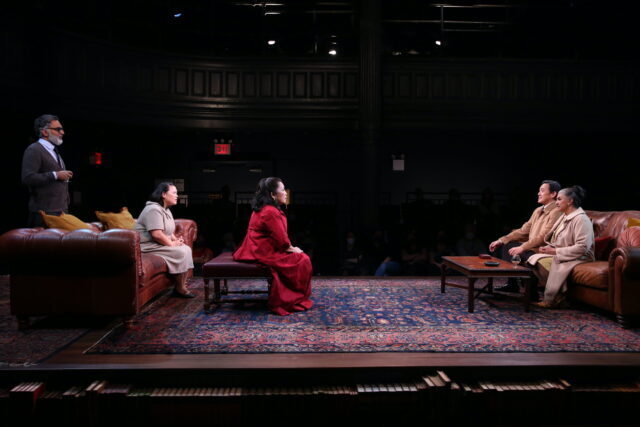
Directed by Jack Cummings III, the three-act, two-intermission show takes place on Peiyi Wong’s horizontal living-room set, which juts out from the stage, where only a tall, impressive staircase resides. The audience sits on either side of the living room, furnished in what might be called midcentury academic WASP, featuring a pair of well-used couches, a few tasteful Ottomans, a small table, an Oriental carpet, and, at the far end, a fashionable bar glittering with cut crystal glasses and decanters. The stage is slightly raised, and below it, running around on all sides, the audience can see a single row of hundreds of immaculately shelved old hardcover books. Below the bookshelf, on the floor, sit carelessly arranged empty glasses of all types, evidence of problems underneath the dysfunctional family’s pristine veneer. (The terrific props are by Rhys Roffey.)

There’s not a lot of warmth in the household, beginning with matriarch Agnes (Mia Katigbak) and patriarch Tobias (Manu Narayan). The play opens with Agnes explaining, “What I find most astonishing — aside from that belief of mine, which never ceases to surprise me by the very fact of its surprising lack of unpleasantness, the belief that I might very easily — as they say — lose my mind one day, not that I suspect I am about to, or am even . . . nearby . . .” Retired businessman Tobias responds, “There is no saner woman on earth, Agnes.” Everyone in the play has their own issues with sanity, which is splendidly conveyed in Albee’s stinging dialogue.

Tobias and Agnes live with Claire (Carmen M. Herlihy), Agnes’s cynical alcoholic younger sister. The couple has just found out that their thirty-six-year-old daughter, Julia (Tina Chilip), is on her way home, as her fourth marriage appears to be over. But before Julia arrives, their best friends, Harry (Paul Juhn) and Edna (Rita Wolf), show up at their doorstep, asking if they can stay with them for an undetermined amount of time.

Claire (Carmen M. Herlihy) and Tobias (Manu Narayan) wonder where it all went wrong in A Delicate Balance (photo by Carol Rosegg)

When Claire asks them why they left their house in the middle of the night, Harry says, “I . . . I don’t know quite what happened then; we . . . we were . . . it was all very quiet, and we were all alone . . . and then . . . nothing happened but . . . nothing at all happened, but . . .” Edna adds, “We got . . . frightened.” Harry: “We got scared.” Edna: “We were . . . frightened.” Harry: “There was nothing . . . but we were very scared.” Edna: “We . . . were . . . terrified.” Harry: “We were scared. It was like being lost: very young again, with the dark, and lost. There was no . . . thing . . . to be . . . frightened of, but . . .” It’s a chilling scene, something that everyone can relate to, a sudden, unexpected fear of the unknown, in this case despite apparent wealth and success. But it’s even more powerful in 2022, delivered by these actors, when anti-Asian hate is rising in the United States and around the world.

Empty nesters Tobias and Agnes take them in and put them up in Julia’s room, news that the daughter greets with loud anger and resentment. Agnes next considers how her life would have better if she were born a man, in which case her only worries would be money and death.

Many cognacs and martinis are sipped as the six characters — haunted by the memory of Tobias and Agnes’s deceased child — mock one another, promise not to reveal secrets, ponder nuclear annihilation, and try to get Claire to stop playing her accordion. “I tell ya, there are so many martyrdoms here,” Claire declares at one of numerous uncomfortable moments. “One to a person,” Edna says.

Through it all, the regal Agnes, who believes strongly in manners and how one presents oneself to others, tries to keep everything from falling apart. She tells Tobias and Julia without much fanfare, “There is a balance to be maintained, after all, though the rest of you teeter, unconcerned, or uncaring, assuming you’re on the level ground . . . by divine right, I gather, though that is hardly so. And if I must be the fulcrum . . . I think I shall have a divorce.” Tobias is stunned, so Agnes clarifies, “No, no; Julia has them for all of us. . . . We become allegorical, my darling Tobias, as we grow older.”

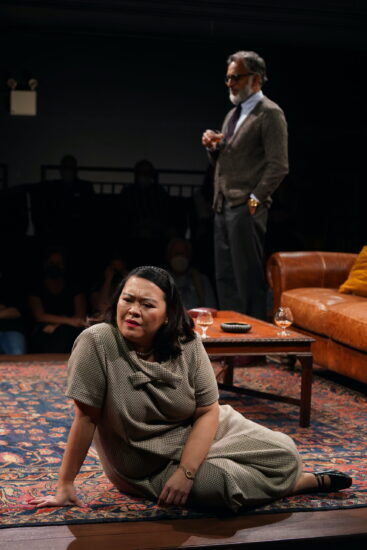
Transport cofounder Cummings III (Come Back, Little Sheba; Broadbend, Arkansas) guides the actors with a steady, assured hand, letting just the right tinge of mystery hover over the proceedings. The all-Asian cast — a first for an Albee play in New York — sparkles in Mariko Ohigashi’s old-school suburban-chic costumes. NYC treasure Katigbak is cool and calm as Agnes, while Narayan portrays Tobias as a stiff-backed man whose nerves threaten to explode at any moment. Herlihy and Chilip are vibrant and noisy as the rowdier relatives, while Juhn and Wolf are like shadowy specters as Harry and Edna, whose fears make our own palpable.

Albee, who would go on to win Pulitzers for Seascape in 1975 and Three Tall Women in 1994, based the sharply drawn characters on relatives of his; I can’t imagine what a dinner party would be like with them. Well, maybe I can. And I’ll be sure to invite my friend who shouldn’t have skipped this revival.

[On November 9, there will be a preshow Casting Conversation with casting directors Stephanie Yankwitt and Andrea Zee and NAATCO creative producer Peter Kim, moderated by NYU professor Michael Dinwiddie.]

OUT OF TIME

A documentary filmmaker (Page Leong) looks back at her life in Anna Ouyang Moench’s My Documentary (photo by Joan Marcus)

OUT OF TIME
Martinson Theater, the Public Theater
425 Lafayette St. at Astor Pl.
Tuesday through Sunday through March 13, $60
212-539-8500
publictheater.org
www.naatco.org

In Sam Chanse’s Disturbance Specialist, the last of five monologues comprising Out of Time, author Leonie Z. (Natsuko Ohama) says, “You know nothing of what it is to live when you haven’t yet understood that you will die. And none of you really understands that. You get the concept maybe but you don’t actually believe it.”

Out of Time, which opened last night at the Public’s Martinson Theater, is an extraordinary concept: Five Asian American playwrights have written monologues for five Asian American actors over the age of sixty, directed by Les Waters, who is also over sixty. The five stories don’t always focus on aging, although getting older, with fewer years ahead than behind, is an inherent theme throughout the works, as is the call for respect for the elderly from family, friends, colleagues, and strangers. Isolation, loss, and loneliness abound, along with deep pockets of hope and defiance.

Speaking about her longtime producer, the unnamed documentary filmmaker (Page Leong) in Anna Ouyang Moench’s My Documentary explains, “Neil, who hugged me hello and then listened to my carefully crafted pitch about my just-dead husband and passed and hugged me goodbye as though he hadn’t just told a widow in no uncertain terms to go fuck herself because she’s old and no one cares when old people grieve other old people.”

Ena (Mia Katigbak) knows getting older is no mere game in Mia Chung’s Ball in the Air (photo by Joan Marcus)

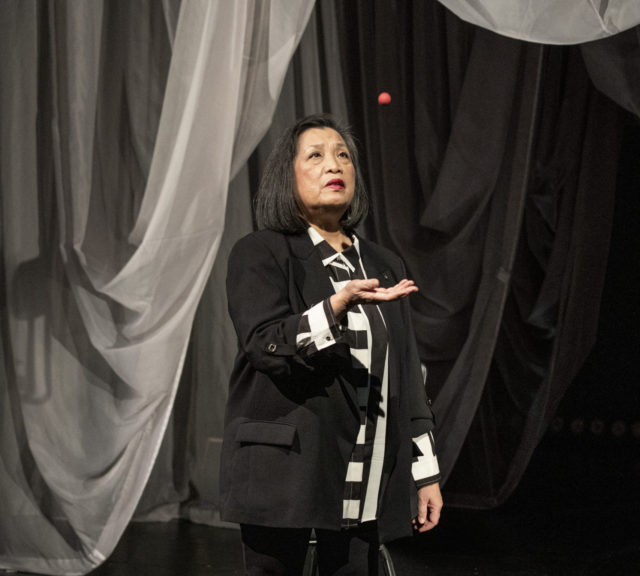
In Mia Chung’s Ball in the Air, Ena (Mia Katigbak) walks onto the stage playing with a kids’ paddle ball, bouncing a little red ball against a wooden paddle, the two held together tenuously by a thin rubber band. She displays a childlike desire to succeed at the game shortly before describing a horrible accident she was involved in. She worries about feeling confused as different stories merge together in her mind. “Time is no guarantee,” she says. “These moments — when someone sees red when you see blue — well, it can be a stunner. It can seem as if something has vanished. In an instant.”

Glenn Kubota is the only male in the cast, portraying Taki in Naomi Iizuka’s Japanese Folk Song. The Scotch- and cigar-loving, jazz-hating Taki details how he nearly died in every decade from his teens to his seventies — “I must be pretty tough,” he acknowledges. “And lucky. I must be lucky.” — before telling a version of the Japanese ghost story “Yuki-onna,” which was famously retold in Masaki Kobayashi’s classic film Kwaidan. Taki is straightforward and practical even as he ventures into the realm of the fantastic.

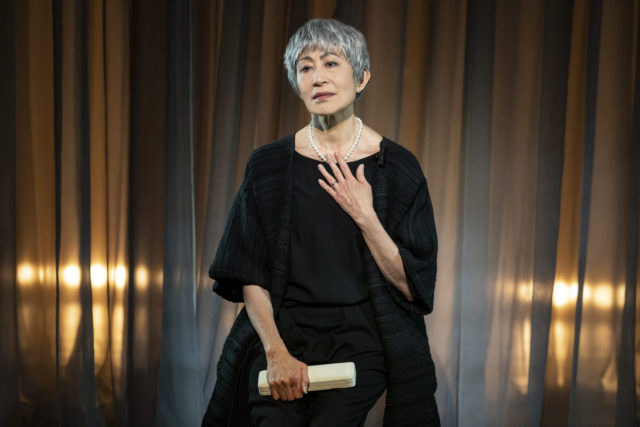
Carla (Rita Wolf) is a voice from the past discussing the history of cancer among the women in her family in Jaclyn Backhaus’s Black Market Caviar. The piece is structured as a video the character made on December 31, 2019, offering advice to a descendant watching decades later. “Time is moving more quickly than I’d like,” she says. Carla is sitting behind a translucent curtain; we watch her on a video monitor at the corner of the stage. Ena, Taki, and the documentarian all sit in chairs front and center, evoking Waters’s direction of Lucas Hnath’s Dana H., in which Deirdre Connell performs the play sitting down (and lip-syncing the dialogue). Leonie Z. stands at a podium, delivering a fiery lecture to students who have already canceled her. (The spare scenic design is by dots.)

Leonie Z. (Natsuko Ohama) fights back in Sam Chanse’s Disturbance Specialist (photo by Joan Marcus)

Commissioned and produced by NAATCO, Out of Time is a play for the ages. Inspired by Anne Teresa De Keersmaeker’s Mitten wir im Leben sind/Bach6Cellosuiten, a piece choreographed for older dancers (including De Keersmaeker herself, who is in her early sixties), Waters (Big Love, The Thin Place) gives agency to each of the actors, and each of the characters, who look back at their lives in personal ways that are poignant and gripping, especially amid a rise in anti-Asian hate crimes and during a pandemic in which nursing home deaths related to Covid-19 were seen by many as the cost of doing business as a society.

The basic conceit of the play itself is a bold act of resistance, proving that actors over sixty are fully able to present long monologues and inhabit complex characters who are a lot more than elderly grandparents ready to be put out to pasture. Each of these characters is imbued with an inner strength and purpose even as they recognize their approaching fate — and we know the same is in store for the rest of us.

“Think about death, but remember life: our long lineage,” Carla says. “Because of you, our mother, our grandmother, I am here. Today. Today I am alive. I revel in all of it.” The titular “disturbance specialist” in Leonie Z.’s lecture is a volcano mouse “that flourishes, revels, in ruined environments.” The canceled author sternly proclaims, “And in all this, what you have to tell me is that I’m not welcome. I, Leonie Z., am not welcome here, that I should go home. Delete my account. Shut up and erase myself. Roll over and quietly die?” In Out of Time, none of those are acceptable options.

NOH-NOW: HANJO

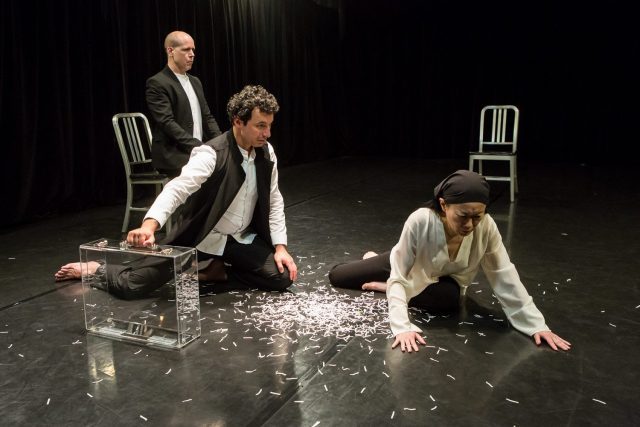
SITI Company presents a new adaptation of Yukio Mishimas Hanjo at Japan Society

SITI Company presents a new adaptation of Yukio Mishima’s Hanjo at Japan Society

Japan Society
333 East 47th St. at First Ave.
December 7-9, $35, 7:30
212-715-1258
www.japansociety.org
siti.org

Japan Society’s four-part “NOH-NOW” series, which began with Luca Veggetti’s Left-Right-Left and Hiroshi Sugimoto’s Rikyu-Enoura, continues with SITI Company’s adaptation of Yukio Mishima’s Hanjo, running December 7-9. (SITI presented a staged reading of Hanjo at Japan Society in May 2007.) Freely adapted by Japanese author, poet, and filmmaker Mishima (The Sailor Who Fell from Grace with the Sea, Madame de Sade) from Seami Motokiyo’s fourteenth-century noh play about love and betrayal, the work features three characters, the mad girl Hanako, the spinster Jitsuko, and a young man, Yoshio, performed in rotation through three iterations by Akiko Aizawa (who just appeared in Ripe Time’s adaptation of Haruki Murakami’s Sleep at BAM), Gian-Murray Gianino, and Stephen Duff Webber. Leon Ingulsrud directs the bilingual production from his translation, with live music composed and played by violist Christian Frederickson, sets and lighting by Brian H Scott, costumes by Mariko Ohigashi, and choreography by Wendell Beavers. Founded by Anne Bogart and Tadashi Suzuki in 1992, the company has previously staged such inventive works as Chess Match No. 5, bobrauschenbergamerica, Steel Hammer, and Bob and, in its early years, were regulars at the Toga Festival in Japan. The December 7 show at Japan Society will be followed by a reception with members of the company, while the December 8 performance will be followed by a Q&A with the artists. “NOH-NOW” concludes January 11-14 with Satoshi Miyagi’s Mugen Noh Othello as part of the Public Theater’s Under the Radar Festival.