A family faces some hard truths in stellar revival of Henrik Ibsen’s The Wild Duck (photo by Gerry Goodstein)
THE WILD DUCK
Theatre for a New Audience, Polonsky Shakespeare Center
262 Ashland Pl. between Lafayette Ave. & Fulton St.
Tuesday – Sunday through September 28, $102-$132
www.tfana.org
“Men are the most peculiar creatures,” Gina (Melanie Field) says near the middle of Simon Godwin’s adaptation of David Eldridge’s 2005 translation of Henrik Ibsen’s The Wild Duck at the Polonsky Shakespeare Center.
That’s not the half of it.
Over the last fourteen years, Henrik Ibsen’s plays have been experiencing a renaissance, with productions of Ghosts at Lincoln Center, An Enemy of the People on Broadway and at Park Ave. Armory, The Master Builder and John Gabriel Borkman at BAM, and A Doll’s House and Lucas Hnath’s A Doll’s House, Part 2 on Broadway, along with Charles Busch’s Ibsen’s Ghost in midtown and Will Eno’s Peer Gynt reimagining, Gnit, at the Polonsky. It’s been a while since New York City has seen a major revival of Hedda Gabler and even longer of The Wild Duck, which is at last back in this exquisite rendering.
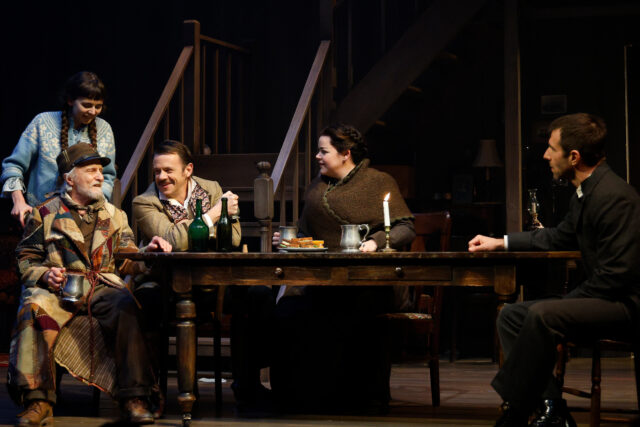
A dual presentation from Theatre for a New Audience and Shakespeare Theatre Company (STC), The Wild Duck is a complex tale of parents and children, money and power, truth-telling, and the ability to see what’s happening right in front of you. The story takes place in 1880s Norway, where wealthy mill owner Håkon Werle (Robert Stanton) is having a dinner party in honor of his son, Gregers (Alexander Hurt), who apparently would rather be anywhere else. Gregers has invited his old friend Hjalmar Ekdal (Nick Westrate), whom he has not seen in sixteen years; Hjalmar, who is not in the same class as the other guests, has reluctantly shown up and is embarrassed when his bedraggled father, Old Ekdal (David Patrick Kelly), a onetime war hero and partner of Håkon’s who spent several years in prison, walks through the party, muttering to himself, and accepts a bottle from Miss Pettersen (Katie Broad), the housekeeper.
Gregers and Hjalmar have a long conversation that leads to Gregers confronting his father, accusing Håkon of having had an affair and an ulterior motive in helping Hjalmar and his family. Håkon asks Gregers to become his partner, explaining, “I’m not as fit for work as I used to be. My eyes aren’t as good.” Gregers thinks his father, who is preparing to marry his current housekeeper, Mrs. Sørby (Mahira Kakkar), is up to something. “I know how you’re using me,” Gregers says. An angry Håkon replies, “I don’t think there’s a man in this world you could detest as much as you detest me.” A frightfully earnest Gregers retorts, “I’ve observed you too closely and for too long, Father.”
The narrative then switches to the Ekdals’ dusty, rustic studio, where Hjalmar and his wife, Gina, live with their bright, inquisitive fifteen-year-old daughter, Hedvig (Maaike Laanstra-Corn), and her grandfather, Old Ekdal, who was a well-regarded hunter. The old man now resigns himself to shooting animals in their loft, which is populated by birds, rabbits, chickens, and a wild duck that was winged by Håkon, was rescued in the sea by Håkon’s dog, and is now cared for by Hedvig, an avid reader who is losing her eyesight. (The impressive sets are by Andrew Boyce.) Hjalmar believes he will be able to lift up his family with an invention he is working on that will make them rich. For additional income, they have two boarders, Dr. Relling (Matthew Saldívar) and the unseen theologian Mr. Molvik. Gregers arrives to inquire if he can rent a vacant room; despite Gina’s misgivings, he moves in and almost immediately inserts himself into situations that drive wedges between just about everyone. Oh, and then there’s the Chekhovian gun. . . .
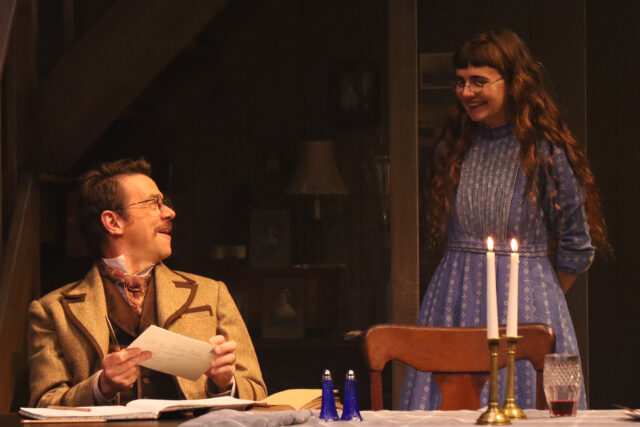
Hjalmar Ekdal (Nick Westrate) and his daughter, Hedvig (Maaike Laanstra-Corn), share a happy moment in The Wild Duck at TFANA’s Polonsky Shakespeare Center (photo by Gerry Goodstein)
The Wild Duck centers on the relationships between fathers and children: Håkon and Gregers, Old Ekdal and Hjalmar, and Hjalmar and Hedvig. Håkon blames Gregers’s distaste for him on his late wife; Hjalmar tells Gregers that he wants to save his aging, ailing father. And Hjalmar reevaluates his love for Hedvig after a secret is revealed.
It’s also focused on the concept of truth, particularly as it applies to Gregers, who believes in getting everything out into the open, no matter how much it might harm certain people. But he is not a master manipulator or self-righteous believer as much as he might be mad. “Damn it, can’t you see the man’s insane — He’s disturbed!” Dr. Relling shouts at one point. In addition, sight plays a major role, literally and figuratively, as some characters are losing their eyesight and others refuse to see the truth that’s staring them in the face.
Eldridge (Festen, Under the Blue Sky) and STC artistic director Godwin (Timon of Athens, Man and Superman) get right to the heart of Ibsen’s play with an exquisite rendering that grabs you and never lets go. It’s so on target, so alive and bursting with energy and intrigue, that you’ll wonder why you’ve never seen it before.
Westrate (Bernhardt/Hamlet, Casa Valentina) is a powder keg as Hjalmar, a tortured soul with pipe dreams who loves his family but seems powerless to take action; as a photographer, he takes pictures of others but never looks at himself. Field (The Phantom of the Opera, Uncle Vanya) is touching as Gina, a woman who is determined to move forward, intent on keeping the past behind her. Rising star Laanstra-Corn (Grief Camp, Homofermenters) steals every scene she’s in as Hedvig, an inelegant teenager who worships her father. Kelly (An Enemy of the People, Into the Woods) is affecting as Old Ekdal, a once proud man who has long lost his grip on reality. (He also wears a dazzling multi-patched coat; the fine period costumes are by Heather Freedman.) And Stanton (The Killer, Ink) is steely as the unyielding Håkon, who is unable to connect with his son.
Hurt (Continuity, Love, Love, Love) is an enigma as Gregers, a complex character whose motives are not always clear. The night I went, it was difficult to hear him; none of the actors use microphones, which is a special treat, but Hurt delivered his lines at a significantly lower decibel level. His body movement was also rather stiff and his eyes often distant, reminiscent of Jeremy Strong’s performance as Dr. Stockmann in Amy Herzog and Sam Gold’s recent adaptation of An Enemy of the People. Although the interpretation was generally successful, it called too much attention to itself in an otherwise stellar and memorable production.
And as far as the duck goes, it’s an extraordinarily salient metaphor not just for all the characters in the play but for the audience as well, a potent reminder of who we are, what we’ve done, and where we’re going.
[Mark Rifkin is a Brooklyn-born, Manhattan-based writer and editor; you can follow him on Substack here.]