Tag Archives: Lyle Ashton Harris

ALVIN AILEY: ON THE CUTTING EDGE

Carmen de Lavallade performs with Alvin Ailey at Jacob’s Pillow in 1961 (photo by John Lindquist)

EDGES OF AILEY
Whitney Museum of American Art
99 Gansevoort St.
Wednesday – Tuesday through February 9, $24-$30 (eighteen and under free; Friday nights and second Sundays free)
212-570-3600
whitney.org

“I’m trying to hold up a mirror to our society so they can see how beautiful they are, Black people, you know?” Alvin Ailey once said.

When I was in junior high, we were visited by Alvin Ailey American Dance Theater. I had never seen anything like it, certainly not in my all-white class on Long Island. It opened my eyes to a world of possibilities, now highlighted at the end of every year when I go see AAADT in their annual season at City Center. I was even pulled onstage once by Ailey dancer Belén Pereyra to join her and others for an audience participation section of Ohad Naharin’s Minus 16.

The continuing legacy of Alvin Ailey himself and his company is celebrated in the exhilarating exhibition “Edges of Ailey,” on view at the Whitney through February 9. The dazzling multimedia show features painting, sculpture, drawings, photography, postcards and letters, video, notebooks, posters, and more, along with a multichannel loop of rare archival footage of the troupe’s remarkable history, circling around the top of the gallery in an awe-inspiring video installation. The artworks are divided into such categories as “Blackness in Dance,” “Black Spirituality,” “Black Liberation,” “Ailey’s Collaborators/Nightlife,” and “After Ailey,” arranged in sections that encourage fluid but random movement; you can wander through at your own pace, following your own path.

The exhibit is supplemented by several vitrines filled with wonderful ephemera, from family photos, programs, and research notes to epistolary exchanges with Dudley Williams, Langston Hughes, and Ailey’s mother, Lula Cooper. The notebooks are utterly fascinating, with exciting and revealing notations, early drafts, intricately detailed schedules, and such quotes as “One must discover what the music is about + visualize it if possible.” and “Very important: The choreographer as storyteller / story inventor.”

Exhibit includes notebooks filled with intimate and intricate details of Alvin Ailey’s life and career (photo by twi-ny/mdr)

A handful of the pieces were created specifically for the show, while others date back to the 1860s. Among the artists represented are Carrie Mae Weems, Jacob Lawrence, Lorna Simpson, James Van Der Zee, Alma Thomas, Kevin Beasley, Elizabeth Catlett, Jean-Michel Basquiat, David Driskell, Purvis Young, Horace Pippin, Theaster Gates, and Lyle Ashton Harris. A poem by Nikki Giovanni, “Quilting the Black-Eyed Pea (We’re Going to Mars),” hangs on a long, narrow vertical panel. Three stark 1970 woodcuts by Aaron Douglas are titled Bravado, Flight, and Surrender.

In the center of the space is a daring untitled sculpture by David Hammons made of human hair, wire, metallic mylar, a sledge hammer, plastic beads, string, a metal food tin, panty hose, leather, tea bags, and feathers. Faith Ringgold’s United States of Attica map is in the red, black, and green colors of the Pan-African flag. One of the most poignant sections is “Black Women,” a gathering of such works as Emma Amos’s 1985 Judith Jamison as Josephine Baker, Elizabeth Catlett’s 1947 I Am the Negro Woman, Beauford Delaney’s 1965 Marian Anderson, Geoffrey Holder’s 1976 Portrait of Carmen de Lavallade, Kara Walker’s 1998 African/American, Mickalene Thomas’s 2024 Katherine Dunham: Revelation, and Karon Davis’s 2024 Dear Mama, paying tribute to Black women artists and performers — and, particularly, longtime Ailey dancer and artistic director Judith Jamison, on whom Ailey choreographed the 1971 solo Cry, a birthday present for his mother that he dedicated “to all Black women everywhere — especially our mothers.”

Ailey collaborator Romare Bearden’s “Bayou Fever” series is a colorful depiction of joy and movement. Choreographer and visual artist Ralph Lemon’s Untitled (On Black Music) consists of forty-one ink and watercolor on paper drawings, leaving one slot empty at the lower right. Video stations show performances by Jack Cole, the Katherine Dunham Company, Martha Graham, Duke Ellington, Lester Horton, Pearl Primus, and Ailey himself, including in the three-minute black-and-white A Study in Choreography for Camera, directed by Maya Deren and Talley Beatty.

Ailey was born in Texas in 1931 and died from an AIDS-related illness in New York City in 1989, at the age of fifty-four. He left behind a thrilling legacy of movement and music honoring the African American experience and supporting civil rights and social justice. It’s evident not only in the exhibition itself but in the accompanying program of live performances, which has already featured Ronald K. Brown and Matthew Rushing and continues November 7-9 with Yusha-Marie Sorzano’s This World Anew, November 16 with Bill T. Jones’s Memory Piece: Mr. Ailey, Alvin… the un-Ailey?, December 13-15 with Will Rawls’s Parable of the Guest, January 17-19 with Jawole Willa Jo Zollar’s Solo Voyages, January 24-26 with Excerpts from New Works, February 6-8 with Okwui Okpokwasili and Peter Born’s let slip, hold sway, and Ailey II: Harmonic Echo November 20-24, December 21-22, and January 22-26.

Hope Boykin’s Finding Free makes its debut at Ailey season at City Center (photo by Paul Kolnik)

ALVIN AILEY AMERICAN DANCE THEATER
New York City Center
131 West 55th St. between Sixth & Seventh Aves.
December 4 – January 5, $42-$172
www.alvinailey.org
www.nycitycenter.org

Before or after visiting “Edges of Ailey,” you must see the real thing, taking in a a show or two at Alvin Ailey American Dance Theater’s five-week season, its sixty-sixth, at New York City Center, running December 4 through January 5. As always, it’s a combination of world and company premieres, classic favorites by Ailey and other choreographers, and presentations with live music; many programs conclude with the AAADT’s masterpiece, the thirty-six-minute multipart Revelations.

“This season we celebrate the lineage and legacy of Mr. Ailey, highlighting his acclaimed works as well as new ballets by choreographers for whom he paved the way,” interim artistic director Matthew Rushing said in a statement. “As I look at the repertory for our season, I am reminded that dance is both a reflection of our past and a guide to our future. We are excited to welcome audiences this holiday season to be inspired by Ailey’s extraordinary artistry and rich story, as it continues to be written.”

“All New” evenings feature former Ailey dancer Jamar Roberts’s Al-Andalus Blues, set to music by Roberta Flack and Miles Davis; former company member Hope Boykin’s Finding Free, with an original jazz and gospel score by pianist Matthew Whitaker that he will perform live at several shows; Lar Lubovitch’s Ailey debut, Many Angels, which explores St. Thomas Aquinas’s question “How many angels can dance on the head of a pin?,” set to Gustav Mahler’s Symphony No. 5; and Rushing’s Sacred Songs, built around music from the original 1960 version of Revelations that was eventually edited out because of length.

There will also be new productions of Elisa Monte’s twelve-minute duet, Treading, and Ronald K. Brown’s spectacular Grace, which premiered at City Center twenty-five years ago. The opening night gala honors dance educator Jody Gottfried Arnhold with presentations of Grace with Leslie Odom Jr. and Revelations with a live choir.

Other highlights are Dancing Spirit, Brown’s tribute to Jamison; Roberts’s 2019 Ode; Elizabeth Roxas-Dobrish’s Me, Myself and You; Amy Hall Garner’s CENTURY; Hans van Manen’s Solo; Alonzo King’s Following the Subtle Current Upstream; and Kyle Abraham’s Are You in Your Feelings? Among the Ailey classics on the schedule are Memoria, A Song for You, Cry, and Night Creature. Saturday matinees are followed by Q&As with the dancers, which this year welcome newcomers Leonardo Brito, Jesse Obremski, Kali Marie Oliver, and Dandara Veiga and the return of Jessica Amber Pinkett; closing night will celebrate what would have been Alvin Ailey’s ninety-third birthday.

And to keep your Ailey fix rolling, you can stream the eight-part Ailey PBS documentary Portrait of Ailey here.

[Mark Rifkin is a Brooklyn-born, Manhattan-based writer and editor; you can follow him on Substack here.]
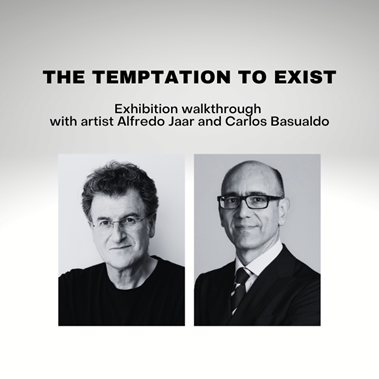
ALFREDO JAAR EXHIBITION WALKTHROUGH: THE TEMPTATION TO EXIST

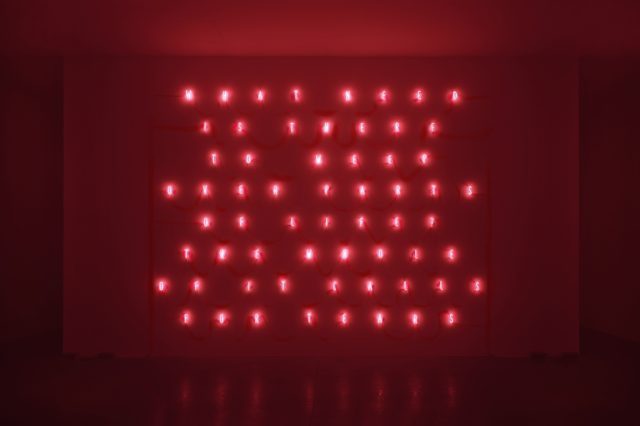
Alfredo Jaar, What Need Is There to Weep Over Parts of Life? The Whole of It Calls for Tears, neon, 2018 (photo courtesy Galerie Lelong)

Who: Alfredo Jaar, Carlos Basualdo
What: Exhibition walkthrough of “The Temptation to Exist”
Where: Galerie Lelong & Co., 528 West Twenty-Sixth St. between Tenth & Eleventh Aves.
When: Saturday, May 14, free with advance RSVP, 4:00
Why: Alfredo Jaar is one of the most provocative and innovative artists working today. Born in Santiago, Chile, in 1956 and based in New York City since 1982, the artist, architect, and filmmaker uses multimedia works to immerse viewers in the images and sounds of sociopolitical strife across the globe, exposing the lies associated with war, government control, rampant capitalism, and other issues. At the Whitney Biennial, people wait on line to experience his 06.01.2020 18.39, a video installation comprising footage from a Black Lives Matter protest in Washington, DC, on June 1, 2020, incorporating a bonus element that makes visitors feel like the helicopters are coming for them. His 2011 installation Three Women made a trio of female activists the focus of the media; it has since been expanded to thirty-three women. Neon projects declare, “I Can’t Go On / I’ll Go On,” “Be Afraid of the Enormity of Possibility,” and “This Is Not America.” Other potent projects include The Skoghall Konsthall, Culture = Capital, Shadows, and Lament of the Images.

His 2018 installation, What Need Is There to Weep Over Parts of Life? The Whole of It Calls for Tears, a quote from the Roman stoic philosopher Seneca, makes its New York debut on May 13 at Galerie Lelong as part of the exhibition “The Temptation to Exist.” The name of the show is inspired by Emil Cioran’s 1956 book of the same name; the Romanian philosopher wrote, “The universe is one big failure, and not even poetry can succeed in correcting it.” Dedicated to Italian photojournalist Letizia Battaglia, who passed away in April at the age of eighty-seven, “The Temptation to Exist” features lightboxes, ink prints, and such neon phrases as “Gesamtkunstwerk” and “Other People Think.”

For the exhibit, Jaar has also curated works from more than sixty-five artists seeking change in the world, creating what he calls “a space of resistance, a space of hope.” Among those included are Dawoud Bey, Luis Camnitzer, Lygia Clark, Valie Export, LaToya Ruby Frazier, Félix González-Torres, Hans Haacke, David Hammons, Lyle Ashton Harris, Mona Hatoum, Jenny Holzer, Emily Jacir, Joan Jonas, On Kawara, Glenn Ligon, Piero Manzoni, Gordon Matta-Clark, Ana Mendieta, Shirin Neshat, Yoko Ono, Adam Pendleton, Michelangelo Pistoletto, Gerhard Richter, Carolee Schneemann, Nancy Spero, Hank Willis Thomas, Kara Walker, Carrie Mae Weems, Lawrence Weiner, and Francesca Woodman.

There will be an opening reception on May 13 at 6:00; on May 14 at 4:00, Jaar will hold a public walkthrough of the exhibition, joined by Philadelphia Museum of Art senior curator Carlos Basualdo. Admission is free with advance registration. Don’t miss this rare chance to witness art history in the making.

IMPLICIT TENSIONS: MAPPLETHORPE NOW

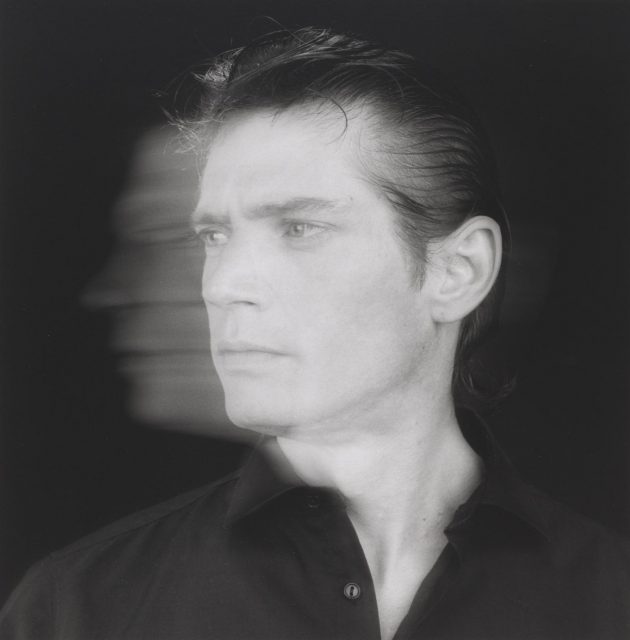
Self Portrait 1985, printed 2005 Robert Mapplethorpe 1946-1989 ARTIST ROOMS   Tate and National Galleries of Scotland. Lent by the Robert Mapplethorpe Foundation 2014

Robert Mapplethorpe, Self Portrait, gelatin silver print, 1985 (Solomon R. Guggenheim Museum, New York; gift, the Robert Mapplethorpe Foundation, 1996)

Solomon R. Guggenheim Museum
1071 Fifth Ave. at 89th St.
Through July 10, $18-$25 (pay-what-you-wish Saturday 5:00-7:00)
Part 2 runs July 24 – January 5
212-423-3587
www.guggenheim.org

There’s only one week left to see the first phase of the Guggenheim’s yearlong, two-part exhibition “Implicit Tensions: Mapplethorpe Now,” a concise survey in conjunction with the thirtieth anniversary of the death of visual artist Robert Mapplethorpe in 1989 at the age of forty-two. Mapplethorpe’s reputation has been growing since the January 2010 publication of Patti Smith’s award-winning book Just Kids, which details the punk rocker’s relationship with Mapplethorpe, from lovers to best friends and artistic collaborators in the late 1960s and 1970s. More recently, there was the 2016 documentary Mapplethorpe: Look at the Pictures and the 2018 biopic Mapplethorpe as well as Bryce Dessner’s multimedia Triptych (Eyes of One on Another), which used music and images to focus on several of the controversies surrounding Mapplethorpe’s work, from obscenity charges to questions about racism and his photos of black bodies. “Implicit Tensions” circumvents all of that and concentrates on his immense skill in composition and his immeasurable artistic vision in his photographs of flowers, sadomasochism, male and female nudes, and, most notably, himself, although he’s no mere narcissistic selfie taker.

Robert Mapplethorpe

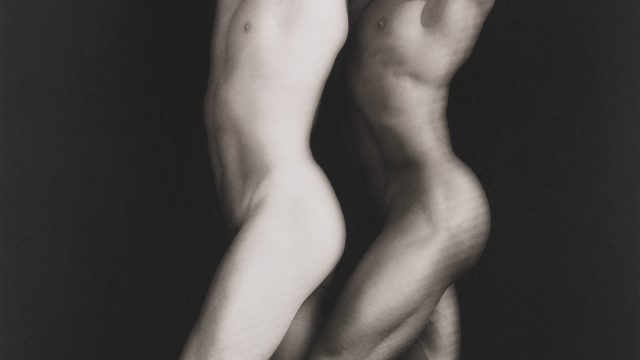
Robert Mapplethorpe, Ken and Tyler, platinum-palladium print, 1985 (Solomon R. Guggenheim Museum, New York; gift, the Robert Mapplethorpe Foundation, 1996)

The Guggenheim show consists of more than fifty photographs and unique objects from the museum’s collection, gifts from the Robert Mapplethorpe Foundation between 1993 and 1998 that led to the Guggenheim developing and expanding its photography collection and forming its Photography Council. The wholly satisfying exhibit is somewhat of a greatest hits display, with iconic photos as well as pictures of such well-known figures as Arnold Schwarzenegger, Louise Bourgeois, Andy Warhol, Cindy Sherman, Laurie Anderson, Candy Darling, Philip Glass with Robert Wilson, David Hockney with Henry Gelzahler, and Smith. Mapplethorpe treated all his subjects equally, whether a celebrity, a lover, a flower, an S&M scene, or himself. “My interest was to open people’s eyes, get them to realize anything can be acceptable,” he said in an interview. “It’s not what it is, it’s the way it’s photographed.”

Using Polaroid and Hasselblad cameras, among others, Mapplethorpe captured a bold intimacy in his work, which, in 2019, seems more revolutionary than shocking, although some photos are still daring and outrageous. Early on, he created such collages as Black Bag, Green Bag, and Red Bag, made of clippings from gay porn magazines arranged behind a mesh screen, placing homosexuality tantalizingly out of reach (and seemingly imprisoned). In Dominick and Elliot, a bound and naked Dominick is upside down, as if in a reverse crucifixion pose, next to the shirtless Elliot, who has a cigarette in one hand, Elliot’s testicles in the other. In Ken Moody and Robert Sherman, Moody’s and Sherman’s heads are seen sideways as they look seriously off into the distance, the former’s blackness and the latter’s whiteness almost blending together. It’s a visual companion piece to Ken and Tyler, with Moody’s and Tyler’s nude bodies — their heads are out of the frame — right behind each other, facing the same direction as Ken’s and Robert’s heads.

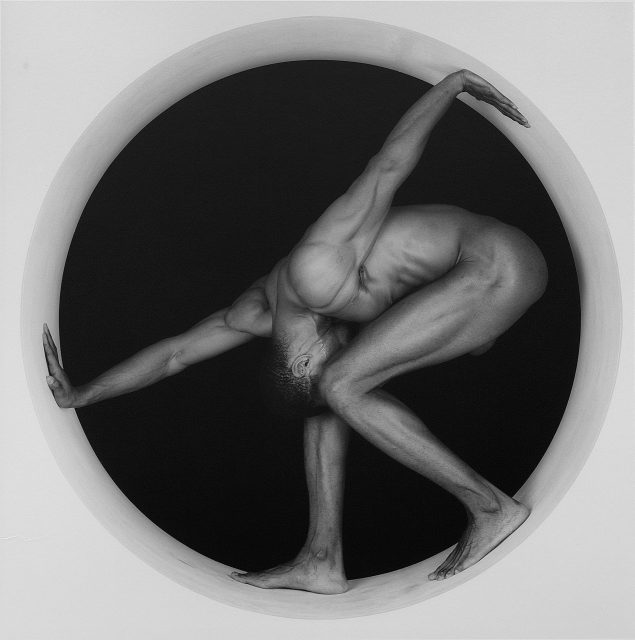
Robert Mapplethorpe (1946-1989) Thomas, 1987 Gelatin silver print A.P. 1/2 image: 19 1/4 x 19 3/16 inches (48.9 x 48.7 cm); sheet: 23 3/4 x 19 13/16 inches (60.3 x 50.3 cm) Solomon R. Guggenheim Museum, New York Gift, The Robert Mapplethorpe Foundation, 1993 93.4304

Robert Mapplethorpe, Thomas, gelatin silver print, 1987 (Solomon R. Guggenheim Museum, New York; gift, the Robert Mapplethorpe Foundation, 1993)

This theme of dichotomy is central to the bisexual Mapplethorpe’s oeuvre and is fully evident at the Guggenheim. Two of the most telling photos are a pair of 1977 works titled Pictures/Self Portrait, which were invitations to a gallery show. In both, Mapplethorpe’s hand is writing the word “Pictures”; in one, the hand is shown in a conventional man’s shirt and watch, while in the other the hand wears a black leather glove and a brash metal bracelet, equalizing and contrasting so-called normal and S&M costuming. In one gelatin silver print of bodybuilder Lisa Lyon, she is dressed in black, as if at a funeral, while in another she is nude except for a white sheet over her face that falls like the train of a wedding dress to the floor.

The implicit tension is also on display in Mapplethorpe’s numerous self-portraits, which range from the angelic to the demonic; he has evil horns in one and holds a skull-topped cane in another, while in a third he is elegant in a lush fur and wearing lipstick. In two 1980 self-portraits, he is shirtless and androgynous in one, smoking a cigarette and wearing a leather jacket in the other, comparing sensitivity with toughness as he addresses gender identity and societal ideas of maleness. And then there’s American Flag, a photograph of a ratty, torn flag that speaks volumes. Mapplethorpe had a very personal way of depicting both the private and the public, and thirty years after his death from HIV/AIDS complications, his pictures still get under your skin, the man behind the camera — and in front of it — as elusive as ever, and just as beautiful and beguiling. The second phase of “Implicit Tensions” opens July 24 and will examine Mapplethorpe’s legacy and influence, combining his works with those of Rotimi Fani-Kayode, Lyle Ashton Harris, Glenn Ligon, Zanele Muholi, Catherine Opie, and Paul Mpagi Sepuya.

FIRST SATURDAYS: BROOKLYN FASHION

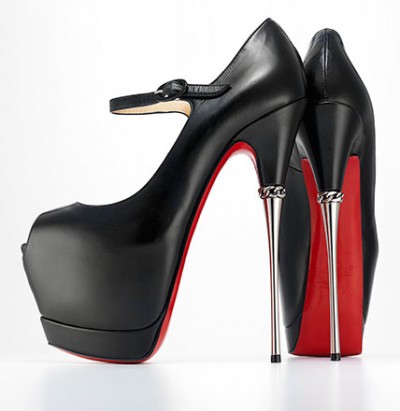
Christian Louboutin, “Printz,” Spring/Summer 2013 (courtesy of Christian Louboutin; photograph by Jay Zukerkorn)

Christian Louboutin, “Printz,” Spring/Summer 2013 (courtesy of Christian Louboutin; photograph by Jay Zukerkorn)

Brooklyn Museum
200 Eastern Parkway at Washington St.
Saturday, December 6, free, 5:00 – 11:00
212-864-5400
www.brooklynmuseum.org

The Brooklyn Museum has fun with its new exhibit, “Killer Heels: The Art of the High-Heeled Shoe,” in the December edition of its free First Saturdays program. “Brooklyn Fashion” will feature live performances by the Hot Sardines and TK Wonder; a shoe-making art workshop; a talk with Manufacture New York CEO Bob Bland; screenings of Julie Benasra’s 2011 documentary, God Save My Shoes, and Tom Kalin’s Alternate Endings, short films made in collaboration with artists Rhys Ernst, Glen Fogel, Lyle Ashton Harris, Derek Jackson, My Barbarian, and Julie Tolentino in honor of the twenty-fifth anniversary of Visual AIDS’ Day With(out) Art; a talk with “Killer Heels: The Art of the High-Heeled Shoe” curator Lisa Small; an interactive story hour with Aunt Helen’s Closet; a “Killer Heels” photo booth; and a social club with dapperQ.com that includes pop-up shops, a Dapper Academy, and a fashion show. In addition, you can check out such exhibitions as “Revolution! Works from the Black Arts Movement,” “Judith Scott — Bound and Unbound,” and “Crossing Brooklyn: Art from Bushwick, Bed-Stuy, and Beyond.”

DAY WITH(OUT) ART: ALTERNATE ENDINGS

Glen Fogel’s 7 YEARS LATER is one of seven ALTERNATE ENDING shorts being shown on World AIDS Day

Glen Fogel’s 7 YEARS LATER is one of seven ALTERNATE ENDINGS shorts being shown on World AIDS Day

ALTERNATE ENDINGS (multiple directors, 2014)
SVA Theatre (and other locations)
333 West 23rd St between Eighth & Ninth Aves.
Monday, December 1, free, 7:00
www.visualaids.org

In honor or the twenty-fifth anniversary of World AIDS Day’s Day with(out) Art on December 1, Visual AIDS is presenting a screening of the specially commissioned Alternate Endings, an omnibus of seven short films that examine AIDS in both personal and public ways. Alternate Endings consists of Rhys Ernst’s Dear Lou Sullivan, Glen Fogel’s 7 Years Later, Lyle Ashton Harris’s Selections from the Ektachrome Archive 1986-1996, Hi Tiger’s The Village, Tom Kalin’s Ashes, My Barbarian’s Counterpublicity, and Julie Tolentino’s evidence. The screening, taking place at 7:00 at the SVA Theatre in Chelsea, will be followed by a panel discussion with Kalin, Ashton Harris, and Hi Tiger’s Derek Jackson, moderated by VOCAL-NY’s Wanda Hernandez-Parks and SVA profesor and film critic Amy Taubin. On December 1, Alternate Endings will also be shown at BRIC in Brooklyn and at Hunter College’s Bertha and Karl Leubsdorf Art Gallery, as well as on December 4 at the New School, December 5 at the New Museum (followed by a Q&A with Fogel, Kalin, and My Barbarian’s Malik Gaines, Jade Gordon, and Alexandro Segade), December 6 at the Queens Museum (accompanied by a series of workshops, presentations, discussions, and performances) and the Brooklyn Museum (with Jackson and Fogel), and December 7 at the Studio Museum in Harlem (with Kalin).

THROUGH A LENS DARKLY: BLACK PHOTOGRAPHERS AND THE EMERGENCE OF A PEOPLE

THROUGH A LENS DARKLY

Brothers Lyle Ashton Harris and Thomas Allen Harris collaborate on a photo of their cousin Peggy in THROUGH A LENS DARKLY

THROUGH A LENS DARKLY: BLACK PHOTOGRAPHERS AND THE EMERGENCE OF A PEOPLE (Thomas Allen Harris, 2014)
Film Forum
209 West Houston St.
August 27 – September 9
212-727-8110
www.filmforum.org
www.throughalensdarkly.wordpress.com

Thomas Allen Harris exposes the conflicting relationship between the public and private visual depiction of African Americans in the powerful, if overly idealistic and methodical, Through a Lens Darkly: Black Photographers and the Emergence of a People. Inspired by Deborah Willis’s 2000 book, Reflections in Black: A History of Black Photographers 1840 to the Present, the documentary examines how black men, women, and children have been portrayed in advertising and the media and on postcards since the development of the camera and daguerreotypes, depicting them in negative, stereotyped ways as animals, criminals, and, most horrifically, victims of lynchings. Over the course of seven years, the Bronx-born Harris interviewed such photographers and scholars as Carrie Mae Weems, Glenn Ligon, Lorna Simpson, Dawoud Bey, Coco Fusco, Chuck Stewart, and Lyle Ashton Harris (Harris’s brother), as well as Willis (one of the film’s producers) and her son, artist Hank Willis Thomas, exploring how blacks countered these distortions through family photos, where they not only controlled the image but the gaze itself. “How was, is, the photograph used in the battle between two legacies, self-affirmation and negation?” Harris (Twelve Disciples of Nelson Mandela, É Minha Cara/That’s My Face), the founder and president of Chimpanzee Productions, asks early in the film. “Our salvation as a people, as a culture, depends on salving the wounds of this war, a war of images within the American family album.” Harris and his many talking heads look at the importance of such black photographers as J. P. Ball, James Van Der Zee, Roy DeCarava, Vera Jackson, and Gordon Parks as well as such trailblazers as Sojourner Truth, Frederick Douglass, Booker T. Washington, and W. E. B. Du Bois, who used the camera to their advantage when presenting themselves and their views to the public.
The documentary does get repetitive, and Harris’s personal story occasionally stops the compelling general narrative as he attempts to relate his family history to the bigger picture. But the film is worth seeing just for the amazing archival footage, a marvelous collection of black-and-white and color photographs that show how a people can reclaim their image and validate their culture in the face of extreme prejudice. Winner of the Social Justice Award at the Santa Barbara International Film Festival and Best Diaspora Documentary at the tenth Africa Movie Academy Awards, Through a Lens Darkly is playing August 27 to September 9 at Film Forum, with special events scheduled to follow one screening per day for the first eleven days, including a Q&A with Thomas Allen Harris and producers Deborah Willis, Don Perry, and Ann Bennett on August 27 (7:20), a Salute to Harlem Photographers with Renee Cox, C. Danny Dawson, and John Pinderhughes, moderated by Moikgantsi Kgama, on August 29 (7:20), a Salute to Women Photographers with Willis and Coreen Simpson, moderated by Michaela Angela Davis, on August 30 (2:50), a Q&A with composer Vernon Reid on September 1 (2:50), and a Salute to Brooklyn Photographers with Delphine Fawundu-Buford, Russell Frederick, and Radcliffe Roye, moderated by Dawson, on September 6.

CARRIE MAE WEEMS LIVE: PAST TENSE / FUTURE PERFECT

Carrie Mae Weems

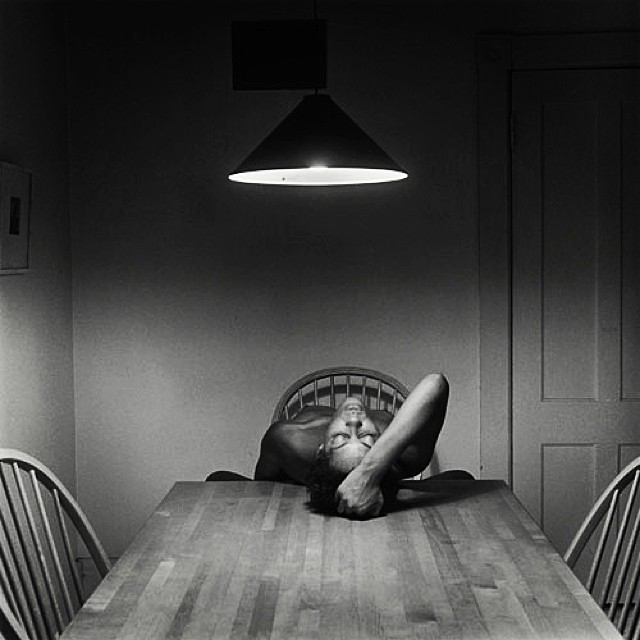
Carrie Mae Weems, “Untitled (Kitchen Table Series),” gelatin silver print and text, 1953 (© Carrie Mae Weems. Photo: © The Art Institute of Chicago)

Solomon R. Guggenheim Museum
1071 Fifth Ave. at 89th St.
April 25-27, most events free with museum admission of $18-$22, evening concerts $15-$35
Exhibition continues through May 14
212-423-3587
www.guggenheim.org

In her online biography, Carrie Mae Weems writes, “My work has led me to investigate family relationships, gender roles, the histories of racism, sexism, class, and various political systems. Despite the variety of my explorations, throughout it all it has been my contention that my responsibility as an artist is to work, to sing for my supper, to make art, beautiful and powerful, that adds and reveals; to beautify the mess of a messy world, to heal the sick and feed the helpless; to shout bravely from the roof-tops and storm barricaded doors and voice the specifics of our historic moment.” All this and more is evident in her current exhibition at the Guggenheim, ”Carrie Mae Weems: Three Decades of Photography and Video.” The show, which continues through May 14, is centered by her subtly powerful 1990 black-and-white “Kitchen Table Series,” which details the evolution of a woman photographed in the same domestic space, sometimes by herself, sometimes with children, sometimes with a man. In many ways it harkens back to painting series by Jacob Lawrence, capturing the African American experience, in this case with the focus on a woman. The show also includes photos from her “Colored People” grids, “Family Pictures and Stories” (accompanied by a voice-over by Weems), “Dreaming in Cuba,” “Roaming,” “From Here I Saw What Happened and I Cried,” “The Louisiana Project,” and “Sea Islands Series” in addition to such short films as Afro-Chic and ceramic commemoration plates, all of which explore elements of black history from an often extremely personal perspective.

Carrie Mae Weems will cohost three days of art and activism at the Guggenheim this weekend (photo by Scott Rudd)

Carrie Mae Weems will cohost three days of art and activism at the Guggenheim this weekend (photo by Scott Rudd)

The Portland, Oregon-born artist will be at the Guggenheim this weekend presenting “Carrie Mae Weems LIVE: Past Tense/Future Perfect,” three days of discussions, live music, processions, readings, and more, cohosted by Weems and multidisciplinary artist Carl Hancock Rux. On Friday, there will be a tribute to conceptual sculptor and saxophonist Terry Adkins, who passed away at the age of sixty in February, with Vijay Iyer, Vincent Chancey, Dick Griffin, Marshall Sealy, and Kiane Zawadi, followed by “The Blue Notes of Blues People,” consisting of four sets of presentations by such visual artists, curators, choreographers, and scholars as Julie Mehretu, Leslie Hewitt, Shinique Smith, Thomas Lax, Michele Wallace, Camille A. Brown, Shahzia Sikander, Mark Anthony Neal, Sanford Biggers, Lyle Ashton Harris, and Xaviera Simmons. Other programs include “Written on Skin: Posing Questions on Beauty,” “Slow Fade to Black: Explorations in the Cinematic,” and “Laughing to Keep from Crying: A Critical Read on Comedy,” with Nelson George. The first two nights will conclude with ticketed concerts and conversations, with Jason Moran and the Bandwagon (Friday, with Weems) and the Geri Allen Trio (Saturday, with Weems and Theaster Gates). on Sunday, visual artist María Magdalena Campos-Pons will lead the procession “Habla Lamadre” before Weems offers closing remarks. Select programs on Friday and Saturday will be streamed live here.