Tag Archives: Luzer Twersky

NEW YIDDISH REP: AWAKE AND SING!

(photo by Pedro HernandezP

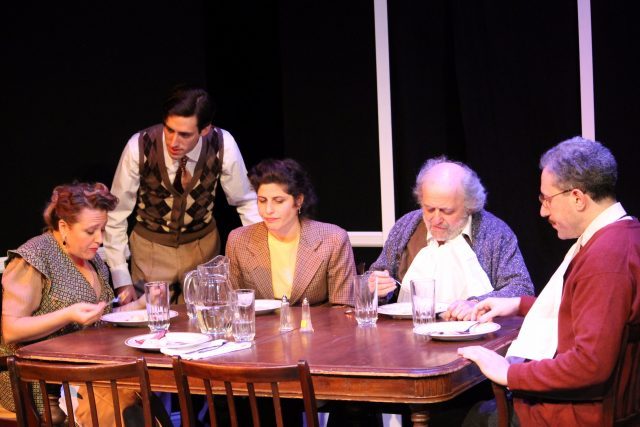
The Bergers sit down for some food and tsouris in New Yiddish Rep adaptation of Clifford Odets’s Awake and Sing! at the 14th Street Y (photo by Pedro Hernandez)

VAKH OYF UN ZING
Theater at the 14th Street Y
344 East 14th St. at First Ave.
Tuesday – Saturday through December 24, $45
646-395-4310
www.newyiddishrep.org
www.14streety.org

In her 1983 book From Stereotype to Metaphor: The Jew in Contemporary Drama, Ellen Schiff calls Clifford Odets’s Awake and Sing! “the earliest quintessentially Jewish play outside the Yiddish theatre. It bears the unmistakable stamp of authenticity, exactly what one would wish from a Jewish dramatist writing a slice of Jewish life problem play.” That stamp of authenticity is at the center of a new version by New Yiddish Rep, continuing at the Theater at the 14th Street Y through Christmas Eve. The show is adapted and directed by New Yiddish Rep artistic director David Mandelbaum, using Chaver Paver’s Yiddish translation for Jacob Mestel’s 1938 Federal Theatre production. During the Depression, the Berger family is trying to get by in their crowded Bronx apartment, where they are not exactly living the immigrant American dream. Matriarch Bessie Berger (Ronit Asheri-Sandler) is desperate for her children to marry well, but son Ralph (Moshe Lobel), a wannabe entertainer, is secretly dating a young woman from a poor family and daughter Hennie (Mira Kessler) doesn’t seem to like any of her suitors, who include Moe Axelrod (Gera Sandler), a shady operator who lost his leg in the war, and Sam Feinschreiber (Luzer Twersky), for whom Hennie has no desire. Bessie’s husband, Myron (Eli Rosen), is a gentle man who can’t keep a good job and instead puts money on the horses, while Bessie’s elderly father, Jacob (Mandelbaum), wanders around the apartment listening to opera and spouting Marxist doctrine. Bessie’s sister, Mimi (Amy Coleman), occasionally stops by to gossip and gloat. When Hennie gets pregnant and the man who did it is instantly out of the picture, the close-knit but argumentative family has some important decisions to make, facing difficult choices in very hard times.
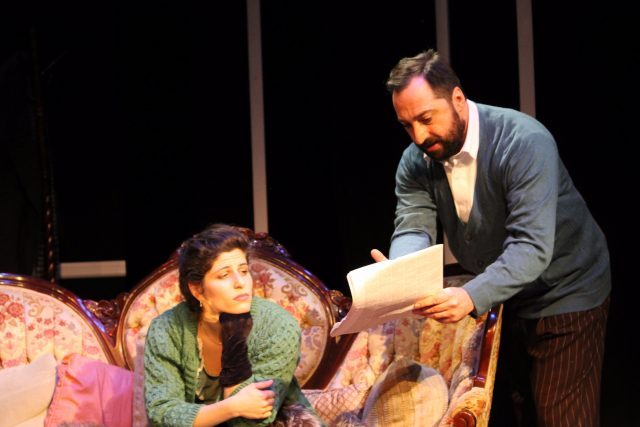
(photo by Pedro Hernandez)

Hennie Berger (Mira Kessler) and Moe Axelrod (Gera Sandler) have one of many disagreements in New Yiddish Rep production of Awake and Sing! (photo by Pedro Hernandez)

Awake and Sing! premiered on Broadway in 1935 with the sensational cast of Luther Adler, Stella Adler, Morris Carnovsky, John Garfield, and Sanford Meisner. In 2013, the National Asian American Theatre Co. staged a strong version with an all-Asian cast. But the show really feels at home in this Yiddish production, featuring a charming apartment set by Nathan Rosen, with an old radio and Victrola, a kitchen table, a couch, an armchair, and a daybed in the corner of the living room, where Ralph sleeps. The Bergers complain about life and love in Yiddish, with English supertitles. The whole thing is warm and comfy, with an emphasis on the status and power of women in Jewish families; the men in the show are at the mercy of the women. In addition, the part of Mimi was originally written for a man, Morty, but it has been skillfully changed to a successful businesswoman, something that was relatively unusual in 1930s America. Asheri-Sandler, who is married to Sandler in real life, is wonderfully domineering as Bessie, while Lobel ably personifies a man refusing to give up on his dreams. The play sounds absolutely lovely in Yiddish, flowing with the beauty and angst ingrained in the language like no other. It’s almost disappointing when English words or lines suddenly show up, probably because there’s no legitimate translation for them. The theater is also filled with Yiddish songs as the audience enters and during intermission, adding to the nostalgic atmosphere. Established in 2013 to keep Yiddish theater alive, New Yiddish Rep has previously staged Waiting for Godot, Death of a Salesman, Rhinoceros, and a double bill of one-acts by Wolf Mankowitz. Awake and Sing! is a natural for them, and they do Odets, and Yiddish theater, proud.
RHINOCEROS

(photo by Pedro Hernandez)

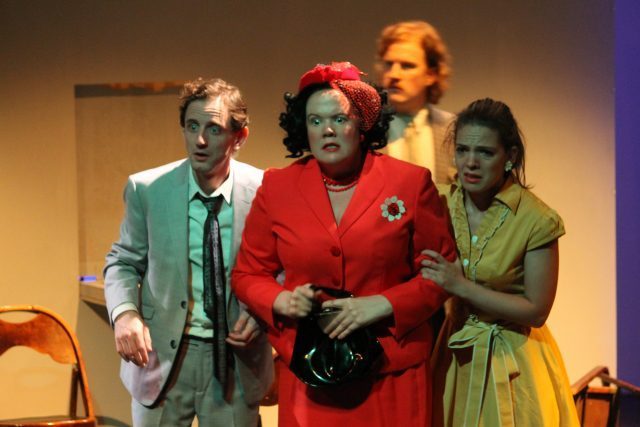
Café denizens can’t believe what they see in New Yiddish Rep adaptation of Eugène Ionesco’s Rhinoceros (photo by Pedro Hernandez)

Castillo Theatre
543 West 42nd St. between Tenth & Eleventh Aves.
Thursday – Sunday through October 8, $45
212-941-1234
www.castillo.org
www.newyiddishrep.org

With the recent success of its productions of Death of a Salesman, Waiting for Godot, and God of Vengeance, the New Yiddish Rep’s world premiere of Eugène Ionesco’s Rhinoceros in the rich, historical language promised a potential stampede. Unfortunately, Ionseco’s 1960 absurdist screed against the rise of Fascism creeps in more like a mouse in a surprisingly lackluster production. “Rhinoceros reminds me of the personal struggle of many of my current and former co-religionists who are trapped in their own skin,” translator and former Hasid Eli Rosen, who also stars as Jean, writes in a program note. He hopes the play “will penetrate the high walls of ghettos and sound the shofar of freedom to humans everywhere,” an apt metaphor as Rosh Hashanah and the Days of Awe approach, but the play falls well short of its admirable goals. Continuing at the Castillo Theatre through October 8, Rhinoceros takes place on director Moshe Yassur’s small, spare set, consisting of a few chairs and tables and walls from which further elements, such as a bed, emerge. The erudite Jean (Rosen) is waiting for Bérenger (Luzer Twersky) in a café run by a cheapskate proprietor (Amy Coleman) who regularly berates her waitress (Mira Kessler). Jean chastises Bérenger for his lack of dignity, decrying his penchant for alcohol, uncombed hair, and lack of a tie. But Berenger — Ionesco’s everyman who appears in several of his works — just wants to relax and take a break from what he considers his exhausting life. After a rhinoceros makes its way through the middle of town, the characters in the café — which also include the Logician (Alex Leyzer Burko), a housewife clutching her dear cat (Macha Fogel), the grocer (Sean Griffin), the grocer’s wife (Caraid O’Brien), a gentleman (Gera Sandler) with the hots for the housewife, and, eventually, Daisy (Malky Goldman), with whom Bérenger is smitten — start debating what they saw and what it means, even as the rhino, or perhaps a different one, marches back through town in the other direction. But when people begin actually turning into rhinos themselves, only Bérenger refuses to become part of the crash.

(photo by Pedro Hernandez)

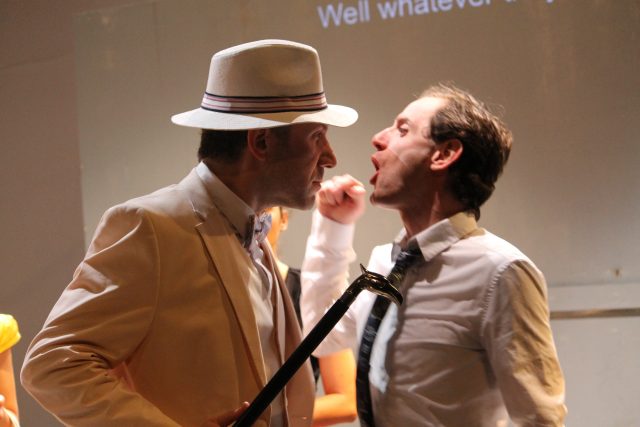
Jean (Eli Rosen) and Bérenger (Luzer Twersky) argue about logic, demeanor, and rhinos in Ionesco’s absurdist classic (photo by Pedro Hernandez)

In writing Rhinoceros, Romanian playwright Ionesco (Exit the King, The Chair) was inspired by the fascism that was building in Romania and across Eastern Europe in the 1930s. Rosen makes clear parallels to what is happening now in America, as antifa battles white supremacists and neo-Nazis and President Donald Trump shows dictatorial tendencies. Rosen even uses the phrase “fake news” when Botard (Burko) declares that the whole rhino story is a hoax, propaganda perpetrated by journalists and university elitists. “An example of collective psychosis,” he tells Dudard (Griffin), “just like religion — the opiate of the people!” However, the translation is too obvious in making connections to contemporary America, and the staging is static and uninvolving. What could have been intimate — the audience is seated on two sides of the catty-corner set — instead separates the two parts of the crowd and creates a distance from the actors, who are often only several feet away. The surtitles, projected on the two perpendicular walls, contain a handful of typos and sometimes can’t keep up with the spoken dialogue; in addition, when the actors spoke out of turn or missed a cue, it was hard to follow what was going on. The play has a long, distinguished history; Laurence Olivier and Joan Plowright starred in Orson Welles’s original London version, and Zero Mostel won a Tony as Jean in the 1961 Broadway edition, with Eli Wallach, Anne Jackson, and Jean Stapleton. (Mostel also starred with Gene Wilder and Karen Black in the 1974 film directed by Tom O’Horgan.) But it’s not a big-name cast that is missing from New Yiddish Rep’s version; in 2012, Emmanuel Demarcy-Mota and Théâtre de la Ville brought their wildly inventive take to BAM’s Next Wave Festival. Yassur a Romanian who has previously directed Ionesco’s Jacques, or the Submission; The Bald Soprano, and The Future Is in Eggs, never finds the right balance between absurdity and reality, getting caught in the middle, as if blinded by the dust of the stampeding animals.

GOD OF VENGEANCE (GOT FUN NEKOME)

(photo by Ronald L. Glassman)

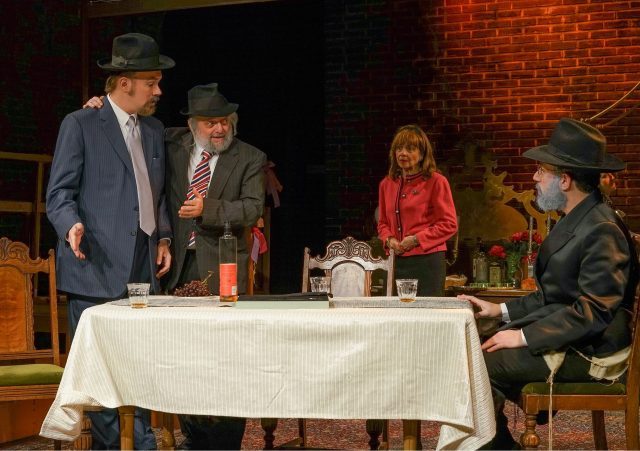
Brothel owner Yankl (Shane Baker) believes paying for a new Torah scroll will protect his daughter’s innocence in controversial GOD OF VENGEANCE (photo by Ronald L. Glassman)

La MaMa, First Floor Theatre
74A East Fourth St. between Bowery & Second Ave.
Wednesday – Sunday through January 22, $36
212-475-7710
www.newyiddishrep.org
lamama.org

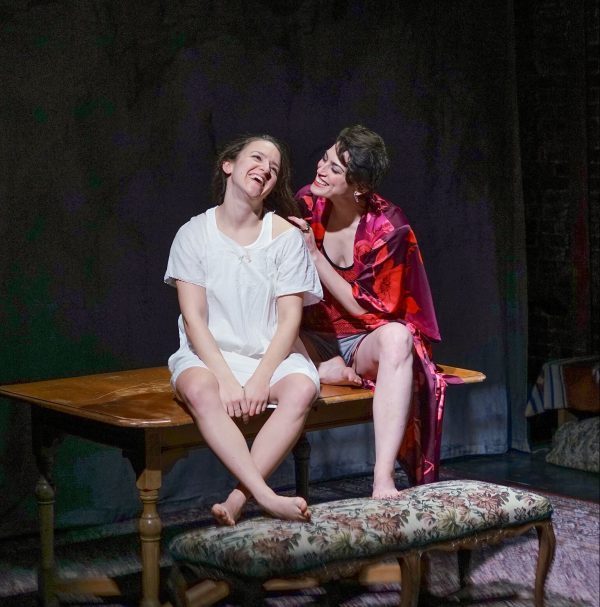
On March 6, 1923, between acts of God of Vengeance, which had begun its Broadway run at the Apollo Theatre on February 19, detectives informed the twelve actors and the producer that they had been indicted for “unlawfully advertising, giving, presenting, and participating in an obscene, indecent, immoral, and impure drama or play.” The cast of the show, which was written by Sholem Asch in Yiddish in 1906 but performed in English at the Apollo following a downtown engagement at the Provincetown Playhouse, included Morris Carnovsky, Sam Jaffe, and director and star Rudolph Schildkraut, who had originated the role of Yankl in the 1907 German version; the producer was First Amendment lawyer Harry Weinberger, who fought the charges and ultimately won on appeal. God of Vengeance is currently running at La MaMa, in a fine, if bumpy, New Yiddish Rep production that continues through January 22. One of the main reasons the play is being revived now is that the controversy that swirled around it almost a century ago is the subject of Rebecca Taichman and Pulitzer Prize winner Paula Vogel’s Indecent, which is transferring to Broadway in April after playing the Vineyard Theatre last spring. It also feels necessary as anti-Semitic rhetoric increases around the world; in fact, there is often debate whether the play itself contains anti-Semitic sentiment. Performed in Yiddish with English supertitles, God of Vengeance is a tale of family and responsibility in a Jewish Orthodox community. Yankl (Shane Baker) operates a brothel out of his basement, which makes him nervous about the future of his teenage daughter, Rifkele (Shayna Schmidt), so the less-than-virtuous businessman decides to pay for a new Sefer Torah for his daughter, believing the deed will protect her innocence and help find her a good husband despite what goes on downstairs, which is no secret. Even rabbi and matchmaker Reb Eli (New Yiddish Rep artistic director David Mandelbaum) knows what goes on below, but as long as there’s money in it for him and the Torah scribe (Eli Rosen), he is willing to look the other way. At a party for some local destitute people, Yankl declares, “Poor or rich, let the whole town know! What I am, I am. What she is, she is. It’s all true — everything. But if they say a word against my daughter . . . I’ll split their heads with this bottle!” Later, when pimp Shloyme (Luzer Twersky) suggests that Rifkele would “do good business” as a prostitute, Yankl explodes, crying out, “If you mention her name, I’ll slit your guts. She doesn’t know you, and you don’t know her!” Yankl is also upset with his wife, Sarah (director Eleanor Reissa), who has encouraged Rifkele to become friendly with one of the prostitutes, Manke (Melissa Weisz). “I don’t want my home mixing with downstairs! Keep them separate from each other. Like kosher and treyf!” he demands. But the friendship grows into something more when Rifkele and Manke declare their love for each other in a beautiful, heartwarming scene that leads to a lesbian kiss. It’s an unforgettable moment, gorgeously staged — and the one that resulted in the indictments and arrests back in 1923.

(photo by Ronald L. Glassman)

The relationship between virginal Rifkele (Shayna Schmidt) and prostitute Manke (Melissa Weisz) leads to a stunning moment in New Yiddish Rep revival of Sholem Asch play (photo by Ronald L. Glassman)

God of Vengeance also features Caraid O’Brien as Hindl, Rachel Botchan as Reyzl, and Mira Kessler as Basha, three other prostitutes, who share memories of what led them to sex work. Reissa sets the story in an indeterminate time period, which occasionally gets confusing, and the acting is inconsistent, although Schmidt, who played Miss Forsythe in New Yiddish Rep’s Death of a Salesman, and Weisz, in her off-Broadway debut, are both terrific, eliciting an exciting chemistry. Billy Martin’s music curiously lets the audience know when a new character is about to enter Vicki Davis’s crowded set. Neither Baker (NYR’s Waiting for Godot) nor O’Brien, who is also a playwright and author, is Jewish, yet they have appeared in numerous Yiddish productions; Twersky and Rosen are former Hasids, while Reissa is the daughter of Holocaust survivors. The play, known as Got Fun Nekome in Yiddish, was first presented to the public in a German version directed by Max Reinhardt and starring Schildkraut; in 2002, Donald Margulies wrote an English-language adaptation that starred Ron Leibman, Diane Venora, and Marin Hinkle. And in 2013, a production in Poland, where the play was originally banned, has an audience age restriction: No one under sixteen is allowed. Asch himself was ostracized from the Jewish community when, between 1939 and 1949, he wrote a trilogy about Christianity, The Nazarene, The Apostle, and Mary. Thus, God of Vengeance returns to New York City with quite a history. The New Yiddish Rep version is an admirable, if not wholly successful, revival, but one that is well worth seeing, especially for those theatergoers planning on going to Indecent when it arrives at the Cort Theatre in April.

FÉLIX AND MEIRA

FELIX AND MEIRA

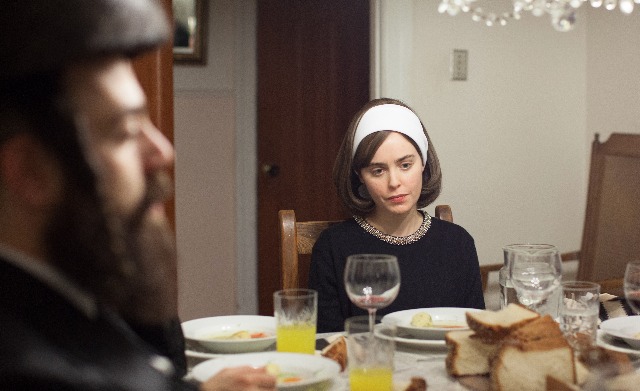
Meira (Hadas Yaron) takes a long, hard look at her life in Maxime Giroux’s FELIX AND MEIRA

FELIX AND MEIRA (FÉLIX ET MEIRA) (Maxime Giroux, 2014)
Lincoln Plaza Cinema
1886 Broadway between 62nd & 63rd Sts.
Opens Friday, April 17
212-757-2280
www.felixandmeira.com
www.lincolnplazacinema.com

Named Best Canadian Feature at the 2014 Toronto International Film Festival and the closing-night selection of the 2015 New York Jewish Film Festival, Maxime Giroux’s Félix and Meira is a somber, reflective tale starring Israeli actress Hadas Yaron as Meira, a young married woman who is feeling trapped by the constraints of the Hasidic world in which she lives in Montreal’s Mile End district. Her husband, Shulem (Luzer Twersky), is a devout man who follows the tenets of his religion; he and Meira sleep in separate beds, and he seems more intent on ritualistically washing his hands in the bedroom than touching his wife. One morning, while pushing her daughter in a stroller, she is approached by Félix (Martin Dubreuil), a conflicted man whose father just died so he is seeking advice about God and death. Meira tells him to leave them alone, but soon Félix and Meira are meeting in secret, and when Shulem finds out about it, he ships Meira off to Brooklyn. Félix goes after her, wanting to take their relationship to the next level as Meira considers her responsibilities to her husband, her daughter, and herself.

FELIX AND MEIRA

Félix (Martin Dubreuil) and Meira (Hadas Yaron) are both looking for something more in Canadian drama set in Hasidic world

Félix and Meira is a subtle, slow-moving tale that avoids genre clichés, keeping the details tantalizingly vague and mysterious. There’s not a lot of humor in the film; instead, there’s an ominous, moody cloud hanging over everything, the story bordering just on the edge of passion without ever exploding. Yaron (Fill the Void) plays Meira with a dark foreboding, while Dubreuil (Bunker, Ressac) and Twersky (Romeo and Juliet in Yiddish, Where Is Joel Baum?) work well as adversaries who want Meira in their life, albeit for different reasons. Cowriter and director Giroux (Demain, Jo pour Jonathan) doesn’t force any issues, maintaining a low-key approach that is intensified by an overall palette of blacks, whites, and grays.

NEW YORK JEWISH FILM FESTIVAL CLOSING NIGHT: FELIX AND MEIRA

FELIX AND MEIRA

Meira (Hadas Yaron) takes a long, hard look at her life in Maxime Giroux’s FELIX AND MEIRA

FELIX AND MEIRA (FÉLIX ET MEIRA) (Maxime Giroux, 2014)
Film Society of Lincoln Center, Walter Reade Theater
165 West 65th St. between Eighth Ave. & Broadway
Thursday, January 29, 3:30 & 9:00
Festival runs through January 29
212-875-5050
www.filmlinc.com

The 2015 New York Jewish Film Festival comes to a close on January 29 with Maxime Giroux’s somber, reflective Félix and Meira. Named Best Canadian Feature at the Toronto International Film Festival, the film stars Israeli actress Hadas Yaron as Meira, a young married woman who is feeling trapped by the constraints of the Hasidic world in which she lives in Montreal’s Mile End district. Her husband, Shulem (Luzer Twersky), is a devout man who follows the tenets of his religion; he and Meira sleep in separate beds, and he seems more intent on ritualistically washing his hands in the bedroom than touching his wife. One morning, while pushing her daughter in a stroller, she is approached by Félix (Martin Dubreuil), a conflicted man whose father just died so he is seeking advice about God and death. Meira tells him to leave them alone, but soon Félix and Meira are meeting in secret, and when Shulem finds out about it, he ships Meira off to Brooklyn. Félix goes after her, wanting to take their relationship to the next level as Meira considers her responsibilities to her husband, her daughter, and herself.

FELIX AND MEIRA

Félix (Martin Dubreuil) and Meira (Hadas Yaron) are both looking for something more in Canadian drama set in Hasidic world

Félix and Meira is a subtle, slow-moving tale that avoids genre clichés, keeping the details tantalizingly vague and mysterious. There’s not a lot of humor in the film; instead, there’s an ominous, moody cloud hanging over everything, the story bordering just on the edge of passion without ever exploding. Yaron (Fill the Void) plays Meira with a dark foreboding, while Dubreuil (Bunker, Ressac) and Twersky (Romeo and Juliet in Yiddish, Where Is Joel Baum?) work well as adversaries who want Meira in their life, albeit for different reasons. Cowriter and director Giroux (Demain, Jo pour Jonathan) doesn’t force any issues, maintaining a low-key approach that is intensified by an overall palette of blacks, whites, and grays. Félix and Meira is the closing-night selection of the New York Jewish Film Festival, screening on January 29 at 3:30 and 9:00 at the Walter Reade Theater, with each show followed by a Q&A with Giroux and members of the cast.